
Pre-Owned Forklifts for Construction: Reliable Picks That Boost Productivity
· Updated
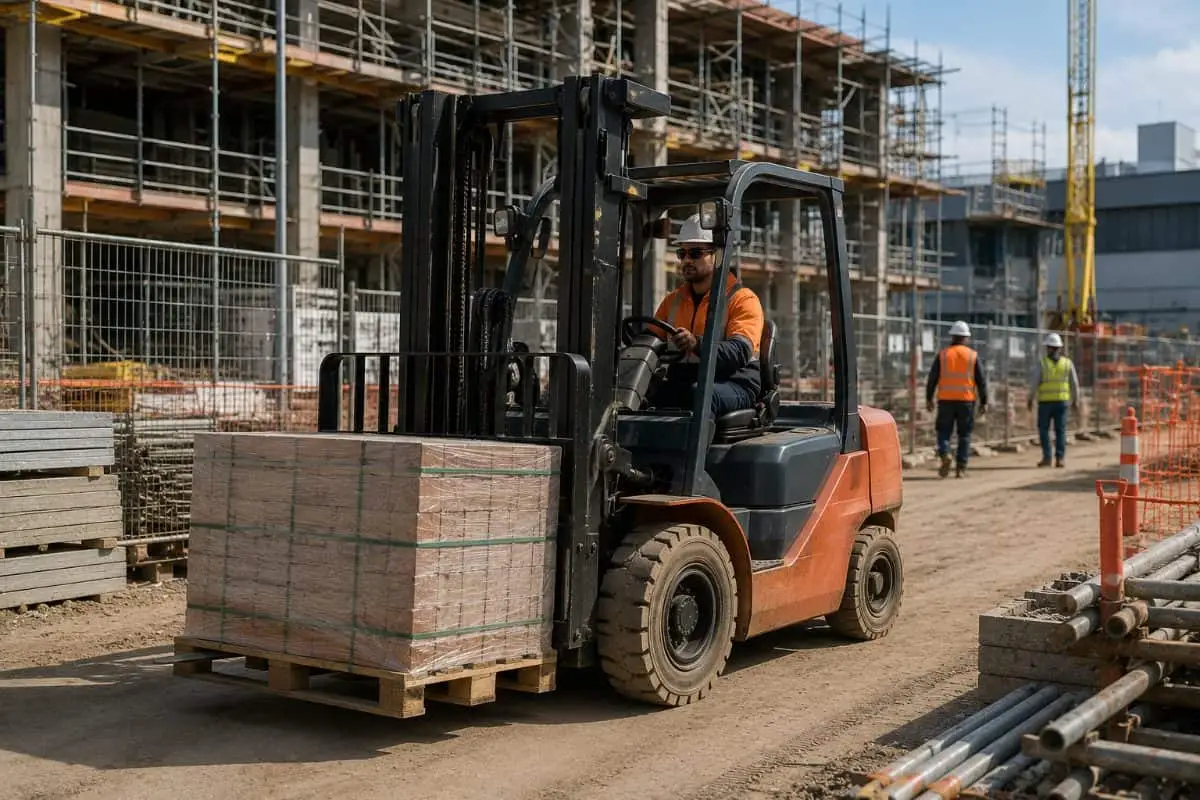
The best pre-owned forklifts for construction are usually diesel counterbalance or rough-terrain machines with suitable pneumatic-style tyres, enough ground clearance and capacity for the site’s heaviest loads. A high-capacity or high-reach forklift may be more suitable when handling oversized materials or placing loads at elevated work areas.
A used construction forklift can be reliable when its service history, mast, hydraulics, tyres, chassis and drivetrain are properly inspected before purchase. Matching the machine to the terrain and workload is just as important as choosing a recognised brand.
The right forklift can also improve site productivity by reducing double-handling, unloading deliveries faster and keeping materials available to trades when needed.
Which Pre-Owned Forklift Is Best for Construction?
A diesel counterbalance forklift with pneumatic or solid-pneumatic tyres suits many established construction sites with compacted, reasonably level surfaces. Rough-terrain forklifts are better for more uneven ground, while high-capacity machines suit heavy structural materials and oversized loads.
The correct choice depends on:
- Ground conditions: Concrete, compacted gravel, mud, slopes and site transitions create different requirements.
- Load type: Bricks, blocks, steel, timber, formwork and equipment have different centres of gravity.
- Maximum load weight: Include the pallet, stillage, attachment and packaging.
- Lift height: Confirm where materials must be placed rather than using mast height alone.
- Access: Check gates, temporary structures, overhead services and turning areas.
- Working hours: Long shifts may favour fast refuelling and robust outdoor configurations.
- Attachments: Jibs, fork positioners and extensions may affect usable capacity.
- Project duration: Utilisation influences whether purchasing used, buying new or arranging short-term equipment is most practical.
Work Safe Victoria advises buyers to consider surfaces, terrain, ramps, overhead obstructions, load centre, lift height and intended attachments when selecting a forklift. It also recommends reviewing the maintenance, inspection and use history before purchasing second-hand equipment.
Businesses can begin by reviewing diesel forklifts for outdoor sites and used forklifts built for outdoor conditions.
Best Pre-Owned Forklift Types for Construction Sites
| Forklift Type | Terrain Fit | Capacity Direction | Best Construction Use |
|---|---|---|---|
| Diesel counterbalance forklift | Compacted gravel, concrete and paved yards | Light to heavy classes available | Palletised bricks, blocks, timber and general deliveries |
| Rough-terrain forklift | Uneven, loose or unfinished ground | Usually selected for substantial site loads | Remote work areas, early-stage projects and variable surfaces |
| High-capacity forklift | Firm, prepared outdoor surfaces | Heavy and oversized loads | Steel, precast products, machinery and large material packs |
| High-reach forklift | Prepared surfaces with elevated placement needs | Depends on mast and load centre | Raising materials to loading platforms or high storage areas |
| LPG counterbalance forklift | Smooth indoor and paved outdoor areas | General construction and warehouse classes | Mixed warehouse, workshop and covered-yard work |
| Electric counterbalance forklift | Smooth, clean and mainly indoor environments | Light to medium classes commonly used | Fit-outs, enclosed warehouses and finished buildings |
Capacity varies significantly by model, mast, attachment, lift height and load centre. Always check the exact machine’s capacity plate rather than relying on a broad equipment category.
1. Diesel Counterbalance Forklifts
Diesel counterbalance forklifts are a practical choice for many outdoor construction and building-material applications because they support quick refuelling and are available in a wide range of capacities.
They commonly suit:
- Building-supply yards
- Civil projects
- Precast operations
- Timber and steel handling
- Outdoor manufacturing
- Site compounds
- Loading and unloading trucks
A standard diesel counterbalance forklift still requires reasonably stable ground. It should not be treated as a rough-terrain machine simply because it has large tyres.
Buy A Fork’s guide to diesel forklifts in Melbourne provides additional guidance on outdoor suitability, running costs and ownership considerations.
2. Rough-Terrain Forklifts
Rough-terrain forklifts are designed around uneven outdoor conditions. They may have:
- Increased ground clearance
- Larger pneumatic tyres
- Wider chassis configurations
- Enhanced traction
- Stronger outdoor-focused construction
- Improved approach and departure clearance
They suit sites where a conventional counterbalance forklift could lose traction, ground out or become unstable.
However, rough-terrain capability does not make every slope, trench crossing or soft surface safe. Ground conditions must be assessed, and the machine must remain within the manufacturer’s operating limits.
3. High-Capacity Forklifts
A high-capacity forklift may be required for:
- Structural steel
- Precast concrete products
- Heavy machinery
- Large stone packs
- Oversized timber
- Industrial plant components
- Dense building-material pallets
The load’s shape and centre of gravity may be more important than its total weight. Long or irregular loads can move the load centre forward and reduce effective capacity.
Buyers handling substantial loads can compare powerful forklifts for heavy-duty work and learn how to read a forklift load capacity chart.
4. High-Reach Forklifts
High-reach equipment may suit projects where materials must be placed:
- On elevated decks
- Near scaffold loading areas
- On high storage racks
- At mezzanine levels
- On raised loading platforms
A high mast does not automatically make a machine suitable for unfinished ground. The site must support the forklift’s weight and stability requirements.
For elevated material placement, review high-reach forklifts and lift heights before choosing a mast configuration.
How the Right Forklift Boosts Site Productivity
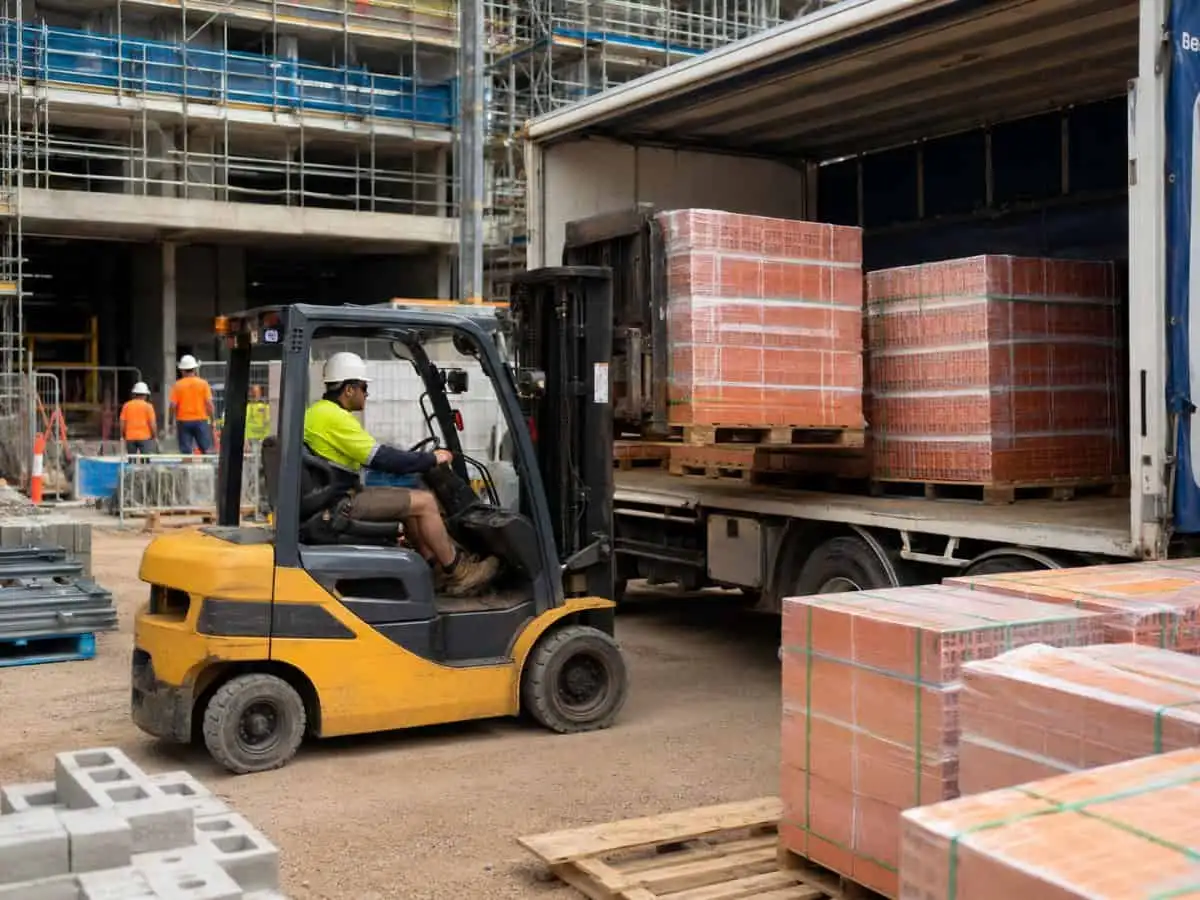
A suitable forklift improves productivity by moving materials closer to where they are needed without repeated manual handling or unnecessary reloading.
1. Reduces Double-Handling
Poorly planned material delivery may involve:
- Unloading materials into a temporary area.
- Moving them again when access changes.
- Repacking or restacking damaged pallets.
- Transporting individual items to the workface.
A correctly selected forklift can unload, transport and place the pallet in fewer movements.
2. Speeds Up Loading and Unloading
The right capacity, fork length and tyre configuration help operators unload deliveries without repeatedly repositioning the machine or changing equipment.
Faster unloading can:
- Reduce truck waiting time
- Keep access roads clear
- Limit congestion around delivery areas
- Help suppliers maintain delivery schedules
- Make better use of operator hours
3. Reduces Manual Labour
Forklifts can move complete palletised loads that would otherwise require several workers and repeated handling.
This allows workers to focus on skilled construction tasks rather than shifting materials by hand. Mechanical handling should still be supported by appropriate planning, safe loading methods and pedestrian controls.
4. Keeps Trades Moving
Construction delays can occur when materials are:
- Delivered to the wrong area
- Blocked behind other stock
- Unavailable at the workface
- Damaged during repeated movement
- Waiting for suitable handling equipment
A forklift matched to the site allows materials to be staged by work sequence and distributed when needed.
4. Reduces Equipment Downtime
Using an undersized or unsuitable forklift can lead to excessive tyre wear, overheating, instability and repeated breakdowns.
A properly matched machine is less likely to be pushed beyond its design. Planned maintenance remains essential, particularly in dusty outdoor conditions.
The effect of servicing and breakdown exposure is covered in the guides to forklift maintenance costs and forklift maintenance schedules.
Tyres, Fuel and Lift Height for Site Conditions
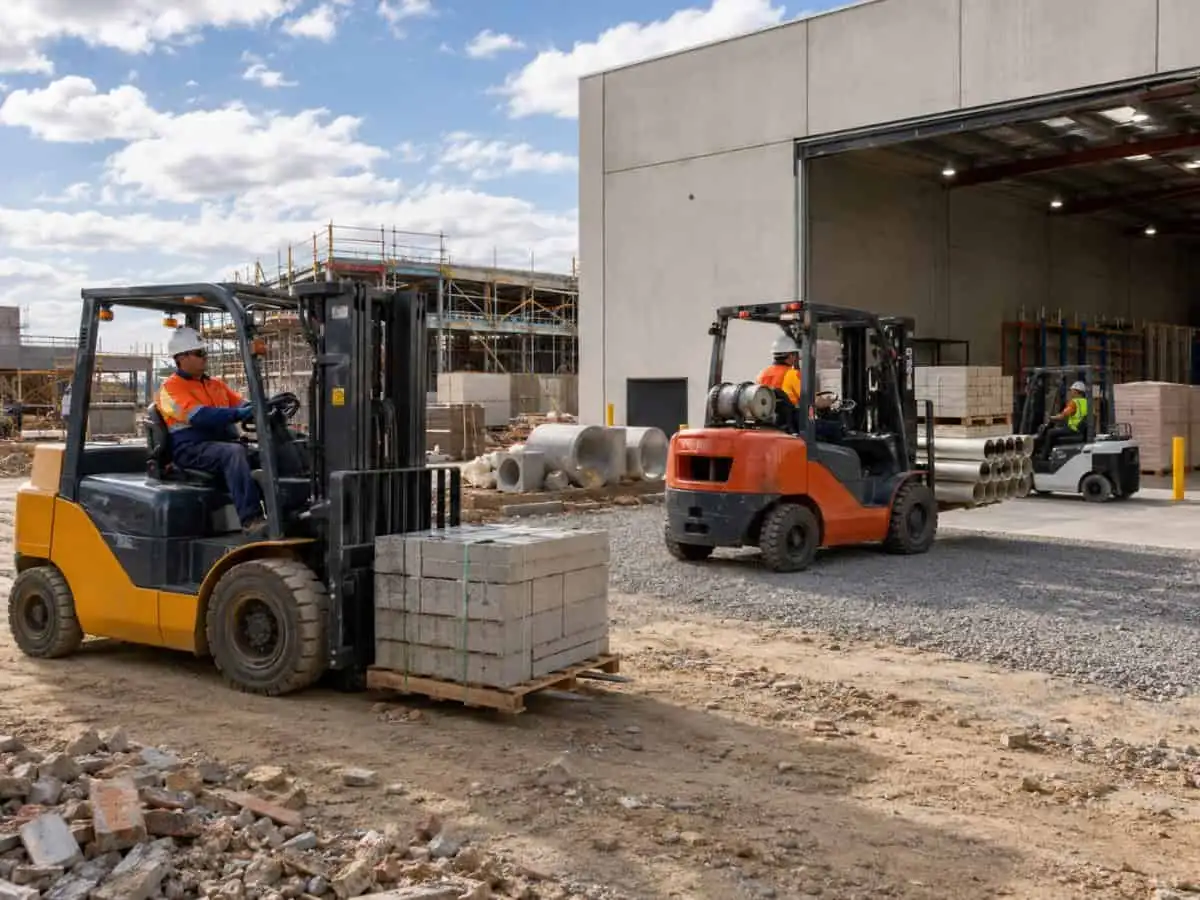
Tyres, power source and mast configuration determine whether a forklift can operate productively in the actual site conditions.
| Site Condition | Tyre Direction | Power Direction | Key Consideration |
|---|---|---|---|
| Smooth concrete | Cushion or solid pneumatic | Electric, LPG or diesel depending on ventilation | Turning space and indoor emissions |
| Compacted outdoor yard | Solid or air-filled pneumatic | Diesel or LPG | Traction and ride quality |
| Rough gravel | Pneumatic-style tyres | Diesel | Ground clearance and stability |
| Debris-prone area | Solid pneumatic | Diesel or LPG | Puncture resistance |
| Enclosed fit-out | Non-marking indoor tyre where required | Electric | Charging and clean operation |
| Mixed warehouse and paved yard | Solid pneumatic | LPG or suitable electric | Ventilation, weather and gradients |
| Uneven unfinished ground | Rough-terrain configuration | Diesel | Manufacturer terrain and slope limits |
1. Air-Filled Pneumatic Tyres
Air-filled tyres can provide:
- Better shock absorption
- Improved operator comfort
- Greater surface compliance
- Useful traction on rough ground
Their main limitation is puncture risk from nails, metal, timber offcuts and sharp debris.
2. Solid-Pneumatic Tyres
Solid-pneumatic tyres cannot be punctured and often suit construction areas where debris is difficult to eliminate.
They provide less cushioning than air-filled tyres but may reduce unplanned stoppages caused by punctures.
The pneumatic tyres for rough ground guide explains the trade-offs in greater detail.
3. Diesel, LPG or Electric
Diesel: Best suited to outdoor, heavy-duty and long-shift applications where rapid refuelling is valuable.
LPG: Can suit paved outdoor areas, covered yards and some indoor environments with suitable ventilation and controls.
Electric: Best suited to enclosed or completed buildings, clean warehouses and sites with suitable charging infrastructure.
A full power comparison is available in diesel, electric and LPG forklifts compared.
4. Mast and Lift Height
Measure the actual placement point and allow for:
- Pallet thickness
- Fork clearance
- Load height
- Overhead powerlines
- Temporary roofing
- Scaffolding
- Building openings
- Raised platforms
- Load-centre changes
- Residual capacity at height
Do not use a forklift near overhead services without a site-specific risk assessment and suitable controls.
Is a Used Forklift Reliable Enough for Construction?
Yes, a properly inspected and maintained used forklift can be reliable for construction work. Condition, application history and preparation matter more than age alone.
A dependable pre-owned machine should have:
- Verifiable service records
- A legible and correct capacity plate
- A sound mast and carriage
- Acceptable chain condition
- Dry hydraulic components
- Suitable tyres
- A stable chassis and counterweight
- Reliable steering and brakes
- A healthy engine or battery
- Functioning warning devices
- No unauthorised structural repairs
- Parts and service support
Work Safe Victoria recommends reviewing a second-hand forklift’s maintenance, inspection and use history before purchase. Its guidance also requires forklifts and attachments to be inspected and maintained regularly, with defects reported and unsafe equipment locked out of service.
Site History Matters
A forklift previously used in a clean warehouse may have different wear from one exposed to:
- Concrete dust
- Mud
- Salt air
- Rough yards
- Heavy attachments
- Frequent impact
- Long shifts
- Repeated slopes
An outdoor history is not automatically a reason to reject a machine, but it increases the importance of underbody, cooling, tyre, mast and chassis inspection.
Reconditioning Reduces Early Risk
Dealer preparation may include:
- Scheduled servicing
- Fluid and filter replacement
- Safety inspection
- Tyre replacement
- Battery or engine testing
- Hydraulic repairs
- Mast adjustment
- Cosmetic preparation
- Operational testing
Buyers can review pre-owned forklifts in Melbourne with warranty and service rather than relying on an untested private-sale machine.
The broader factors affecting useful service life are covered in what affects forklift lifespan.
New vs Used for Project-Based Construction Work
| Factor | Pre-Owned Forklift | New Forklift |
|---|---|---|
| Initial cost | Usually lower | Usually higher |
| Depreciation | A substantial portion may already have occurred | Greatest in early ownership |
| Immediate availability | Often available from current dealer stock | Lead time may apply |
| Condition | Depends on history and preparation | New and unused |
| Warranty | Dealer-specific coverage | Manufacturer warranty |
| Specification choice | Limited to available stock | Greater configuration flexibility |
| Repair exposure | May be higher as the machine ages | Usually lower during early ownership |
| Best fit | Intermittent work, budget control and established applications | Intensive use and exact specification requirements |
Pre-Owned May Suit When
- The project workload is intermittent.
- Purchase budget is limited.
- A suitable machine is already available.
- The forklift will be retained across future projects.
- The business can inspect and maintain equipment.
- A lower purchase cost improves project cash flow.
New May Suit When
- The forklift will operate intensively.
- The application needs an exact specification.
- Downtime would be highly disruptive.
- Current technology or safety features are important.
- Manufacturer support justifies the higher cost.
- The business plans to retain the machine long term.
The full ownership comparison is covered in used versus new forklifts.
Businesses that need the correct machine but want to preserve working capital can review forklift finance for a construction project.
Construction Site Safety and Licensing
Forklifts introduce serious crushing, collision, falling-load and overturning hazards. Uneven ground, temporary traffic routes and changing site conditions can increase these risks.
In Victoria, a person performing high-risk forklift work must hold the appropriate licence. Employers must also provide the information, instruction, training and supervision needed for safe operation.
1. Control Uneven-Ground Risks
Forklift instability increases when operating:
- On uneven surfaces
- On slopes or ramps
- At excessive speed
- With a raised load
- With an unstable load
- Outside manufacturer gradient limits
These factors can cause sideways or forward overturning.
Before operation:
- Inspect the route.
- Fill or barricade potholes where practicable.
- Check gradients.
- Confirm ground bearing capacity.
- Remove loose debris.
- Establish safe turning areas.
- Keep loads low during travel.
- Stop work when rain changes ground conditions.
2. Separate Forklifts and Pedestrians
Construction sites may include workers, subcontractors, delivery drivers and visitors who are unfamiliar with forklift routes.
Work Safe Victoria identifies physical separation, traffic-management plans, exclusion zones and designated walkways as important controls. Forklift and pedestrian interaction should not rely only on eye contact or informal communication.
Controls may include:
- Fixed or temporary barriers
- Pedestrian-only routes
- Forklift exclusion zones
- Driver safety zones
- Spotters where suitable
- Controlled delivery times
- Warning devices
- Speed limits
- High-visibility clothing
- Site induction
- Clear communication procedures
3. Control the Load
Loads should be:
- Within the forklift’s rated configuration
- Stable and secured
- Centred on the forks
- Supported by sound pallets or stillages
- Carried as low as practicable during travel
- Kept clear of pedestrians
Work Safe has reported fatal incidents involving unstable loads and forklifts operating on slopes or uneven surfaces, reinforcing the need to keep people away from operating forklifts and unsecured loads.
Operators should use a structured forklift safety checklist and receive suitable forklift operator training.
How to Inspect a Used Construction Forklift
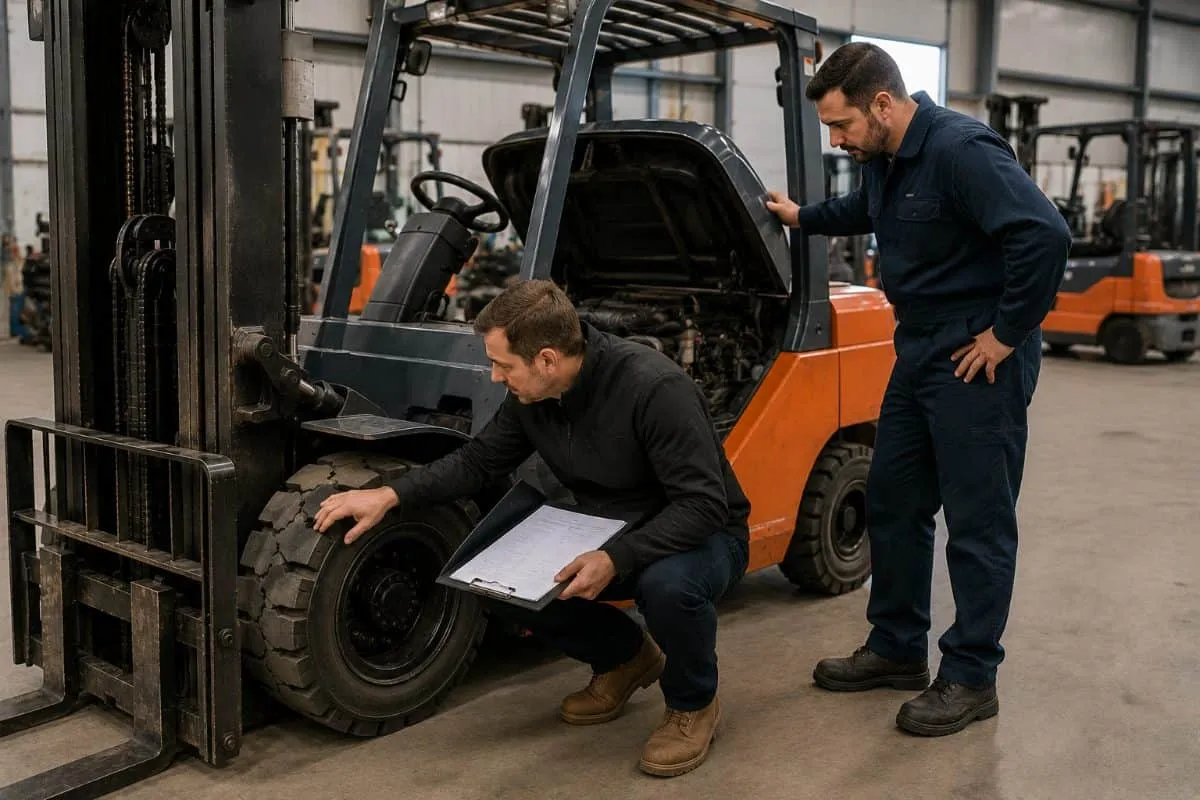
A pre-purchase inspection should examine how the machine starts, travels, lifts and performs under a suitable test load.
1. Confirm the Identity and Capacity Plate
Check:
- Make and model
- Serial number
- Year where available
- Rated capacity
- Load centre
- Mast configuration
- Approved attachments
- Tyre specification
Do not purchase a forklift with a missing, illegible or inconsistent capacity plate until its correct rating has been verified.
2. Review Operating Hours and History
Hours should be considered alongside:
- Service records
- Previous workplace
- Shift pattern
- Idle time
- Repair history
- Major component replacements
- Attachment use
Low hours do not guarantee good condition.
3. Inspect the Mast and Chains
Look for:
- Uneven chain tension
- Damaged links
- Corrosion
- Poor lubrication
- Loose rollers
- Binding
- Cracked welds
- Carriage play
- Bent fork arms
Raise and lower the mast through its full working range.
4. Check the Hydraulics
Inspect:
- Hoses
- Fittings
- Cylinders
- Valves
- Pump noise
- Lift drift
- Tilt function
- Attachment circuits
- Fluid condition
Freshly cleaned components may hide leaks, so test the machine until it reaches operating temperature.
5. Inspect the Tyres and Wheels
Construction suitability depends heavily on tyre condition.
Check for:
- Chunking
- Deep cuts
- Cracks
- Flat spots
- Uneven wear
- Low tread
- Rim damage
- Loose wheel nuts
- Mismatched tyres
Tyre replacement can materially affect the purchase budget.
6. Inspect the Chassis and Counterweight
Look beneath and around the forklift for:
- Impact damage
- Distorted panels
- Cracked welds
- Corrosion
- Loose counterweight mounting
- Damaged overhead guard
- Signs of unauthorised modification
- Grounding damage
7. Test the Engine or Battery
For diesel and LPG machines, check:
- Cold starting
- Exhaust smoke
- Engine noise
- Fluid leaks
- Cooling performance
- Transmission engagement
- Fuel-system condition
For electric machines, check:
- Battery age
- Test results
- Charger compatibility
- Connectors
- Cable condition
- Drive and lift performance
8. Test Steering and Brakes
Operate the forklift at low speed and assess:
- Steering response
- Excessive free play
- Brake performance
- Parking brake
- Direction changes
- Unusual vibration
- Differential or axle noise
9. Test Under Load
A forklift can appear normal without a load but reveal problems when lifting.
Use a suitable known load to assess:
- Lift performance
- Mast movement
- Hydraulic drift
- Steering
- Braking
- Transmission
- Stability
- Warning devices
10. Review Warranty and Support
Confirm in writing:
- Warranty period
- Components covered
- Labour coverage
- Battery exclusions
- Delivery arrangements
- Service inclusions
- Parts support
- Fault-reporting procedure
Use the complete guide on how to inspect a used forklift before committing to a machine.
Buyers can also browse the full forklift range or contact Buy A Fork to arrange an inspection.
Frequently Asked Questions
1. What Is a Forklift in Construction?
A construction forklift is a powered industrial truck used to lift, transport and place building materials, equipment and palletised goods around a site. Depending on the terrain and task, it may be a standard counterbalance, rough-terrain, high-capacity or high-reach machine.
2. What Forklift Is Best for a Construction Site?
A diesel counterbalance forklift with pneumatic-style tyres suits many firm outdoor sites. A rough-terrain forklift is better for uneven ground, while a high-capacity machine may be needed for precast products, steel or heavy equipment. Selection should be based on load, surface, height and access.
3. How Heavy Is a Construction Forklift?
Construction forklift weight varies substantially according to capacity, counterweight, mast, tyres and machine type. The forklift’s operating weight should be confirmed from its data plate or manufacturer documentation, particularly when checking floor strength, transport or site access.
4. Are Used Forklifts Reliable for Construction?
A used forklift can be reliable when it has a suitable specification, documented maintenance and a thorough inspection. Check the mast, chains, hydraulics, tyres, chassis, drivetrain and capacity plate, then test the machine under a known load before purchase.
5. Do You Need a Licence to Operate a Forklift on a Construction Site?
In Victoria, operating a forklift truck as high-risk work requires the appropriate high-risk work licence. Operators also need site-specific information, familiarisation and supervision suited to the machine, attachments, loads and construction environment.
6. Rough-Terrain vs Standard Forklift: Which Is Better for Construction?
A rough-terrain forklift is better for uneven, loose or unfinished ground. A standard counterbalance forklift is usually more compact and economical on concrete, asphalt or well-compacted yards. Tyres alone do not turn a standard forklift into a rough-terrain machine.
7. Is a Diesel or Electric Forklift Better for a Building Site?
Diesel generally suits outdoor and demanding site work because it supports quick refuelling and robust duty cycles. Electric is better for enclosed fit-outs, finished buildings and clean indoor areas with charging infrastructure. The correct choice depends on ventilation, terrain, shift length and load.
Conclusion
Reliable pre-owned forklifts for construction provide a cost-effective way to unload deliveries, reduce double-handling and keep materials moving between trades. Diesel counterbalance machines suit many prepared outdoor sites, while rough-terrain, high-capacity or high-reach equipment may be needed for more demanding conditions.
Choose the forklift by assessing load weight, load centre, lift height, terrain, tyres and site access. Then verify its history and condition through a detailed inspection and loaded test.
Businesses can review Buy A Fork’s available diesel and construction-suitable equipment or contact the team to discuss the site, materials and project requirements.