
Forklift Maintenance Guide: Service Schedules and Pro Tips
· Updated
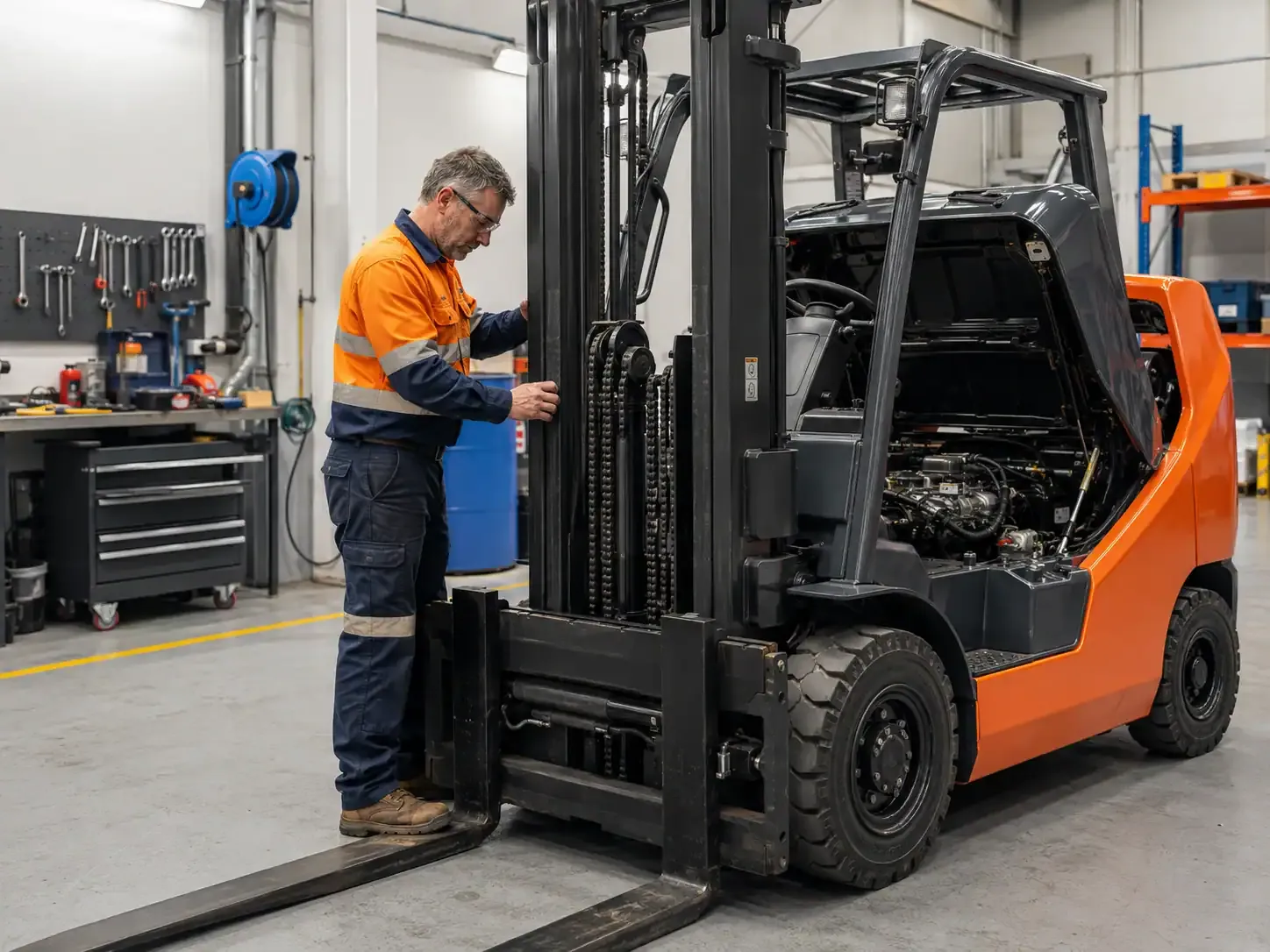
Forklift maintenance combines daily operator checks, scheduled servicing and prompt repairs when faults appear. A consistent maintenance routine helps keep the machine safe, reduces unexpected downtime and prevents minor wear from developing into expensive mechanical failures.
The correct schedule depends on the forklift model, power type, operating hours and working conditions. Always treat the manufacturer’s handbook as the primary maintenance schedule, then adjust your service plan for heavy use, dust, heat, moisture, ramps and demanding loads.
What Does Forklift Maintenance Involve?
Forklift maintenance involves inspecting, servicing and repairing the systems that allow the machine to lift, steer, stop and travel safely. It has three main levels: daily operator checks, planned servicing at specified intervals and reactive repairs when a fault develops.
The main maintenance areas include:
- Engine or power system: Checking the engine, battery, LPG system, fuel system, charger and related components.
- Hydraulic system: Inspecting fluid levels, hoses, seals, cylinders and fittings for wear or leakage.
- Mast and lifting components: Checking the mast channels, rollers, chains, carriage, forks and load backrest.
- Tyres and wheels: Monitoring tread, wear, damage, pressure where applicable and wheel security.
- Brakes and steering: Testing the service brake, parking brake, steering response and associated components.
- Safety systems: Checking the seatbelt, horn, warning lights, reversing alarm, mirrors and operator controls.
- Attachments: Confirming attachments are secure, approved and maintained according to their instructions.
- Documentation: Recording inspections, faults, repairs, service hours and outstanding work.
WorkSafe Victoria states that forklifts and their attachments must be regularly inspected and maintained. It also recommends using a suitably competent forklift technician so the machine continues to operate in line with the manufacturer’s recommendations.
How Often Should a Forklift Be Serviced?
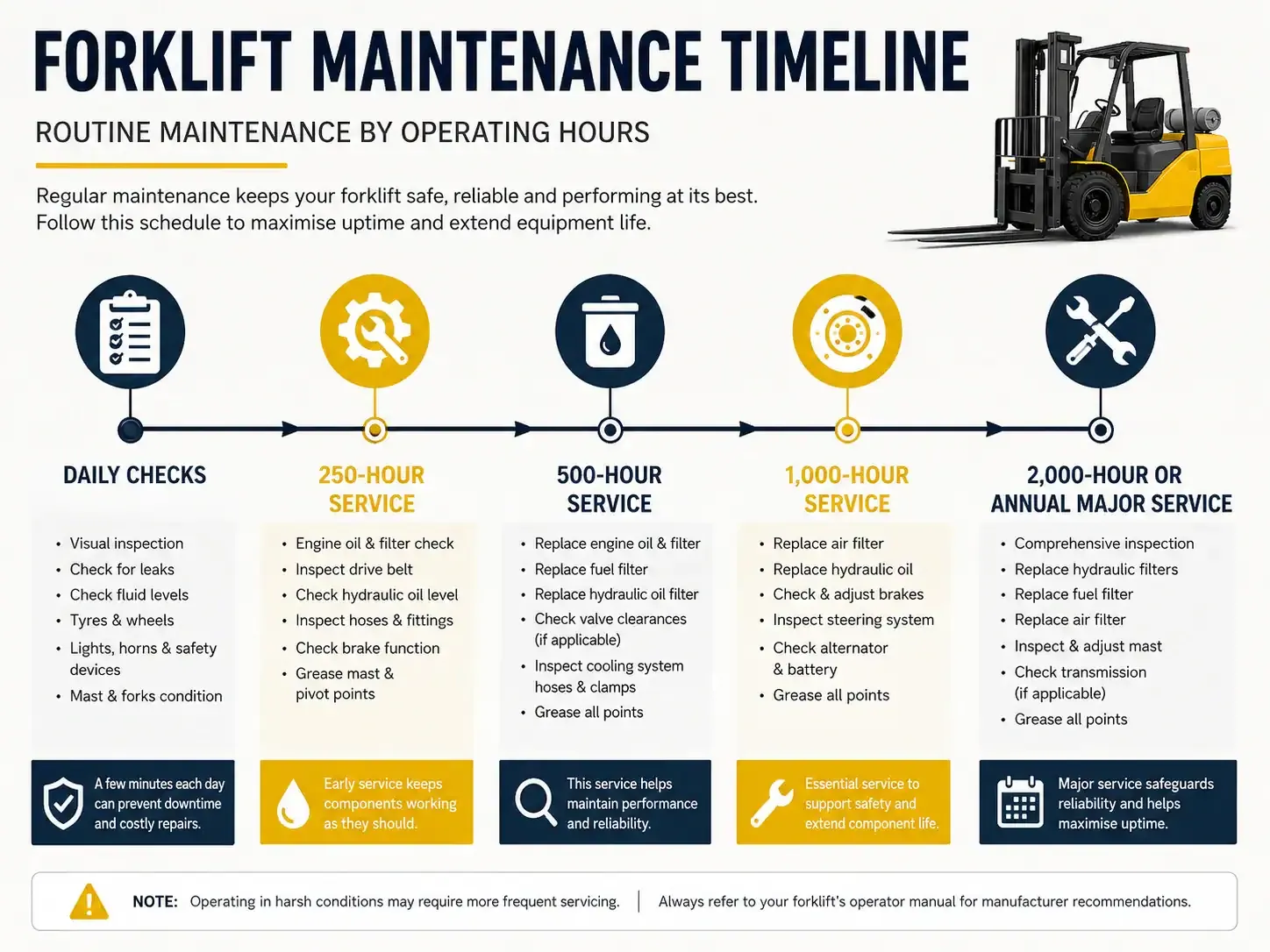
A forklift should be serviced at the operating-hour or calendar interval specified by its manufacturer. Many fleet maintenance programs use checkpoints around 250, 500, 1,000 and 2,000 operating hours, but these are planning guides rather than universal requirements.
Service intervals can differ significantly between models. Some forklifts require regular attention after a few hundred operating hours, while newer low-maintenance models may allow longer intervals for particular components. The handbook for the exact model and serial number should always take priority.
General Forklift Service Schedule
|
Interval |
Typical maintenance tasks |
Who normally completes it |
|
Before each shift or daily |
Visual inspection, fluid levels, tyres, forks, chains, leaks, brakes, steering, lights, horn, seatbelt and capacity plate |
Trained operator |
|
Around 250 operating hours or monthly |
Lubrication, mast and chain inspection, battery checks, hose and belt inspection, tyre wear assessment and fluid checks |
Competent technician or trained maintenance staff |
|
Around 500 operating hours or every three months |
Planned service, oil and filter work where specified, brake inspection, steering checks, hydraulic inspection, cooling-system checks and safety-system testing |
Competent forklift technician |
|
Around 1,000 operating hours or every six months |
Comprehensive service, mast and chain wear measurement, hydraulic and transmission checks, electrical diagnostics and battery condition testing |
Competent forklift technician |
|
Around 2,000 operating hours or annually |
Major inspection, manufacturer-specified fluid and filter replacement, structural checks, fuel or emission-system service and detailed safety inspection |
Competent forklift technician |
Important: This table is a general planning framework. Do not use it instead of the manufacturer’s service handbook. Use whichever authorised interval comes first when the handbook specifies both operating hours and calendar time.
A low-use forklift may still require calendar-based servicing because seals, fluids, batteries and corrosion can deteriorate while the machine is parked. A forklift operating across multiple shifts may reach its hour-based service point much sooner than expected.
Conditions That May Require More Frequent Servicing
Shorten inspection or service intervals when a forklift regularly operates in:
- Dusty or dirty yards
- Cold storage
- High temperatures
- Wet or corrosive environments
- Uneven outdoor surfaces
- Areas containing paper, timber or packaging debris
- Multiple-shift operations
- Frequent ramp work
- High-load or high-lift applications
- Environments requiring regular washdowns
A technician should assess the operating environment and recommend suitable intervals rather than applying the same schedule to every machine.
Daily Pre-Start Checks Operators Should Complete
A forklift should receive a pre-operational inspection before it enters service. WorkSafe Victoria recommends completing the inspection at the start of each shift, before the first daily use and whenever there is a change of operator. Any defect that could make the forklift unsafe must be reported, and the machine should be locked out of service until the problem is rectified.
Operators should follow the workplace checklist and the manufacturer’s instructions rather than relying on memory.
Printable Forklift Maintenance Checklist
Before Starting the Forklift
- Tyres and wheels: Check for excessive wear, cuts, embedded objects, missing rubber, low pressure and loose wheel components.
- Forks: Look for cracks, bends, uneven fork tips, damaged heels and worn locking pins.
- Mast and carriage: Inspect mast channels, rollers, chains, guides and the load backrest.
- Hydraulic system: Look underneath and around cylinders, hoses and fittings for leaks or damage.
- Fluid levels: Check engine oil, coolant, hydraulic fluid, fuel and other accessible levels as instructed.
- Battery: Inspect the battery, cables, connectors, restraint and charge level.
- LPG equipment: Confirm the cylinder is correctly positioned, secured and free from obvious damage.
- Seat and seatbelt: Check the seat adjustment and make sure the restraint operates correctly.
- Capacity plate: Confirm the data plate is fitted, legible and matches the forklift and its attachment.
- General condition: Look for loose panels, structural damage, debris and anything that could affect safe operation.
After Starting the Forklift
- Brakes: Test the service brake and parking brake.
- Steering: Check for excessive movement, unusual resistance or poor response.
- Controls: Test the accelerator, directional controls, lift, lower, tilt and attachment functions.
- Warning devices: Test the horn, reversing alarm, lights and any fitted warning systems.
- Gauges and alerts: Check for warning lights, unusual readings or error codes.
- Unusual behaviour: Listen for knocking, grinding, squealing or other abnormal sounds.
- Leaks: Check again for fluid appearing under pressure.
Operators can use a consistent daily pre-operational inspection to document these checks and ensure faults are reported before the machine enters an active work area.
A checklist does not make an unsafe forklift safe. It helps identify problems so the machine can be isolated and assessed before an incident occurs.
Planned Maintenance vs Reactive Forklift Repairs
Planned maintenance is servicing performed before a breakdown occurs. Reactive maintenance begins after a component has failed or the forklift has already become unreliable.
Both have a place in fleet management, but relying mainly on reactive repairs creates unpredictable downtime and may allow a minor issue to damage other components.
|
Maintenance type |
Planned or preventive maintenance |
Reactive or breakdown repair |
|
When it happens |
At scheduled hours, dates or condition triggers |
After a fault or failure appears |
|
Main purpose |
Prevent deterioration and identify wear early |
Restore a failed or malfunctioning forklift |
|
Downtime |
Usually scheduled around operations |
Often unexpected |
|
Cost control |
Easier to forecast and manage |
Can include urgent labour, transport and secondary damage |
|
Parts planning |
Parts can often be ordered in advance |
Parts may not be immediately available |
|
Safety impact |
Faults can be identified before the machine becomes unsafe |
The fault may already affect safe operation |
|
Useful for |
Routine servicing, inspections and wear monitoring |
Sudden electrical, mechanical or hydraulic failures |
Planned maintenance does not eliminate every breakdown. It reduces avoidable failures by finding worn tyres, damaged hoses, loose connections, contaminated fluids and deteriorating components early.
Toyota’s official maintenance guidance also identifies reduced downtime and earlier access to technicians as key benefits of a planned maintenance arrangement.
Forklift Maintenance Tasks by Power Type
Every forklift needs attention to its mast, hydraulics, tyres, brakes and safety equipment. The power source adds another set of maintenance requirements.
|
Forklift power type |
Recurring maintenance tasks |
Common issues to watch |
|
LPG |
Cylinder inspection, mounting checks, hose and connection checks, regulator or vaporiser service, ignition inspection and engine servicing |
Gas odour, damaged hoses, poor starting, rough running, incorrect cylinder position and loose mounting |
|
Lead-acid electric |
Charging, electrolyte checks, watering, terminal cleaning, cable inspection, battery restraint checks and charger maintenance |
Low electrolyte, corrosion, heat, damaged connectors, poor charging habits and short runtime |
|
Lithium-ion electric |
Approved charging, cable and connector inspection, software or battery-management checks and temperature monitoring |
Incorrect charger, damaged connections, fault codes, overheating and impact damage |
|
Diesel |
Engine oil, oil filters, fuel filters, air filters, cooling system, belts, exhaust and emissions components |
Smoke, overheating, fuel contamination, hard starting, fluid leakage and clogged filters |
|
Petrol or dual-fuel |
Engine oil, filters, cooling system, ignition components and fuel-system checks |
Rough running, leaks, overheating, misfiring and starting problems |
LPG Forklift Maintenance
Inspect the LPG cylinder, bracket, hose and connectors during the pre-start check. Cylinders should be correctly positioned, secured and changed only by trained and authorised people in an appropriate location.
WorkSafe Victoria advises that LPG cylinders should be filled, exchanged and stored only in designated areas. The cylinder’s safety valve must remain at the top, and appropriate gloves should be provided to control the risk of freeze burns during cylinder changes.
A technician should inspect the LPG regulator, fuel system, ignition system and engine at the intervals specified by the manufacturer. Remove the forklift from service if there is a suspected gas leak or damaged LPG equipment.
Electric Forklift Maintenance
Electric forklift maintenance depends heavily on the battery type.
Lead-acid batteries require:
- Correct charging cycles
- Electrolyte-level checks
- Watering at the correct time
- Clean terminals and connectors
- Secure cables and restraints
- A ventilated charging area
- Suitable eyewash, spill and fire-response equipment
Lithium-ion batteries generally do not require watering or equalisation. They must still be charged with an approved charger and inspected for cable damage, connector wear, fault codes, excessive heat and physical damage.
WorkSafe Victoria recommends that battery charging and changing be completed only by trained and authorised people in a designated area. Charging instructions should be available and followed, and power leads should not create a trip hazard.
Battery Watering and Charging
Watering a lead-acid battery too early can cause electrolyte overflow during charging. Leaving it too late can expose the plates and shorten battery life.
The correct process for when to water a forklift battery depends on the battery manufacturer’s instructions, but watering is normally checked after charging unless the electrolyte level is too low to cover the plates beforehand.
Use approved water and filling equipment. Never assume lithium-ion and lead-acid batteries have the same maintenance needs.
Diesel and Internal-Combustion Forklift Maintenance
Diesel, petrol and LPG forklifts have engine components that electric machines do not. Their service schedules may include:
- Engine oil and filter replacement
- Fuel-filter replacement
- Air-filter cleaning or replacement
- Coolant inspection
- Radiator cleaning
- Belt and hose inspection
- Spark-plug and ignition checks on petrol or LPG models
- Exhaust and emission-system checks
- Transmission and differential servicing
Dust, packaging material and blocked radiator fins can restrict airflow and contribute to overheating. Keeping the cooling system clean is particularly important in hot, dirty or high-use environments.
Key Forklift Components and What to Check
Hydraulic System
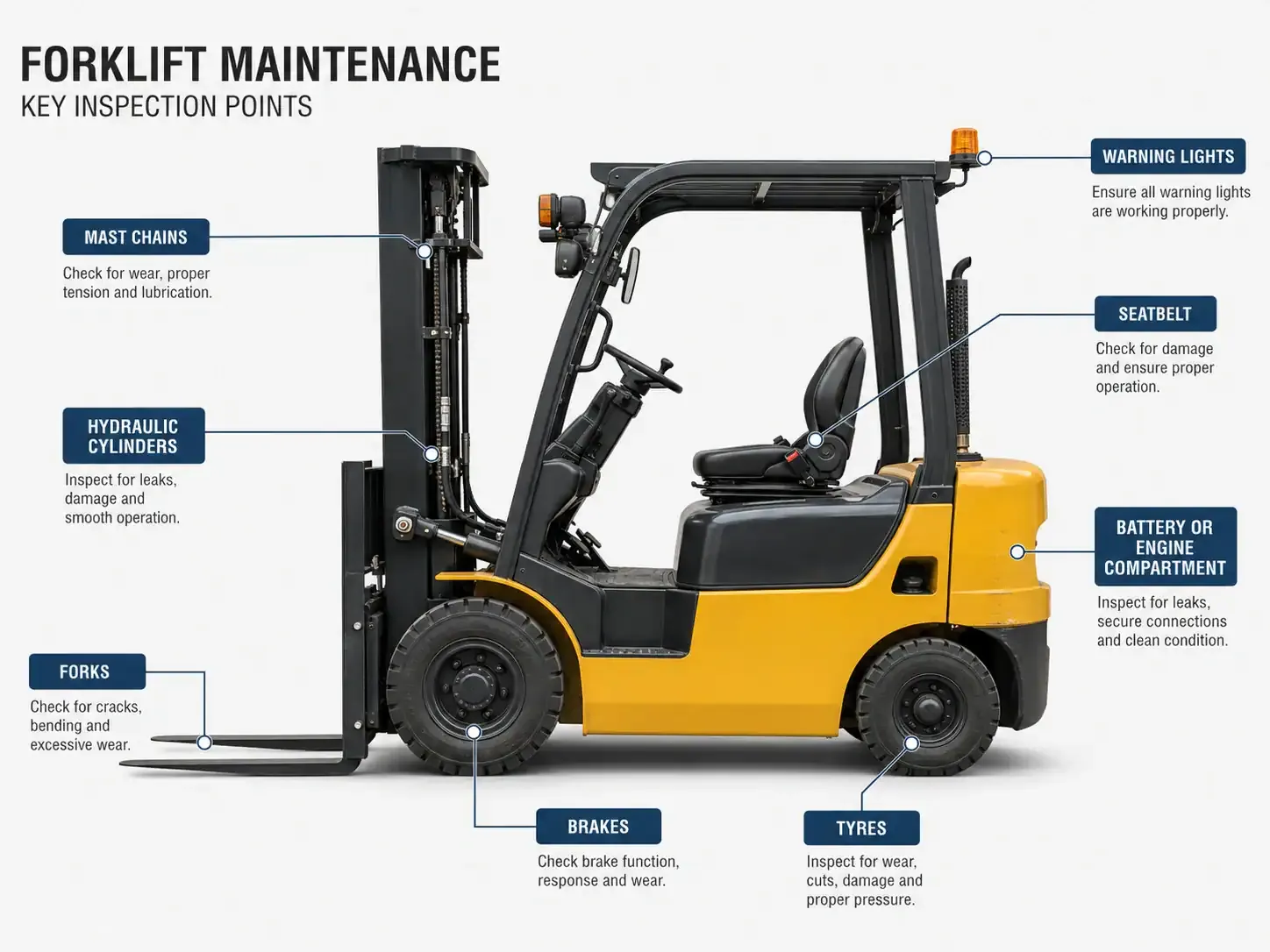
The hydraulic system supplies the force required to raise, lower and tilt the load.
Check:
- Hydraulic fluid level and condition
- Hoses for cracking, rubbing, bulging or leakage
- Fittings and seals
- Lift and tilt cylinders
- Mast movement
- Unusual noises during operation
- Load drift when controls are neutral
Hydraulic fluid should be replaced only at the interval and with the specification approved for the forklift. The correct steps for changing hydraulic oil include controlling contamination, using the specified fluid and safely managing hydraulic pressure.
Never use your hands to search for a pressurised hydraulic leak. Isolate the forklift and have the system inspected by a competent technician.
Mast, Forks and Lift Chains
The lifting assembly handles significant force during every load cycle.
Inspect:
- Fork heels and blades for wear or cracking
- Uneven fork height
- Fork locking pins
- Mast rails and rollers
- Lift-chain tension
- Chain elongation, corrosion and damaged links
- Carriage movement
- Load-backrest condition
- Attachment mounting points
Forks and chains require specialist measurement at specified service intervals. Visual checks alone may not identify excessive wear or elongation.
Brakes and Steering
The operator should test the service brake, parking brake and steering before use. Technicians should inspect brake wear, adjustment, fluid systems, steering components and related linkages during scheduled servicing.
Warning signs include:
- Longer stopping distances
- Pulling to one side
- A weak parking brake
- Excessive steering movement
- Jerking or stiffness
- Grinding or squealing
- Fluid leakage
Tyres and Wheels
Forklift tyres affect stability, ground clearance, braking and operator comfort. A tyre can appear usable while being worn beyond its safe replacement point.
Check for:
- Cracks and cuts
- Flat spots
- Chunking
- Embedded metal or debris
- Uneven wear
- Low pneumatic-tyre pressure
- Damage near the wear line
- Loose wheel components
The correct process for changing forklift tyres depends on whether the machine uses pneumatic, solid or press-on tyres. Forklift tyre replacement often requires specialist presses, lifting equipment and safe isolation procedures.
Safety Equipment
Regularly test and inspect:
- Seatbelts and operator restraints
- Horns and alarms
- Headlights and warning lights
- Mirrors and cameras
- Blue or red safety lights
- Pedestrian-detection equipment
- Interlocks
- Load-capacity plates
- Guards and covers
- Emergency disconnects on electric machines
A safety device that is fitted but not maintained may create false confidence. Defective warning or restraint systems should be reported and assessed before the forklift returns to work.
Signs a Forklift Needs Unscheduled Attention
Do not wait for the next planned service when a forklift develops a new fault or changes how it operates.
Arrange an inspection when you notice:
- Oil, coolant, fuel or hydraulic fluid on the ground
- A gas smell
- Slow or uneven lifting
- A mast that jerks or drifts
- Warning lights or fault codes
- Reduced battery runtime
- Charging problems
- Excessive smoke
- Overheating
- Hard starting
- Grinding, knocking or squealing
- Poor braking
- Unresponsive steering
- Strong vibration
- Damaged forks, chains or tyres
- Repeated blown fuses
- A loose or damaged attachment
Basic checks may help identify a simple operational issue if your forklift will not start, but bypassing an interlock, warning system or safety device is not an acceptable repair.
Pro Tips to Extend Forklift Life and Reduce Downtime
1. Train Operators to Report Small Changes
Operators often notice deterioration before a complete failure. Encourage them to report new noises, slower lifting, steering changes, reduced battery runtime and warning lights immediately.
A small leak or loose connection is usually easier to manage before it damages another component.
2. Keep a Detailed Service Log
Record:
- Date and operating hours
- Inspection results
- Faults reported
- Work completed
- Parts replaced
- Technician details
- Outstanding recommendations
- Next service due
- Attachment inspections
- Battery or tyre replacement history
WorkSafe Victoria recommends that maintenance records show what requires inspection, what was inspected, work completed, defects found and rectification or follow-up work.
3. Monitor Operating Hours
Use the hour meter or a telematics system to schedule servicing before the due point. Calendar reminders alone may be unreliable when operating hours vary between forklifts.
A machine working two or three shifts can reach its service interval much faster than a lightly used forklift.
4. Adjust the Schedule to the Application
A forklift that works outside on rough surfaces will not wear at the same rate as a warehouse forklift operating on smooth concrete.
Review the schedule when:
- Shift patterns change
- New attachments are fitted
- Loads become heavier
- The machine moves to another site
- New racking increases lift height
- Operating conditions become dustier, hotter or wetter
5. Keep the Forklift Clean
Cleanliness makes inspections easier and prevents debris from collecting around radiators, wheels, pedals, mast channels and moving components.
Use cleaning methods approved by the manufacturer. High-pressure water can damage electrical components, connectors, seals and bearings when used incorrectly.
6. Lubricate the Correct Points
Insufficient lubrication accelerates wear. Excessive or incorrect lubrication can attract dirt or contaminate braking and electrical components.
Follow the lubrication chart for the specific model rather than applying grease to every visible moving part.
7. Use the Correct Fluids and Parts
Incorrect engine oil, hydraulic fluid, coolant, filters, tyres or electrical components can affect performance and reliability.
Match parts and fluids to the model and serial number. Similar-looking components are not always interchangeable.
8. Do Not Delay Safety-Critical Repairs
A forklift with defective brakes, steering, forks, mast components, tyres, restraints or warning systems may be unsafe to operate.
WorkSafe Victoria advises workplaces to have a system for locking out a forklift when a defect makes it unsafe for use.
9. Respect Capacity and Operating Limits
Repeated overloading, impacts, harsh braking and travelling over unsuitable surfaces increase wear on the mast, tyres, brakes, steering and chassis.
Maintenance works best when operators also follow the capacity plate and safe operating procedures.
10. Review the Forklift’s Age and Usage
Maintenance history, operating conditions, power type and previous repairs all influence what affects forklift lifespan.
Increasing repair frequency can indicate that a forklift needs a major overhaul, a change in application or replacement rather than another short-term repair.
Should You Service a Forklift In-House or Use a Maintenance Plan?
Operators and internal staff can usually complete daily inspections, cleaning and basic manufacturer-approved tasks. Scheduled servicing, adjustments, structural inspection and technical repairs should be completed by someone with the necessary skills, equipment and model knowledge.
In-House Maintenance May Suit You When:
- You operate a large fleet
- You employ qualified forklift technicians
- You have suitable workshop equipment
- You stock commonly used parts
- You have safe isolation procedures
- You can maintain detailed records
- You have access to manufacturer service information
A Maintenance Provider May Be Better When:
- You have one or a small number of forklifts
- Internal staff do not have forklift-specific technical training
- You need mobile servicing
- Downtime must be planned around production
- You operate several forklift brands
- You need access to diagnostic equipment
- You want service reminders and documented inspections
- You need clearer maintenance forecasting
Structured forklift service plans and maintenance packages can make scheduled servicing easier to manage, particularly where no internal technician is available.
Buy A Fork currently advertises a free six-month basic service with eligible forklift purchases, subject to terms and conditions. The inclusions and eligibility should be confirmed for the specific machine before purchase.
What Does Forklift Maintenance Cost?
Forklift maintenance costs depend on the machine’s age, power type, operating hours, condition, parts availability, service level and working environment.
A routine planned service will usually cost less than a major breakdown involving urgent labour, transport and multiple damaged components. A separate breakdown of how much forklift maintenance costs can help owners budget for servicing, parts, tyres, batteries and unexpected repairs without confusing cost intent with the maintenance schedule covered here.
Keep Your Forklift Maintenance on Schedule
A reliable forklift maintenance program begins with daily inspections and continues through planned servicing, accurate record keeping and prompt fault reporting.
Use the manufacturer’s schedule as the foundation, then account for the forklift’s power type, operating hours, attachments and working environment. Most importantly, do not keep an unsafe forklift operating simply to reach the end of a shift or the next scheduled service.
Catching wear early protects the machine, the load, the operator and everyone working around it.
Frequently Asked Questions
1. How Often Does a Forklift Need to Be Serviced?
A forklift should be serviced according to the manufacturer’s operating-hour and calendar schedule. Many maintenance programs use checkpoints around 250 or 500 operating hours, followed by more comprehensive work at higher intervals, but the exact timing varies by model and application.
Daily inspections do not replace scheduled servicing.
2. How Many Hours Should a Forklift Run Before a Service?
There is no single service interval for every forklift. The required number of hours depends on the model, power type, working environment and manufacturer’s instructions.
Some components may need attention after a few hundred hours, while certain newer models permit longer intervals. Check the machine’s handbook and hour meter rather than relying on a general fleet rule.
3. What Maintenance Does a Forklift Need?
A forklift needs daily checks, scheduled lubrication, hydraulic inspection, mast and chain checks, tyre and brake maintenance, power-system servicing and safety-equipment testing.
Electric forklifts also need battery and charging-system care. Internal-combustion forklifts require engine oil, filter, cooling, fuel and ignition maintenance.
4. What Is Included in a Forklift Service?
A forklift service may include fluid and filter checks, lubrication, brake and steering inspection, mast and chain inspection, tyre assessment, hydraulic checks, electrical testing and safety-system checks.
The exact inclusions depend on the operating-hour interval and service agreement. Ask for a written checklist showing what will be inspected, adjusted and replaced.
5. Can I Do Forklift Maintenance Myself?
Operators can complete pre-start checks, cleaning and basic tasks allowed by the manufacturer and workplace procedures. Technical servicing and repairs should be completed by a suitably competent person with the correct tools and service information.
WorkSafe Victoria specifically recommends engaging a competent forklift technician to help keep the machine operating according to the manufacturer’s requirements.
6. What Is the Three-Metre Rule for Forklifts?
The three-metre rule refers to pedestrian separation, not a maintenance interval. WorkSafe Victoria has advised that when fixed physical separation is not reasonably practicable, pedestrians should remain outside an advised three-metre exclusion zone and should not interact with the load during forklift operations.
The required exclusion area may need to be larger where load height, load stability, speed or site conditions increase the risk. Physical barriers and properly designed traffic-management controls provide stronger protection than relying only on a painted distance.