
How to Change and Replace Forklift Tyres: Complete Guide
· Updated
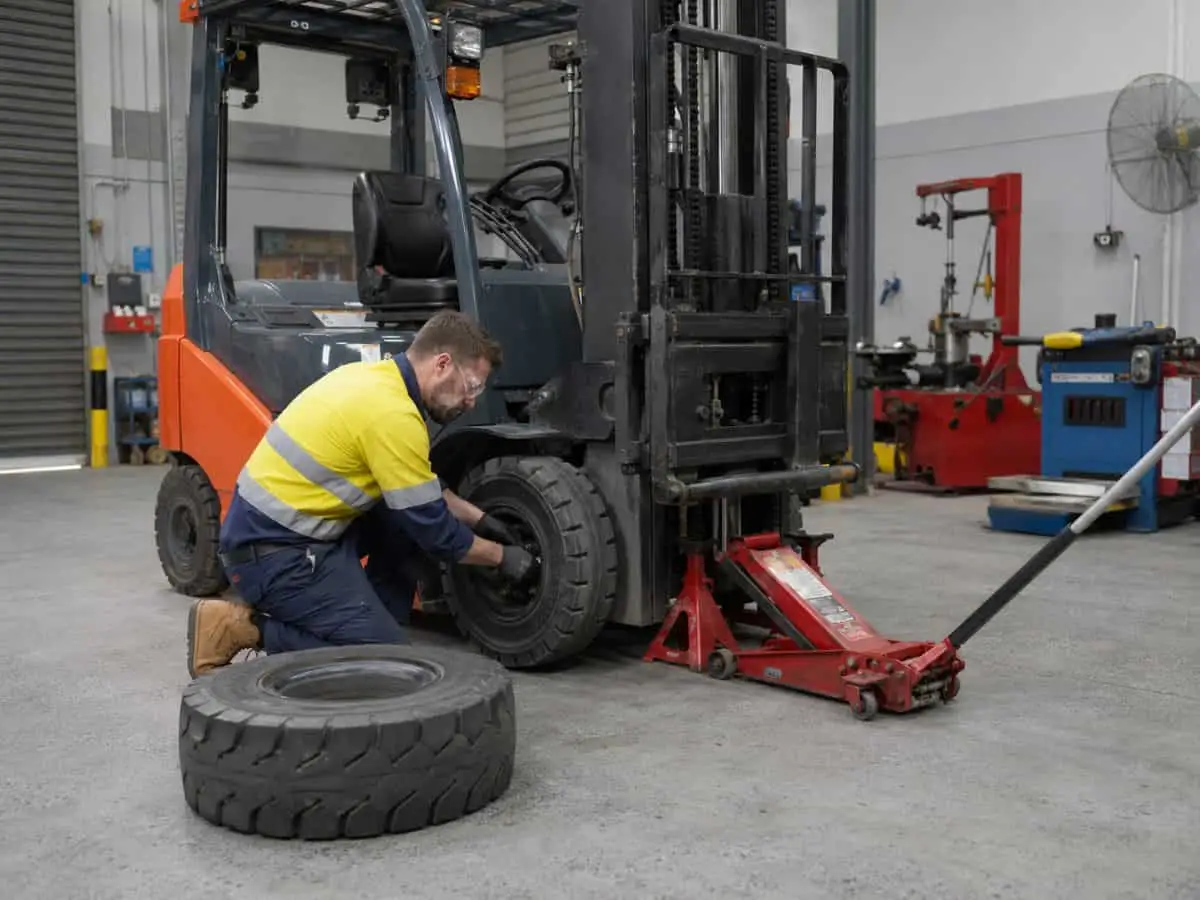
Changing a forklift tyre involves isolating the machine, securing it against movement, lifting it from the manufacturer-approved jacking point, removing the wheel and fitting the correct replacement. However, the process depends heavily on the tyre type.
Pneumatic wheel assemblies may be removed in a similar way to vehicle wheels, although split-rim assemblies present serious stored-energy hazards. Solid, cushion and press-on tyres normally require specialised hydraulic presses and should be replaced by a competent forklift tyre technician.
This guide explains how to identify your tyre type, when forklift tyre replacement is necessary and which tyres suit indoor, outdoor and demanding industrial applications.
How Do You Change a Forklift Tyre?
To change a forklift tyre safely, park and isolate the forklift, chock the wheels, raise it using the approved jacking point, support it securely and remove the wheel assembly. The replacement method then depends on whether the machine uses pneumatic, solid pneumatic, cushion or press-on tyres.
Solid and press-on tyres should not be removed with ordinary workshop tools. They are fitted and removed with specialised tyre presses that apply substantial force. Attempting the work without the correct equipment can damage the wheel, tyre or forklift and expose workers to serious injury.
Split-rim pneumatic assemblies also require specialist knowledge because compressed air and incorrectly handled rim components can release stored energy suddenly.
WorkSafe Victoria recommends that forklifts receive regular inspections and maintenance and that unsafe equipment be removed from service until defects are corrected by a suitably competent person.
Businesses that are unsure about the tyre or fitting method can book a tyre replacement rather than attempting safety-critical work without suitable equipment.
Forklift Tyre Types and How to Identify Yours
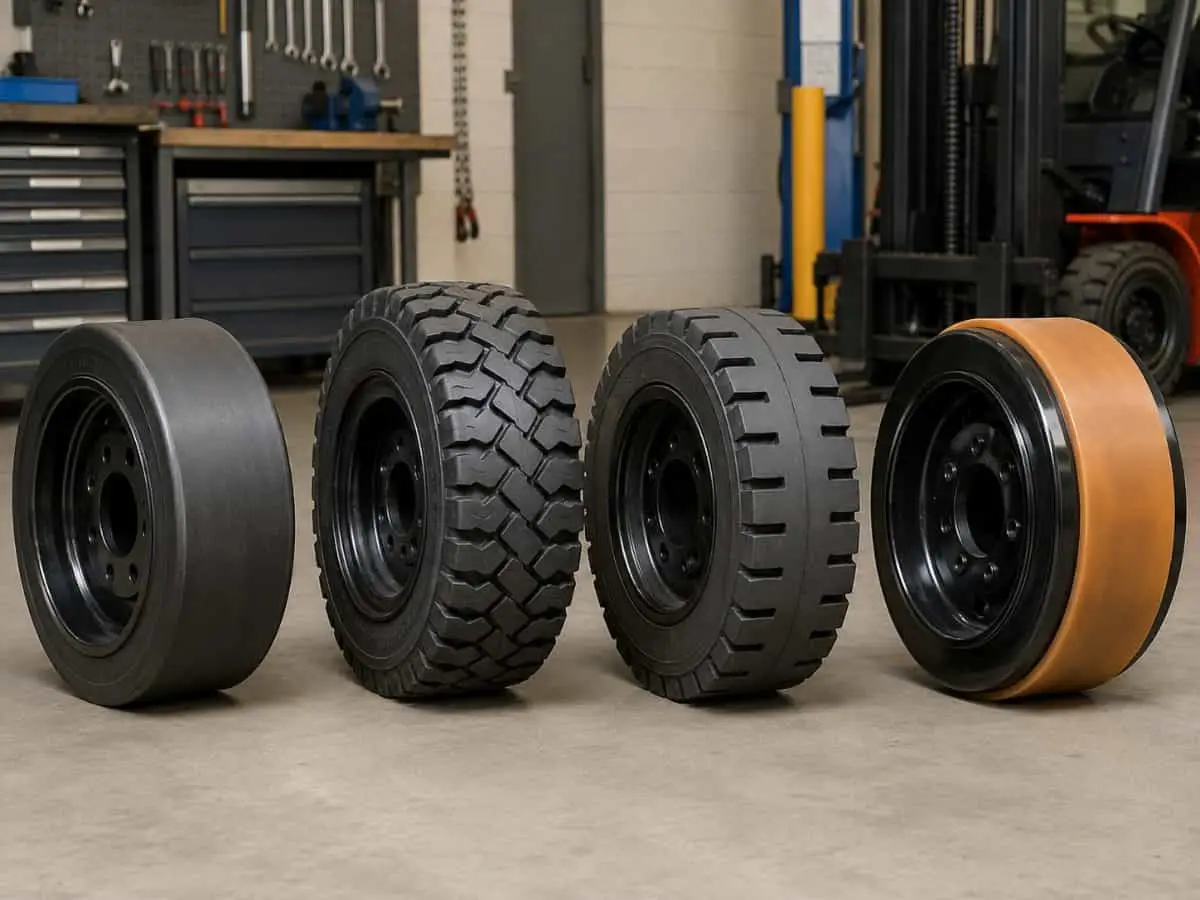
Identifying the tyre type is the first step in planning a replacement. Forklift tyres are not interchangeable simply because they appear to have a similar diameter.
| Tyre Type | Construction | Best Surface | Main Advantages | Main Limitations |
|---|---|---|---|---|
| Cushion tyre | Solid rubber bonded or fitted to a metal wheel | Smooth indoor floors | Compact turning radius, durable and low maintenance | Limited cushioning and poor performance on rough ground |
| Air-filled pneumatic | Rubber tyre containing compressed air | Outdoor yards and uneven surfaces | Strong shock absorption, traction and operator comfort | Vulnerable to punctures and pressure loss |
| Solid pneumatic | Solid rubber shaped like a pneumatic tyre | Rough, debris-prone indoor or outdoor surfaces | Puncture-proof with better cushioning than basic cushion tyres | Heavier, more expensive and less cushioning than air-filled tyres |
| Press-on tyre | Rubber or polyurethane bonded to a steel band | Smooth warehouse and factory floors | Compact, durable and suited to intensive indoor work | Requires a hydraulic press and is unsuitable for rough surfaces |
| Polyurethane tyre | Hard synthetic material, often used on warehouse equipment | Smooth, clean indoor floors | Low rolling resistance and clean operation | Limited grip and cushioning on uneven or wet surfaces |
Cushion Tyres
Cushion tyres are compact solid tyres commonly fitted to counterbalance forklifts used on smooth warehouse and factory floors. Their smaller diameter can help reduce the forklift’s turning radius and overall height.
They provide limited shock absorption. Repeated operation over broken concrete, gravel or potholes can increase vibration, tyre damage and wear on other forklift components.
Pneumatic Tyres
Pneumatic forklift tyres resemble heavy-duty truck tyres and may be either air-filled or solid.
Air-filled pneumatic tyres provide the greatest cushioning and can improve traction on uneven surfaces. They need regular pressure checks and remain vulnerable to punctures.
Solid pneumatic tyres do not require inflation and cannot be punctured. They are often selected for outdoor yards containing nails, timber fragments, metal or other sharp debris.
The construction, applications and trade-offs are covered further in pneumatic tyres explained.
Press-On and Polyurethane Tyres
Press-on tyres are fitted tightly onto a steel wheel using a hydraulic press. They are common on warehouse forklifts and specialised material-handling equipment.
Polyurethane tyres and wheels are frequently found on reach trucks, pallet jacks and stackers. They offer low rolling resistance on smooth floors but can wear quickly when exposed to rough expansion joints, debris or uneven concrete.
Businesses comparing replacement tyres should first confirm the forklift model, wheel dimensions, load requirements and current tyre specification.
How to Change a Forklift Tyre Step by Step
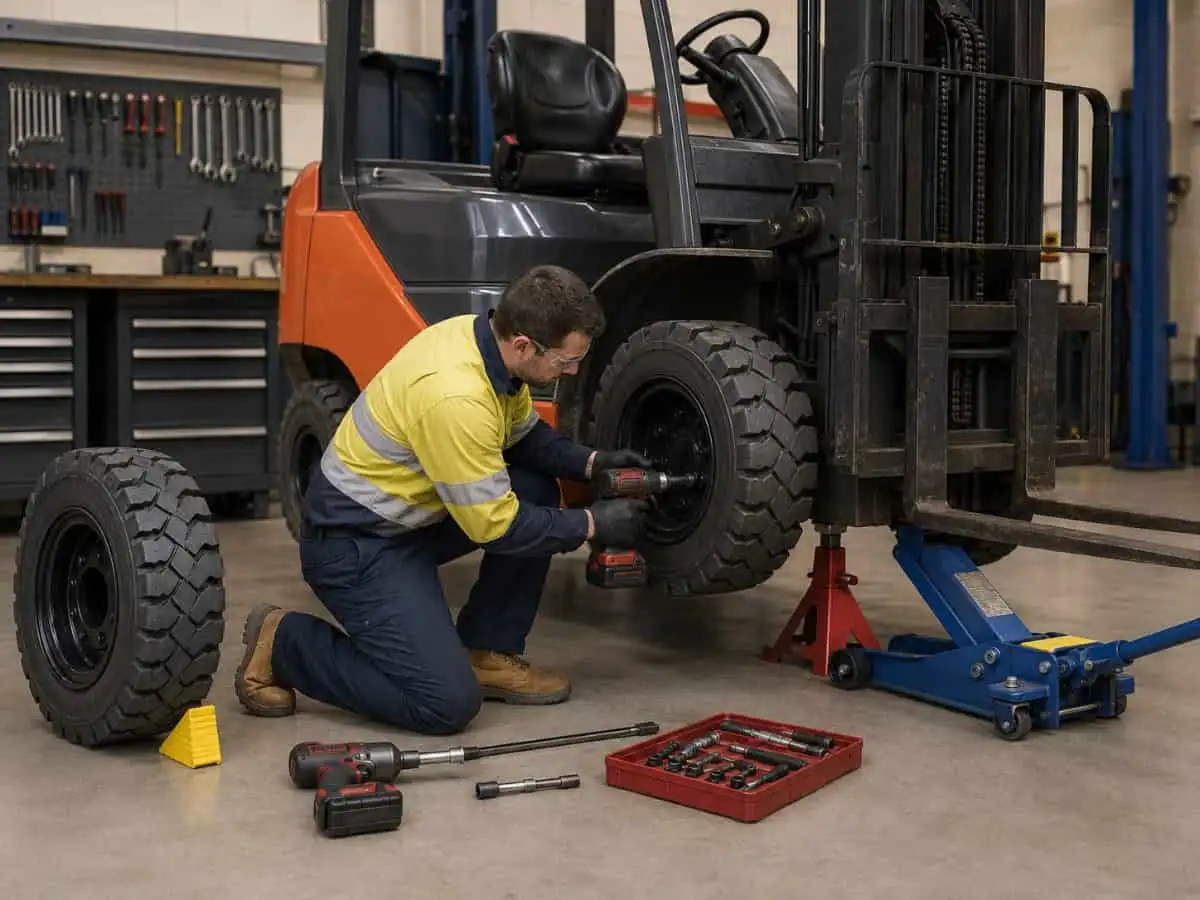
The following process is a general overview only. Always follow the forklift manufacturer’s manual, approved jacking points, wheel procedures and torque specifications.
1. Identify the Tyre and Wheel Assembly
Confirm whether the forklift has:
- A standard pneumatic wheel
- A split-rim pneumatic assembly
- A solid pneumatic tyre
- A cushion tyre
- A press-on tyre
- A polyurethane warehouse wheel
Also record the tyre size, wheel size, tread pattern, load rating and directional requirements.
Do not purchase a replacement based only on visual dimensions. The wrong tyre can affect clearance, stability, steering, gearing and load handling.
Businesses reviewing the broader condition of an older machine can use the 14-step used forklift inspection to assess tyres alongside the mast, forks, hydraulics and controls.
2. Select a Safe Work Area
Move the forklift to a level, solid and well-lit surface away from active traffic.
The area should provide:
- Enough room to use lifting equipment
- A firm surface that can support the machine
- Separation from pedestrians and operating forklifts
- Suitable lighting
- Access to the required tools
- A method for controlling unauthorised entry
Never attempt to jack a forklift on loose gravel, soft ground, an incline or an unstable surface.
3. Park and Isolate the Forklift
Lower the forks fully, place the direction control in neutral, apply the parking brake and switch off the machine.
Remove the key and follow the workplace’s isolation procedure. Disconnect the battery or isolate the fuel system where required by the manufacturer or maintenance procedure.
WorkSafe Victoria advises that defects should be reported and that unsafe forklifts should be locked out of service until rectification is completed.
4. Chock the Wheels
Chock the wheels that will remain on the ground. Place the chocks securely so the forklift cannot roll during lifting or tyre removal.
Do not rely only on the parking brake.
Tyre condition should also form part of daily tyre checks in your pre-start so defects are identified before the forklift enters service.
5. Use the Approved Jacking Point
Check the manufacturer’s manual for the correct jacking point.
A forklift is significantly heavier than a passenger vehicle and has an uneven weight distribution. Positioning a jack under an unsuitable panel, counterweight edge or steering component can damage the machine or cause it to slip.
Use a jack with sufficient rated capacity for the forklift and the specific end being raised.
6. Support the Forklift Securely
Once raised, position suitable rated supports beneath approved structural points.
Never work beneath or beside a forklift supported only by a hydraulic jack. Hydraulic systems can fail, leak or shift unexpectedly.
Confirm that the forklift is stable before removing the wheel.
7. Remove the Wheel Assembly
Loosen and remove the wheel nuts according to the manufacturer’s procedure. Use mechanical handling equipment when required because forklift wheels can be extremely heavy.
Keep hands and feet clear of the wheel’s path. Inspect the studs, nuts, hub and wheel for damage after removal.
Do not dismantle an inflated split-rim assembly. The tyre must be deflated and the assembly handled according to the tyre and rim manufacturer’s procedure by a qualified person.
8. Replace the Tyre
The replacement method depends on the tyre.
Pneumatic tyre: The tyre is removed from the wheel using commercial tyre-changing equipment. Split-rim assemblies require additional controlled procedures.
Solid pneumatic tyre: A specialist press and suitable tooling are generally required to remove and fit the tyre.
Cushion or press-on tyre: The worn tyre is pressed from the wheel and the replacement is installed using a hydraulic press.
Polyurethane wheel: The entire wheel assembly may be replaced rather than fitting a separate tyre.
Queensland workplace safety guidance specifically recommends using qualified tyre fitters to remove and fit forklift tyres.
9. Refit the Wheel
Clean the mating surfaces and inspect the wheel studs and nuts before installation.
Position the wheel carefully, install the nuts by hand and tighten them in the manufacturer-recommended sequence. Use the specified torque rather than estimating tightness with an impact wrench.
Incorrect tightening can damage studs, distort the wheel or allow the wheel to loosen during operation.
10. Lower the Forklift
Clear tools and personnel from the area. Raise the forklift slightly, remove the stands and lower the machine slowly onto the floor.
Remove the jack and wheel chocks only after confirming that the machine is stable.
11. Complete Final Checks
Before returning the forklift to service:
- Confirm wheel-nut torque
- Check pneumatic tyre pressure where applicable
- Inspect the wheel for correct seating
- Check clearance around the tyre
- Look for leaks or damage
- Test steering at low speed
- Check for unusual vibration
- Confirm braking performance
- Record the work completed
- Arrange a wheel-nut recheck when specified
Tyre replacement should be recorded as part of routine forklift maintenance.
When Should You Replace Forklift Tyres?
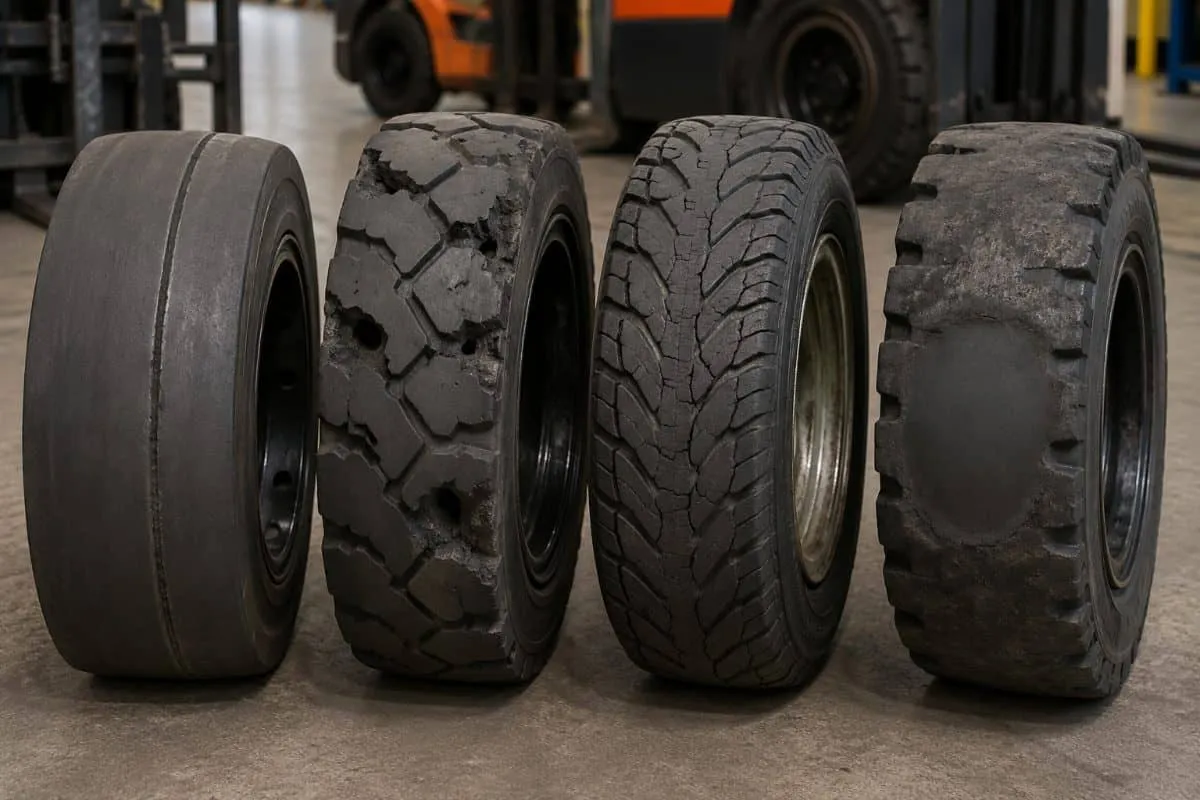
Forklift tyres should be replaced when they reach the manufacturer’s wear limit, lose structural integrity or affect safe and predictable operation.
The Wear or Safety Line Has Been Reached
Many cushion and solid tyres have a wear or safety line moulded into the sidewall. The tyre should normally be replaced when wear reaches that indicator.
Do not continue using the tyre until the rubber is almost level with the wheel.
Chunking or Tearing
Chunking occurs when pieces of rubber break away from the tyre. It may result from:
- Sharp debris
- Rough concrete
- Repeated contact with dock edges
- Excessive heat
- Overloading
- Harsh turning
- Incorrect tyre selection
Small superficial marks may not make the forklift immediately unsafe, but deep or widespread chunking requires professional assessment.
Flat Spots
Flat spots can develop through harsh braking, skidding, prolonged parking under load or uneven wear.
A flat-spotted tyre may cause repetitive vibration while travelling. That vibration can affect the operator, load stability and other forklift components.
Cracking or Splitting
Cracks can develop from age, heat, chemical exposure, overloading or unsuitable operating conditions.
Deep cracks, exposed internal material or separation from the wheel indicate that the tyre requires replacement.
Loss of Tread
Pneumatic and solid pneumatic tyres need enough tread to provide traction in their intended environment.
Worn tread can reduce grip on:
- Wet concrete
- Compacted gravel
- Loose surfaces
- Loading ramps
- Outdoor yards
- Sloping areas
Operators working in these environments should also follow suitable guidance for operating in wet or rough conditions.
Frequent Pressure Loss
An air-filled pneumatic tyre that repeatedly loses pressure may have a puncture, damaged valve, rim problem or bead leak.
Running with insufficient pressure can increase heat, sidewall flex, steering effort and instability.
Excessive Vibration
New vibration may indicate:
- A flat spot
- Uneven tyre wear
- A damaged wheel
- Incorrect tyre fitting
- Loose wheel nuts
- Steering or axle problems
The forklift should be removed from service until the cause is identified.
Reduced Clearance
As cushion tyres wear, the forklift’s ground clearance reduces. This can cause the underside, counterweight or mast components to contact ramps, transitions and uneven floors.
Uneven Wear Between Tyres
Tyres on the same axle should be compatible in size, type and wear level. A significant difference can affect level travel, steering and load handling.
Worn tyres also increase shock and vibration through the forklift. Correct replacement and maintenance can therefore contribute to what affects forklift lifespan.
Choosing the Right Forklift Tyre for Indoor or Outdoor Work
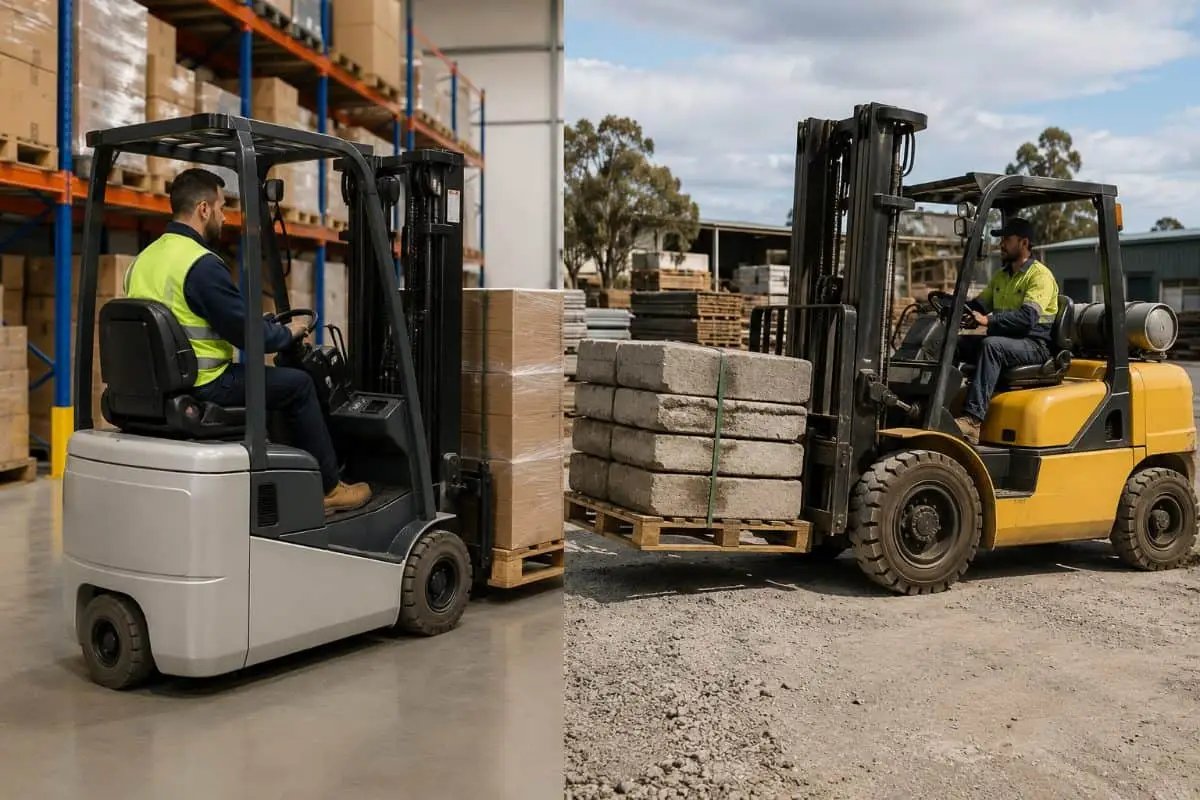
The right tyre depends on the surface, load, operating hours, debris, moisture and manoeuvring requirements.
| Working Environment | Suitable Tyre Direction | Main Reason |
|---|---|---|
| Smooth indoor warehouse | Cushion or polyurethane | Compact operation and low rolling resistance |
| Clean factory floor | Cushion or press-on | Durability on smooth concrete |
| Indoor and outdoor concrete | Solid pneumatic | Puncture resistance with useful cushioning |
| Rough industrial yard | Solid pneumatic or air-filled pneumatic | Better shock absorption and traction |
| Gravel or compacted ground | Pneumatic-style tyre | Improved surface compliance |
| Yard with nails or sharp debris | Solid pneumatic | Eliminates puncture risk |
| Wet outdoor surface | Treaded pneumatic or solid pneumatic | Better traction than smooth cushion tyres |
| Cold-store floor | Application-specific compound | Suitable grip and resistance to temperature conditions |
Smooth Indoor Floors
Cushion and polyurethane tyres suit smooth, level floors where compact manoeuvrability is important.
They are commonly used on:
- Electric counterbalance forklifts
- Reach trucks
- Order pickers
- Pallet jacks
- Walkie stackers
- Indoor LPG forklifts
Buyers replacing a machine that no longer suits its environment can compare the electric forklift range for indoor warehouse applications.
Mixed Indoor and Outdoor Work
Solid pneumatic tyres often provide a practical compromise for forklifts that travel between a warehouse, loading canopy and paved yard.
They reduce puncture risk while providing more cushioning than compact cushion tyres.
Businesses comparing complete machines rather than tyres alone can review the available counterbalance forklift range.
Rough Outdoor Yards
Air-filled pneumatic tyres generally provide the strongest cushioning on rough ground. Solid pneumatic tyres are often preferred when puncture hazards would cause excessive downtime.
Suitable applications may include:
- Timber yards
- Building-material suppliers
- Farms
- Recycling facilities
- Transport yards
- Construction compounds
- Manufacturing yards
The machine itself must also be designed for the conditions. Compare forklifts for outdoor conditions when tyre changes alone cannot make an indoor forklift suitable for rough ground.
Loads and Duty Cycle
Heavier loads, longer shifts and frequent turning increase tyre heat and wear.
Provide the tyre supplier with:
- Forklift model
- Rated capacity
- Normal load weight
- Maximum load
- Working surface
- Hours per day
- Travel distance
- Indoor or outdoor use
- Existing tyre size
- Current tyre type
- Known wear problems
The cheapest tyre may not provide the lowest operating cost. A longer-lasting compound or puncture-proof construction can reduce downtime in a demanding application.
Businesses planning broader equipment replacement can browse the full forklift range to compare machines already configured for the required surface and duty.
DIY vs Professional Forklift Tyre Replacement
Forklift tyre replacement is not equivalent to changing an ordinary car tyre. The weight of the machine, stored energy in tyre assemblies and specialised press requirements make professional fitting the safer choice in many cases.
When DIY Work May Be Considered
A competent workshop may remove and reinstall a conventional pneumatic wheel assembly when it has:
- The manufacturer’s maintenance instructions
- Correct jacking and support equipment
- Suitable wheel-handling equipment
- A safe isolation procedure
- Calibrated torque tools
- Trained maintenance personnel
- A standard wheel rather than an unfamiliar split rim
Even then, removing the tyre from the wheel may need to be completed by a qualified commercial tyre fitter.
When Professional Replacement Is Necessary
Professional assistance should be used when:
- The tyre is solid or press-on
- A hydraulic tyre press is required
- The wheel uses a split-rim assembly
- The forklift’s jacking points are unclear
- The wheel is too heavy to handle safely
- The tyre has failed under load
- The rim or wheel is damaged
- Correct torque specifications are unavailable
- The workplace lacks suitable support equipment
- The cause of abnormal wear is unknown
Benefits of Professional Replacement
- Correct tyre identification
- Suitable pressing equipment
- Safe handling of heavy wheels
- Wheel and hub inspection
- Correct tyre orientation
- Correct wheel-nut torque
- Reduced risk of equipment damage
- Identification of steering or alignment faults
- Less operational downtime
WorkSafe Victoria advises engaging a suitably competent forklift technician to help ensure equipment continues operating according to manufacturer recommendations.
Buy A Fork supplies inspected material-handling equipment and supports businesses managing forklift ownership and maintenance. Visit the Buy A Fork homepage to review the business and available equipment, or use the contact page to discuss tyre replacement needs.
How Much Does Forklift Tyre Replacement Cost?
Forklift tyre replacement cost depends on the tyre type, size, compound, quantity, wheel condition and fitting method. Labour and transport may also affect the final price.
The main cost drivers include:
- Cushion, pneumatic or solid construction
- Tyre dimensions
- Load rating
- Tread pattern
- Standard or non-marking compound
- Number of tyres being changed
- Press-on fitting
- Split-rim handling
- Damaged wheels or studs
- Mobile or workshop fitting
- Forklift transport
- After-hours service
- Alignment or steering repairs
- Disposal of old tyres
Air-filled pneumatic tyres may cost less to purchase than equivalent solid pneumatic tyres, but puncture risk and maintenance should be considered. Press-on tyres require specialist labour and machinery even when the replacement tyre appears simple.
Avoid comparing quotes based only on the tyre price. Confirm whether the quote includes:
- Tyre supply
- Removal
- Press fitting
- Wheel inspection
- Installation
- Wheel-nut torque
- Travel
- Disposal
- GST
- Any follow-up inspection
A broader explanation of repair, servicing and ownership expenses is available in Buy A Fork’s guide to forklift maintenance and tyre costs.
When tyre costs are part of a larger decision about repairing or replacing the machine, compare available used forklifts and material-handling equipment before committing to extensive work.
Frequently Asked Questions
1. Can You Change a Forklift Tyre Yourself?
A competent workshop may be able to remove and reinstall some conventional pneumatic wheel assemblies using approved procedures and correctly rated equipment. Solid, cushion and press-on tyres normally require a hydraulic press and qualified fitting. Split-rim assemblies also involve serious stored-energy hazards and should be handled by trained professionals.
2. When Should Forklift Tyres Be Replaced?
Replace forklift tyres when they reach the manufacturer’s wear line, develop deep cracks, lose chunks, form flat spots or show significant tread loss. Replacement is also required when a tyre causes vibration, repeatedly loses pressure or affects traction and ground clearance.
3. How Long Do Forklift Tyres Last?
Forklift tyre life depends on tyre construction, surface condition, load weight, operating hours, turning habits, travel distance and maintenance. A tyre used lightly on smooth concrete can last considerably longer than the same tyre used continuously on rough ground or around sharp debris.
4. What Are the Different Forklift Tyre Types?
The main forklift tyre types are cushion, air-filled pneumatic, solid pneumatic, press-on and polyurethane. Cushion and polyurethane tyres suit smooth indoor floors. Pneumatic and solid pneumatic tyres generally provide better cushioning and traction for outdoor or uneven surfaces.
5. How Much Does It Cost to Replace Forklift Tyres?
The cost varies according to tyre type, size, quantity, brand, fitting labour and whether a hydraulic press or mobile service is required. Wheel damage, transport and disposal can add to the price. A tyre specialist needs the forklift model and tyre specification to provide an accurate quote.
6. Are Solid or Pneumatic Tyres Better for Outdoor Use?
Air-filled pneumatic tyres generally provide better cushioning and comfort on rough outdoor ground. Solid pneumatic tyres cannot be punctured and are often better for yards containing nails, metal or broken timber. The best choice depends on the balance between ride comfort, traction and puncture risk.
Conclusion
Changing forklift tyres safely begins with identifying the tyre type and following the manufacturer’s lifting, wheel-removal and torque procedures. Pneumatic wheel assemblies may sometimes be removed by a properly equipped workshop, but solid, cushion, press-on and split-rim tyre work should normally be completed by qualified technicians.
Inspect tyres during every pre-start check and replace them when they reach their wear limit or develop cracking, chunking, flat spots or traction problems. Choosing tyres that match the surface, load and duty cycle will improve reliability, reduce vibration and help protect the forklift from avoidable wear.
For advice on tyre suitability, fitting or replacing a forklift that no longer matches its working environment, contact Buy A Fork.