
Forklift Pre-Operational Inspection Checklist: What to Check Daily
· Updated
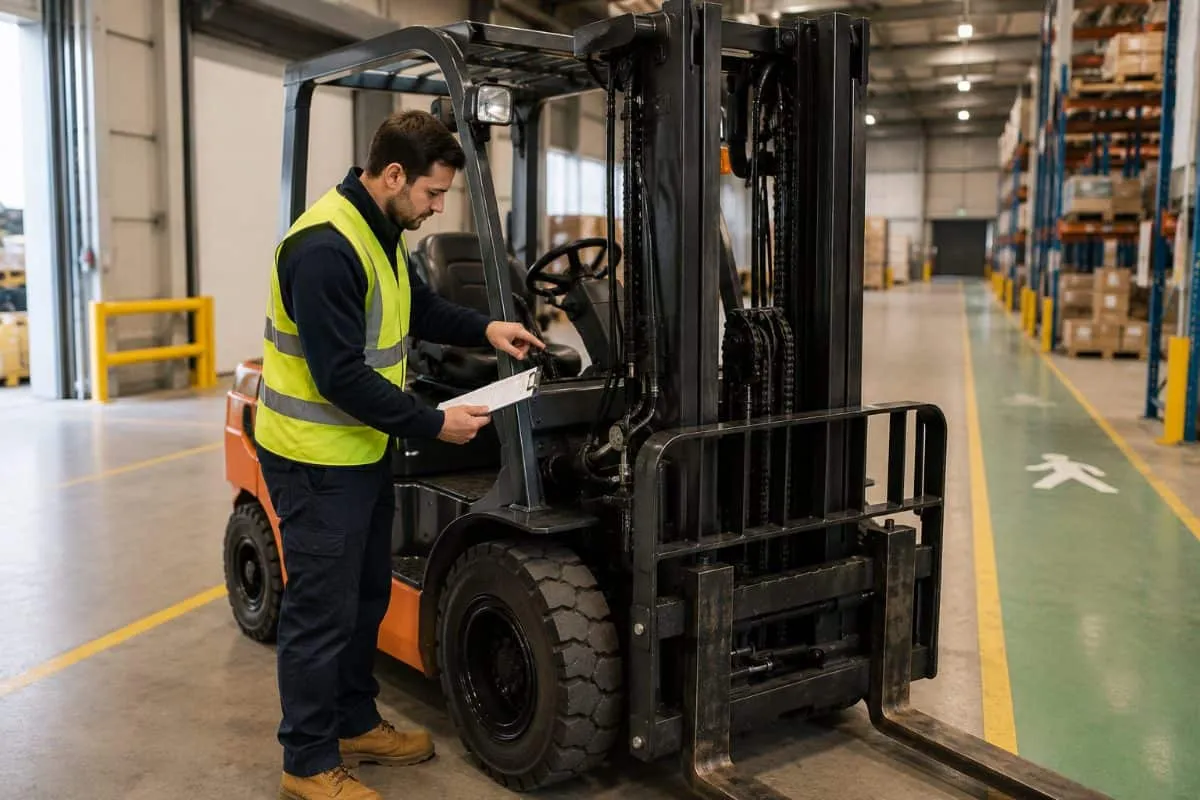
A forklift pre-operational inspection is a visual and functional check completed before the forklift is used. It should cover the tyres, forks, mast, chains, hydraulics, attachments, restraints, controls, brakes, steering, warning devices and power system.
WorkSafe Victoria recommends completing the inspection according to the manufacturer’s instructions at the start of each shift, before first daily use and whenever the operator changes. Any defect that makes the forklift unsafe should be reported, and the machine should be locked out of service.
Daily checks do not replace scheduled servicing or a technician’s inspection. They help operators identify visible faults and abnormal operation before the forklift enters an active work area.
What Is a Forklift Pre-Operational Inspection?
A forklift pre-operational inspection, also called a forklift pre-start check or daily inspection, confirms that the machine appears safe and functional before work begins.
It normally includes:
- Parked checks: Visual checks completed with the forklift stationary and switched off.
- Operational checks: Function tests completed after starting or energising the machine.
- Fuel-system checks: Battery, LPG or diesel checks relevant to the forklift.
- Attachment checks: Inspection of any fitted side shift, clamp, jib or other attachment.
- Fault reporting: Recording defects and removing unsafe equipment from service.
The inspection should follow the manufacturer’s operator manual because controls, warning systems and inspection requirements can differ between models.
Operators should also understand why trained forklift operators perform daily checks rather than treating the checklist as a paperwork exercise.
Forklift Pre-Start Inspection Checklist
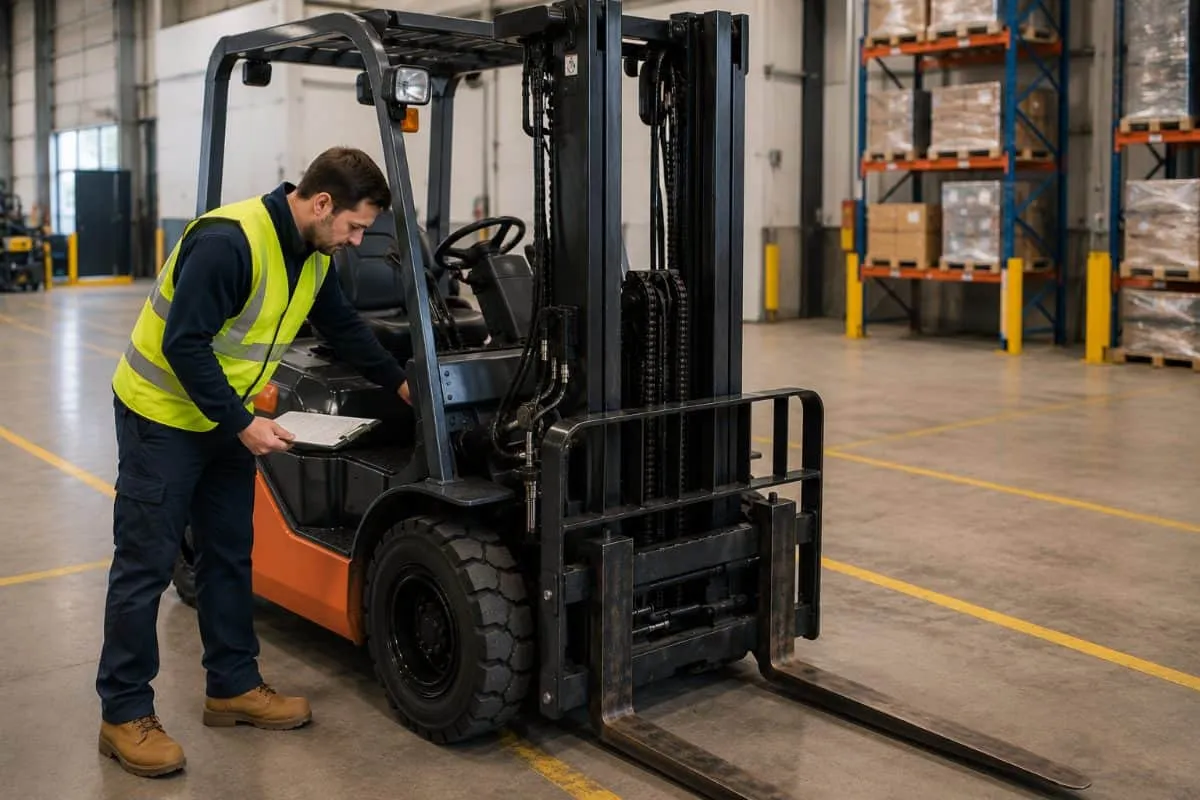
Complete the parked inspection first. Start the forklift only after checking that there are no obvious faults, people or obstructions around the machine.
Parked Checks With the Key or Engine Off
1. Check the Inspection Record
Review the previous checklist or logbook before using the forklift.
Look for:
- Unresolved defects
- Pending maintenance
- Previous operator comments
- Repair notes
- Out-of-service tags
- Technician restrictions
Do not remove a lockout or defect tag unless authorised under the workplace procedure.
2. Inspect the Ground Beneath the Forklift
Look for fresh:
- Hydraulic oil
- Engine oil
- Coolant
- Fuel
- Battery electrolyte
- Other unidentified fluid
A small old mark on the floor may not come from the forklift, but fresh fluid directly beneath a component requires investigation.
3. Check the Tyres and Wheels
Inspect every tyre for:
- Cuts
- Chunking
- Embedded objects
- Flat spots
- Excessive wear
- Separation
- Low pressure on pneumatic tyres
- Damage around the rim
Check that wheel nuts appear present and secure. Do not attempt to tighten or repair wheels unless you are authorised and trained.
4. Inspect the Fork Arms
Check both forks for:
- Cracks
- Bending
- Uneven height
- Damaged tips
- Excessive heel wear
- Missing or damaged locking pins
- Unauthorised welding
- Poor carriage engagement
The forks should be lowered fully while being inspected.
5. Check the Load Backrest and Carriage
Inspect the load backrest and carriage for:
- Cracks
- Bent sections
- Loose fasteners
- Damaged rollers
- Missing components
- Excessive movement
- Obstructions
The backrest helps reduce the risk of a load moving towards the operator when it is suitable for the load and correctly fitted.
6. Inspect the Mast and Lift Chains
Look along the mast channels and chains for:
- Visible damage
- Cracked welds
- Corrosion
- Uneven chain tension
- Damaged links
- Poor lubrication
- Loose anchors
- Foreign material
- Roller damage
Do not place hands inside the mast or between moving components.
7. Check Hydraulic Hoses and Cylinders
Inspect visible hydraulic components for:
- Leaks
- Cracked hose coverings
- Damaged fittings
- Flattened hoses
- Pitted cylinder rods
- Loose connections
- Rubbing or abrasion
A fine high-pressure hydraulic leak may be difficult to see and can penetrate skin. Do not use your hand to search for leaks.
8. Inspect the Overhead Guard
Check the overhead guard and surrounding structure for:
- Impact damage
- Cracks
- Bent sections
- Loose fasteners
- Unauthorised modifications
- Items stored on the guard
Nothing should be attached to the overhead guard if it could affect visibility, clearance or structural performance.
9. Check the Seat and Restraint
Inspect the:
- Seatbelt
- Buckle
- Seat mounting
- Operator-presence system
- Armrests or side restraints
- Seat adjustment
The restraint should latch, release and retract correctly.
10. Check Steps, Handles and Floor Areas
Make sure entry and operator areas are:
- Clean
- Dry
- Free from loose tools
- Free from wrapping material
- Free from grease or mud
- Structurally sound
Use the provided steps and handholds when entering or leaving the forklift.
11. Read the Capacity Plate
Confirm that the capacity plate is:
- Present
- Legible
- Secure
- Relevant to the forklift
- Updated for any attachment
Fitted attachments can alter a forklift’s stability and available capacity. WorkSafe Victoria advises that attachments should form part of the daily inspection and that the information plate should reflect the forklift and attachment combination.
12. Inspect Any Attachment
Check side shifts, clamps, jibs and other attachments for:
- Damage
- Loose mountings
- Missing retaining devices
- Hydraulic leaks
- Cracked welds
- Incorrect positioning
- Unsecured pins or chains
Do not operate an attachment that is not listed on the information plate or approved for the machine.
A broader operator forklift safety checklist can help place these machine checks within the complete warehouse safety process.
Operational Checks With the Key On
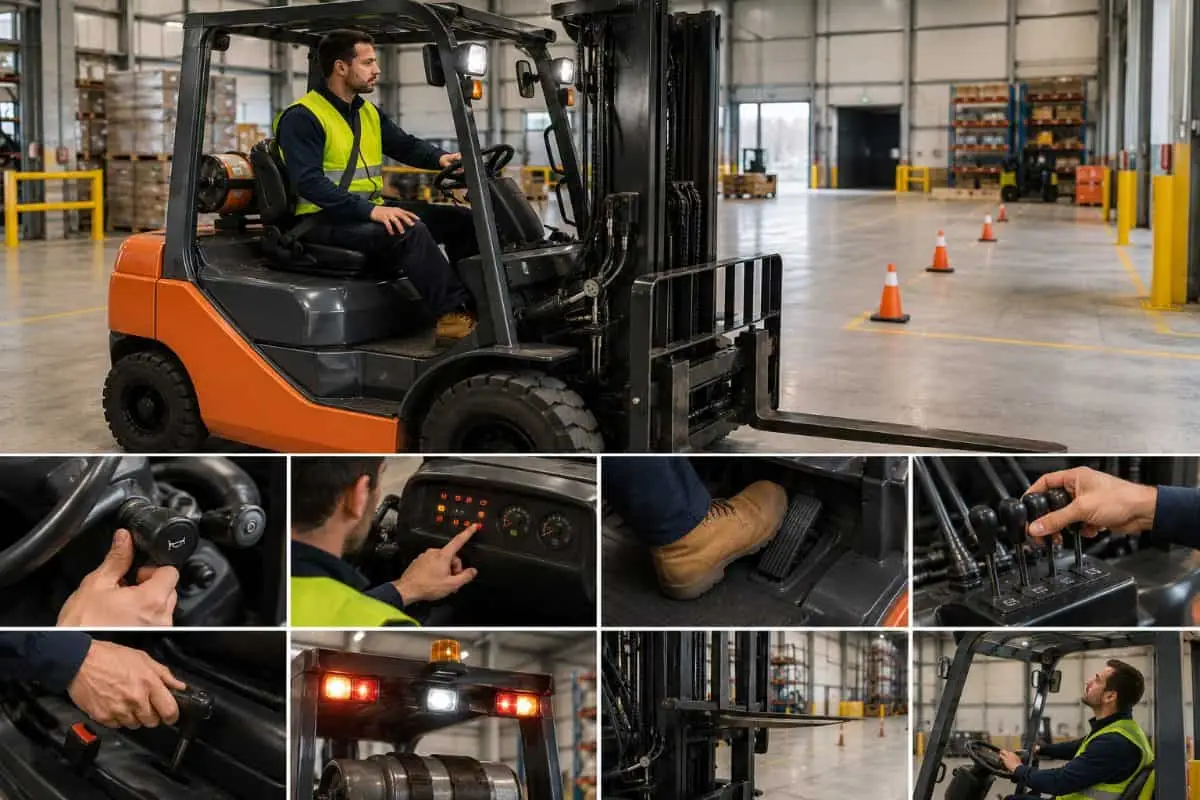
Complete these tests in a clear area away from pedestrians and active traffic.
13. Check Dashboard Indicators
After starting or energising the forklift, observe:
- Warning lights
- Fuel or battery level
- Engine temperature
- Oil-pressure warning
- Hour meter
- Fault codes
- Display messages
Some warning lights illuminate briefly during start-up and should then turn off. Follow the manufacturer’s manual when an indicator remains active.
14. Test the Horn and Warning Devices
Check the:
- Horn
- Reverse alarm
- Travel alarm
- Warning beacon
- Pedestrian warning light
- Other fitted warning systems
Do not assume a device works because it operated during the previous shift.
15. Test the Lights
Check applicable:
- Headlights
- Tail lights
- Brake lights
- Direction indicators
- Work lights
- Blue or red pedestrian lights
Clean dirty lenses where this can be done safely.
16. Test the Steering
Turn the steering in both directions at low speed.
Watch for:
- Excessive free play
- Delayed response
- Unusual resistance
- Jerking
- Vibration
- Clicking or grinding
- Fluid leaks
The steering should respond smoothly and predictably.
17. Test the Service Brake
At low speed in a controlled area, apply the service brake smoothly.
The forklift should:
- Stop promptly
- Remain straight
- Avoid pulling to one side
- Avoid severe vibration
- Produce no unusual noise
18. Test the Parking Brake
Apply the parking brake and confirm that it holds the forklift stationary.
Where the workplace procedure includes testing on a slight grade, use only the designated test area and follow the manufacturer’s instructions.
19. Test Forward and Reverse Travel
Check that directional controls engage correctly.
Watch for:
- Delayed engagement
- Sudden movement
- Slipping
- Abnormal noise
- Warning lights
- Poor acceleration
Keep the forks low and the area clear.
20. Test the Hydraulic Controls
Operate the:
- Lift
- Lower
- Forward tilt
- Backward tilt
- Side shift
- Approved attachment controls
Movement should be smooth and controlled. Check for hydraulic drift, jerking, leaks or unusual sounds.
21. Check Operator-Presence and Interlock Systems
Where fitted, confirm that the forklift responds correctly when:
- The operator leaves the seat
- The seatbelt is not engaged
- The direction control is selected
- A safety interlock activates
- The parking brake is applied
Never bypass an interlock or operator-presence system.
22. Listen and Observe During Movement
Stop the forklift if you notice:
- Knocking
- Grinding
- Squealing
- Strong vibration
- Smoke
- Burning smells
- Fuel odour
- Fluid leaks
- Erratic controls
- Abnormal exhaust
The guide on what to check when a forklift will not start covers basic troubleshooting, but operators should not attempt repairs outside their training or authority.
Printable Daily Forklift Checklist
Parked Checks
- Review the previous inspection record
- Check beneath the forklift for leaks
- Inspect tyres and wheels
- Check forks and locking pins
- Inspect the carriage and load backrest
- Check mast channels and lift chains
- Inspect hydraulic hoses and cylinders
- Check the overhead guard
- Inspect the seat and seatbelt
- Check steps, handles and floor areas
- Confirm the capacity plate is legible
- Inspect fitted attachments
- Complete electric, LPG or diesel checks
- Confirm the surrounding area is clear
Operational Checks
- Check warning lights and gauges
- Test the horn and alarms
- Test lights and warning beacons
- Test steering
- Test the service brake
- Test the parking brake
- Test forward and reverse travel
- Test lift, lower and tilt functions
- Test side shift or attachments
- Check operator-presence systems
- Listen for unusual noises
- Check for leaks, smoke or odours
- Record the result
- Report and isolate any unsafe forklift
Why Daily Forklift Inspections Matter
Daily inspections help identify faults before they contribute to equipment failure, loss of control, dropped loads or unsafe operation.
They Identify Problems Before Work Starts
A pre-start check can reveal:
- Damaged tyres
- Bent forks
- Hydraulic leaks
- Worn restraints
- Brake faults
- Steering problems
- Loose attachments
- Missing capacity information
- Battery or fuel-system damage
Early reporting may prevent a minor defect from becoming a more expensive repair.
They Help Prevent Common Forklift Incidents
Forklift incidents can involve collisions, tip-overs, falling loads and operators or pedestrians being struck or crushed. WorkSafe Victoria’s forklift checklist identifies vehicle-pedestrian interaction, tip-over, falling loads and unsafe lifting of people as significant hazards.
Daily checks are one control within a larger system that should also include traffic separation, operator training, speed control, load management and supervision. The article on common forklift accidents explains how equipment condition and operator behaviour contribute to recurring incident types.
They Support Inspection and Maintenance Duties
WorkSafe Victoria advises that forklifts and attachments must be regularly inspected and maintained to control risks. It also recommends keeping records of inspections, maintenance, defects and rectification work.
Daily findings should feed into the organisation’s forklift maintenance schedule rather than remaining disconnected paper records.
They Confirm the Forklift Is Ready for That Shift
A machine that was safe yesterday may have developed a fault overnight or during the previous shift. Damage may also have gone unreported.
A new check is particularly important when:
- Operators change
- Attachments change
- The forklift has been repaired
- The machine has been refuelled or charged
- It has been used outdoors
- It has experienced an impact
- Conditions have changed
Checks by Fuel Type: Electric, LPG and Diesel
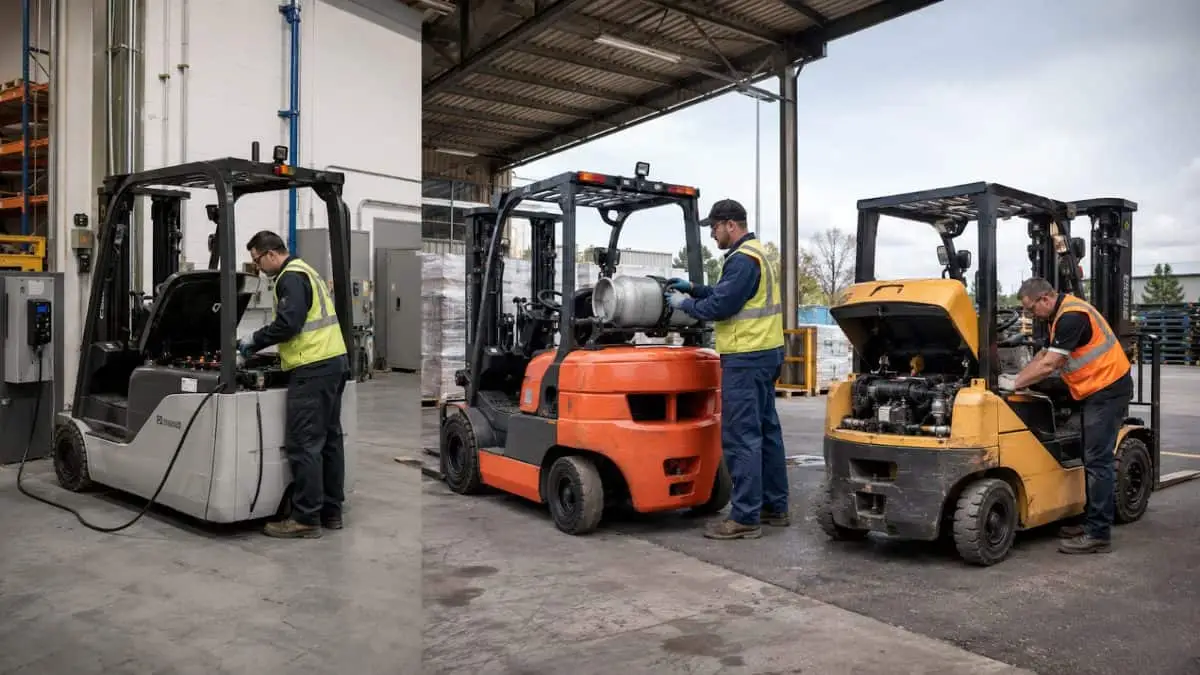
The general inspection applies to every forklift, but the power system requires additional checks.
| Electric Forklift | LPG Forklift | Diesel Forklift |
|---|---|---|
| Battery charge level | LPG cylinder condition | Engine oil level |
| Battery security | Cylinder mounting | Coolant level |
| Cable condition | Retaining straps or brackets | Fuel level |
| Connector damage | Hose and connection condition | Fuel or oil leaks |
| Corrosion | Signs or smell of leakage | Belts and hoses |
| Electrolyte level where applicable | Correct cylinder orientation | Exhaust condition |
| Charger disconnected and stored | Valve condition | Cold-start behaviour |
| Vent caps secure where applicable | Ventilation around the machine | Warning indicators |
Electric Forklift Checks
Before use, inspect:
- Battery cables
- Connectors
- Retaining system
- Visible corrosion
- Battery compartment
- Charge level
- Electrolyte level where the battery design requires operator checks
- Signs of overheating
- Charger disconnection
Only trained and authorised people should maintain, charge or water industrial batteries. Refer to the forklift battery watering guide for the correct precautions and timing.
LPG Forklift Checks
Check that:
- The cylinder is secured correctly.
- The valve and connection appear undamaged.
- Hoses are not cracked or rubbing.
- There is no obvious LPG odour.
- The cylinder is positioned as specified.
- The surrounding area is suitably ventilated.
- There is no frost or damage around the connection.
Do not start the forklift when a leak is suspected. Shut the system down according to workplace procedures, keep ignition sources away and report the fault.
Diesel Forklift Checks
Inspect:
- Engine oil
- Coolant
- Fuel
- Belts
- Hoses
- Visible leaks
- Exhaust
- Warning lights
Check fluid levels only as directed by the manufacturer. Do not remove a hot cooling-system cap.
What to Do When You Find a Fault
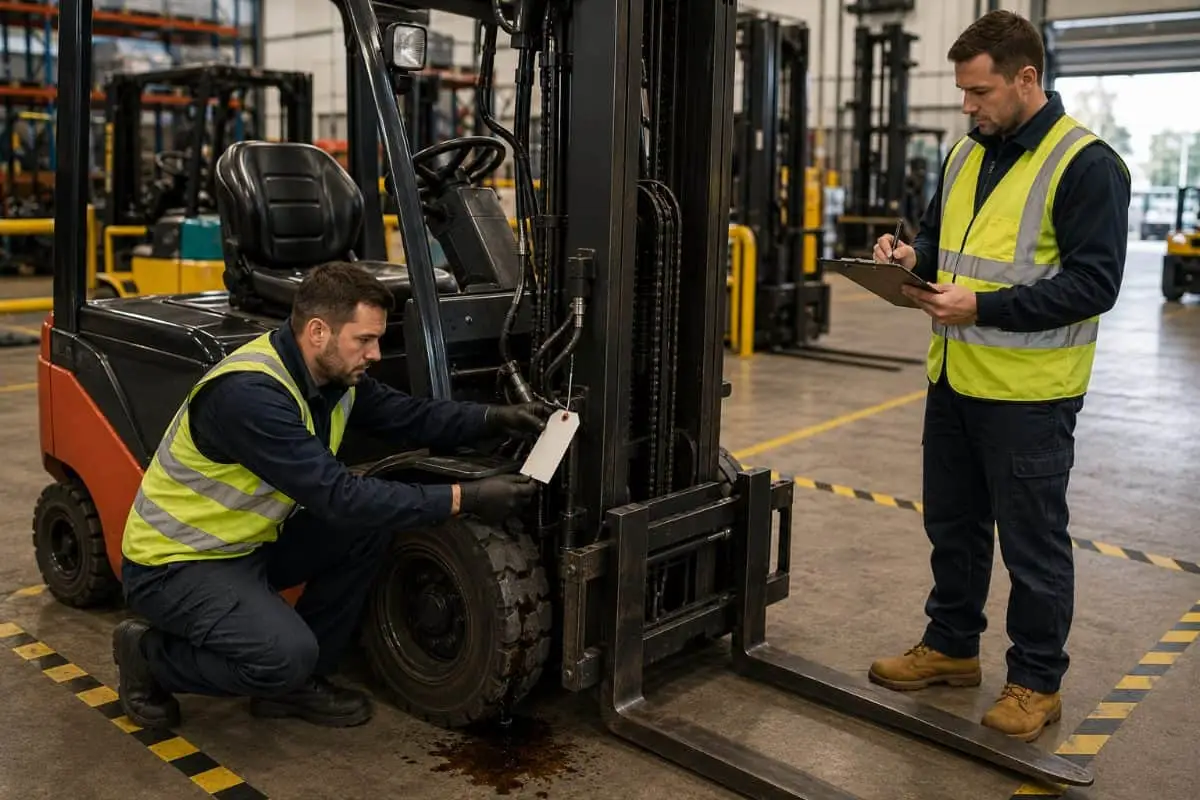
A checklist is ineffective when operators identify defects but continue using the forklift.
1. Stop the Inspection or Operation
Do not start or continue operating the forklift when the defect could affect safe use.
2. Lower the Forks and Secure the Machine
Where safe to do so:
- Park in an approved location.
- Lower the forks or attachment.
- Select neutral.
- Apply the parking brake.
- Switch off the power.
- Remove the key or isolate the energy source.
3. Tag or Lock Out the Forklift
Follow the workplace isolation procedure so another operator cannot use the machine.
WorkSafe Victoria recommends having a system to lock a forklift or attachment out of service when a defect makes it unsafe.
4. Report the Fault
Notify the supervisor, manager or maintenance contact.
Provide:
- Forklift identification
- Date and time
- Your name
- Fault location
- Symptoms observed
- Warning lights or sounds
- Whether the machine was operating
- Any recent impact or incident
5. Record the Defect
Enter the fault in the checklist, logbook or maintenance system.
Avoid vague descriptions such as “not working properly”. Record what happened, such as:
Service brake pedal travelled unusually far and the forklift pulled left during a low-speed test.
6. Do Not Return It to Service Without Clearance
A competent person should assess and repair the forklift. It should be returned to use only after the workplace’s clearance procedure has been completed.
Operators should not:
- Bypass safety systems
- Disconnect warning lights
- Repair hydraulic components
- Alter brakes
- Modify attachments
- Remove lockout tags without authority
How Often Should Forklifts Be Inspected?
Complete a pre-operation inspection:
- At the start of each shift
- Before the forklift’s first daily use
- When the operator changes
- After an impact or unusual event where workplace procedures require another check
- After maintenance where a return-to-service check is required
These timings align with current WorkSafe Victoria guidance.
A daily check does not replace:
- Scheduled maintenance
- Routine technician inspections
- Major inspections
- Attachment inspections
- Repairs
- Manufacturer-specified servicing
Keeping Forklift Inspection Records
The record can be paper-based or digital, provided it is clear, accessible and consistently used.
Include:
- Date
- Time or shift
- Forklift identification
- Hour-meter reading
- Operator name
- Checklist results
- Defects found
- Fault report reference
- Lockout status
- Repair details
- Return-to-service authorisation
WorkSafe Victoria advises that inspection and maintenance records should identify what was inspected, maintenance completed, defects found and rectification work, including matters requiring follow-up.
Supervisors should review records for repeated defects. Several reports of steering play, low battery runtime or hydraulic seepage may indicate a developing issue even when the forklift remains operational.
Daily Pre-Operational Check vs Pre-Purchase Inspection
These inspections have different purposes.
| Inspection | Daily Pre-Operational Check | Pre-Purchase Inspection |
|---|---|---|
| Main purpose | Confirm the forklift appears safe for the shift | Assess condition, suitability and buying risk |
| Frequency | Every shift, first daily use and operator change | Before purchasing a particular machine |
| Completed by | Trained operator under workplace procedures | Buyer and preferably a competent forklift technician |
| Main focus | Visible faults and operating functions | Service history, remaining condition, value and hidden defects |
| Loaded test | Only where required by the workplace procedure | Commonly part of a controlled technical assessment |
| Result | Use, report or isolate | Buy, renegotiate or reject |
The pre-operational check is not detailed enough for assessing a second-hand purchase. Before buying, complete a separate used forklift pre-purchase inspection.
Frequently Asked Questions
1. Is a Forklift Pre-Start Check Required Every Day?
A pre-operation inspection should be completed at the start of each shift, before first daily use and whenever the operator changes, following the manufacturer’s recommendations and workplace procedures.
2. Who Should Complete the Forklift Inspection?
The operator who will use the forklift normally completes the pre-start inspection. The operator should be trained in the specific machine, inspection process, fault reporting procedure and controls they are authorised to test.
3. Can You Use a Forklift With a Minor Defect?
That depends on the defect and the workplace’s assessment procedure. Operators should not make an informal decision that a safety-related defect is minor. Report it and obtain clearance from an authorised or competent person before use.
4. What Should Be Checked on Forklift Brakes?
Check pedal response, stopping performance, straight-line braking, unusual noises and the parking brake’s ability to hold the machine. Conduct tests at low speed in a designated area free from pedestrians and obstructions.
5. Should Forklift Attachments Be Inspected Daily?
Yes. WorkSafe Victoria advises that attachments form part of the daily pre-operational inspection. Check their condition, security, hydraulic connections and compatibility with the forklift’s information plate.
6. Do You Need a Forklift Licence to Complete a Pre-Start Check?
A person should not operate forklift controls unless appropriately licensed, trained, authorised or directly supervised under an applicable training arrangement. The Australian forklift licensing guide explains the main licensing pathway and operator responsibilities.
Conclusion
A forklift pre-operational inspection should be completed before the machine enters an active work area. Start with parked checks covering the tyres, forks, mast, chains, hydraulics, restraints, capacity plate and power system. Then test the steering, brakes, controls, alarms and safety devices in a controlled area.
Record the result and report every defect. When a fault could affect safe operation, lower the forks, isolate the forklift and keep it out of service until an authorised person confirms that it is safe to use.