
Used Forklift Inspection Checklist: 14 Steps Before You Buy
· Updated
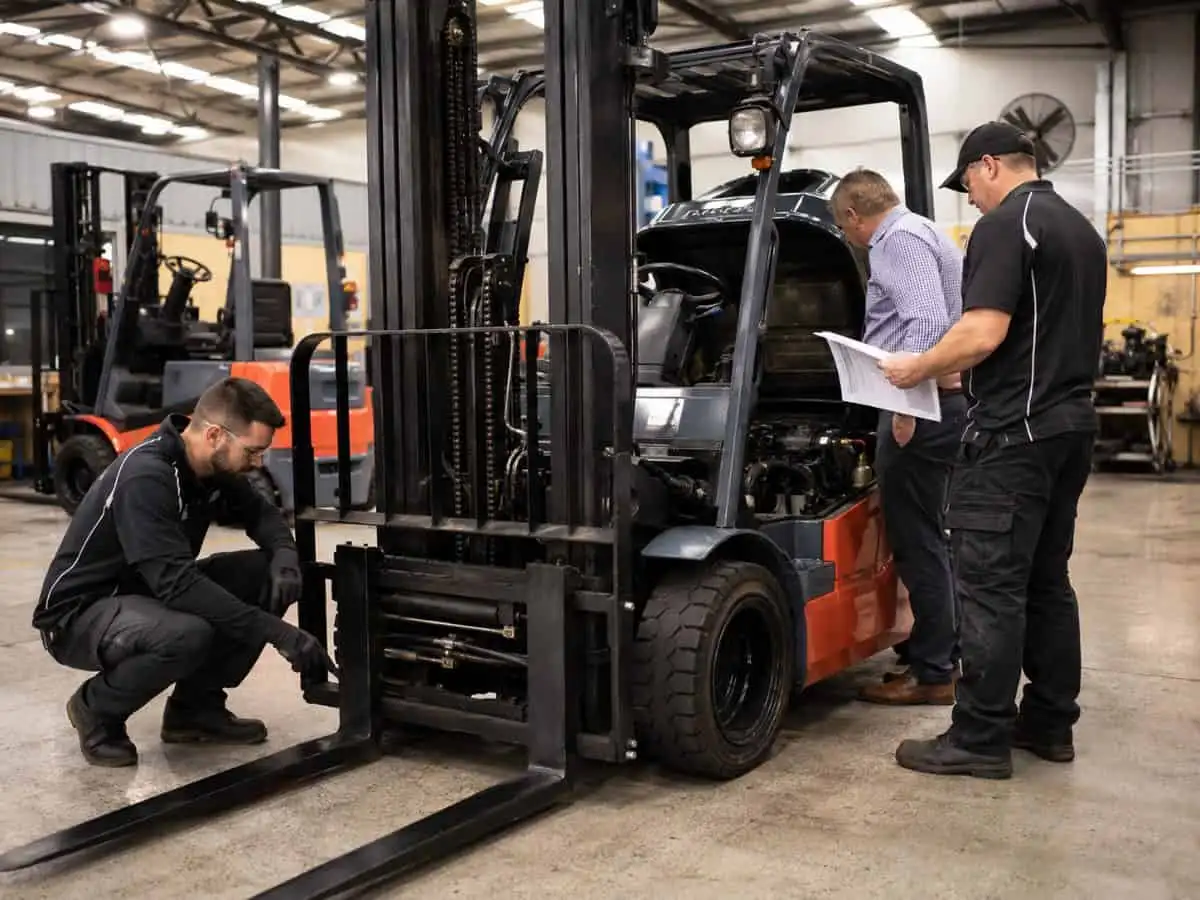
A used forklift inspection should confirm that the machine suits your loads, operates safely and does not have hidden structural, mechanical or electrical problems. Start with the capacity plate, service records, brakes, mast, forks, hydraulic system and power source, then complete a controlled test drive and loaded function test.
Do not judge a second-hand forklift by its paintwork or hour meter alone. A lower-hour machine with poor maintenance can present more risk than an older forklift with complete records and evidence of regular servicing.
WorkSafe Victoria recommends reviewing a second-hand forklift’s maintenance, inspection and use history before purchase. It should then be inspected and serviced before being placed into operation.
How to Inspect a Used Forklift Before You Buy
The most important part of a used forklift inspection is confirming that the machine is structurally sound, correctly rated and safe under load. Check the records and information plate first, inspect the mast and forks closely, test the brakes and steering, look for leaks, and assess the engine or battery condition.
Check these five areas before spending time negotiating:
- Capacity plate: Confirm it is present, legible and matches the mast and attachments.
- Service history: Look for regular maintenance, previous repairs and unresolved defects.
- Mast and forks: Check for cracks, distortion, excessive wear and uneven movement.
- Brakes and steering: Test both systems in a controlled area before considering the sale.
- Hydraulics and power system: Look for leaks, unusual sounds, weak lifting or poor battery performance.
The inspection must also confirm that the forklift is appropriate for your site. Load weight, lift height, aisle width, surface conditions, fuel type and attachments should be established before assessing available stock.
Buyers still deciding between equipment options should first review the differences between used and new forklifts.
Used Forklift Inspection Checklist: 14 Steps
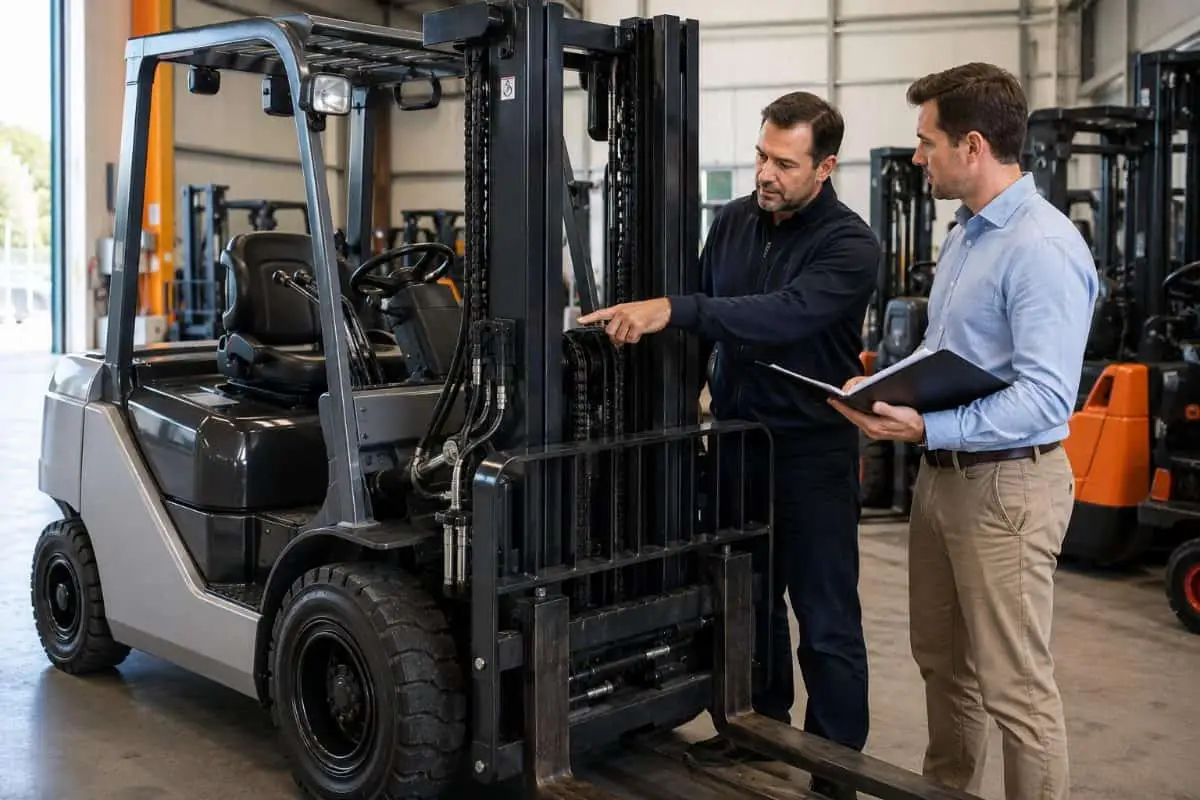
The following forklift pre-purchase inspection covers the documents, structural components, controls and operating systems that should be assessed before buying.
1. Confirm the Forklift Matches Your Application
Start by defining what the forklift must do.
Record:
- Maximum load weight
- Load dimensions
- Load centre
- Required lift height
- Lowest overhead clearance
- Aisle width
- Indoor or outdoor operation
- Surface condition
- Expected daily operating hours
- Required attachments
- Fuel or battery preferences
A forklift that is mechanically sound can still be the wrong purchase when its capacity, mast or power source does not suit the workplace.
WorkSafe Victoria advises buyers to assess the task, operating environment, load characteristics, lift height, attachments and workplace conditions before selecting either new or second-hand equipment.
Fail signal: The seller cannot confirm the rated capacity, lift height or suitability for your intended application.
2. Inspect the Capacity and Information Plates
The forklift should have a legible information plate showing its rated capacity and configuration.
Check that it identifies:
- Manufacturer
- Model
- Serial number
- Rated capacity
- Load centre
- Maximum lift height
- Mast configuration
- Attachments where applicable
An attachment can reduce the forklift’s available lifting capacity. WorkSafe Victoria notes that when an attachment is fitted, the supplier should amend the information plate or provide a supplementary plate reflecting the revised rating.
Compare the plate details with the physical machine. A plate for a standard carriage should not be relied upon when the forklift has an unlisted clamp, rotator or other attachment installed.
Fail signal: Missing, unreadable, altered or mismatched information plates.
3. Check the Serial Number and Ownership Records
Confirm that the serial number on the forklift matches:
- Sales documents
- Service records
- Warranty information
- Inspection reports
- Finance or ownership documentation
Ask whether the machine has previously been:
- Written off
- Rebuilt
- Used in corrosive conditions
- Operated in cold storage
- Used near saltwater
- Involved in a collision
- Modified from its original configuration
Be cautious when buying a forklift online without first verifying its identity and condition.
Fail signal: Conflicting serial numbers, unexplained ownership gaps or missing machine records.
4. Review the Hour Meter
The hour meter provides useful context, but it does not prove the forklift’s condition.
Check whether the reading appears consistent with wear on the:
- Seat
- Pedals
- Steering wheel
- Control levers
- Fork carriage
- Tyres
- Entry step
- Paint around contact areas
Ask whether the recorded hours represent:
- Light intermittent use
- Continuous single-shift use
- Multi-shift operation
- Long periods of idling
- Demanding outdoor work
A higher-hour forklift with complete servicing may be a better purchase than a lower-hour unit that has been neglected. Read more about what hours and age mean for forklift lifespan.
Fail signal: Very low displayed hours combined with extensive wear, damaged meter seals or records that do not match the reading.
5. Examine the Frame and Chassis
Inspect the forklift from several angles in good lighting.
Look for:
- Cracked welds
- Distorted steel
- Fresh paint over repair areas
- Corrosion
- Impact damage
- Missing panels
- Damaged overhead guard sections
- Loose counterweight fixings
- Repairs around the mast mounting points
- Oil or coolant beneath the machine
Minor cosmetic scratches are common on used equipment. Structural distortion, fatigue cracking and poorly completed repairs are more serious.
WorkSafe Victoria identifies structural defects, including fatigue cracking, as one of the potential costs involved in bringing a second-hand forklift into serviceable condition.
Fail signal: Cracks, bent structural sections, questionable weld repairs or evidence of a major collision.
6. Inspect the Forks and Carriage
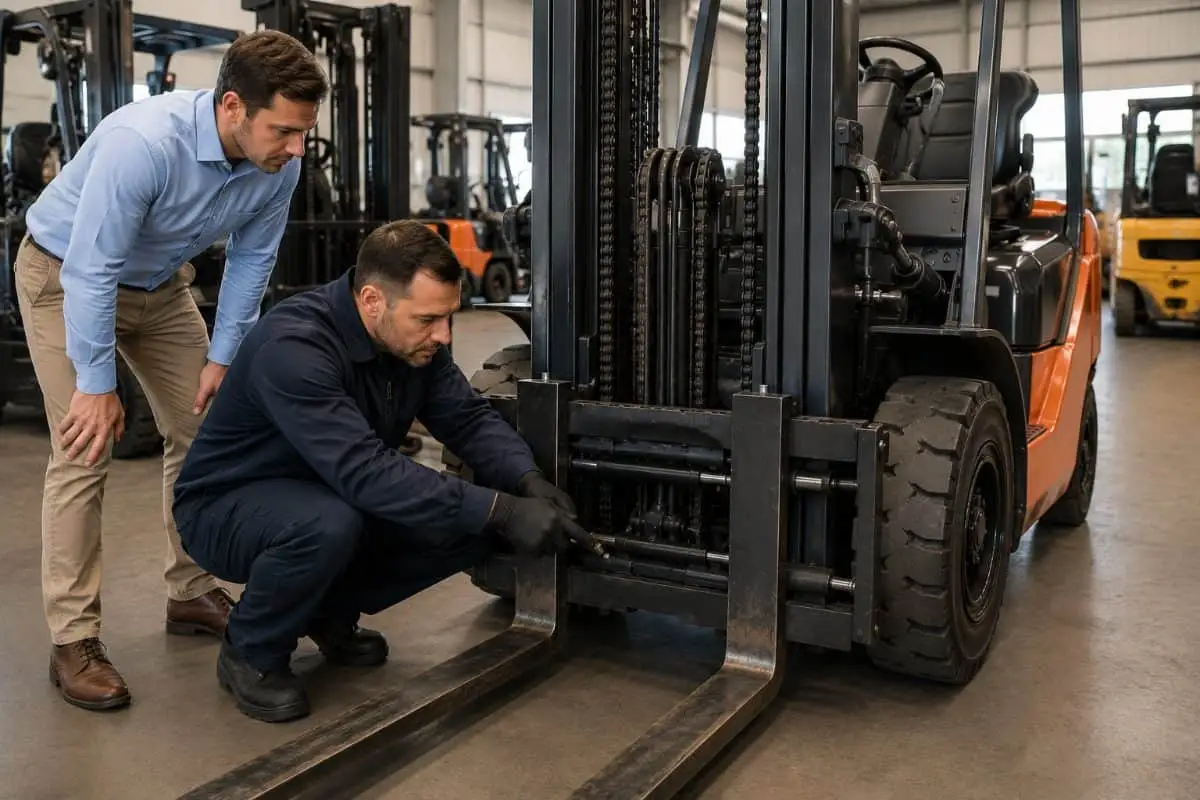
Lower the forks onto a clear surface and inspect both arms.
Check for:
- Bent or twisted blades
- Unequal fork height
- Cracks around the heel
- Excessive wear
- Damaged tips
- Worn or missing locking pins
- Poor attachment to the carriage
- Side-to-side movement
- Damaged carriage rollers
- Evidence of heating or unauthorised welding
Both forks should appear evenly matched. Manufacturer specifications and a competent technician should be used to determine whether wear remains within the permitted limits.
Do not accept forks that have been straightened, welded or modified without appropriate engineering approval.
Fail signal: Cracked heels, bent blades, mismatched forks or insecure locking mechanisms.
7. Inspect the Mast and Lift Chains
Check the mast channels, rollers, chains, anchors and carriage through their full visible length.
Look for:
- Bent mast rails
- Cracked welds
- Uneven chain tension
- Corrosion
- Damaged links
- Poor lubrication
- Loose anchors
- Excessive side movement
- Worn rollers
- Binding during lifting
- Jerky carriage movement
Raise and lower the mast without a load, listening for grinding, knocking or scraping. Where safe and properly supervised, repeat the test using an appropriate load.
The mast should lift smoothly, remain stable and hold its position without creeping down unexpectedly.
Fail signal: Cracks, heavy chain wear, uneven lifting, uncontrolled lowering or substantial movement between mast sections.
8. Check the Hydraulic System
Inspect the hydraulic cylinders, hoses, fittings, pump area and visible seals.
Look for:
- Wet hoses
- Oil around fittings
- Damaged hose coverings
- Cracked or flattened lines
- Pitted cylinder rods
- Leaking seals
- Low fluid levels
- Contaminated oil
- Slow or noisy lifting
- Mast drift
Operate each hydraulic function separately:
- Lift
- Lower
- Tilt forward
- Tilt backwards
- Side shift
- Attachment controls
The movement should be controlled and consistent. A forklift that lifts slowly or struggles under an appropriate load may have a pump, valve, cylinder or power-system problem.
Fail signal: Active leaks, damaged hoses, weak lift performance or hydraulic functions that move unpredictably.
9. Inspect the Tyres and Wheels
The correct tyre type depends on the operating environment.
Check each tyre for:
- Uneven wear
- Chunking
- Cuts
- Flat spots
- Separation
- Embedded debris
- Damage near the rim
- Incorrect tyre combinations
- Low pressure on pneumatic tyres
- Missing or loose wheel nuts
Solid tyres may suit debris-prone industrial floors, while pneumatic tyres may provide better cushioning on rough outdoor surfaces. The machine should not have unsuitable or mismatched tyres simply because replacements were available.
Uneven tyre wear may indicate:
- Steering problems
- Axle issues
- Poor alignment
- Repeated overloading
- Operation on unsuitable surfaces
Fail signal: Tyres worn beyond their service limits, exposed damage, major flat spots or mismatched tyre specifications.
10. Test the Service Brake and Park Brake
Brake inspection is one of the most important safety checks.
Test:
- Pedal travel
- Pedal firmness
- Stopping response
- Straight-line braking
- Park brake holding ability
- Warning lights
- Unusual noises
- Fluid leaks
- Response on a slight controlled grade
The Safe Work Australia industrial lift truck guidance includes steering, service brakes and park brakes among the operating systems that should be checked. (Safe Work Australia)
Do not test brakes in an uncontrolled yard, near pedestrians or with an unsuitable load.
Fail signal: Excessive pedal travel, pulling to one side, weak stopping, grinding noises or a park brake that does not hold.
11. Check the Steering and Drive System
Drive the forklift slowly in a controlled area.
Check:
- Forward and reverse engagement
- Steering response
- Steering free play
- Unusual vibration
- Transmission delay
- Sudden gear engagement
- Clicking during turns
- Axle noises
- Directional control
- Smooth acceleration
- Stability during manoeuvres
Complete several gentle turns in both directions. The steering should respond consistently without excessive effort or delay.
For internal-combustion models, inspect the transmission fluid where accessible and note any burning smell or discolouration.
Fail signal: Delayed direction changes, severe vibration, heavy steering, transmission slipping or loud mechanical noises.
12. Inspect the Engine, LPG System or Battery
The required checks depend on the power source.
Diesel and LPG Forklifts
Check:
- Cold-start behaviour
- Exhaust smoke
- Engine noise
- Oil condition
- Coolant condition
- Fuel leaks
- Cooling system
- Belts and hoses
- LPG cylinder mounting
- Connections and fuel lines
- Engine warning lights
- Excessive vibration
Ask the seller not to warm the machine before your arrival. A cold start can reveal problems that are less obvious after the engine has been running.
Electric Forklifts
Check:
- Battery age
- Battery type
- Charge history
- Charger compatibility
- Corrosion
- Cable condition
- Connector damage
- Electrolyte levels where applicable
- Cell condition
- Runtime under load
- Battery test results
A visual inspection cannot confirm an industrial battery’s remaining capacity. Request a professional battery test and confirm whether the charger is included.
The used electric forklift buying guide covers additional checks for batteries, chargers and electric drive systems.
Fail signal: Heavy smoke, persistent warning lights, major leaks, damaged battery cells or a seller unwilling to provide power-system test results.
13. Check the Controls and Safety Equipment
Inspect and operate the:
- Horn
- Lights
- Reverse alarm
- Warning beacon
- Mirrors
- Direction controls
- Lift controls
- Emergency disconnect
- Seatbelt
- Operator-presence system
- Parking brake warning
- Battery indicator or fuel gauge
- Dashboard warning lights
- Speed controls where fitted
Check that the overhead guard is secure and the seat, restraint and entry points are in serviceable condition.
WorkSafe Victoria advises that required safety features should be considered when buying a forklift and notes that second-hand machines may require replacement seats, restraints, information plates or updated safety features.
Do not assume a warning device works because it is physically present.
Fail signal: Inoperative restraints, warning systems, controls or operator-presence features.
14. Complete a Test Drive and Loaded Function Test
A forklift may appear satisfactory while stationary but reveal faults once driven and placed under load.
Complete the test in a controlled area with an authorised operator and a suitable load.
Test:
- Cold start
- Forward travel
- Reverse travel
- Steering
- Service brake
- Park brake
- Mast lift
- Controlled lowering
- Tilt
- Side shift
- Attachment operation
- Load holding
- Acceleration
- Operation on a slight grade where appropriate
- Battery runtime or engine temperature
The forklift should remain stable and responsive without leaks, slipping, unusual noises or warning lights.
A buyer who is not technically qualified should arrange an independent inspection by a competent forklift technician.
Fail signal: The seller refuses a proper test, restricts access to the machine or will not allow inspection by an independent technician.
How to Inspect the Brakes Before Buying
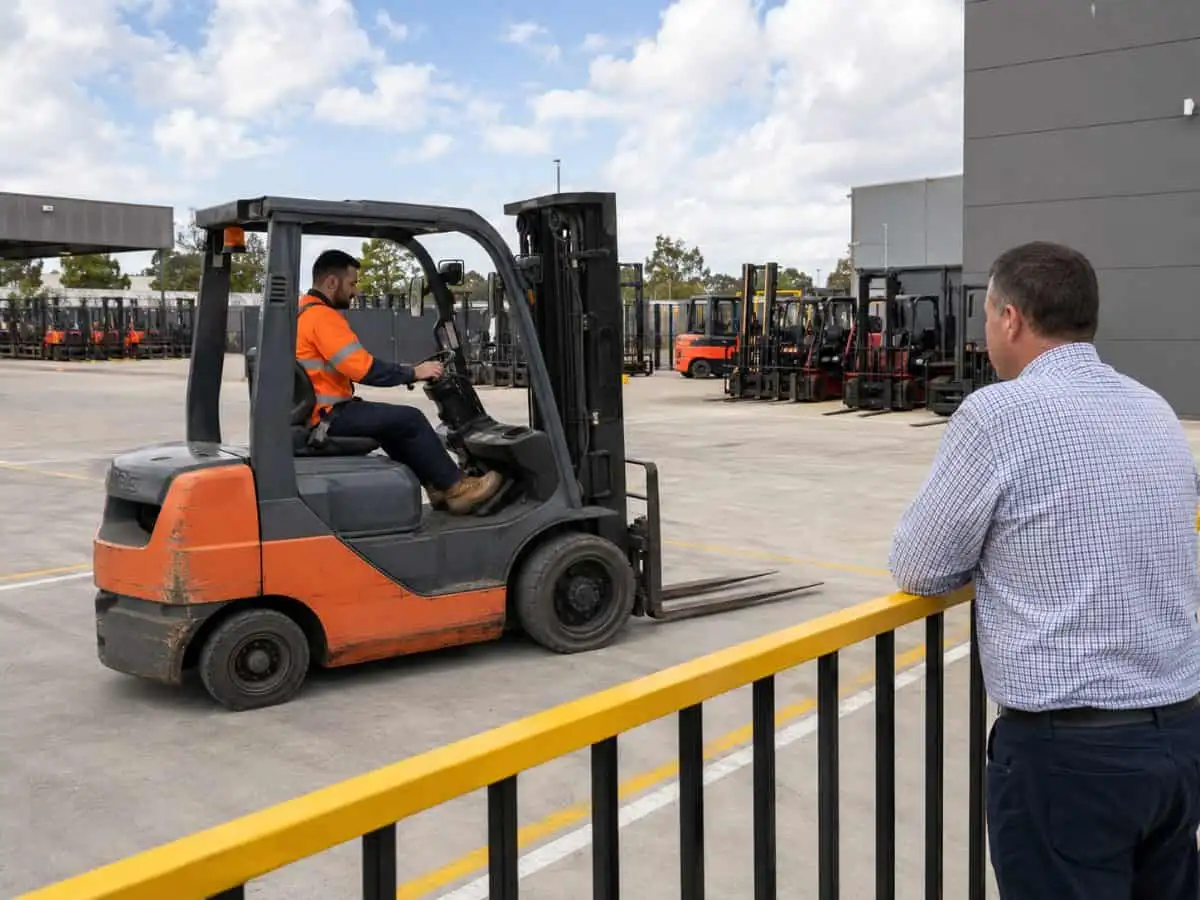
Brake faults should be treated as major safety issues rather than minor bargaining points.
Check the Brake Pedal
The pedal should feel firm and respond consistently.
Watch for:
- Excessive travel
- Spongy resistance
- Delayed braking
- Pedal sinking while held
- Different response between repeated stops
A soft pedal may indicate air, fluid loss or another fault requiring diagnosis.
Test Straight-Line Braking
At low speed in a clear test area, apply the service brake smoothly.
The forklift should:
- Stop predictably
- Remain straight
- Avoid severe vibration
- Avoid pulling to one side
- Produce no grinding or knocking sounds
Test the Park Brake
On a slight controlled grade, confirm that the parking brake holds the stationary forklift without movement.
Do not conduct this test on a steep slope, near an edge or with pedestrians nearby.
Check for Leaks and Damage
Inspect around:
- Brake lines
- Hoses
- Master cylinder
- Wheel areas
- Pedal mechanisms
- Park brake linkages
Do not buy a forklift for immediate use when its brakes are defective. It should remain out of service until assessed and repaired by a competent technician.
Key Features and Specifications to Prioritise
Condition alone does not determine whether a forklift is suitable. Its configuration must fit your work.
| Feature | What to Confirm | Why It Matters |
|---|---|---|
| Rated capacity | Load weight and load centre | Prevents unsafe overloading |
| Residual capacity | Capacity at the required height with attachments | Attachments and mast height can reduce usable capacity |
| Mast type | Duplex, triplex or another configuration | Affects lift height and collapsed height |
| Free lift | Carriage movement before mast extension | Important beneath low roofs and inside containers |
| Fork length | Ability to support the intended load | Short forks may not support the load correctly |
| Tyres | Solid, pneumatic or non-marking | Must suit the surface and environment |
| Power source | Electric, LPG or diesel | Affects emissions, ventilation and operating conditions |
| Attachments | Compatibility and rated configuration | Changes load handling and capacity |
| Dimensions | Height, width and turning radius | Must suit doors, aisles and work areas |
| Safety features | Restraint, warning devices and visibility aids | Helps control operating risks |
| Parts support | Local service and replacement components | Reduces repair delays |
| Charger | Correct voltage and battery compatibility | Essential for electric models |
Investigating reliable used forklift brands can help identify machines with suitable parts and service support.
How to Read Hours, Age and Service History
A forklift’s condition cannot be reduced to one number.
| Indicator | What It May Suggest |
|---|---|
| High hours with complete records | Intensive use but potentially consistent maintenance |
| Low hours with heavy wear | Meter inconsistency or harsh previous use |
| Long periods between services | Increased risk of neglected faults |
| Repeated hydraulic repairs | Possible recurring system problems |
| Several battery replacements | Intensive electric-forklift use |
| Regular tyre replacement | High utilisation or demanding surfaces |
| Missing recent records | Unknown current condition |
| Major component replacement | Potential benefit if documented and completed properly |
| Fresh paint without repair records | Cosmetic preparation may be hiding damage |
| Consistent annual servicing | Better evidence of planned maintenance |
Service Records to Request
Ask for:
- Scheduled service invoices
- Inspection reports
- Previous defect lists
- Repair invoices
- Battery reports
- Major component replacements
- Tyre replacement dates
- Attachment inspections
- Safety-system repairs
- Current warranty documents
WorkSafe Victoria states that inspection and maintenance records should identify what required inspection, what was checked, maintenance completed, defects found and rectification work.
How Age Affects the Decision
Age may influence:
- Parts availability
- Emissions
- Safety features
- Energy efficiency
- Battery technology
- Resale value
- Compatibility with current attachments
Age is not automatically a reason to reject a forklift. It becomes more important when combined with high utilisation, missing records and limited parts support.
Avoid focusing on the advertised price while overlooking common forklift buying mistakes.
Red Flags That Should Stop the Sale
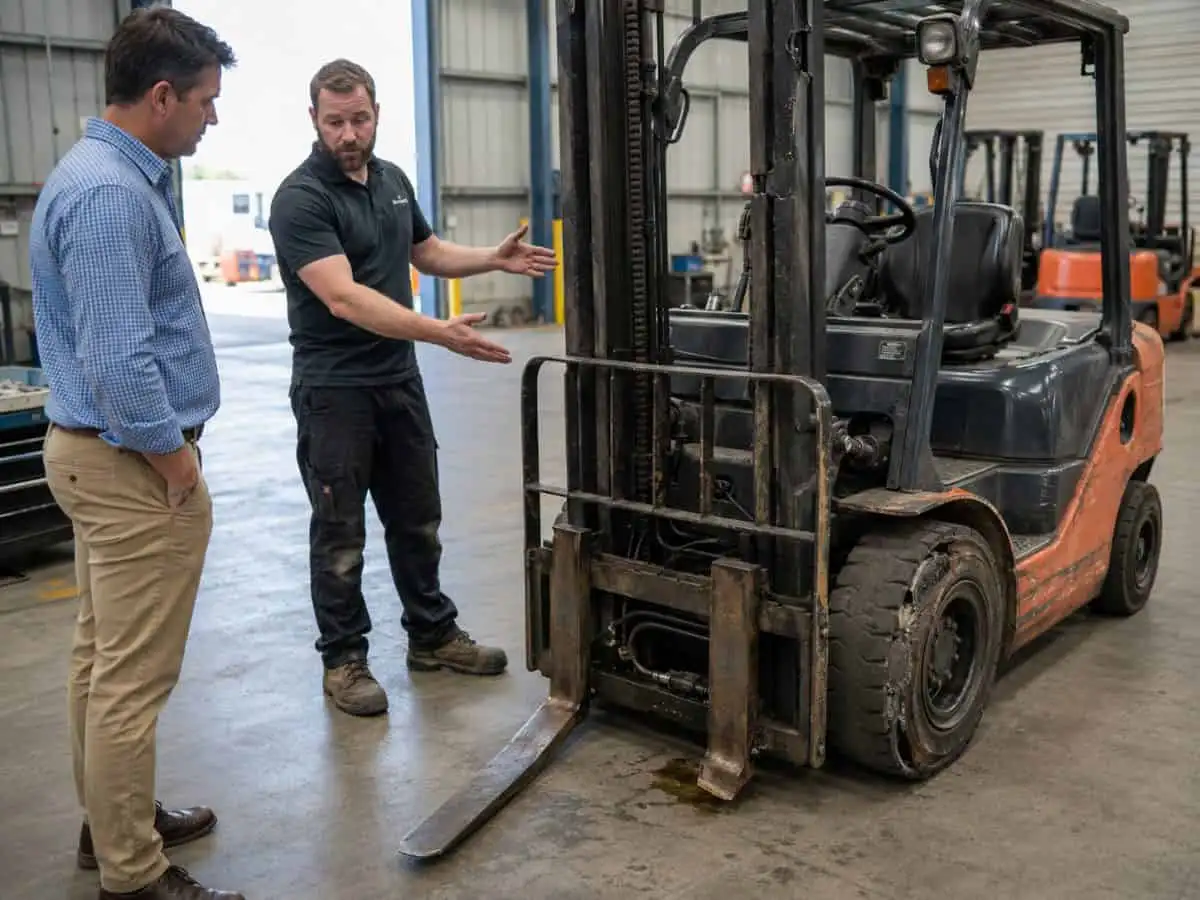
Some issues may justify renegotiation. Others should stop the purchase until the forklift is professionally assessed and repaired.
| Red Flag | Why It Matters | Recommended Action |
|---|---|---|
| Missing capacity plate | Safe rated capacity cannot be confirmed | Stop and request correct documentation |
| Cracked mast or frame | Potential structural failure | Walk away or require engineering assessment |
| Bent or cracked forks | Load-support failure risk | Do not use until replaced and assessed |
| Heavy chain damage | May affect lifting and load control | Require technician assessment |
| Brake failure | Immediate operating risk | Stop the sale for use in current condition |
| Major hydraulic leaks | Loss of control and repair exposure | Obtain repair diagnosis and quotation |
| Mismatched serial numbers | Ownership or history uncertainty | Do not proceed until resolved |
| Altered hour meter | Remaining-life assessment becomes unreliable | Investigate records or walk away |
| Severe battery corrosion | May indicate expensive battery replacement | Obtain a professional battery report |
| Heavy exhaust smoke | Potential engine or combustion fault | Arrange mechanical diagnosis |
| Unauthorised modifications | Capacity and compliance may be affected | Require engineering and plate verification |
| Refusal of a test drive | Faults may be intentionally concealed | Walk away |
| No service history | Condition and maintenance are difficult to verify | Price the risk or choose another machine |
| Active warning lights | Unresolved electrical or mechanical fault | Diagnose before purchase |
A clean appearance should never outweigh serious faults or missing documentation.
Professionally prepared and inspected pre-owned forklifts in Melbourne may reduce some uncertainty, but buyers should still confirm the condition, specification and written purchase terms.
Used Forklift Inspection vs Daily Pre-Operational Check
A pre-purchase inspection and a daily pre-operational check serve different purposes.
| Inspection Type | Purpose | When It Happens |
|---|---|---|
| Pre-purchase inspection | Assesses condition, suitability, history and financial risk before buying | Once before purchase |
| Daily pre-operational check | Confirms the owned forklift appears safe before being used | Before daily use, at shift start or when operators change |
A pre-purchase inspection is broader. It considers the forklift’s remaining value, repair exposure, configuration, service history and condition under load.
A daily check focuses on whether the forklift is safe to operate for the coming shift. WorkSafe Victoria recommends completing a pre-operation inspection according to the manufacturer’s instructions at the start of each shift, before first daily use and when the operator changes.
Once the purchase is complete, operators should follow a separate daily forklift pre-operational inspection.
Used Forklift Pre-Purchase Checklist
Use this condensed list while viewing a machine:
- ☐ Confirm the required capacity and lift height
- ☐ Match the model and serial number to the records
- ☐ Check the capacity and attachment plates
- ☐ Review the hour meter and wear
- ☐ Read the service and repair history
- ☐ Inspect the frame and chassis
- ☐ Check the forks, carriage, mast and chains
- ☐ Inspect hydraulic hoses, cylinders and leaks
- ☐ Check tyres, wheels and wheel nuts
- ☐ Test service and parking brakes
- ☐ Test steering and directional controls
- ☐ Inspect the engine, LPG system or battery
- ☐ Check restraints, warnings and safety equipment
- ☐ Complete a controlled test drive and loaded test
Frequently Asked Questions
1. What Is the Most Important Check When Buying a Used Forklift?
The most important checks are the structural condition of the mast and forks, the braking system and the capacity plate. Serious defects in these areas can affect the forklift’s ability to lift, hold and stop safely. They should be assessed before price negotiations.
2. Should a Mechanic Inspect a Used Forklift Before Purchase?
A competent forklift technician should inspect the machine when the buyer does not have the technical knowledge to assess its structural, hydraulic, mechanical or electrical condition. A general vehicle mechanic may not have the specialist knowledge required for forklift masts, chains, attachments and industrial batteries.
3. How Many Hours Are Too Many for a Used Forklift?
There is no universal hour limit. The significance of the reading depends on the model, maintenance history, previous duty cycle, environment and current component condition. Higher hours with complete records may represent less risk than lower hours with evidence of neglect.
4. How Do You Test a Used Electric Forklift Battery?
Request a professional battery capacity or discharge test and review the battery’s age, cell condition, cables, connectors, corrosion and charger compatibility. A voltage reading or dashboard charge indicator alone does not show the battery’s remaining operating capacity.
5. Can You Inspect a Used Forklift Without Driving It?
A stationary inspection is not enough. Steering, brakes, transmission response, hydraulic operation, warning systems and performance under load must be assessed through a controlled function test. Refusal to permit a reasonable test is a significant buying red flag.
6. What Documents Should Come With a Used Forklift?
Request the sales document, model and serial details, information plate, service records, repair history, operator information, attachment documents, warranty terms and battery or charger records where relevant. Confirm that the documents match the specific machine.
Conclusion
A thorough used forklift inspection protects the business from buying unsuitable, unsafe or excessively worn equipment. Check the machine’s identity, capacity, service history and structural condition before testing the brakes, hydraulics, steering, power system and safety features.
Do not rely on paintwork, price or operating hours alone. Complete a controlled loaded test and arrange an independent technician inspection when the machine’s condition is unclear. This is particularly important for private, auction and online purchases where preparation and support may be limited.
Buyers can compare used and new forklift options or review pre-owned forklifts available in Melbourne after establishing the capacity, lift height and configuration their operation requires.