
How to Read a Forklift Load Capacity Chart (Weight Limits Explained)
· Updated
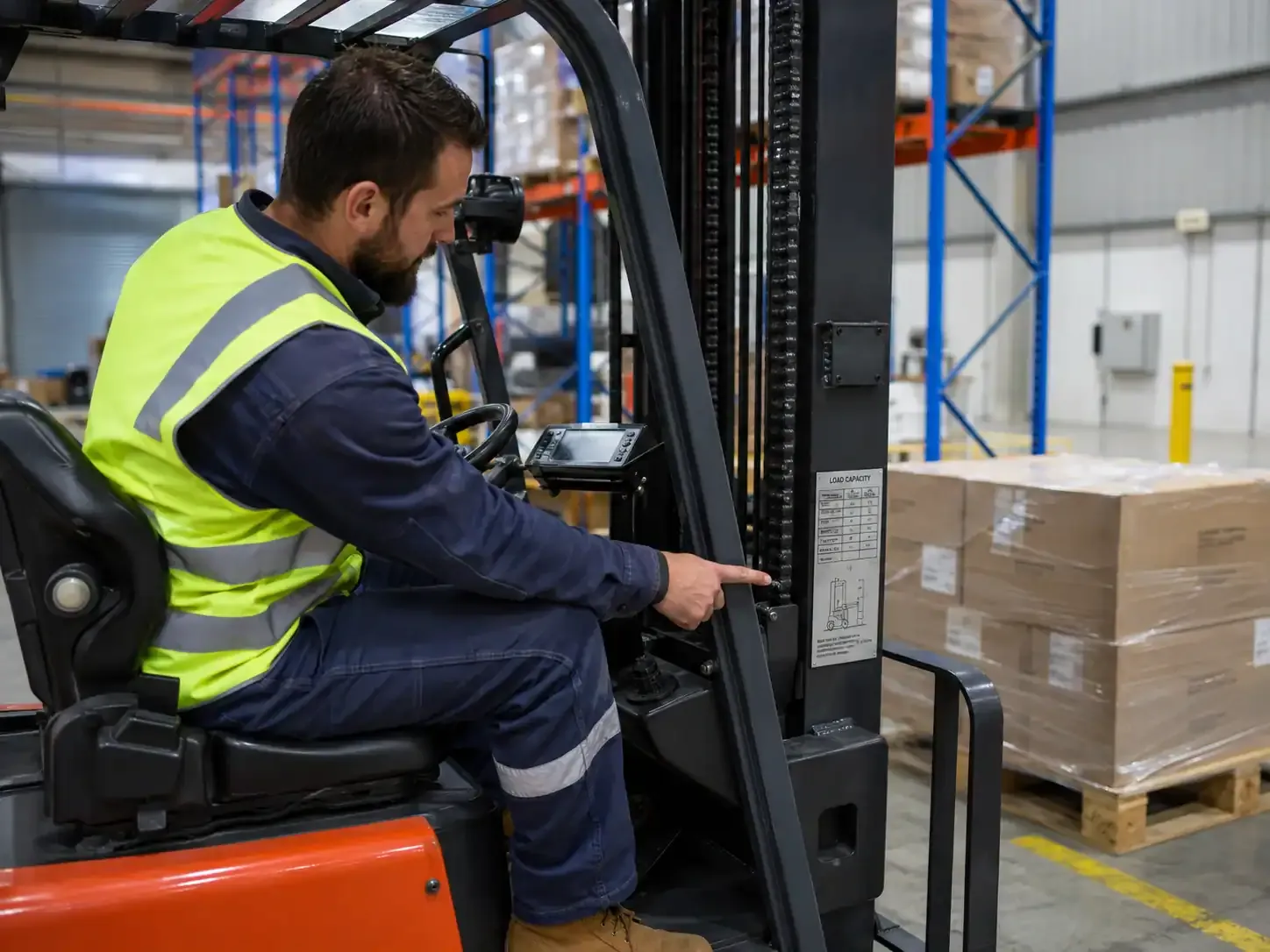
A forklift load capacity chart tells you the maximum load a forklift can safely lift under specific conditions. The stated capacity only applies at the load centre, lift height, mast position and attachment configuration shown on the forklift’s data plate.
That means a forklift rated to lift 2,500 kg cannot necessarily lift every 2,500 kg load. A longer pallet, an off-centre load, a higher lift or an added attachment may reduce its usable capacity significantly.
How to Read a Forklift Load Capacity Chart: The Short Answer
To read a forklift load capacity chart, identify the rated capacity, load centre distance, maximum lift height and approved attachments. Then confirm that the load you intend to lift remains within every limit shown for the forklift’s current configuration.
The main details to check are:
- Rated capacity: The maximum permissible load under the stated conditions.
- Load centre: The horizontal distance from the vertical face of the forks to the load’s centre of gravity.
- Maximum fork height: The height at which the listed capacity applies.
- Attachments: Any side shift, clamp, jib or fork extension included in the rating.
- Mast and tyre configuration: The mast type, tyre type and other specifications used when the capacity was calculated.
Safe Work Australia advises that a forklift’s load chart should show the rated capacity at a stated load centre and maximum lift height. It is critical not to exceed the rating shown for the forklift or attachment.
The one-line rule: Never lift a load unless its weight, load centre, lift height and attachment configuration are all covered by the forklift’s current capacity plate.
What Is a Forklift Load Capacity Chart?
A forklift load capacity chart is a manufacturer-issued rating that shows how much the machine can lift in a defined configuration. It may be displayed on the main data plate, a separate load chart or a supplementary plate added when an attachment is fitted.
The chart does not give one universal weight limit. It may show several capacities based on variables such as:
- Lift height
- Load centre distance
- Mast type
- Fork length
- Mast tilt
- Attachment type
- Attachment position
- Tyres and counterweight configuration
Safe Work Australia recommends that every industrial lift truck have a manufacturer’s data plate and load chart attached in clear view. WorkSafe Victoria also requires approved attachments and their combined forklift capacity to be recorded on the information or load capacity plate.
What Is on a Forklift Data Plate?
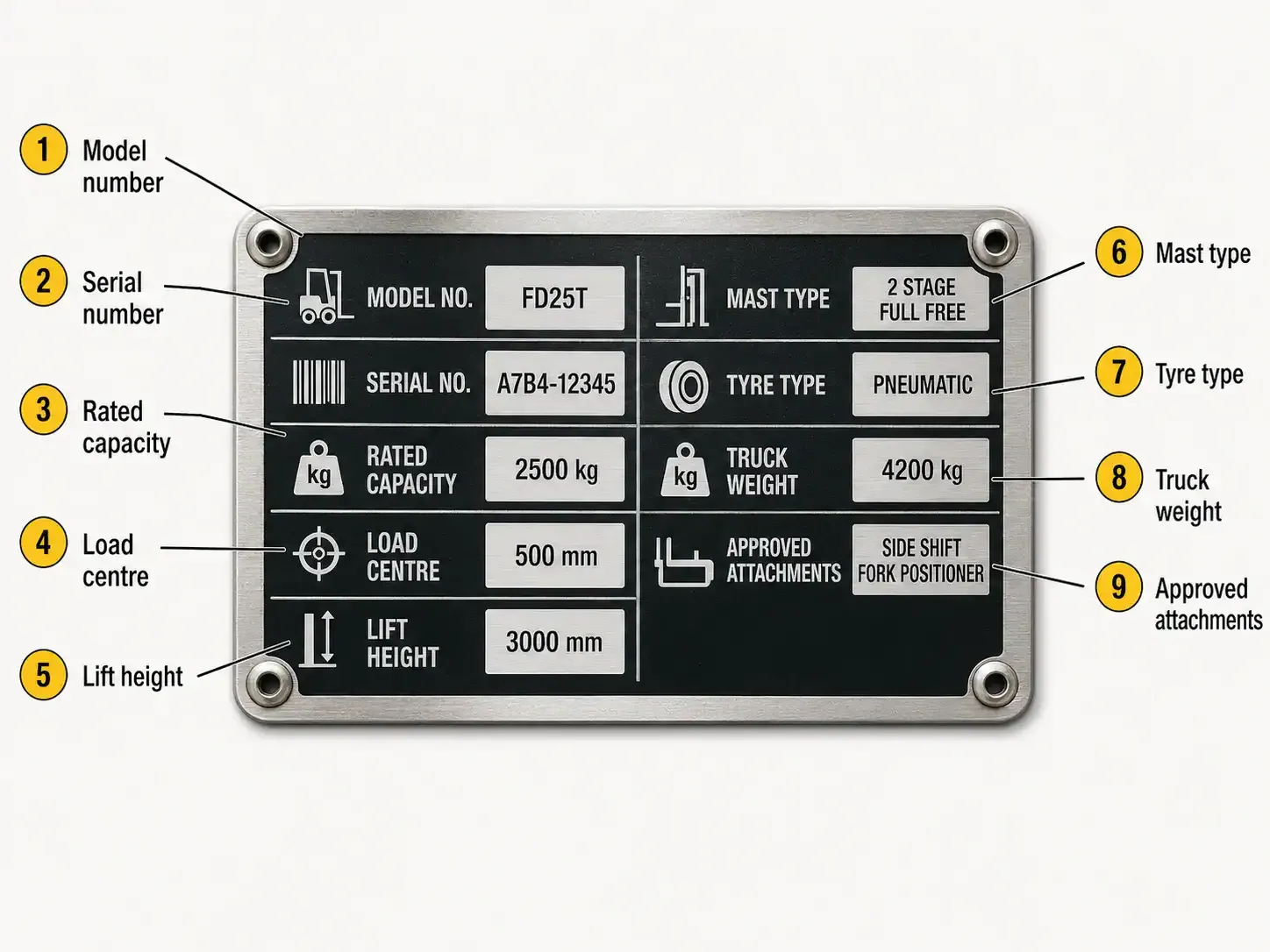
The exact layout varies between manufacturers, but most forklift data plates combine identification details with operating limits.
|
Plate field |
What it means |
|
Model number |
Identifies the forklift model and helps confirm specifications, parts and manuals. |
|
Serial number |
Identifies the individual machine and its manufacturing record. |
|
Rated capacity |
The maximum load permitted under the stated conditions. |
|
Load centre |
The distance from the fork face to the load’s centre of gravity. |
|
Maximum fork height |
The maximum lift height associated with the stated capacity. |
|
Mast type |
Identifies the fitted mast, such as two-stage, three-stage or full free-lift. |
|
Mast tilt |
Shows the permitted forward and backward tilt range. |
|
Approved attachments |
Lists attachments included in the capacity calculation. |
|
Attachment capacity |
Shows the revised capacity when a particular attachment is installed. |
|
Tyre type |
Identifies pneumatic, solid or cushion tyres used in the approved configuration. |
|
Truck mass |
Shows the unloaded forklift weight, which is important for floors, docks and transport. |
|
Fuel type |
Identifies diesel, LPG, petrol or another combustion fuel. |
|
Battery voltage |
Shows the required electrical system voltage on an electric forklift. |
|
Battery weight range |
Shows the approved battery weight, which can affect the forklift’s counterbalance and stability. |
Manufacturer plates may also show front tread, fork dimensions, battery amp-hour ratings and axle loads. The operator manual should explain the exact fields used on that particular model.
Check That the Plate Matches the Machine
Do not assume the original plate still reflects the forklift’s current configuration. Check whether the machine has been modified or fitted with:
- A side shift
- Fork positioner
- Paper roll clamp
- Carton clamp
- Rotator
- Jib
- Drum handler
- Longer forks
- Fork extensions
- Different mast
- Different counterweight or battery
The attachment must be approved for the forklift and included on the plate. WorkSafe Victoria states that an attachment not listed on the information plate must not be used.
The plate should also be included in the operator’s daily safety checks. If it is missing, damaged, unreadable or clearly inconsistent with the fitted equipment, stop using the forklift for lifting until the correct rating has been confirmed.
Load Centre Explained: Why 500 mm or 600 mm Matters
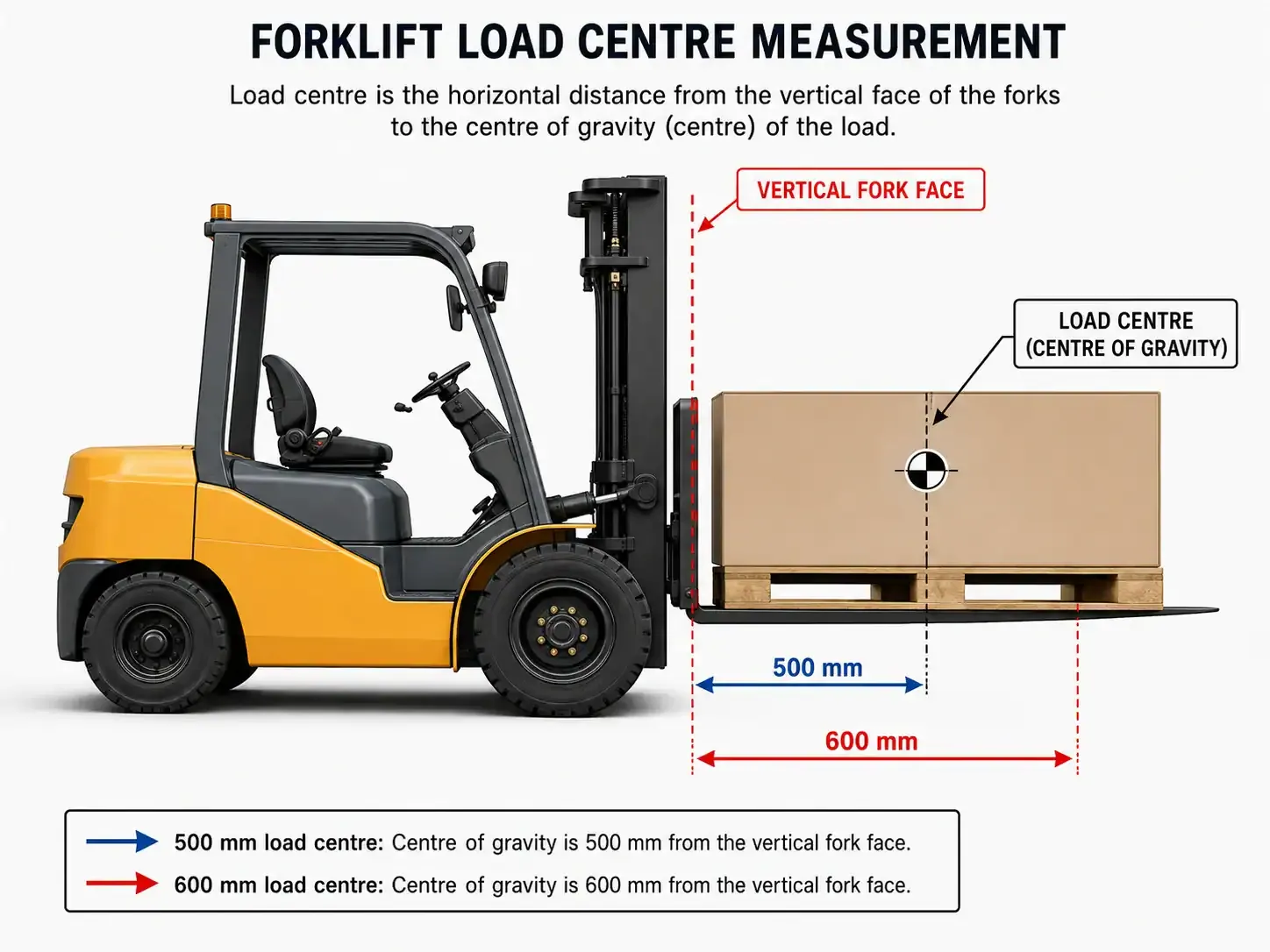
The load centre is the horizontal distance from the vertical face of the forks to the centre of gravity of the load.
For an evenly distributed rectangular load, the centre of gravity is normally halfway through its depth. A load that is 1,000 mm deep therefore has an approximate load centre of 500 mm. A load that is 1,200 mm deep has an approximate load centre of 600 mm.
WorkSafe Victoria states that Australian forklifts rated above one tonne are typically designed around a 600 mm load centre, which accommodates a standard 1,200 mm by 1,200 mm hardwood pallet. However, some imported forklifts may carry a 500 mm load centre rating. The actual plate must always be checked.
Why a Longer Load Reduces Capacity
Moving a load’s centre of gravity further away from the fork face increases the overturning force acting on the forklift. Even when the load’s total weight does not change, the forklift becomes less stable.
This is why load centre is closely connected to the forklift stability triangle. The combined centre of gravity of the forklift and load must remain within the machine’s stable area.
Worked Load Centre Example
Assume a forklift is rated for:
- 2,500 kg capacity
- 500 mm load centre
- A stated mast height
- No unlisted attachments
Its rated load moment can be illustrated as:
2,500 kg × 500 mm = 1,250,000 kg-mm
Now assume the load is 1,200 mm deep and evenly distributed. Its load centre is approximately 600 mm.
Using a simplified load-moment comparison:
1,250,000 kg-mm ÷ 600 mm = approximately 2,083 kg
|
Load depth |
Approximate load centre |
Simplified equivalent capacity |
|
1,000 mm |
500 mm |
2,500 kg |
|
1,100 mm |
550 mm |
2,273 kg |
|
1,200 mm |
600 mm |
2,083 kg |
|
1,400 mm |
700 mm |
1,786 kg |
Important: This table is a teaching example only. It is not an authorised capacity chart. Actual capacity may be lower because of mast height, attachments, fork length, load shape, dynamic forces and manufacturer safety margins. Only the forklift’s approved plate or manufacturer-issued chart can confirm the permitted load.
Uneven Loads Need Extra Attention
The centre of gravity may not be halfway through the load when:
- One side is heavier than the other
- Machinery is mounted off-centre on a pallet
- A liquid load can move
- Long products extend beyond the fork tips
- Multiple items are stacked unevenly
- The pallet is damaged or poorly packed
Position the heavier end as close to the fork face as possible and centre the load across the forks. Safe Work Australia recommends placing loads firmly against the carriage or load backrest and securing anything that could slip, roll or fall.
How Capacity Changes With Lift Height and Attachments
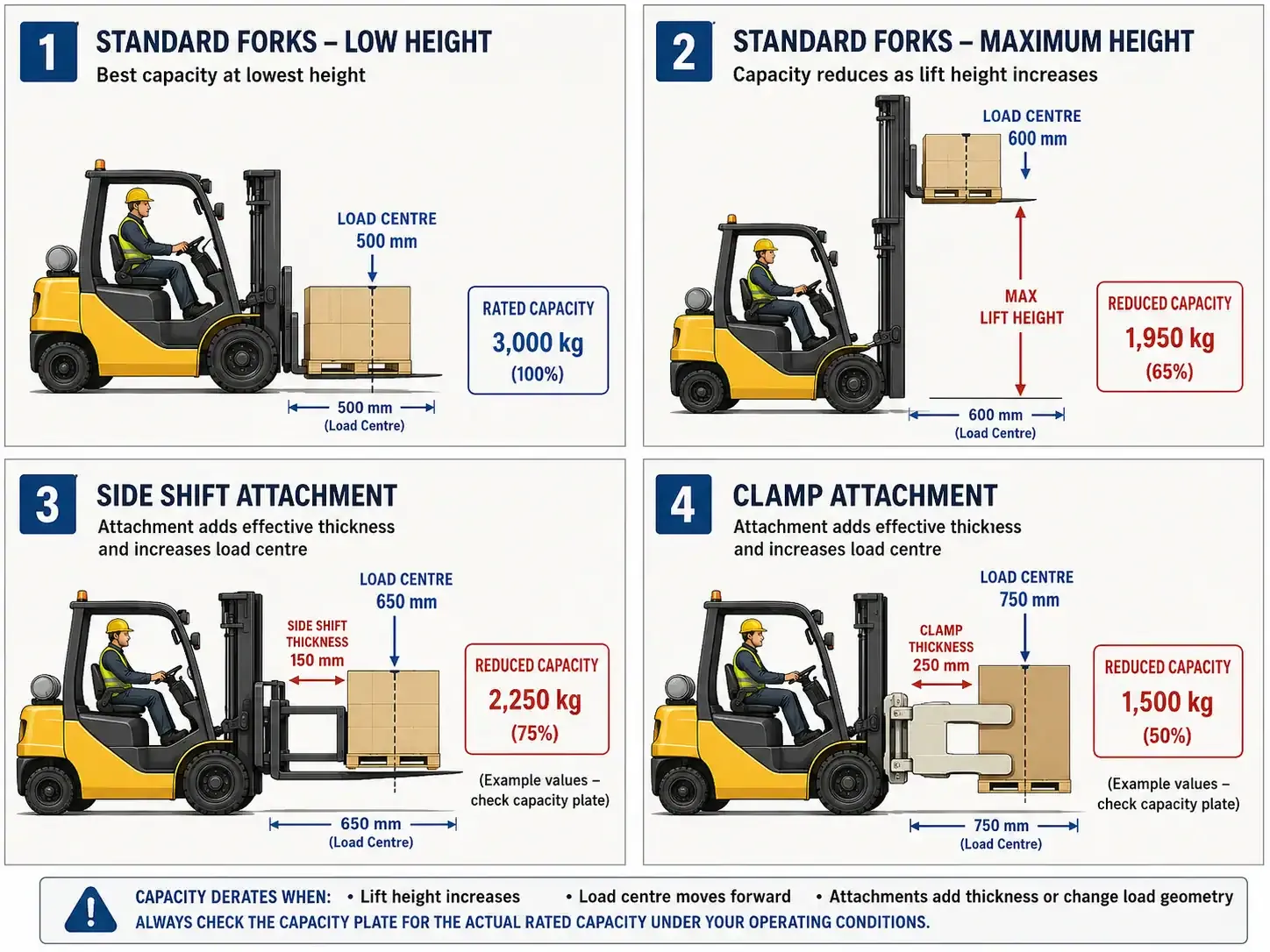
The capacity stated in a forklift brochure is often the base capacity. The forklift’s residual capacity is the amount it can safely lift after the effects of mast height, load centre and attachments are considered.
Capacity at Greater Lift Heights
A load becomes less stable as it is raised because the combined centre of gravity moves upwards. Mast deflection and the forklift’s reduced stability margin at height may also require the manufacturer to lower the permitted capacity.
A forklift may therefore be rated to lift:
- One capacity at a low or intermediate height
- A lower capacity at maximum fork height
- A further reduced capacity at a longer load centre
This is particularly important when comparing how rated capacity drops at greater lift heights on reach trucks and high-mast forklifts.
How Attachments Reduce Forklift Capacity
Attachments can reduce usable capacity in two ways:
- They add weight: The forklift must carry the attachment as well as the load.
- They move the load forward: The attachment’s thickness increases the effective load centre.
WorkSafe Victoria states that fitting an attachment changes a forklift’s stability and operating characteristics. The information plate must show the actual capacity of the forklift and attachment when used together.
Common attachments that may reduce capacity include:
|
Attachment |
Why capacity may decrease |
|
Side shift |
Adds weight in front of the mast and may increase the effective load centre. |
|
Fork positioner |
Adds weight to the carriage assembly. |
|
Clamp |
Adds weight and holds the load farther forward. |
|
Rotator |
Adds weight, moves the load forward and changes load behaviour while rotating. |
|
Jib |
Suspends the load farther from the forklift and can introduce swinging forces. |
|
Fork extensions |
Move the centre of gravity farther from the fork face. |
|
Longer forks |
Allow deeper loads that may exceed the original load centre rating. |
Illustrative Derated Capacity Chart
The following figures are examples only. They are not specifications for a real forklift.
|
Configuration |
Lift height |
Load centre |
Example permitted capacity |
|
Standard forks, no attachment |
3,000 mm |
500 mm |
2,500 kg |
|
Standard forks, no attachment |
4,500 mm |
500 mm |
2,200 kg |
|
Side shift fitted |
4,500 mm |
500 mm |
2,000 kg |
|
Clamp fitted |
4,500 mm |
600 mm |
1,750 kg |
The actual reduction is determined by the forklift and attachment manufacturer. Do not calculate a final working capacity by simply subtracting the attachment’s weight from the forklift’s base rating.
How High Should a Load Be Carried While Travelling?
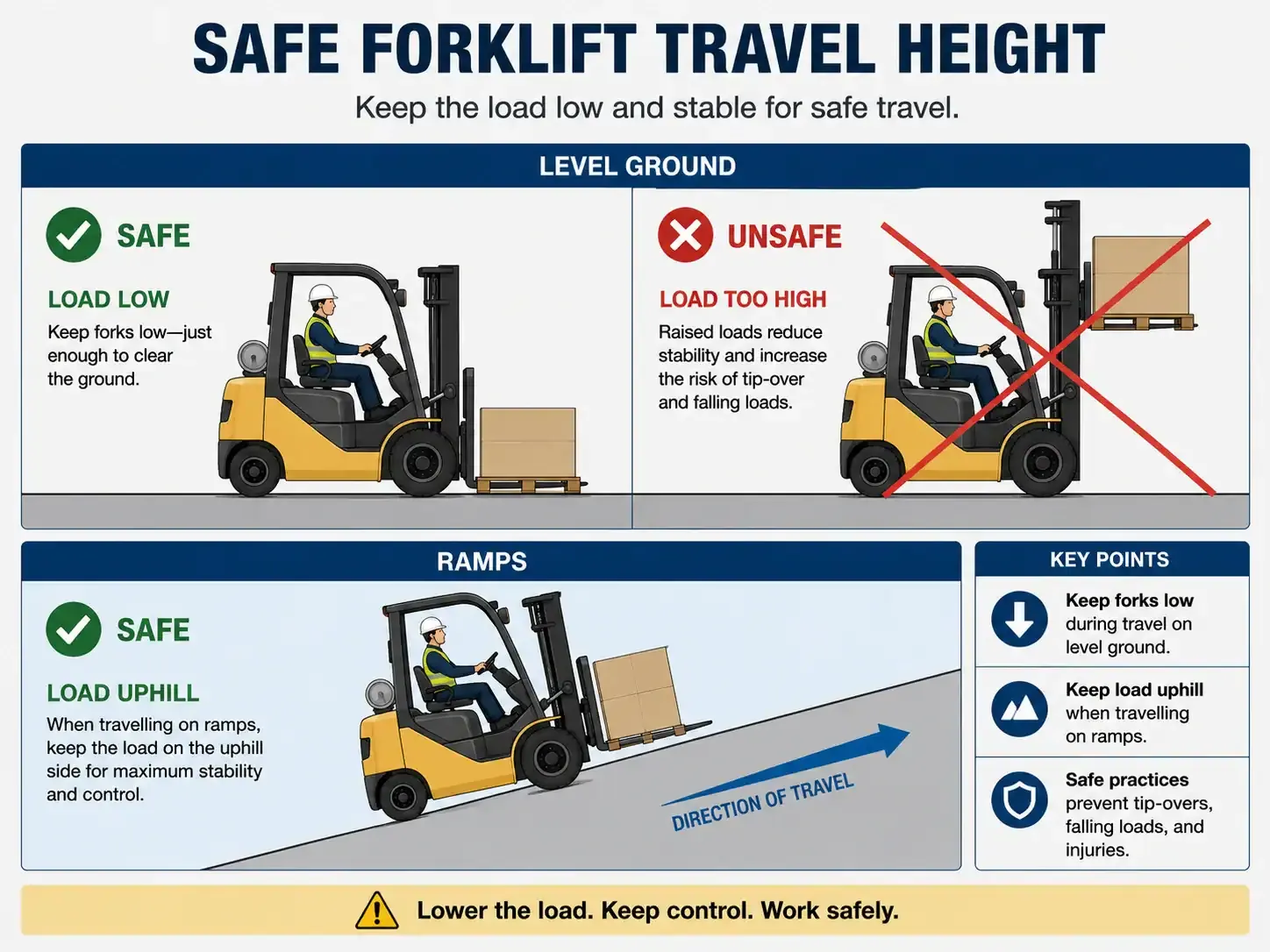
A travelling load should be carried as close to the ground as reasonably practicable while leaving enough clearance for the forks and load to avoid the surface.
There is no single centimetre measurement that suits every forklift, surface and load. Operators must follow the manufacturer’s manual and the workplace’s safe operating procedure.
Safe travel practices include:
- Lower the load after clearing the rack or loading surface.
- Keep the forks and load only high enough to clear the ground.
- Tilt the mast back enough to stabilise the load, without creating an unsafe configuration.
- Do not travel with the load raised to stacking height.
- Maintain a clear view in the direction of travel.
- Use an approved alternative procedure if the load blocks forward visibility.
- Slow down before turning, stopping or changing direction.
- Keep the load centred and secured against the load backrest.
- Avoid sudden acceleration and braking.
Safe Work Australia advises carrying loads near the ground and not driving with a raised load. WorkSafe Victoria identifies raised loads, obstructed visibility and loads that exceed the rated load centre as significant instability and collision hazards.
Travelling on Ramps and Slopes
Avoid operating on inclines where reasonably practicable. Where a manufacturer-approved ramp must be used:
- Keep the load on the uphill side.
- Raise it only enough to clear the surface.
- Tilt the load back as required to prevent movement.
- Do not turn across the slope.
- Stay within the manufacturer’s permitted gradient.
- Inspect the ramp and surface before entering.
Safe Work Australia recommends keeping the load on the uphill side when travelling up or down a slope. WorkSafe Victoria advises that a load on an incline should be raised only far enough to clear the road surface.
How to Choose the Right Forklift Capacity for Your Loads
Choosing capacity involves more than finding the heaviest pallet and buying a forklift with the same number on its brochure.
1. Weigh Your Heaviest Loads
Use verified weights from scales, supplier records or product specifications. Include:
- The product
- Pallet or stillage
- Packaging
- Containers
- Any lifting accessories carried with the load
The pallet forms part of the total load placed on the forks.
2. Measure the Load Dimensions
Record the depth, width and height of the heaviest and most awkward loads. Depth is especially important because it determines the likely load centre.
3. Identify the Required Lift Height
Measure the highest point at which the forklift must place the load. Allow for:
- Top rack beams
- Pallet clearance
- Sprinkler clearance
- Doorways
- Containers
- Mezzanine levels
- Truck and trailer decks
WorkSafe Victoria recommends assessing load weight, load type, lifting heights, attachments and load centre before buying, hiring or leasing a forklift.
4. Include Every Attachment
Confirm which attachments will remain permanently fitted and which may be added occasionally. Request a plate showing the residual capacity for every approved configuration.
5. Allow a Practical Capacity Buffer
Do not select a forklift that only just meets today’s maximum load under perfect conditions. A suitable margin may be needed for:
- Load-weight variation
- Longer pallets
- Higher future racking
- Additional attachments
- Changes in products or packaging
- Difficult operating conditions
The appropriate margin should be established with the supplier or manufacturer, not guessed by the operator.
6. Match the Forklift to the Whole Workplace
Capacity is only one selection factor. Also consider:
- Aisle width
- Turning radius
- Floor loading
- Door height
- Ventilation
- Indoor or outdoor use
- Surface condition
- Ramp gradients
- Tyre type
- Battery runtime or fuel availability
WorkSafe Victoria advises assessing whether the forklift is suitable for the loads, site conditions, operator and identified hazards before purchase or hire.
The process of matching forklift capacity to the loads you handle should be completed using your actual pallets, lift heights and intended attachments. Buyers should also examine the applicable forklift safety and compliance standards before committing to a particular model.
What Happens If You Exceed the Rated Capacity?
Exceeding the capacity plate can shift the combined centre of gravity outside the forklift’s stable area. The forklift may tip forwards, overturn sideways or lose control of the load.
Possible consequences include:
- The rear wheels lifting from the ground
- Reduced steering control
- The forklift tipping forwards
- Sideways overturning during a turn
- The load sliding or falling
- Damage to the mast, chains, forks or hydraulic system
- Collisions with racking, vehicles or pedestrians
- Serious injury or death
- Damage to stock and workplace structures
WorkSafe Victoria lists loads exceeding the forklift’s capacity or load centre among the causes of forklift instability. Safe Work Australia also states that the load must be limited to the rated capacity shown on the load chart.
Clear operating procedures, operator training and accurate capacity plates are central to avoiding forklift overload accidents.
Forklift Capacity Plates and Australian Safety Requirements
The AS 2359 series covers powered industrial trucks in Australia. AS 2359.1 addresses general requirements, while AS 2359.2 covers operation, maintenance, repair and modification.
In Victoria, employers must provide and maintain a working environment that is safe and without risks to health so far as reasonably practicable. WorkSafe Victoria’s current forklift guidebook states that operator training should cover capacity limits and how to understand the forklift information plate.
Forklifts and attachments must also be regularly inspected and maintained. WorkSafe Victoria recommends a pre-operational inspection at the start of each shift, before first daily use and when the operator changes.
Check the Plate Before Every Lift
A forklift’s advertised capacity is only a starting point. The number that matters is the capacity shown on the machine for the actual load centre, lift height and attachment configuration being used.
Before lifting, confirm the load’s total weight, dimensions, centre of gravity and required placement height. If any detail falls outside the plate, use a correctly rated forklift rather than testing the machine’s limits.
Businesses comparing equipment can review available counterbalance forklifts for sale or browse the full forklift range and confirm residual capacity with Buy A Fork before purchase.
Frequently Asked Questions
1. What Does 2,500 kg at a 500 mm Load Centre Mean?
It means the forklift is rated to lift a maximum of 2,500 kg when the load’s centre of gravity is no more than 500 mm horizontally from the vertical fork face, subject to the height, mast and attachment conditions shown on the plate.
A deeper load may have a longer load centre and a lower permitted capacity.
2. Does Forklift Capacity Include the Pallet Weight?
Yes. Rated capacity applies to the entire load carried by the forks, including the product, pallet, packaging, stillage and any loose lifting equipment supported by the forks.
A 2,400 kg product on a 100 kg pallet creates a total load of 2,500 kg.
3. Can a Forklift Lift Its Rated Capacity to Full Height?
Only when the plate specifically shows that capacity at the required maximum fork height. Some forklifts have a lower residual capacity at full mast extension.
Check the height and capacity combination printed on the machine rather than relying on the model’s advertised base capacity.
4. Does a Side Shift Reduce Forklift Capacity?
It can. A side shift adds weight to the carriage and may move the load farther forward, reducing residual capacity.
The approved capacity with the side shift fitted should appear on the forklift’s information plate.
5. Do Longer Forks Increase Forklift Capacity?
No. Longer forks do not increase the forklift’s lifting capacity. They may allow a deeper load to be supported, but that deeper load can move the centre of gravity farther from the forklift and reduce capacity.
Only use fork lengths and extensions approved by the manufacturer and included in the forklift’s rating.
6. What Should I Do If the Forklift Capacity Plate Is Missing or Unreadable?
Do not guess the capacity from the model number, appearance or a similar forklift. Remove the machine from lifting service until the correct plate has been obtained or verified by the manufacturer, authorised supplier or another competent person.
The replacement plate must reflect the forklift’s actual mast, tyres, forks and attachments.