
How to Choose the Right Forklift: Size, Type and Fit for Your Business
· Updated
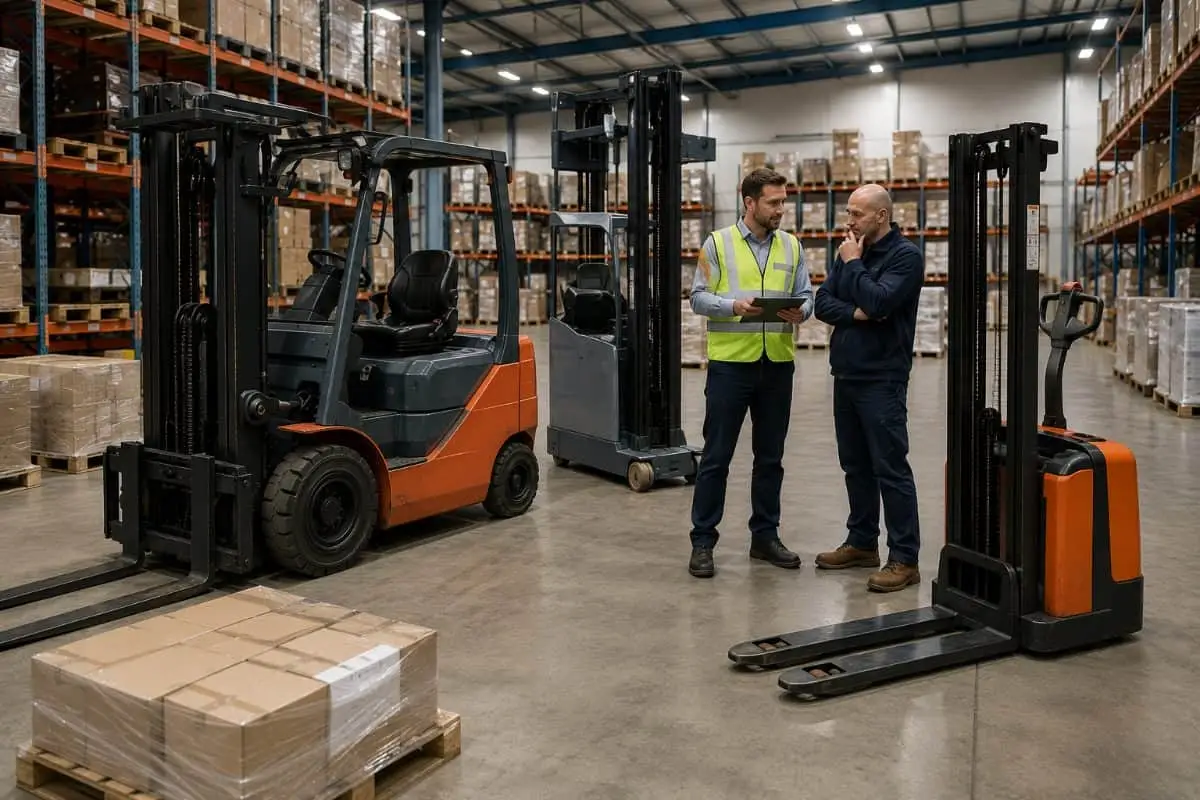
Choosing the right forklift means matching the machine to six factors: load weight, load centre, lift height, power source, tyre type and available operating space. The forklift must also suit the surface, attachments, operator needs and daily workload.
A machine with enough headline capacity can still be unsuitable if the load is long, the mast cannot clear a doorway, the turning radius is too wide or the tyres do not suit the floor. Start with the task and workplace, then compare equipment types and ownership costs.
This guide explains how to choose a forklift for an Australian warehouse, workshop or outdoor yard without relying on capacity alone.
How to Choose the Right Forklift: The Six Factors
Use these six factors as the starting point:
- Load capacity and load centre: Confirm the heaviest and most awkward load, including its dimensions and centre of gravity.
- Lift height and mast type: Measure the highest racking level, doorway clearance and lowered mast height.
- Power source: Match electric, LPG or diesel power to the environment, shift length and charging or refuelling facilities.
- Tyre type: Select tyres for smooth indoor floors, paved outdoor areas or rough and debris-prone ground.
- Aisle width and layout: Check turning radius, right-angle stacking space, intersections and pedestrian separation.
- Forklift size and configuration: Confirm the machine can pass through doors, work beneath ceilings and safely handle the required attachments.
| Factor | What to Check | Why It Matters |
|---|---|---|
| Load | Maximum weight, dimensions and load centre | Determines safe capacity |
| Height | Top racking beam and placement clearance | Determines mast and residual capacity |
| Power | Indoor or outdoor use and shift pattern | Affects emissions, charging and refuelling |
| Tyres | Floor surface, moisture and puncture hazards | Affects traction, comfort and wear |
| Layout | Aisle width, turning areas and traffic routes | Determines manoeuvrability |
| Size | Overall height, width, length and mast clearance | Ensures the forklift physically fits |
Businesses ready to compare available machines can see the full forklift range after documenting these requirements.
Step 1: Load Capacity and Load Centre
Forklift capacity is not determined by load weight alone. You must also consider the load centre, dimensions, lift height and any fitted attachment.
The rated capacity shown on the forklift’s information plate applies to a specified configuration. Capacity can reduce when:
- The load centre moves further forward.
- The load is unusually long or uneven.
- The load is lifted higher.
- Longer fork arms are installed.
- A clamp, rotator or other attachment is fitted.
- The load is not centred correctly.
Work Safe Victoria states that approved attachments must be rated and recorded on the forklift information plate. The plate should show the actual capacity of the forklift-attachment combination.
Start With the Heaviest Real Load
Record:
- Product weight
- Pallet, stillage or container weight
- Load width and depth
- Load height
- Centre of gravity
- Any attachment required
- Maximum lift level
- Whether loads are stable, liquid or irregular
Do not select a machine that only just meets the normal load. Allow for the heaviest legitimate task, while avoiding unnecessary excess capacity that increases machine size and cost.
Read the Capacity Plate
The information plate should identify:
- Rated capacity
- Load centre
- Mast and lift configuration
- Tyre specification
- Approved attachments
- Machine weight
- Relevant capacity changes
The article on how to read a forklift load capacity chart explains how weight, load centre and height affect the usable rating.
Example
A forklift rated for a pallet centred close to the mast may not safely handle the same weight when the load is longer and its centre sits further forward.
The correct response is not to estimate or proceed cautiously. Check the capacity plate for the actual configuration or have the machine assessed by the manufacturer, supplier or another suitably competent person.
Step 2: Lift Height and Mast Type
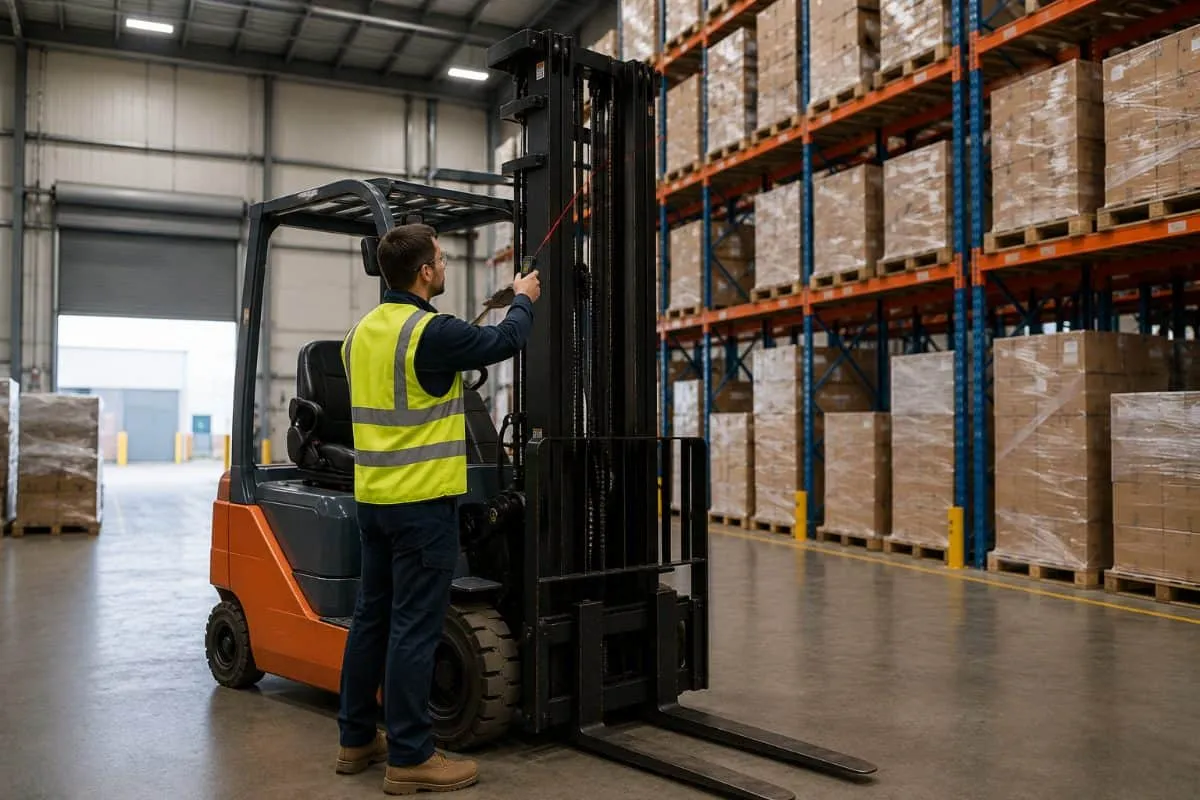
Measure the highest point where the forks must place a pallet. Do not use the height of the top racking beam alone.
Allow for:
- Pallet thickness
- Fork clearance
- Load height
- Safe placement space
- Sprinklers
- Lighting
- Roof structures
- Doorways
- Mezzanines
- Loading-container clearance
Common Mast Configurations
- Single-stage mast: Simple, lower-height applications.
- Duplex mast: Two mast stages for general warehouse work.
- Triplex mast: Three-stage configuration offering greater lift while retaining a lower closed height.
- Container-entry mast: Designed to pass through restricted overhead openings.
- Full free-lift mast: Allows the forks to rise before the overall mast height increases significantly.
Check Both Raised and Lowered Height
A forklift can reach the required shelf but still be unsuitable if the lowered mast cannot pass through a doorway or container.
Measure:
- Overall lowered mast height
- Maximum fork height
- Raised mast height
- Overhead-guard height
- Door and roller-door openings
- Trailer or container entrances
- Ceiling and sprinkler clearances
Businesses with high racking should review high reach forklifts and lift heights before deciding between a counterbalance forklift and a reach truck.
Step 3: Power Type: Electric, LPG or Diesel
The right power type depends on where the forklift works, how long it operates and whether the site can support charging or fuel storage.
| Power Type | Best Fit | Main Advantages | Main Considerations |
|---|---|---|---|
| Electric | Indoor warehouses and clean operations | Quiet, no tailpipe emissions, fewer engine service items | Battery condition, charging time and charging space |
| LPG | Mixed indoor and outdoor operations with suitable ventilation | Fast cylinder changes and flexible use | Fuel handling, ventilation and engine servicing |
| Diesel | Outdoor yards and demanding applications | Strong outdoor performance and rapid refuelling | Exhaust, noise and greater engine maintenance |
A more detailed comparison is available in diesel, electric and LPG forklifts compared.
1. Electric Forklifts
Electric forklifts generally suit:
- Warehouses
- Food and packaged-goods operations
- Retail distribution
- Manufacturing
- Enclosed workshops
- Noise-sensitive sites
Before choosing electric, check:
- Shift length
- Battery runtime
- Charger compatibility
- Electrical supply
- Charging location
- Opportunity-charging requirements
- Battery replacement exposure
Buyers can compare the current electric forklift range and electric counterbalance forklifts.
2. LPG Forklifts
LPG can suit businesses moving between:
- Warehouses
- Loading canopies
- Paved yards
- Manufacturing areas
- Transport depots
Indoor LPG use requires suitable ventilation and site controls. LPG equipment should not be treated as emission-free.
Current options can be reviewed through the LPG counterbalance range.
3. Diesel Forklifts
Diesel forklifts generally suit:
- Construction suppliers
- Farms
- Timber yards
- Building-material yards
- Recycling facilities
- Outdoor manufacturing
- Uneven industrial sites
Do not choose diesel for enclosed indoor work simply because a used machine has an attractive price.
Step 4: Tyres: Cushion vs Pneumatic
Tyre selection affects traction, ride quality, turning footprint, stability and maintenance.
1. Cushion Tyres
Cushion tyres suit:
- Smooth warehouse floors
- Clean manufacturing facilities
- Compact indoor layouts
- Applications requiring a smaller turning footprint
They provide less cushioning on rough ground and are generally unsuitable for gravel, potholes and damaged concrete.
2. Air-Filled Pneumatic Tyres
Air-filled pneumatic tyres provide:
- Better shock absorption
- Improved ride quality
- Useful traction on outdoor surfaces
- Better performance over uneven ground
Their main limitation is puncture risk.
3. Solid Pneumatic Tyres
Solid pneumatic tyres combine a pneumatic-style shape with puncture resistance.
They may suit:
- Outdoor yards
- Mixed indoor and outdoor work
- Recycling or timber sites
- Workplaces with nails, metal or sharp debris
Their purchase cost may be higher, and they generally provide less cushioning than air-filled tyres.
The pneumatic tyres guide explains the differences between air-filled and solid options.
4. Match the Tyre to the Surface
| Surface | Suitable Direction |
|---|---|
| Smooth, dry warehouse floor | Cushion or polyurethane |
| Paved indoor and outdoor area | Solid pneumatic |
| Rough yard | Pneumatic or solid pneumatic |
| Gravel or uneven ground | Pneumatic-style tyre |
| Yard with sharp debris | Solid pneumatic |
| Wet paved surface | Treaded tyre suited to the forklift and environment |
Tyres alone cannot convert a warehouse forklift into a rough-terrain machine. The entire forklift must be designed for the surface and duty.
Step 5: Aisle Width and Warehouse Layout
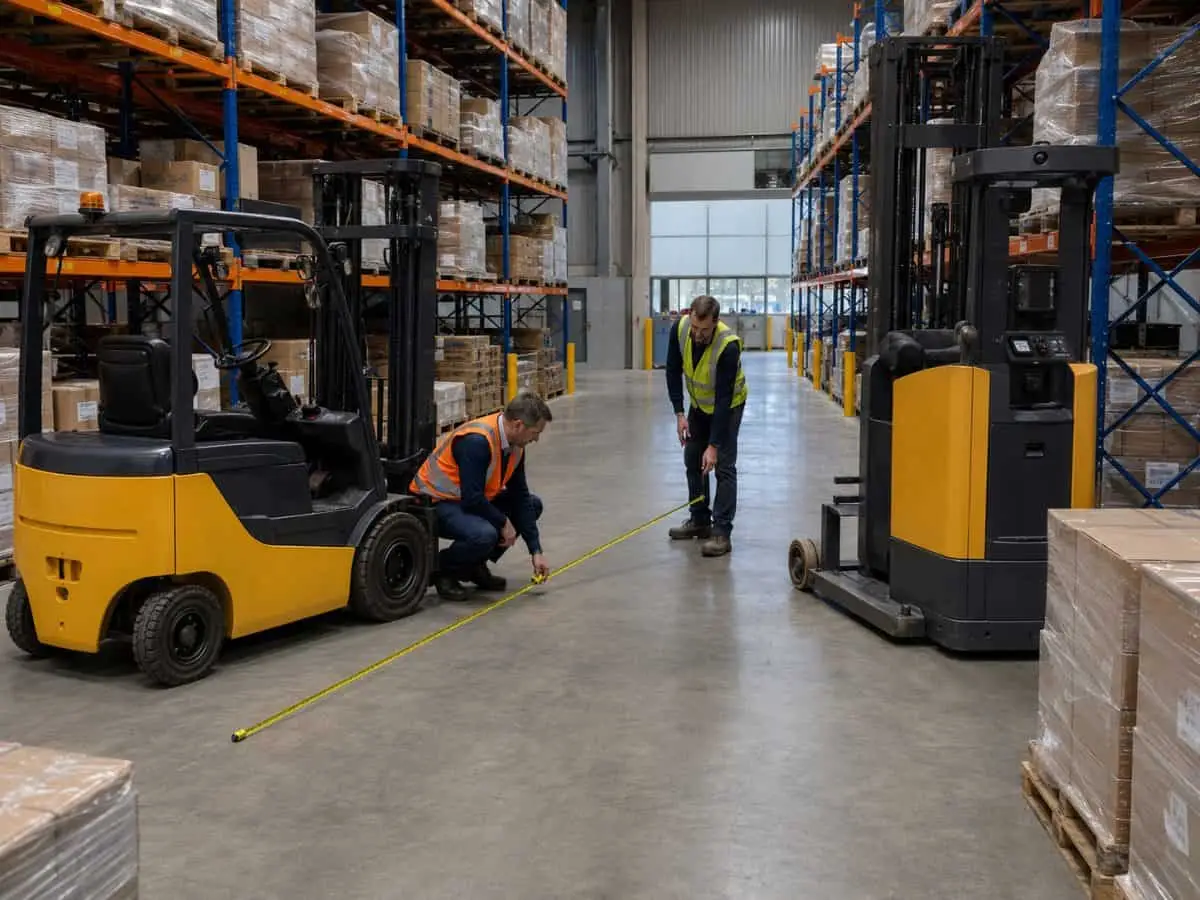
The forklift must have enough room to approach, turn and place the pallet safely. Overall machine width alone does not tell you how much operating space is required.
Check:
- Turning radius
- Right-angle stacking aisle
- Load length
- Fork length
- Pallet overhang
- Racking depth
- Intersections
- Pedestrian walkways
- Columns and barriers
- Fire equipment
- Emergency exits
- Loading areas
Work Safe Victoria recommends that workplace traffic-management plans identify forklift routes, ground conditions, structures, no-go zones and pedestrian paths. Physical separation and clearly planned traffic arrangements should be considered when designing the layout.
Right-Angle Stacking Space
The right-angle stacking aisle is the space required for the forklift to enter an aisle, turn through approximately 90 degrees and place a pallet into racking.
It depends on:
- Forklift length
- Turning radius
- Load length
- Pallet dimensions
- Clearance allowance
- Mast and fork configuration
Use the manufacturer’s specification for the exact machine and load. Do not rely on a generic capacity-based estimate.
When a Counterbalance Forklift Fits
A counterbalance forklift may suit:
- Wider aisles
- Loading trucks
- General warehouse handling
- Indoor and outdoor travel
- Floor stacking
- Mixed applications
The guide explaining what a counterbalance forklift is covers its layout and operating advantages. Buyers can also review available counterbalance forklifts.
When to Choose a Reach Truck
A reach truck may be better when:
- Racking is high.
- Aisles are narrower.
- Work is mainly indoors.
- Pallets move frequently between racking and staging areas.
- Smooth warehouse floors are available.
Reach trucks are designed around warehouse storage rather than general outdoor use.
Narrow-Aisle Equipment
A narrow-aisle or very-narrow-aisle machine may be required where storage density is the main priority.
These machines may involve:
- Specialist racking layouts
- Guidance systems
- Very smooth floors
- Operator training
- Higher lift capability
- More complex site planning
Review forklifts for narrow aisles before reducing aisle widths around a standard forklift.
What Size Forklift Do I Need?
Forklift size should be based on the load, building and operating space rather than choosing a standard tonne class by habit.
| Workplace Type | Typical Equipment Direction | Main Sizing Checks |
|---|---|---|
| Small stockroom | Walkie stacker or compact electric forklift | Door clearance, pallet compatibility and turning space |
| General warehouse | Electric or LPG counterbalance | Capacity, mast height and aisle width |
| High-racking warehouse | Reach truck or high-reach machine | Lift height, residual capacity and floor quality |
| Loading dock | Counterbalance forklift | Trailer access, load weight and manoeuvring room |
| Outdoor trade yard | LPG or diesel counterbalance | Tyres, ground clearance and surface condition |
| Narrow-aisle warehouse | Reach or specialist narrow-aisle machine | Right-angle stack, guidance and racking |
| Heavy industrial site | Higher-capacity counterbalance forklift | Load centre, attachment and ground strength |
These are equipment directions, not fixed specifications. The exact machine must be checked against actual measurements and loads.
Physical Dimensions to Record
Before approaching a supplier, measure:
- Narrowest doorway
- Lowest overhead point
- Clear aisle width
- Racking height
- Loading-dock dimensions
- Container or trailer opening
- Turning areas
- Ramp width and gradient
- Floor loading restrictions
- Maximum permitted equipment length
Do Not Oversize the Forklift
A larger machine may provide more capacity, but it can also create:
- Wider turning requirements
- Greater equipment weight
- Reduced visibility
- Higher purchase and running costs
- More tyre wear
- Difficulty entering containers
- Reduced storage efficiency
Choose enough capacity and stability for the task, not the largest machine that fits the budget.
Other Purchasing Factors
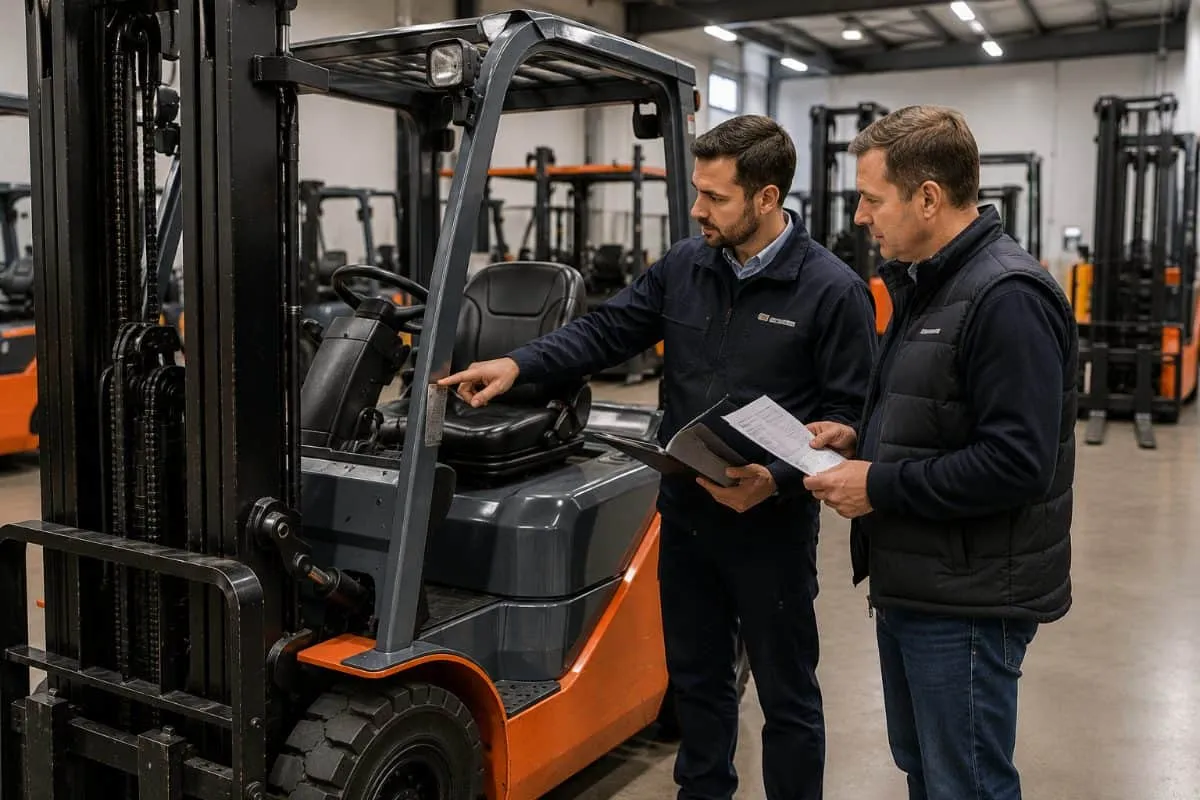
Capacity and dimensions are only part of the decision.
Attachments
Possible attachments include:
- Side shift
- Fork positioner
- Bale clamp
- Paper-roll clamp
- Rotator
- Push-pull attachment
- Jib
- Slipper forks
Work Safe Victoria advises that attachments must be approved, rated and listed on the forklift information plate. Operators also need suitable information, instruction or training for each attachment used.
The attachment’s weight and increased load centre may reduce the forklift’s usable capacity.
Operator Ergonomics
Check:
- Seat support and adjustment
- Steering effort
- Pedal layout
- Hydraulic controls
- Entry and exit
- Forward and rear visibility
- Vibration
- Cabin protection
- Climate conditions
- Space for the operator
Poor fit can increase fatigue and reduce control during long shifts. The operator ergonomics guide provides a more detailed assessment.
New vs Used
New equipment may offer:
- Manufacturer warranty
- Current safety technology
- Known service history
- Lower early repair exposure
- Easier specification selection
Used equipment may offer:
- Lower purchase price
- Reduced depreciation
- Established brands within budget
- Faster availability
- More capacity for the same upfront spend
Work Safe Victoria notes that second-hand forklifts may require additional spending to correct seats, seat belts, information plates, electrical faults, mechanical issues and structural defects. A used forklift should therefore be inspected and serviced before use.
Compare the broader implications in used vs new forklifts.
Purchase Budget and Ownership Cost
Include:
- Purchase price
- GST
- Finance
- Delivery
- Battery and charger
- Fuel or electricity
- Scheduled servicing
- Tyres
- Attachments
- Operator training
- Repairs
- Downtime
- Insurance
- Resale value
Where the correct machine sits above the available cash budget, forklift finance options may allow the business to avoid choosing unsuitable equipment based only on upfront price.
Brand, Parts and Dealer Support
Ask:
- Can the model be serviced locally?
- Are parts available?
- Is technical support accessible?
- What warranty applies?
- Are battery and charger coverage separate?
- Can the supplier inspect the workplace?
- Is transport support available?
- Are service records supplied?
The cheapest forklift may become expensive when parts are difficult to obtain or downtime is prolonged.
Matching a Forklift Type to Your Business
| Task or Site | Recommended Equipment Direction | Reason |
|---|---|---|
| Loading trucks and general pallet work | Counterbalance forklift | Direct pallet access and versatile handling |
| High indoor racking | Reach truck | Greater lift and compact aisle operation |
| Floor-level pallet transport | Electric pallet jack | Lower cost where stacking is not required |
| Light pallet stacking | Walkie stacker | Compact powered lift for smaller operations |
| Narrow warehouse aisles | Reach or narrow-aisle forklift | Reduced turning-space requirement |
| Outdoor yard work | LPG or diesel counterbalance | Suitable power and tyre configurations |
| Clean indoor warehouse | Electric counterbalance | Quiet operation and no tailpipe emissions |
| Container entry | Container-mast counterbalance | Lowered mast and overhead-guard clearance |
| Heavy industrial loads | High-capacity counterbalance | Stronger chassis and capacity |
| Frequent high lifting | High-reach warehouse forklift | Designed for elevated storage |
1. Counterbalance Forklift
Choose a counterbalance forklift for:
- Truck loading
- General warehouse work
- Floor stacking
- Mixed indoor and outdoor handling
- Loads requiring direct approach
2. Reach Truck
Choose a reach truck for:
- High racking
- Indoor warehouses
- Narrower aisles
- Frequent storage and retrieval
- Smooth floors
3. Walkie Stacker
Choose a walkie stacker for:
- Small warehouses
- Short travel distances
- Light or medium pallet stacking
- Lower throughput
- Compact storage areas
Check leg and pallet compatibility, particularly with closed-bottom Australian pallets.
4. Electric Pallet Jack
Choose an electric pallet jack where:
- Pallets remain at floor level.
- Horizontal movement is the main task.
- Lift height is not required.
- Travel distances are moderate.
- A full forklift is unnecessary.
5. High-Reach or Narrow-Aisle Forklift
Choose specialist warehouse equipment when:
- Racking is high.
- Storage density is important.
- Aisles cannot accommodate a counterbalance forklift.
- Floors and guidance systems meet equipment requirements.
- Operators have suitable training.
Frequently Asked Questions
1. What Size Forklift Do I Need for My Warehouse?
The correct size depends on the heaviest load, load centre, lift height, aisle width and doorway clearance. Measure the workplace and use the exact manufacturer specifications for turning radius, lowered mast height and right-angle stacking. Do not choose capacity before confirming the forklift can physically operate in the building.
2. How Do I Work Out the Load Capacity I Need?
Add the weight of the product, pallet and any load-handling equipment, then assess the load dimensions and centre of gravity. Check the forklift’s information plate for the required lift height, load centre and attachment. Choose a machine rated for the complete configuration rather than relying on its headline capacity.
3. Is an Electric or Diesel Forklift Better for Indoor Use?
An electric forklift is generally better for enclosed indoor use because it produces no tailpipe emissions during operation and is quieter. Diesel equipment is normally intended for outdoor applications. LPG may suit some indoor environments where ventilation and site controls are appropriate.
4. What Forklift Is Best for Narrow Aisles?
Reach trucks and specialist narrow-aisle forklifts are usually better suited to restricted warehouse aisles than conventional counterbalance forklifts. The decision depends on aisle width, pallet dimensions, racking height, turning requirements and floor condition.
5. Should I Buy New or Used for My First Forklift?
A new forklift may suit intensive daily work where warranty and low early repair exposure justify the cost. A professionally inspected used forklift can offer better value for lighter or intermittent work. Assess service history, operating hours, battery or engine condition, mast, tyres and support before purchasing.
6. How High Can a Forklift Lift?
Lift height varies significantly by forklift type and mast. Standard counterbalance forklifts may suit low to medium storage, while reach trucks and high-reach warehouse machines are designed for taller racking. Always confirm maximum fork height and usable capacity at that height for the exact machine.
7. Which Forklift Do I Need for Indoor and Outdoor Work?
An LPG counterbalance forklift or suitably configured electric counterbalance may work across smooth indoor floors and paved outdoor areas. Solid pneumatic tyres can support mixed-surface operation. The machine must still suit ventilation, weather exposure, gradients and ground conditions.
Conclusion
Choosing the right forklift starts with the load and workplace, not the brand or advertised price. Confirm capacity at the actual load centre and height, then measure racking, aisles, doorways and operating surfaces before comparing power types and equipment categories.
Attachments, tyres, operator ergonomics, servicing and dealer support also affect whether the forklift remains productive after purchase. A properly matched machine will handle the required work without unnecessary size, cost or compromise.
Businesses ready to compare suitable options can browse Buy A Fork’s complete range or contact Buy A Fork with their load, height, aisle and operating requirements.