
Top 10 Narrow Aisle Forklifts and How to Choose One
· Updated
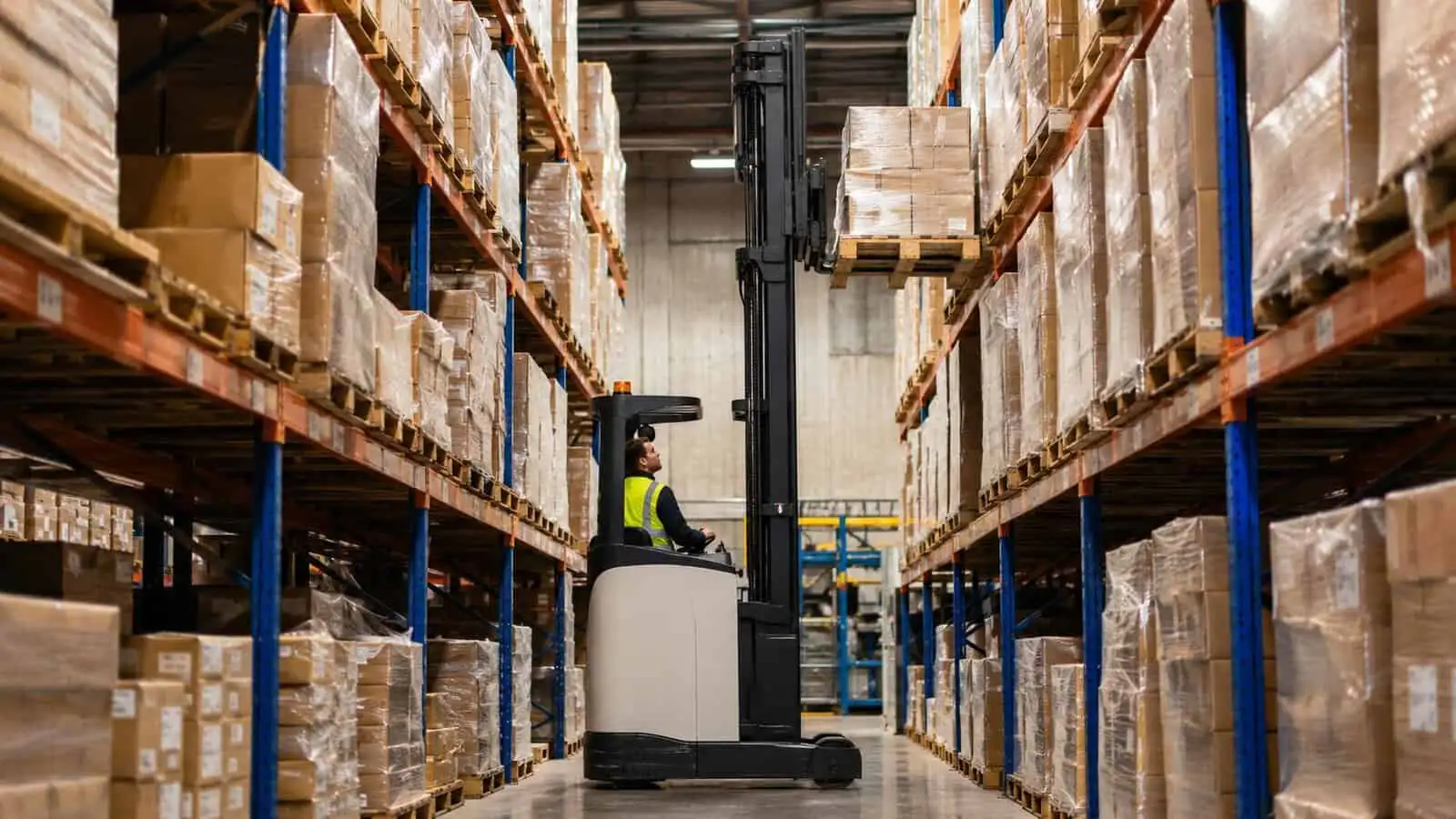
The best narrow aisle forklift depends on the aisle width, required lift height, load weight, racking design and daily throughput. Reach trucks suit most narrow pallet-racking operations, while double-deep trucks increase storage density and very narrow aisle turret trucks work in highly compressed high-bay layouts.
Compact stackers and order pickers may be more appropriate when the operation handles lighter pallets, shorter travel distances or individual cartons rather than full pallets.
Do not choose a machine from its maximum lift height or rated capacity alone. Measure the complete aisle, confirm the forklift’s residual capacity at the required height and assess the floor, guidance system, battery, operator environment and attachment requirements.
The Best Narrow Aisle Forklifts at a Glance
The following shortlist covers ten useful narrow aisle forklift configurations and model families for Australian warehouses. Manufacturer ratings vary by chassis, mast, battery and attachment, so the final specification must be confirmed for the individual machine.
| Narrow Aisle Forklift | Machine Type | Published Maximum Capacity | Published Maximum Lift Height | Best For |
|---|---|---|---|---|
| Crown ESR Series | Sit-down reach truck | Up to 2,000 kg | Up to 13,560 mm on the Australian range | High-bay warehousing and longer shifts |
| Crown RR Series | Single-deep reach truck | Up to 2,000 kg | Up to 11,225 mm | General narrow-aisle pallet storage |
| Crown RD Series | Double-deep reach truck | Up to 1,450 kg | Up to 11,225 mm | Double-deep racking |
| Crown RM Series | MonoLift reach truck | Up to 2,000 kg | Up to 12,825 mm | High lifts and strong capacity at height |
| Crown RMD Series | MonoLift deep-reach truck | Up to 1,450 kg | Up to 12,825 mm | High double-deep storage |
| Crown TSP 1000/1500 | VNA turret truck | Up to 1,500 kg | Up to 17,145 mm | Very narrow, high-bay warehouses |
| Crown SP Series | High-level order picker | Up to 1,360 kg | Up to 10,210 mm, depending on series | Case and item picking at height |
| Crown ST/SX Series | Walkie straddle stacker | Up to 1,500 kg | Up to 5,500 mm | Light-duty narrow aisles |
| Crown SH Series | Heavy-duty walkie stacker | Up to 1,800 kg | Up to 4,875 mm | Heavier pallets with limited travel |
| Toyota 8FBRE Series | Electric reach truck | 1,200 to 1,600 kg | Up to 8,500 mm | Small to medium single-shift warehouses |
Crown’s current Australian range lists reach trucks with capacities up to 2,000 kg and lift heights exceeding 13 metres, while its TSP turret trucks can reach more than 17 metres. Its stacker range covers lighter narrow-aisle applications with lift heights up to 5.5 metres for the ST/SX family.
Toyota Material Handling Australia describes the 8FBRE family as narrow-aisle electric reach trucks with capacities from 1.2 to 1.6 tonnes and maximum lift heights of 8.5 metres.
These figures indicate the upper limits of particular configurations. They do not mean the forklift can lift its full nominal capacity at maximum height.
What Is a Narrow Aisle Forklift?
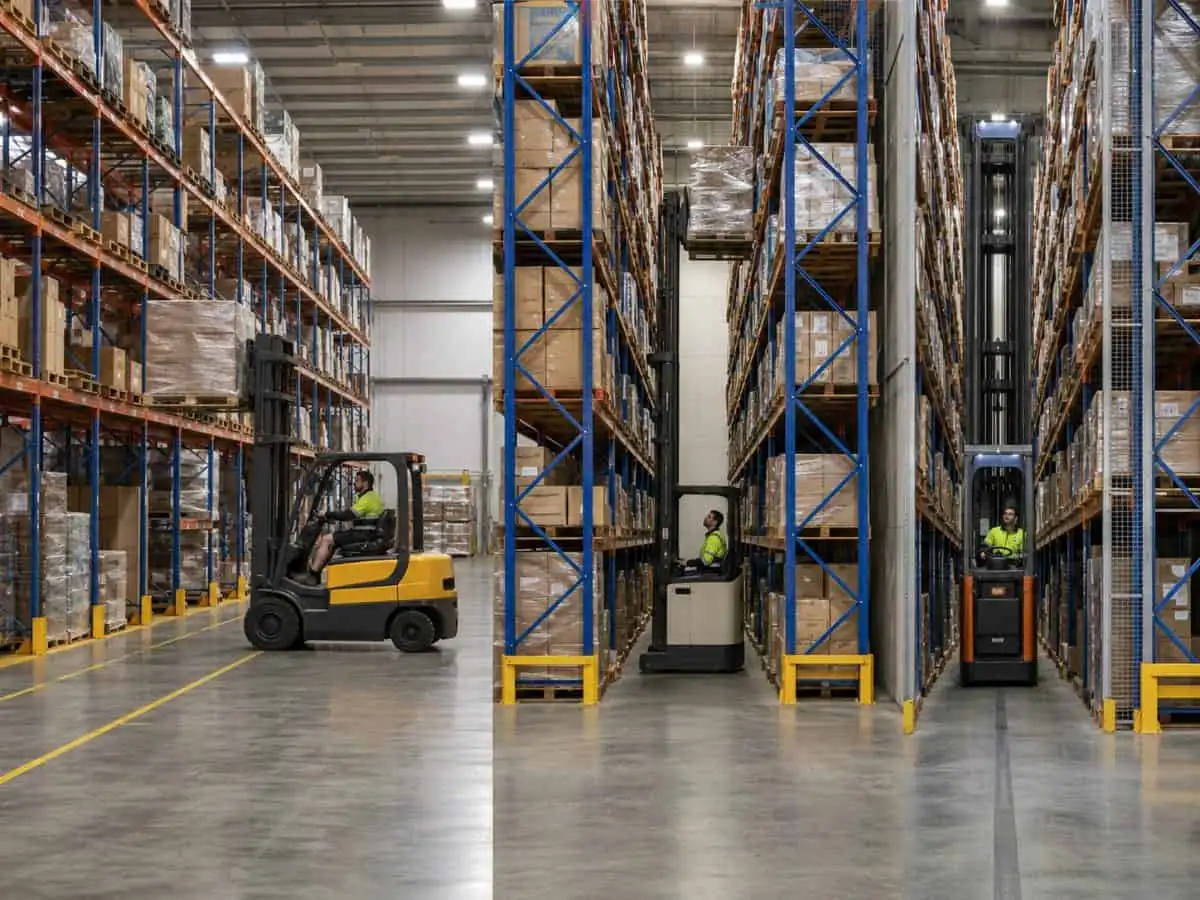
A narrow aisle forklift is designed to store, retrieve or move loads in racking aisles that are too tight for a standard counterbalance forklift to turn and stack efficiently.
Instead of carrying the load fully in front of a long counterweight, narrow aisle machines use a more compact chassis and specialised load-handling system.
Common layouts include:
- Conventional aisles: Usually designed around counterbalance forklifts.
- Narrow aisles: Commonly served by reach trucks and compact stackers.
- Very narrow aisles: Served by turret, man-up or other guided VNA equipment.
There is no single aisle measurement that defines every category. The minimum working width depends on:
- Forklift model
- Chassis length
- Load dimensions
- Pallet orientation
- Turning geometry
- Racking clearance
- Guidance system
- Workplace safety margins
A warehouse should not reduce aisle width simply because a brochure lists a minimum figure. The final design should be checked against the chosen forklift, pallets, racking and site risk assessment.
Why Warehouses Use Narrow Aisle Equipment
The main purpose is to increase storage density within the existing building.
Narrower aisles may allow a warehouse to:
- Add more racking runs
- Increase pallet locations
- Use additional vertical space
- Reduce building expansion requirements
- Improve high-bay access
- Keep inventory closer to picking and dispatch areas
The trade-off is that specialised forklifts may require flatter floors, tighter operating controls, trained operators and a more carefully engineered racking layout.
Types of Narrow Aisle Forklift
Different machine classes solve different warehouse problems. A reach truck is not automatically interchangeable with a turret truck, order picker or pallet stacker.
Reach Trucks
Reach trucks are the most common narrow aisle forklifts for full-pallet storage.
They use a retractable mast or fork carriage to move the load forwards into the racking and retract it towards the chassis for travel. This reduces the working footprint compared with a counterbalance forklift.
Best for:
- Single-deep pallet racking
- Medium and high lift heights
- Indoor warehouse floors
- Frequent pallet placement
- Distribution and manufacturing warehouses
Crown describes its reach trucks as narrow-aisle machines for storage-density and productivity applications. Its Australian range includes side-stance, sit-down and MonoLift configurations.
Businesses comparing machines can review available reach trucks and the broader guide to high reach forklifts.
Double-Deep Reach Trucks
A double-deep reach truck uses an extended reach mechanism to place and retrieve a pallet from the second position in double-deep racking.
This can increase storage density because two pallets are stored one behind the other.
Best for:
- High quantities of the same stock item
- Lower stock-keeping-unit variety
- Batch storage
- Warehouses prioritising pallet density
- Operations using controlled inventory rotation
Double-deep storage reduces direct access to every pallet. The front pallet may need to be removed before the rear pallet can be accessed.
Read more about the operational trade-offs of double-deep forklifts.
Sit-Down Reach Trucks
A sit-down reach truck may suit longer shifts, greater travel distances or operators who prefer a seated driving position.
It still provides a compact warehouse footprint but may have different aisle and chassis requirements from a stand-up reach truck.
Best for:
- Longer operating shifts
- High-bay racking
- Mixed travel and stacking
- Cold-store configurations
- Higher-throughput pallet operations
Very Narrow Aisle Turret Trucks
A turret truck rotates or traverses its fork assembly to handle pallets on either side of the aisle without turning the complete forklift.
This enables operation in much tighter racking layouts than conventional reach trucks.
Best for:
- Very narrow aisles
- High-bay warehouses
- Maximum storage density
- Facilities with specialised floors
- Guided travel systems
- Full-pallet handling at height
Crown’s Australian TSP range is listed for very narrow aisle order picking and rack storage, with capacities up to 1,500 kg and lift heights up to 17,145 mm.
Man-Up VNA Trucks
A man-up VNA truck raises the operator’s compartment with the forks or picking platform.
This can allow the operator to:
- Handle full pallets
- Pick cases directly from racking
- See storage positions at height
- Combine pallet handling with order picking
The operation requires appropriate fall protection, operator training and a suitable warehouse design.
Man-Down VNA Trucks
A man-down VNA truck keeps the operator at ground level while the forks handle loads at height.
Cameras, height indicators and positioning systems may assist the operator when placing pallets into upper levels.
Best for:
- Full-pallet storage
- High-bay operations
- Warehouses where case picking at height is not required
- Guided VNA aisles
Articulated Forklifts
Articulated forklifts use a pivoting mast or chassis section to turn the forks into the racking while the main machine remains relatively straight.
They can sometimes move between:
- Narrow racking aisles
- Loading areas
- Indoor warehouse floors
- Suitable outdoor surfaces
Their main attraction is the ability to complete work that might otherwise require both a reach truck and a counterbalance forklift.
The compromises can include specialised servicing, operator familiarisation and the need to confirm outdoor and dock suitability carefully.
High-Level Order Pickers
An order picker raises the operator to retrieve cartons, components or individual items directly from storage positions.
It is designed primarily for picking rather than placing standard full pallets into racking.
Best for:
- E-commerce fulfilment
- Spare-parts warehouses
- Case picking
- Retail distribution
- Slow- and medium-moving stock
Crown’s current Australian order picker range includes machines for narrow and very narrow aisles, with lift heights varying from low-level platforms to more than 10 metres.
Walkie Stackers
A walkie stacker is controlled by an operator walking behind or beside the machine.
It has a smaller footprint and lower purchase cost than many ride-on reach trucks but is generally better suited to shorter travel distances and moderate lift heights.
Best for:
- Small warehouses
- Light-duty pallet stacking
- Short travel distances
- Occasional racking access
- Lower throughput
- Budget-conscious operations
The guide to walkie stacker types and lift heights explains the differences between straddle, fork-over, counterbalance and reach-style stackers.
Stand-On Stackers
Stand-on or ride-on stackers provide a platform or operator compartment for longer travel than a walk-behind model.
They can fill the gap between a pedestrian stacker and a full reach truck.
Before choosing either machine, compare the differences between a reach truck and pallet stacker.
Top 10 Narrow Aisle Forklifts
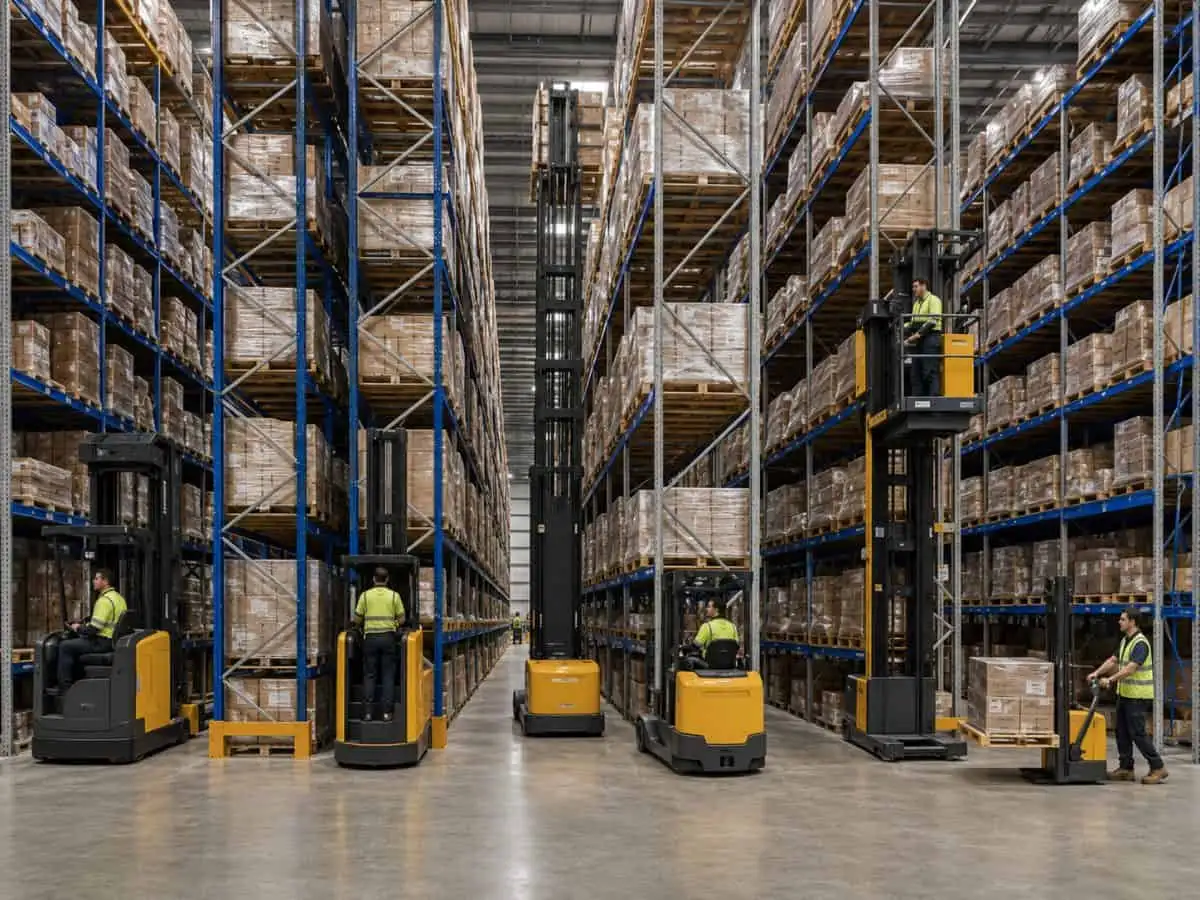
The following shortlist combines major narrow-aisle machine classes with recognised model families available in the Australian market.
1. Crown ESR Series Sit-Down Reach Truck
The Crown ESR range is a strong option for high-bay storage, longer shifts and applications requiring a seated operating position.
The Australian reach-truck category lists the ESR family at up to 2,000 kg capacity and up to 13,560 mm lift height.
Best for: High-bay warehouses with significant travel and stacking.
Advantages:
- Seated operator position
- High lift capability
- Narrow-aisle application
- Suitable for rack and bulk storage
- Electric power
Considerations:
- Aisle requirements depend on the selected chassis and pallet.
- High-lift work requires a suitable floor.
- Residual capacity must be checked at the target height.
2. Crown RR Series Single-Deep Reach Truck
The RR Series is a stand-up reach truck for narrow-aisle pallet handling and single-deep racking.
Crown’s Australian range lists the RR/RD family at up to 2,000 kg capacity and up to 11,225 mm lift height.
Best for: Busy single-deep pallet racking.
Advantages:
- Compact chassis
- Direct access to each pallet
- Suitable for frequent stacking cycles
- Side-stance operation
- Strong warehouse manoeuvrability
Considerations:
- The side-stance layout may require operator familiarisation.
- It is mainly intended for suitable indoor floors.
- The aisle must be calculated using the actual load dimensions.
Businesses comparing this style can also review Raymond reach trucks for narrow aisles.
3. Crown RD Series Double-Deep Reach Truck
The RD Series adds deep-reach capability for storing pallets two positions deep.
Crown’s Australian rental range lists RD deep-reach trucks at up to 1,450 kg and 11,225 mm.
Best for: Double-deep racking and high-density pallet storage.
Advantages:
- Higher storage density than single-deep layouts
- Deep-reach fork mechanism
- Narrow-aisle chassis
- Suitable for high-bay warehouses
Considerations:
- Rear pallets are not directly accessible.
- Residual capacity is especially important with extended forks.
- Inventory planning becomes more complex.
4. Crown RM Series MonoLift Reach Truck
The RM Series uses Crown’s MonoLift mast and is designed for greater capacity and stability at height.
The Australian range lists RM reach trucks at up to 2,000 kg and 12,825 mm.
Best for: High lifts where capacity at height is a major concern.
Advantages:
- High lift capability
- Compact narrow-aisle footprint
- Strong visibility design
- Single-deep pallet access
- Suitable for high-throughput racking
Considerations:
- The required mast may increase collapsed height.
- Warehouse floors and racking tolerances become more important at higher lifts.
- Final capacity depends on the mast, battery and load centre.
5. Crown RMD Series MonoLift Deep-Reach Truck
The RMD combines the MonoLift mast with double-deep reach.
Crown’s Australian equipment range lists the RMD at up to 1,450 kg capacity and 12,825 mm lift height.
Best for: High double-deep racking with limited aisle space.
Advantages:
- Combines height with deep-reach storage
- Increases pallet density
- Narrow-aisle design
- Designed for demanding warehouse applications
Considerations:
- Higher equipment and racking complexity
- Reduced selectivity
- Greater reliance on accurate load data
- More demanding operator task
6. Crown TSP 1000/1500 VNA Turret Truck
The TSP is a specialised very narrow aisle turret truck that can handle pallets and support order-picking tasks.
The current Australian range lists up to 1,500 kg capacity and lift heights up to 17,145 mm.
Best for: Maximum high-bay storage density.
Advantages:
- Very narrow aisle capability
- Extremely high lift
- Turret fork system
- Man-up operation
- Pallet handling and picking capability
Considerations:
- Requires specialist warehouse planning
- May require wire or rail guidance
- Floor flatness is critical
- Higher capital cost
- Operator licensing and fall-protection requirements must be confirmed
7. Crown SP High-Level Order Picker
The SP family is designed for high-level order picking in narrow and very narrow aisles.
Crown’s Australian range includes SP models with capacities up to 1,360 kg and lift heights up to 10,210 mm, depending on the series.
Best for: Picking individual items or cases from elevated storage.
Advantages:
- Operator rises with the platform
- Direct product access
- Suitable for narrow aisles
- Multiple configurations
- Strong option for parts and e-commerce operations
Considerations:
- Not a direct replacement for every pallet-handling forklift
- Requires appropriate operator protection
- Picking productivity depends on warehouse layout
- Load platform capacity must be respected
8. Crown ST/SX Walkie Straddle Stacker
The ST/SX is a compact pedestrian stacker suitable for narrow-aisle rack and bulk storage.
Crown lists this family at up to 1,500 kg capacity and 5,500 mm lift height.
Best for: Small warehouses with short travel distances.
Advantages:
- Compact size
- Lower investment than a ride-on reach truck
- Precise low-speed control
- Suitable for different pallet styles
- Easy to use in congested storage areas
Considerations:
- Slower over longer travel distances
- Lower lift than high-bay reach trucks
- Operator fatigue may increase in large warehouses
- Straddle legs require suitable pallet and racking clearance
9. Crown SH Heavy-Duty Walkie Stacker
The SH is a heavier-duty walkie straddle stacker for larger loads and moderate stacking heights.
The Australian range lists up to 1,800 kg capacity and 4,875 mm lift height.
Best for: Heavier pallets in compact warehouses.
Advantages:
- Higher nominal capacity than lighter stackers
- Compact pedestrian operation
- Suitable for rack and bulk storage
- Strong option where travel is limited
Considerations:
- Lower maximum lift than many reach trucks
- Not ideal for high-throughput long-distance movement
- Pallet base and straddle clearance must be checked
10. Toyota 8FBRE Electric Reach Truck
Toyota’s 8FBRE Series is a practical electric reach-truck option for small and medium warehouse operations.
Toyota Material Handling Australia lists capacities from 1.2 to 1.6 tonnes and maximum lift heights of 8.5 metres. The range was positioned for versatile single-shift applications. (Toyota Material Handling Australia)
Best for: Small to medium warehouses requiring straightforward narrow-aisle pallet handling.
Advantages:
- Recognised industrial brand
- Electric operation
- Multiple capacity options
- Practical reach-truck configuration
- Suitable for single-shift use
Considerations:
- Confirm current model availability and specifications.
- Battery condition is critical when buying used.
- Higher racking may require another configuration.
- Residual capacity must be confirmed.
How to Choose a Narrow Aisle Forklift
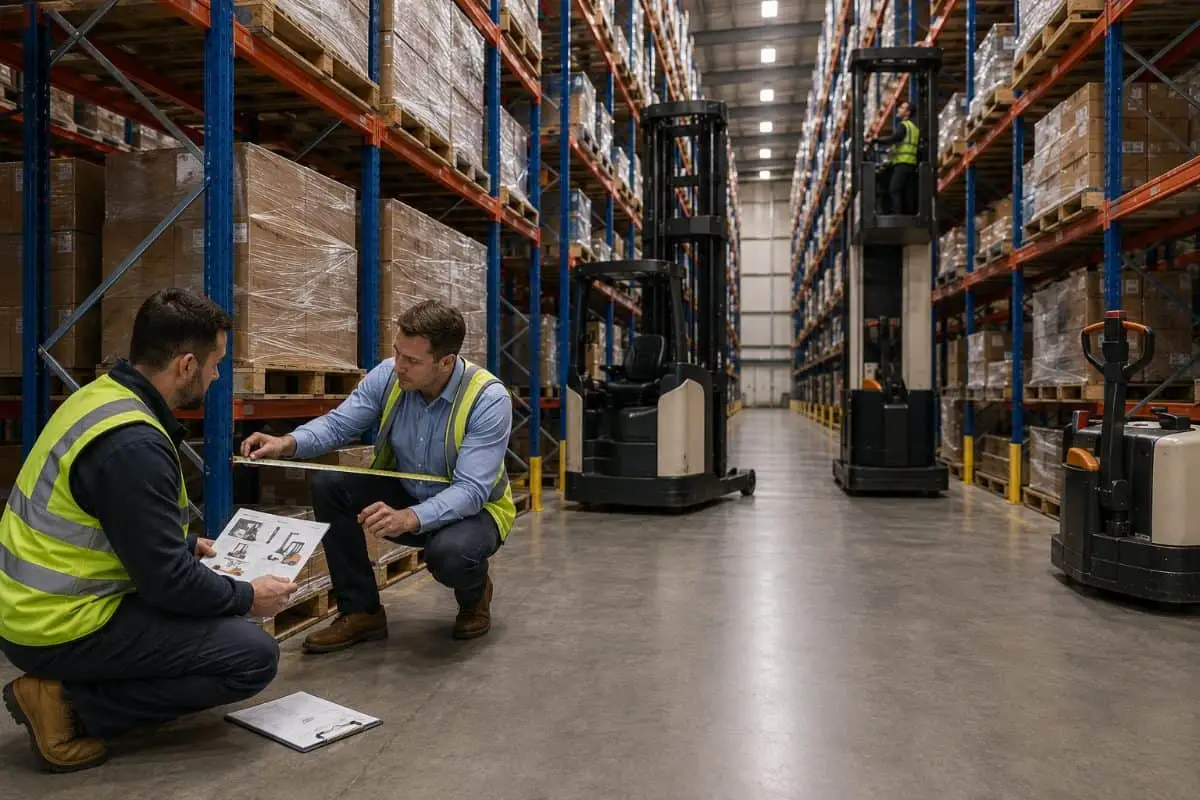
Do not select the truck before measuring the warehouse and defining the task.
1. Measure the Complete Working Aisle
Measure the clear distance between the nearest obstructions, not simply between the front faces of the racking.
Consider:
- Rack protectors
- Pallet overhang
- Upright frames
- Building columns
- Fire equipment
- Floor barriers
- Damaged racking
- Loads protruding into the aisle
- Pedestrian controls
The forklift supplier should calculate the required aisle using the actual truck, fork and load dimensions.
2. Confirm the Load Dimensions
Two pallets of the same weight may require different aisle widths when one is longer or wider.
Record:
- Pallet width
- Pallet depth
- Load overhang
- Load centre
- Maximum weight
- Uneven or offset loads
- Attachment requirements
The machine must suit the real load rather than a standard pallet assumption.
3. Establish the Required Lift Height
Measure from the floor to the highest required fork position.
Allow for:
- Top beam height
- Pallet base
- Load clearance
- Sprinkler clearance
- Roof structure
- Mast configuration
- Building door height
Do not select a forklift whose quoted maximum lift height only just reaches the highest position. Suitable placement and retrieval clearance is required.
4. Check Residual Capacity at Height
A forklift rated to lift 2,000 kg at a standard load centre may handle less when:
- The mast is raised
- The load centre increases
- An attachment is fitted
- The reach mechanism is extended
- A longer load is carried
Ask the supplier for the capacity relevant to:
- Required height
- Actual load centre
- Selected mast
- Fork length
- Attachment
- Battery and chassis configuration
5. Match the Machine to Throughput
Estimate:
- Pallet movements per hour
- Travel distance
- Lift cycles
- Shift length
- Peak workload
- Number of operators
- Charging opportunities
A pedestrian stacker may be economical for occasional work but slow a high-volume warehouse. A specialised VNA machine may offer exceptional storage density but be unnecessary for moderate-height racking.
6. Assess Floor Flatness and Condition
Narrow aisle machines operating at height depend on stable and predictable floors.
Check for:
- Uneven joints
- Cracks
- Slopes
- Surface damage
- Drainage channels
- Debris
- Changes in floor level
- Traction
- Floor load capacity
The importance of floor tolerances increases as the aisle narrows and lift height rises.
7. Determine Whether Guidance Is Needed
Very narrow aisle trucks may use:
- Rail guidance: Guide rollers follow rails installed along the aisle.
- Wire guidance: A sensor follows an embedded wire or signal in the floor.
- Free-ranging operation: The operator steers without a fixed aisle-guidance system.
- Electronic assistance: Sensors or positioning systems support aisle entry and travel.
A guidance system may allow more consistent aisle positioning, but it adds infrastructure, installation and maintenance requirements.
8. Select the Right Power System
Most indoor narrow aisle machines are electric.
Compare:
- Lead-acid battery
- Lithium-ion battery
- Battery capacity
- Charger compatibility
- Opportunity charging
- Battery-change requirements
- Available electrical supply
- Shift length
- Cold-store use
A used forklift should include a battery assessment rather than relying on its displayed charge level.
9. Consider Operator Comfort and Visibility
Operator comfort can affect accuracy and productivity across a long shift.
Assess:
- Seated or standing position
- Side stance or forward-facing operation
- Control layout
- Entry and exit
- Mast visibility
- Camera systems
- Vibration
- Cabin options
- Heating for cold storage
- Platform space
- Emergency lowering arrangements
Have operators test the shortlisted equipment where possible.
10. Confirm Licensing and Training
A narrow aisle machine does not create a separate universal forklift-licence category simply because it works in tight aisles. The required licence depends on the equipment and how it operates.
A standard forklift truck generally falls under the relevant forklift high-risk work classification, while an order-picking forklift that raises the operator with the controls may fall under the order-picking classification. Confirm the exact requirement with the applicable workplace regulator and the machine supplier.
Site-specific training is also required because reach, articulated, turret and man-up trucks have different controls, stability characteristics and emergency procedures.
11. Compare Parts and Service Support
Check:
- Local technician coverage
- Parts availability
- Battery support
- Diagnostic equipment
- Attachment support
- Response times
- Maintenance plans
- Availability of replacement tyres and wheels
- Experience with specialised VNA machines
The most advanced forklift is a poor investment when downtime is extended by limited local support.
Buyers reviewing brands can view available Crown forklifts.
12. Compare New and Used Narrow Aisle Forklifts
A used reach truck can offer strong value when:
- The application is standard
- The machine has complete records
- The battery is tested
- The mast suits the building
- The required capacity is confirmed
- Local support is available
New equipment may be more suitable when:
- A precise mast configuration is required
- A VNA guidance system is being installed
- The truck will operate intensive shifts
- Current battery technology is important
- Full warranty is required
- A specialised attachment is needed
Used VNA and high-lift equipment requires a particularly detailed inspection. Small differences in mast, guidance, chassis or control configuration can make the machine unsuitable for the warehouse.
Use the broader guide on how to choose the right forklift before comparing final prices.
Narrow Aisle vs Standard Forklift: Is It Worth It?
A narrow aisle forklift can be worth the investment when increasing pallet positions or using more vertical space produces a measurable return.
Potential Benefits
- More racking within the same warehouse
- Better access to high storage levels
- Reduced need to relocate
- Improved use of expensive floor space
- Greater pallet density
- Specialised order-picking capability
- More efficient indoor handling
Potential Trade-Offs
- Higher equipment cost
- Stricter floor requirements
- Specialised operator training
- More complex battery needs
- Guidance-system installation
- Reduced outdoor versatility
- Greater reliance on accurate aisle discipline
- Higher maintenance complexity for some machines
A standard counterbalance forklift remains more versatile for loading vehicles, outdoor work and travelling across mixed surfaces. A reach or VNA truck is primarily a storage specialist.
Many operations use both:
- A counterbalance forklift for receiving and dispatch
- A reach or VNA forklift for storage
- A stacker or order picker for lighter internal tasks
The investment should be assessed against the additional pallet locations, throughput improvement and building cost it may avoid.
Frequently Asked Questions
1. What Is the Narrowest Aisle a Forklift Can Operate In?
There is no single minimum aisle width for every forklift. The required width depends on the machine’s turning geometry, chassis, load length, pallet orientation, racking clearance and guidance system. Very narrow aisle turret trucks generally work in tighter spaces than reach trucks, while reach trucks require less room than standard counterbalance machines.
2. What Is the Difference Between a Narrow Aisle and Very Narrow Aisle Forklift?
A narrow aisle forklift, such as a reach truck, normally steers and positions within the aisle to place a load. A very narrow aisle truck typically uses rotating or traversing forks and may follow wire or rail guidance, allowing it to handle loads without turning the complete machine across the aisle.
3. Is a Reach Truck a Narrow Aisle Forklift?
Yes. A reach truck is one of the most common narrow aisle forklifts. Its retractable load mechanism and compact chassis allow it to stack pallets in tighter racking aisles than most counterbalance forklifts.
4. What Is a Turret Truck?
A turret truck is a very narrow aisle forklift with a fork assembly that rotates or traverses to handle loads on either side of the aisle. The complete machine does not need to turn through 90 degrees to face the racking.
5. Do Narrow Aisle Forklifts Need Special Floors?
Some reach trucks can operate on standard warehouse floors that are level and maintained appropriately. High-lift VNA equipment often requires tighter floor-flatness tolerances because small floor variations can create greater mast movement at height. The floor should be assessed for the selected machine and lift height.
6. Do Very Narrow Aisle Forklifts Need Wire or Rail Guidance?
Not every VNA forklift requires fixed guidance, but many high-density systems use wire or rail guidance to maintain accurate positioning inside the aisle. The requirement depends on the forklift, aisle width, rack design, travel speed and warehouse layout.
7. What Forklift Licence Is Needed for Narrow Aisle Equipment?
The required high-risk work licence depends on the machine type rather than aisle width alone. Conventional reach trucks generally fall within the relevant forklift-truck classification, while order-picking machines that raise the operator with the controls may require the order-picking classification. Confirm the requirement with the local regulator and equipment supplier.
Conclusion
The best narrow aisle forklift is the machine that fits the actual aisle, load, racking and workload without sacrificing capacity or safe clearance. Reach trucks suit most single-deep warehouse applications, while double-deep trucks increase pallet density and VNA turret trucks support the tightest high-bay layouts.
Order pickers and stackers serve different roles and should not be selected as cheaper substitutes without considering travel distance, pallet weight and required lift height.
Measure the warehouse first, then confirm residual capacity, floor condition, battery requirements, guidance, operator needs and service support. Final specifications should always be checked against the individual forklift and its intended configuration.