
Double-Deep Forklifts: What They Are and When to Use One
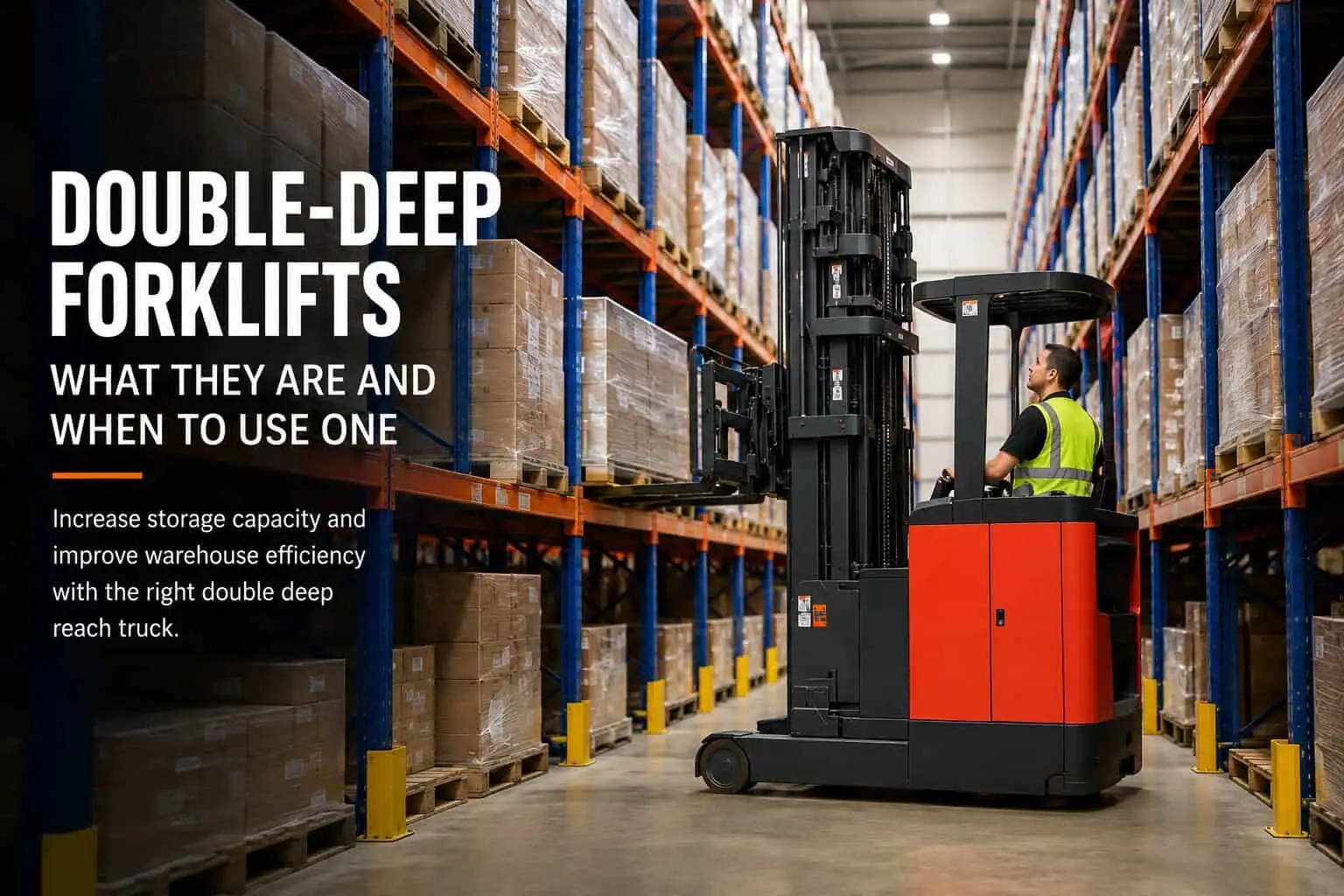
Warehouse space is expensive, and many Australian businesses need more pallet storage without moving to a larger site. That is where double-deep forklifts can be useful.
Built for high-density warehouse storage, these machines help operators access pallets stored two positions deep in racking. They are especially useful in warehouses handling bulk stock, repeated SKUs, cold storage goods, food and beverage products, or high-volume inventory.
This guide explains what double-deep forklifts are, how they work, when to use one, and what to check before buying a used double deep reach truck in Australia.
What Is a Double-Deep Forklift?
A double-deep forklift is a warehouse forklift designed to access pallets stored two positions deep in pallet racking. In most warehouse settings, the more accurate term is double deep reach truck, because these machines use an extended reach mechanism to place or retrieve pallets from the second racking position.
They are mainly used in warehouses that need better storage density without adding more floor space.
- Main use: Accessing pallets stored two rows deep in racking.
- Best environment: Indoor warehouses with level floors and double deep pallet racking.
- Key advantage: More pallet storage capacity with fewer aisles than standard selective racking.
- Best suited for: Bulk stock, repeated SKUs, cold storage, manufacturing and distribution warehouses.
What Does “Double Deep” Mean in Warehouse Storage?
In warehouse storage, double deep means pallets are stored two rows deep in the racking system instead of one. The front pallet sits closest to the aisle, while the second pallet sits directly behind it.
This setup allows warehouses to store more pallets within the same floor area because fewer aisles are needed. However, it also means the forklift must be able to reach past the first pallet position to access the rear pallet, which is why double deep layouts often need equipment designed for high-bay racking and deeper pallet access.
Double deep storage is best suited to warehouses that handle multiple pallets of the same product, rather than operations that need direct access to every single pallet at all times.
| Feature | Standard Selective Racking | Double Deep Racking |
| Pallet depth | One pallet deep | Two pallets deep |
| Pallet access | Direct access to each pallet | Rear pallet access may require moving the front pallet |
| Storage density | Lower | Higher |
| Aisle requirement | More aisles needed | Fewer aisles needed |
| Best suited for | Many SKUs and frequent picking | Bulk stock and repeated SKUs |
| Equipment needed | Standard forklift or reach truck | Double deep reach |
How Does a Double-Deep Forklift Work?
A double-deep forklift works by using an extended reach mechanism to access pallets positioned deeper inside the racking system. Instead of only placing or retrieving the pallet closest to the aisle, the machine can reach into the second pallet position.
This is why double deep reach trucks are commonly used in high-density warehouse layouts. They allow operators to work safely within the aisle while still accessing pallets stored further back in the rack.
- The operator lines up with the racking bay.
The forklift is positioned squarely in front of the pallet location to keep the load stable during placement or retrieval. - The reach mechanism extends forward.
The forks move beyond the front pallet position so the machine can access the rear pallet. - The pallet is lifted or placed into position.
The operator carefully raises, lowers or retrieves the pallet from the second-deep location. - The reach mechanism retracts.
Once the pallet is secure, the forks retract so the load sits closer to the forklift before the machine moves away. - The operator exits the aisle safely.
The forklift travels with the load controlled and positioned correctly for safe movement through the warehouse.
Because the machine reaches deeper into the racking system, operator skill matters. Good visibility, correct load handling, stable flooring and compatible racking all play an important role in safe double deep forklift operation.
Double-Deep Forklift vs Double Deep Reach Truck: Are They the Same?
In most warehouse settings, the term double-deep forklift usually refers to a double deep reach truck. “Forklift” is the broader term people use when searching, while “double deep reach truck” is the more accurate equipment name.
A standard counterbalance forklift is not usually the right machine for double deep pallet racking. Double deep racking needs a forklift with the reach, lift height and stability to access pallets stored two positions deep. That is why many warehouses use specialised reach trucks for this type of storage system.
The difference matters when buying used equipment. If your warehouse has double deep racking, you should check that the machine is designed for double deep operation, not just general pallet handling. This is also where understanding the difference between reach trucks and forklifts can help you choose the right machine for your site.
| Term | What It Usually Means |
| Forklift | A broad term for powered machines used to lift and move loads |
| Reach truck | A warehouse forklift designed for narrow aisles and pallet racking |
| Double deep reach truck | A specialised reach truck designed to access pallets stored two positions deep |
| Double-deep forklift | A common search term often used to describe a double deep reach truck |
When comparing machines, focus on the actual specifications rather than the name alone. Check the lift height, load capacity, reach depth, battery condition, mast setup, service history and whether the truck suits your warehouse racking layout.
When Should You Use a Double-Deep Forklift?
A double-deep forklift is best used when your warehouse needs to store more pallets in the same floor area. It is not the right choice for every operation, but it can be very effective when your racking, stock profile and warehouse workflow are suited to high-density storage.
When You Need More Pallet Storage Without Expanding
If your warehouse is running out of storage space, double deep racking can help increase pallet capacity without moving to a larger site. Because pallets are stored two positions deep, the layout can reduce the number of aisles needed compared with standard selective racking.
This makes double-deep forklifts useful for Australian warehouses where floor space is limited, rent is increasing, or storage demand has grown faster than the available building footprint. It can also form part of choosing a high-performing forklift for warehouse storage and pallet movement.
When You Store Multiple Pallets of the Same Product
Double deep storage works best when you have several pallets of the same SKU or product type. This is because the rear pallet is not always as easy to access as the front pallet.
It can suit:
- Food and beverage warehouses
- Cold storage facilities
- Manufacturing warehouses
- Wholesale distribution centres
- Bulk product storage
- FMCG operations
- Warehouses with predictable stock rotation
For example, if you store multiple pallets of the same product in each racking bay, double deep storage can make sense. If every pallet needs immediate individual access, standard selective racking may be more practical.
When Your Warehouse Already Uses Double Deep Racking
A double-deep forklift should match the racking system it is expected to work with. If your warehouse already has double deep pallet racking, you need a machine with the correct reach depth, lift height and load capacity to access the rear pallet positions safely.
Before buying, always check the forklift against your actual racking layout. This includes aisle width, beam height, pallet size, pallet weight and the depth of the racking system.
When You Want Better Space Use Than Standard Racking
Double-deep forklifts are useful when storage density is more important than direct access to every pallet. They are commonly used in warehouses where space efficiency, pallet volume and stock rotation are major priorities.
| Warehouse Scenario | Is a Double-Deep Forklift Suitable? |
| You need to increase pallet storage capacity | Yes |
| You store many pallets of the same SKU | Yes |
| You use double deep pallet racking | Yes |
| You need direct access to every pallet | Not always |
| You handle many small SKU quantities | Usually not ideal |
| You operate mainly outdoors | Usually not suitable |
| You work indoors on level warehouse floors | Yes |
When Should You Not Use a Double-Deep Forklift?
A double-deep forklift is useful for high-density storage, but it is not always the best fit. Some warehouses are better suited to standard reach trucks, counterbalance forklifts, or selective racking layouts.
You may not need a double-deep forklift if:
- You need direct access to every pallet.
Double deep storage can limit immediate access to rear pallets, especially when a front pallet is already in place. - You handle many different SKUs in small quantities.
If your warehouse stores a wide variety of products with low pallet volume per SKU, selective racking may be more practical. - Your racking is not designed for double deep storage.
The forklift must match the racking layout. Standard racking will not automatically suit double deep operation. - Your floors are uneven or damaged.
Reach trucks work best on smooth, level indoor warehouse floors. Poor floor condition can affect stability, precision and safety. - Your operators are not trained for deep reach handling: Double deep operation requires careful control, especially when placing or retrieving pallets from the second-deep position. Proper forklift operator training is important before using equipment that reaches deeper into pallet racking.
- Your work is mainly outdoors.
Double deep reach trucks are usually designed for indoor warehouse use, not rough yards, gravel surfaces or exposed outdoor areas. - Your pallet sizes or weights vary too much.
Inconsistent pallets can make double deep storage harder to manage safely and efficiently.
In short, a double-deep forklift makes sense when storage density matters and your warehouse is set up for it. If your priority is fast access to every pallet, a standard reach truck or counterbalance forklift may be the better option.
Benefits of Double-Deep Forklifts
The main benefit of a double-deep forklift is better use of warehouse space. By allowing pallets to be stored two positions deep, these machines help businesses increase storage capacity without needing a larger warehouse.
Better Warehouse Storage Density
Double deep racking can store more pallets in the same floor area because it reduces the number of aisles needed. Instead of every pallet row requiring its own aisle access, pallets are stored deeper within the racking system.
For Australian warehouses where rent, storage demand and available space are constant pressures, this can make a major difference to day-to-day operations.
Good for Bulk Pallet Storage
Double-deep forklifts are well suited to warehouses that handle large quantities of the same product. They work best when stock can be stored in grouped pallet positions, rather than every pallet needing immediate individual access.
This makes them useful for:
- Food and beverage stock
- Packaged goods
- Manufacturing materials
- Wholesale inventory
- Cold storage products
- Seasonal stock
- High-volume distribution
Efficient Use of Indoor Warehouse Layouts
A double deep reach truck is designed for indoor warehouse use, especially where pallet racking, aisle width and storage layout need to work together. When matched with the right racking system, it can help create a more efficient storage layout without sacrificing safe pallet handling.
This is especially useful in warehouses that already use narrow aisles, high racking or structured pallet storage.
Lower Pressure to Expand or Relocate
When storage demand grows, many businesses assume they need a larger warehouse. In some cases, improving the racking layout and using the right forklift can help increase usable capacity within the existing site.
A double-deep forklift will not solve every storage problem, but it can help delay expansion costs when the warehouse has the right stock profile, floor condition and racking setup.
Strong Fit for Predictable Stock Rotation
Double deep storage works best when stock movement is organised and predictable. If your warehouse stores multiple pallets of the same product and follows a clear stock rotation system, a double-deep forklift can support efficient pallet movement without creating unnecessary handling delays.
Limitations and Safety Considerations
A double-deep forklift can improve warehouse storage capacity, but it also needs the right setup, operators and handling process. Because the machine reaches further into the racking system, small issues with visibility, load control or racking compatibility can create bigger problems.
| Consideration | Why It Matters |
| Operator visibility | Rear pallet positions can be harder to see clearly, especially at height |
| Load stability | Extended reach changes how the load behaves during placement and retrieval |
| Racking compatibility | The forklift must suit the depth, height and layout of the racking system |
| Floor condition | Reach trucks need smooth, level indoor floors for safe and accurate operation |
| Battery condition | Most double deep reach trucks are electric, so battery performance affects uptime |
| Operator training | Skilled operators reduce the risk of racking damage, pallet damage and downtime |
| Aisle width | The forklift needs enough space to turn, align and operate safely |
| Pallet quality | Damaged or inconsistent pallets can make deep racking harder to handle safely |
Before using or buying a double-deep forklift, check that the machine is suitable for your warehouse layout. This includes the aisle width, racking depth, lift height, load weight, pallet size and floor condition.
It is also important to make sure operators are trained for double deep reach truck operation. Handling pallets two positions deep requires more care than standard pallet movement, especially when working at height or moving heavy loads. A regular forklift safety inspection process can also help identify issues before they affect daily operation.
Double-Deep Forklift vs Standard Reach Truck
A double-deep forklift and a standard reach truck are both designed for warehouse racking, but they are not built for the same storage layout. The main difference is how far the machine can reach into the racking system.
A standard reach truck is usually used for single-deep pallet racking, where each pallet is placed directly at the front of the rack. A double deep reach truck is designed to access pallets stored two positions deep, making it better suited to high-density storage.
| Feature | Standard Reach Truck | Double Deep Reach Truck |
| Best use | Single-deep pallet racking | Double deep pallet racking |
| Pallet access | Accesses one pallet position deep | Accesses two pallet positions deep |
| Storage density | Good | Higher |
| Aisle use | Works well in narrow aisles | Works well in high-density warehouse layouts |
| Visibility | Generally easier for operators | More demanding, especially at rear positions |
| Operator skill | Moderate | Higher |
| Best environment | Indoor warehouses with selective racking | Indoor warehouses with double deep racking |
| Main advantage | Fast access to individual pallets | More pallet storage in the same floor area |
A standard reach truck may be the better choice if your warehouse needs direct access to every pallet. A double deep reach truck may be the better choice if your priority is storing more pallets and your stock profile suits grouped pallet storage.
Before choosing between the two, check your racking layout, aisle width, pallet weights, lift height and how often operators need to access individual pallets.
What to Check Before Buying a Used Double-Deep Forklift in Australia
Buying a used double-deep forklift is not just about finding the right price. Start with a proper used forklift pre-purchase checklist so you can compare condition, capacity, battery health and suitability before committing.
Use this checklist before buying a used double deep reach truck.
Load Capacity
Check the forklift’s rated load capacity and make sure it suits your heaviest pallets. Do not only look at the maximum capacity. Capacity can reduce at higher lift heights or when reaching deeper into the racking system. If you are unsure what your site needs, it can help to review a forklift weight capacity guide before comparing machines.
Lift Height
Measure your highest racking beam and compare it with the forklift’s maximum lift height. The machine should comfortably reach your top pallet positions while still operating within its safe rated capacity.
Reach Depth
This is one of the most important checks. A double deep reach truck must be able to access the second pallet position in your racking system. Confirm the reach depth against your actual racking layout before buying.
Battery Condition
Most double deep reach trucks are electric, so battery health matters. Check the battery age, charger type, charging requirements and expected runtime. It is also worth understanding how much a forklift battery costs, because battery replacement can significantly affect the total value of a used machine.
Mast and Reach Mechanism
Inspect the mast, rollers, chains, hydraulics and reach mechanism. The reach system should extend and retract smoothly without unusual noise, delay or movement. Any issues here can affect safety and productivity.
Forks and Attachments
Check the fork condition, fork length and any attachments included with the machine. Bent, worn or mismatched forks can affect safe pallet handling, especially in deep racking.
Service History
Ask for the service history where available. A used double-deep forklift with regular maintenance, recent servicing and clear condition notes is usually a safer investment than one with limited records.
Hours of Use
Operating hours help show how heavily the machine has been used. However, hours should be considered alongside condition, service history, battery health and the type of work the forklift has been doing.
Racking and Aisle Compatibility
Confirm that the forklift can work safely in your warehouse aisles. Check turning space, aisle width, racking depth, pallet size and floor condition before committing to a machine.
Warranty, Finance and Delivery
A used forklift should be assessed as a business investment, not just a one-off purchase. Check whether the supplier offers warranty, forklift finance, delivery and after-sales support in your area.
| What to Check | Why It Matters |
| Load capacity | Ensures the forklift can safely handle your pallet weights |
| Lift height | Confirms the machine can reach your racking levels |
| Reach depth | Makes sure it can access the second pallet position |
| Battery condition | Affects runtime, reliability and future replacement costs |
| Service history | Shows how well the machine has been maintained |
| Aisle compatibility | Confirms the forklift can operate safely in your warehouse |
| Warranty and support | Reduces risk after purchase |
Before buying, speak with the supplier about your warehouse layout, racking dimensions, pallet weights and daily usage. This makes it easier to choose a used double deep reach truck that suits your operation rather than guessing from the listing alone.
How Much Does a Double-Deep Forklift Cost in Australia?
The cost of a double-deep forklift in Australia depends on the machine’s age, brand, condition, lift height, load capacity, battery health and included support. Used double deep reach trucks can vary significantly in price, especially when comparing machines with different operating hours, battery ages and service histories.
A lower purchase price is not always the better deal. If the battery is near the end of its working life, the reach mechanism needs repairs, or the machine has limited service records, the total cost of ownership can increase quickly.
When comparing prices, look at the full value of the machine, not just the advertised figure.
| Cost Factor | Why It Affects Price |
| Brand and model | Well-known brands may hold value better and be easier to service |
| Year of manufacture | Newer machines usually cost more than older units |
| Operating hours | Lower hours can suggest less wear, but condition still matters |
| Battery condition | Battery age and performance can heavily affect long-term value |
| Lift height | Higher lift capacity can increase machine value |
| Load capacity | Higher-rated machines may cost more |
| Service history | Well-maintained forklifts are usually more valuable |
| Warranty | Warranty can reduce risk after purchase |
| Charger included | A compatible charger can save extra setup costs |
| Delivery and finance | These can affect the total cost of getting the machine operational |
Price Tip
Before choosing a used double deep reach truck, compare the price against the machine’s condition, battery health, warranty, charger, service history and suitability for your racking. A forklift that is correctly matched to your warehouse will usually provide better long-term value than the cheapest available option.
Recommended Double-Deep Forklifts at Buy A Fork
If a double-deep forklift suits your warehouse, the next step is choosing a machine that matches your racking, pallet weights and daily workload. For many Australian warehouses, this means looking for a used double deep reach truck with the right lift height, reach depth, battery condition and service history.
Buy A Fork stocks used forklifts and reach trucks for Australian businesses, including machines suited to high-density warehouse storage. A relevant example is the 2018 1.5t Raymond Electric Double Deep Reach Truck, which is the type of machine buyers may compare when they need deeper reach capability for pallet racking.
When comparing available options, look closely at the specifications rather than choosing by price alone.
Key details to compare include:
- Lift height: Make sure the forklift can safely reach your highest pallet positions.
- Load capacity: Check that the rated capacity suits your heaviest pallets.
- Battery condition: Confirm battery age, charger compatibility and expected runtime.
- Operating hours: Compare hours against age, condition and service records.
- Reach capability: Make sure the machine is suitable for double deep racking.
- Warranty: Check what support is included after purchase.
- Delivery and finance: Ask whether the machine can be delivered to your site and whether finance is available.
A used double deep reach truck can be a practical investment when it is correctly matched to your warehouse. If you are unsure what machine suits your site, speak with the Buy A Fork team about your racking layout, pallet weights, lift height and daily usage before buying.
Final Thoughts
Double-deep forklifts are a strong option for warehouses that need more pallet storage without expanding their floor space. They are best suited to indoor operations with double deep racking, consistent pallet sizes, repeated SKUs and trained operators.
Before buying a used double deep reach truck, check the lift height, load capacity, reach depth, battery condition and racking compatibility. The right machine can improve storage efficiency, reduce space pressure and support smoother warehouse operations.
FAQs About Double-Deep Forklifts
1. What is a double-deep forklift?
A double-deep forklift is a warehouse forklift designed to access pallets stored two positions deep in racking. In most cases, this refers to a double deep reach truck, which uses an extended reach mechanism to place or retrieve pallets from deeper racking positions.
2. Is a double-deep forklift the same as a reach truck?
A double-deep forklift is usually a type of reach truck. The broader term “forklift” is commonly used in search, but the more accurate equipment name is double deep reach truck. These machines are designed for indoor warehouse racking and high-density pallet storage.
3. What is double deep racking?
Double deep racking is a pallet storage system where pallets are stored two rows deep instead of one. This increases storage density by reducing the number of aisles needed, but it also means the warehouse needs a suitable forklift that can reach the rear pallet positions.
4. When should you use a double-deep forklift?
You should use a double-deep forklift when your warehouse needs more pallet storage capacity and your stock profile suits high-density storage. It is best for warehouses that store multiple pallets of the same SKU, operate indoors on level floors, and use double deep pallet racking.
5. Can a normal forklift access double deep racking?
A standard counterbalance forklift is usually not suitable for double deep racking. The machine needs the correct reach capability, lift height, stability and racking compatibility. In most cases, a double deep reach truck is the better option.
6. Are double-deep forklifts suitable for outdoor use?
Double-deep forklifts are usually designed for indoor warehouse use. They work best on smooth, level floors with structured pallet racking. If your work is mainly outdoors, on uneven surfaces or in a yard, another forklift type may be more suitable.
7. What should I check before buying a used double-deep forklift?
Before buying a used double-deep forklift, check the load capacity, lift height, reach depth, battery condition, operating hours, mast condition, service history, warranty, charger compatibility and whether the machine suits your warehouse racking layout.
8. Where can I buy a used double deep reach truck in Australia?
You can buy used double deep reach trucks from Australian forklift suppliers such as Buy A Fork. Before purchasing, compare each machine’s specifications against your racking layout, pallet weights, lift height requirements and daily workload.