
What Is a Reach Truck? Uses, Sizes and Lift Heights
· Updated
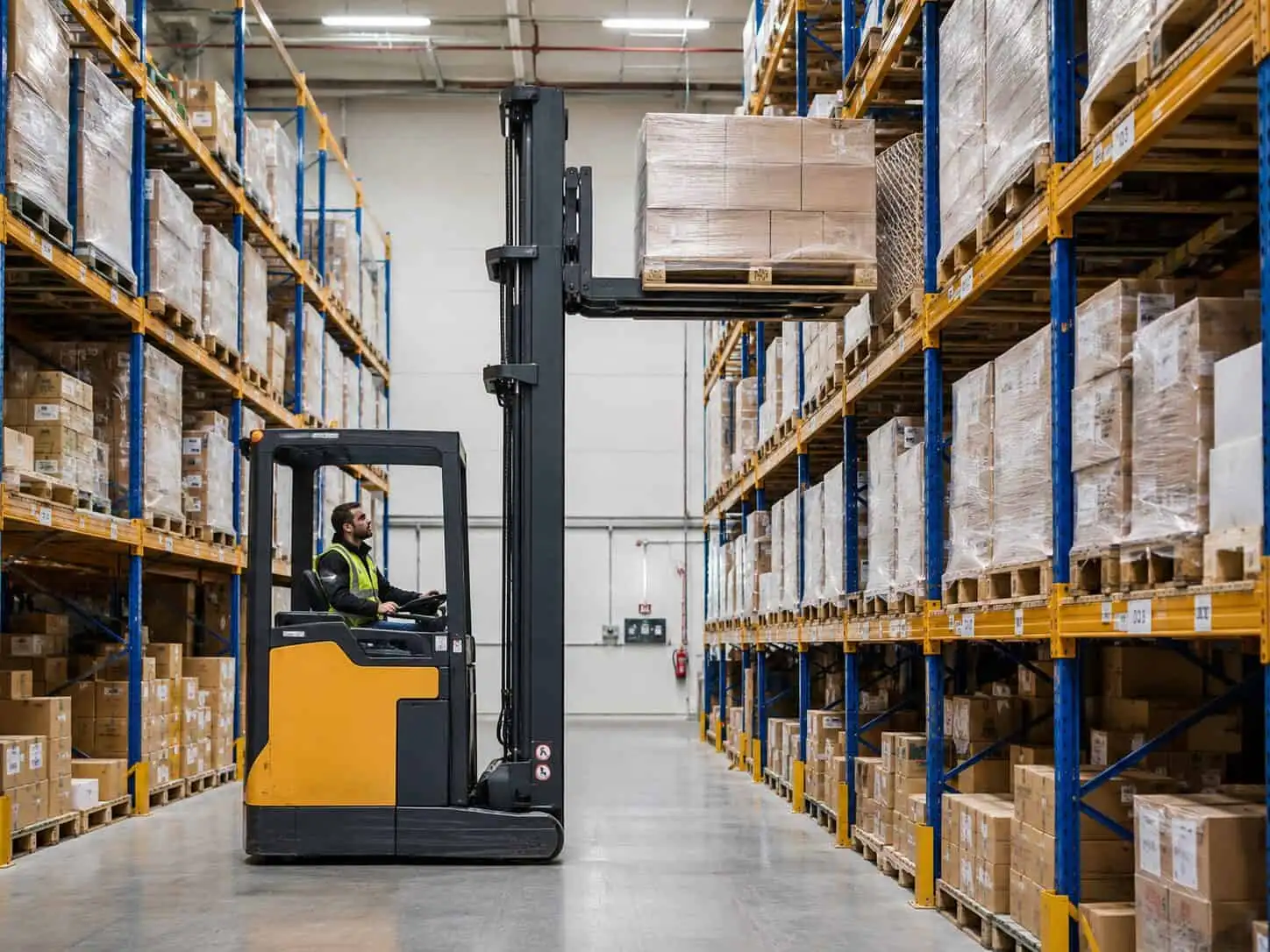
A reach truck is the machine that lets a warehouse store more without moving building. It works in an aisle roughly a metre narrower than a counterbalance forklift needs, and it lifts considerably higher.
The trade is that it carries less, it belongs indoors, and it is unforgiving about floor condition. Those three constraints are why most warehouses end up running a reach truck and a counterbalance rather than choosing between them.
This guide covers how the reach mechanism actually works, the capacities and lift heights available, the aisle width it needs against the alternatives, what licence the operator requires in Australia, and what to check when you are buying one.
What Is a Reach Truck?
A reach truck is an electric warehouse forklift that extends its mast or forks forward, beyond the wheelbase, to place and retrieve pallets from racking. Because the load moves out to the rack rather than the whole machine turning to face it, a reach truck works in a much narrower aisle than a counterbalance forklift of the same capacity.
That is the entire idea, and every other characteristic follows from it. The machine is narrow, it is electric and built for indoor use, the operator usually stands or sits sideways rather than facing forward, and it lifts higher than a counterbalance while carrying less.
In Australian warehouses reach trucks do the replenishment and retrieval work: bringing full pallets from goods inward into the racking and pulling them back out again. They are not yard machines and they are not general-purpose.
How a Reach Truck Works
On a counterbalance forklift the load sits ahead of the front axle and a heavy counterweight at the rear balances it. That geometry is stable and simple, and it means the machine must physically turn ninety degrees to face the rack, which is why it needs a wide aisle.
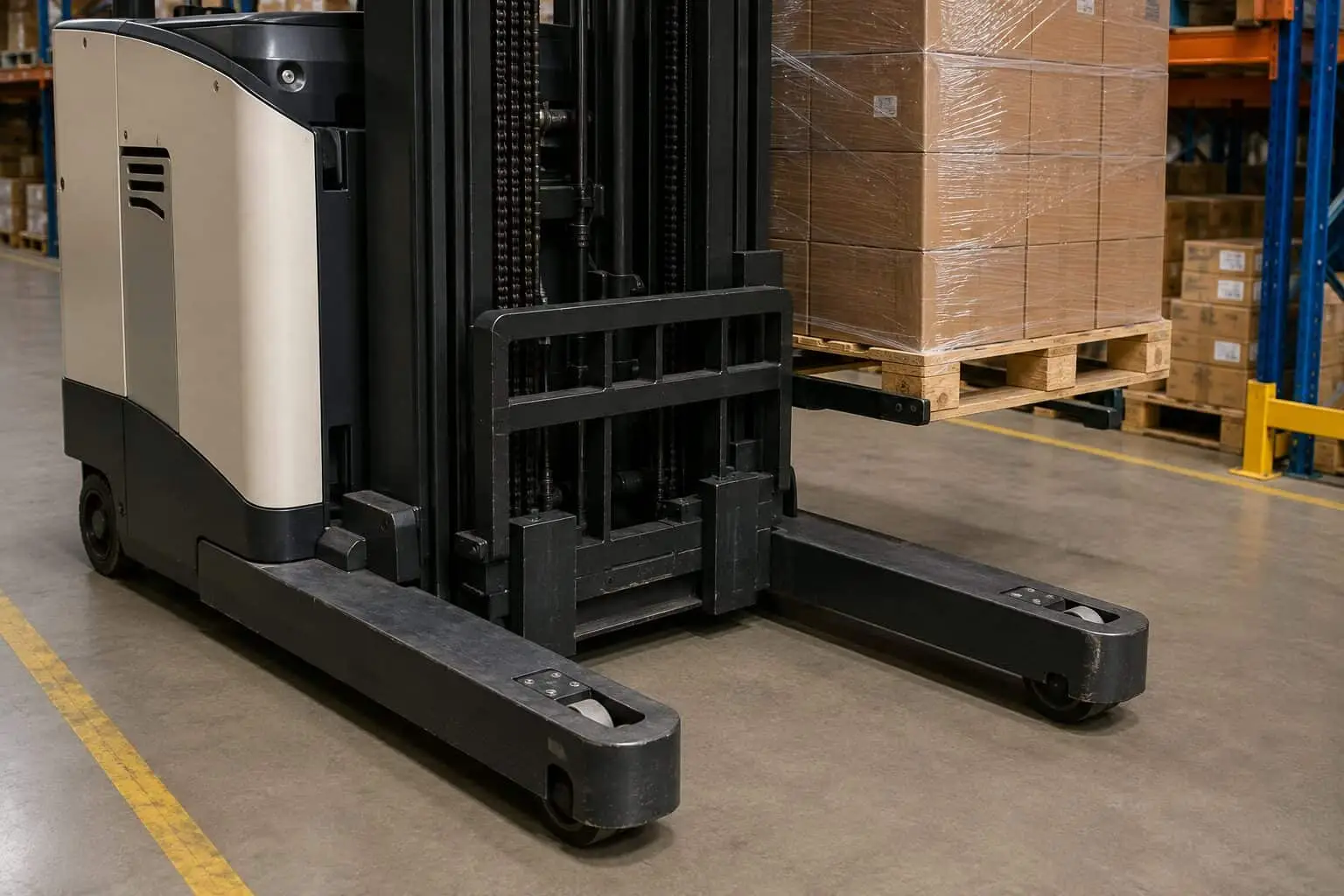
A reach truck removes the counterweight problem by keeping the load inside the wheelbase while travelling. Stabilising legs, called outriggers, run forward on either side at floor level, and the load sits between them. The machine is short, narrow and stable without a large counterweight, and it travels down the aisle with the pallet tucked in.
When it reaches the bay, the mast or the fork carriage extends forward over those outriggers to deposit the pallet into the rack. The machine barely moves. Once the load is placed, the mast retracts and the truck travels on.
There is a trade-off in that design and it is worth being honest about. During the reach stroke the load moves outside the wheelbase and the machine’s stability depends on the outriggers and on the floor being flat. That is why reach trucks are indoor machines, and why floor condition matters more to them than to almost anything else in a warehouse.
Reach Truck Sizes, Capacities and Lift Heights
Reach trucks cluster in a narrower capacity band than counterbalance forklifts, because they are built for pallet handling in racking rather than for gross lifting. The figures below come from published manufacturer specifications.
|
Machine |
Rated capacity |
Load centre |
Maximum lift height |
Overall width |
Minimum aisle |
|
Toyota 8-Series stand-up reach forklift |
1,000kg to 3,000kg |
Not published on the range page |
7,000mm |
Not published on the range page |
2,640mm |
|
Crown ESR 1020 |
1.4t or 1.6t |
600mm |
Up to 4,950mm on tilting duplex |
1,120mm |
2,522mm |
|
Crown ESR 1040 |
1.4t or 1.6t |
600mm |
Mast dependent |
1,285mm |
2,539mm |
|
Crown ESR 1060 / 5200 super duty |
Up to 2.0t |
600mm |
Up to 13,560mm on triplex |
1,285mm and above |
2,591mm |
Figures from Toyota Material Handling Australia 8-Series stand-up product specifications and Crown ESR 1000 and ESR 5200 series specification sheets, pulled 23 August 2026. Aisle figures depend on pallet size and battery option. Confirm against the specific machine and your own pallet.
Two patterns are worth noting. Capacity sits mostly between 1.4 and 2.0 tonnes, which is well below a typical counterbalance, and lift height goes far higher, to more than thirteen metres on a super duty triplex mast.
Those two facts are connected. A machine reaching thirteen metres cannot carry two tonnes up there, and the capacity available at height is materially lower than the rating on the plate. Choosing a reach truck for high-bay racking is a separate question that turns on the residual capacity at your top beam rather than on the headline figure.
Types of Reach Truck
Two mechanisms are common and they solve the same problem differently.
A moving mast reach truck slides the entire mast assembly forward along the outriggers. The whole mast, carriage and load travel out together. This is the more common arrangement; it handles heavier loads well, and it keeps the mast structure supported through the stroke.
A moving carriage or pantograph reach truck keeps the mast fixed and extends only the fork carriage on a scissor mechanism. The reach stroke is usually shorter and the machine can be more compact, which suits tighter layouts and lighter loads.
Alongside that split sits the operator position. A stand-up reach truck suits high-frequency work with regular dismounting, which is most picking and replenishment. A sit-down or seated sideways layout suits longer travel distances and full shifts, where standing becomes tiring.
Mast configuration then decides the height. A duplex mast has two stages and a free lift cylinder. A triplex adds a third stage, which lets the machine reach much higher while keeping its lowered height low enough to pass under doorways and sprinklers. The mast is what turns one chassis into machines with very different working ranges, and on a reach truck it is the specification with the widest effect on price.
How Much Aisle Does a Reach Truck Need?
This is the number that justifies the machine, so it is worth putting against the alternative directly.
Toyota publishes an aisle width of 3,550mm for its 8FB battery counterbalance range and 2,640mm for its 8-Series stand-up reach forklift. Crown’s ESR 1000 series specifies between 2,522mm and 2,591mm depending on model. On those figures a reach truck releases roughly nine hundred millimetres to a metre of aisle width compared with a counterbalance.
Across a warehouse with several aisle runs, that is a significant amount of floor. It either becomes additional racking or it becomes rent you stop paying for space you were not using, and in most Melbourne industrial tenancies that is the calculation that pays for the machine.
Two cautions. The published figure is a minimum measured with a nominated pallet under ideal conditions, so build a working margin into any layout rather than designing to the specification exactly. And the aisle figure changes with the pallet, so ask for it against the pallet you actually run rather than the one the brochure assumes.
If the aisle needs to be tighter still, the machine class changes again. Very narrow aisle equipment operates below what a reach truck will manage, at the cost of flexibility and price.
Reach Truck or Counterbalance Forklift?
The short version is that a reach truck wins indoors, in aisles, at height. A counterbalance wins outdoors, on uneven ground, on ramps, at loading docks and anywhere the machine needs to leave the building.
Most operations that run racking above about four metres end up with both. The counterbalance handles the truck, the yard and the dock, and the reach truck handles everything inside the racking. Trying to make one machine do both usually means buying a counterbalance and then widening aisles to suit it, which is expensive floor space.
Where the decision is genuinely close, the deciding factors are floor condition, whether the machine ever goes outside, and how high the top beam sits. Comparing reach trucks, pallet stackers and counterbalance forklifts side by side covers the full set of trade-offs, including where a cheaper pallet stacker does the job.
Licensing and Safe Operation
A reach truck operator needs an LF high risk work licence in Australia. The LF class covers a powered industrial truck with a mast and an elevating load carriage carrying fork arms that can be raised 900mm or more above the ground, which describes a reach truck. It excludes pedestrian-operated trucks and pallet trucks, and it does not cover order pickers, which sit in the separate LO class because the operator rises with the load.
So an operator moving from a counterbalance to a reach truck holds the right licence class already, but the machine handles very differently and site-specific familiarisation matters. Sideways seating, rear-wheel steering and a mast that extends beyond the wheelbase all take adjustment.
Three risks are specific to this machine type. Working at height means the operator often cannot see the fork tips, which is why camera systems appear on taller machines. The outriggers sit at ankle height and are a genuine pedestrian hazard in a busy aisle. And the machine is quiet, so pedestrians do not hear it coming.
Speed control matters more in an aisle than in open floor space, because sightlines are short and stopping distance is longer with a raised load. Setting and enforcing a sensible speed limit is a workplace decision made under the general duty rather than a fixed national figure.
Licence classes are set nationally and administered by each state. Confirm the current requirement with Safe Work Australia and WorkSafe Victoria, or your own state regulator, before rostering anyone onto a machine.
What a Reach Truck Costs to Run
Reach trucks are electric, which puts the running cost conversation in a different place to a diesel counterbalance. There is no fuel line, service intervals are generally longer, and the largest single cost over the machine’s life is usually the battery.
Battery choice is therefore the decision worth spending time on. Crown’s ESR range runs a 48 volt system, and Toyota offers its stand-up range in both lithium-ion and lead-acid versions. Lithium and lead-acid differ in charging pattern as much as in cost, and on a multi-shift picking operation the ability to opportunity charge during breaks can remove the need for a second battery entirely.
The other cost worth planning for is mast and chain wear, since a reach truck spends its life lifting and lowering rather than travelling. Duty cycle predicts maintenance cost better than age does on this class of machine.
Buying a Reach Truck in Melbourne
Four measurements settle most reach truck decisions: the clear width of your narrowest aisle, the height of your top beam, the heaviest pallet going to that beam, and the pallet size you actually run. With those, the shortlist is short.
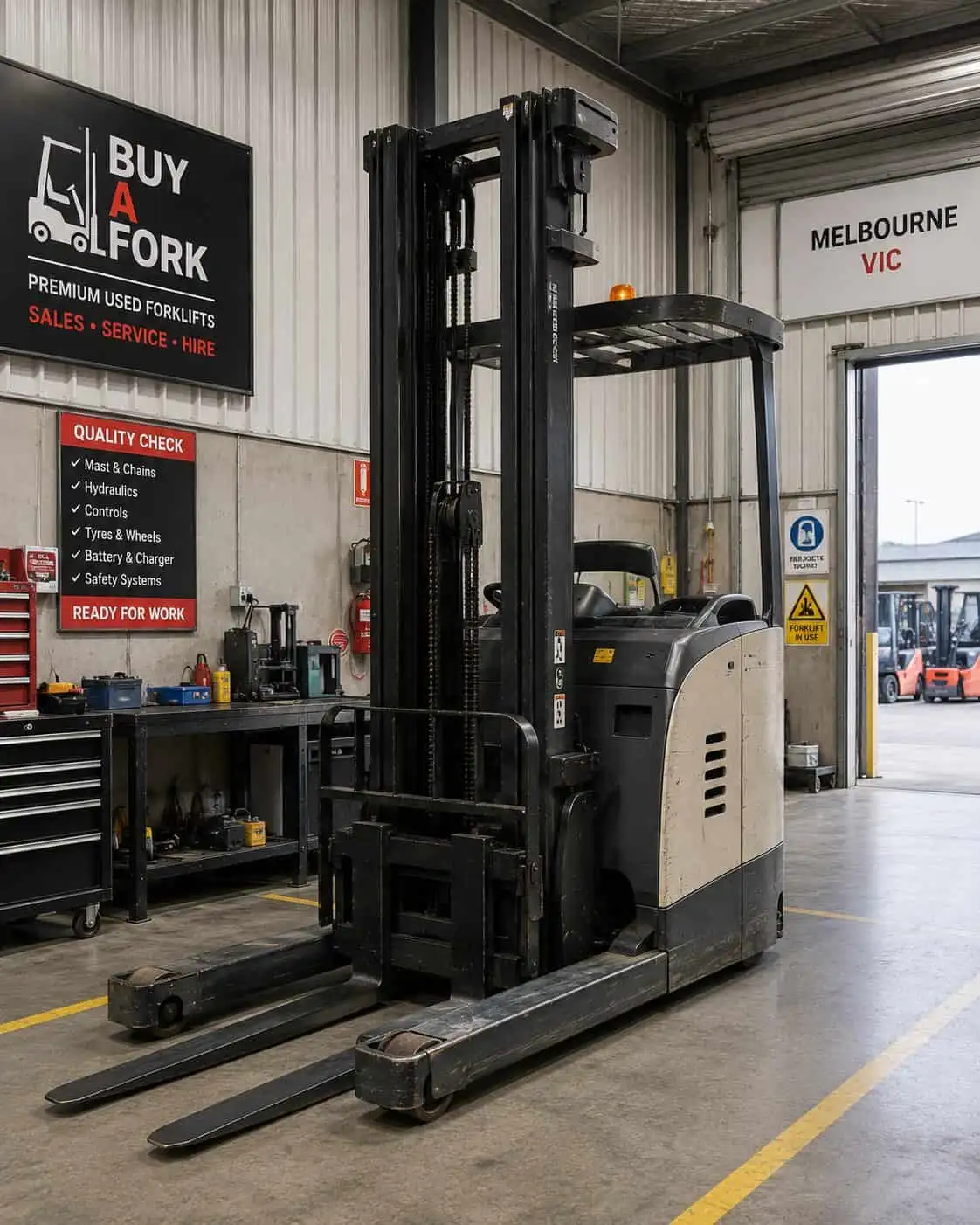
On a used machine the checks that matter are mast wear, chain condition and stretch, hydraulic performance through the full reach stroke rather than just at low level, and battery age and cycle count. What to check before committing to a used electric machine applies here with extra weight on the mast, because a reach truck’s mast does far more work than a counterbalance’s.
We hold electric reach trucks in stock at Somerton alongside the rest of our electric warehouse range, and we can work through your four measurements and tell you which machines physically fit before anyone talks about price.
Frequently Asked Questions
1. What is a reach truck used for?
Indoor pallet handling in racking. It places and retrieves full pallets in narrow aisles at heights a counterbalance forklift cannot reach, which makes it the standard replenishment and retrieval machine in warehouses and distribution centres.
2. What is the difference between a reach truck and a forklift?
A counterbalance forklift carries the load ahead of the front axle and balances it with a rear counterweight, so it must turn to face the rack and needs a wide aisle. A reach truck carries the load between stabilising outriggers and extends the mast forward to place it, which lets it work in a much narrower aisle and lift considerably higher.
3. How high can a reach truck lift?
Commonly between five and ten metres, with super duty triplex configurations reaching as high as 13,560mm on the Crown ESR range. The capacity available at those heights is well below the rated figure, so specify on capacity at your top beam rather than on maximum height.
4. Do you need a licence to drive a reach truck in Australia?
Yes. A reach truck falls under the LF high-risk work licence class, the same class as a standard forklift. Order pickers are different and require an LO licence, because the operator elevates with the load. Confirm the current position with your state regulator.
5. Can a reach truck be used outdoors?
Generally no. They are built for smooth indoor floors, and Toyota lists its stand-up range as indoor use only. Outriggers sitting close to the ground, small wheels and stability that depends on a flat surface all make outdoor and yard work unsuitable.
6. How narrow an aisle can a reach truck work in?
Published minimums sit around 2,522mm to 2,640mm on the Crown ESR 1000 series and the Toyota 8-Series stand-up, against roughly 3,550mm for a comparable battery counterbalance. Allow more than the minimum in a working layout.