
Forklift Masts Explained: Types, Free Lift and Heights
· Updated
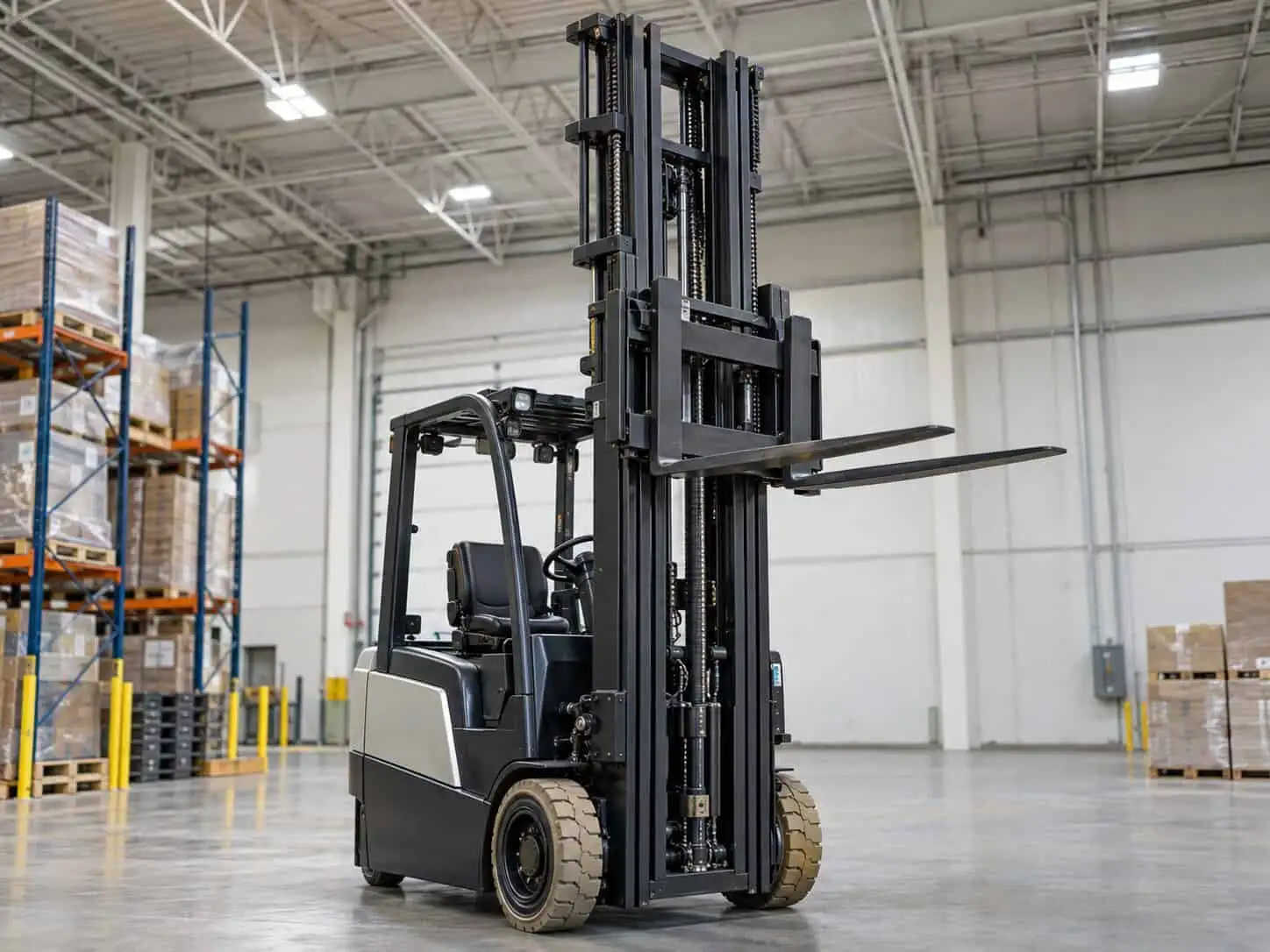
The forklift mast decides more about what a machine can actually do than the engine, the fuel type or the badge on the counterweight. Two forklifts with identical capacity and different masts will do completely different jobs.
It is also the specification most often chosen last and regretted first. Capacity and fuel type can be worked around. A machine that will not get under a doorway or into a shipping container cannot be worked around at all.
This guide covers the four mast types and what separates them, what free lift is and why it decides container work, the trade between lowered height and maximum lift height, and how mast choice quietly cuts the capacity you can use.
What Is a Forklift Mast?
The mast is the vertical assembly at the front of a forklift that raises and lowers the forks. It is built from nested steel channels that slide within each other, driven by hydraulic cylinders and lift chains, with the fork carriage running up the innermost channel on rollers.
It is also the component that decides most of what a forklift can practically do. Two machines with identical chassis, engine and rated capacity will handle completely different jobs depending on the mast fitted, and the mast is usually the single largest variable in the price.
Three specifications describe any mast: how high the forks go, how tall the mast is when lowered, and how far the forks rise before the mast starts growing. Get those three right against your building and the machine works. Get them wrong and you own a forklift that will not fit through a door or will not reach the top beam.
Forklift Mast Types: Simplex, Duplex, Triplex and Quad
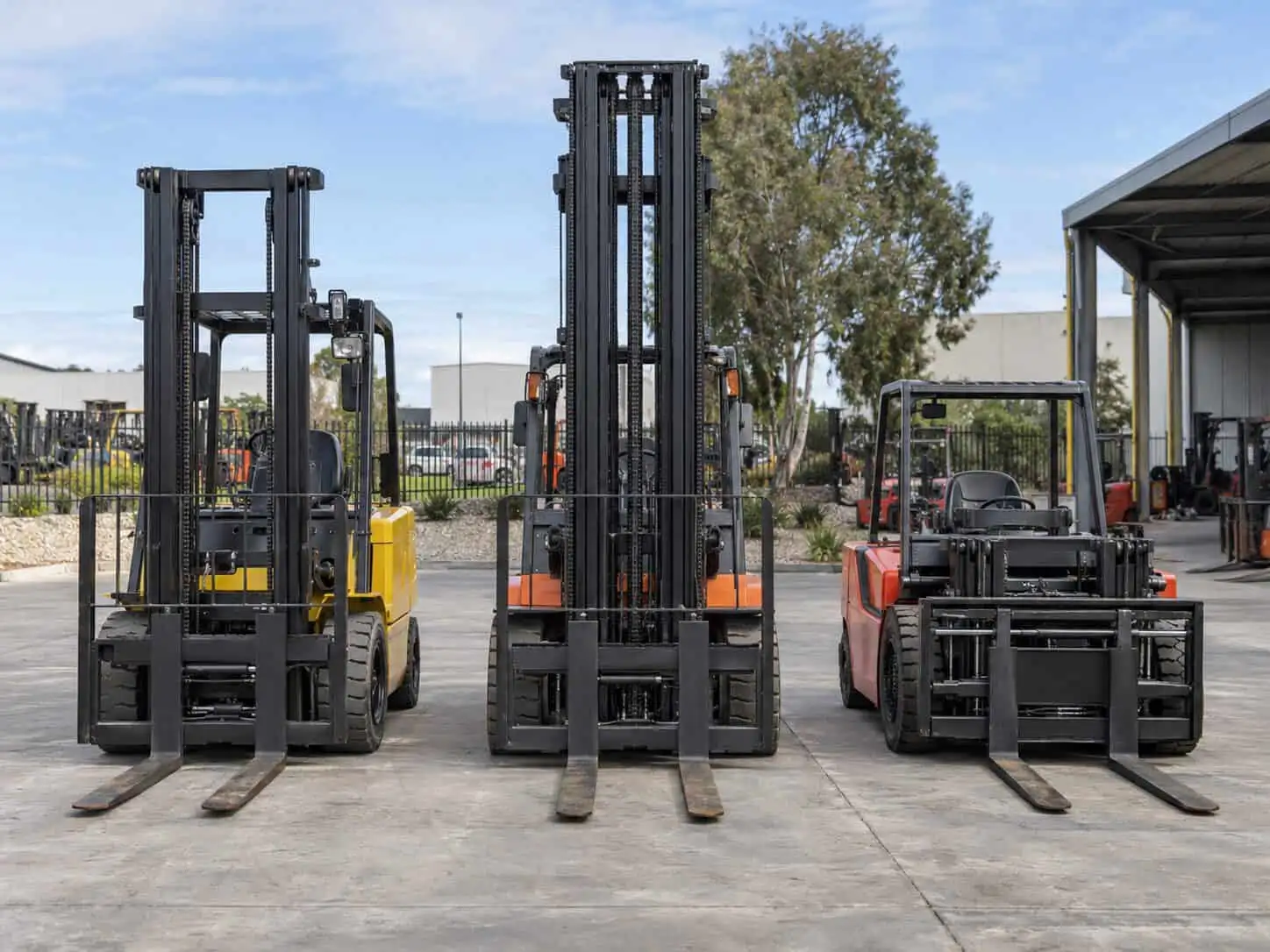
Masts are described by how many stages they have, meaning how many sections extend. More stages means more height for a given lowered height, and more cost and complexity.
|
Mast type |
Stages |
Free lift |
Best suited to |
|
Simplex |
One. The mast and carriage rise together |
None |
Outdoor and yard work with no overhead restriction |
|
Duplex |
Two, with a dedicated free lift cylinder |
Yes |
General warehouse work, low ceilings, container loading |
|
Triplex |
Three, with two inner channels and a free lift cylinder |
Yes, usually generous |
High racking where lowered height is still restricted |
|
Quad |
Four |
Yes |
Extreme lift heights in very high-bay warehousing |
A simplex mast is the simplest arrangement and the cheapest. Because the whole assembly rises as one, the mast grows in height from the moment the forks leave the ground, which makes it unsuitable anywhere with a ceiling, a doorway or a container roof to worry about. Outdoors, where nothing is overhead, it is perfectly adequate and there is no reason to pay for more.
A duplex mast adds a free lift cylinder to a two-stage assembly, which lets the forks rise a considerable distance before the mast extends above its lowered height. This is the standard warehouse arrangement and it covers most indoor work.
A triplex mast has two inner channels plus the free lift cylinder. The extra stage lets a machine reach high while keeping its lowered height low, which is the specific problem high-bay warehouses have: tall racking inside a building whose doorways were not built for tall forklifts.
A quad mast extends the same logic to four stages for the tallest applications. These are specialist machines and outside the range most Australian warehouses need.
What Free Lift Is and Why It Matters
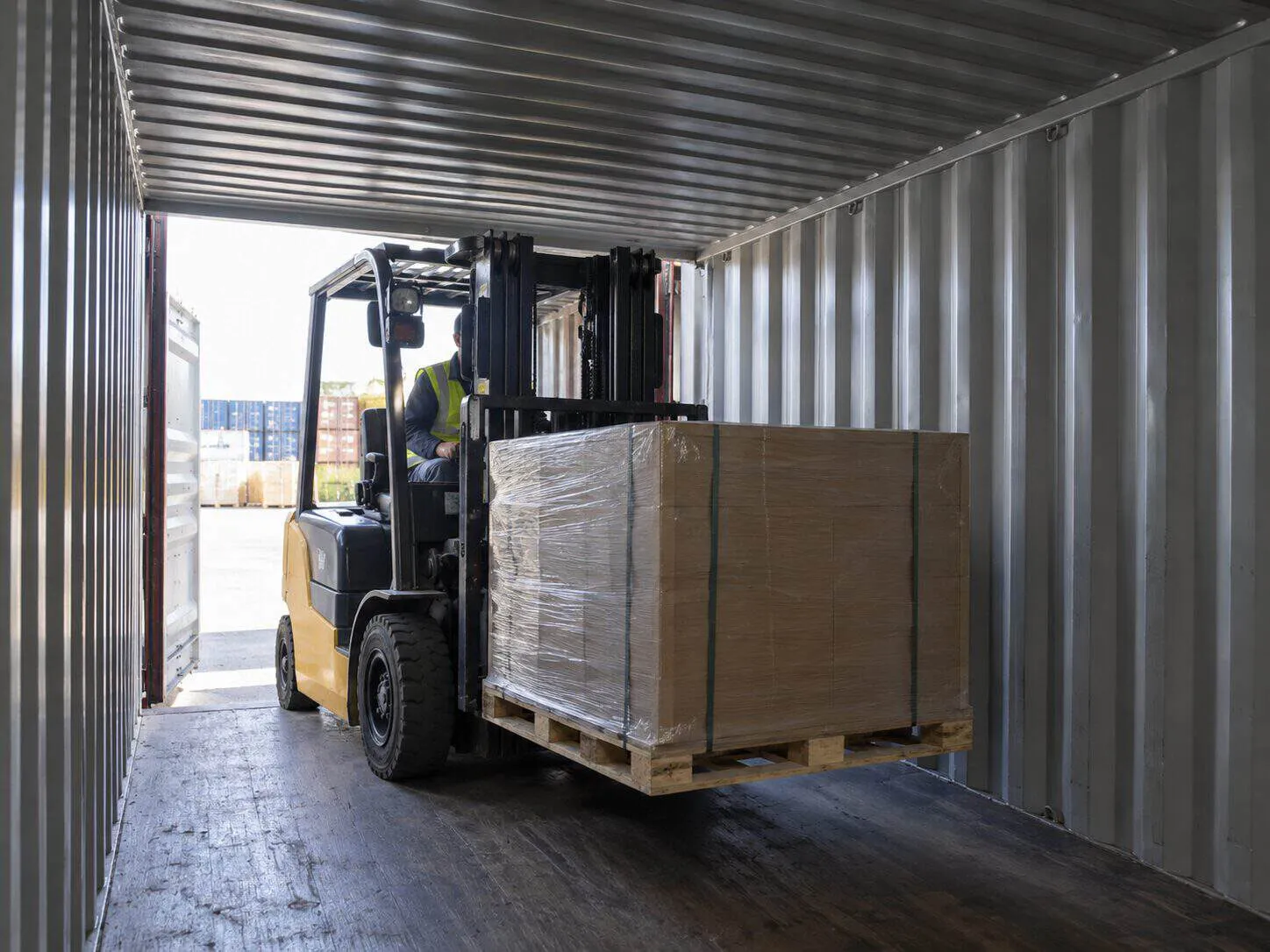
Free lift is how far the forks rise before the mast begins to grow taller than its lowered height. It is the specification most buyers do not ask about and the one that most often makes a machine unusable in a specific building.
The reason it exists is a dedicated hydraulic cylinder that lifts the carriage inside the stationary mast. Until the carriage reaches the top of that inner channel, nothing above the machine moves. Only then does the mast start telescoping.
The figures are more generous than people expect. Crown publishes free lift up to 3,015mm on the ESR 1020 reach truck, up to 3,365mm on the ESR 1040 and up to 4,635mm on the ESR 1060. That means a machine can put a pallet nearly three metres up while its own silhouette has not changed at all.
Where this matters is anywhere with something overhead: a container roof, a mezzanine underside, a sprinkler line, a low-ceilinged older warehouse, or the inside of a truck body. Without free lift, a machine that reaches ten metres cannot safely lift a pallet a metre off the ground inside a container, because the mast goes up with it.
Lowered Height Against Maximum Lift Height
These two specifications pull in opposite directions and the mast type is how you manage the tension.
Maximum lift height is the ceiling of what the machine can do. Lowered height is what has to fit through every opening on the machine’s route: the roller door, the internal doorway, the container aperture, the charging bay entry.
On a standard counterbalance the overhead guard is usually the tallest point when the mast is down. Across Toyota’s 8FG and 8FD range from 1.0 to 3.5 tonne the overhead guard sits between 2,080mm and 2,180mm, and on the heavier 3.5 to 8.0 tonne range between 2,210mm and 2,310mm. A taller mast can exceed those figures, which is exactly the situation to check for.
The rule to work by is that lowered height is measured against the lowest clear opening on the whole route, not against the main entrance. Buildings acquire low points over the years: a mezzanine added at one end, a services run below the roof line, a bottom rail on a roller door. Measure them all before you specify a mast.
This is the same discipline that governs sizing a forklift to a warehouse generally, and the mast is where it bites hardest.
Masts for Container Work
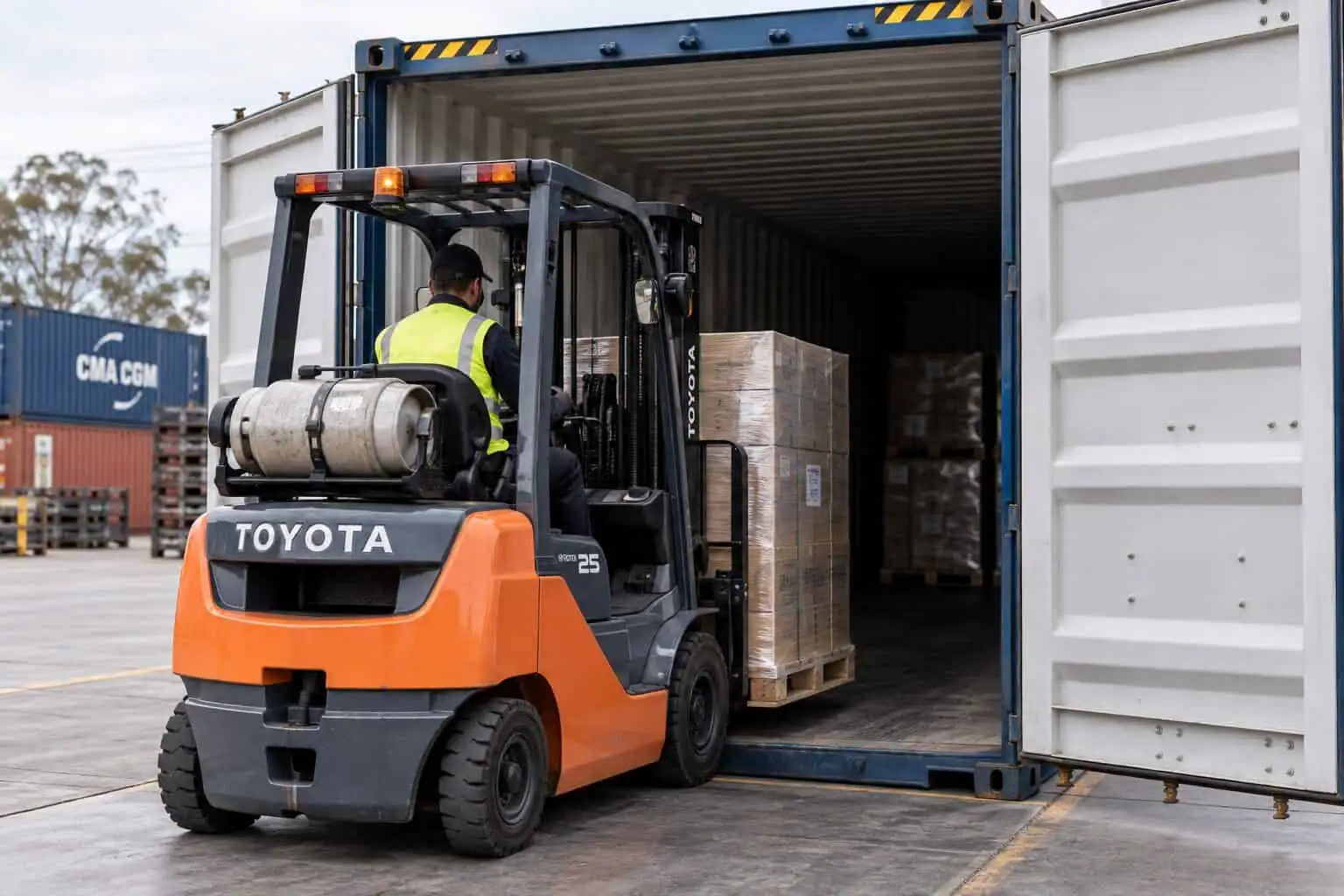
Container loading is the clearest case for a specific mast configuration, and the numbers make it obvious.
A standard 20ft or 40ft shipping container has a door opening of 2,280mm wide by 2,260mm high, with an internal height of 2,350mm. A 40ft high cube gives more room, with a 2,560mm door opening and 2,650mm internal height.
That leaves very little margin. A Toyota 8FG25 at 2,110mm to the overhead guard clears a standard container door with about 150mm to spare, and a 3.0 tonne machine at 2,170mm has under a hundred. Any mast that adds height to that silhouette puts the machine outside the container.
A container mast is a configuration built specifically for this: lowered height low enough to enter, and enough free lift to stack two or three high inside without the mast rising into the roof. It is not an accessory, it is a different machine specification, and it is why container mast forklifts are listed and priced separately.
If any regular part of the work involves loading or unloading containers from the inside, settle the mast before anything else. Capacity and fuel type can be traded. A machine that will not enter the container cannot do the job at all.
How Mast Choice Affects Capacity
A taller mast reduces what the machine can lift, and the reduction is not trivial at full extension.
Two things cause it. The mast assembly itself is heavier, and that weight sits ahead of the front axle. And as the load rises, the combined centre of gravity of the machine and the load rises with it, narrowing the stability margin against tipping forward.
Manufacturers publish the resulting figures as a residual capacity chart per mast option. The scale of the effect is easiest to see on machines that publish it plainly: Crown’s SP 3511 order picker carries its full 1.25 tonne rating to 6,095mm, and in a configuration reaching 9,295mm it is rated at 550kg.
The practical consequence is that specifying a taller mast to gain headroom you rarely use costs you capacity you need every day. Rated capacity is measured under one set of conditions, and mast height is one of the conditions that moves it furthest.
Ask the supplier for the capacity at your actual working height with the mast you are considering, and get it in writing.
Choosing the Right Mast for Your Warehouse
Four measurements settle it, and they should be taken in this order.
- Top beam height plus clearance: measure to the beam you actually place pallets on, then allow room to lift the pallet clear and set it down.
- Lowest clear opening on the route: every doorway, roller door, container aperture and services run the machine passes under, measured at the lowest point including rails and seals.
- Free lift required: the highest you need to lift while still under an overhead restriction, which for container work means stacking height inside the box.
- Capacity at working height: the heaviest load going to the top beam, checked against the residual capacity chart for that specific mast.
Those four numbers usually eliminate all but one or two configurations, and they surface the real conflicts early. The common one is a building whose racking has grown taller over the years while its doorways have not, which is precisely the problem a triplex mast exists to solve.
If the machine will work at height in narrow aisles, the mast decision also interacts with the machine type. Matching a reach truck to high-bay racking runs through the same four measurements with residual capacity carrying more weight.
Mast Maintenance and What Wears
The mast does more cycles than any other part of a forklift and it wears in predictable places. Knowing them makes both maintenance and used machine inspection straightforward.
Lift chains stretch over time and they stretch unevenly, so the check is both for overall elongation and for one chain sitting differently to the other. Uneven chains put the carriage out of square, which shows up as a fork that will not sit level at height. Rollers and channel wear surfaces are the second area, and worn rollers produce play that is invisible at ground level and obvious at eight metres.
Hydraulic cylinders and hoses are the third. A cylinder that weeps or a mast that drifts down under load is a fault, not a characteristic, and drift gets worse under a heavier load and at greater height.
The inspection principle for all three is to test through the full stroke rather than at the bottom. A mast that behaves perfectly to two metres and hesitates or shudders higher up is telling you something. On a used machine that full-stroke test is one of the checks worth insisting on before committing.
Because masts accumulate cycles rather than kilometres, duty cycle predicts maintenance cost better than machine age does, and two machines with identical hours can be in very different condition.
Getting the Mast Right
The mast is the specification most often decided last and most often regretted first. Capacity and fuel type can be worked around. A machine that cannot get under the doorway or into the container cannot be worked around at all.
Bring us your top beam height, your lowest opening, and the heaviest pallet that goes to the top, and we can tell you which mast configuration works before anything else is discussed. Our counterbalance range includes container mast machines, which come up constantly for Melbourne operations doing their own unloading.
Frequently Asked Questions
1. What are the different types of forklift mast?
Simplex, duplex, triplex and quad, named for the number of stages that extend. Simplex has one stage and no free lift, duplex has two stages with a free lift cylinder, triplex has three stages with generous free lift, and quad has four for extreme heights.
2. What is free lift on a forklift?
Free lift is how far the forks rise before the mast extends above its lowered height. It is provided by a dedicated hydraulic cylinder and it determines whether the machine can lift inside a container, under a mezzanine or in a low-ceilinged building. Crown publishes free lift up to 3,015mm on the ESR 1020 and up to 4,635mm on the ESR 1060.
3. What is the difference between duplex and triplex masts?
A duplex mast has two stages and a triplex has three. The third stage lets a triplex reach a higher maximum fork height for the same lowered height, and it usually offers more free lift. A triplex costs more and is the right choice when racking is tall and doorways are not.
4. Does a taller mast reduce forklift capacity?
Yes. A taller mast weighs more and sits ahead of the front axle, and lifting a load higher raises the combined centre of gravity. Manufacturers publish a residual capacity chart showing the reduced figure at each height. Check it against the heaviest load going to your top beam.
5. What mast do I need for container loading?
A container mast configuration, meaning a lowered height that clears the 2,260mm standard container door opening and enough free lift to stack inside the 2,350mm internal height. Standard masts on larger machines will not enter, so this is a specification to settle before capacity or fuel type.
6. How high is a forklift with the mast down?
On the Toyota 8FG and 8FD 1.0 to 3.5 tonne range the overhead guard sits between 2,080mm and 2,180mm, and on the 3.5 to 8.0 tonne range between 2,210mm and 2,310mm. A tall mast can exceed the overhead guard, so check the mast specification rather than assuming the guard is the highest point.