
Forklift Weight Capacity: How to Read a Load Chart
· Updated
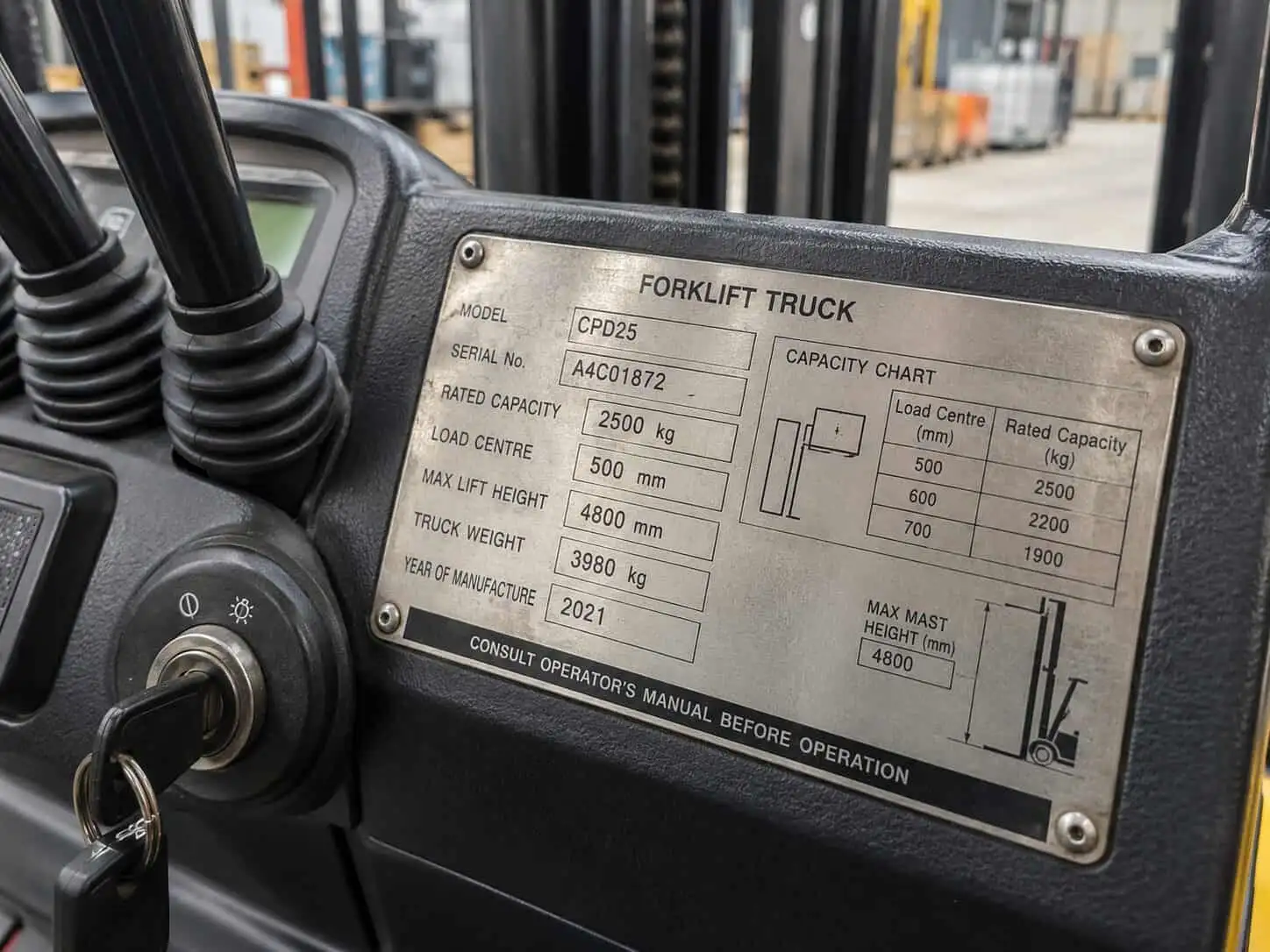
Forklift weight capacity looks like a single number and behaves like a range. The badge says 2.5 tonne, the data plate says 2,500kg at a 500mm load centre, and the pallet sitting in front of you may put the machine well below both figures.
Most capacity mistakes are not reckless. They come from reading the rating as a promise about every load, when it is a measurement taken under one specific condition.
This guide covers what the rating actually means, how to read the data plate and the load chart on the machine in front of you, what pulls the usable figure down, and how to work out the capacity you need before you buy. Every figure here comes from published manufacturer specifications and is cited.
What Forklift Weight Capacity Actually Means
Forklift weight capacity is the maximum load a forklift can lift safely, and it is always quoted at a specified load centre. A machine described as a 2.5 tonne forklift will lift 2,500kg, but only when the centre of that load sits within a set distance of the fork face.
That second half of the sentence is where most capacity mistakes begin. The number on the badge is not a promise about every load. It is a rating measured under one specific condition, and the further your real load departs from that condition, the less the machine can safely carry.
Two figures on the machine tell you what you are actually working with. The rated capacity is the weight, and the load centre is the condition attached to it. Both are stamped on the data plate, and the plate is the reference point that matters, not the sales brochure and not the badge on the counterweight.
How Much Weight Can a Forklift Lift?
Rated capacity across common warehouse and yard machines runs from around 1,000kg on the smallest counterbalance and order picker classes to 3,500kg on a standard engine-powered counterbalance, with heavy-duty models running well beyond that. Reach trucks and order pickers sit at the lower end because they are built for aisle work rather than gross lifting.
The table below draws from published manufacturer specifications. Note the load centre column carefully, because it is not consistent across machine types.
| Machine type | Rated capacity | Load centre | Typical maximum lift height |
| Engine counterbalance (Toyota 8FG / 8FD series) | 1,000kg to 3,500kg | 500mm | Mast dependent |
| Battery counterbalance (Toyota 8FB series) | 1,000kg to 3,000kg | 500mm | 6,000mm |
| Stand-up reach forklift (Toyota 8-Series) | 1,000kg to 3,000kg | Not published on the range page | 7,000mm |
| Moving mast reach truck (Crown ESR 5200) | 1,400kg to 2,000kg | 600mm | Up to 13,560mm by mast option |
| High-level order picker (Crown SP 3500) | 1,000kg to 1,250kg | 600mm | Up to 9,295mm at reduced capacity |
Figures from Toyota Material Handling International 8FG/8FD 1.0 to 3.5 ton Series catalogue, Toyota Material Handling Australia product specifications, and Crown ESR 5200 and SP 3500 series specification sheets. Figures vary by model and mast configuration. Always check the plate on the specific machine.
The load centre column is the detail worth pausing on. Toyota rates its counterbalance range at a 500mm load centre. Crown rates its reach trucks and order pickers at 600mm. You cannot compare two capacity figures until you know they were measured the same way. A 2,000kg rating at 600mm is a stronger machine than a 2,000kg rating at 500mm, because it is holding the same weight further out.
How to Read a Forklift Data Plate
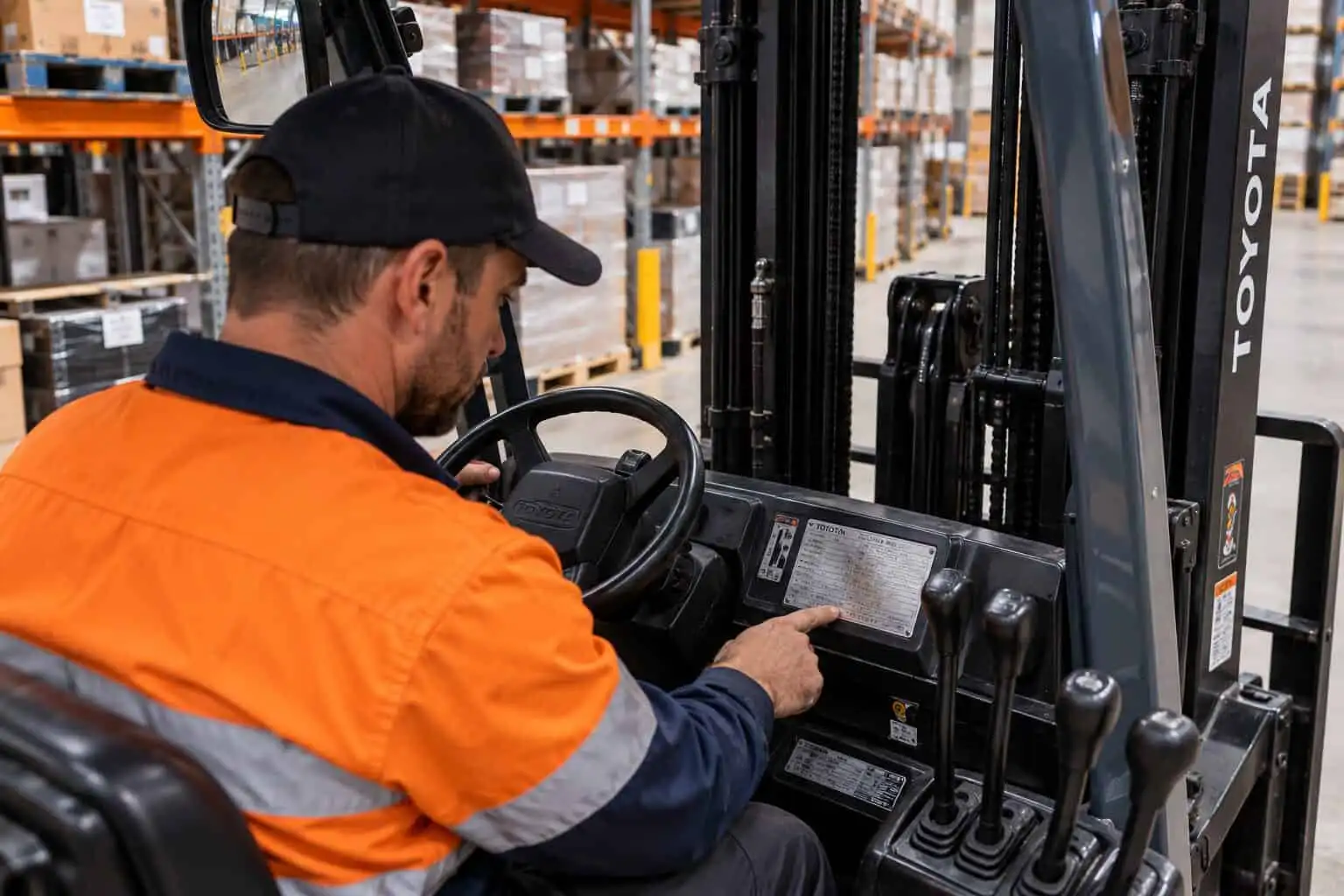
Every forklift carries a data plate, usually on the dash or the cowl in the operator’s line of sight. It is the machine’s legal statement of what it can do, and it is the document a regulator or an insurer will look at after an incident.
The fields you need are these. Model and serial number identify the exact machine, which matters because two units of the same model can carry different masts and different ratings. Rated capacity gives the weight. Load centre gives the condition that rating was measured under.
Mast type and maximum fork height tell you how high the machine goes, and on many plates the capacity is broken down against height rather than given as a single number. Attachment is listed where one is fitted, and if the plate does not reflect the attachment currently on the machine, the plate is out of date and the machine should not be worked until it is corrected.
Tyre type is on the plate because changing between cushion, solid and pneumatic tyres alters the machine’s geometry and its stability. Truck weight is the machine’s own mass, which matters for floor loading and transport rather than for lifting.
If the plate is missing, painted over or unreadable, the machine has a compliance problem before it has a capacity problem. Replacement plates come from the manufacturer against the serial number.
How to Read a Forklift Load Chart
A load chart shows how rated capacity falls as the load centre moves away from the fork face and as the forks go higher. It is usually printed on the data plate itself or on a decal beside it, and it is the single most useful thing an operator can learn to read.
The principle is leverage. The forklift’s counterweight balances the load across a pivot at the front axle. Move the load further forward and you lengthen the lever it acts through, so the same weight applies more turning force and the machine’s safe limit drops. The same effect happens as the mast extends and the combined centre of gravity rises. The relationship between load centre and rated capacity is the mechanism behind almost every derating figure you will see.
Working an example makes it concrete. Take a machine rated at 2,500kg with a 500mm load centre, which describes the Toyota 8FG25 in the table above. A standard 1,165mm Australian pallet loaded evenly has its centre of gravity roughly 580mm from the fork face, already past the rating point. A long or front-heavy load can push that figure to 900mm or beyond.
At that point the badge figure is no longer the answer. The chart on that specific machine gives the reduced figure, and the reduction is not small. This is why a business that handles bulky but light freight often needs more machine than the weight of its loads would suggest.
The practical rule is that you read the chart, not the badge, and you read the chart on the machine in front of you rather than a chart you remember from a similar unit.
What Reduces a Forklift’s Rated Capacity
Several things pull the usable figure below the plate rating, and they compound. A load that is both long and lifted high loses capacity twice.
- Load centre distance: the further the load’s centre of gravity sits from the fork face, the lower the safe weight, which is the single largest factor.
- Lift height: capacity falls as the mast extends, because the combined centre of gravity rises and the machine becomes easier to tip. On tall masts the reduction at full height can be severe.
- Attachments: a clamp, rotator or set of fork extensions adds weight forward of the axle and shifts the load further out, cutting net capacity before you lift anything.
- Mast tilt: tilting forward with an elevated load moves the load beyond the rated position and is one of the fastest ways to lose stability.
- Load shape and stability: a load that can shift, roll or settle during travel does not behave like the uniform block the rating assumes.
- Tyre and surface condition: worn tyres and uneven ground change how the machine sits and how it responds under load, which is why stability depends on more than the weight on the forks.
Attachments deserve the extra warning. Fitting one changes the machine’s rating, and the data plate has to be updated to reflect the new configuration. Every attachment carries a capacity penalty, and running a clamp or rotator against the original plate figure is both unsafe and a compliance failure.
How Much Does a Forklift Itself Weigh?
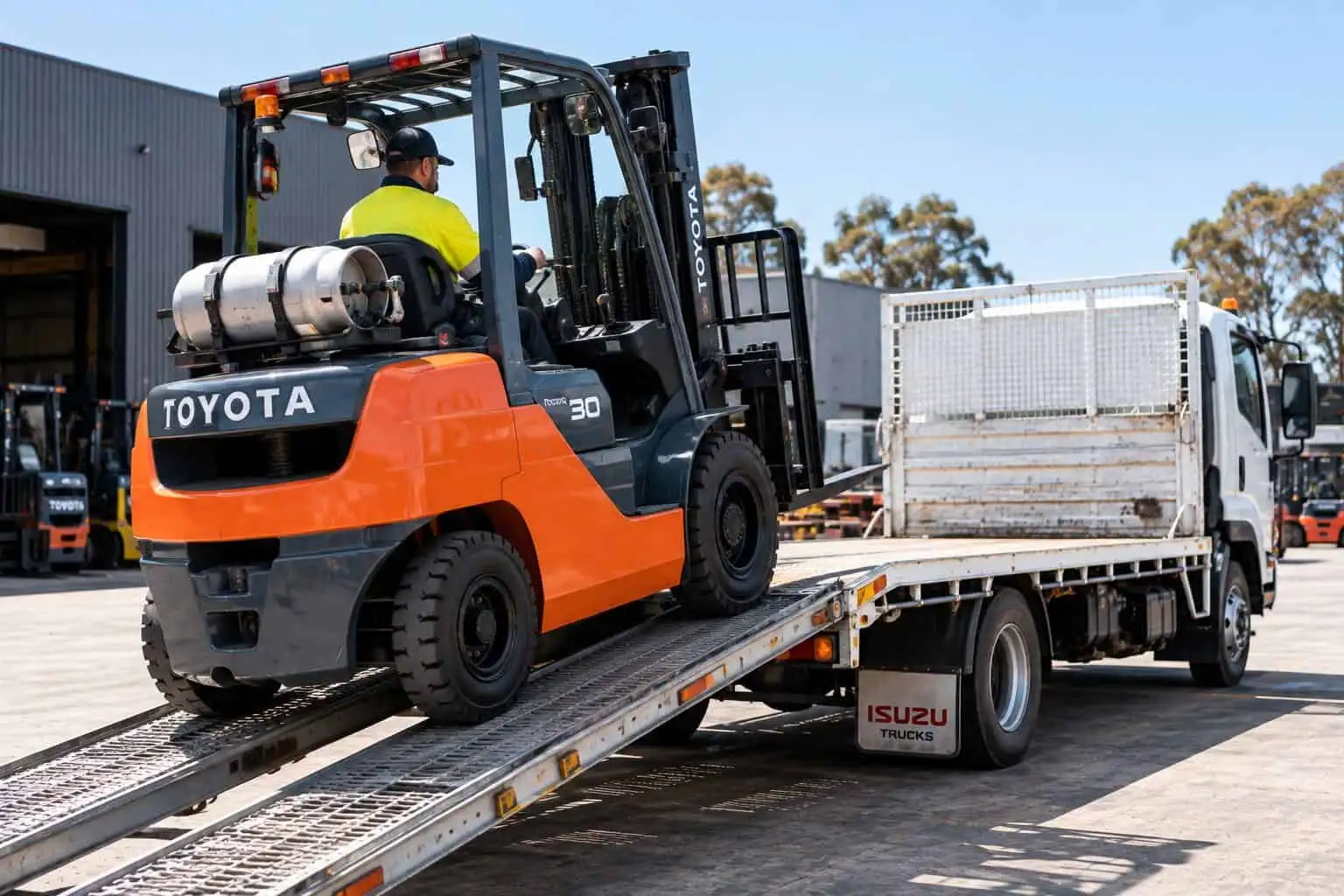
This is a different question to lifting capacity and it catches people out constantly. A 2.5 tonne forklift lifts 2,500kg. It does not weigh 2,500kg. It weighs considerably more, because the counterweight that lets it lift 2,500kg has to be heavy enough to balance that load.
Machine weight matters in four situations. Floor loading in an older building or on a suspended slab is the first. Mezzanine and dock leveller limits are the second. Truck transport is the third, since the machine has to be legal on the trailer. And relocation is the fourth, because moving a forklift usually means another machine lifting it.
Service weight is on the data plate. If you are working out whether a floor or a mezzanine will take a machine, use the plate figure and add the heaviest load it will carry, then get an engineer to confirm the slab. Do not work from the capacity rating, because it will understate the real load by a wide margin.
What Capacity Forklift Do You Actually Need?
Start with the heaviest load you handle routinely, not the heaviest load you have ever handled. Specifying for a once-a-year outlier buys machine you pay for every day and rarely use.
Then measure the load centre of that load rather than assuming it. Put a tape on the pallet or the item and find where its mass actually sits relative to the fork face. If the answer is beyond the rating point, and for most bulky freight it will be, the capacity you need is higher than the load weight suggests.
Next check the height. If that load has to go to the top beam of the racking, the capacity that matters is the capacity at that height, not at ground level. Lift height and available capacity move against each other, and a machine that handles the load on the floor may not handle it in the rack.
Add a margin, and be clear about what a margin is for. It covers load variation, uneven pallets and the difference between a theoretical load centre and a real one. It is not the same as oversizing: a machine two capacity classes larger is heavier, wider and needs more aisle, and those costs are permanent. A sensible margin sits above your real worst case without moving you into a different size of machine.
Overloading and What Australian Law Requires
Under the model work health and safety framework, a business has a duty to provide and maintain plant that is safe and without risks to health, and to ensure it is used within the manufacturer’s specifications. Operating a forklift beyond its rated capacity, or beyond the derated figure on its chart, sits squarely outside that duty. Safe Work Australia publishes the general duty and the model codes, and WorkSafe Victoria administers the equivalent obligation for Victorian workplaces.
Two situations create risk without anyone consciously overloading. The first is a fitted attachment against an unrevised plate, which is common and easily fixed. The second is a load whose centre of gravity is further out than the operator assumes, which is the failure mode behind a large share of tip-overs. Overloading is rarely a deliberate decision and is usually a measurement that was never taken.
Operators also need the right high risk work licence. Under the national classes, an LF licence covers a forklift truck with a mast and elevating load carriage carrying fork arms, and excludes pedestrian-operated trucks and pallet trucks. An LO licence covers order-picking forklift trucks, where the operator’s controls sit in the load carriage and rise with it. The licence class follows the machine type, so a business running both a counterbalance and a high-level picker needs both.
Check the current requirement with Safe Work Australia and your state regulator before relying on any summary, including this one.
Checking Capacity on a Used Forklift
On a used machine the plate is the first thing to look at and the most commonly overlooked. Confirm the serial number on the plate matches the machine, confirm the rated capacity and load centre match what you were told, and confirm any fitted attachment appears on the plate.
A machine that has had a mast change or an attachment fitted during its life may carry a rating that no longer matches its configuration. Service history and documentation answer that question where the plate alone cannot, which is one of the practical arguments for buying through a dealer.
Getting the Capacity Right Before You Buy
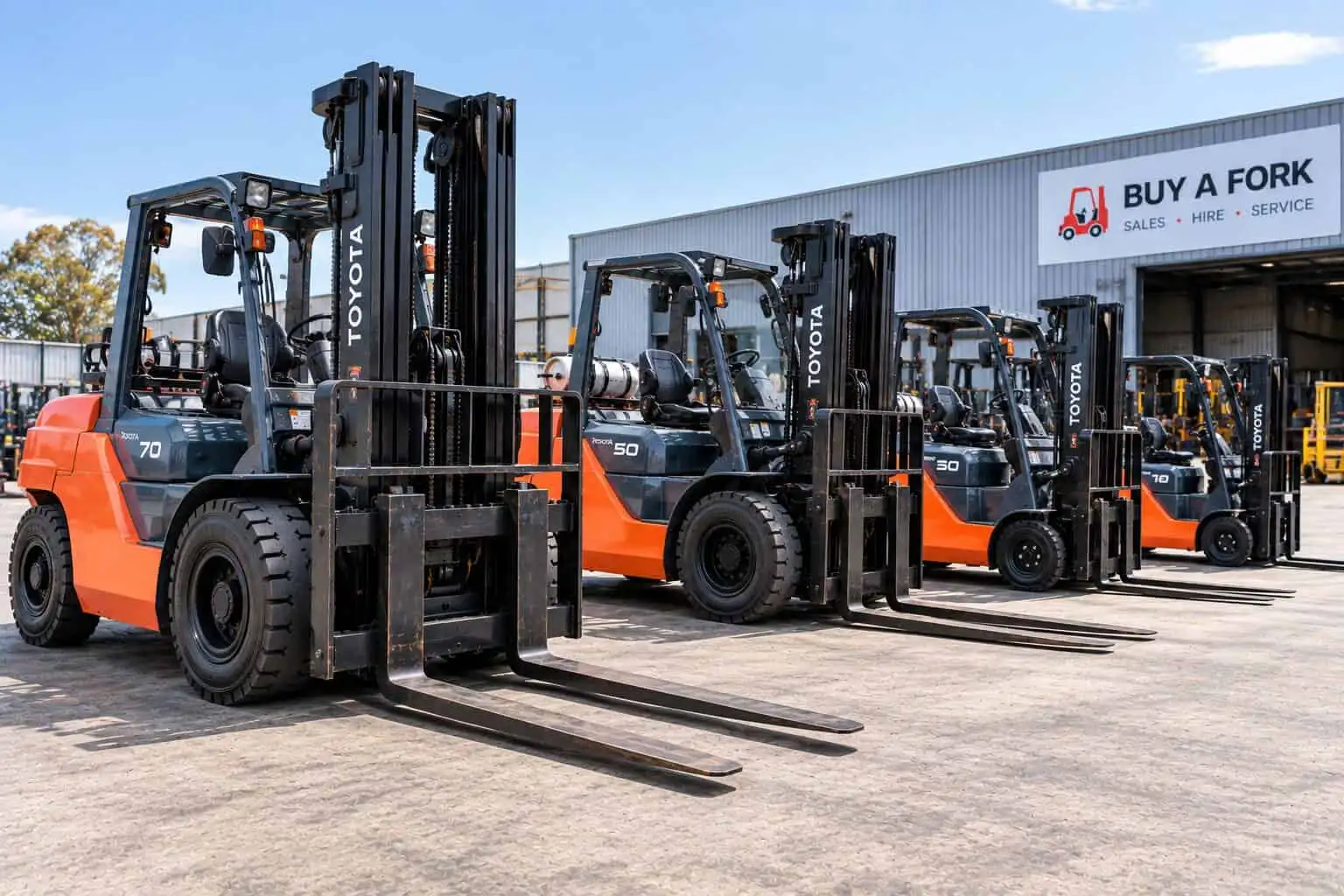
Capacity is the specification most worth getting right the first time, because it is the one you cannot adjust later. A machine that is one class short will handle most of your work and fail on the loads that matter, and the workaround people reach for is usually to lift it anyway.
If you know your heaviest routine load, the depth of the pallet or item, and the height it has to reach, that is enough to specify correctly. Our team can work through the counterbalance range against those three numbers and tell you which class fits, including where a used machine at a higher capacity is better value than a new one.
Frequently Asked Questions
1. What is the maximum load capacity for a forklift?
Standard counterbalance forklifts commonly run from 1,000kg to 3,500kg, and heavy-duty models go well beyond that into the tens of tonnes for container and steel handling work. Warehouse machines such as reach trucks and order pickers are rated lower, typically between 1,000kg and 2,000kg, because they trade gross capacity for aisle performance.
2. How much weight can a forklift carry in kg?
Read the rated capacity in kilograms from the data plate, then check the load centre it was measured at. A 2,500kg rating at a 500mm load centre means the machine lifts 2,500kg only when the load’s centre of gravity sits within 500mm of the fork face. Beyond that distance, the load chart on the machine gives the reduced figure.
3. Can a forklift lift 20 tonnes?
Yes, but not a standard warehouse machine. Twenty tonne capacity sits in the heavy-duty and container handling range, which is a different class of equipment with a different footprint, different tyres and very different ground bearing requirements. If you need that capacity, the constraint is usually your yard rather than the machine.
4. How much can a 2.5 tonne forklift lift?
A 2.5 tonne forklift lifts 2,500kg at its rated load centre, which on the Toyota 8FG25 is 500mm. At a longer load centre, or at full mast height, the safe figure is lower and the load chart on that machine gives the exact number.
5. Does fitting an attachment reduce forklift capacity?
Yes, always. An attachment adds its own weight ahead of the front axle and usually pushes the load further from the fork face, so net capacity drops before you pick anything up. The data plate must be revised to show the machine’s rating with that attachment fitted.
6. What happens if you overload a forklift?
The rear wheels lose grip and steering goes first, often before the operator realises anything is wrong. Beyond that point the machine tips forward or sideways, and a tip-over with a raised load is among the most serious incidents in warehouse work. It is also a breach of the duty to operate plant within the manufacturer’s specifications.