
Reach Trucks for High-Bay Racking: Height and Capacity
· Updated
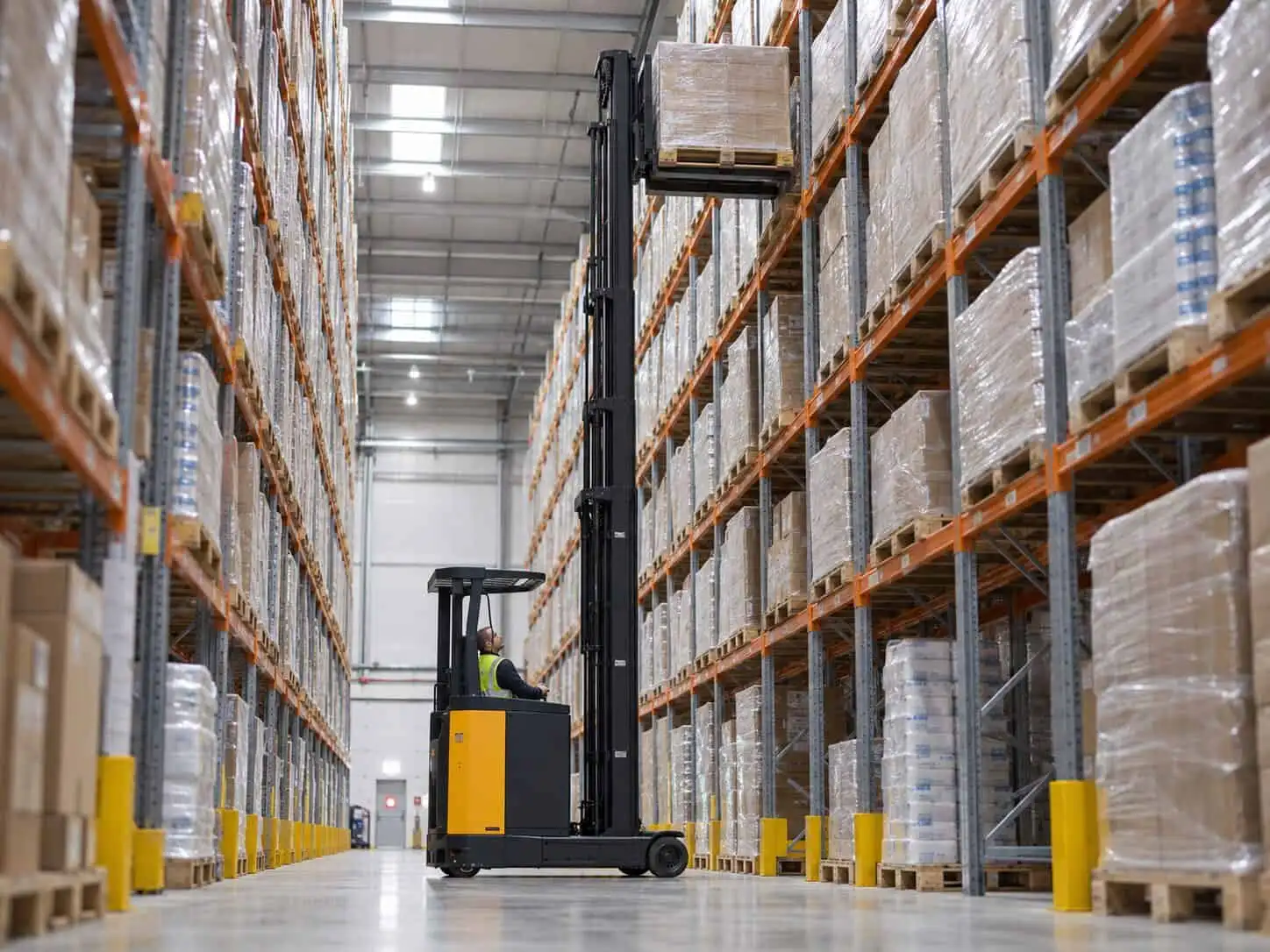
The hardest question in high-bay racking is not which reach truck for high racking reaches your top beam. It is what that machine can still lift once it gets there.
A machine advertised at two tonnes and thirteen metres does not carry two tonnes to thirteen metres. Those are two separate specifications sitting on one data sheet, and reading them as a single number is the most expensive mistake in high-bay purchasing.
What follows: the lift heights and free lift available, why capacity falls as the mast extends, the chart you should demand before you buy, the operator aids that stop mattering as optional above eight metres, and the floor condition that quietly limits all of it.
If you are not yet clear on how the reach mechanism works, start with how a reach truck works and come back.
How High Can a Reach Truck Lift?
Reach trucks commonly work between five and ten metres, and the tallest configurations go considerably further. Crown’s ESR range reaches 13,560mm on a super duty triplex mast, while Toyota’s 8-Series stand-up reach forklift is published to 7,000mm.
The number that matters is not the maximum, though. It is the capacity the machine still has when it gets there, and on this class of equipment the gap between those two figures is wide enough to sink a purchase.
|
Machine |
Rated capacity |
Load centre |
Maximum lift height |
Free lift |
Minimum aisle |
|
Toyota 8-Series stand-up |
1,000kg to 3,000kg |
Not published on the range page |
7,000mm |
Not published on the range page |
2,640mm |
|
Crown ESR 1020 (tilting duplex) |
1.4t or 1.6t |
600mm |
Up to 4,950mm |
Up to 3,015mm |
2,522mm |
|
Crown ESR 1040 |
1.4t or 1.6t |
600mm |
Mast dependent |
Up to 3,365mm |
2,539mm |
|
Crown ESR 1060 (triplex) |
Up to 2.0t |
600mm |
Mast dependent |
Up to 4,635mm |
2,591mm |
|
Crown ESR 5200 (super duty triplex) |
1.4t, 1.6t or 2.0t |
600mm |
Up to 13,560mm |
Mast dependent |
2,522mm to 3,013mm |
Figures from Crown ESR 1000 and ESR 5200 series specification sheets and Toyota Material Handling Australia 8-Series stand-up product specifications, pulled 23 August 2026. Aisle figures vary with pallet size and battery option.
Why a Reach Truck Lifts Less the Higher It Goes
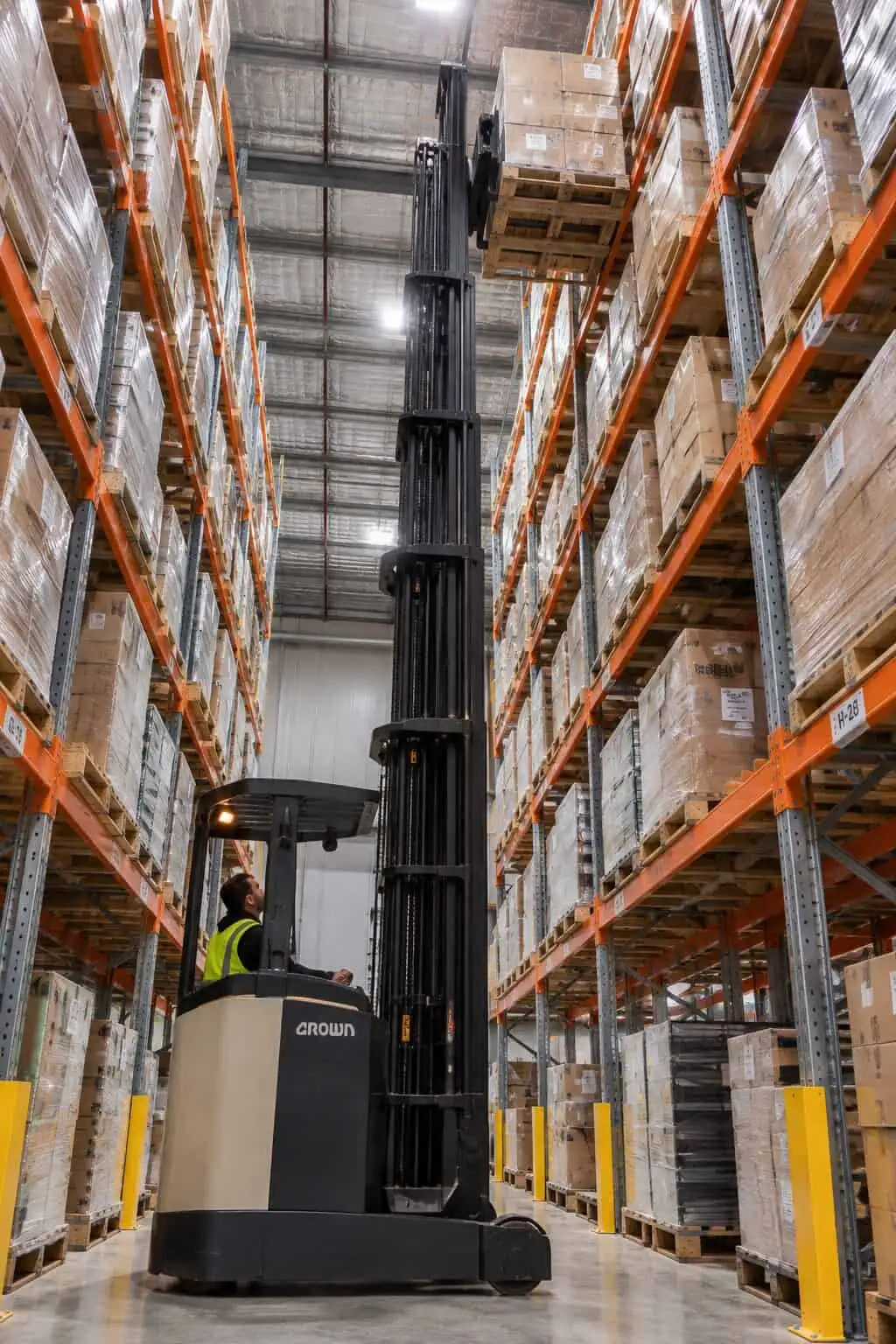
The rated capacity stamped on a reach truck is measured at low lift height and at a nominated load centre, usually 600mm. It is a reference figure, not a working promise across the machine’s whole range.
As the mast extends, two things happen at once. The load’s centre of gravity rises, which reduces the machine’s resistance to tipping forward over the outriggers. And the mast itself, now extended, adds its own weight higher up. The manufacturer publishes a reduced figure to keep the machine within a safe stability margin, and that reduced figure is the residual capacity.
How steep is the reduction? Manufacturers publish it per model, but the pattern is easiest to see on a closely related machine. Crown’s SP 3511 order picker is rated at 1.25 tonnes and reaches 6,095mm carrying that full rating. Configured to reach 9,295mm, the same machine is rated at 550kg. It gains just over three metres and loses more than half its capacity.
Reach trucks derate the same way for the same reasons. A machine advertised at 2.0 tonnes and thirteen metres is not a machine that carries two tonnes to thirteen metres. Those are two separate specifications on one data sheet, and reading them as one number is the most expensive mistake in high-bay purchasing.
This is the same principle that governs how rated capacity is quoted and how it falls away from the reference point, applied vertically instead of horizontally.
Ask for the Residual Capacity Chart
Every manufacturer produces a residual capacity chart for each mast option on each model. It plots capacity against lift height and it is the document that tells you whether a machine will do your job.
It is not always in the brochure. Crown’s published specification sheets, for instance, give rated capacity and maximum lift heights without tabulating the capacity at each height. That information exists, and a dealer or manufacturer will provide it on request, but you generally have to ask.
Ask this way. Give the supplier your top beam height and the weight of the heaviest pallet that will go to that beam, and ask them to confirm in writing that the proposed machine and mast handle that combination. A quote that answers the height and the capacity separately has not answered the question.
If a supplier will not put the residual figure in writing, that is information in itself.
Mast Types and Free Lift for High-Bay Work
Once height is the requirement, the mast becomes the specification that decides everything, including whether the machine can physically get to the aisle.
A duplex mast has two stages and a free lift cylinder. A triplex adds a third stage, which is how a machine reaches high while keeping its lowered height manageable. Above that, super duty triplex configurations carry the tallest ratings, and Crown’s ESR range tops out at 13,560mm on one.
Free lift is the specification people overlook and then regret. It is how far the forks rise before the mast starts extending above its lowered height, and it decides whether the machine can stack inside a container or under a low ceiling without the mast fouling the roof.
The Crown ESR range publishes free lift up to 3,015mm on the ESR 1020, 3,365mm on the ESR 1040 and 4,635mm on the ESR 1060. Those are substantial figures, and they are what let a tall machine work in a low space.
The failure mode to design out is a machine tall enough for the rack that cannot reach the aisle. Lowered height has to clear every doorway, sprinkler line and roller opening on the machine’s route, and that route includes wherever it gets charged and serviced. Mast selection is a trade-off between maximum height and lowered height, and it should be settled by measuring the building, not by picking the tallest option available.
Operator Aids That Matter Above Eight Metres
At two or three metres an operator can see the fork tips. At eight or nine they cannot, and the specification questions change accordingly.
- Fork tip camera: a camera at the carriage with a screen at the operator position, which removes the guesswork from placing a pallet at height and is the single most useful aid on a tall machine.
- Height pre-selection: the operator selects a rack level and the mast stops there automatically, which speeds up repetitive replenishment and reduces overshoot.
- Fork levelling indicator: shows when the forks are horizontal, since a fork tilt invisible at ground level becomes significant at the top of the mast.
- Load weight display: tells the operator what is actually on the forks, which matters when residual capacity at height is well below the plate figure.
- Travel speed reduction with lift height: automatically limits travel speed once the forks are raised. Crown lists this as an option on the ESR range, and on a tall machine it is worth having as standard rather than as a policy the operator has to remember.
Treat these as questions to put to the supplier rather than as a wish list. On a machine working above eight metres, a camera and a load display are closer to necessary than optional, and pricing a machine without them and then retrofitting is usually the expensive path.
Floor Flatness and High-Bay Performance
This is the constraint nobody raises until the machine is on site and not performing.
A reach truck’s stability at height depends on the outriggers sitting flat. Any deviation in the floor is amplified up the length of an extended mast, so a variation the operator cannot feel at ground level becomes visible sway at ten metres. That sway slows every pick, makes accurate placement harder, and in bad cases makes the top levels unusable.
The taller the machine, the tighter the floor tolerance it needs. A slab that works perfectly for a counterbalance and a four metre reach truck can be marginal for a ten metre one, and joints, patches and settlement between bays are the usual culprits.
The practical step is to have the floor surveyed before specifying a tall machine, not after. Remediation is possible and it is far cheaper to budget for at the start than to discover as a performance complaint six months in. If the floor cannot support the height, the honest answer is a shorter machine and lower racking rather than a taller machine that never works properly.
Choosing a Reach Truck for Your Racking
Work through it in this order, because buyers routinely work it backwards and end up with a machine that fits the rack and not the building.
Measure the top beam height and add clearance for the pallet and for placing it, rather than measuring to the top of the frame. Then get the residual capacity at that height and check it against the heaviest pallet going up there, in writing.
Next, check lowered height against the lowest opening on the machine’s whole route, including the charging bay and the service area. Then confirm the aisle figure against your own pallet rather than the brochure pallet, and add working clearance.
Finally, survey the floor if the machine is going above about eight metres. Those five steps in that order will either produce a machine or tell you your racking height is wrong, and both outcomes are cheaper found now.
One layout note. If the racking is not yet installed, the equipment and the rack design should be settled together. Adding a level to the racking that pushes you from a duplex to a super duty triplex mast can cost more in equipment than the additional storage is worth. Working out how high you actually need to go before committing to the steel is the cheapest planning you will do.
New and Used High-Lift Reach Trucks in Melbourne
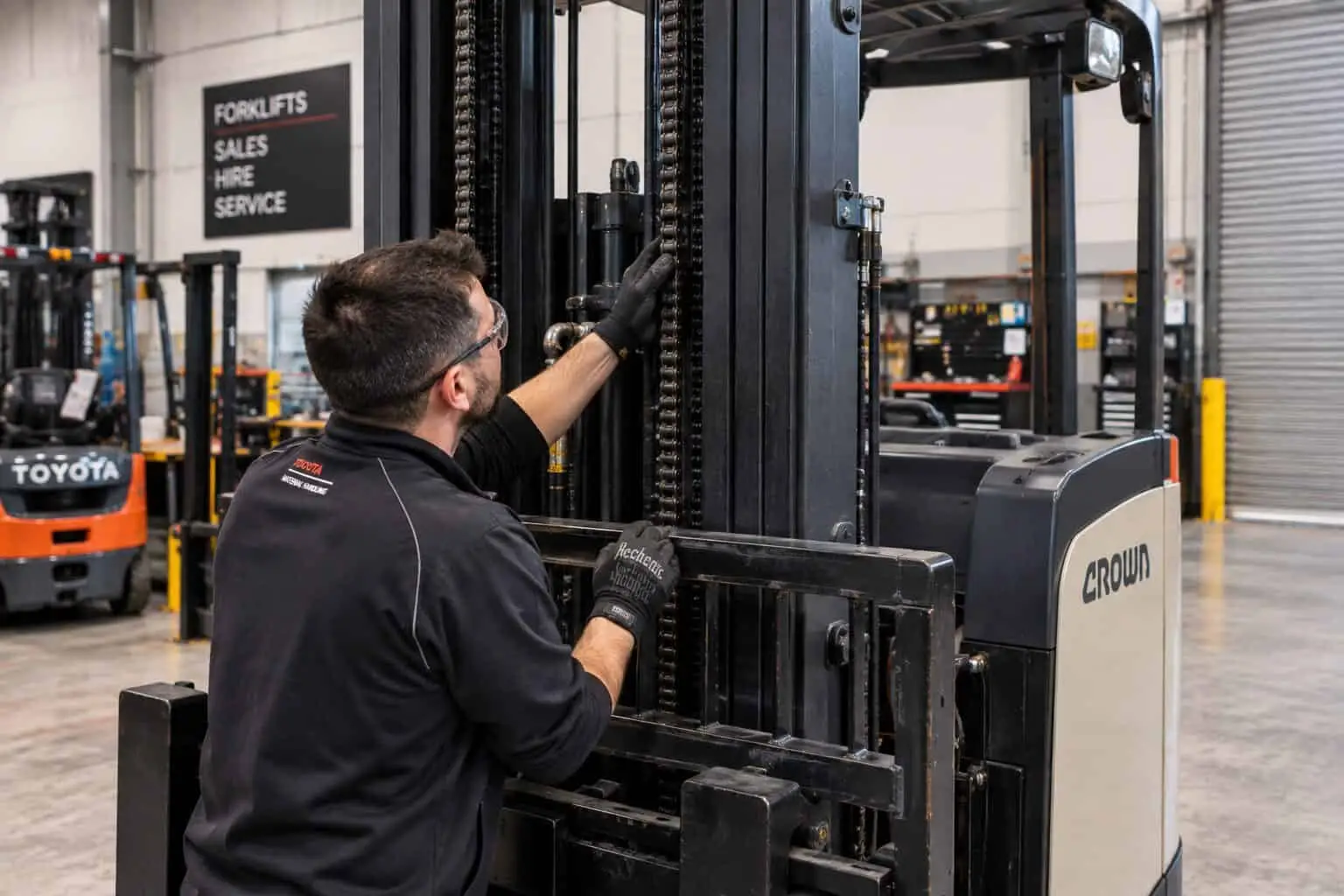
On a used high-lift machine, the mast is where the value and the risk both sit. Check chain condition and stretch across the full length rather than at the bottom, look for wear in the mast channels and rollers, and run the hydraulics through the complete stroke to full extension rather than testing at low level. A machine that lifts smoothly to two metres and hesitates at eight has a problem you need to find before you buy it.
Also confirm the data plate reflects the mast actually fitted. Masts get changed during a machine’s life, and a plate describing a different configuration is both a capacity question and a compliance one. Service history and documentation answer what the visual inspection cannot.
We hold electric reach trucks at Somerton as part of our electric warehouse range. Bring us your top beam height, your heaviest pallet weight and your aisle width, and we will tell you what physically works, including where the honest answer is that your racking is taller than your budget.
Frequently Asked Questions
1. How high can a reach truck lift?
Commonly five to ten metres, with the tallest configurations going further. Crown’s ESR range is published to 13,560mm on a super duty triplex mast and Toyota’s 8-Series stand-up reach forklift to 7,000mm. The usable height depends on the capacity you need at the top.
2. What is residual capacity on a reach truck?
It is the weight the machine can safely lift at a given height, as opposed to the rated capacity measured at low lift. It falls as the mast extends, because the combined centre of gravity rises and the machine’s stability margin narrows. The manufacturer publishes a residual capacity chart per mast option.
3. How much can a reach truck lift at 10 metres?
Considerably less than its rated figure, and the exact number depends on the model and mast. There is no general answer, which is why the residual capacity chart for the specific machine is the document that decides the purchase. Ask for it in writing against your top beam height.
4. What mast do I need for 12 metre racking?
A triplex or super duty triplex configuration, since duplex masts do not reach that height. The more useful question is what capacity that mast still offers at twelve metres and whether its lowered height clears your doorways, because both can rule out a machine that reaches the beam on paper.
5. What is free lift and why does it matter?
Free lift is how far the forks rise before the mast extends above its lowered height. It determines whether a machine can stack inside a container or under a low ceiling without the mast fouling above it. Crown publishes free lift up to 3,015mm on the ESR 1020 and up to 4,635mm on the ESR 1060.
6. Can a reach truck work outdoors?
Generally no, and less so the taller it is. These are indoor machines that depend on a flat floor for stability, and Toyota lists its stand-up range as indoor use only. A tall machine on an uneven surface is both slow and unsafe.