
Forklift Speed: Everything You Need To Know
· Updated
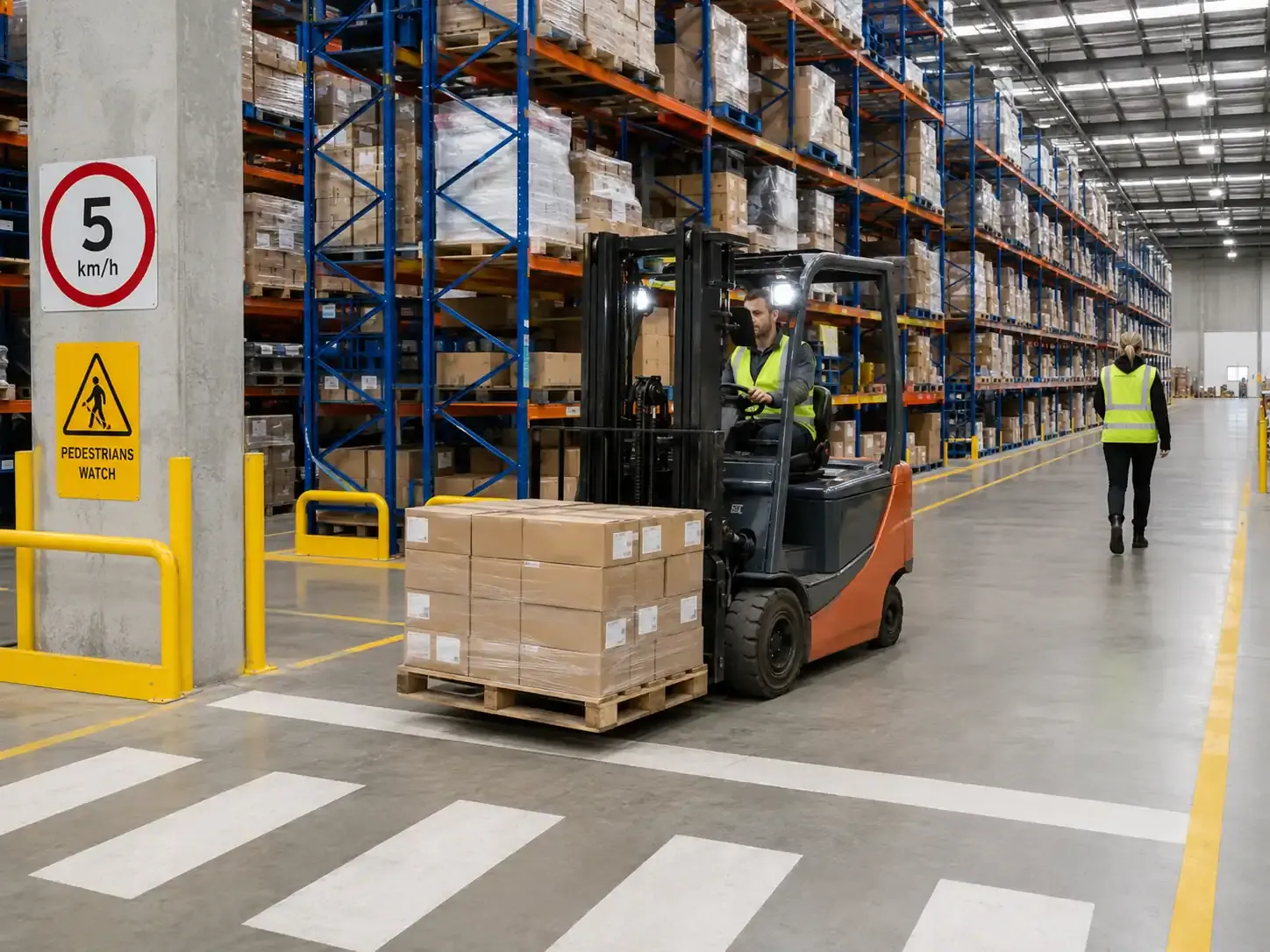
There is no single national forklift speed limit that applies to every Australian workplace. Each business must set a safe maximum speed based on its forklifts, pedestrians, warehouse layout, loads, floor conditions and traffic management risks.
A posted speed limit is also only the maximum permitted speed. Operators must travel more slowly whenever visibility, traffic, load stability, ramps or surface conditions make the posted limit unsafe.
Understanding speed is particularly important because a forklift does not steer, brake or distribute weight like a passenger vehicle. Excessive speed can increase stopping distance, reduce stability and leave operators with less time to react to pedestrians, blind corners and changing site conditions.
Is There a Legal Forklift Speed Limit in Australia?
Australia does not prescribe one universal road-style speed limit for every forklift or workplace.
Instead, employers and workplace managers must identify traffic hazards, assess the risks and establish controls suited to the site. WorkSafe Victoria advises workplaces to review and set a maximum forklift travel speed, display the limit clearly and enforce it through the traffic management plan.
SafeWork NSW also recommends controlling forklift speed with measures such as speed limiters or location-based systems that adjust speed according to the operating area.
This means the correct forklift speed limit depends on factors such as:
- The number of pedestrians in the area
- Whether forklifts and pedestrians are physically separated
- Aisle width and turning space
- Blind corners and doorways
- Floor condition and traction
- Lighting and operator visibility
- Load size and stability
- Forklift type and braking performance
- Ramps, gradients and dock edges
- Other vehicles operating on site
A warehouse may therefore need several speed zones rather than one limit across the entire property.
What Speed Limit Should a Warehouse Set?
A warehouse should set the lowest practical speed that allows work to be completed without exposing operators, pedestrians or property to unnecessary risk.
Many workplaces use limits around 5 km/h in pedestrian-heavy areas and up to approximately 10 km/h on clear routes where forklifts are physically separated from people. These figures are common site-management examples, not legislated limits.
The correct number must come from a site-specific risk assessment.
| Warehouse area | Illustrative starting point | Important considerations |
| Shared or pedestrian-heavy zone | 5 km/h or walking pace | Physical separation should still be the priority |
| Pedestrian crossing | 5 km/h or lower | Operators should have clear sightlines and be prepared to stop |
| Blind corner or doorway | 5 km/h or lower | Mirrors, warning devices and stop controls may also be needed |
| General warehouse aisle with barriers | 5 to 10 km/h | Depends on aisle width, visibility, loads and crossing points |
| Loading dock approach | 5 km/h or lower | Account for dock edges, trailers, workers and changing surfaces |
| Open external route with full separation | Site-assessed limit | Surface, weather, vehicles and stopping distance must be considered |
| Ramp, gradient or slippery surface | Lower than the surrounding route | Follow the forklift manufacturer’s gradient restrictions |
These speeds should not be copied into a traffic management plan without testing them against the actual workplace.
For example, 10 km/h may be inappropriate in a wide aisle if operators frequently carry tall loads that obstruct forward visibility. In another workplace, a low-speed pedestrian pallet truck may already have a manufacturer-set maximum close to walking pace.
Questions to Ask When Setting the Limit
Before choosing a warehouse forklift speed limit, assess:
- Can pedestrians enter the forklift route?
- Can the operator see clearly around every corner?
- Is there enough distance to stop before a crossing or doorway?
- Does the forklift carry loads that obstruct forward vision?
- Do floors become wet, dusty or slippery?
- Are there ramps, dock levellers or speed humps?
- Does the forklift have different braking behaviour when loaded?
- Can the speed limit be enforced mechanically or electronically?
- Are temporary workers, visitors and delivery drivers present?
- Have workers been consulted about traffic hazards?
The limit should be reviewed after layout changes, new equipment purchases, incidents, near misses or changes in pedestrian activity.
How Fast Can a Forklift Actually Go?
The maximum speed of a forklift varies considerably by machine type, configuration and manufacturer.
For example, manufacturer specifications show that some pedestrian electric pallet trucks are limited to about 6 km/h, while ride-on pallet equipment and very narrow aisle forklifts may be capable of speeds above 12 km/h. Travel speed is listed on the spec sheet for every machine in the forklift range, so it can be checked before purchase.
Some larger counterbalance forklifts can travel faster again. However, the manufacturer’s maximum travel speed is a machine capability, not a recommended warehouse operating speed.
A forklift’s actual speed may also change according to:
- Whether it is loaded or unloaded
- Load weight and lift height
- Steering angle
- Travel direction
- Battery charge or engine performance
- Electronic speed settings
- Indoor or outdoor operating mode
- Proximity to pedestrians
- Floor and ramp conditions
Modern forklifts may automatically reduce travel speed when turning, lifting a load, entering a programmed zone or operating with the mast raised.
Buyers should review the model specifications and ask whether the forklift can be configured to match the site’s traffic management plan. Speed-control technology should be considered during purchasing rather than treated only as an aftermarket safety feature.
Why Excessive Forklift Speed Is Dangerous
Speed affects more than the distance travelled each second. It also changes how much time the operator has to identify a hazard, react and bring the forklift to a controlled stop.
Excessive speed can contribute to:
- Collisions with pedestrians
- Impacts with racking, walls and stock
- Loads falling from the forks
- Forklift tip-overs during turns
- Loss of control on ramps
- Overshooting dock edges
- Skidding on wet or dusty floors
- Damage to tyres, brakes and steering components
Many of the most common forklift accidents involve a combination of poor visibility, pedestrian interaction, unstable loads and operators travelling too quickly for the conditions.
Speed is also closely connected to forklift stability and safety. A forklift has a high centre of gravity relative to its wheelbase, particularly when carrying or raising a load. Sudden steering, braking or acceleration can shift the combined centre of gravity and increase the risk of overturning.
Forklift Braking and Stopping Distance
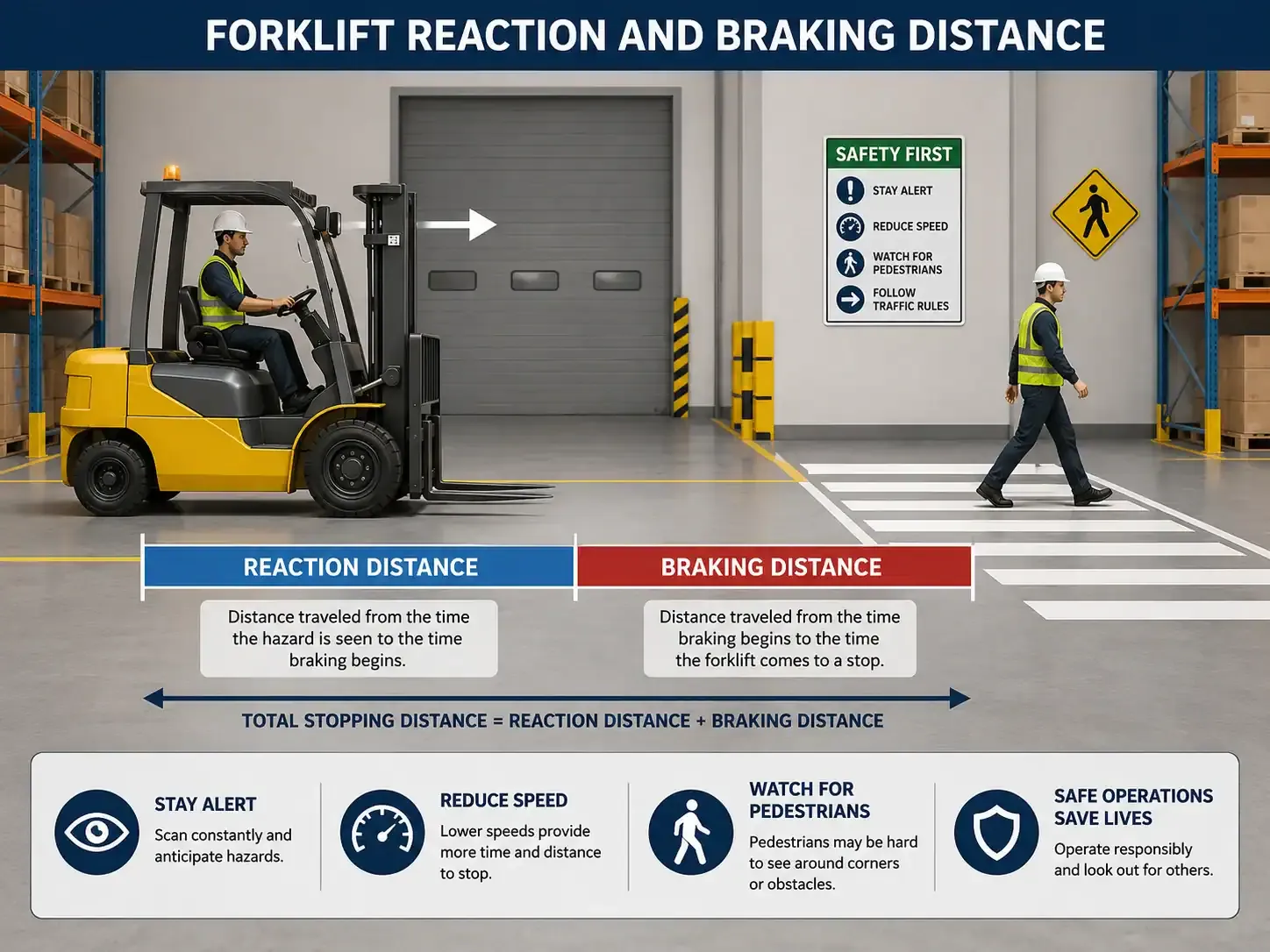
Forklift stopping distance has two main parts:
- Reaction distance: The distance travelled while the operator recognises the hazard and begins braking.
- Braking distance: The distance travelled after the brakes are applied until the forklift stops.
The total stopping distance is the reaction distance plus the braking distance.
Even a short delay matters. A forklift continues moving while the operator sees a pedestrian, understands the risk, moves a foot to the brake and applies sufficient pressure.
Higher speed increases the distance travelled during that reaction period. It also increases the energy that the braking system must control.
Why Stopping Distance Increases Rapidly With Speed
Braking distance does not increase in a simple one-for-one relationship with speed.
Under the same idealised braking conditions, doubling speed can produce roughly four times the braking distance before reaction distance is added. Real forklift performance is more complex because tyres, loads, brake condition, surfaces and electronic controls all affect deceleration.
The practical rule is simple:
A small increase in forklift speed can create a much larger increase in the space needed to stop safely.
This is why operators should slow down before reaching a corner, doorway, crossing or ramp rather than waiting until the hazard becomes visible.
Factors That Affect Forklift Stopping Distance
No generic stopping-distance figure will be accurate for every forklift. The distance required changes according to the machine, load, operator and environment.
| Factor | Effect on stopping distance |
| Higher travel speed | Increases reaction distance and greatly increases braking distance |
| Heavy load | Can change momentum, weight distribution and braking behaviour |
| Raised load | Reduces stability and may require gentler braking |
| Worn brakes | May reduce braking effectiveness or cause uneven stopping |
| Worn or unsuitable tyres | Can reduce traction and increase skidding |
| Wet floor | Reduces available grip |
| Dust, oil or loose material | Can reduce traction and make stopping unpredictable |
| Downhill gradient | Increases the force the brakes must control |
| Operator fatigue or distraction | Increases reaction time |
| Obstructed visibility | Delays hazard identification |
| Poor forklift maintenance | Can affect brakes, steering, tyres and warning systems |
| Trailer or dock movement | Can introduce unexpected changes to the operating surface |
Load Weight and Position
A forklift carrying a heavy pallet has more moving mass than the same forklift travelling empty.
The load may also change the machine’s balance and tyre loading. Sudden braking can cause an unsecured or poorly positioned load to move forward, slide from the forks or affect stability. This is why travel height and speed have to be managed together rather than separately.
Loads should be secure, centred and carried at the lowest practical travel height.
Tyre Type and Condition
Forklift tyres are a critical part of braking performance.
Worn tyres may reduce traction, while tyres unsuitable for the surface can increase slipping and vibration. Pneumatic, solid and polyurethane tyres each behave differently according to the machine and environment.
Tyres should be checked for:
- Excessive wear
- Cuts and chunking
- Flat spots
- Embedded objects
- Incorrect pressure on pneumatic tyres
- Separation from the rim
- Uneven wear patterns
Regular forklift maintenance helps keep brakes and tyres in suitable condition and can reveal faults before they affect stopping performance.
Floor Condition
Smooth, dry and level concrete generally provides more predictable braking than a wet ramp, damaged yard or dusty warehouse floor.
Operations should slow or stop when temporary conditions make the normal speed limit unsafe. A posted limit does not require the operator to maintain that speed.
Ramps and Gradients
A downhill gradient can lengthen stopping distance because gravity continues pulling the forklift in the direction of travel.
Side slopes can also affect stability, particularly during turning. Sites should ensure ramps remain within the manufacturer’s specified gradient and are suitable for the forklift, load and surface conditions.
Pre-Start Brake and Safety Checks
Brake condition should be assessed before the forklift enters normal operation.
A proper pre-start forklift inspection should include the service brake, parking brake, tyres, steering, horn, warning devices and visible hydraulic or mechanical defects.
The operator should confirm that:
- The service brake stops the forklift smoothly
- The parking brake holds the machine
- The brake pedal does not feel unusually soft or hard
- The forklift does not pull to one side during braking
- Steering responds normally
- Tyres are serviceable
- Warning lights and alarms operate
- Mirrors and cameras are clean and correctly positioned
- The seat belt or restraint system works
- No warning indicators remain active
A forklift with a suspected brake, steering or tyre defect should be removed from service and reported through the workplace’s isolation and maintenance procedure.
The site’s forklift safety checklist can be used alongside the manufacturer’s inspection requirements and workplace procedures.
How to Enforce Forklift Speed Limits on Site
Installing a speed sign is not enough. The limit must be supported by the warehouse design, equipment settings, supervision and operator behaviour.
WorkSafe Victoria recommends displaying maximum limits where operators can see them and enforcing those limits through the traffic management plan. SafeWork NSW identifies speed limiters and location-based speed controls as useful options.
1. Physically Separate Forklifts and Pedestrians
Physical separation is more reliable than expecting pedestrians and forklift operators to avoid each other at the last second.
Suitable controls may include:
- Fixed barriers
- Guardrails
- Bollards
- Separate entrances
- Designated walkways
- Controlled crossings
- Pedestrian gates
- Forklift-only operating zones
- Driver safety zones near loading areas
Where possible, redesign the work so pedestrians do not need to enter forklift routes.
2. Use Clearly Visible Speed Signs
Display signs:
- At every forklift entry point
- Where a speed zone changes
- Before crossings and intersections
- Near loading docks
- Before ramps
- At blind corners
- Where indoor and outdoor conditions change
Signs should be positioned within the operator’s normal field of view and should not be hidden by stock, racking or parked equipment.
3. Add Floor Markings and Traffic Controls
Floor markings can define:
- Forklift routes
- Pedestrian walkways
- Stop lines
- Give-way points
- Crossing areas
- Exclusion zones
- Parking areas
- Loading zones
Mirrors, stop signs, gates and warning systems may be required where visibility is restricted.
4. Install Speed Limiters
A speed limiter can restrict the forklift’s maximum travel speed, reducing reliance on operator judgement alone. Programmable top speed is standard on most electric forklifts, which makes them easier to control on mixed-traffic sites.
Some systems allow different speed settings according to:
- Indoor or outdoor location
- Pedestrian proximity
- Steering angle
- Load height
- Forklift direction
- Warehouse zone
- Time of day
- Operator identification
The speed setting should still be based on risk assessment. A limiter set to an unsuitable number does not make the operation safe.
5. Use Telematics and Monitoring
Telematics can record speeding, harsh braking, impacts and operator behaviour.
This information can help managers identify:
- Operators who regularly exceed limits
- Areas where harsh braking occurs
- Routes with repeated impacts
- Times when traffic risk is highest
- Training or layout problems
- Speed limits that do not match site conditions
Monitoring should support consultation and risk control rather than replacing supervision or physical separation.
6. Provide Operator Training
Operators need to understand both the posted limit and the reasons behind it. That sits on top of the licence an operator needs in Australia, which covers the baseline rather than the site rules.
Effective forklift operator training should address:
- Travelling at a speed suitable for conditions
- Approaching blind corners
- Pedestrian right-of-way procedures
- Safe braking with loads
- Reversing when forward visibility is obstructed
- Ramp and gradient procedures
- Load stability
- Speed-zone changes
- Near-miss reporting
- Site-specific traffic rules
Holding a high-risk work licence does not replace workplace induction, familiarisation with the forklift or training in the site traffic plan.
7. Review Work Targets
Production targets should not encourage operators to speed.
Managers should review loading schedules, pick rates, staffing and workflow when workers feel they must travel too quickly to complete assigned tasks. Engineering and layout improvements are more reliable than expecting operators to compensate for poor planning.
Forklift Warning Lights and Speed Control
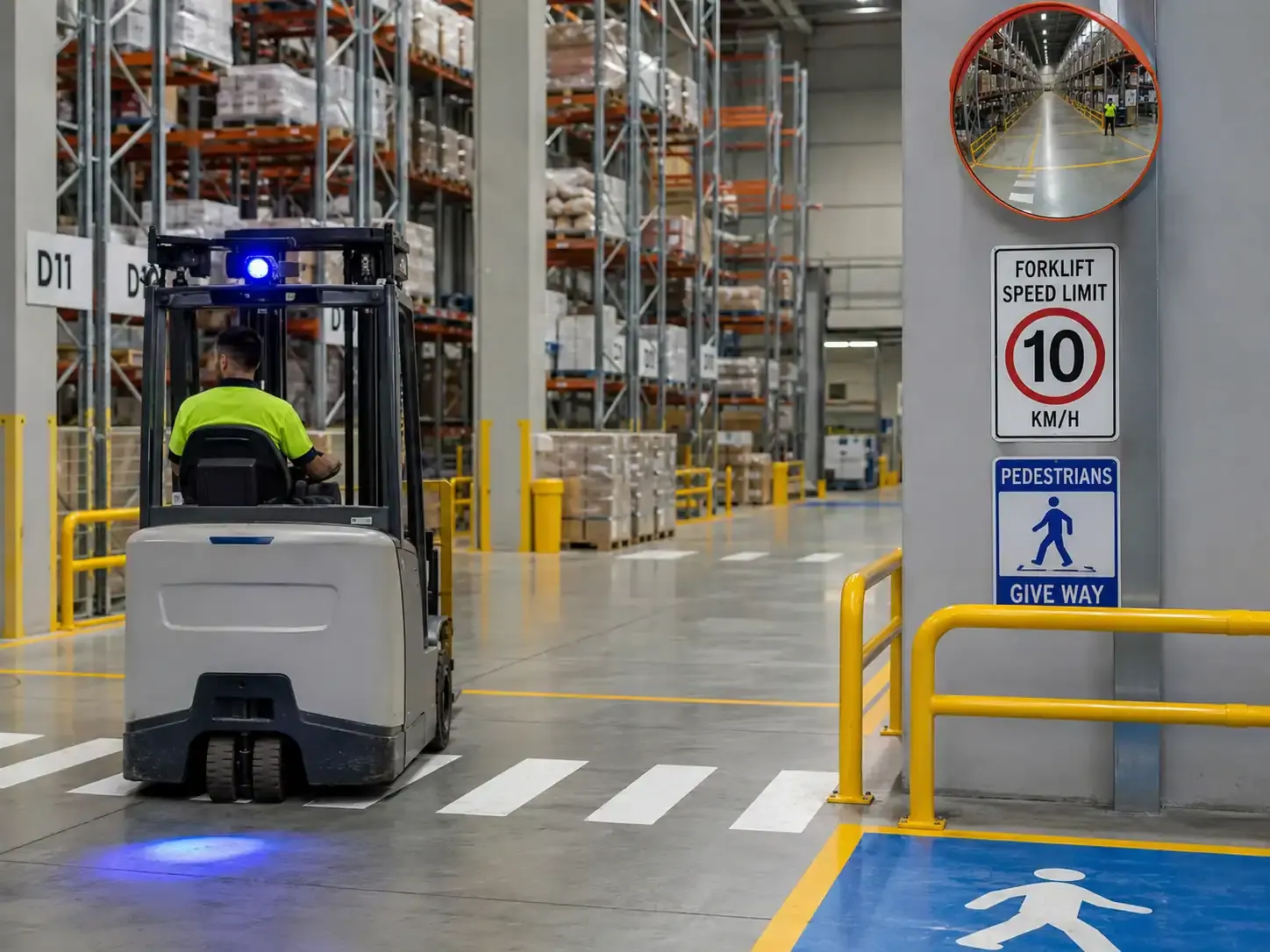
Warning lights can make an approaching forklift more noticeable, particularly near blind corners, doorways and noisy work areas.
A blue spot light projects a visible warning onto the floor ahead of or behind the forklift. The blue safety lights used on forklifts can give pedestrians additional notice that a machine is approaching.
Red zone lights may project boundaries beside or behind the forklift to discourage pedestrians from entering its immediate operating area.
These lights are supplementary controls. They should not replace:
- Physical barriers
- Pedestrian separation
- Safe speed limits
- Clear visibility
- Operator training
- Horns and alarms
- Site traffic rules
Workers can become accustomed to warning devices, particularly when several forklifts operate in the same area. The traffic management system should not depend on one light or alarm.
Forklift Speed on Ramps and Gradients
Forklifts should travel more slowly on ramps than on level routes because gradients affect braking, stability and load control.
When using a ramp:
- Follow the forklift manufacturer’s maximum gradient
- Inspect the ramp for moisture, oil and damage
- Travel straight rather than turning across the gradient
- Keep a safe distance from edges
- Avoid sudden acceleration or braking
- Keep the load stable and at a low travel height
- Maintain clear visibility
- Prevent pedestrians from entering the route
- Do not stop or park on a ramp unless the approved procedure allows it
- Use a spotter only where a safe system has been established
The procedure for operating on slopes and ramps should account for whether the forklift is loaded, the direction of travel, tyre traction and the manufacturer’s instructions.
A ramp that is safe for one forklift may not be suitable for another model with a different wheelbase, ground clearance, capacity or braking system.
The 3-Metre Rule and Safe Separation Distances
The phrase “3-metre rule” commonly refers to a WorkSafe Victoria recommendation for pedestrian exclusion around moving forklifts.
WorkSafe Victoria recommends a minimum three-metre exclusion zone between a pedestrian and a forklift travelling at walking pace with its load at axle height.
That distance may need to increase significantly when:
- The forklift travels faster than walking pace
- The load is raised
- The load could fall or spread
- Visibility is restricted
- The surface is slippery
- The forklift is turning
- The pedestrian is near a wall, rack or other obstruction
- The forklift requires more room to stop
When a load is elevated, WorkSafe Victoria advises considering the height of the load and mast plus an additional three metres. This recognises that the potential falling-load area can extend beyond the forklift itself.
The three-metre distance is therefore not a universal safe bubble for every situation. It is a recommended minimum under defined conditions.
Physical separation and properly designed exclusion zones remain preferable to relying on workers to judge distance around a moving forklift.
Can Forklifts Travel Over Speed Humps?
A forklift may travel over a speed hump when the hump is suitable for industrial vehicles, the forklift manufacturer allows it and the site procedure has assessed the risks.
The operator should:
- Approach at a low speed
- Travel straight over the hump
- Keep the forks and load low
- Avoid braking or turning sharply while crossing
- Ensure the load is secure
- Check that the hump will not contact the forklift underside
- Keep pedestrians clear
- Report any damage or excessive jolting
A road-style speed hump may be too steep or abrupt for a forklift with low ground clearance, small solid tyres or an unstable load.
Speed humps should not be installed without considering forklift dimensions, loads, emergency access, floor damage and operator comfort. Electronic limiters, chicanes, barriers or layout changes may provide better control in some warehouses.
Creating a Forklift Speed Management Plan
A practical speed-management plan should document:
Forklift Routes
Map every indoor and outdoor route, crossing, ramp, loading area, charging area and parking location.
Pedestrian Movements
Identify where employees, contractors, delivery drivers and visitors may come into contact with forklifts.
Speed Zones
Set the limit for each area according to visibility, separation, surface, traffic and stopping distance.
Signage and Markings
Specify where speed signs, stop lines, crossings, exclusion zones and directional arrows will be installed.
Engineering Controls
Record speed limiters, proximity sensors, barriers, gates, mirrors, warning lights and other equipment.
Operating Procedures
Explain cornering, reversing, ramp use, dock approaches, load handling and pedestrian right-of-way.
Inspection and Maintenance
Include brake testing, tyre inspections, warning-device checks and fault reporting.
Training and Supervision
Document operator induction, familiarisation, refresher training and how speeding will be addressed.
Review Process
Set review dates and trigger reviews after incidents, layout changes, equipment purchases or changes in production.
Workers who operate forklifts or work near them should be consulted because they may identify blind corners, traffic conflicts and practical problems that are not obvious from a warehouse plan.
Final Forklift Speed and Braking Checklist
Before allowing normal operation, confirm that:
- A site-specific traffic risk assessment has been completed
- Maximum speeds have been set for each operating zone
- Forklift and pedestrian routes are separated
- Speed signs are clearly visible
- Operators understand the traffic management plan
- Brakes, tyres and steering are inspected before use
- The forklift can stop within the available clear distance
- Speed is reduced near crossings, corners and doorways
- Ramp procedures follow manufacturer requirements
- Speed limiters or telematics are considered where appropriate
- Warning lights supplement rather than replace separation
- Incidents and near misses trigger a review
A safe forklift speed is not simply the number printed on a sign. It is the speed that allows the operator to maintain control, protect pedestrians, preserve load stability and stop safely within the available space.
Frequently Asked Questions
1. What Is the Maximum Speed for a Forklift?
There is no single maximum speed that applies to every forklift.
The machine’s technical maximum is listed in its specifications, but the workplace speed limit should normally be lower and based on a site risk assessment. Operators must travel below the posted limit whenever visibility, pedestrians, loads, surfaces or gradients make the maximum unsafe.
2. Is There a Legal Speed Limit for Forklifts in Australia?
There is no one Australia-wide forklift speed number equivalent to a public-road speed limit.
Workplaces must identify traffic risks, set an appropriate maximum speed, display it and enforce it through their safety and traffic management systems. The selected speed must be suitable for the actual forklift, environment and work being performed.
3. What Speed Limit Should a Warehouse Have?
Many warehouses use approximately 5 km/h in pedestrian-heavy or restricted areas and between 5 and 10 km/h in physically segregated aisles.
These are examples rather than legal defaults. A warehouse should determine its limits by assessing pedestrians, aisle width, visibility, stopping distance, loads, floor conditions, intersections and forklift specifications.
4. What Is the 3-Metre Rule for Forklifts?
WorkSafe Victoria recommends a minimum three-metre pedestrian exclusion zone for a forklift travelling at walking pace with the load at axle height.
A greater distance is required when the forklift is faster, the load is elevated or conditions increase the potential stopping or falling-load area. Physical barriers should be used wherever reasonably practicable.
5. What Are Five Important Forklift Safety Rules?
Five essential forklift safety rules are:
- Keep forklifts physically separated from pedestrians wherever possible.
- Obey the site speed limit and slow down further when conditions require it.
- Wear the operator restraint or seat belt where fitted.
- Keep loads stable, within rated capacity and low during travel.
- Complete pre-start checks and remove defective forklifts from service.
These rules should operate alongside the manufacturer’s instructions and site-specific procedures.
6. Can a Forklift Go Over a Speed Bump?
Yes, but only when the speed hump is suitable for the forklift and has been included in the site risk assessment.
The operator should cross slowly and straight, keep the load low and avoid sharp braking or steering. Unsuitable humps may affect stability, ground clearance, tyres, loads and operator comfort.
7. How Long Does It Take a Forklift to Stop?
There is no reliable universal stopping time or distance.
Stopping performance depends on speed, reaction time, brake condition, tyre grip, load weight, floor surface, gradient and forklift design. Sites should test stopping performance under controlled conditions and provide enough clear distance before crossings, doors and other hazards.
8. Should a Forklift Always Travel at the Posted Speed Limit?
No. A speed limit is the maximum permitted speed, not a target.
Operators should travel more slowly near pedestrians, blind corners, ramps, wet floors, unstable loads, doorways, dock edges and areas with restricted visibility.