
Forklift Safety Lights: Blue, Red Zone and Halo Explained
· Updated
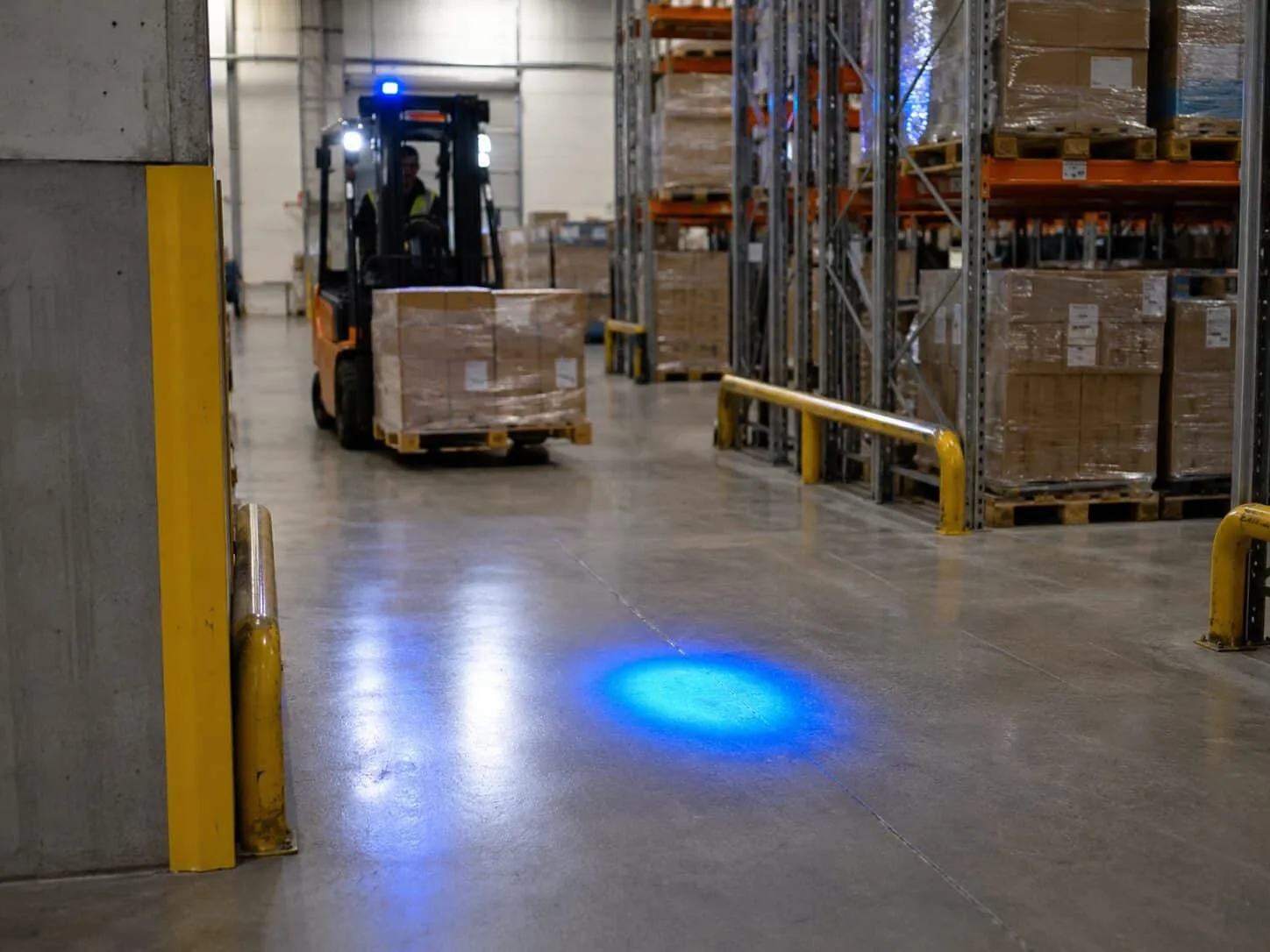
Forklift safety lights project a visible warning onto the floor around a moving machine so pedestrians see it coming before they hear it.
They come in several forms, and the two most common do genuinely different jobs. A blue spot warns of approach. A red zone or halo light marks out the area alongside the machine that people should stay clear of.
This guide covers what each type does, which suits which site, and where lighting sits in a pedestrian safety plan. It also covers what to check before fitting them, because the light is only as useful as its aim.
Why Do Forklifts Have Blue Lights?
A blue spot light projects a bright blue mark on the floor ahead of or behind a forklift so pedestrians can see the machine coming before they can see or hear it.
It is most valuable at blind corners, at the ends of racking runs, at doorways, and in noisy environments where a reversing alarm gets lost in the background.
The light travels ahead of the machine, which is the whole point. A pedestrian about to step into an aisle sees the blue mark on the floor before the forklift itself comes into view, and that gap is what prevents the incident.
The Main Types of Forklift Safety Light
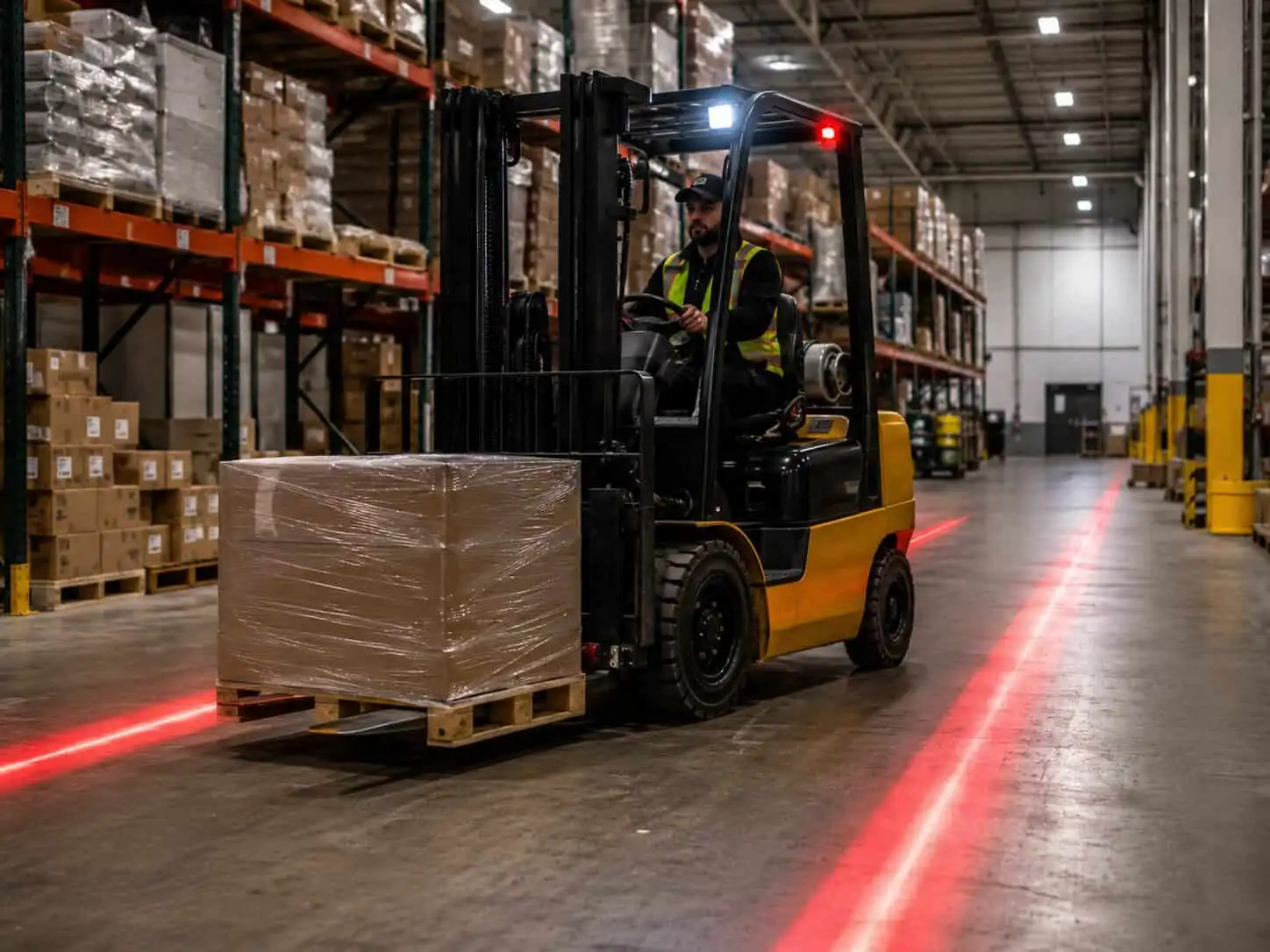
The category is broader than blue spots.
Choosing between the options depends on whether your risk is people walking into the machine’s path, or people walking too close alongside it.
|
Light type |
What it does |
Works best |
Limitations |
|---|---|---|---|
|
Blue spot light |
Projects a bright spot on the floor ahead of or behind the machine |
Blind corners, aisle ends, doorways, noisy sites |
Warns of approach only; says nothing about the safe distance alongside |
|
Red zone or halo light |
Projects lines or a perimeter marking a keep-out area around the machine |
Mixed pedestrian and forklift areas, pick faces, loading docks |
Less effective as an early warning at a distance |
|
Arrow or directional projection |
Projects a directional symbol showing which way the machine is travelling |
Two-way aisles and intersections |
Needs the pedestrian to be looking at the floor |
|
Strobe or beacon |
Flashing light mounted on the overhead guard |
Open yards, outdoor areas, high ambient noise |
Poor in bright daylight; easy to become background noise on a busy site |
|
LED work and reversing lights |
Illuminates the path and the load |
Poorly lit areas, cold stores, night operations |
Not a pedestrian warning device |
Most sites that take this seriously fit more than one type, because they are solving different problems.
Blue Spot or Red Zone Light: Which Should You Fit?
Fit a blue spot if your incidents and near misses involve pedestrians stepping into the path of a machine they did not know was coming.
That is a visibility-at-distance problem, and a projected spot travelling ahead of the forklift solves it.
Fit a red zone light if your problem is people working too close alongside a moving machine.
Warehouse pick faces, loading docks and any area where pedestrians and forklifts share space continuously are where the exclusion-zone marking earns its keep, because the risk is proximity rather than surprise.
If you are unsure which, look at your near-miss reports rather than guessing.
Sites that log them usually find the pattern is obvious once someone reads the last six months in one sitting, and the accident types that recur most often tend to point straight at which control is missing.
Where Safety Lights Fit in Your Pedestrian Safety Plan
Lights support a traffic management plan. They do not replace one.
That distinction matters, because a site that fits blue spots and considers the problem solved has bought a warning device rather than a control.
The controls that come first are the ones that remove the interaction altogether: physical separation of pedestrians and forklifts, designated walkways, barriers at aisle ends, one-way traffic flow, and exclusion zones around operating machines.
Where the interaction cannot be removed, speed limits, mirrors at blind corners and supervision reduce the risk further. Lighting sits alongside those as a way of making the machine more visible when the interaction does occur.
Speed is the control most often set too high on Australian sites, and how quickly a loaded forklift actually stops is worth checking before deciding lighting is the answer.
Confirm the current traffic management expectations for your site with WorkSafe Victoria or your state regulator, and see Safe Work Australia for the model guidance on traffic management in workplaces.
How Far Should a Blue Spot Light Project?
Far enough that a pedestrian sees the mark and has time to stop before the machine reaches them.
That depends on your aisle layout and your forklift speed rather than on a universal number.
Four things determine where the spot lands: the mounting height on the overhead guard, the angle it is set at, the machine’s travel speed, and the ambient light in the area.
A light aimed too close to the machine gives no useful warning. A light aimed too far ahead becomes a mark on the floor that nobody associates with an approaching forklift.
The practical approach is to set it on site, with the machine at operating speed, and check it from a pedestrian’s eye level at the corners that actually matter. Manufacturer specifications will give you a projection distance range, and the final aim is a site decision within that range.
Choosing Lights for Cold Storage, Wet Areas and Outdoor Work
A light that works in a dry warehouse will not necessarily survive a freezer or a wash-down area, and this is where cheap units fail first.
- Ingress protection rating: check the IP rating against the environment. Wash-down areas, wet docks and outdoor work all demand more than a dry warehouse does.
- Condensation in cold stores: machines moving between a freezer and an ambient loading area cycle through condensation repeatedly, which finds any weakness in a seal.
- Vibration resistance: rough yard surfaces shake mountings loose and kill poorly built LED units. Check the mounting as well as the light.
- Ambient light: a projected spot competes with daylight. Outdoors and near roller doors, a projection may be far less visible than it is inside, which is where a strobe or beacon does better.
Fitting and Wiring Safety Lights
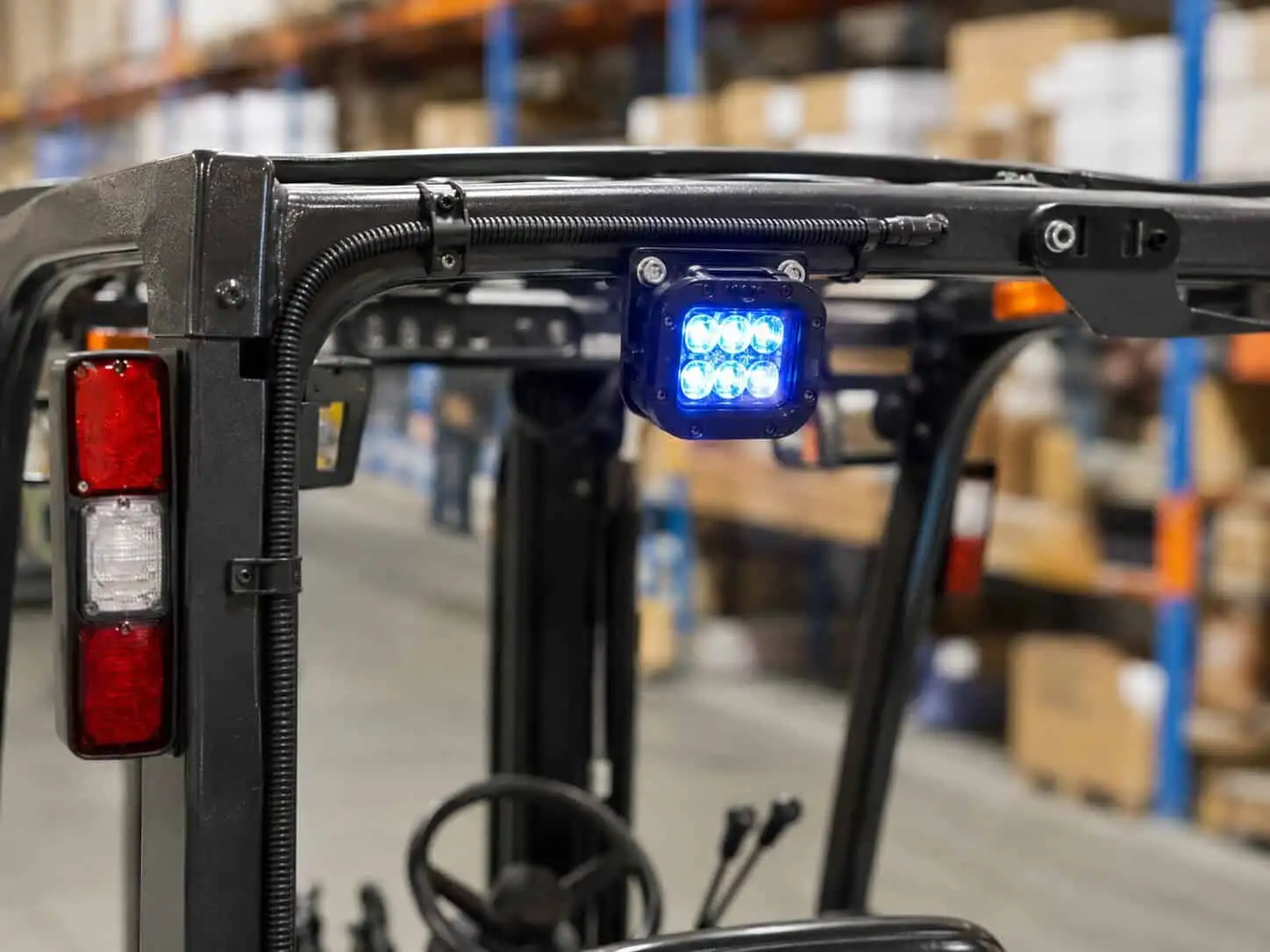
Fitting is straightforward mechanically and less straightforward electrically.
The light needs to be mounted where it will not be knocked off, wired into the machine’s electrical system correctly, and aimed properly.
Three things to confirm before anyone starts drilling.
First, that mounting to the overhead guard does not compromise its structure, since the guard is a protective structure and not a convenient bracket. Second, that the wiring is rated for the machine’s system and routed so it cannot chafe or be caught.
Third, that fitting the light does not affect the machine’s compliance or void a warranty, which is a question for the manufacturer or your service provider rather than an assumption.
This is work for a competent person. Check the machine manufacturer’s guidance before fitting anything to the overhead guard.
Maintaining and Checking Safety Lights
A safety light that has stopped working is worse than no light, because the site has adapted to expecting it.
Add light function to the daily pre-start check so a failure is caught the morning it happens rather than at the next service.
The check takes seconds: confirm the light comes on, confirm the projection is still landing where it should, and confirm the lens is clean.
Dust and shrink wrap film on a lens will dim a projection noticeably long before the unit fails.
Also check the aim periodically. Mountings move with vibration, and a light knocked out of alignment goes on working while doing nothing useful. That belongs on the same periodic inspection schedule as the mast, forks and tyres rather than being left to whoever notices.
Can You Retrofit Safety Lights to an Older Forklift?
Yes, in most cases.
Aftermarket LED safety lights are designed to be fitted to existing machines and run off the forklift’s own electrical system, which makes them one of the cheaper safety improvements available on an older fleet.
Check the machine’s electrical system voltage, whether there is a suitable mounting point on the overhead guard, and whether the manufacturer has any guidance on fitting to that model.
On a pre-owned machine, ask the seller whether lights have been fitted before and whether the wiring was done properly, because a poorly executed previous installation is more work to correct than a clean start.
If lighting is part of the plan, it is worth raising at the point of purchase, and the condition of the existing wiring is one more thing to look at when buying a pre-owned machine in Melbourne.
Frequently Asked Questions
1. Why do forklifts have blue lights?
A blue spot light projects a bright blue mark on the floor ahead of or behind the forklift so pedestrians can see the machine coming before they can see or hear it.
It is most useful at blind corners, aisle ends and in noisy environments where a reversing alarm is easily missed.
2. What is a forklift red zone light?
A red zone light projects lines or a perimeter onto the floor alongside the forklift, marking an area pedestrians should stay out of while the machine is operating.
Where a blue spot warns of an approaching machine, a red zone light marks the safe distance to keep from one that is already there.
3. Are forklift safety lights required by law in Australia?
Lighting is generally not mandated as a specific requirement, but the duty to manage the risk of pedestrians and powered mobile plant interacting is.
Where a risk assessment identifies that visibility is a factor, lighting can form part of the controls. Confirm what applies to your workplace with WorkSafe Victoria or your state regulator, and treat lighting as a supporting control rather than a substitute for separation and traffic management.
4. How far does a blue forklift light project?
It depends on the mounting height, the angle it is set at and the unit itself, and the right distance for your site depends on aisle layout and machine speed.
Set it so a pedestrian sees the mark with time to stop, and check it from eye level at the corners that matter rather than relying on a specification figure alone.
5. Can you fit safety lights to any forklift?
Most machines can take aftermarket LED lights, which run off the forklift’s own electrical system.
Check the system voltage, confirm there is a suitable mounting point that does not compromise the overhead guard, and check the manufacturer’s guidance for that model before fitting.
6. Do blue lights actually reduce forklift accidents?
They improve the visibility of an approaching machine, particularly at blind corners and in noisy areas, which addresses one specific failure mode.
They do not address speed, load handling, poor traffic management or operator behaviour. Treat them as one control among several rather than as a solution on their own.