
Lithium vs Lead Acid Forklift Batteries: Which Wins?
· Updated
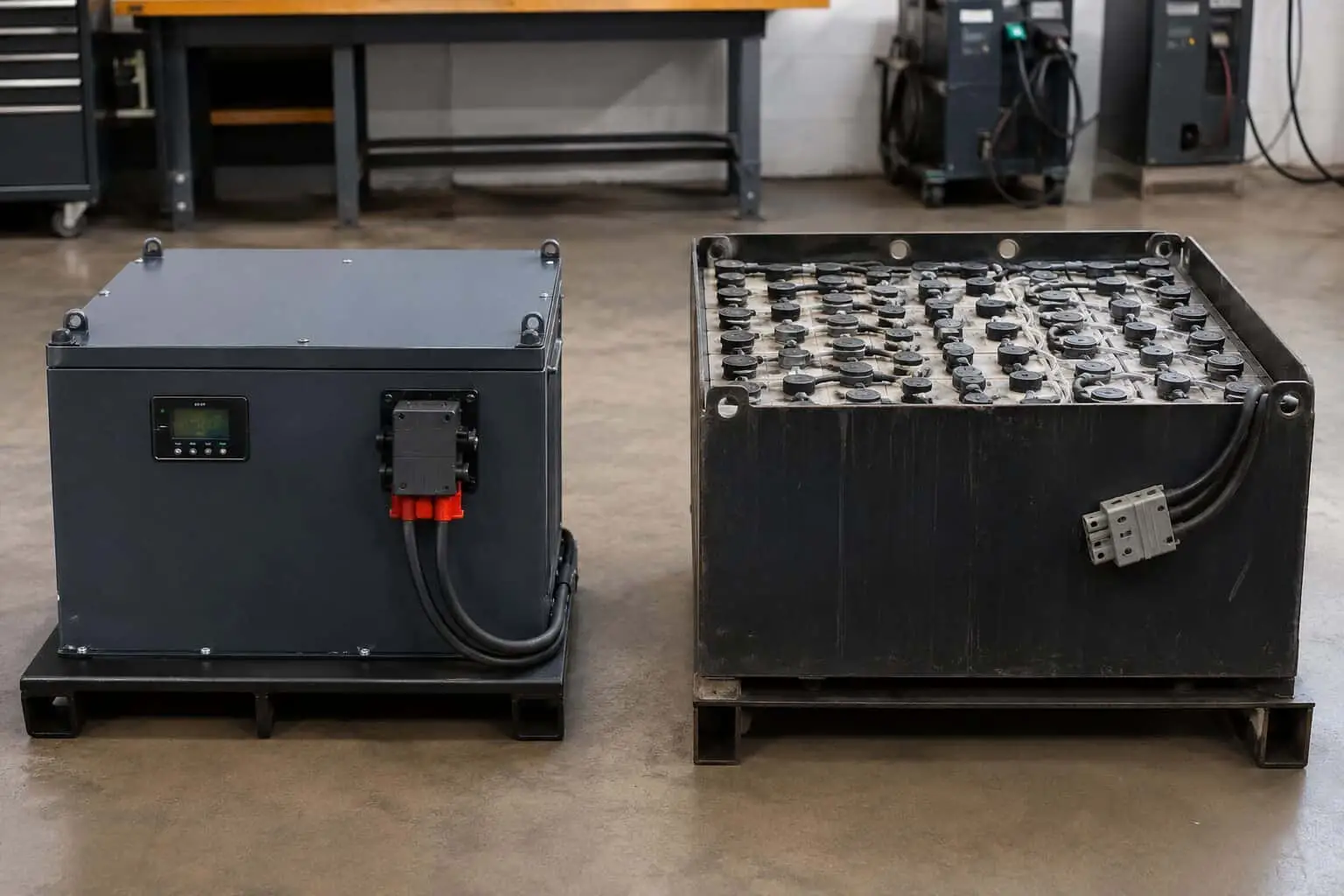
The choice between a lithium forklift battery and a lead acid one comes down to how hard the machine works, not to which technology is newer.
Single-shift operations with an overnight charge usually come out ahead on lead acid. Multi-shift or high-utilisation sites usually come out ahead on lithium, because opportunity charging removes the second battery and the swap entirely.
This guide compares the two on the things that actually decide it: charging, lifespan, maintenance, the space each one needs, and what the whole cost looks like over the years you own the machine.
Lithium or Lead Acid: the Short Answer
If your forklift runs one shift a day and sits idle overnight, lead acid does the job and costs less to buy.
There is no shift pattern problem to solve, the overnight charge fits the operating window, and the higher upfront cost of lithium buys you capability you will not use.
If your forklift runs across two shifts, or runs hard enough that charging downtime becomes a bottleneck, lithium changes the arithmetic.
It can be charged in short bursts during breaks without damage, which means one battery covers the whole day instead of two batteries plus the gear and labour to swap them.
The other case where lithium wins outright is floor space. Lead acid charging areas have requirements that lithium generally does not, and on a tight site that can decide it on its own.
Lithium vs Lead Acid Forklift Batteries Compared
|
Factor |
Lead acid |
Lithium ion |
|---|---|---|
|
Upfront cost |
Lower |
Higher |
|
Charging time |
Long, followed by a cool-down period before use |
Considerably faster, no cool-down required |
|
Opportunity charging |
Damages the battery and shortens its life |
Designed for it; partial charges do no harm |
|
Routine maintenance |
Regular watering, terminal cleaning, equalisation charging |
Effectively none beyond keeping it clean |
|
Charging area |
Dedicated area with ventilation requirements |
Generally fewer requirements; confirm with the regulator |
|
Performance as charge drops |
Voltage sags towards the end of the shift, so the machine slows |
Holds output more consistently through the discharge |
|
Weight and ballast |
Heavy, and on many machines that weight is doing real counterbalance work |
Lighter, which can require compensating ballast on some models |
|
Second battery needed |
Usually, for multi-shift work |
Usually not |
|
Disposal |
Established recycling stream |
Different handling and disposal obligations |
The weight row is the one people miss.
On many electric counterbalance forklifts the lead acid battery is not just a power source, it is part of the counterweight. Swapping to a lighter lithium pack on a machine designed around a heavy battery can affect the rated capacity, which is why a retrofit is a specification question rather than a straight swap.
How the Two Chemistries Actually Work
Lead acid
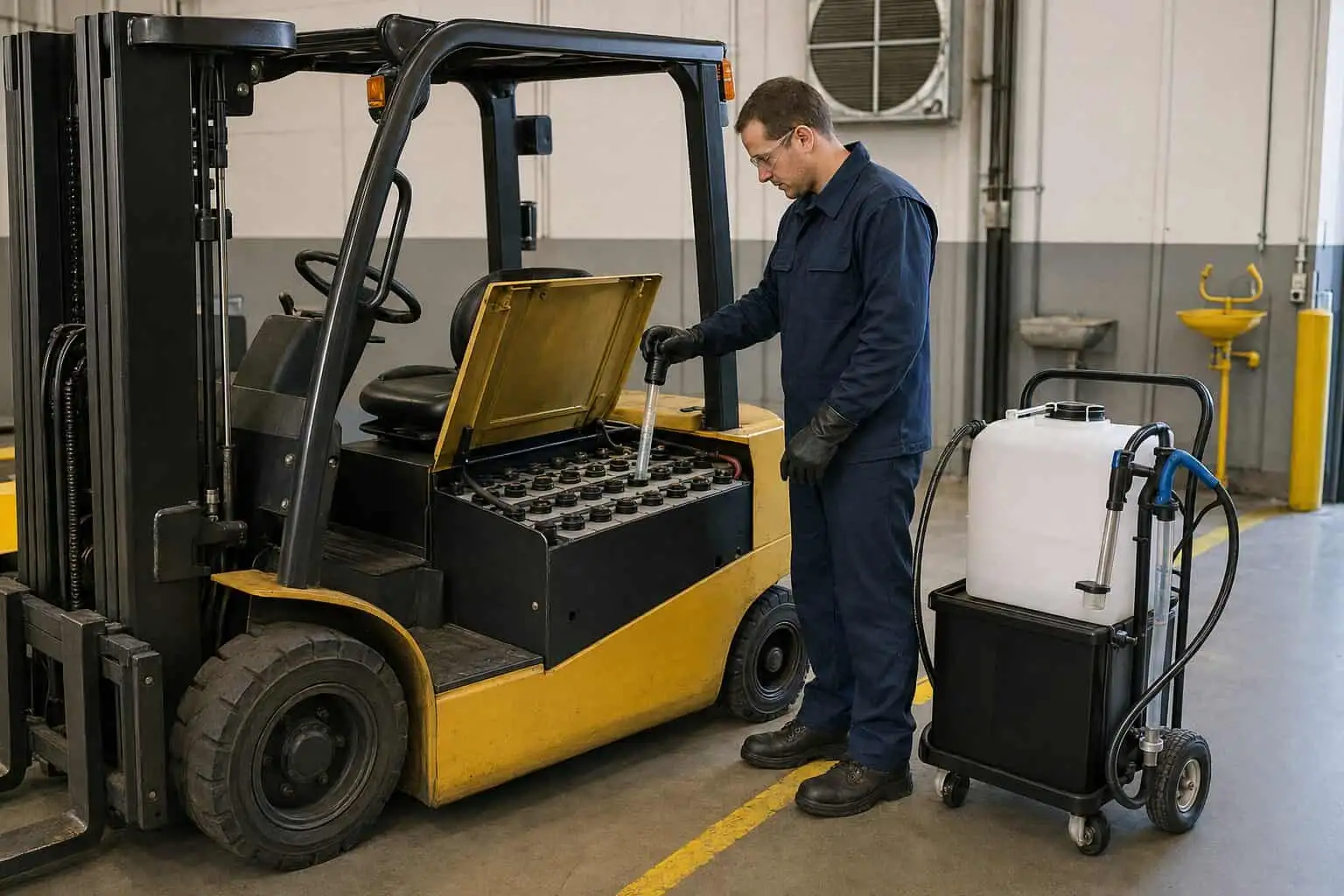
A lead acid forklift battery uses lead plates in a sulphuric acid electrolyte. That electrolyte needs topping up with distilled water on a schedule, because charging causes water loss.
Skipping the watering routine is the single most common way these batteries die years before they should.
Charging generates heat and releases hydrogen, which is why lead acid batteries need a cool-down period after charging and why the charging area needs ventilation.
Equalisation charging, an intentional controlled overcharge, is also part of the routine to keep the cells balanced.
Lithium ion
A lithium forklift battery is a sealed pack managed by a battery management system, which monitors cell temperature, voltage and charge state and protects the pack from damage.
There is no watering, no equalisation and no cool-down.
The practical consequence is that partial charging does not hurt it. An operator can plug in during a smoko break and gain useful runtime, which is what makes the multi-shift case work.
Charging: the Constraint That Usually Decides It
Match the battery to the shift pattern and the space, in that order.
- One shift with an overnight window: lead acid handles it. One battery, one charger, a suitable charging area.
- Two shifts back to back: either a second lead acid battery with the racking and handling gear to swap it, or a lithium pack charged during breaks.
- Round-the-clock operation: lithium, in nearly all cases.
- No room for a charging bay: lithium, because the space requirement is the binding constraint rather than the shift pattern.
The second battery is not just a battery cost. It is floor space, a lifting device and the labour to do the swap safely, and those three things are what usually close the gap on the lithium premium.
Lead acid charging areas have requirements around ventilation because of the hydrogen released during charging. These are set by the work health and safety regulator and need designing in before the machine arrives.
Confirm what applies to your site and battery type with WorkSafe Victoria or your state regulator.
Total Cost of Ownership: What to Compare
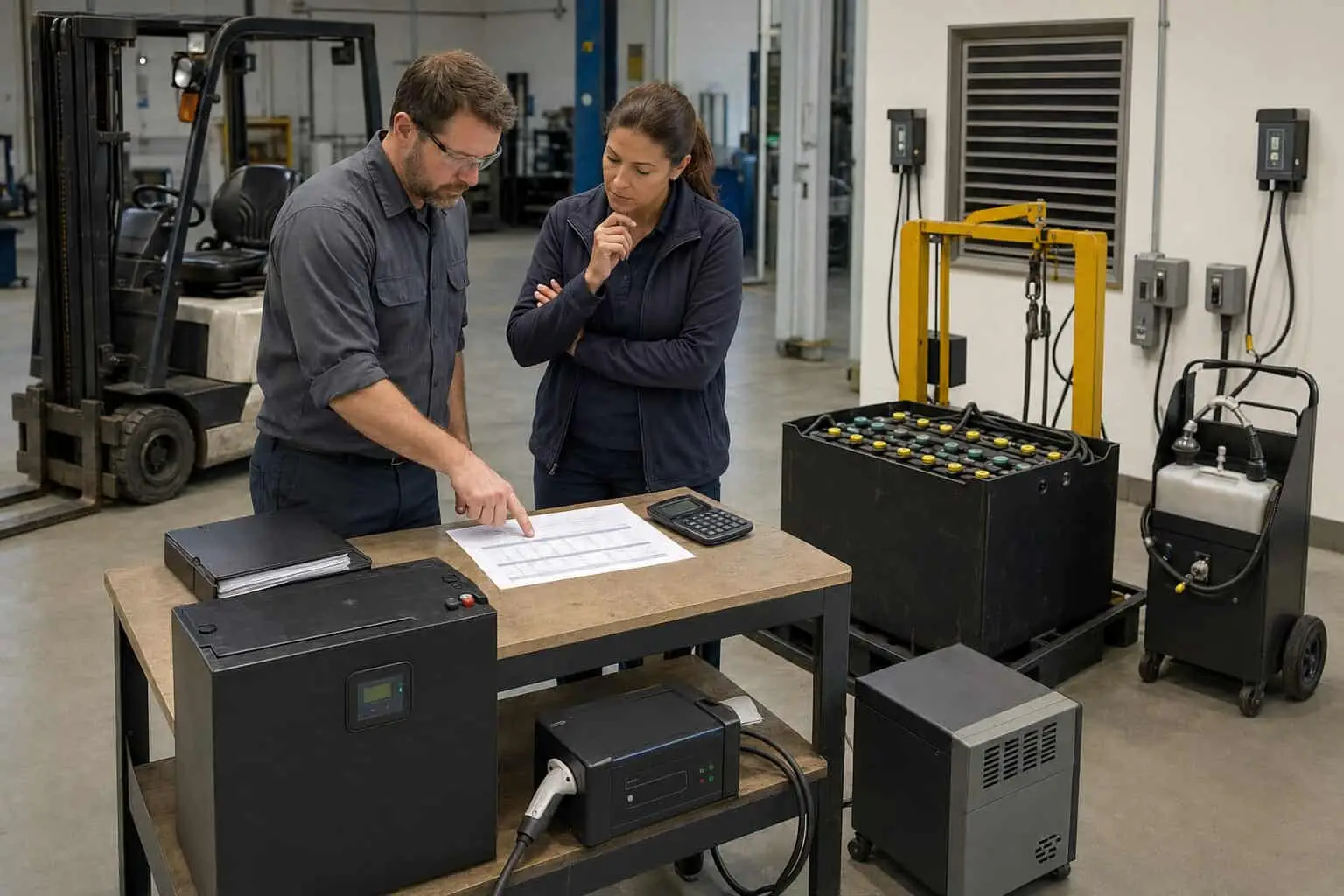
Comparing the two on purchase price alone gets the answer wrong more often than it gets it right, because the costs that separate them mostly sit elsewhere.
Work through these categories with your own numbers rather than accepting a generic payback figure.
- Battery purchase: the headline difference, and the one that favours lead acid.
- Charger purchase: the two chemistries need different chargers, so this is not a shared cost.
- Second battery and swap equipment: only applies to multi-shift lead acid, and it is a large line item once the handling gear is included.
- Charging area fit-out: ventilation, bunding and signage for lead acid, against a smaller footprint for lithium.
- Labour: watering, terminal cleaning and battery swapping are recurring costs that lithium removes.
- Downtime: time the machine spends charging or cooling down instead of working.
- Replacement interval: how many batteries you buy across the years you keep the machine.
- Disposal and residual: end-of-life obligations differ between the two.
Payback depends almost entirely on utilisation, which is why we do not publish a generic figure. Send us your shift pattern and the machine you are running, and we will work the comparison against real quotes.
For a straight replacement rather than a chemistry change, what a forklift battery costs turns on capacity and chemistry far more than on the age of the machine it goes into.
When Lead Acid Is Still the Better Buy
Most content on this topic reads like lithium marketing. It is worth being clear about where lead acid remains the right answer, because on a lot of Australian sites it is.
- Single-shift operations: if the machine has all night to charge, the main advantage of lithium is one you will never use.
- Machines that need the ballast: where the battery weight is part of the counterbalance design, changing it is a specification exercise with capacity implications.
- Short remaining ownership horizon: if the forklift is being sold or replaced in a couple of years, the lithium premium will not pay back before it leaves.
- Existing charging infrastructure: a compliant charging bay and chargers already installed are a sunk cost that favours staying with lead acid.
- Tight upfront budget: the lower purchase price is real, and cash flow is a legitimate constraint.
Lithium and Lead Acid in Pallet Jacks and Stackers
The calculation is different at this equipment class.
The batteries are much smaller, which compresses the upfront price gap, and lithium units have become common at entry price points across the electric pallet jack range.
The ballast argument also largely disappears, because a pallet jack is not relying on battery weight as a counterweight the way a seated counterbalance forklift does.
That leaves charging convenience as the main differentiator, and on a machine used in short bursts throughout the day, opportunity charging suits the pattern well. The same holds for the electric stackers, where the duty cycle is usually even more intermittent.
Safety, Storage and Disposal
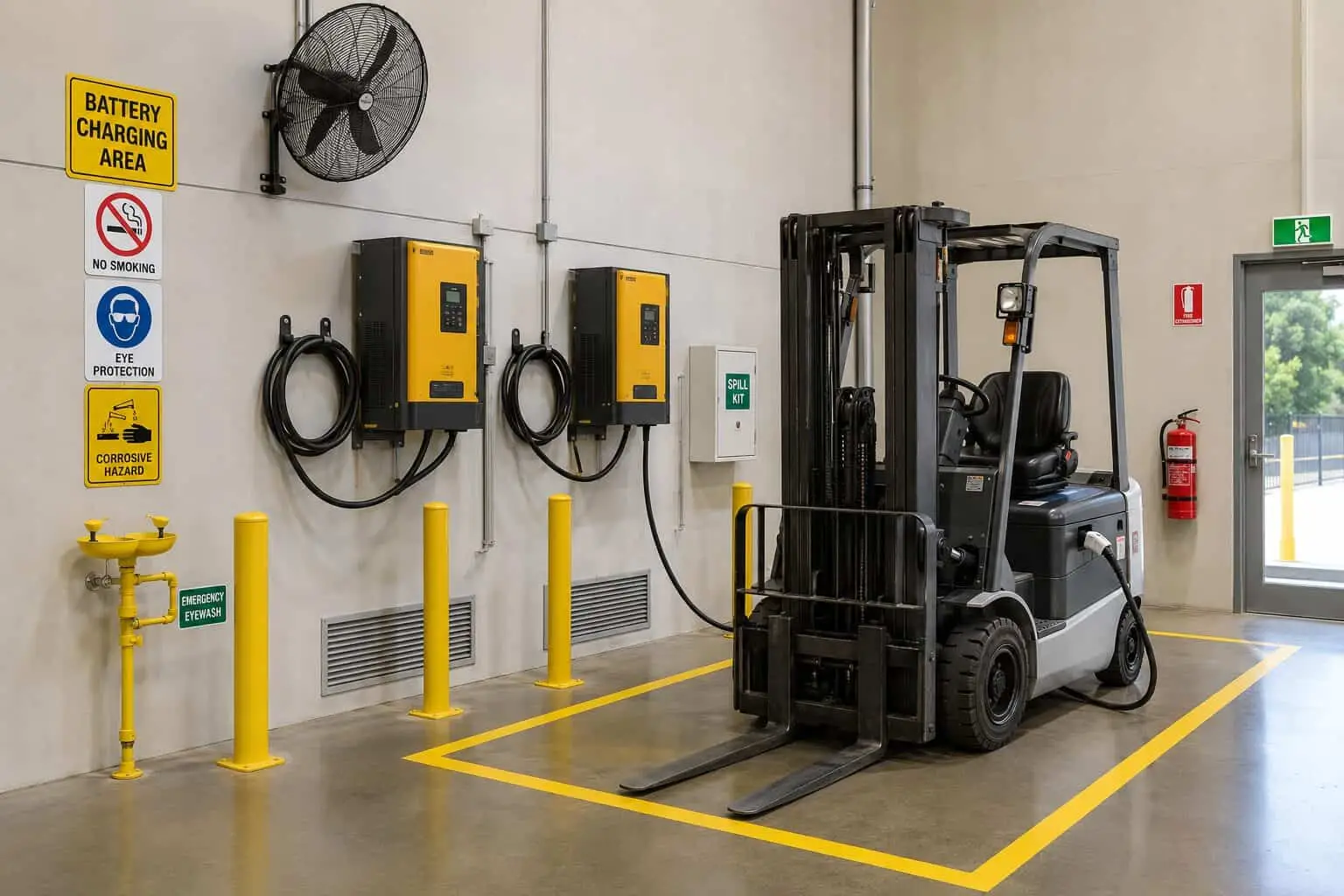
Both chemistries carry handling obligations, and they are different obligations.
Lead acid involves sulphuric acid, which means personal protective equipment for anyone watering or handling the battery, spill provisions, and eyewash access. Charging releases hydrogen, so ventilation and ignition source control matter in the charging area.
Lithium carries its own storage and charging requirements, and it has become an area of active regulatory attention in Australia.
Do not assume that because a lithium pack is sealed and maintenance-free it has no requirements at all. Check the current position for your site with your state regulator, and follow the battery manufacturer’s storage and charging instructions.
End-of-life obligations differ too. Lead acid has a long-established recycling stream, while lithium disposal is handled differently. Ask the supplier what happens to the pack at the end of its life before you buy, not afterwards.
Replacing a Battery on an Existing Forklift
Switching chemistry on a machine already in service is possible, but it is not a drop-in. Confirm the following before committing.
- Charger compatibility. A lead acid charger will not correctly charge a lithium pack. Budget for the charger as part of the change.
- Battery compartment fit. Tray dimensions and restraint arrangements have to suit the new pack.
- Weight and rated capacity. If the original battery contributed to the counterbalance, a lighter pack may change what the machine can safely lift.
- Data plate accuracy. If the machine’s rated capacity changes, the capacity information on the machine has to reflect it.
- Warranty and service implications. Check with the machine manufacturer or your service provider before changing the battery type.
Point three is the one that catches people out. It is a capacity question, not just a fitment question, and it should be assessed by someone qualified rather than assumed.
Frequently Asked Questions
1. How long does a lithium forklift battery last?
Lithium packs are generally rated for substantially more charge cycles than lead acid, but the actual life depends on the duty cycle, the operating temperature and how the pack is managed.
The manufacturer’s cycle rating for the specific pack is the figure to work from, not a general industry number.
2. Can you replace a lead acid forklift battery with lithium?
Often yes, but it is a specification exercise rather than a swap.
You need a compatible charger, a pack that fits the compartment and restraint, and confirmation that the change in weight does not affect the machine’s rated capacity. Where the original battery formed part of the counterbalance, compensating ballast may be required.
3. Do lithium forklift batteries need a special charger?
Yes. A lead acid charger will not charge a lithium pack correctly and using one can damage the battery.
The charger is a separate cost that needs including in any comparison.
4. Does a lighter battery reduce forklift capacity?
It can. On machines where the battery weight contributes to the counterbalance, fitting a lighter pack shifts the balance and may reduce the safe rated capacity.
If the rated capacity changes, the machine’s capacity information has to be updated to match.
5. Is lithium worth it for a single-shift operation?
Usually not on cost alone. The main advantage of lithium is opportunity charging, which only pays back when charging downtime is a constraint.
On a single shift with an overnight charging window, that constraint does not exist. The exception is a site with no room for a compliant lead acid charging area.
6. Do lithium forklift batteries need maintenance?
They need no watering, no equalisation charging and no terminal cleaning routine, which is the main day-to-day difference from lead acid.
They still need to be kept clean, charged with the correct charger and stored according to the manufacturer’s instructions.