Forklift Safety Cages and Work Platforms: Types, Rules and Safe Use in Australia
Yes, you can still use a forklift safety cage in Australia. They have not been banned. The cage has to be an engineered work platform designed for the job, fitted to a forklift rated to carry it, with a licensed operator at the controls the whole time, and Safe Work Australia limits the practice to occasional tasks.
Every forklift safety cage raises two separate compliance questions. Is the cage itself compliant? And is the way you are using it compliant? A well-built cage used the wrong way is still a breach.
What is a forklift safety cage?
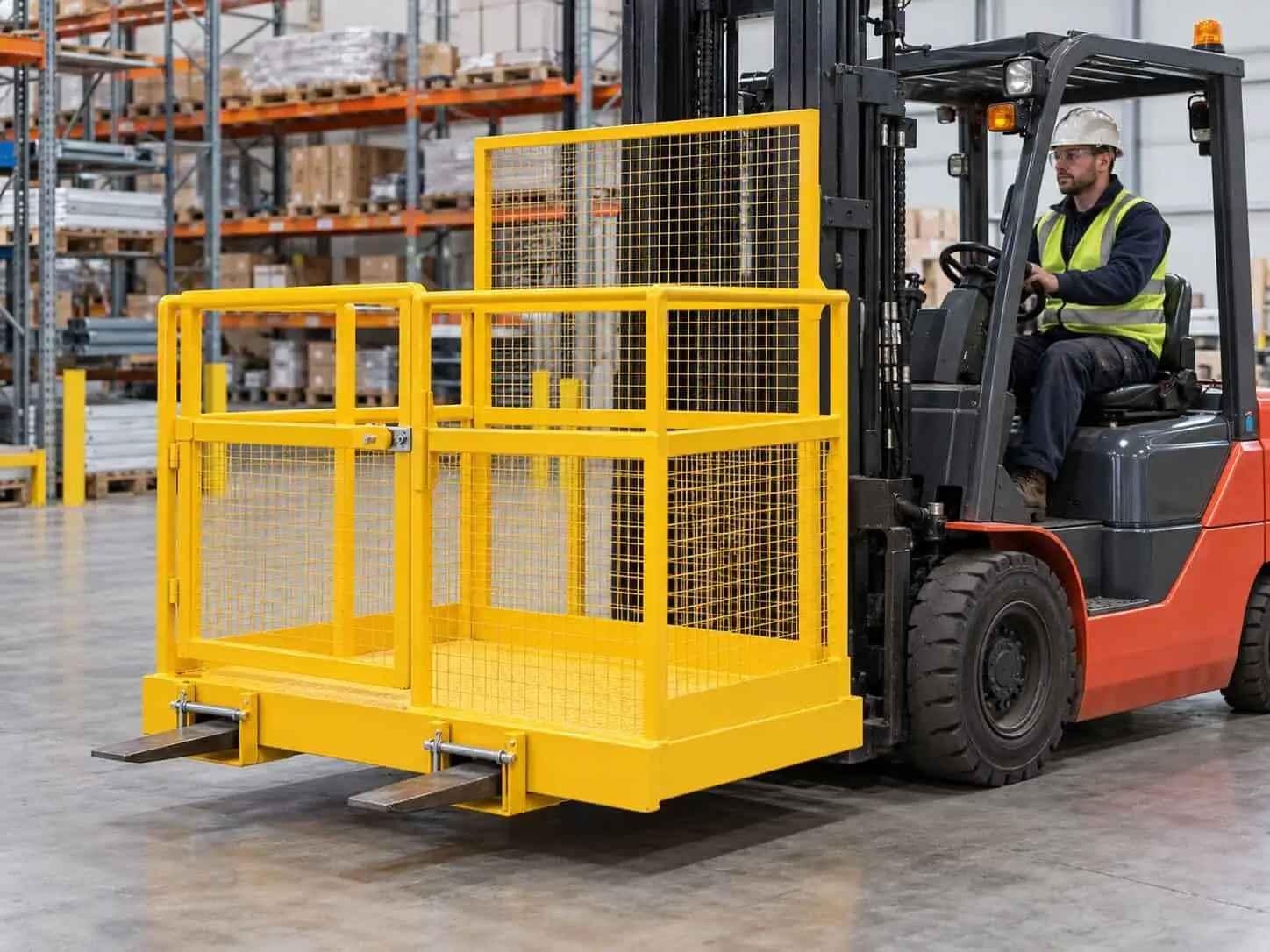
A forklift safety cage is an engineered platform that mounts on a forklift’s fork arms so a person can be raised to work at height. It has a floor, handrails on all sides, a gate, and fittings that lock it to the forklift.
The same equipment goes by several names, and the one you search for decides which information you find. The trade usually calls it a man cage. Suppliers sell it as a safety cage or personnel cage. Regulators write work box or work platform, which is why the official guidance rarely appears when you search the trade terms. This article uses the names interchangeably except when quoting a regulator.
A crane work box is a different piece of equipment with its own requirements. If people are being lifted by a crane rather than on fork arms, the guidance below does not apply.
Can you still use a forklift safety cage in Australia?
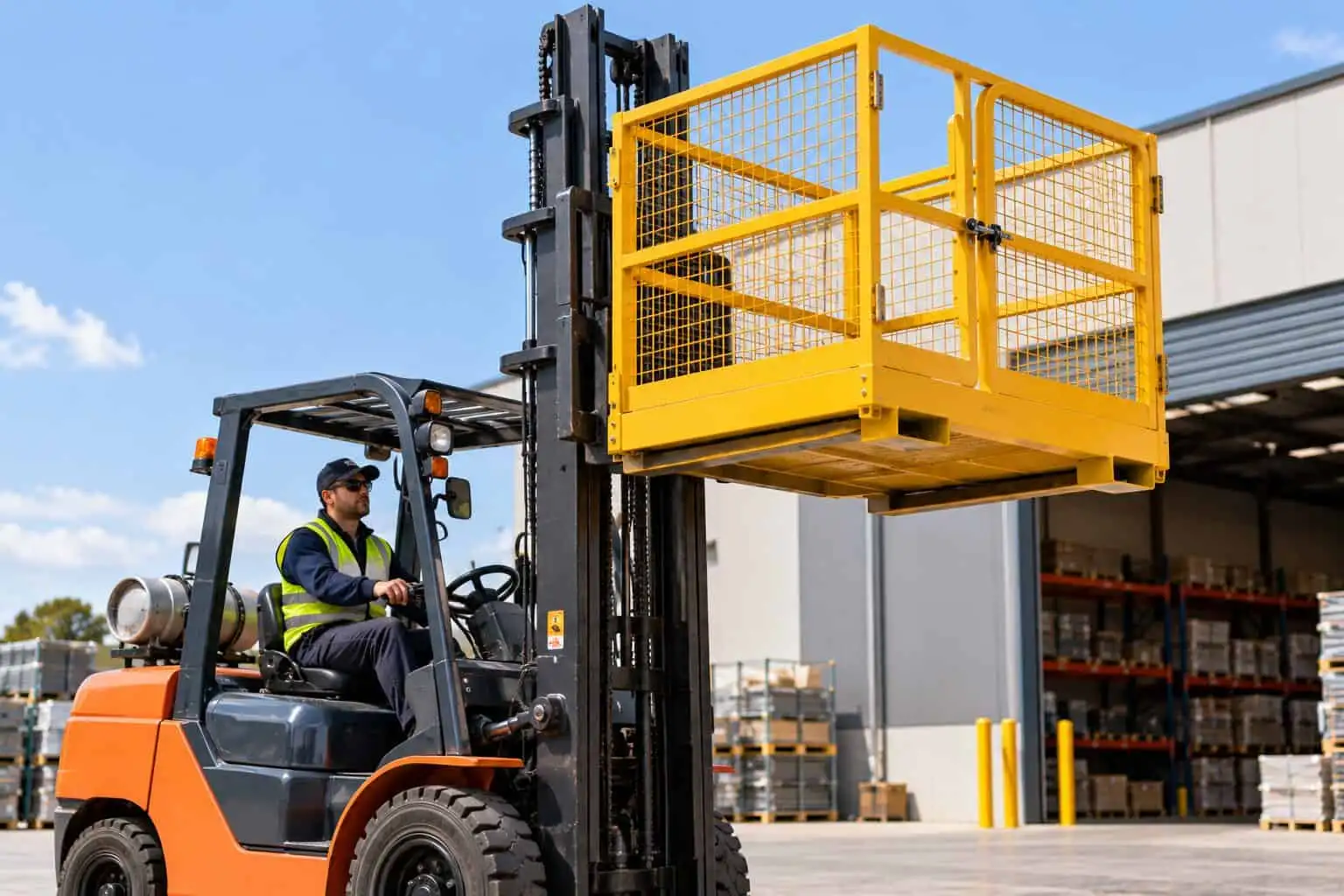
Yes, under specific conditions. Safe Work Australia’s position is that forklifts may be used to provide a work platform only if they are designed to lift people, and that work boxes are for occasional tasks. WorkSafe WA states that people may be raised “By use of a correctly secured Safety cage (Forklift Truck Work Platform)”.
The shortcut everyone has seen is not allowed. Safe Work Australia states that it is “not safe to use a forklift as a work platform or to gain extra height by standing on the fork arms or a pallet”. Asked whether people can ride on bare fork arms or on a load, WorkSafe WA’s answer is “No, not under any circumstances”, and it adds that “Loads must never be passed over people.”
Work health and safety in Australia is administered by a regulator in each state and territory, so the body you answer to depends on where you operate. The forklift man cage regulations in Australia covered here come from Safe Work Australia, WorkSafe Queensland and WorkSafe WA, because they address work platforms directly. Check the current guidance from your own state regulator as well.
Types of forklift safety cage
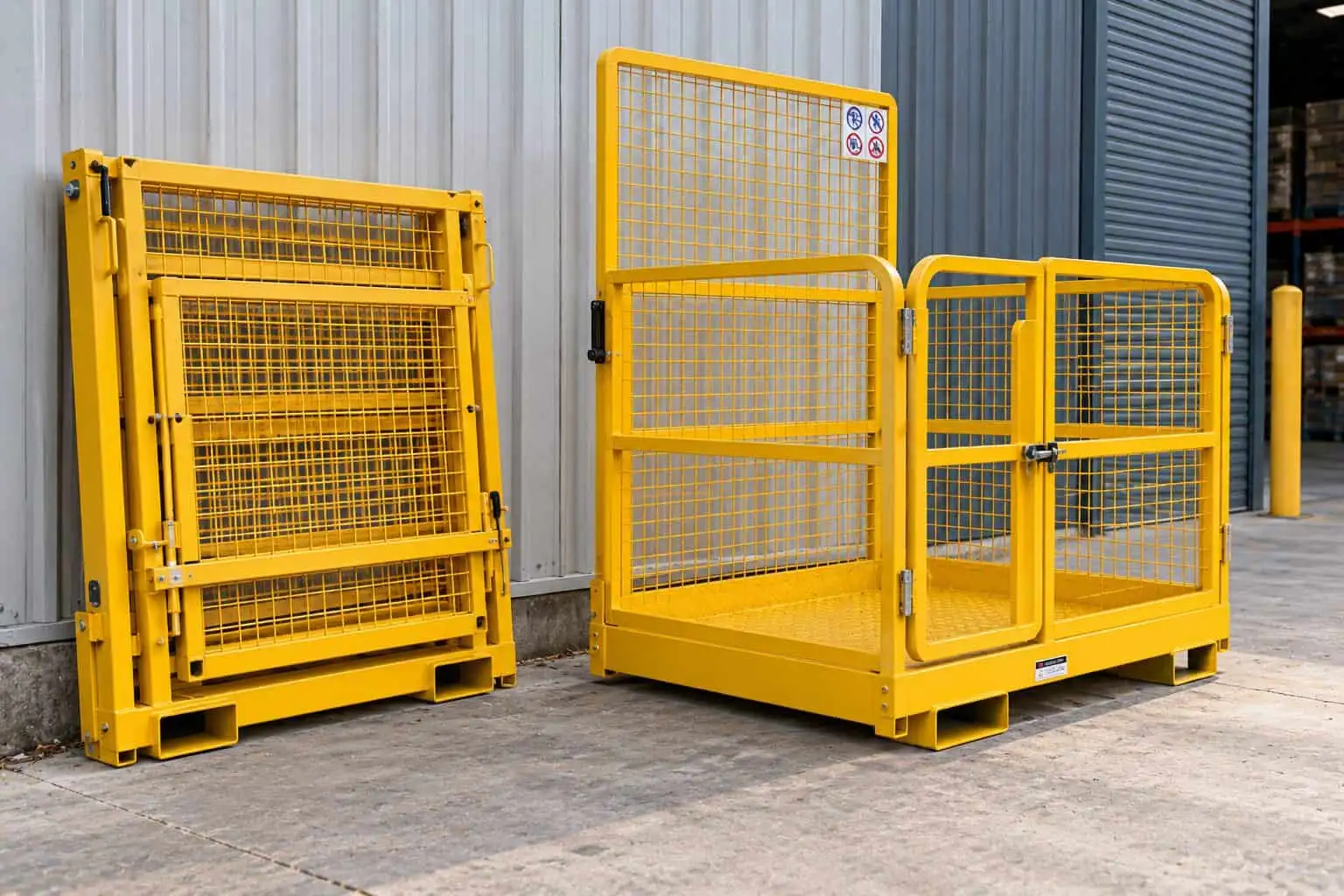
Forklift safety cages differ mainly in how they are built, how many people they carry and how they are stored. These are the main variations you will see from Australian suppliers:
Welded: a fixed, fully welded frame that arrives ready to use.
Bolt-together or flat-packed: supplied in panels and assembled on site.
Collapsible or folding: folds down when not in use to save storage space.
One-person or two-person: sized and rated for the number of occupants.
Rail sides or mesh sides: open handrails, or mesh infill between the rails to stop tools and materials falling through.
With castors: wheels for moving the cage around the floor when it is off the forklift.
Finish: zinc-plated or powder-coated.
The type matters far less than two other questions: whether the cage is engineer-designed to the Australian Standard, and whether your forklift is rated to carry it.
Is the cage itself compliant?
A forklift safety cage must be engineer-designed and built to AS 2359 Powered Industrial Trucks, Part 1. WorkSafe Queensland states that a workbox fitted to a forklift “must be securely attached to the forklift carriage and engineer-designed”, and constructed in accordance with that standard. A cage welded up in a workshop by someone handy is not a compliant work platform, however solid it looks.
WorkSafe Queensland sets out what the cage itself needs:
Requirement
What WorkSafe Queensland says
Design
Engineer-designed and constructed in accordance with AS 2359 Part 1
Attachment
Secured to the forklift with “a minimum of two independent securing devices”
Mast protection
Occupants “protected from the mast of the forklift and associated moving parts by a barrier”
Tine spacing
Tines “spaced widely apart to avoid the cage overbalancing”
Fork tunnels or clamps
Located “within 150mm to 250mm of the outside edge of a workbox”
Gate
“self-closing and kept shut when in the elevated position”
Fall protection
Anchorage points for safety harnesses
For a cage already on your site, the practical test is simple. Can you identify who designed and built it? Is there documentation? Can both securing devices be seen from inside? Does the gate close by itself? An unmarked cage of unknown origin cannot be shown to comply, and that is a poor position to be in when an inspector asks.
Is your forklift rated to carry it?
A safety cage is one of the forklift attachments that change what a machine can carry, and the forklift must be rated to carry it. The load is the cage plus the people in it, their tools and any materials, and that total has to sit within the forklift’s weight capacity at the height you plan to work.
The forklift’s data plate is the reference. It sets out what the machine is rated to lift and at what load centre, which makes reading the forklift load chart correctly the first step before any cage goes on. If the plate does not account for the attachment, do not guess. Get the forklift’s rating with the cage fitted confirmed in writing by the manufacturer or your dealer before anyone goes up.
Before the lift
Every lift starts with the same checks, in this order. They come from WorkSafe Queensland and Safe Work Australia.
Confirm the forklift is rated for the cage. Check the data plate covers the attachment before anything else.
Confirm the cage is engineer-designed and correctly fitted, with both independent securing devices engaged.
Carry out a trial lift with nobody inside. WorkSafe Queensland calls for “an initial trial lift without a person inside”.
Check the ground. The forklift must be on firm, level ground for the whole job.
Set the forklift up. WorkSafe Queensland: the parking brake set, the controls in neutral and the mast vertical.
Plan how people get down if something fails. Safe Work Australia says users must be able to “safely exit from the workbox and the forklift in the event of a failure”.
The operator stays at the controls the entire time people are in the cage. WorkSafe Queensland states it without qualification: “The employee operating the forklift must always remain at the controls.”
People in the cage stay in the cage. WorkSafe Queensland requires workers to remain within the work platform when it is elevated or being raised or lowered, to stand on the floor of the workbox, and not to use a ladder, pallet or other object to gain extra height. The gate stays shut while the cage is up.
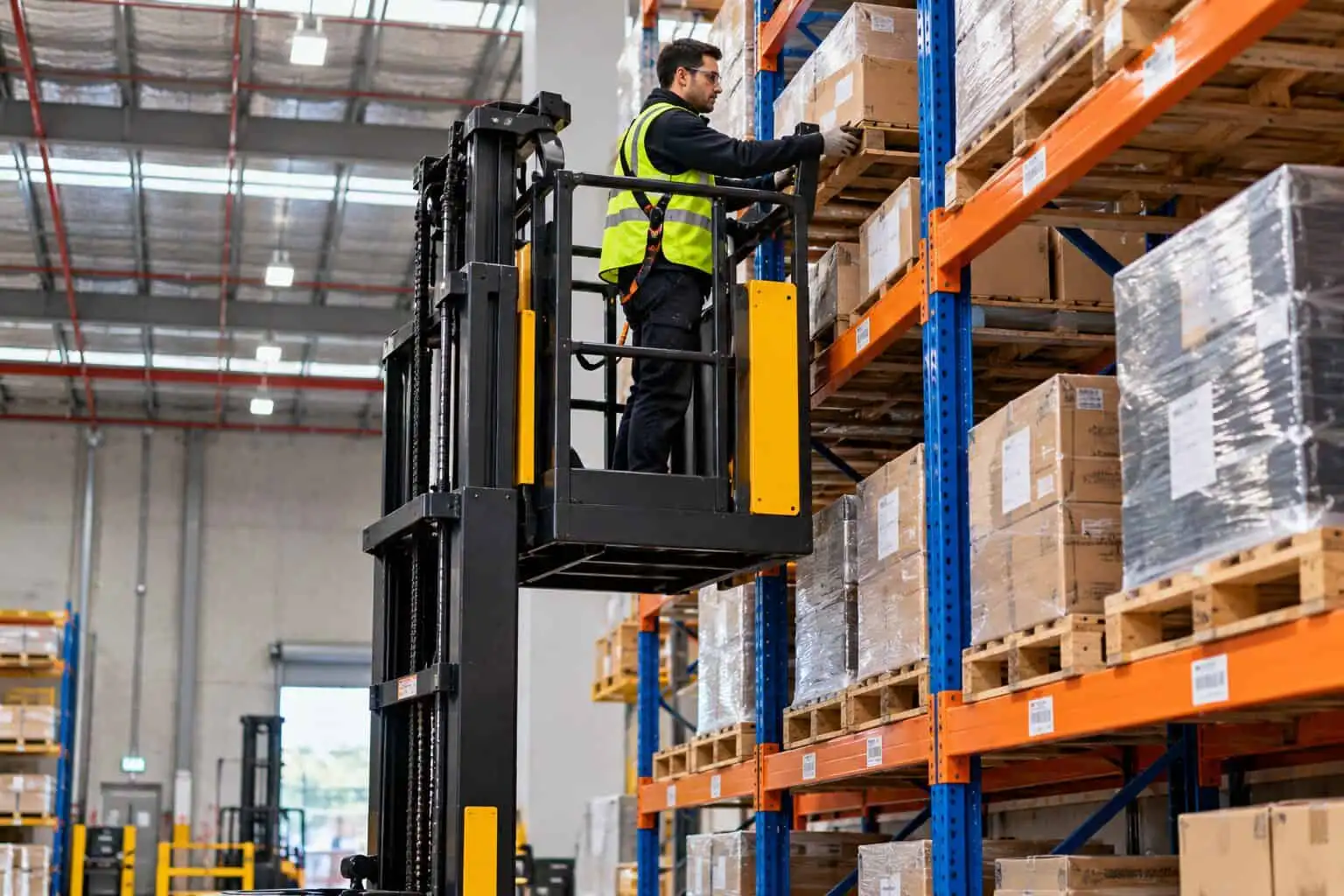
Fall protection is part of the cage’s design. WorkSafe Queensland calls for anchorage points for safety harnesses, and Safe Work Australia’s guidance illustrates an engineer-designed work box with a harness and lanyard correctly positioned. The anchorage has to be engineered into the platform, which is one more reason a workshop-built cage cannot be brought up to standard after the fact.
The same forklift stability principles that govern any raised load apply here, with far less margin for error when the load is a person.
Who can operate the forklift?
Only a licensed operator. WorkSafe Queensland’s guidance is to “Only operate a forklift if you hold a high-risk work licence or are an authorised trainee.” There is no separate licence class for raising people; the standard forklift licence in Australia covers it, but the standard of care expected is higher.
Do OSHA rules apply in Australia?
No. OSHA is the United States regulator, and its man basket rules have no legal force in Australia. Australian obligations come from work health and safety law administered by each state and territory regulator, with AS 2359 as the standard for powered industrial trucks.
When a safety cage is the wrong tool
A forklift safety cage is for occasional tasks, and Safe Work Australia says so. Changing a light, reaching stock now and then, or a job that comes up a few times a year are what a cage is for. It is not designed for lifting people as part of the weekly routine.
If people are going up regularly, a cage is the wrong answer. An order picker or an elevating work platform is built for an operator to work at height, with the platform, controls and safety systems designed around that from the start. On a site where people go up most days, the better question is choosing an order picking forklift that suits the racking height and pick volume.
To be clear about where Buy A Fork sits: we do not sell safety cages. What we can do is look at what you are lifting, how often and how high, and tell you whether the forklift you have suits the job.
What happens when it goes wrong
On 28 August 2025, WorkSafe Queensland reported that a worker sustained serious injuries after falling from an elevated forklift. According to the alert, the worker had been lifted on a pallet by the forklift to make repairs to a pull-chain roller door. WorkSafe Queensland noted that its findings were not yet confirmed and that investigations were continuing.
Forks, a pallet and a quick repair is the most common shortcut on this topic, and exactly what Safe Work Australia warns against.
Frequently asked questions
1. Can you still use a forklift cage?
Yes. Forklift safety cages have not been banned in Australia. A forklift may raise a person in an engineered work platform designed for the job, on a forklift rated to carry it, with a licensed operator at the controls, and Safe Work Australia limits this to occasional tasks.
2. What is the cage called on a forklift?
It is called a safety cage, man cage, personnel cage, work box or work platform. They are all the same equipment. Regulators use work box and work platform, so official guidance is written under those terms rather than the trade names.
3. What are the safety requirements for a forklift man cage?
The cage must be engineer-designed to AS 2359 Part 1, secured with at least two independent securing devices, fitted with a barrier from the mast, a self-closing gate and harness anchorage points. A trial lift without occupants comes first, and the operator must stay at the controls throughout.
4. What are the regulations for forklift man cage use in Australia?
Each state and territory regulator administers work health and safety law. Safe Work Australia allows forklifts to provide a work platform only if designed to lift people, for occasional tasks. WorkSafe Queensland and WorkSafe WA set out the cage, operator and use requirements summarised in this guide.
5. What are the Australian standard requirements for forklifts?
AS 2359 Powered Industrial Trucks is the Australian Standard for forklifts, and WorkSafe Queensland states that workboxes must be constructed in accordance with Part 1 of it. The standard is published by Standards Australia and requires purchase or a subscription to read in full.
6. What are the OSHA requirements for man baskets for forklifts?
OSHA requirements do not apply in Australia. OSHA is the United States regulator. In Australia, the rules come from state and territory work health and safety law, with AS 2359 as the relevant standard for powered industrial trucks.
7. Can you lift someone on the forks or a pallet?
No. Safe Work Australia states it is not safe to gain extra height by standing on the fork arms or a pallet, and WorkSafe WA says people must not be carried on bare fork arms or a load under any circumstances.
8. How do I know if my forklift is rated for a safety cage?
Check the forklift’s data plate, which shows its rated capacity and load centre. If the plate does not cover the attachment, ask the manufacturer or your dealer to confirm the rating with the cage fitted, in writing, before anyone uses it.
Getting it right on both counts comes back to the two questions this guide started with: is the cage compliant, and is the way you use it compliant. If you are not sure the forklift you have is rated for what you are asking of it, the Buy A Fork team can look at what you are lifting and how often, and whether a machine from the current forklift range would suit the job better.