
Indoor Electric Forklifts: How to Choose the Right One
· Updated
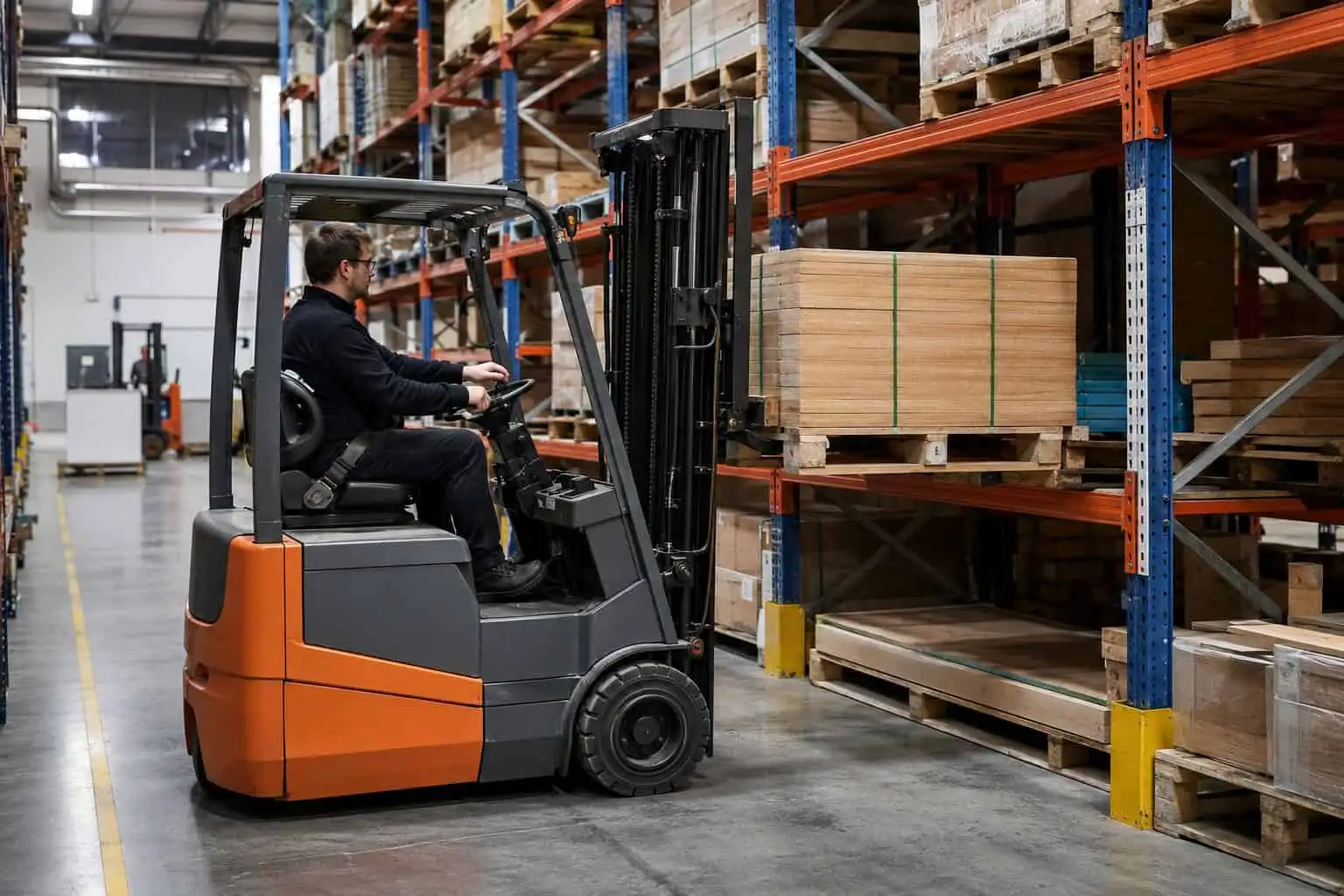
An electric forklift is the default choice for indoor work because it produces no exhaust emissions and runs quietly.
That only settles the fuel question. The harder decisions are aisle width, capacity, tyres and where the machine charges, and those four things determine whether the forklift you buy fits the building you are putting it in.
Are Electric Forklifts Suitable for Indoor Work?
Yes, and on most indoor sites they are the only sensible option.
An electric forklift produces no exhaust at the point of use, which removes the ventilation problem that comes with running combustion engines inside. It is also significantly quieter, which matters in any building where people work near the machine all day.
Two practical constraints come with the choice. The machine needs somewhere to charge, and if it runs lead acid batteries, that charging area has its own requirements around ventilation.
Neither is a reason to avoid electric, but both need planning before the machine arrives rather than after.
How to Choose an Indoor Electric Forklift: the Five Things That Decide It
Work through these in order. Getting the first one wrong makes the other four irrelevant.
- Aisle width. Measure the narrowest aisle the machine has to work in, including rack overhang and pallet overhang, not the nominal aisle on the plan. This decides the body style before anything else does.
- Capacity and load centre. Size against the heaviest load, and remember the rated capacity applies at the load centre stated on the data plate.
- Lift height and free lift. Check the top beam you need to reach and the lowest doorway or roof truss the mast has to pass under.
- Floor surface and tyres. Smooth concrete, expansion joints, a ramp to the dock and any outdoor work all change the tyre answer.
- Shift pattern and charging. One shift with an overnight charge is a different machine specification from two shifts running back to back.
Aisle Width: Which Body Style Fits Your Warehouse
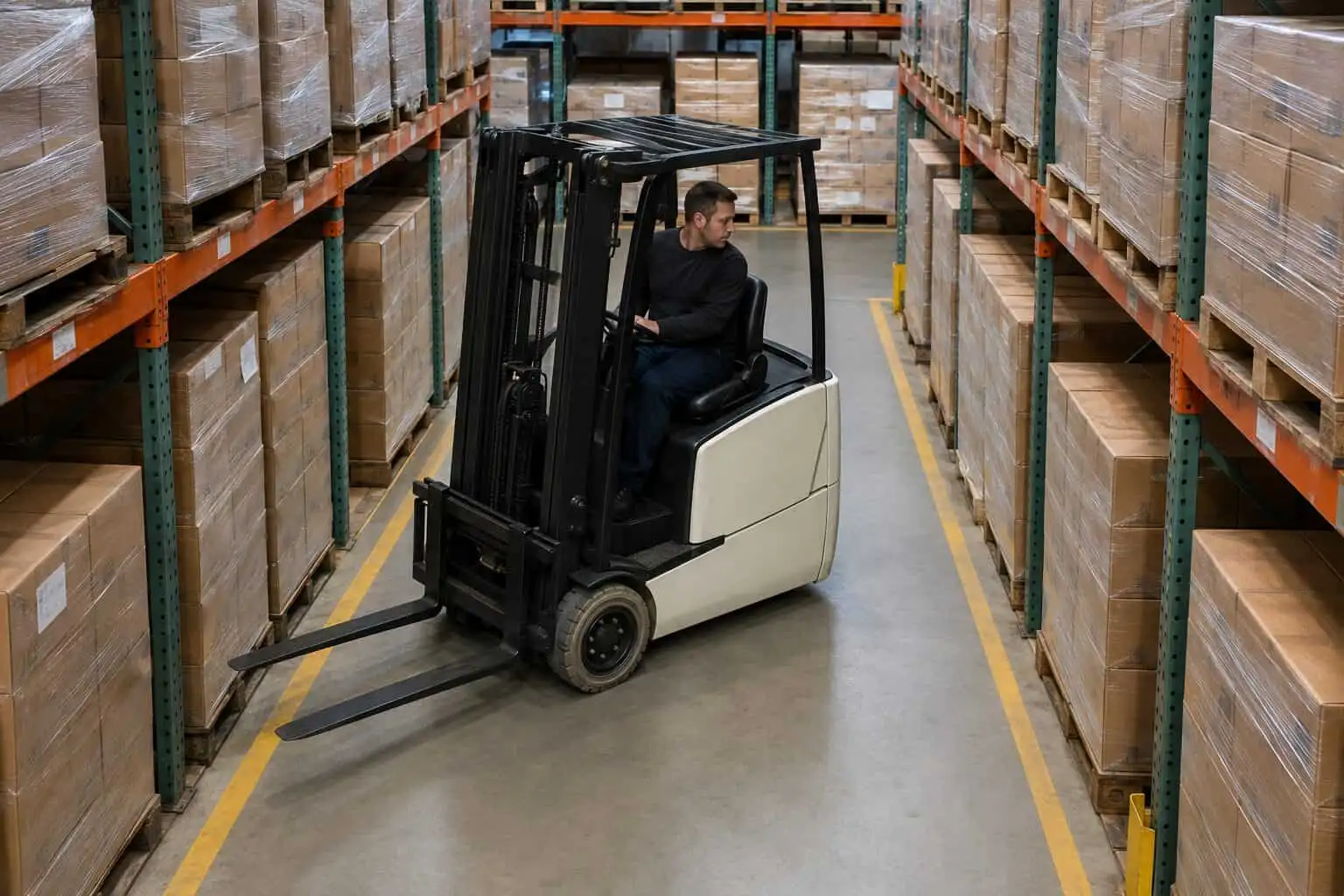
Aisle width is the constraint that eliminates most of the options, which is why it belongs first.
A four-wheel counterbalance needs the most room because the counterweight swings through the turn. Each step from there buys aisle efficiency and gives something up in return.
|
Body style |
How it turns |
Aisle requirement |
Best for |
Gives up |
|---|---|---|---|---|
|
Four-wheel counterbalance |
Rear wheels steer, counterweight swings wide |
Widest |
Mixed indoor and dock work, higher capacities, uneven floors |
Storage density |
|
Three-wheel counterbalance |
Single or twin drive wheel at the rear, tighter circle |
Narrower |
Compact indoor sites on smooth floors |
Capacity ceiling and stability on rough ground |
|
Reach truck |
Outrigger legs under the load, mast reaches forward |
Considerably narrower |
High bay racking and dense storage |
Truck loading and outdoor work |
|
Walkie stacker |
Operator walks alongside, straddle or outrigger legs |
Narrowest |
Light stacking in confined spaces |
Heavy loads and travel distance |
Deciding between three and four wheels comes down to whether the turning circle or the capacity ceiling is your binding constraint.
Where the aisles are genuinely tight, the honest answer is often a different machine altogether, and reach trucks will beat any counterbalance on storage density.
Sites already running at the limit of what a seated machine can do usually find the fix in how the racking is laid out rather than in a smaller forklift.
Capacity and Lift Height for Indoor Racking
Undersizing is the most common and most expensive specification error, because a machine that cannot safely lift your peak load is a machine you replace rather than adapt.
The rated capacity on a forklift applies at the load centre stated on the data plate, and it reduces as the load centre moves forward or as the mast goes up.
That means a machine rated comfortably above your heaviest pallet at ground level may not be rated for the same pallet at the top beam. The relationship between load centre and rated capacity is what makes the difference.
Free lift matters indoors more than anywhere else. It is the height the forks can travel before the mast starts to extend, and it decides whether you can lift a pallet inside a shipping container or under a low roof truss without fouling the building.
If your site has a low doorway, a mezzanine or container work, ask about free lift specifically rather than only asking about maximum lift height.
Cushion or Pneumatic Tyres for Indoor Use?
Cushion tyres are solid rubber pressed onto the wheel and are built for smooth indoor floors.
They give a tighter turning circle and a lower overall machine height, and they last well on clean concrete.
The complication most buyers hit is that the machine rarely stays inside. If it has to cross a yard, work a loading dock apron or handle a broken concrete joint, cushion tyres will make that miserable and wear quickly.
For a machine that works mostly inside with occasional outdoor duty, solid pneumatic tyres are the usual compromise.
Charging: Space, Time and Battery Choice
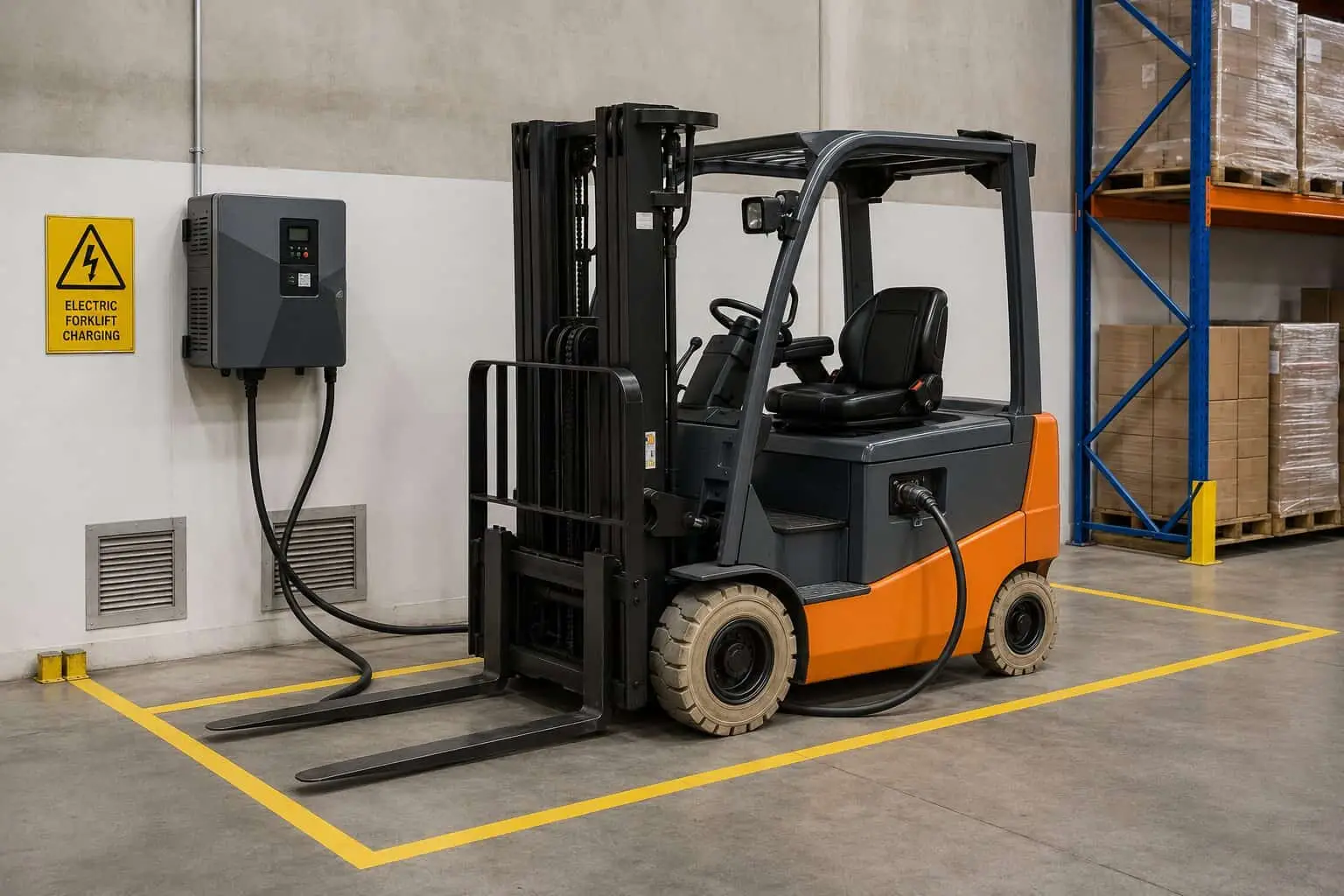
Charging is where electric forklift projects go wrong, and it is almost always because nobody planned for it before the machine arrived.
The requirements depend on the battery chemistry and the shift pattern.
- Single shift, overnight charge: the simplest case. A lead acid battery and one charger will usually cover it, provided there is a dedicated, appropriately ventilated charging area.
- Two shifts, no downtime: either a second battery with swap equipment, or a lithium battery that can be opportunity charged during breaks without damage.
- Limited floor space: lithium generally removes the need for a separate charging room, which on a tight site can be the deciding factor on its own.
Lead acid batteries release hydrogen during charging, which is why the charging area has ventilation requirements. Confirm what applies with WorkSafe Victoria or your state regulator, and design the bay before the forklift is delivered.
On the chemistry itself, utilisation decides it rather than technology preference, and the gap between lithium and lead acid only opens up once the machine runs hard enough that charging downtime costs you something.
If you are budgeting a replacement on a machine already in service, what a forklift battery costs depends far more on capacity and chemistry than on the age of the forklift itself.
Electric vs LPG for Indoor Work
LPG is still run indoors on some Australian sites, and it is worth understanding why before ruling it out.
The refuelling advantage is real: a bottle swap takes minutes, where a lead acid charge takes hours. For a multi-shift operation without the budget for lithium, that is a genuine argument.
The counter-argument is emissions. An LPG forklift produces exhaust, and running one indoors requires the ventilation to handle it, which is a site-specific assessment rather than a general permission.
On a sealed or poorly ventilated building, electric is the only defensible answer. Where ventilation is adequate, the running cost gap between electric and LPG is what usually settles it.
Running Costs of an Indoor Electric Forklift
Electric forklifts have fewer moving parts than combustion machines, no fuel filters, no oil changes on the engine and no exhaust system.
That shows up as lower routine servicing over the life of the machine. Against it sit the battery replacement, which is the single largest scheduled cost on an electric unit, and the electricity to charge it.
Cost per hour depends on your tariff, your duty cycle and your battery, so a published figure would tell you nothing useful about your site. Working out your own electricity usage per hour takes ten minutes and beats any industry average.
New or Used Electric Forklifts
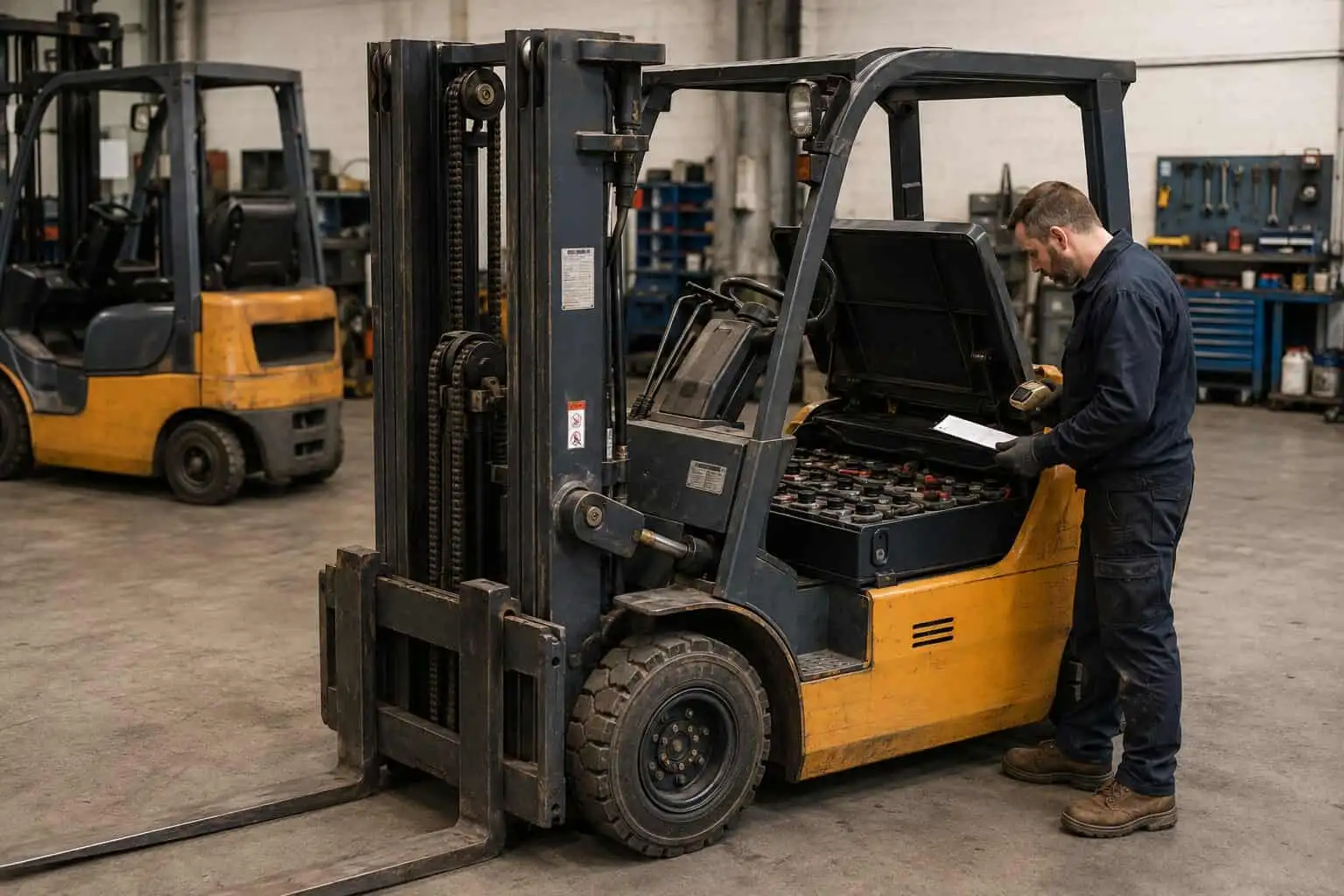
A pre-owned electric forklift is often the better buy, but the inspection priorities differ from a diesel or LPG machine.
The battery is the first thing to check, not the last, because on a used electric unit it can represent a substantial share of the machine’s value.
- Battery age and charge history. Ask how old it is, how it has been charged, and whether it has been watered correctly if it is lead acid. This is where most of the risk in buying a used electric machine actually sits.
- Hours on the machine. More telling than model year for drive and hydraulic wear.
- Mast condition. Check the chains, rollers and channels for wear, and run the mast through its full travel.
- Tyre wear and type. Confirm the tyres suit your floors, not the previous owner’s.
- Controller and electrics. Ask for the service history on the controller specifically.
- Data plate. It must be legible and must match the mast fitted.
Electric Forklifts Available from Buy A Fork
Buy A Fork stocks new and pre-owned electric forklifts across the common capacity classes, from the Somerton yard with delivery across Melbourne.
Stock changes regularly, so the categories below show what is currently on the floor rather than a fixed list.
Seated machines built for indoor work sit in the electric counterbalance range, which covers the compact and mid capacity classes.
The wider electric line-up takes in pallet jacks and stackers as well, and for light stacking in confined spaces the electric stackers are often a better fit than a seated forklift.
Brands in the current range include Toyota, Linde, Crown, Raymond, BT, Nissan, Mitsubishi, Baoli and Komatsu, though availability by brand varies with stock.
Frequently Asked Questions
1. Can an electric forklift be used outdoors?
Yes, with the right tyres and provided the surface is reasonable.
A cushion-tyred machine specified for smooth indoor floors will struggle on gravel or broken ground, and sustained wet outdoor work needs a machine rated for it. If the forklift will split its time between a warehouse and a yard, specify for the harder of the two.
2. What is the smallest electric forklift available?
Compact three-wheel counterbalance machines and walkie stackers cover the small end of the range, and the right one depends on whether you need to stack and how much you are lifting.
Rather than working from a size, measure your narrowest aisle and heaviest load and specify from those.
3. How long does an electric forklift battery last on one charge?
It depends on the battery capacity, the load weight and how much of the shift involves lifting rather than travelling.
Size the battery to your actual duty cycle, and if the machine has to run through two shifts, plan for either a spare battery or a lithium unit that can be charged during breaks.
4. Do electric forklifts need a special charging area?
Lead acid batteries release hydrogen during charging, so charging areas have ventilation and safety requirements set by the work health and safety regulator.
Lithium batteries generally have different and often less demanding requirements. Confirm what applies to your site and battery type with WorkSafe Victoria or your state regulator.
5. Are electric forklifts more expensive than diesel or LPG?
The upfront comparison varies by capacity class and battery type, and the running-cost comparison usually favours electric over the life of the machine because there is less to service and no fuel to buy.
The battery replacement is the offsetting cost, so compare over the ownership period rather than on the purchase price alone.
6. Can an electric forklift work in a cold store?
Cold storage places specific demands on batteries, hydraulics and seals, and a standard machine is not suitable without the right specification.
Tell us the operating temperature before you specify, because it changes the machine.