
Forklift Tynes & Forks: Sizes, Wear Limits and When to Replace Them
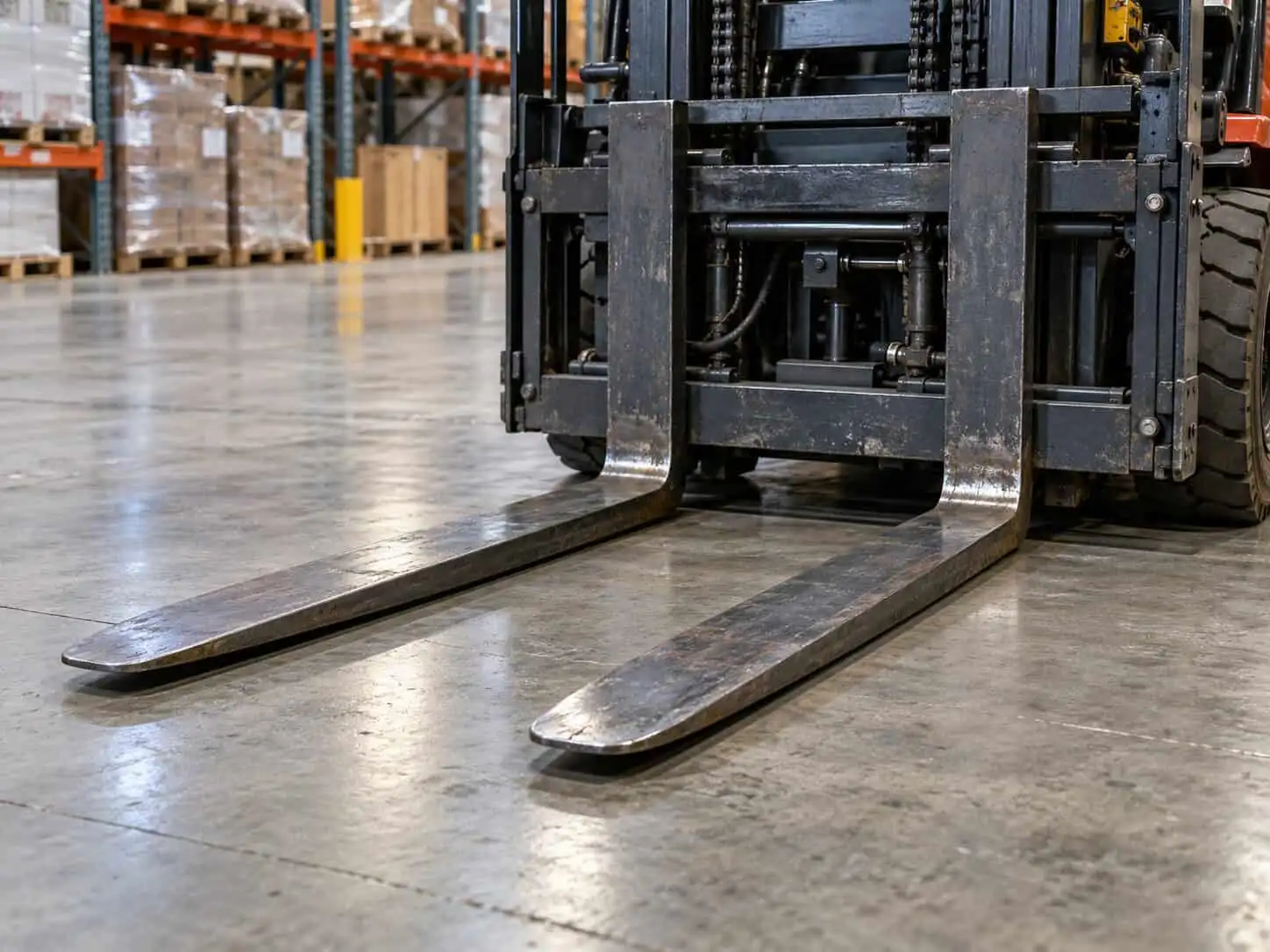
Forklift tynes (also spelt tines) are the two steel fork arms that carry the load, and they are sized by mounting class, length, width and thickness. A tyne comes out of service if it is cracked, if its blade or shank has worn by 10% of its original thickness, or if the tips of the pair sit at different heights by more than 3% of the blade length. ISO 5057, the international standard for inspecting fork arms in service, also requires a thorough inspection at least every 12 months.
What are forklift tynes, and is it tynes or tines?
Forklift tynes are the L-shaped steel arms that hang from the carriage and slide under a pallet or load. “Tynes” and “tines” are both used in Australia for the same part, and so are “forks” and “fork arms”. The international standards use “fork arms”. None of them should be confused with forklift tyres, which are the wheels and a separate maintenance job entirely.
Every tyne has the same basic parts:
- Hooks or mount: the top and bottom hooks that hang the tyne on the carriage bars, or a pin or shaft mount on some machines.
- Shank: the vertical section that sits against the carriage.
- Heel: the bend where the shank meets the blade. It carries the highest stress and usually wears first.
- Blade: the horizontal section that goes under the load.
- Tip: the tapered front end of the blade.
Fork manufacturer Bolzoni Auramo describes its forks as steel that is hardened and tempered across the whole fork, which is why a tyne cannot be welded or heated and bent back into shape.
How do you work out what size tynes your forklift has?
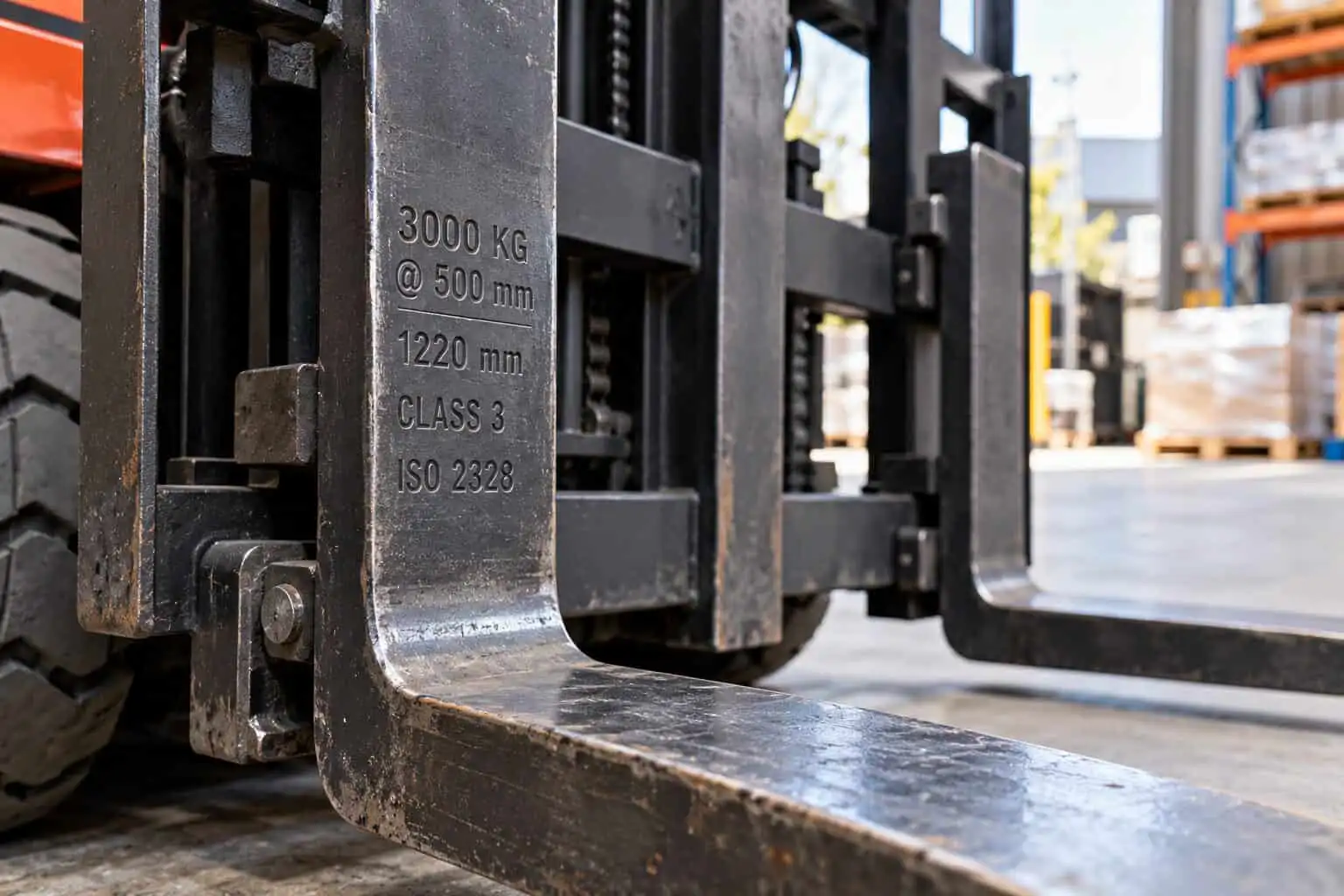
Start with the stamp, then measure. ISO 2330 requires forks to be marked with their nominal capacity and load centre, and that stamp is usually on the side of the shank.
Then take four measurements: blade length from the face of the shank to the tip, blade width, blade thickness, and the height of the carriage plate from its top edge to its bottom edge. The carriage height tells you the mounting class, and the class decides which tynes will physically fit.
Forklift tyne classes and carriage heights
Fork mounting classes are set by ISO 2328, and each class matches a band of truck capacity. Capacity ranges and load centres below are from Bolzoni Auramo’s ISO 2328 fork catalogue; carriage heights are the commonly published figures, so check them against your truck before ordering.
| Class | Truck capacity | Rated load centre | Carriage height (approx.) |
|---|---|---|---|
| Class 2 | 1,000 to 2,500 kg | 500 mm | 407 mm |
| Class 3 | 2,501 to 4,999 kg | 500 mm | 508 mm |
| Class 4 | 5,000 to 8,000 kg | 600 mm | 635 mm |
| Class 5 | 8,001 to 10,999 kg | 600 mm | 728 mm |
A 2.5 tonne counterbalance forklift, for example, sits in Class 2. Bolzoni notes that Class 5 capacities are often included in Class 4, which is why some suppliers quote different upper limits for the same class.
Common tyne lengths in Australia
There is no single standard length; tynes are made to suit the load. Lengths regularly listed by Australian suppliers include 1,070 mm, 1,220 mm, 1,370 mm and 1,530 mm, and longer tynes are available for long or deep loads.
Longer is not automatically better: a tyne that reaches past the load can strike whatever sits behind it, so match the length to the deepest load you routinely carry.
How far apart should forklift tynes be?
Set the tynes as wide as the load allows, centred on the carriage, so the weight sits evenly across both. Tynes set close together under a wide load let it tip sideways, and tynes set off-centre put more weight on one arm. Whatever the spacing, the positioning locks must be engaged before the machine moves.
What should you check on the tynes before every shift?
The pre-start check is where most tyne problems are first found, so the operator’s daily look matters. WorkSafe Victoria’s forklift guidance says the pre-operational inspection should happen at the start of each shift, before first daily use and whenever there is a change of operator.
With the tynes lowered to the floor, the operator looks for cracks (especially at the heel and hooks), bends, uneven tips, damaged tips, obvious heel wear, missing positioning locks and any sign of welding. Any of these is a reason to tag the forklift out of service and report it, not to finish the shift, exactly as you would with any other fault picked up during a daily pre-start inspection.
What are the wear limits that mean a tyne must be replaced?
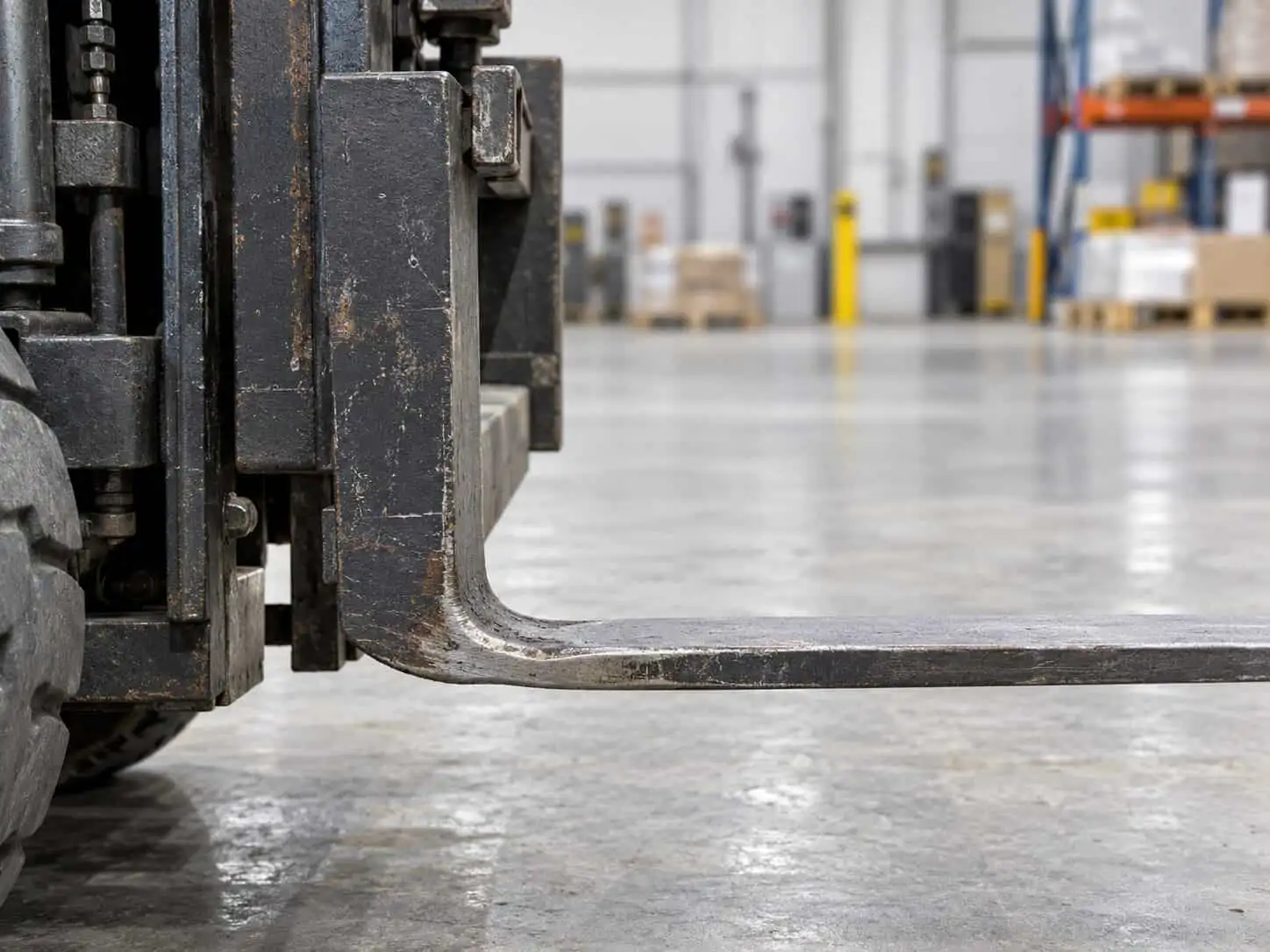
A forklift tyne must be withdrawn from service if it is cracked, if its blade or shank has worn by 10% of its original thickness, or if the tips of the pair differ in height by more than 3% of the blade length. Those three come from ISO 5057, and fork manufacturers add further criteria. The table brings them together.
| Check | Withdraw from service when | Source |
|---|---|---|
| Surface cracks | Any crack is found, especially at the heel or hook welds | ISO 5057; Vetter |
| Blade and shank thickness | Worn by 10% or more of the original thickness | Bolzoni (citing ISO 5057); Linde MH Australia; Vetter |
| Tip height difference | The pair differs by more than 3% of blade length, or the truck maker’s lower figure | ISO 5057 |
| Angle between blade and shank | More than 3 degrees from the original angle | ANSI/ITSDF B56.1, as reported by Adaptalift |
| Straightness of blade and shank | Deviation of more than 0.5% of blade length or shank height | ANSI/ITSDF B56.1, as reported by Adaptalift |
| Markings | The capacity stamp is no longer legible | Vetter |
| Positioning lock | The lock is missing, damaged or not holding | Vetter |
The 10% rule matters more than it sounds. Bolzoni states that a 10% reduction in fork blade thickness results in a 20% reduction in operating capacity, so a tyne at the limit can no longer safely carry the load stamped on it.
The tip height limit varies by source: ISO 5057 sets 3% of blade length, while Vetter uses 1.5%. Where the truck or fork manufacturer gives a stricter figure, use theirs. Bolzoni also states that inspections, repairs and replacements are carried out as a pair, so if one tyne fails, both are replaced.
How often do forklift tynes need a thorough inspection?
ISO 5057 requires fork arms to be inspected at intervals of no more than 12 months, and whenever a defect or permanent deformation is found. Bolzoni advises shorter intervals for severe applications and multi-shift operation, so a machine running two or three shifts a day should be measured more often than once a year.
In practice that gives three layers: the operator’s visual check every shift, a thorough inspection with measurements by a competent forklift technician at least every 12 months, and an unscheduled inspection after any impact, overload or visible bend. WorkSafe Victoria requires forklifts and their attachments to be regularly inspected and maintained by a competent technician but does not set a separate interval for tynes, which makes the ISO 5057 interval the practical benchmark for the tynes within a wider forklift safety inspection.
How do you measure tyne wear?
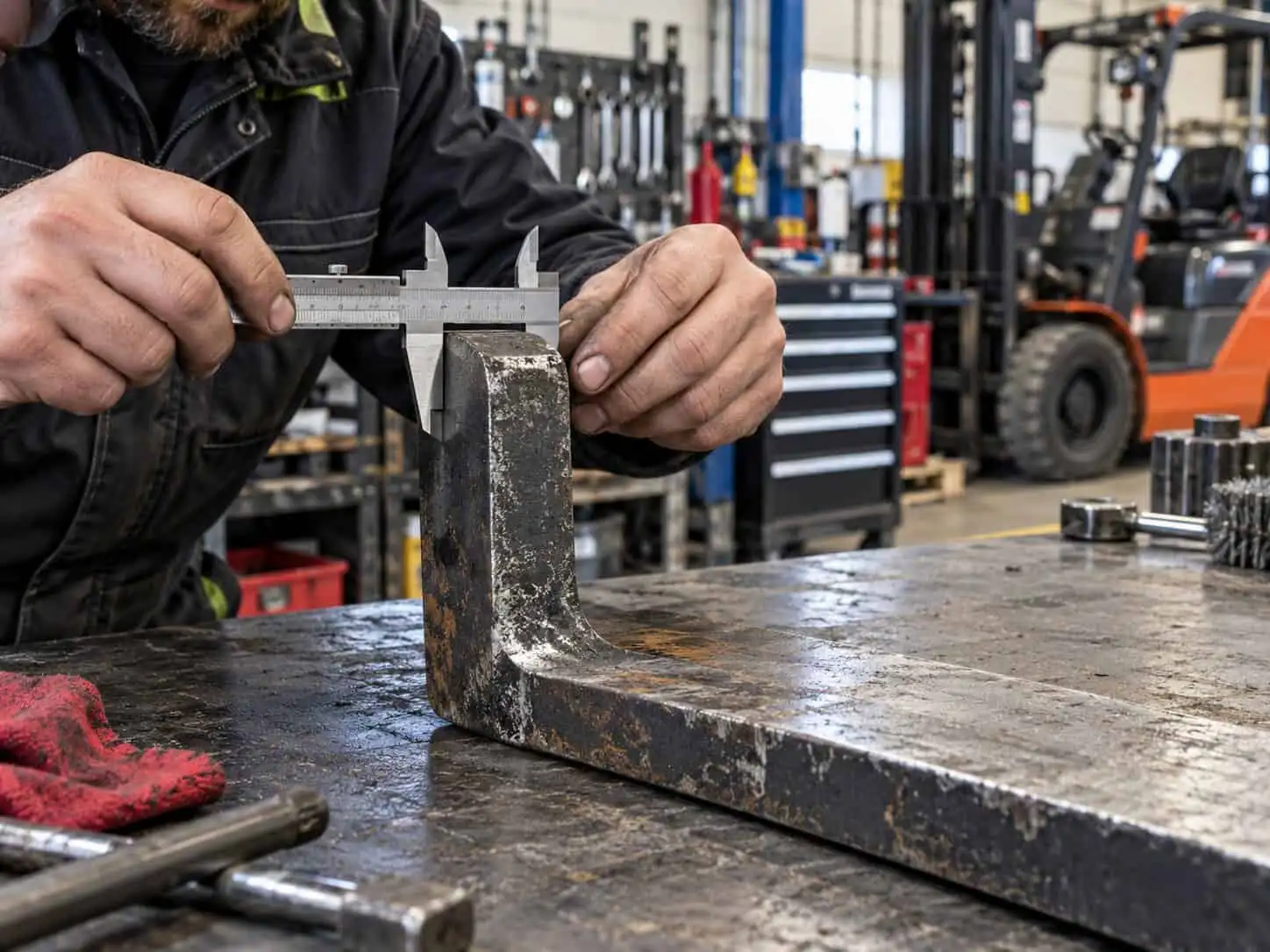
Compare the thickness at the heel with the thickness of the shank above it. The upper shank does almost no work against the floor or the load, so it stays close to the original thickness and gives you a reliable reference.
- Lower the tynes to the floor, park the forklift and isolate it.
- Measure the shank thickness above the heel with callipers or a fork wear gauge. This is your reference figure.
- Measure the heel thickness at its thinnest point.
- Divide the heel figure by the shank figure. Anything below 90% means the tyne has worn past the 10% limit.
- Repeat on the second tyne, then measure the tip heights of the pair against each other.
- Record both results in the forklift’s maintenance log with the date.
A fork wear gauge gives a quick pass or fail; callipers give an actual figure, which helps track how fast a set is wearing between inspections.
Can worn or bent tynes be repaired?
Worn tynes are replaced, not repaired, and bent tynes should never be straightened on site. Bolzoni’s guidance is explicit: do not repair surface cracks or wear by welding, and any fork that is re-set must be given an appropriate heat treatment afterwards. Heating or welding a tyne changes the steel’s hardening and leaves a weak point where the load sits, so any repair is a job for the fork manufacturer or an equally competent specialist. For a worn heel, a new pair is the usual answer.
How do you choose replacement tynes?
Replacement tynes have to match the truck as well as the load.
- Mounting class: must match the carriage, as shown in the class table above.
- Mounting type: hook, pin or shaft mounted, matching what the truck has.
- Length: suited to the deepest load you routinely carry, not longer.
- Section: width and thickness that suit the load and the class.
- Rated capacity and load centre: at least equal to the truck’s rated capacity at the same load centre.
- Pairs: always ordered and fitted as a matched pair.
A forklift’s rated capacity depends on the equipment fitted to it, so a change of tynes can affect the figure on the data plate. Check with the truck manufacturer or a competent technician before running a machine on non-original tynes.
What about tyne extensions?
Tyne extensions, often called slippers, slide over the existing tynes to handle longer loads, and they reduce the forklift’s effective capacity. Lengthening the tynes moves the load centre further from the mast, and the further out the load sits, the less the machine can safely lift.
Like any of the forklift attachments that change what a machine can carry, extensions need to be rated for the tynes they sit on, secured so they cannot slide off, and inspected like any other part of the lifting system.
Checking the tynes on a used forklift before you buy
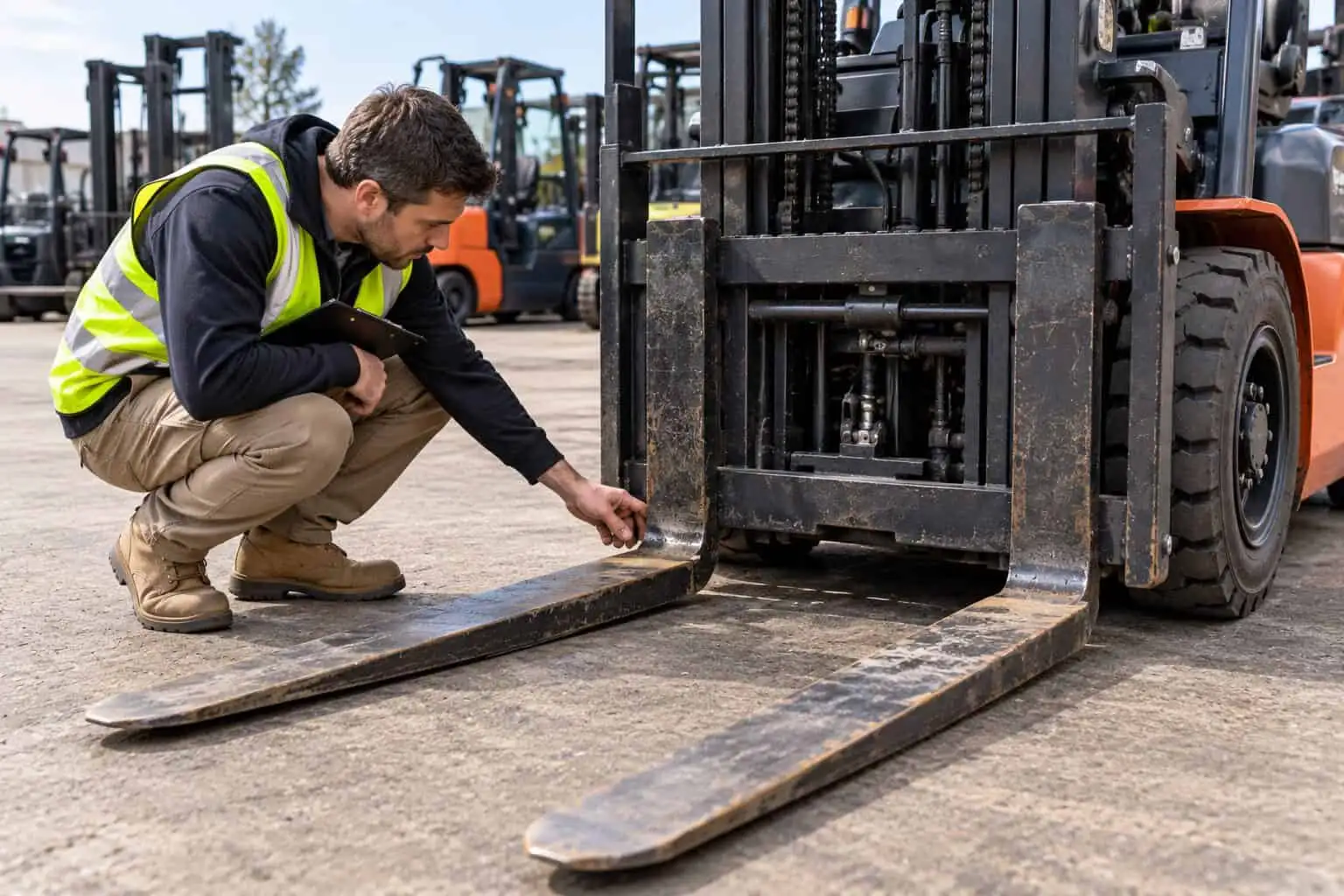
The tynes tell you how hard a used forklift has worked. Heavy heel wear and uneven tips are not reasons to walk away on their own, because tynes are replaceable, but both should be priced in and both are a prompt to look closely at the rest of the lifting system.
On any used machine, check that the tynes are the original pair or a matched replacement pair, that the capacity stamp is legible and at least matches the truck’s rated capacity, and that both tynes pass the same heel and tip checks covered above. The forks are one line on a used forklift pre-purchase checklist, and the mast, chains and hydraulics deserve the same attention when inspecting a used forklift. The condition of the forks is also worth asking about on any machine in the current used forklift range.
Frequently asked questions
1. What are tynes on a forklift?
Tynes are the two steel fork arms that carry the load on a forklift. They hang from the carriage and slide under a pallet so the mast can lift it, and each one is stamped with its rated capacity and load centre.
2. Is it tines or tynes?
Both spellings are used in Australia for the same part, and the international standards call them fork arms. All of these refer to the forks, not the tyres.
3. What are forklift prongs called?
Forklift prongs are called tynes, tines, forks or fork arms, which are all names for the same part. “Blade” is sometimes used too, although it strictly means the horizontal section of each tyne.
4. What is tyne material?
Forklift tynes are made from heat-treated steel. Bolzoni Auramo describes its forks as hardened and tempered across the whole fork, which is why tynes should never be welded, heated or bent back into shape outside the manufacturer’s process.
5. How do I know if my forklift tynes are worn out?
A tyne is worn out when its heel or blade has lost 10% of its original thickness. If the heel measures below 90% of the shank above it, replace the pair. Cracks, bends and uneven tips also take a tyne out of service.
6. Do forklift tynes need to be replaced in pairs?
Yes. Bolzoni’s guidance is that inspections, repairs and replacements are carried out as a pair, because a new tyne beside a worn one carries the load unevenly.
Whether a machine with worn forks is worth keeping, or how a used forklift’s forks stack up, is the kind of question the Buy A Fork team can give you a straight answer on.