
Parts of a Forklift: A Labelled Guide for Buyers
A used forklift can look tidy at the front of the yard and still hide a stretched lift chain or a fork heel worn thin. The main parts of a forklift are the mast, lift chains, carriage, forks, load backrest, hydraulics, overhead guard, counterweight, axles, tyres, data plate, controls and power source. Here's what each one does, and the check that matters on a second-hand machine.
The Main Parts of a Forklift at a Glance
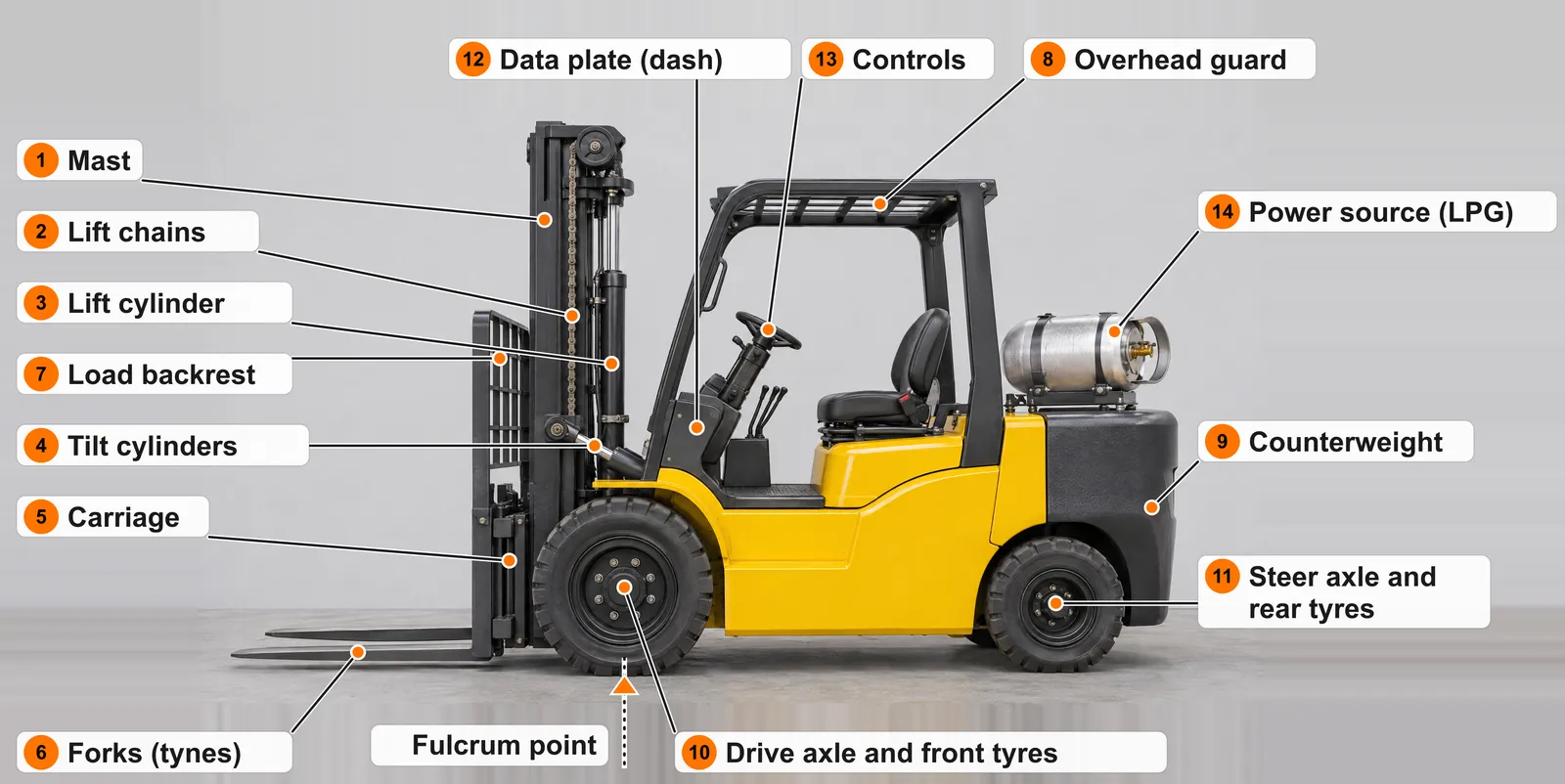
This forklift parts diagram follows a standard sit-down counterbalance truck, which carries the load in front of its wheels and balances it with a weight at the back. Buy A Fork sells mostly used forklifts, with Toyota the biggest brand in the range, so every check below is written for a second-hand machine.
| No. | Part | Where It Sits | What It Does |
|---|---|---|---|
| 1 | Mast | Upright frame at the front | Raises and lowers the load |
| 2 | Lift chains | Over pulley wheels at the top of the mast | Carry the carriage up and down |
| 3 | Lift cylinder | Behind or between the mast channels | Pushes the mast stages up |
| 4 | Tilt cylinders | Between the truck frame and the mast | Tilt the mast forward and back |
| 5 | Carriage | Front face of the mast | Holds the forks and any attachment |
| 6 | Forks (tynes) | Hooked onto the carriage | Carry the load from underneath |
| 7 | Load backrest | Top of the carriage | Stops the load sliding back toward the driver |
| 8 | Overhead guard | Frame over the driver's seat | Protects the driver from large falling objects |
| 9 | Counterweight | Rear of the truck | Balances the load on the forks |
| 10 | Drive axle and front tyres | Under the mast | Drive the truck and form the fulcrum point |
| 11 | Steer axle and rear tyres | Under the counterweight | Steer the truck |
| 12 | Data plate | In the operator compartment on most trucks | Records the model, serial number and rated capacity |
| 13 | Controls | Operator compartment | Steer, drive, brake and work the hydraulics |
| 14 | Power source | Engine or battery bay, with LPG bottles at the rear | Powers the drive and the hydraulic pump |
The numbers match the diagram, and the sections below run in the same order.
Mast: Simplex, Duplex, Triplex and Container Masts
The mast is the upright frame of nested steel channels that lifts the carriage and load. Masts are named by how many stages they have, and each extra stage buys more lift height without making the truck taller when the mast is down.
| Mast Type | Stages | Free Lift | Typical Use |
|---|---|---|---|
| Simplex | One | Little or none | Outdoor yards with no height limits |
| Duplex | Two | Yes, amount varies by model | Trailers and low-clearance indoor work |
| Triplex | Three | High | General warehouses and taller racking |
| Quad | Four | High | Very high stacking in specialised warehouses |
Free lift is how far the forks can rise before the mast itself starts to get taller. Toyota describes the triplex as the most common and versatile of the four. Lowered height, maximum lift height and capacity at height are the three numbers to compare between machines, and most of the differences between duplex, triplex and quad masts come down to how each design trades those off.
A container mast is built for work inside shipping containers: low enough with the mast down to drive through the door, with enough free lift to raise a pallet inside without hitting the roof. A container mast forklift only does that job if its closed height (its height with the mast fully lowered, measured to the mast or the overhead guard, whichever is higher) clears the containers you unload.
Buyer check: Run the mast to full height empty, then again with a load, and watch the top half of the stroke. Shudder, hesitation or a clunk as the stages change over usually means worn rollers or channel wear, and play that's obvious at height can be invisible at ground level. Look along each channel for cracked welds, and compare the lift height on the plate with what the mast actually reaches.
Lift Chains, Lift Cylinder and Tilt Cylinders
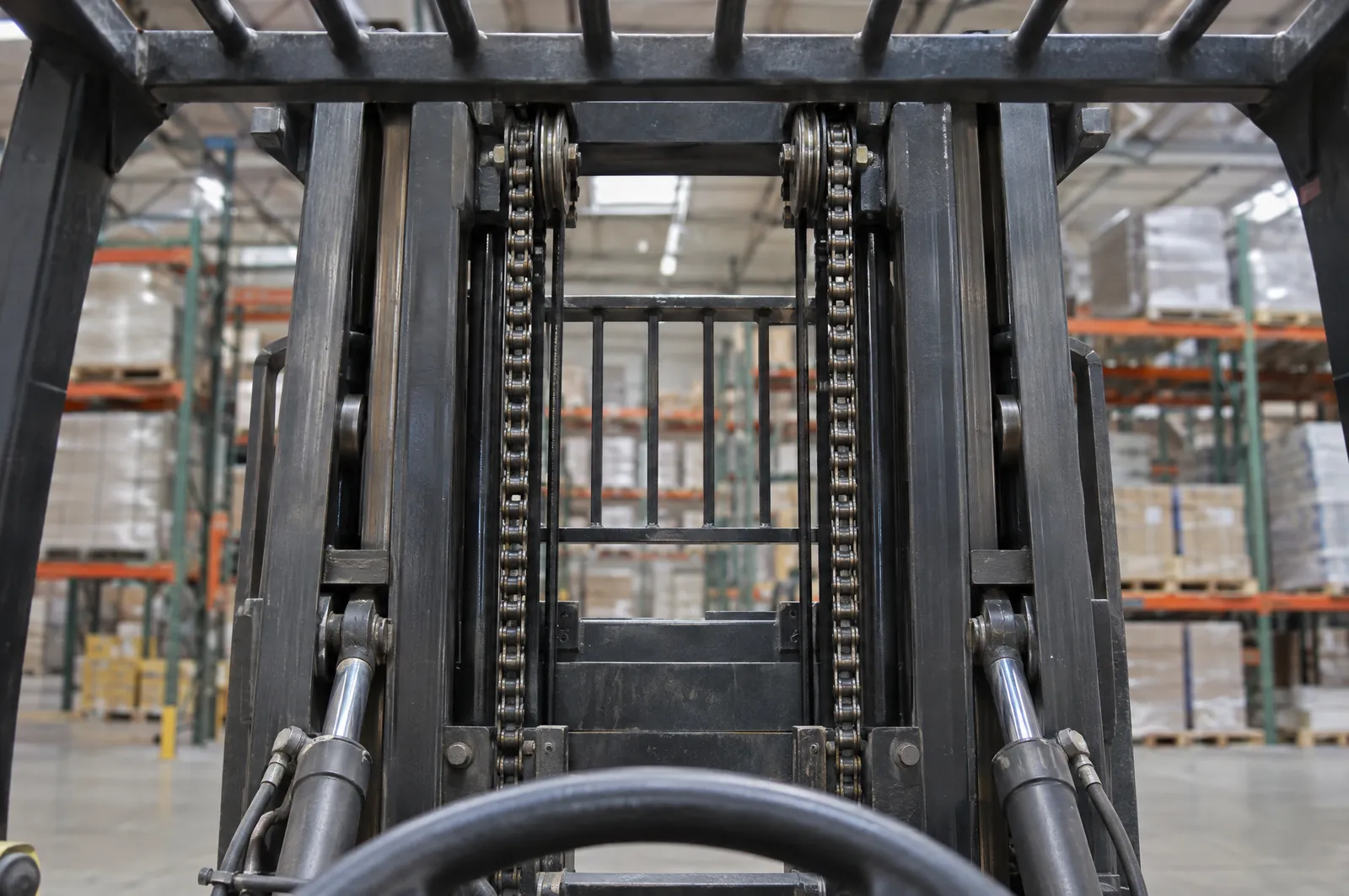
The hydraulic system turns pump pressure into movement. The lift cylinder pushes the mast stages up, the tilt cylinders tip the mast forward to pick up a load and back to carry it, and the lift chains do the actual lifting of the carriage.
Lift Chains
Each forklift chain runs from the carriage up over a pulley wheel at the top of the mast and down to an anchor point, so the carriage rises as the mast extends. There are two, side by side.
Buyer check: Toyota says a chain stretched more than three percent is due for replacement, and stretch is measured with a chain gauge, not by eye. Also look for cracked or broken links, pins that have turned in the side plates (usually a sign of poor lubrication), and one chain hanging slacker than the other, which leaves the carriage sitting out of level.
Lift and Tilt Cylinders
Most masts have a main lift cylinder, and duplex and triplex designs often add a separate free lift cylinder.
Buyer check: Lift a load clear of the floor, return the levers to neutral and leave it for a few minutes. Forks creeping down point to a leak in the lift circuit, and a mast creeping forward points to the tilt cylinders. Then look for oil weeping at the cylinder seals and for hoses that are cracked, chafed or rubbing on the mast. A freshly degreased mast on an otherwise grubby truck is worth a second look.
Carriage, Forks and Load Backrest
Carriage
The carriage is the plate frame that runs up the front of the mast on rollers. The forks hook onto its top and bottom bars, and attachments such as clamps and side shifters (which slide the forks left and right) mount to it as well. Fork hooks are made to suit a carriage class (a mounting size set by the ISO 2328 standard), so replacement forks have to be the right class as well as the right length.
Buyer check: Look for bent or gouged carriage bars, fork locking pins that don't drop fully home and, if a side shifter is fitted, smooth travel both ways with a load on.
Forks (Tynes)
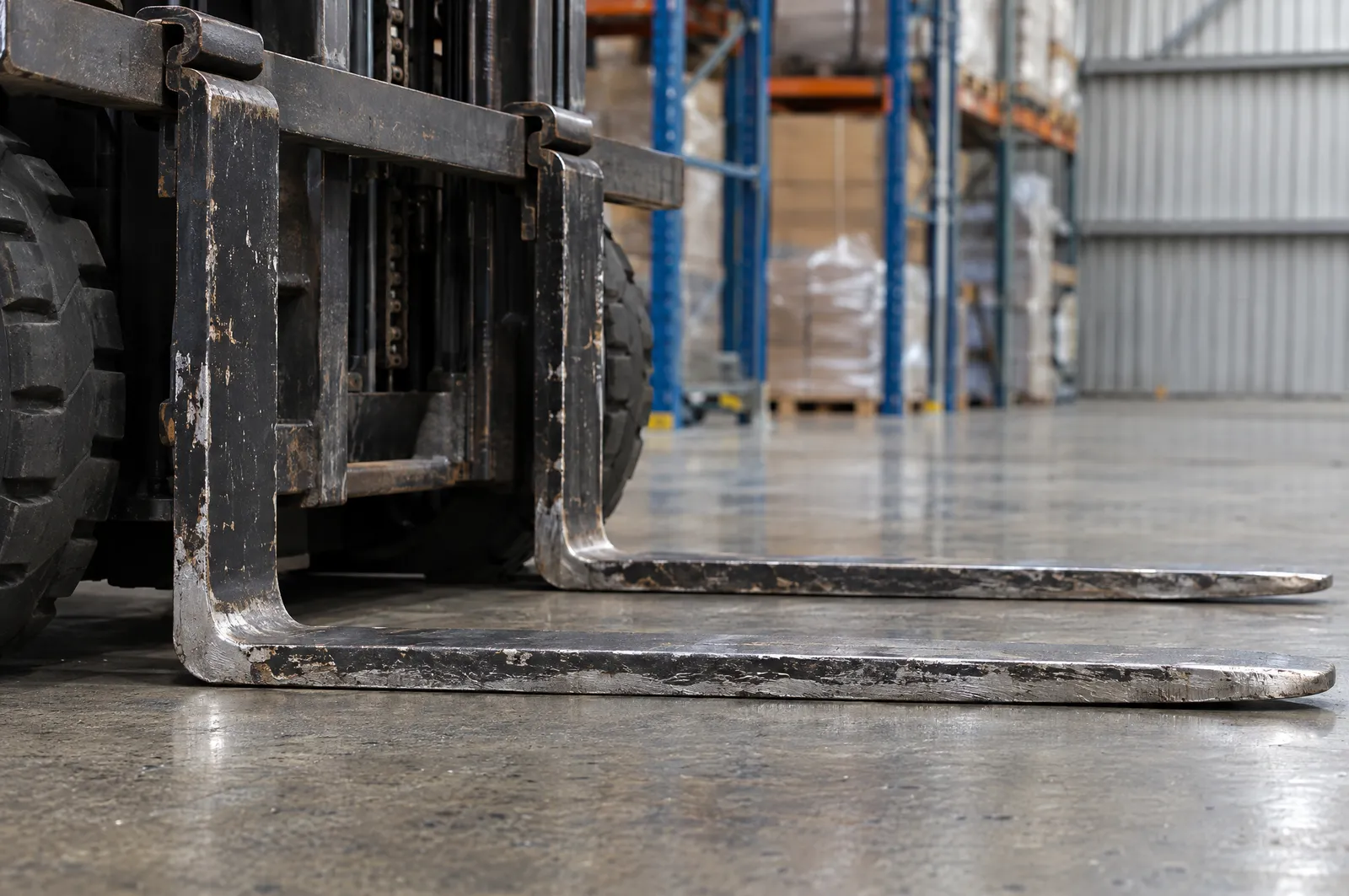
Forks, usually called tynes in Australia, carry the load from underneath. The heel, where the blade bends up into the upright shank, does most of the wearing because it drags on concrete.
Buyer check: Fork maker Vetter says a fork worn more than 10% in thickness must be replaced, and puts the loss in load capacity at about 20% by then. Measure the heel against the shank with callipers, check that both tips sit at the same height, and treat any crack at the heel or hooks as the end of that fork. If a pair fails these checks, replacement forklift tynes are matched by carriage class, length and cross-section, so measure the old set before it goes.
Load Backrest
The load backrest on a forklift is the frame on top of the carriage that stops the load sliding back toward the driver, mainly when the mast tilts back. Toyota describes its job as keeping the load from falling toward the driver.
Buyer check: It should be straight, firmly bolted and tall enough for what you carry. A bent backrest is a sign of hard work or a collision, and if you handle tall cartons or loose stock, ask whether a taller backrest extension is available for that model.
Overhead Guard
The overhead guard is the steel frame over the driver's seat. Toyota describes it as protection against large objects falling onto the driver. It's an open grid, so it won't stop small items, and it also sets part of the truck's overall height, which makes it one of the measurements to check against low doorways and container openings.
Buyer check: Look for cracked welds where the legs meet the body, dents from impacts, and any sign the guard has been cut down, re-welded or drilled to mount lights or clear a low door. Any of those is a question for the seller: was the change approved by the manufacturer?
Counterweight and the Forklift Fulcrum Point
The counterweight is the heavy cast block at the rear of the truck. It balances the weight on the forks, which is how a counterbalance forklift lifts a load in front of its wheels without legs or outriggers to brace it. Every counterbalance forklift works on this principle, whether it runs on LPG, diesel or a battery.
The Forklift Fulcrum Point
Think of the truck as a seesaw. The fulcrum point is the line it would pivot around if it tipped forward, which is where the front tyres touch the floor. The load sits in front of that line, and the truck and counterweight sit behind it. Move the load further out along the forks and it acts on a longer lever, so it takes more counterweight to balance. That's why capacity is always quoted at a set load centre, the distance from the fork face to the load's centre of gravity.
Buyer check: Look for cracks in the casting, heavy damage from reversing into racking or walls, and loose or missing mounting bolts. Don't add weight to the back to squeeze out more capacity: the rating on the plate applies to the truck as the manufacturer built it.
Axles and Tyres
On a counterbalance forklift the front axle drives and the rear axle steers, which is why the back of the truck swings wide on a tight turn.
Steer Axle
The steer axle pivots on a centre pin so the rear wheels can follow uneven ground, and that pivot is the third point of the truck's stability triangle.
Buyer check: Turn the steering hard on the spot and listen for clunks from the kingpins (the pivots each steer wheel turns on) or wheel bearings, check the steering cylinder for leaks, and look for steer tyres worn more on one edge than the other, which can point to worn steering parts.
Tyres
Forklifts run on air-filled pneumatic tyres, solid (resilient) tyres that look similar but can't go flat, or press-on tyres for smooth indoor floors. Non-marking compounds are available for sites where floors must stay clean.
Buyer check: Solid tyres carry a moulded wear line, and Linde's advice is to replace them before the tread wears down to it. Look for chunks missing from the tread, flat spots and sidewall cracks, and expect tyres to be replaced in pairs so the truck sits level.
Data Plate
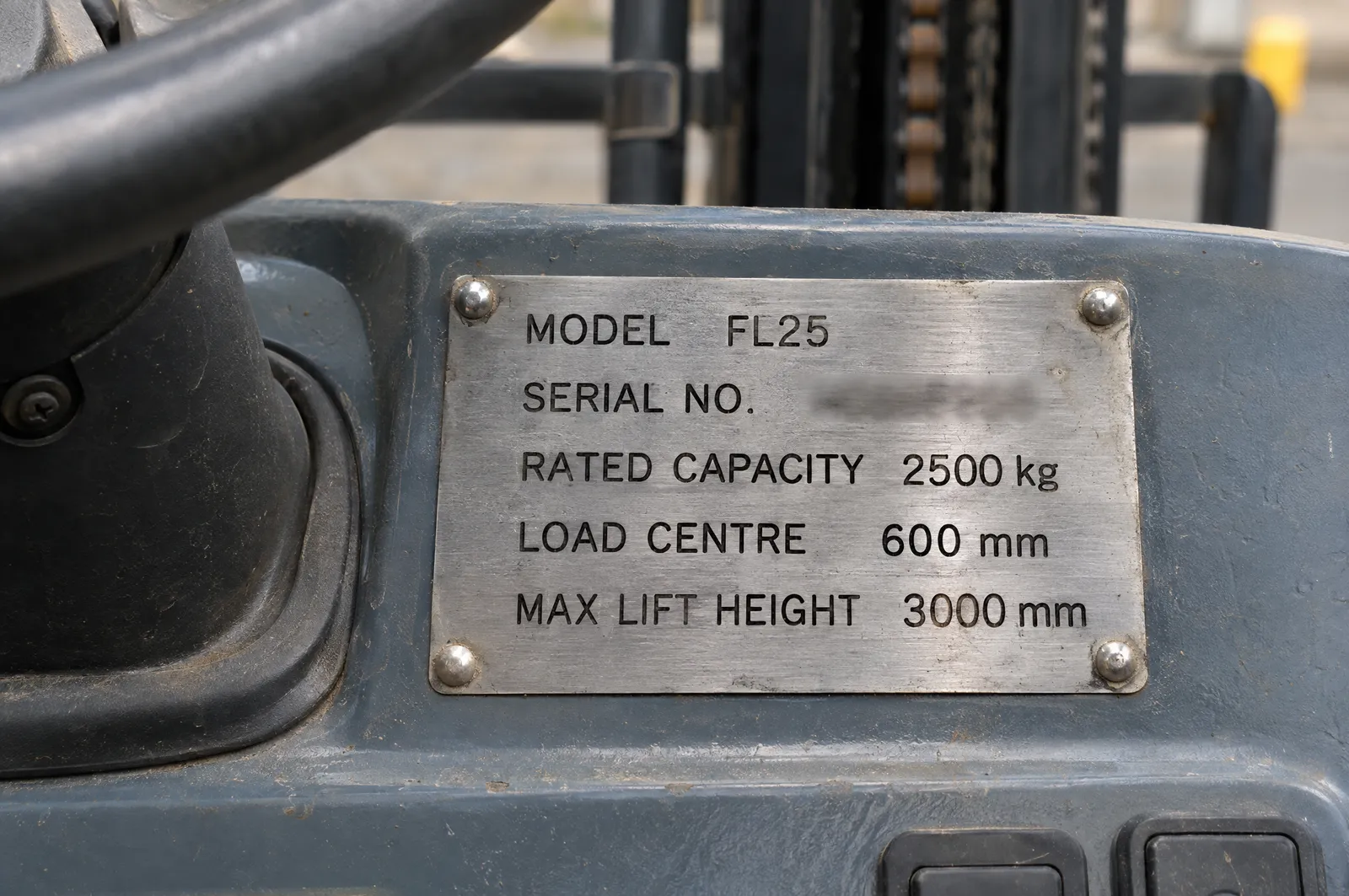
The data plate, which WorkSafe Victoria calls the information plate, is the truck's identity and capacity rating in one place. It lists the model and serial number, plus the rated capacity at a stated load centre and lift height. WorkSafe notes that forklifts over one tonne are typically designed around a 600 mm load centre.
The capacity block is effectively a small forklift load chart, and it only holds for the mast, forks and attachments it lists. WorkSafe Victoria says that if an attachment isn't on the information plate, it must not be used, and that the supplier amends the plate or provides a supplementary one when an attachment is fitted.
Buyer check: Make sure the plate is there, legible and matches the machine in front of you. The serial number should agree with the truck's paperwork, and the mast height and attachments listed should match what's fitted. A missing or wrong plate isn't cosmetic: WorkSafe lists replacing information plates among the possible costs of bringing a second-hand forklift up to a serviceable condition. This is the first thing we'd check on any used truck, because every other number depends on it.
Controls and Operator Compartment
The operator compartment holds the steering wheel, pedals, hydraulic levers, gauges and safety devices. Most counterbalance trucks have a forward and reverse direction lever, accelerator and brake pedals (often an inching pedal too, for fine movement while lifting), and a lever or joystick for each of lift, tilt and side shift.
Seatbelts deserve a look on older trucks. Australian Standards have required sequential interlocking seatbelts in new forklifts since 2013, according to WorkSafe Victoria, so the truck won't start or move unless the driver sits down first and then buckles up. A pre-2013 machine may not have one, and fitting one later is a conversation to have with the manufacturer or supplier.
Buyer check: Every hydraulic lever should spring back to neutral, the horn, lights and any beacon should work, the park brake should hold, and the hour meter should be running. Finish with a loaded test drive, because the brakes, steering and mast all behave differently with weight on the forks, and a proper used forklift inspection always ends with one.
Power Source: Electric, LPG or Diesel
Counterbalance forklifts run on LPG, diesel or battery power, and the power source decides where the truck can work. WorkSafe Victoria points out that combustion engines produce exhaust emissions, so ventilation needs considering before an LPG or diesel truck works in an enclosed space. Battery-electric trucks have no exhaust at all.
- Electric: Ask for the battery's age and service history, look for corrosion on the terminals and, on lead-acid batteries, low electrolyte, and confirm the charger suits the battery.
- LPG: Check the hose and regulator for cracks, smell for gas at the bottle connection, and make sure the bottle's stamped test date is current.
- Diesel: Start it from cold, watch for heavy smoke once it's warm, and look for oil, fuel and coolant leaks around the engine.
Check the Parts Before You Commit to a Used Forklift
Mast type, plate details and the condition of the forks, chains and tyres are the questions worth asking about every machine on your shortlist. Questions about a specific truck can go to the team on 1300 057 880 or through the Buy A Fork contact page, and servicing, extended warranty, trade-ins, finance and rent-to-own can all be part of the same conversation.
Frequently Asked Questions
1. What is the stability triangle on a forklift?
It's the triangle formed by the two front tyres and the pivot pin of the rear steer axle. The truck stays upright while the combined centre of gravity of the truck and load stays inside that triangle. Overloading, cornering fast or travelling with the load raised can push it outside, and that's when a forklift tips.
2. What are forklift parts called in Australia?
Mostly the same as overseas, with a few local terms. Forks are usually called tynes, the data plate is also called the information, capacity or rating plate, gas trucks run on LPG rather than "propane", and tires are spelt tyres. US diagrams and manuals use the American terms.
3. Which forklift parts wear out first?
The parts that touch the floor or move on every lift: tyres, fork heels, lift chains, mast rollers, brakes and hydraulic hoses. Linde notes that heat is the main cause of tyre wear, that running empty wears steer tyres quickly and that constant heavy loads wear drive tyres faster, so a truck's tyres often show how it's been worked.
4. Do electric and LPG forklifts have the same parts?
From the forks back to the counterweight, largely yes: the mast, chains, carriage, forks, backrest, overhead guard and axles do the same jobs. The difference is under the seat. An LPG truck has an engine, fuel system and radiator, while an electric truck has a traction battery, drive and pump motors and an electronic controller.