
Types of Forklifts: A Plain Guide to the 7 Classes
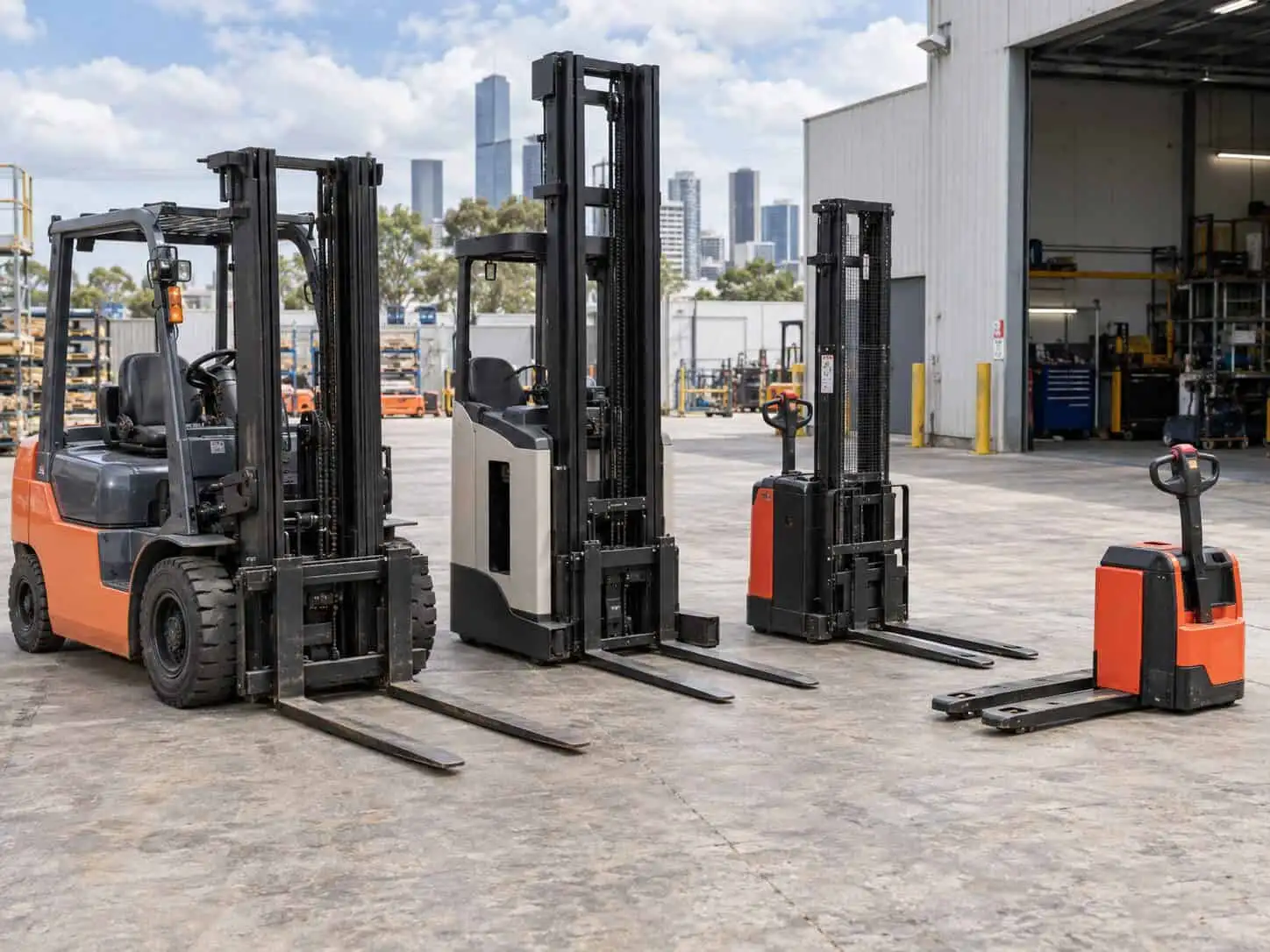
There are eight machines most Australian warehouses actually choose between, and the industry sorts them into seven classes. The types of forklifts you will come across are the counterbalance, the reach truck, the order picker, the walkie stacker, the electric pallet jack, the container mast forklift, the rough terrain forklift and the telehandler. Which one suits you comes down to three things: how high you need to lift, how much room you have to turn, and whether the work happens indoors or out.
This guide explains what each machine is, what it is for, and the one constraint that usually rules it out. It then sets out the seven-class code published by the Australian Industrial Truck Association and which of these machines need a high risk work licence in Australia.
What counts as a forklift
A forklift is a powered industrial truck with a mast and a load carriage carrying fork arms, where the forks can be raised well clear of the ground to lift and stack a load. That definition is worth pinning down, because it decides what is on this list and what is not.
The Australian regulators use a version of it for licensing. WorkSafe Queensland defines a forklift truck as “a powered industrial truck equipped with lifting media made up of a mast and an elevating load carriage to which is attached a pair of fork arms or other arms that can be raised 900mm or more above the ground, but does not include a pedestrian-operated truck or a pallet truck.”
That is the regulator’s boundary, not the industry’s. In practice the material handling trade counts pallet jacks and walkie stackers as forklift equipment, because they do the same job at the low end of the range, and both sit inside the industry class codes further down this page. A crane is not on the list because it lifts on a hook or a sling rather than a mast and forks.
A telehandler sits on the edge of the definition: it lifts on a telescopic boom rather than a fixed mast, but it takes fork attachments and does forklift work on sites where nothing else can.
The main types of forklifts, and what each one is for
1. Counterbalance forklift
A counterbalance forklift carries the load out in front on forks, with a heavy weight at the rear balancing it, so it needs no outrigger legs and can drive straight up to a pallet or a truck tray. It is the machine most people picture when they hear the word forklift, and it is the most common type in Australian warehouses and yards.
Counterbalance machines come in electric, LPG and diesel. Electric suits indoor work where fumes and noise matter. Gas and diesel suit yards, loading docks and outdoor surfaces. Buy A Fork carries a range of counterbalance forklifts across both drive types.
The constraint that rules it out is space. A counterbalance needs a wide aisle to turn in, because the whole machine has to swing around the load. If your racking aisles are tight, this is the wrong machine and no amount of operator skill fixes it.
2. Reach truck
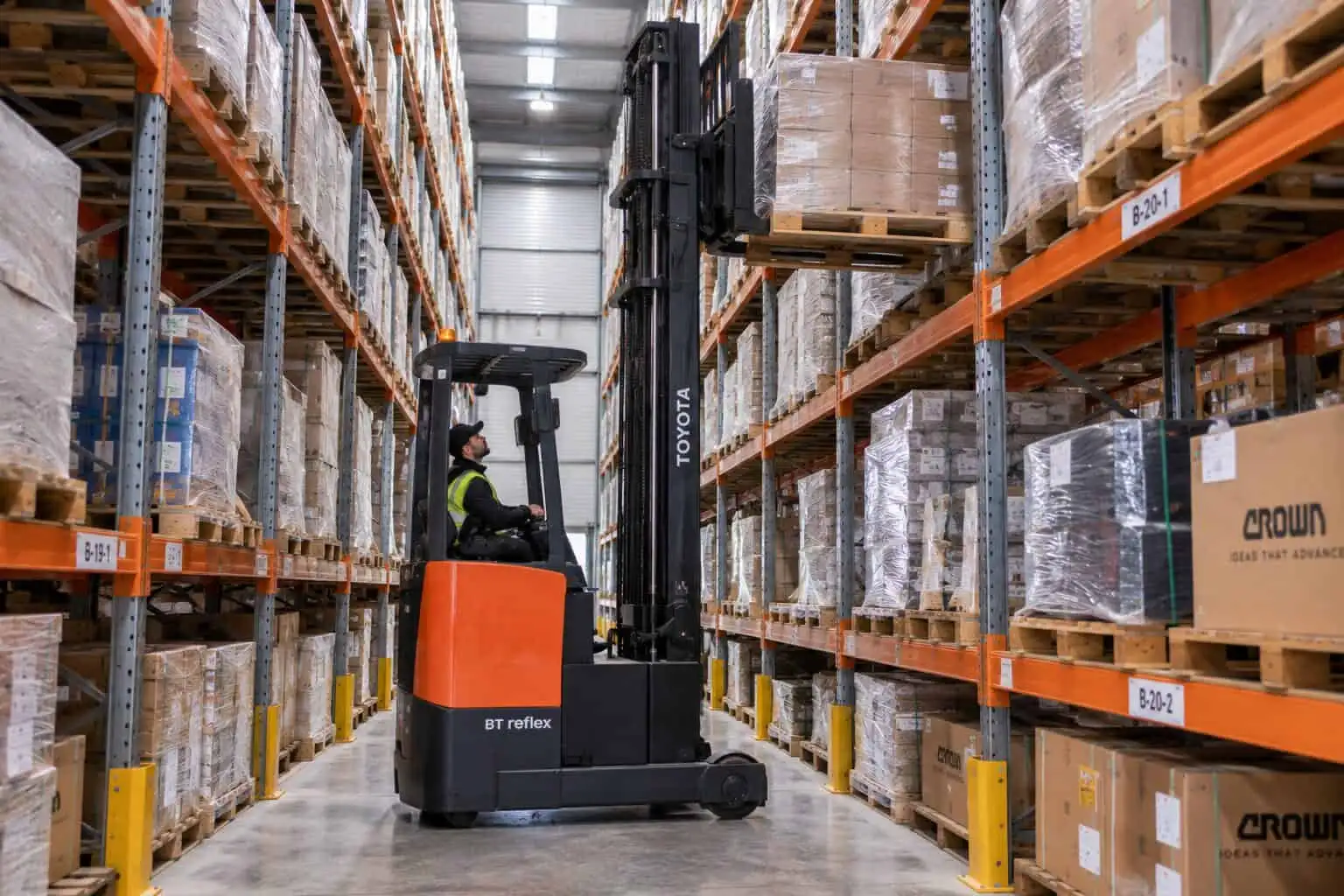
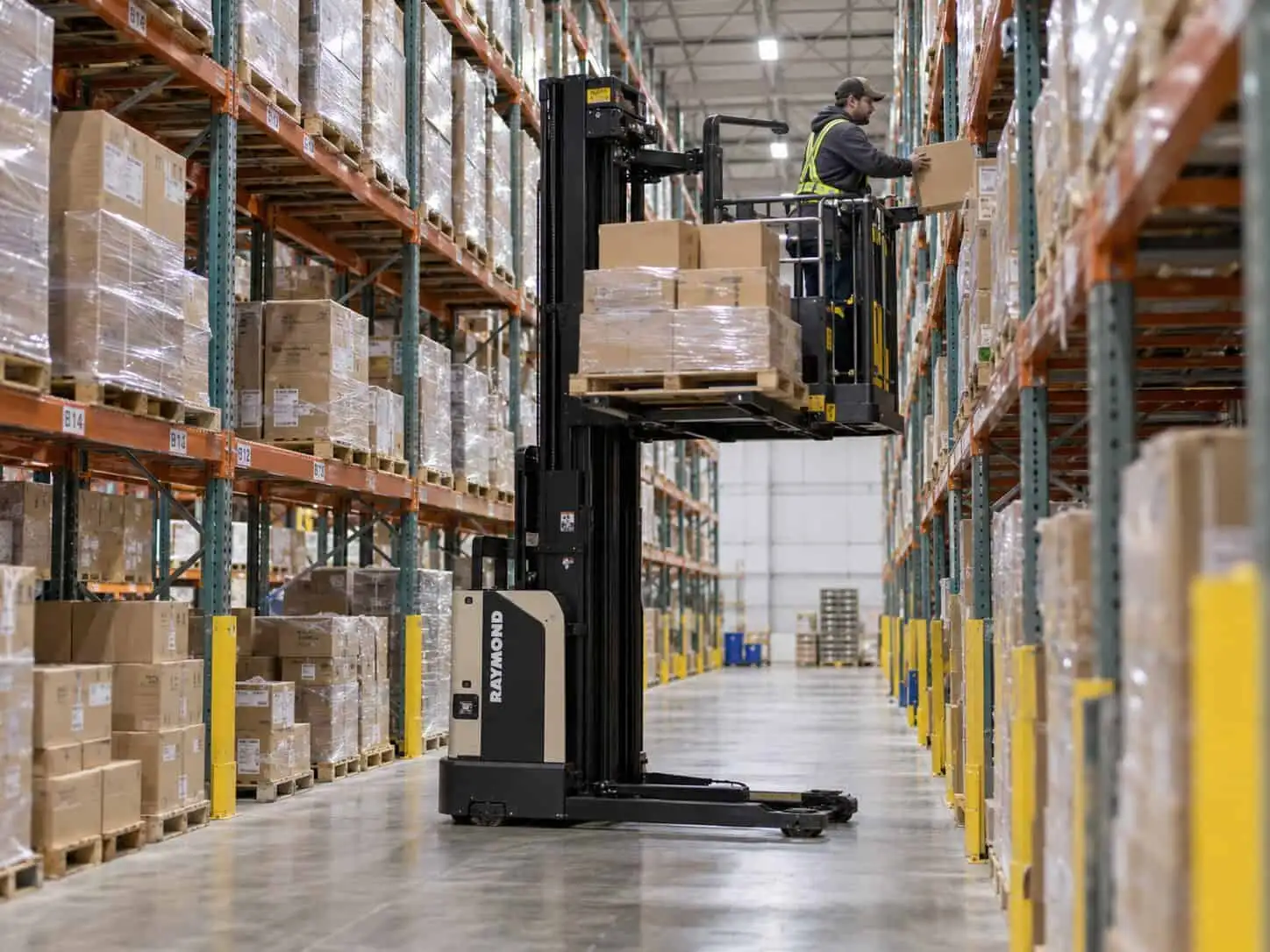
A reach truck is an electric warehouse machine with outrigger legs and a mast that extends forward, so it can place a pallet deep into racking without the whole truck entering the aisle. That extending mast is the point of the machine: it lets you run narrower aisles and fit more racking into the same floor.
Reach trucks lift higher than a standard counterbalance of the same footprint, which is why they dominate high-bay storage. Double deep models extend far enough to load a second pallet position behind the first. Buy A Fork stocks used reach trucks from Raymond, Toyota and BT, and there is a longer explanation of the racking side in our guide to reach trucks for high-bay racking.
The constraint is the floor and the weather. Reach trucks need a smooth, level surface and are built for indoor use. Take one outside onto gravel or a sloped yard and you will damage it.
3. Order picker
An order picker lifts the operator up with the load, so they can pick individual cartons from racking rather than moving whole pallets. The operator platform is part of the lifting carriage, and it rises with the forks.
This is the machine for businesses that ship in carton or piece quantities rather than full pallets, which covers most distribution and ecommerce warehousing. It replaces the alternative, which is bringing whole pallets down to floor level, picking from them, and putting them back.
The constraint is that it is a picking machine, not a transport machine. It is not the tool for moving pallets around a yard or unloading trucks, and it carries a separate licence requirement covered further down.
4. Walkie stacker
A walkie stacker is a pedestrian-operated machine with a mast, so it lifts and stacks pallets to racking height while the operator walks behind it. It sits between a pallet jack, which only lifts a pallet clear of the floor, and a ride-on forklift.
Walkie stackers suit small warehouses, cool rooms, retail back-of-house and anywhere a full forklift is more machine than the work needs. They take up little room, they are quiet, and they cost less to buy and run. The comparison against a pallet jack is covered in detail in our guide to electric pallet jacks against walkie stackers.
The constraint is throughput. The operator walks, so the machine moves at walking pace. Over a long shift with long travel distances, that adds up, and a ride-on machine starts to make more sense.
5. Electric pallet jack
An electric pallet jack lifts a pallet just clear of the floor and moves it horizontally, with no mast and no stacking ability. It is the workhorse of truck unloading, dock work and moving loads to a staging area where something else picks them up.
Models run from pedestrian walkie units to centre-ride and rider-seated machines for longer travel. Buy A Fork stocks electric pallet jacks from BT, Toyota and Raymond.
The constraint is obvious but worth stating: it cannot stack. If you need anything off the floor and into racking, you need a stacker or a forklift.
6. Container mast forklift
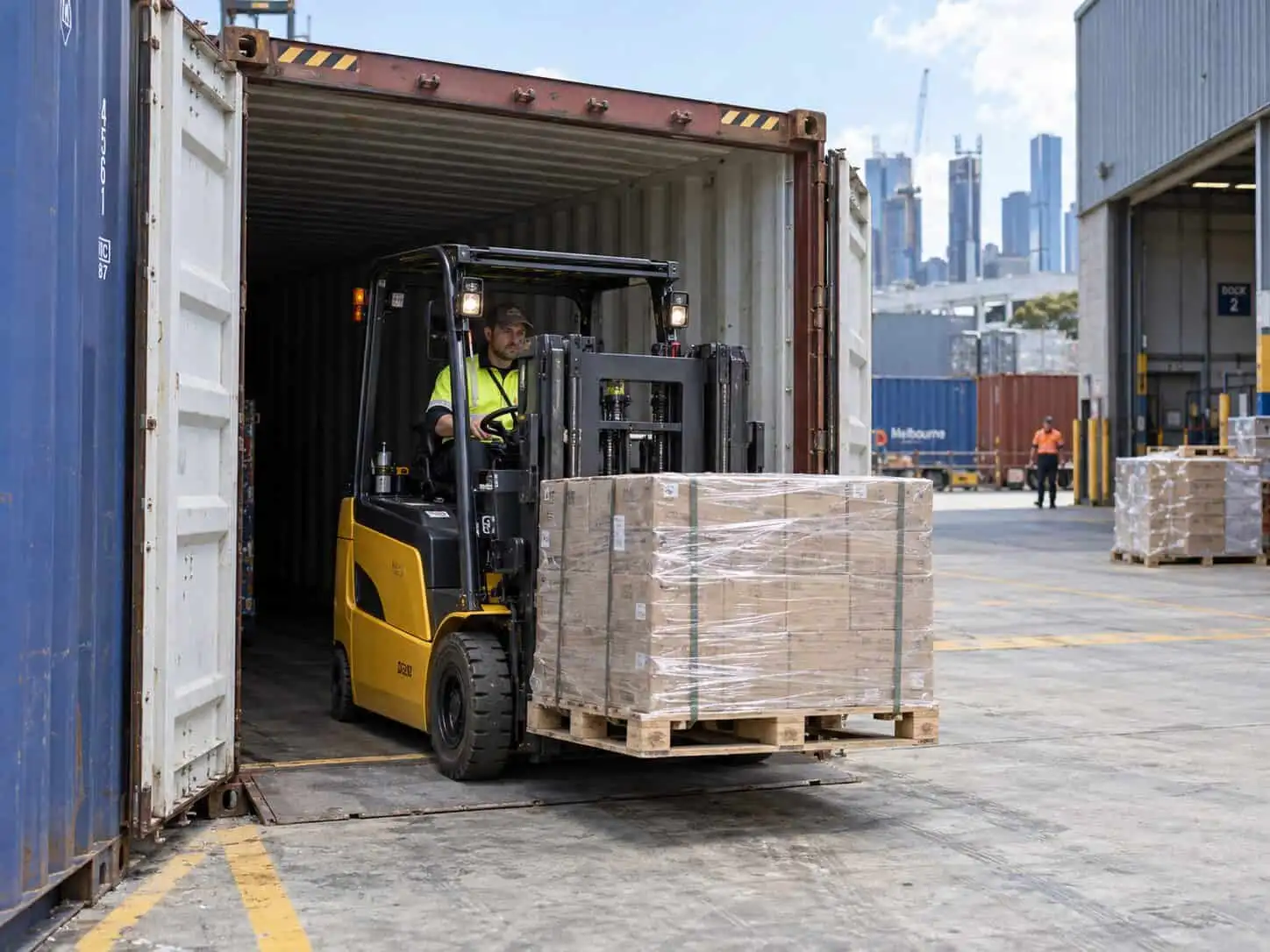
A container mast forklift is a counterbalance machine with a mast built to collapse low enough to drive inside a shipping container, then lift to full height once it is out. The mast does the work in more stages, so the collapsed height stays under the container door.
Anyone who regularly devans containers on their own site needs one, because a standard mast simply will not fit through the door. Buy A Fork carries a large number of container mast forklifts in both electric and gas.
The constraint is cost and complexity. You are paying for a specialised mast. If container work is occasional rather than routine, the sums usually favour a standard machine and a different unloading method.
7. Rough terrain forklift
A rough terrain forklift has large tractor-style tyres and high ground clearance, so it can carry loads across unsealed ground where a warehouse machine would bog or bottom out. AITA’s own class code describes these as “most commonly used at timberyards or construction sites to lift building materials to elevated work sites.”
These are almost always diesel, and almost always outdoor-only machines. If your work is building sites, timber yards or unsealed storage, this is the category to look at, and diesel forklifts are the starting point.
The constraint is that it is an outdoor machine in every sense. The tyres, the clearance and the engine all make it unsuitable for indoor racking work.
8. Telehandler
A telehandler lifts on a telescopic boom rather than a fixed mast, so it can reach forward and up at the same time and place a load over an obstacle. With forks fitted it does forklift work, and it is standard equipment on construction sites for that reason.
The reach is what you are buying. A mast lifts straight up; a boom lets you put a pallet of bricks onto a first-floor slab from ground level without repositioning.
The constraint is that reach costs capacity. A telehandler’s safe load drops sharply as the boom extends, which is why load charts matter more on these machines than on any other type here.
Forklift types compared at a glance
| Type | Indoor or outdoor | Typical work | Aisle needed | Stacks to height |
|---|---|---|---|---|
| Counterbalance | Both, by fuel type | General handling, docks, yards | Wide | Yes |
| Reach truck | Indoor | High-bay racking | Narrow | Yes, highest of the warehouse types |
| Order picker | Indoor | Carton and piece picking | Narrow | Yes, operator lifts too |
| Walkie stacker | Indoor | Small-site stacking | Narrow | Yes, limited height |
| Electric pallet jack | Indoor | Truck unloading, horizontal transport | Narrow | No |
| Container mast | Both, by fuel type | Devanning containers | Wide | Yes |
| Rough terrain | Outdoor | Building sites, timber yards | Not applicable | Yes |
| Telehandler | Outdoor | Construction, reaching over obstacles | Not applicable | Yes, with reach |
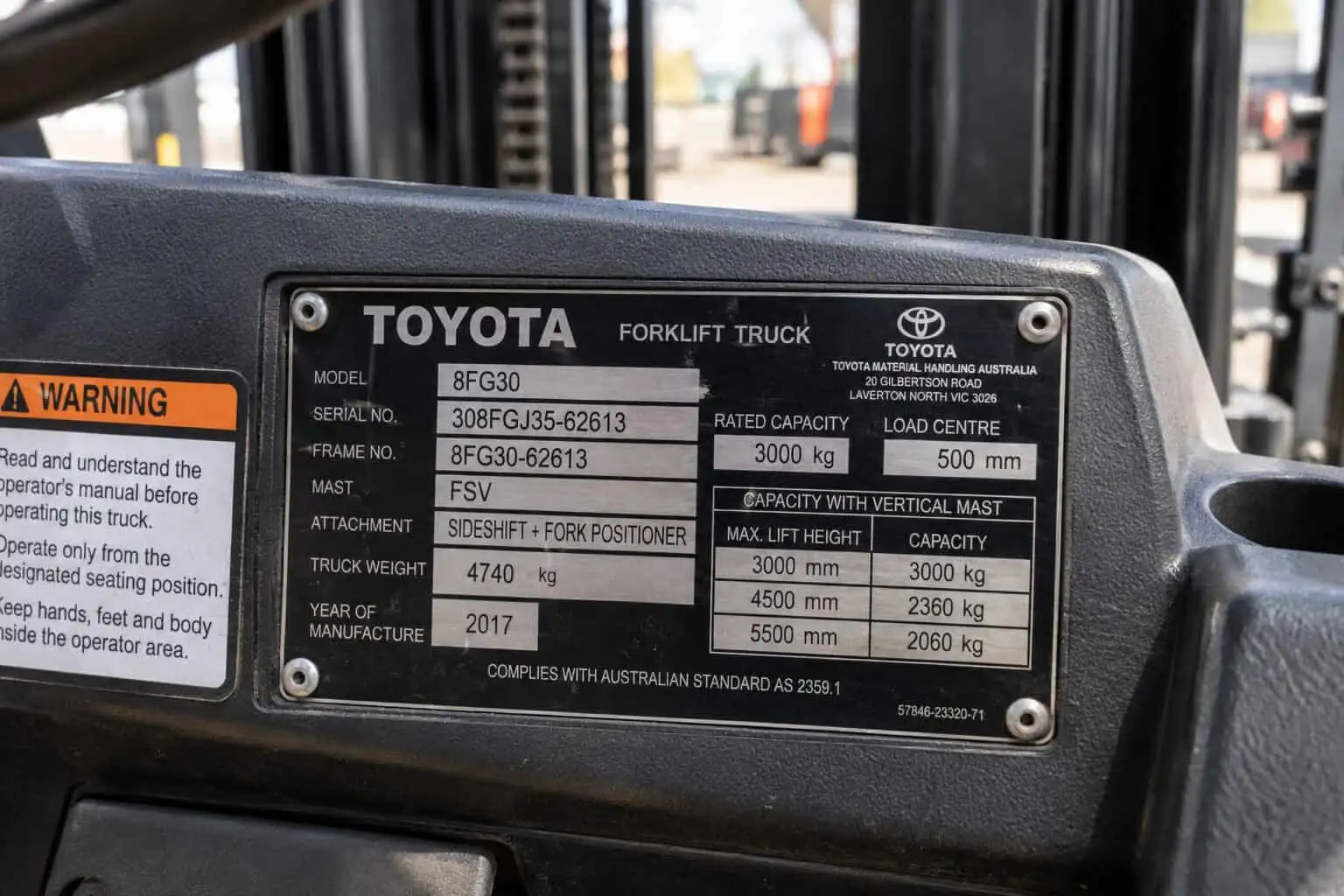
Read the table as a shortlist tool, not a specification sheet. Capacity, lift height and collapsed height vary widely inside every one of these categories, and those figures come off the individual machine’s data plate rather than the category.
The seven forklift classes, and where they come from
The Australian Forklift and Industrial Truck Association, AITA , publishes a seven-class lift truck code, and it is the Australian industry reference for classifying these machines. The page is marked “Lifttruck Codes, AITA , as at 23.01”.
| Class | AITA description |
|---|---|
| Class I | Electric Motor Riders |
| Class II | Electric Motor Narrow Aisle |
| Class III | Electric Pallet Jacks / Stackers / Tow Tractors |
| Class IV | Internal Combustion Engine Cushion Tire |
| Class V | Internal Combustion Engine Pneumatic Tire |
| Class VI | Electric/ IC Engine Tow Tractors |
| Class VII | Rough Terrain Forklift Trucks |
The class descriptions are reproduced as AITA publishes them, including the American spelling of “tire”.
This seven-class structure is the same one the United States Occupational Safety and Health Administration uses. AITA’s page does not state whether the Australian code was adopted from the American system or arrived at separately, so neither claim belongs in an Australian buying decision. What is accurate to say is that Australia’s industry association publishes the same seven classes, and that an Australian buyer can use them.
What the classes are useful for, and what they are not. They are a clean way to describe a machine’s power source and body style in a quote, a fleet list or an insurance schedule. Class II, for example, covers order pickers, low level order pickers and reach trucks in one term. What they do not do is tell you anything about Australian licensing, which runs on an entirely separate set of codes.
Which types of forklift need a licence in Australia
Two of the machines on this list carry their own high risk work licence class, several need no licence at all, and the employer’s training duty applies to every one of them regardless.
The forklift licence class is LF. WorkSafe Queensland states that “the LF high risk work licence class allows you to use forklift trucks, but does not include order-picking forklift trucks.” That covers counterbalance, container mast and rough terrain machines.
The order picking licence class is LO, and it is separate because the operator rises with the load. SafeWork NSW describes it as the class that “allows you to operate an order picking forklift truck where the operator’s controls are incorporated and elevate with the load carriage/lifting media.” An LF licence does not cover an order picker, which is the single most commonly missed point in this area. Our guide to the difference between LF and LO licences works through it in full.
Some machines fall outside high risk work licensing altogether:
- Electric pallet jacks and pallet trucks: the regulator’s definition of a forklift truck expressly excludes a pallet truck.
- Pedestrian-operated machines, including walkie stackers: the same definition expressly excludes a pedestrian-operated truck.
- Telehandlers fitted with forks or a bucket: SafeWork NSW states these do not require a high risk work licence.
No licence does not mean no training. SafeWork NSW states the business “has a duty of care to ensure workers have appropriate training to operate a telehandler”, and the same general work health and safety duty applies to every machine on this list. An untrained operator on an unlicensed machine is still the employer’s liability, and licensing requirements are administered by each state and territory regulator, so confirm the position with yours before you buy. For the licence application process itself, see our guide to getting a forklift licence in Australia.
How to narrow eight types down to one
Work through it in this order, because each answer removes types from the list rather than adding them.
- Indoors or outdoors. Outdoor work on unsealed ground leaves you with rough terrain machines and telehandlers. Indoor work removes both immediately.
- How high you need to lift. Floor-level transport only means a pallet jack. Low stacking means a walkie stacker. High racking means a reach truck or a counterbalance with the right mast.
- How wide your aisles are. This is where a counterbalance is usually won or lost. Measure the narrowest aisle the machine has to turn in before you look at any specific unit.
- What you pick. Whole pallets point to a forklift or reach truck. Cartons and pieces point to an order picker.
- Whether you devan containers. Regular container work means a container mast, and the collapsed height has to clear your container door.
Once the type is settled, the specification work starts: capacity, mast height, fuel, tyres and hours. Our guide to choosing the right forklift covers that stage, and you can see what is currently available across the full range or talk to us about your site.
Frequently asked questions
1. What are the three main types of forklifts?
The three most common types in Australian workplaces are the counterbalance forklift, the reach truck and the electric pallet jack. The counterbalance handles general lifting and yard work, the reach truck handles high racking in narrow aisles, and the pallet jack moves loads horizontally at floor level. Most sites run some combination of these three before adding anything more specialised.
2. What are the 7 classes of forklifts?
The seven classes published by AITA are Class I electric motor riders, Class II electric motor narrow aisle, Class III electric pallet jacks, stackers and tow tractors, Class IV internal combustion engine cushion tire, Class V internal combustion engine pneumatic tire, Class VI electric and internal combustion engine tow tractors, and Class VII rough terrain forklift trucks. The same seven-class structure is used by the United States OSHA. The classes describe power source and body style, and they are separate from Australian licence classes.
3. What are the different types of reach forklifts?
Reach machines split into standard reach trucks, double deep reach trucks and walkie reach stackers. A standard reach truck places a pallet into a single racking position. A double deep model extends far enough to load a second pallet position behind the first, which lets you run deeper racking. A walkie reach stacker is a pedestrian version for smaller sites. AITA groups reach trucks with order pickers in Class II.
4. Which types of forklift do not need a licence in Australia?
Pallet trucks, pedestrian-operated machines such as walkie stackers, and telehandlers fitted with forks or a bucket are excluded from high risk work licensing. The forklift truck definition used for the LF licence expressly excludes pedestrian-operated trucks and pallet trucks, and SafeWork NSW confirms telehandlers with forks or buckets do not need a licence. Employers still hold a duty of care to train operators on every one of these machines.
5. Which type of forklift suits a small warehouse?
For a small warehouse with tight aisles and modest stacking height, a walkie stacker or an electric pallet jack usually does the work without the cost and floor space of a ride-on machine. Step up to a reach truck when the racking goes high, and to a counterbalance when you need to work outside or load trucks. Measure your narrowest aisle first, because that number rules more machines out than any other.