
Counterbalance Forklift Guide: Types, Uses and How to Choose
· Updated
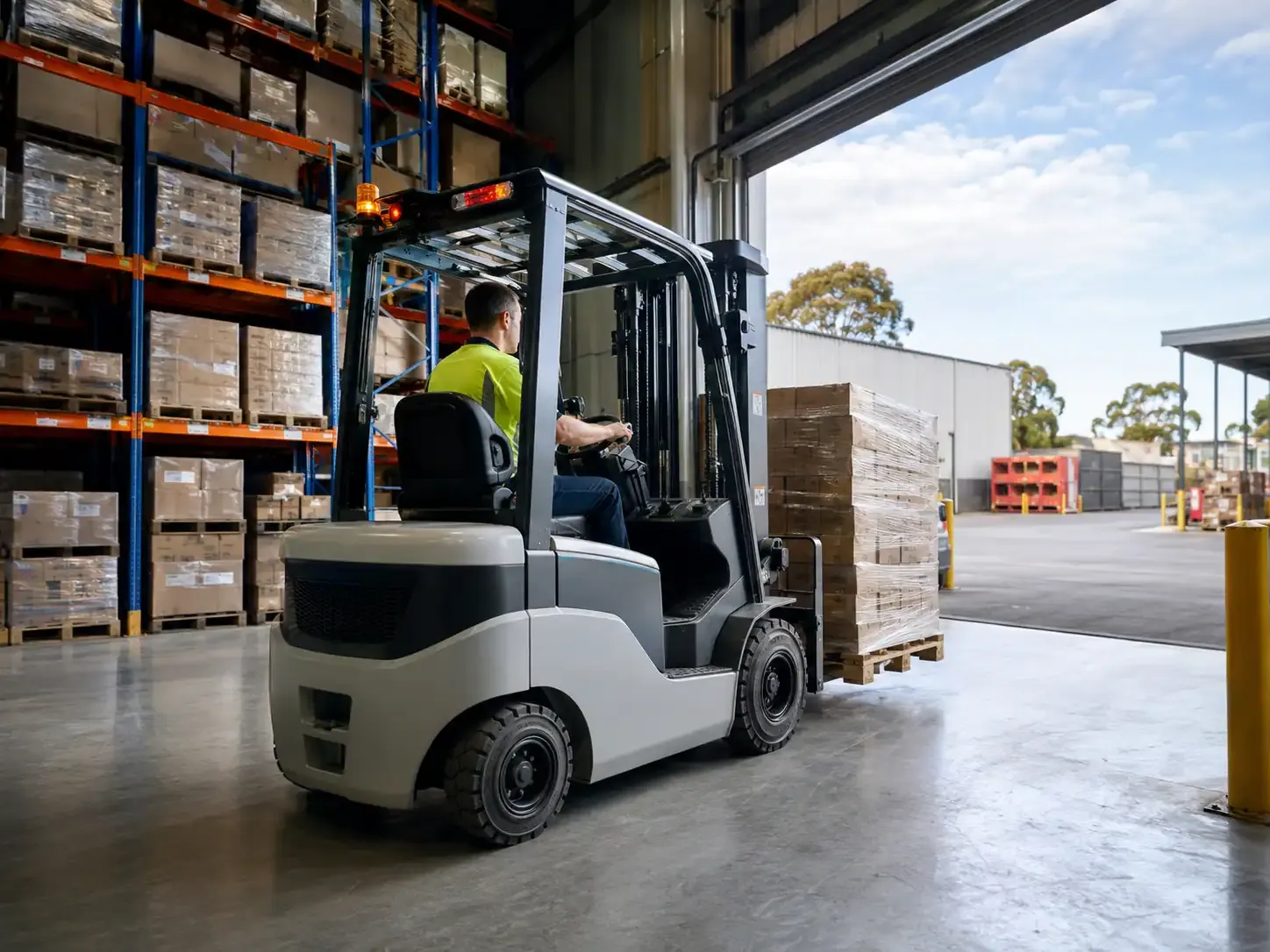
A counterbalance forklift is a lift truck with forks at the front and a heavy counterweight at the rear. The rear weight balances the load being carried, allowing the forklift to approach pallets, trucks and storage areas without outrigger legs extending in front of the machine.
This straightforward design makes counterbalance forklifts one of the most versatile options for warehouses, loading docks, factories, yards and small businesses. They are available with electric, LPG and diesel power, as well as three-wheel, four-wheel and heavy-capacity configurations.
The right model depends on what you lift, how high it must travel, your operating surface, available aisle space and whether the forklift will work indoors, outdoors or across both environments.
What Is a Counterbalance Forklift?
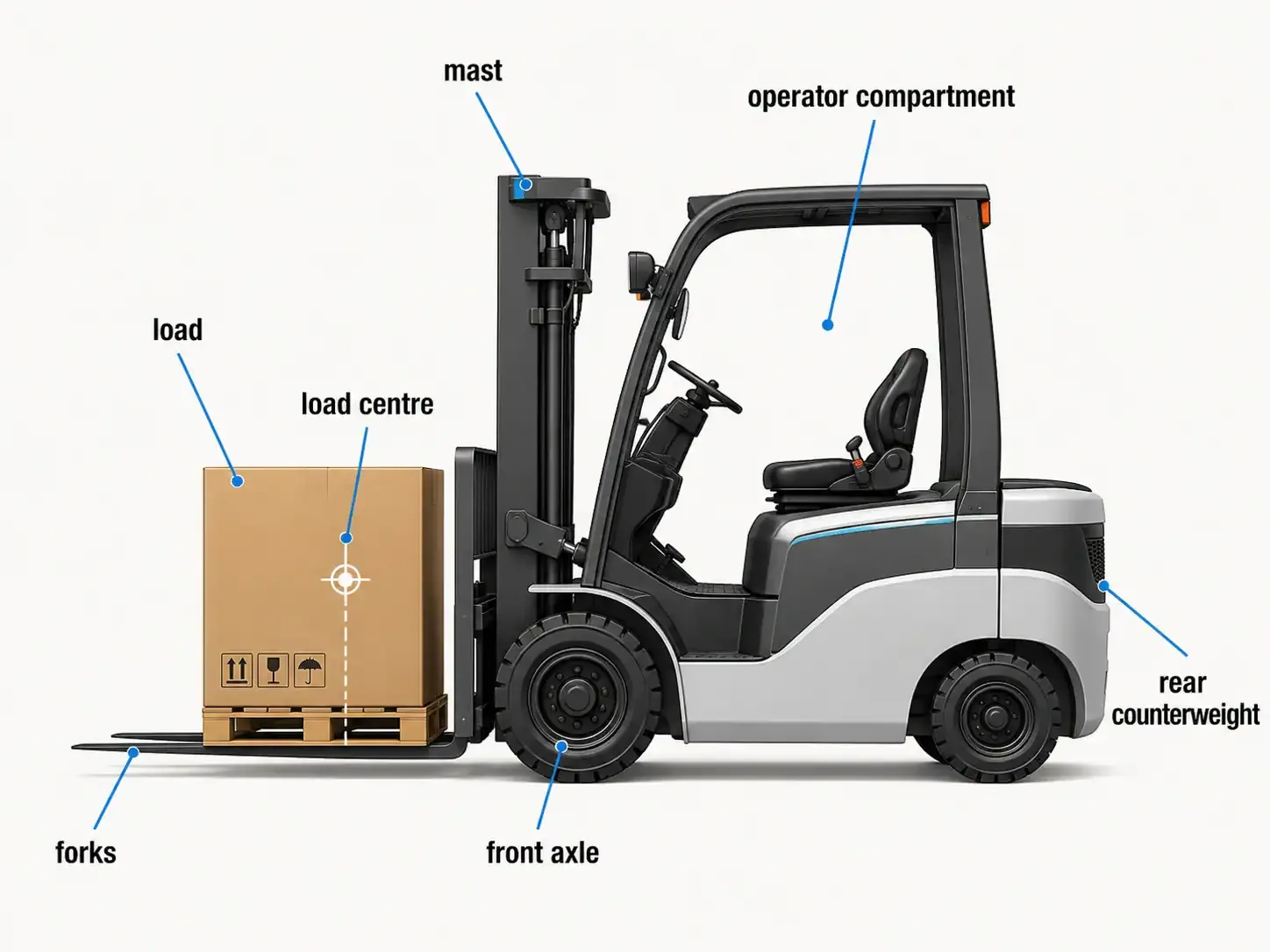
A counterbalance forklift is a powered industrial truck that balances a load on its front-mounted forks with a counterweight built into the rear of the machine.
The front axle acts as the main balancing point. The load and forks sit on one side of this point, while the truck body, battery or rear counterweight provides balancing mass on the other side.
Unlike a reach truck or many pallet stackers, a counterbalance forklift does not normally need outrigger legs extending beside the pallet. Its forks project directly from the front of the mast, allowing the truck to drive up to a load, pick it up and reverse away.
This makes the design particularly useful for:
- Loading and unloading trucks.
- Moving pallets across warehouse floors.
- Storing goods in racking.
- Handling loads in outdoor yards.
- Moving materials between production areas.
- Operating in locations without specialised narrow-aisle equipment.
Businesses comparing available models can browse the current counterbalance forklift range by power source, load capacity and other operating requirements.
How Does a Counterbalance Forklift Work?
A counterbalance forklift works like a balanced lever. The front axle acts as the fulcrum, the pallet creates forward force, and the truck’s rear weight creates the opposing force needed to keep the machine stable.
Four concepts influence how safely the forklift can carry a load.
The Counterweight
The counterweight is built into the rear of the forklift. On an internal-combustion model, this is usually a heavy metal structure. On many electric forklifts, the battery also contributes significantly to the balancing weight.
A heavier counterweight does not automatically mean the forklift can lift any load. The manufacturer determines the machine’s rated capacity based on its complete design, mast, tyres, attachments, lift height and load centre.
The Front Axle
The front axle is the main pivot point between the load and the rear counterweight. As the load becomes heavier or moves farther forward, it creates more forward tipping force around this axle.
This is why a long pallet can reduce safe lifting capacity even when its total weight is below the number shown on the forklift’s capacity plate.
The Load Centre
The load centre is the horizontal distance from the vertical face of the forks to the load’s centre of gravity.
A forklift may be rated to lift a specific weight at a stated load centre. If the load is longer, unevenly positioned or sitting too far forward, the effective load centre increases and the forklift’s safe capacity can fall.
Operators and buyers should know how to read a forklift load capacity chart rather than relying only on the large capacity number displayed on a sales listing.
The Stability Triangle
A conventional forklift’s points of support form an imaginary triangle between the two front wheels and the pivot point of the rear steering axle.
The combined centre of gravity of the forklift and its load should remain within this stability area. Sharp turns, raised loads, uneven surfaces, excess speed, slopes and incorrect attachments can move the centre of gravity closer to the edge of the triangle and increase the risk of overturning.
WorkSafe Victoria warns that instability can be caused by raised or tilted loads, uneven surfaces, excessive load-centre distance and loads that exceed the forklift or attachment capacity.
Types of Counterbalance Forklift
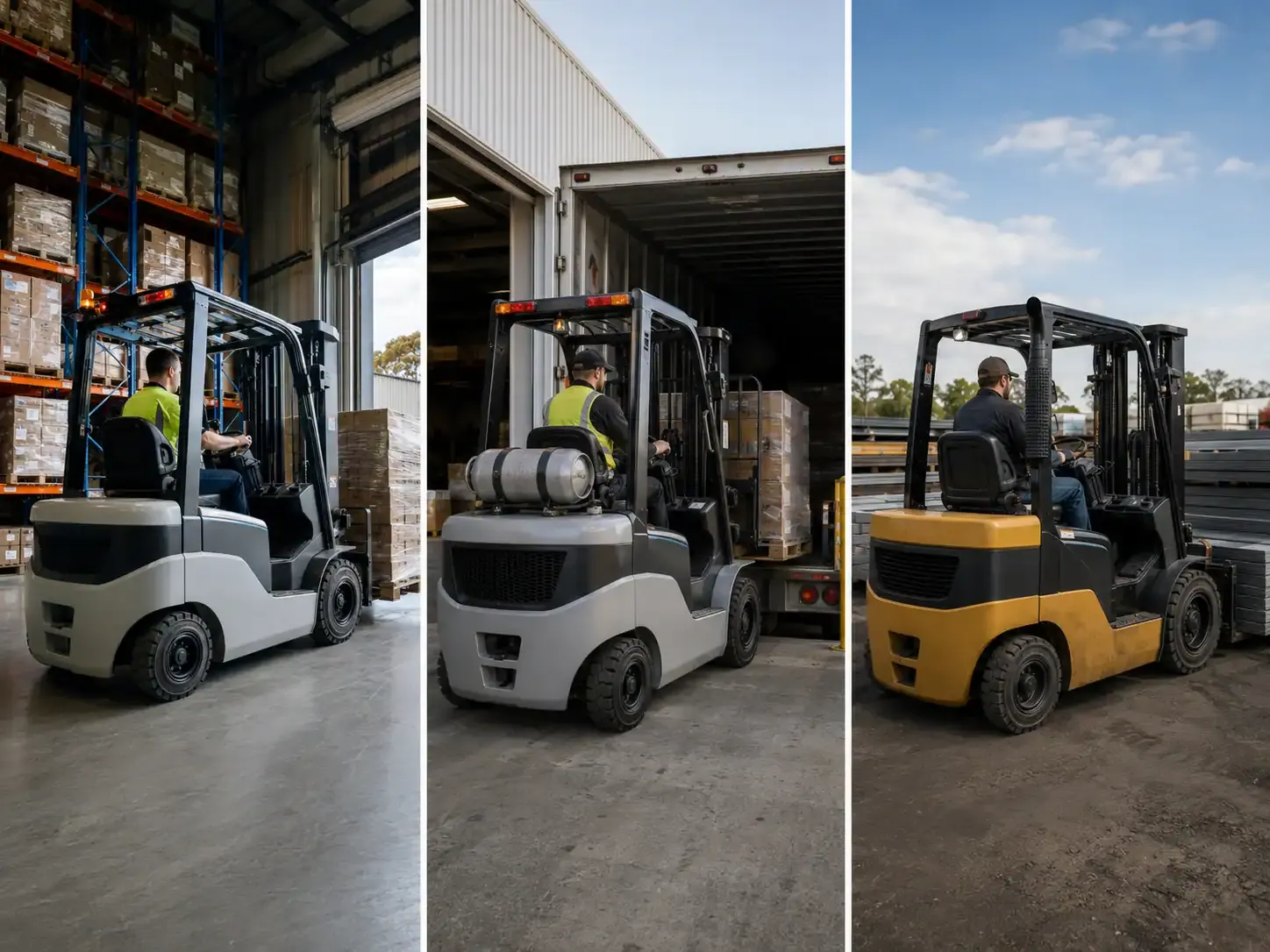
Counterbalance forklifts are commonly grouped by power source, wheel configuration and load capacity. There is no single best type for every workplace.
Running costs are where diesel, electric and LPG separate most clearly over a machine’s working life.
Counterbalance Forklift Types by Power Source
| Type | Best operating environment | Main strengths | Points to consider |
| Electric | Warehouses, food facilities, retail storage and enclosed production areas | No tailpipe emissions, quiet operation, responsive controls and lower routine motor maintenance | Requires suitable charging infrastructure and battery planning |
| LPG or gas | Loading docks, warehouses and mixed indoor-outdoor work | Fast refuelling, consistent performance and flexible use across different work areas | Produces exhaust emissions and requires safe cylinder storage and ventilation |
| Diesel | Outdoor yards, construction supply, timber, steel and demanding applications | Strong continuous performance, durable construction and broad heavy-capacity availability | Noise and exhaust make diesel unsuitable for many enclosed workplaces |
Electric Counterbalance Forklifts
Electric forklifts are well suited to enclosed warehouses and facilities where noise, fumes and indoor air quality are important.
They are available with lead-acid or lithium-ion batteries.
- Lead-acid batteries: Often cost less initially and are widely available, but require scheduled charging, battery maintenance and appropriate ventilation in the charging area.
- Lithium-ion batteries: Support faster charging and opportunity charging during breaks. They generally require less routine battery maintenance but may cost more to purchase.
Many electric counterbalance models are available with three or four wheels. Some can also work outdoors when the truck, tyres, weather protection and surface conditions are suitable. Toyota and Crown both offer electric counterbalance ranges for varied warehouse, manufacturing and distribution applications.
The available electric counterbalance forklifts include compact warehouse machines, stand-up models and larger sit-down units.
LPG Counterbalance Forklifts
LPG counterbalance forklifts are popular in operations that move repeatedly between warehouses, loading areas and sealed outdoor surfaces.
They can be refuelled quickly by changing the gas cylinder, which may suit businesses that cannot stop for extended battery charging. LPG models also provide consistent power during longer shifts.
They still produce exhaust gases, so indoor use requires appropriate ventilation, emissions controls and a workplace-specific risk assessment. Businesses should not assume that an LPG forklift is automatically suitable for every enclosed environment.
Current LPG counterbalance forklifts may suit general warehousing, logistics, manufacturing and mixed-site applications.
Diesel Counterbalance Forklifts
Diesel forklifts are generally selected for outdoor work, demanding operating conditions and applications involving heavier loads or longer travel distances.
They are commonly used in:
- Building supply yards.
- Timber and steel handling.
- Transport depots.
- Large outdoor storage areas.
- Construction and industrial sites.
- Heavy manufacturing operations.
Diesel engines provide dependable performance under demanding workloads, but their exhaust emissions and noise usually make them a poor choice for enclosed indoor areas.
A detailed comparison of electric vs diesel counterbalance forklifts can help businesses assess energy costs, operating conditions, emissions and shift requirements before selecting a power source.
Three-Wheel vs Four-Wheel Counterbalance Forklifts
Wheel configuration affects turning ability, stability and the type of environment in which the forklift performs best.
| Feature | Three-wheel counterbalance | Four-wheel counterbalance |
| Manoeuvrability | Very tight turning circle | Wider turning circle |
| Best environment | Indoor warehouses and confined spaces | Warehouses, docks and mixed indoor-outdoor areas |
| Typical power source | Usually electric | Electric, LPG or diesel |
| Stability | Suits light to medium work on smooth surfaces | Generally preferred for heavier work and varied conditions |
| Aisle requirement | Better where space is restricted | Requires more room to turn |
| Common application | Racking, production and compact warehouses | Loading, transport, stacking and yard work |
The comparison between three-wheel and four-wheel electric machines goes into more detail on turning circle and stability.
When to Choose a Three-Wheel Forklift
A three-wheel electric counterbalance forklift is useful where manoeuvrability is more important than maximum capacity.
Its rear wheel or closely positioned rear-wheel arrangement allows the truck to turn sharply. This can reduce the aisle space required for pallet handling.
Three-wheel models are commonly used in:
- Compact warehouses.
- Retail distribution areas.
- Production facilities.
- Indoor loading zones.
- Operations handling lighter pallets.
Manufacturers commonly position three-wheel electric trucks as compact options for confined warehouse environments.
When to Choose a Four-Wheel Forklift
A four-wheel counterbalance forklift provides a broader platform for mixed duties, higher capacities and longer travel distances.
It may be the better option where the machine must handle ramps, loading docks, outdoor surfaces or heavier loads. Tyre type and ground clearance still need to match the operating surface.
Four-wheel forklifts are available with electric, LPG and diesel power, giving buyers a much wider choice of capacities and configurations.
Counterbalance Forklift Capacity Bands
Counterbalance forklifts are available in a broad range of lifting capacities. Practical buying categories include:
- Light-duty models: Approximately 1 to 2 tonnes for retail storage, compact warehouses, food facilities and lighter pallet work.
- Medium-duty models: Approximately 2 to 5 tonnes for general warehousing, manufacturing, logistics and building supplies.
- Heavy-capacity models: More than 5 tonnes for steel, timber, industrial materials, machinery and other specialised loads.
These are general buying bands rather than formal forklift classifications. Individual models can differ significantly.
The capacity shown in a model name or specification is usually based on defined conditions. Actual residual capacity may be lower when:
- The mast is raised to greater heights.
- The load centre increases.
- A side shift, clamp or other attachment is fitted.
- The load is irregular or unbalanced.
- Fork extensions are used.
- The mast is tilted.
- The forklift operates on an unsuitable surface.
The correct machine must safely lift the required load at the required height, not only at ground level.
Indoor or Outdoor: Surfaces, Tyres and Fuel
Where the machine spends its day decides more of the specification than most buyers expect. A smooth concrete warehouse floor, a sealed yard and a gravel hardstand are three different problems, and the tyre choice is what separates them.
Cushion tyres are solid rubber pressed onto the wheel. They suit clean indoor floors, give a tighter turning circle and sit the machine lower to the ground. They do not cope with gravel, potholes or broken outdoor surfaces.
Pneumatic tyres, whether air filled or solid, absorb uneven ground and are the standard fit on yard machines. You give up a little turning circle in exchange for a machine that survives outside.
If the same forklift has to work indoors and out, solid pneumatic tyres are usually the compromise worth making.
On fuel, the honest position is that electric is the default for enclosed indoor work, diesel is the default for yards and rough ground, and LPG sits between them where ventilation allows. Purchase price separates the three less than running costs do, and the gap widens the more hours the machine works.
What Is a Counterbalance Forklift Used For?
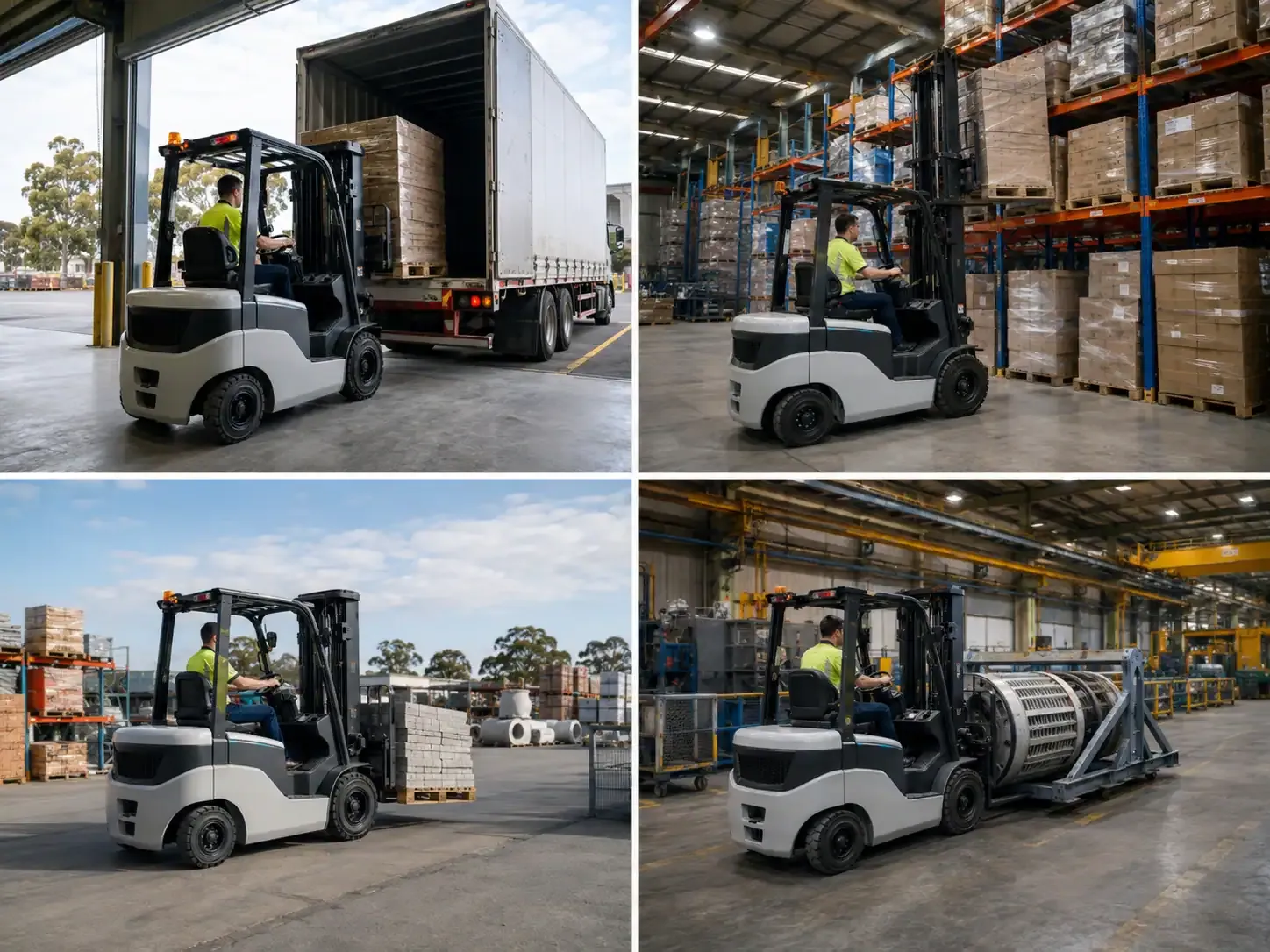
Counterbalance forklifts are used for lifting, transporting and stacking palletised or supported loads over short distances.
Their open-front design allows them to approach a pallet directly, making them useful for several common materials-handling tasks.
Loading and Unloading Trucks
A counterbalance forklift can approach the side or rear of a truck, pick up a pallet and move it to a warehouse, staging area or yard.
Low-mast or container-entry models may also enter shipping containers when the doorway height, floor capacity, ventilation and internal clearance allow it.
A standard forklift should not be confused with specialised equipment designed to lift entire shipping containers.
General Warehouse Handling
Counterbalance forklifts can move stock between receiving areas, production floors, bulk storage and pallet racking.
They work best where there is enough aisle width for the truck to turn and align squarely with the pallet.
Manufacturing and Production
Factories use counterbalance forklifts to move raw materials, components, finished goods, bins, stillages and production equipment.
Attachments such as clamps, rotators or fork positioners may expand the machine’s functions, provided the attachment is approved and reflected on the capacity plate.
Outdoor Yard Work
Pneumatic-tyre LPG and diesel forklifts can transport materials around yards, depots and building supply businesses.
The truck must still be suited to the surface. A conventional warehouse forklift is not designed for deep mud, loose gravel, steep slopes or rough terrain unless the manufacturer specifically approves those conditions.
Heavy Lifting
Higher-capacity counterbalance forklifts are used for loads such as steel products, timber packs, concrete materials, machinery and industrial components.
The main advantage is not only lifting strength. A suitable counterbalance forklift can pick up the load, transport it and place it without requiring a separate machine at each stage.
Benefits of Counterbalance Forklifts for Businesses
The strongest benefit of a counterbalance forklift is versatility. One correctly specified machine can perform several everyday lifting and transport tasks.
Direct Pallet Access
Because there are usually no outrigger legs extending beside the forks, the forklift can drive directly towards many pallets, trucks and staging areas.
This makes loading and unloading more straightforward than with equipment that needs space beneath or beside the pallet for support legs.
Indoor and Outdoor Options
Counterbalance forklifts are available for enclosed warehouses, smooth loading areas, outdoor yards and mixed environments.
The buyer can select an appropriate combination of power source, tyres, weather protection, wheel configuration and ground clearance.
Broad Capacity Range
Compact electric units can handle lighter warehouse duties, while larger LPG, diesel and electric machines can carry several tonnes.
This broad range allows growing businesses to remain within the counterbalance category as their handling requirements change.
Familiar Controls and Wide Availability
Counterbalance forklifts are widely used across Australian industries. This generally makes trained operators, servicing support, replacement parts and pre-owned machines easier to find than for highly specialised equipment.
Operators must still be trained and assessed as competent on the particular forklift, attachment and workplace.
Potential Long-Term Value
A well-maintained forklift from a recognised manufacturer may retain useful resale or trade-in value.
Value depends on factors including:
- Operating hours.
- Service history.
- Battery or engine condition.
- Mast and hydraulic condition.
- Tyre wear.
- Model demand.
- Availability of parts.
- Overall workplace suitability.
Suitability for Small Businesses
Counterbalance forklifts can suit small and growing businesses because one machine may cover receiving, transport, stacking and dispatch.
A small business may not need the highest-capacity or most technically advanced model. A reliable pre-owned forklift that safely meets the actual workload may provide better value than a larger machine with unused capacity.
Small businesses should prioritise:
- Verified load requirements.
- Simple servicing.
- Available parts.
- Suitable warranty coverage.
- Affordable energy or fuel costs.
- A manageable turning radius.
- Reliable local support.
- A clear maintenance history.
Buying solely on price can result in higher costs if the forklift is too large, too small, unsuitable for the site or frequently unavailable due to repairs.
What a Counterbalance Forklift Is Not Good At
Buying the wrong machine type costs more than buying the wrong brand, so it is worth being clear about where a counterbalance forklift is the wrong answer.
It needs a wider aisle than any other warehouse machine. The counterweight has to swing through every turn, which means a counterbalance takes more room to work than a reach truck or a stacker doing the same job. If your storage plan depends on narrow aisles, choosing a counterbalance costs you rack positions.
It tops out lower on lift height. In most configurations a reach truck will place a pallet higher than a counterbalance of comparable capacity, so very high bay racking is not counterbalance territory.
It is inefficient for picking. If your work is pulling individual cartons rather than moving full pallets, an order picker does that job and a counterbalance does not.
And a cushion tyred machine on gravel is slow, uncomfortable and hard on the drivetrain. If any of those describe your site, the answer is a different machine type, not a bigger counterbalance.
Counterbalance Forklift vs Reach Truck vs Pallet Stacker
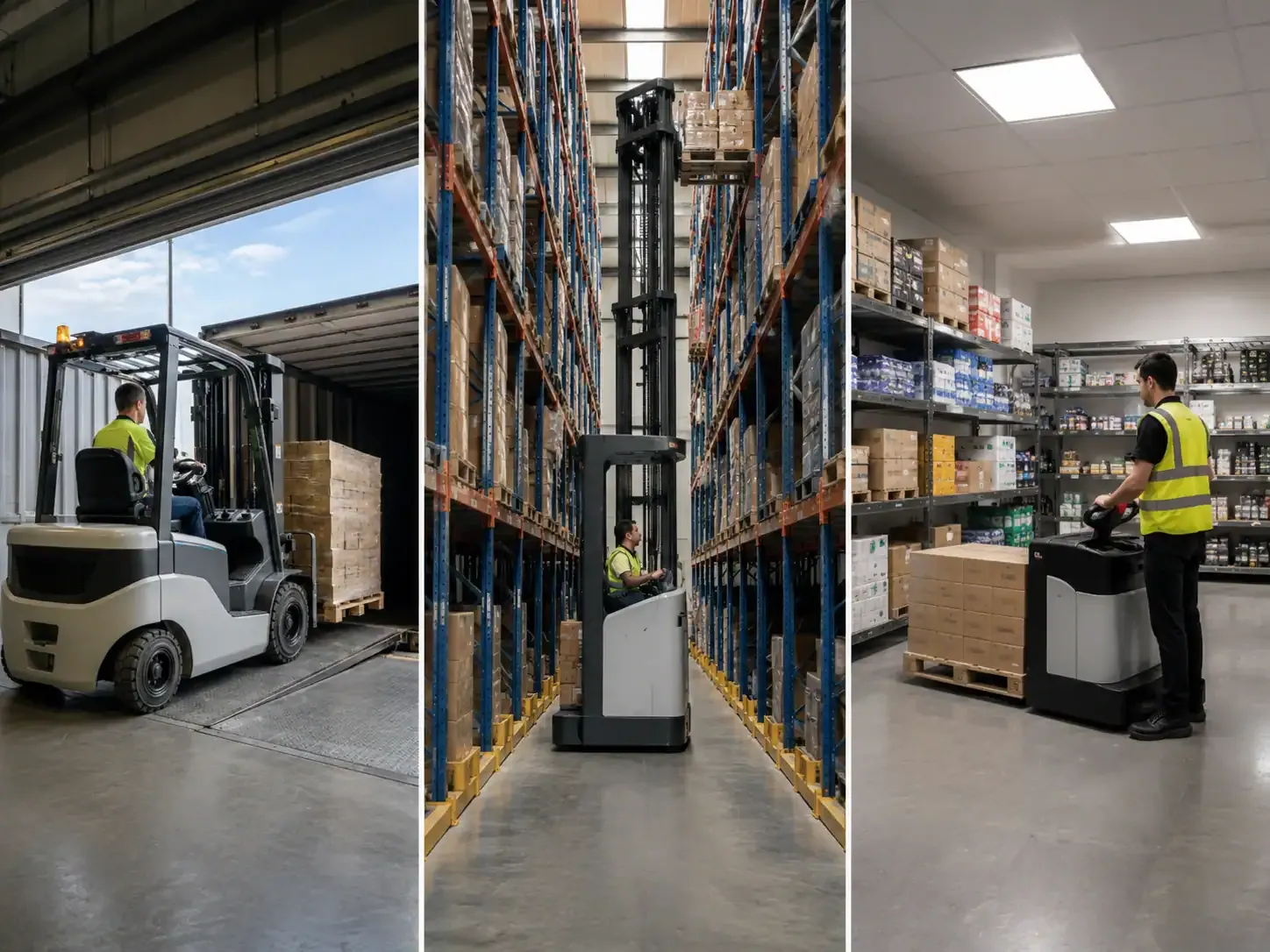
Counterbalance forklifts, reach trucks and pallet stackers can all lift pallets, but they are designed for different operating conditions.
| Feature | Counterbalance forklift | Reach truck | Pallet stacker |
| Primary purpose | General lifting, transport, truck loading and stacking | High racking in narrow warehouse aisles | Light to medium pallet transport and stacking |
| Typical environment | Indoor, outdoor or mixed | Mainly indoors on smooth floors | Mainly indoors on smooth floors |
| Aisle requirement | Usually needs the most turning room | Designed for narrower aisles | Compact in confined work areas |
| Lift height | Moderate to high, depending on model | Usually best for high warehouse racking | Low to moderate, depending on model |
| Load capacity | Very broad range | Commonly medium warehouse capacities | Usually lighter capacities |
| Truck loading | Well suited | Usually not the first choice | Limited, depending on design and access |
| Travel distance | Suitable for regular transport | Best within warehouse racking systems | Best for shorter distances |
| Purchase cost | Varies widely | Usually higher than a basic stacker | Often the lowest-cost option |
| Outdoor use | Available with suitable configuration | Generally unsuitable | Usually unsuitable |
Counterbalance Forklift or Reach Truck?
Choose a counterbalance forklift when the machine must load trucks, travel between different work areas or operate outdoors as well as indoors.
Choose a reach truck when the priority is storing pallets at greater heights inside a warehouse with narrow aisles and smooth floors.
Counterbalance Forklift or Pallet Stacker?
Choose a counterbalance forklift for regular transport, truck loading, greater capacity and more intensive work.
Choose a pallet stacker for lighter pallet movement, shorter travel distances and lower to moderate stacking requirements.
Businesses considering compact warehouse equipment can compare a reach truck vs pallet stacker before deciding whether either option can replace or support a counterbalance forklift.
Quick verdict: A counterbalance forklift is the strongest all-round choice, a reach truck is the high-racking specialist, and a pallet stacker is the compact option for lighter work.
How to Choose the Right Counterbalance Forklift
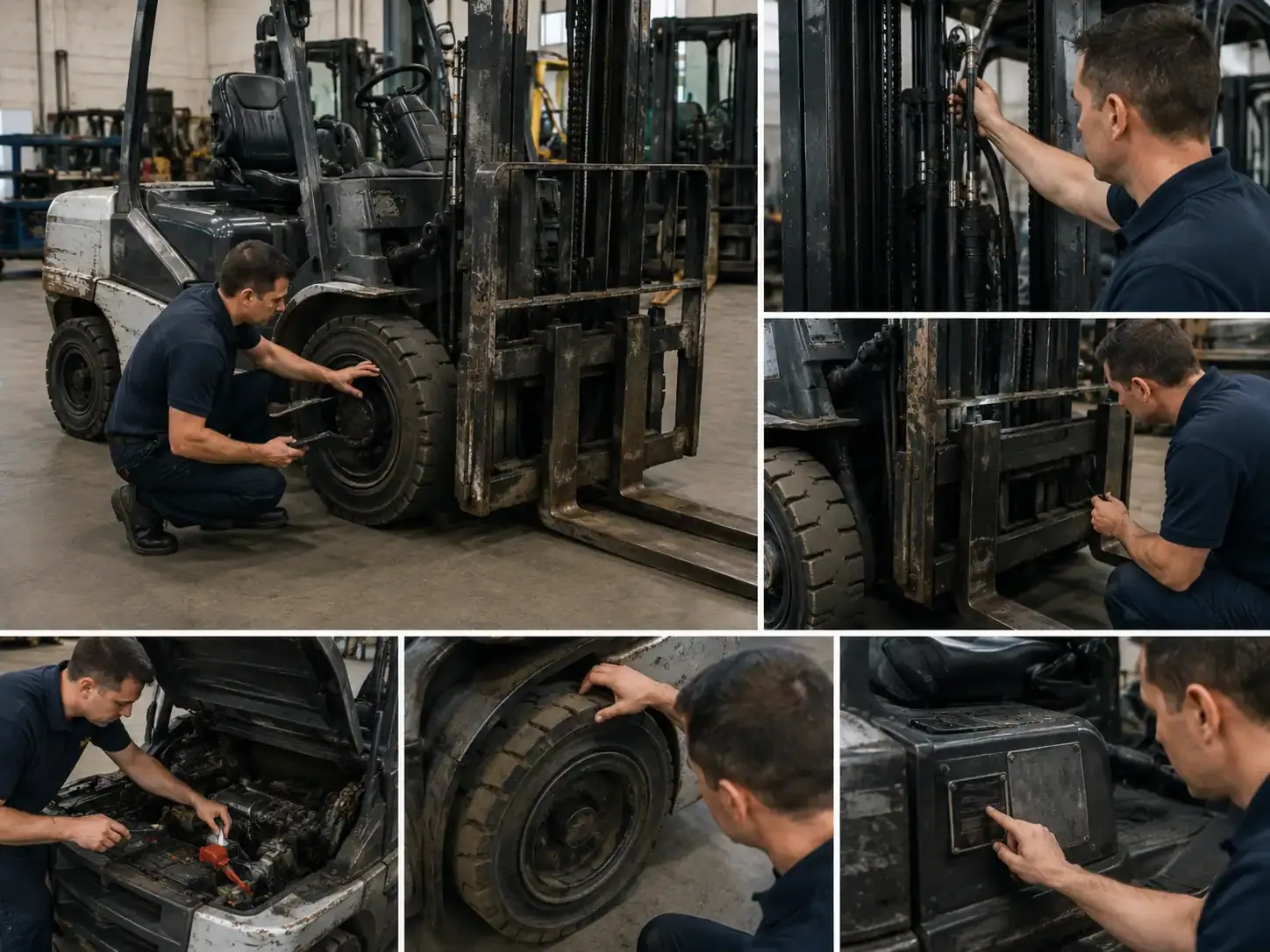
Choosing a forklift should begin with the load and workplace, not with a preferred model, fuel type or advertised price.
1. Identify the Heaviest Load
Record the heaviest load the forklift will handle during normal and occasional work.
Do not base the decision only on average pallet weight. The machine must safely manage the heaviest planned load without exceeding its rated capacity.
Also record:
- Load length.
- Load width.
- Pallet type.
- Weight distribution.
- Whether the load is stable or irregular.
- Any attachments required.
2. Calculate the Load Centre
Long loads move the centre of gravity farther from the mast and create greater forward leverage.
A forklift rated for 2,500 kg at one load centre may not safely lift 2,500 kg when the load is longer, positioned forward or handled with an attachment.
Ask the supplier to confirm capacity using the actual load dimensions.
3. Confirm Lift Height and Residual Capacity
Measure the highest beam, shelf, truck deck or stacking position the forklift must reach.
Then confirm the forklift’s residual capacity at that height. A model’s maximum lift height does not mean it can lift its full nominal capacity to that point.
Attachments, high masts and increased load centres can further reduce residual capacity.
4. Measure the Workplace
Record the dimensions of:
- Working aisles.
- Doorways.
- Loading bays.
- Container entrances.
- Racking clearances.
- Ceiling heights.
- Overhead pipes and sprinklers.
- Turning areas.
- Ramps and gradients.
Check the forklift’s overall width, turning radius, mast height when lowered and height with the overhead guard.
A forklift may have enough lifting capacity but still be unusable if it cannot turn into the aisle or pass through a doorway.
5. Match the Power Source to the Environment
Choose electric for enclosed operations, lower noise and no tailpipe emissions.
Choose LPG where fast refuelling and mixed indoor-outdoor use are important, subject to ventilation and emissions controls.
Choose diesel for demanding outdoor applications, longer travel and heavy work where exhaust fumes will not create an indoor hazard.
The broader process for how to choose the right forklift should also consider workload, site layout, operator requirements and expected ownership costs.
6. Select the Right Tyres
Counterbalance forklifts may be fitted with cushion, solid, pneumatic or solid-pneumatic tyres.
Cushion tyres: Best suited to smooth concrete and sealed indoor surfaces. They can support a compact chassis and smaller turning radius.
Pneumatic tyres: Provide improved cushioning and traction on suitable outdoor surfaces but may be vulnerable to punctures.
Solid-pneumatic tyres: Provide the profile and ground clearance of a pneumatic tyre without the same puncture risk, although they create a firmer ride.
Tyre terminology and availability vary by manufacturer. Confirm that the selected tyre is approved for the model and operating surface.
7. Choose Between Three and Four Wheels
Choose three wheels when indoor manoeuvrability and a tight turning circle are the priority.
Choose four wheels when the machine must handle heavier work, longer travel, loading docks or varied site conditions.
The correct choice still depends on the complete truck specification, not wheel count alone.
8. Review Shift Length and Energy Requirements
For an electric forklift, calculate whether one battery can cover the expected operating hours.
Consider:
- Charging time.
- Break periods.
- Opportunity charging.
- Spare batteries.
- Charger compatibility.
- Available electrical supply.
- Battery ventilation requirements.
- Future shift expansion.
For LPG and diesel machines, plan safe fuel storage, refuelling procedures and expected fuel consumption.
9. Compare New and Pre-Owned Forklifts
A new forklift may provide the latest controls, safety systems, energy technology and manufacturer warranty.
A pre-owned forklift may reduce the purchase cost and allow faster deployment, but its condition must be properly assessed.
For a used machine, check:
- Verified operating hours.
- Service history.
- Battery test results.
- Engine and transmission condition.
- Mast rollers and lift chains.
- Hydraulic leaks.
- Fork wear.
- Tyre condition.
- Capacity plate.
- Attachment approval.
- Evidence of previous damage.
- Warranty and after-sales support.
10. Calculate Total Ownership Cost
The cheapest forklift to purchase may not be the cheapest to operate.
Compare:
- Purchase price.
- Finance costs.
- Fuel or electricity.
- Battery replacement.
- Scheduled servicing.
- Tyres.
- Replacement parts.
- Expected downtime.
- Insurance.
- Operator training.
- Resale or trade-in value.
The best-value forklift is the machine that meets the application safely and remains dependable throughout the planned ownership period.
Counterbalance Forklift Brands Compared
Brand matters less than condition and specification on a pre-owned machine, but it does affect parts availability, resale and what you can expect from the drivetrain. These are the counterbalance brands we see most often on Australian sites.
| Brand | Where it sits | Typical use |
| Toyota | The most common counterbalance brand in Australia, and the largest part of our own stock | General warehousing, truck loading and container work across electric, LPG and diesel |
| Linde | European build, strong hydraulics, well regarded on longer shifts | Mid capacity warehouse and yard work |
| Crown | Better known for warehouse equipment, also builds gas counterbalance and stand-up models | Indoor operations running mixed equipment on one brand |
| Raymond | Electric specialist, including stand-up counterbalance and reach trucks | Warehouses running electric fleets in tighter aisles |
| Mitsubishi | Light to mid capacity across electric, diesel and LPG | Warehouses and workshops needing one versatile machine |
| Nissan | The DX series is still widely used and well understood by technicians | Budget entry into a reliable diesel or LPG counterbalance |
| Komatsu | Compact electric only in our stock, one to one and a half tonne | Indoor, cool room and light manufacturing work |
| Baoli | Budget line under the KION group, including heavy diesel classes | Lower purchase price where hours are moderate |
Two things are worth saying plainly. First, BT builds warehouse equipment rather than counterbalance forklifts, so if you are comparing a BT against a Toyota counterbalance you are comparing two different machine types. Second, a well maintained budget brand with low hours will outlast a neglected premium machine, so hours and service history should outrank the badge on any pre-owned purchase.
You can see current stock by brand across our Toyota forklifts, Linde forklifts, Crown forklifts, Raymond forklifts, Mitsubishi forklifts, Nissan forklifts, Komatsu forklifts and Baoli forklifts.
What Does a Counterbalance Forklift Cost?
Capacity, hours and fuel type drive the price of a pre-owned counterbalance forklift more than the brand does. The bands below reflect what pre-owned machines in our own yard have been listed at, and they give a realistic starting point rather than a quote.
| Budget | What it typically buys |
| Under $15,000 | Pre-owned 1.3 to 1.5 tonne machines in electric, LPG or diesel. Suits single pallet work and light warehousing |
| $15,000 to $20,000 | Pre-owned 1.8 to 2.5 tonne, including later model diesel and gas. The most common band for general warehouse work |
| $25,000 to $40,000 | 4 to 5 tonne machines, container masts, and newer models with lower hours |
| $45,000 and above | Specialist configurations, four wheel drive machines and new stock |
Purchase price is only part of the number. Servicing, tyres, fuel or charging, and battery replacement on an electric machine all sit on top of it, and on a machine running full shifts those running costs will exceed the purchase price over its working life.
Finance is available through Ausloans if you would rather spread the cost, and every pre-owned machine we sell carries a minimum six month warranty, extendable up to five years.
Counterbalance Forklift Licensing and Safety in Australia
A person operating a counterbalance forklift in Victoria generally needs an LF high risk work licence. WorkSafe Victoria lists LF as the licence class for forklift truck operation, while LO applies to order-picking forklift trucks where the operator’s controls elevate with the load carriage.
The process for obtaining a forklift licence in Australia involves completing approved training and passing the required assessment through the relevant state or territory system.
Holding a licence does not remove the employer’s responsibility to provide information, instruction, training and supervision. Operators must also be familiar with the specific forklift, attachments, workplace layout and hazards. WorkSafe Victoria provides separate guidance on operator competency and workplace training.
Safe counterbalance forklift operation should include:
- Completing a pre-start inspection.
- Wearing the fitted seatbelt or restraint.
- Checking the capacity plate before lifting.
- Keeping loads stable and centred.
- Travelling with the load lowered.
- Avoiding sudden braking and sharp turns.
- Maintaining safe speeds.
- Separating forklifts from pedestrians.
- Following site traffic routes.
- Using only approved attachments.
- Reporting faults immediately.
- Never carrying passengers unless an approved seat is fitted.
WorkSafe Victoria also recommends workplace traffic management measures that separate pedestrians from forklift travel paths.
Confirm the current requirements with Safe Work Australia or your state or territory regulator, since licence classes and application processes are updated periodically.
Buying a Counterbalance Forklift from Buy A Fork
Buy A Fork supplies brand-new and pre-owned counterbalance forklifts for warehouses, logistics businesses, manufacturers, retailers, trades and industrial operations across Melbourne and Victoria.
Available stock can include Toyota, Linde, Crown, Raymond, BT, Nissan, Mitsubishi, Baoli and Komatsu forklifts, although brands and individual models change as machines are sold or added.
Current advertised purchase benefits include:
- A free pallet jack valued at $499.
- Free local delivery within 10 km.
- A free six-month basic service, subject to terms and conditions.
- Minimum warranty coverage shown on eligible listings.
- Flexible finance options.
- Trade-ins.
The exact inclusions, warranty period, delivery area and eligibility should be confirmed for the selected forklift before purchase. Buy A Fork’s current category listings display the free pallet jack, local delivery, service and warranty inclusions, as well as finance and trade-in availability.
When requesting a recommendation, provide the team with:
- Maximum load weight.
- Load dimensions.
- Required lift height.
- Minimum aisle width.
- Door and container clearances.
- Indoor or outdoor use.
- Operating surface.
- Daily operating hours.
- Preferred power source.
- Available budget.
These details make it easier to identify a forklift that fits the workplace rather than selecting a machine based only on its advertised capacity.
Choosing a Counterbalance Forklift That Fits the Job
A counterbalance forklift is often the best all-round option for businesses that need to unload vehicles, transport pallets and stack goods with one machine.
However, the familiar design does not make every model interchangeable. Load weight, load centre, residual capacity, aisle width, lift height, tyres, power source and operating surface must all be checked before buying.
Start with the heaviest load and the most demanding part of the workplace. Once those requirements are clear, you can compare suitable electric, LPG and diesel models with greater confidence and avoid paying for a forklift that cannot safely or efficiently perform the work.
Frequently Asked Questions
1. What Is a Counterbalance Forklift Used For?
A counterbalance forklift is used to lift, transport and stack pallets or supported loads. Common applications include truck loading, warehouse handling, manufacturing, outdoor yard work and moving heavy industrial materials.
2. What Is the Difference Between a Counterbalance Forklift and a Reach Truck?
A counterbalance forklift carries the load in front of the truck and is suited to loading, transport and mixed indoor-outdoor work. A reach truck uses a reaching mast or fork mechanism and is designed mainly for high racking in narrow indoor warehouse aisles.
3. What Are the Three Main Types of Counterbalance Forklift?
The three main types by power source are electric, LPG or gas, and diesel. Electric models are commonly used indoors, LPG models suit mixed environments, and diesel models are generally used for outdoor or heavy-duty work.
4. How Much Can a Counterbalance Forklift Lift?
Counterbalance forklifts range from compact models lifting approximately one tonne to heavy industrial machines lifting several tonnes. Safe capacity depends on the model, load centre, lift height, mast, attachments and load position.
5. Is a Three-Wheel or Four-Wheel Forklift Better?
A three-wheel forklift is usually better for tight indoor spaces because it has a smaller turning circle. A four-wheel forklift is generally preferred for heavier loads, longer travel and mixed operating conditions.
6. Do You Need a Licence to Operate a Counterbalance Forklift in Australia?
Yes. A counterbalance forklift operator generally requires an LF high risk work licence. Licensing is administered by the relevant regulator in each state or territory, and employers must also provide site-specific training and supervision.
7. Are Counterbalance Forklifts Good for Small Businesses?
Yes. A counterbalance forklift can be a practical choice for a small business because one machine can load trucks, transport pallets and stack goods. The best value usually comes from selecting a forklift that matches the actual load, site and operating hours rather than buying more capacity than the business needs.
8. Can a Counterbalance Forklift Be Used Outdoors?
Yes, provided the forklift, tyres, ground clearance and power source are suitable for the surface and weather conditions. Pneumatic-tyre LPG and diesel models are commonly used outdoors, while some electric four-wheel models can also operate on suitable sealed outdoor surfaces.
9. What does counterbalance mean on a forklift?
It refers to the fixed weight built into the rear of the machine, which offsets the weight of the load on the forks. The front axle acts as the pivot point, and the counterweight is what stops the forklift tipping forward when a load is lifted.
10. Why are seat belts fitted to counterbalance forklifts?
Because the most dangerous thing an operator can do in a tip-over is try to jump clear. The overhead guard and the operator restraint are designed to keep the operator inside the protective zone, where the machine structure shields them. Regulators treat restraint use as a standard control on counterbalance machines.
11. What is a pedestrian counterbalance forklift?
It is a walk-behind counterbalance machine where the operator controls the truck from a tiller handle rather than a seat. It suits sites with limited space and lower throughput, sitting between a powered stacker and a ride-on counterbalance in capability.
12. How high can a counterbalance forklift lift?
Lift height depends entirely on the mast fitted, and the safe capacity reduces as the forks go higher. The maximum lift height and the capacity available at that height are both stated on the machine data plate, which is the only figure worth relying on.