
Top Affordable Electric Stackers in Australia
· Updated
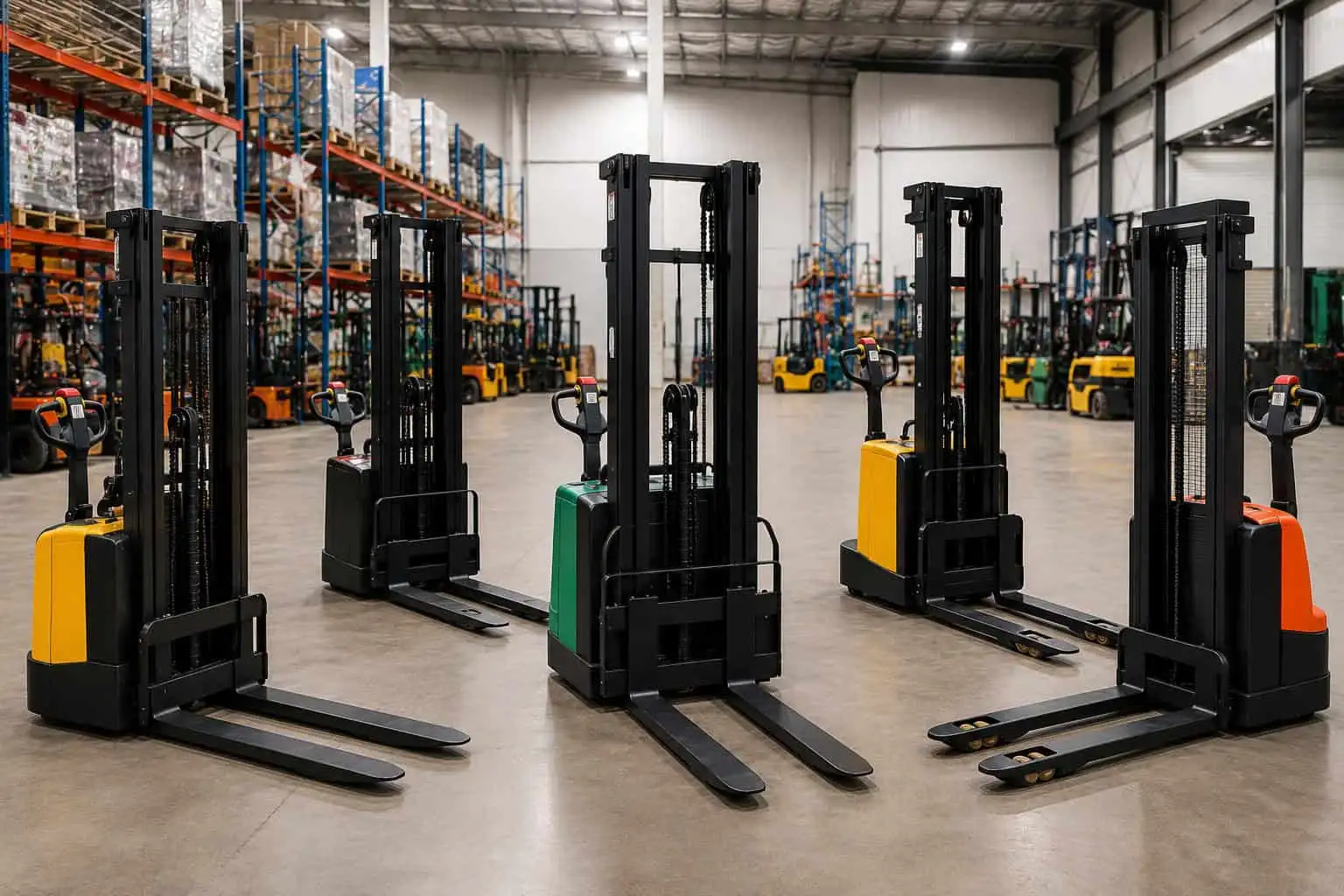
An affordable electric stacker can give a small warehouse, retail stockroom or workshop powered pallet lifting without the cost and space requirements of a full-sized forklift. The best options are usually compact walk-behind machines matched to the pallet weight, required lift height and available aisle width.
Prices vary significantly according to capacity, mast height, battery type, leg configuration and whether the stacker is new or used. A lower purchase price only represents good value when the machine can safely enter the pallets, reach the racking and complete the expected workload.
This guide compares the main affordable electric stacker types available in Australia and explains how to choose a reliable model for your operation.
The Best Affordable Electric Stackers in Australia
For most small businesses, the best affordable electric stacker is a pedestrian-operated model with powered travel and lift, enough capacity for the heaviest pallet and a mast that reaches the required storage height.
The strongest options depend on the application rather than one model being best for every buyer.
| Electric Stacker Type | Common Capacity Class | Common Lift Requirement | Best For | Typical Buying Position |
|---|---|---|---|---|
| Compact walkie stacker | Around 1.0 to 1.2 tonnes | Low to medium racking | Retail stockrooms and light warehouses | Entry-level fully electric option |
| Straddle-leg stacker | Around 1.0 to 1.5 tonnes | Low to medium racking | Open-bottom pallets and adjustable pallet widths | Practical general warehouse option |
| Reach-leg stacker | Around 1.0 to 1.5 tonnes | Medium racking | Warehouses handling closed-bottom Australian pallets | More specialised but versatile |
| Counterbalanced walkie stacker | Around 1.0 to 1.5 tonnes | Low to medium racking | Pallets or loads that cannot accept support legs underneath | Higher-cost specialised option |
| Semi-electric stacker | Around 1.0 to 1.5 tonnes | Low-volume stacking | Small businesses with occasional lifts | Lower purchase price with manual travel |
| Used branded electric stacker | Varies by model | Varies by mast | Buyers prioritising established brands and value | Requires battery and condition inspection |
| Lithium-ion walkie stacker | Around 1.0 to 1.5 tonnes | Low to medium racking | Regular use and opportunity charging | Higher initial cost, lower daily battery maintenance |
These figures are broad equipment classes rather than specifications for individual machines. Buyers should confirm the capacity plate, maximum lift height and residual capacity of the exact stacker being considered.
Current stock can be reviewed through Buy A Fork’s electric stackers for sale category. Availability, prices and specifications can change as equipment is sold or added.
Best for Light Stockroom Work
A compact pedestrian stacker is often the most affordable fully powered option for retail storage areas, small warehouses and light manufacturing.
It may suit businesses that:
- Handle relatively light pallets
- Complete short travel distances
- Use low or medium-height racking
- Have narrow aisles
- Need more lifting ability than a pallet jack
- Do not require a ride-on forklift
Compact dimensions can improve manoeuvrability, but the buyer must still check whether the legs and forks fit the pallets used onsite.
Best for Australian Pallets
Australian pallets often have enclosed bottom boards that can interfere with standard stacker legs. A reach-leg or counterbalanced design may be required when support legs cannot travel beneath the pallet.
This is one of the most important compatibility checks. A stacker can have sufficient capacity and lift height but still be unusable because its legs cannot enter the pallet correctly.
Best for Regular Daily Use
A fully electric stacker with powered travel and lift is usually more suitable than a semi-electric model for regular daily work.
Powered travel can reduce operator effort when:
- Pallets are moved repeatedly
- Travel distances are longer
- Loads are close to the rated capacity
- The floor has minor gradients
- Productivity matters throughout the shift
Battery capacity, charger compatibility and local service support become more important as usage increases.
Best for Buyers on a Tight Budget
A semi-electric stacker or professionally prepared used electric stacker may provide the lowest practical entry cost.
Semi-electric machines reduce lifting effort but still require the operator to push or pull the stacker. They are more suitable for short distances, lighter loads and occasional use than high-throughput warehouse work.
A used stacker can provide fully powered travel at a lower purchase price, but battery condition and service history must be assessed carefully.
What Is an Electric Stacker?
An electric stacker is a compact material-handling machine designed to move, lift and stack palletised loads. Most models are operated by a person walking behind the machine, which is why they are also commonly called walkie stackers or pedestrian stackers.
A fully electric stacker uses battery power for both travel and lifting. A semi-electric model uses powered lifting but must be moved manually.
The main stacker configurations include:
- Standard-leg stacker: Fixed support legs extend in front of the machine beneath suitable pallets.
- Straddle stacker: Wider or adjustable legs sit outside the pallet.
- Reach stacker: The mast or fork carriage extends towards the pallet while the support legs remain outside or beneath it.
- Counterbalanced stacker: A rear counterweight balances the load, removing the need for support legs around the pallet.
- Platform stacker: A folding or fixed operator platform allows faster movement across longer warehouse routes.
“Electric stacker” and “walkie stacker” often refer to the same equipment class. The term walkie describes how the operator controls the machine, while electric describes the powered drive and lifting system.
Buyers needing a detailed breakdown of configurations can compare walkie stacker types and lift heights.
How Much Does an Electric Stacker Cost?
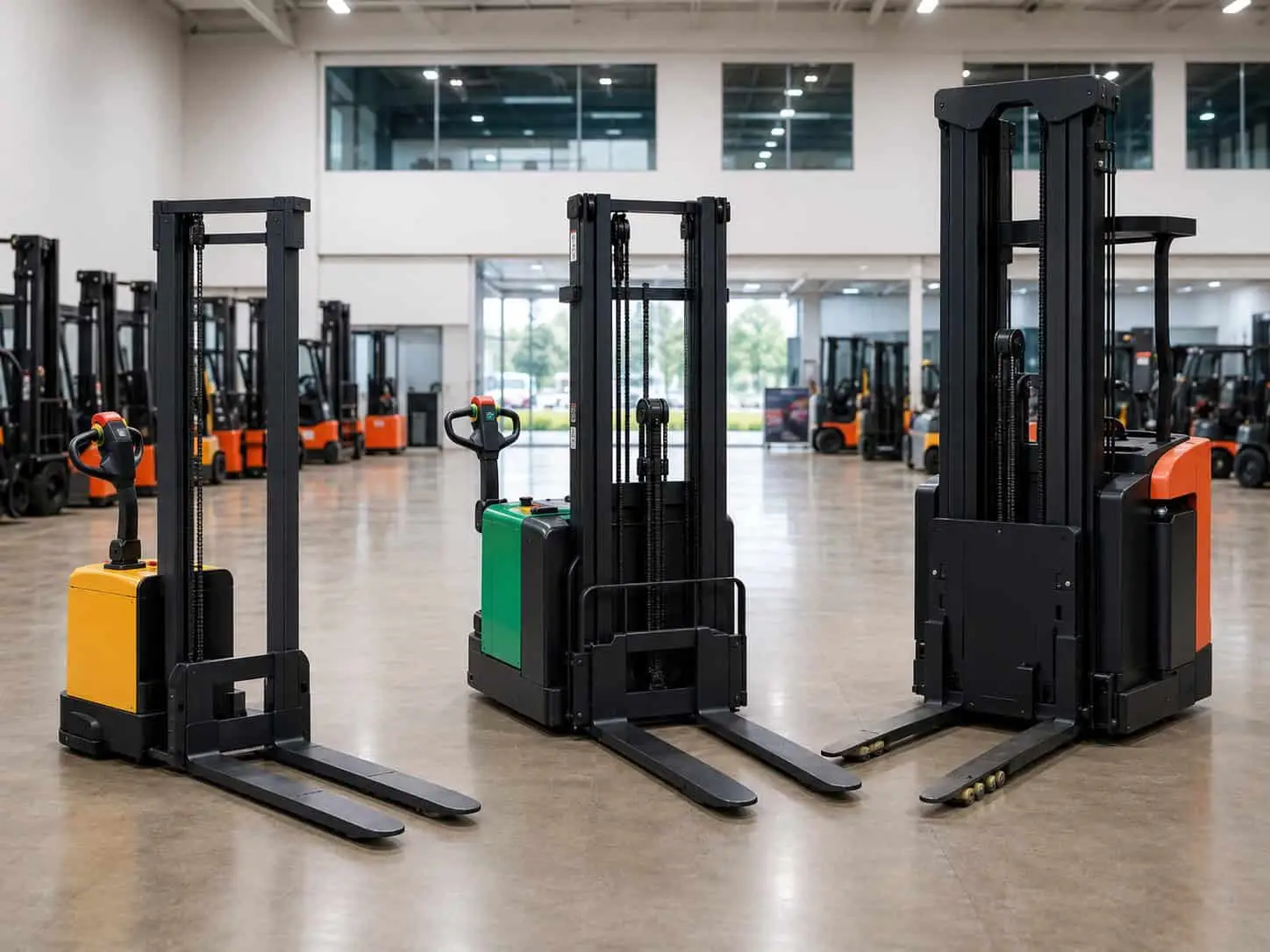
Electric stacker prices in Australia vary from relatively low-cost semi-electric machines to higher-priced lithium-ion, reach-leg and ride-on models.
Current Buy A Fork listings show that professionally prepared used stackers can begin in the low-thousands, while specialised equipment may be listed as price on application. Exact pricing depends on current inventory and machine condition.
| Price Factor | Lower-Cost Position | Higher-Cost Position |
|---|---|---|
| Drive system | Manual travel with electric lift | Fully powered travel and lift |
| Capacity | Light-duty capacity | Higher rated capacity |
| Lift height | Low mast | High or specialised mast |
| Leg design | Basic fixed-leg design | Reach, straddle or counterbalanced design |
| Battery | Older lead-acid or basic sealed battery | Higher-capacity lithium-ion system |
| Operator position | Walk-behind | Ride-on platform |
| Condition | Used with visible wear | New or professionally refurbished |
| Brand | Lesser-known manufacturer | Established warehouse-equipment brand |
| Warranty | Limited or private-sale coverage | Dealer or manufacturer support |
| Attachments | Standard forks | Adjustable forks or specialised attachments |
What Drives the Purchase Price?
- Capacity: A higher-capacity frame, mast, motor and battery can increase the price.
- Lift height: Taller masts generally require heavier structures and additional mast stages.
- Battery type: Lithium-ion stackers usually cost more initially than comparable lead-acid machines.
- Leg configuration: Reach and counterbalanced designs are more specialised than fixed-leg models.
- Powered travel: Fully electric machines cost more than manual or semi-electric stackers but reduce operator effort.
- New or used condition: Used machines can reduce the initial cost, although battery or repair expenses must be included.
- Brand and support: Equipment from an established manufacturer may carry a higher price but offer stronger parts and service access.
- Warranty and preparation: Dealer-inspected equipment may cost more than an untested private-sale machine but can reduce purchase risk.
Include the Full Cost of Ownership
The purchase price is only part of the cost. Buyers should also consider:
- Charger installation
- Battery replacement
- Scheduled servicing
- Load-wheel replacement
- Drive-wheel replacement
- Hydraulic repairs
- Mast and chain servicing
- Transport and delivery
- Operator training
- Downtime
- Parts availability
- End-of-life battery handling
An inexpensive machine that needs an immediate battery replacement may cost more than a better-prepared stacker with a higher advertised price.
Top Affordable Electric Stackers Reviewed
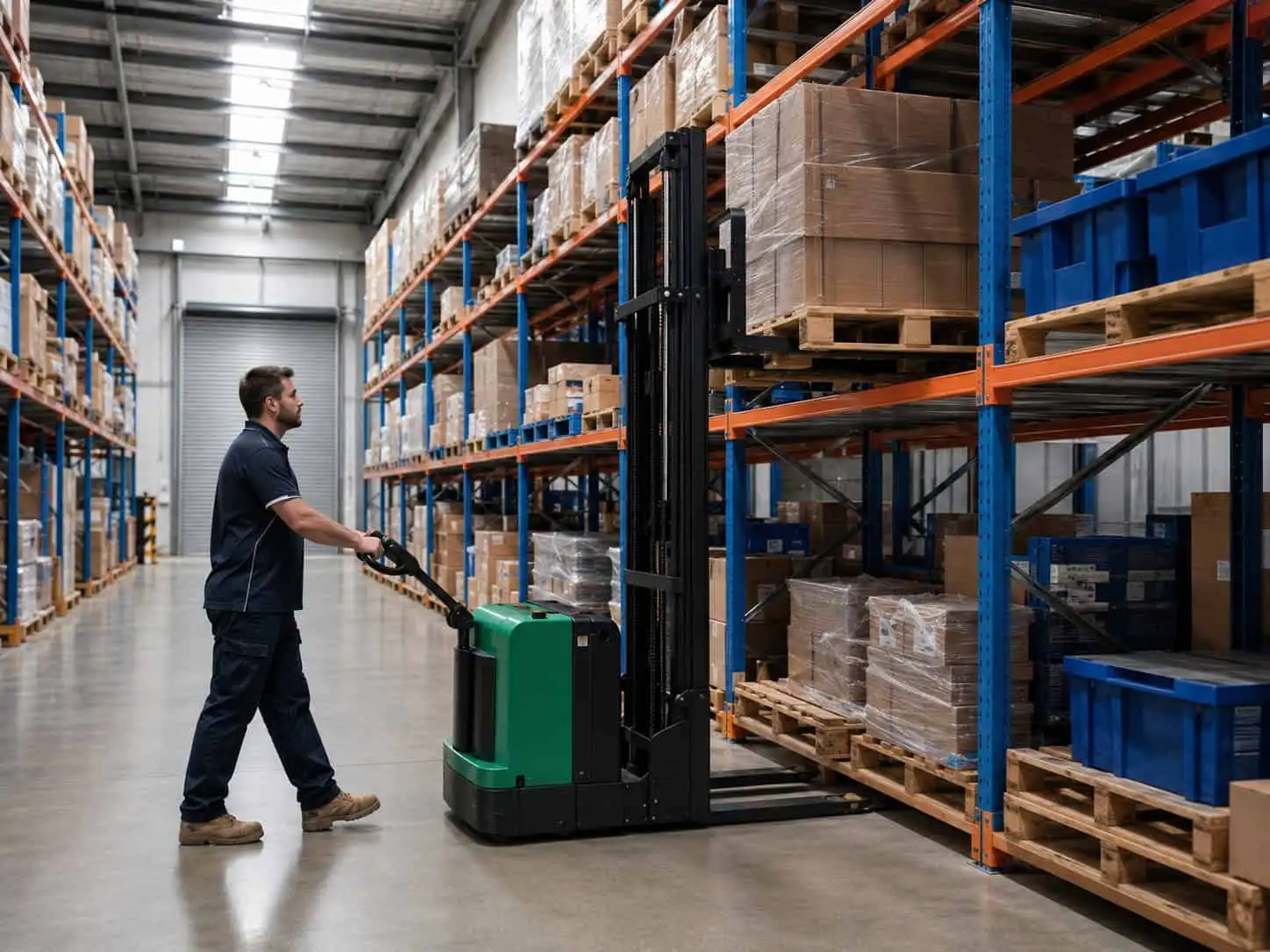
The following categories represent practical options for Australian budget buyers. Exact models and specifications should be confirmed against current stock rather than assumed from a model family.
Compact Fully Electric Walkie Stacker
A compact fully electric walkie stacker is the best all-round choice for many small warehouses. Powered lift and travel reduce manual effort while the pedestrian design keeps the machine smaller than a ride-on forklift.
Best for:
- Small warehouses
- Retail stockrooms
- Light manufacturing
- Short travel distances
- Regular pallet stacking
- Narrow operating areas
Advantages:
- Powered travel and lifting
- Compact turning footprint
- Lower purchase cost than many forklifts
- No tailpipe emissions during operation
- Straightforward pedestrian controls
Limitations:
- Lower travel speed than ride-on equipment
- Limited suitability for long distances
- Pallet compatibility depends on leg design
- Capacity may reduce at maximum lift height
- Uneven outdoor surfaces can restrict use
A compact stacker offers good value when most travel is short and the load does not exceed its capacity at the required height.
BT Electric Walkie Stacker
BT pedestrian stackers are widely used in warehouse and retail applications. The brand is associated with Toyota Material Handling and offers compact equipment for light and medium pallet movement.
Buy A Fork’s current electric stacker category includes a BT SWE120S listing, although buyers should verify its full mast, capacity and battery specifications before purchase.
Best for:
- Buyers wanting an established warehouse-equipment brand
- Indoor pallet movement
- Retail and distribution stockrooms
- Businesses with access to service support
Advantages:
- Recognised manufacturer
- Compact warehouse design
- Familiar pedestrian controls
- Suitable for short-distance pallet handling
Considerations:
- Used battery condition must be assessed
- Exact mast and leg configuration may differ
- Some models are better suited to specific pallet styles
- Parts availability should be confirmed by model and year
Linde Electric Walkie Stacker
Linde produces pedestrian stackers for warehouse handling, including compact machines for pallet movement and stacking.
The current Buy A Fork category includes a Linde L10-L12 AS Series listing with a stated 1,000 kg capacity and 4,000 mm lift height. Buyers should verify the individual machine’s capacity plate and configuration because attachments, mast and load centre can affect usable capacity.
Best for:
- Warehouses needing greater lift height
- Buyers looking for established European equipment
- Regular indoor pallet handling
- Operations with suitable local service access
Advantages:
- Recognised material-handling brand
- Purpose-built warehouse configuration
- Compact pedestrian operation
- Suitable for pallet stacking and short travel
Considerations:
- Specialised components may increase repair costs
- Battery condition influences value
- Pallet entry must be checked
- Service history remains important
Baoli Electric Walkie Reach Stacker
Baoli electric stackers can provide a value-focused option for small and medium warehouses. Reach-style configurations may help businesses handle pallets that cannot accept fixed support legs underneath.
Best for:
- Australian pallets
- Small warehouses with racking
- Budget-conscious businesses
- Buyers needing reach capability
- Operations with narrow aisles
Advantages:
- Practical reach-leg configuration
- Compact walk-behind operation
- Potentially lower purchase cost than premium brands
- Suitable for indoor warehouse tasks
Considerations:
- Confirm capacity and lift height for the exact machine
- Check local parts and service access
- Inspect the battery and charger
- Confirm aisle and turning requirements
Buyers considering this category can review Baoli electric stackers for small warehouses.
Used Branded Electric Stacker
A used stacker from BT, Linde, Crown, Raymond, Toyota or another established brand may offer stronger specifications for the budget than a new entry-level machine.
Best for:
- Buyers prioritising value
- Businesses with a fixed equipment budget
- Operations that can inspect and test equipment
- Buyers with access to servicing
Advantages:
- Lower initial purchase price
- Established industrial construction
- Potentially higher lift or capacity for the budget
- Reduced initial depreciation
Considerations:
- Battery age
- Charger compatibility
- Mast wear
- Load-wheel condition
- Service history
- Parts availability
- Remaining warranty
Used equipment should be judged by condition rather than age or brand alone.
Lithium-Ion Electric Stacker
Lithium-ion stackers suit businesses that use equipment regularly and need flexible charging.
Best for:
- Multi-shift work
- Opportunity charging
- Operations without battery-watering resources
- Businesses wanting reduced daily battery maintenance
Advantages:
- Faster charging capability
- Opportunity charging
- No routine battery watering
- Stable performance through the charge cycle
- Compact battery packaging on many models
Considerations:
- Higher purchase price
- Charger compatibility
- Battery-management-system repairs
- End-of-life recycling arrangements
- Replacement battery cost
A lithium stacker may be affordable over its complete ownership life even when its initial price is higher.
Electric vs Semi-Electric vs Manual Stackers
The correct power level depends on workload, travel distance and budget.
| Feature | Fully Electric Stacker | Semi-Electric Stacker | Manual Stacker |
|---|---|---|---|
| Lifting | Electric | Electric | Manual hydraulic |
| Travel | Electric | Manual | Manual |
| Operator effort | Lowest | Moderate | Highest |
| Purchase price | Highest | Mid-range | Lowest |
| Productivity | Best for regular use | Suitable for moderate use | Suitable for occasional use |
| Travel distance | Short to moderate | Short | Very short |
| Load frequency | Regular | Occasional to moderate | Occasional |
| Floor requirements | Smooth and level preferred | Smooth and level preferred | Smooth and level essential |
| Maintenance | Battery, drive and hydraulic systems | Battery and hydraulic systems | Mainly hydraulic and mechanical systems |
| Best application | Daily warehouse operations | Budget-conscious light stacking | Infrequent low-volume work |
Choose Fully Electric When
- The stacker will be used daily
- Pallets must travel more than very short distances
- Operator fatigue is a concern
- Productivity matters
- Loads are regularly close to the rated capacity
- The business has charging facilities
Choose Semi-Electric When
- The budget is limited
- Travel distances are short
- Loads are stacked occasionally
- The floor is smooth and level
- Electric lifting provides enough labour reduction
Choose Manual When
- Usage is infrequent
- Loads are light
- Travel distances are minimal
- The operation cannot justify powered equipment
- Staff can safely move the equipment within site procedures
A manual stacker should not be selected for regular heavy work simply because it has the lowest purchase price. Labour effort and productivity are part of the total cost.
Lithium vs Lead-Acid Batteries for Stackers
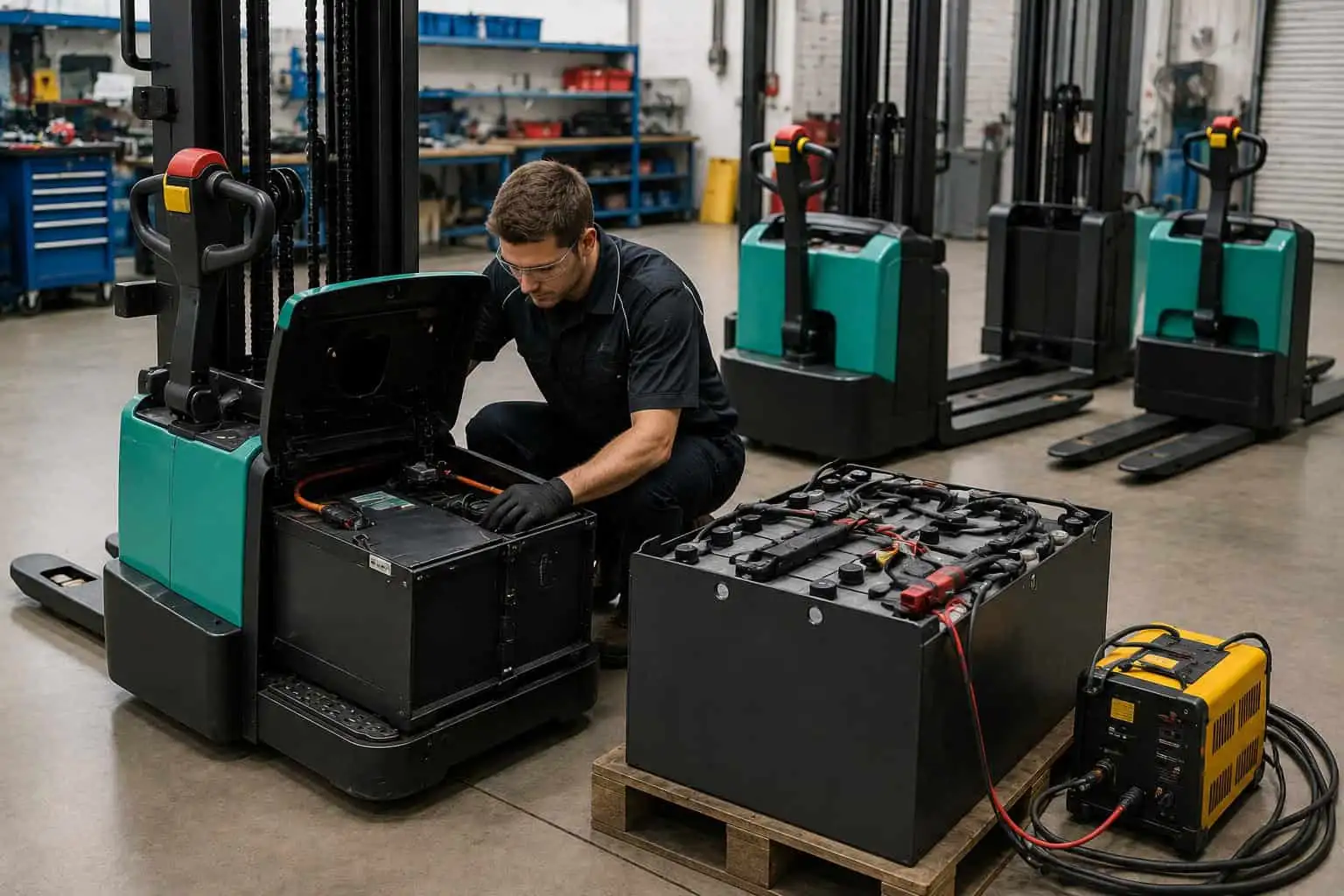
Lithium-ion and lead-acid batteries can both power reliable electric stackers. The best choice depends on shift patterns, charging habits, maintenance capacity and purchase budget.
| Factor | Lithium-Ion | Lead-Acid |
|---|---|---|
| Initial price | Usually higher | Usually lower |
| Charging speed | Generally faster | Generally slower |
| Opportunity charging | Commonly supported | Usually less suitable |
| Watering | Not required | Required on flooded batteries |
| Daily maintenance | Lower | Higher |
| Charging efficiency | Generally higher | Generally lower |
| Weight | Often lighter | Heavier |
| Replacement cost | Usually higher | Usually lower |
| Recycling pathway | Requires suitable lithium processing | Established lead recycling is widely available |
| Best fit | Regular use and flexible charging | Predictable shifts and lower initial budgets |
Lithium-Ion May Be Worth It When
- The stacker is used throughout the day
- Short charging opportunities are available
- The business cannot manage battery watering
- Downtime must be limited
- The equipment will be retained long term
Lead-Acid May Be Better When
- Initial purchase price is the main constraint
- The stacker works a predictable single shift
- A proper charging area is available
- Staff can complete battery maintenance
- A suitable used battery has been tested
The broader differences are covered in Buy A Fork’s guide to lithium vs lead-acid batteries.
New vs Used Electric Stackers
Buying new provides predictable condition and manufacturer support. Buying used can provide a better-known brand or higher specification for the same budget.
Benefits of Buying New
- No previous operating wear
- Manufacturer warranty
- Current battery technology
- Known service starting point
- New charger supplied with compatible equipment
- Easier specification selection
- Potential access to current safety features
Benefits of Buying Used
- Lower purchase price
- Reduced initial depreciation
- Established brands may become affordable
- Higher lift or powered-travel capability may fit the budget
- Equipment may be available immediately
- Dealer-prepared machines may include service support
Used-Stacker Checks
Inspect the:
- Capacity plate
- Mast channels
- Lift chains
- Hydraulic cylinder
- Forks
- Load wheels
- Drive wheel
- Tiller controls
- Emergency reverse button
- Horn
- Brakes
- Battery
- Charger
- Electrical connectors
- Hour meter
- Service records
Test the stacker under a suitable load. A machine may move normally without weight but develop mast, hydraulic or battery problems during actual lifting.
The full ownership decision is covered in used vs new electric stackers.
How to Choose an Affordable Electric Stacker
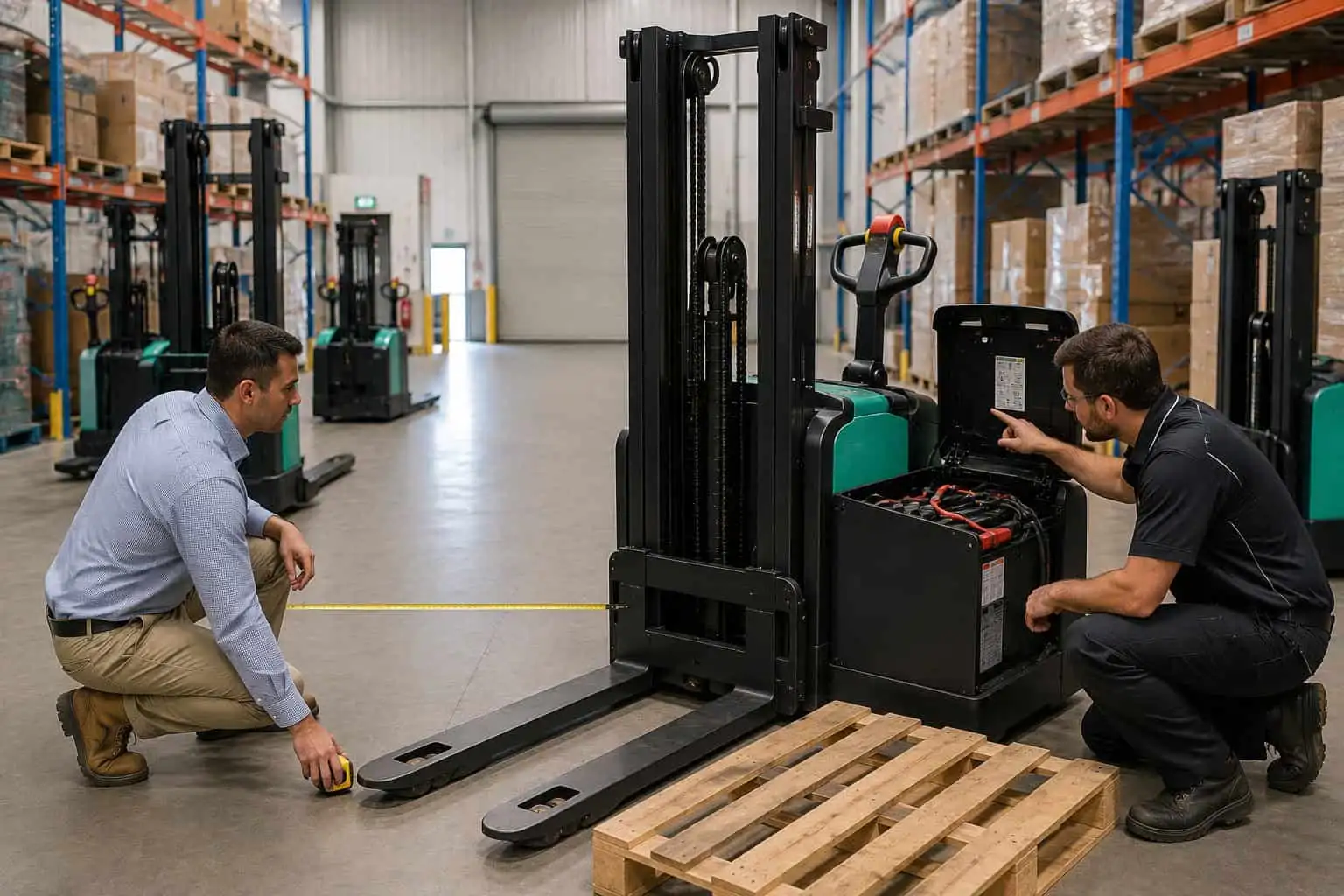
An affordable electric stacker must match the pallet, racking, floor and daily workload. Use the following checks before comparing prices.
1. Confirm the Maximum Load Weight
Identify the heaviest pallet the stacker will handle, not the average load.
Include:
- Product weight
- Pallet weight
- Packaging
- Containers
- Attachments
- Any uneven load distribution
Never assume a stacker can lift its full nominal capacity to every height. Check the rated capacity at the required lift height and load centre.
2. Measure the Required Lift Height
Measure from the floor to the highest racking level where the pallet must be placed.
Allow for:
- Pallet thickness
- Fork clearance
- Load height
- Racking beam position
- Safe placement clearance
Also measure doorways and overhead obstructions to confirm the lowered mast can move through the site.
3. Check Pallet and Leg Compatibility
Record the pallets used onsite.
Check whether they are:
- Open-bottom
- Closed-bottom
- Australian standard pallets
- Euro pallets
- Custom pallets
- Skids
- Stillages
The stacker’s support legs and forks must enter the pallet without contacting bottom boards or stock.
4. Measure the Aisles
Measure:
- Clear aisle width
- Turning areas
- Racking depth
- Pedestrian routes
- Dock approaches
- Doorways
- Storage obstructions
Use the manufacturer’s turning radius and right-angle stacking dimensions for the exact model.
5. Assess the Floor and Ramps
Most pedestrian stackers are intended for smooth, level warehouse floors.
Check for:
- Cracks
- Expansion joints
- Drainage channels
- Slopes
- Ramps
- Wet areas
- Uneven outdoor surfaces
- Dock plates
Do not assume a compact stacker can safely operate on a ramp. Confirm the model’s gradeability and site procedures.
6. Define the Duty Cycle
Estimate:
- Operating hours per day
- Number of pallet movements
- Average travel distance
- Number of lifts
- Maximum lift height
- Shift pattern
- Charging opportunities
- Peak seasonal workload
A semi-electric model may suit occasional use but slow a business that handles pallets continuously.
7. Choose the Battery
Compare:
- Battery chemistry
- Rated capacity
- Expected runtime
- Charging time
- Charger supply
- Electrical connection
- Watering requirements
- Replacement cost
- Battery warranty
- Recycling pathway
Request a battery condition report when buying used.
8. Check Safety Controls
Confirm that the stacker has functioning:
- Emergency stop
- Emergency reverse button
- Horn
- Braking system
- Tiller controls
- Load backrest where required
- Guards
- Warning devices
- Capacity plate
Pedestrian-operated plant still creates risks for operators and nearby workers. Businesses should separate people from moving equipment, maintain clear travel routes and provide instruction for the specific machine. WorkSafe Victoria continues to emphasise traffic management, pedestrian separation, training and regular plant inspection where mobile equipment is used.
9. Confirm Training and Licensing Requirements
A pedestrian walkie stacker is not automatically treated the same as a ride-on forklift for licensing purposes. Requirements depend on the equipment’s design and how it is operated.
The employer must still ensure the operator receives suitable information, instruction, training and supervision. Confirm the exact Victorian requirements for the selected machine before it enters service, particularly when it includes a ride-on platform or operator-elevating function.
10. Review Warranty and Service Support
Ask:
- What the warranty covers
- How long coverage lasts
- Whether labour is included
- Whether transport is included
- Who provides servicing
- Whether parts are held locally
- What happens during a breakdown
- Whether battery coverage differs from machine coverage
Buy A Fork’s current stacker listings advertise a minimum six-month warranty, six-month service and local delivery offers, subject to the applicable terms and the selected machine. Confirm all inclusions in writing before purchasing.
11. Compare the Stacker With Other Equipment
An electric stacker is appropriate when pallets need to be lifted into racking.
Choose an electric pallet jack instead when:
- Pallets remain at floor level
- The main task is horizontal transport
- Storage height is not required
- Lower equipment cost is the priority
Choose a reach truck instead when:
- Lift heights are substantially greater
- Pallets move frequently
- Travel distances are longer
- The warehouse has high racking
- Productivity justifies ride-on equipment
The practical differences are explained in electric pallet jack vs walkie stacker.
Businesses sourcing equipment locally can also compare pallet stackers for sale in Victoria.
Frequently Asked Questions
1. How Much Does an Electric Stacker Cost in Australia?
Electric stacker prices range from low-cost manual and semi-electric machines to higher-priced fully powered, lithium-ion and reach configurations. Used pedestrian stackers may begin in the low-thousands, while newer or specialised models cost more. Capacity, lift height, battery, leg design and warranty have the greatest influence on price.
2. What Is the Difference Between an Electric Stacker and a Walkie Stacker?
An electric stacker is a battery-powered machine used to move and lift pallets. A walkie stacker is normally an electric or semi-electric stacker controlled by an operator walking behind it. The terms often describe the same equipment class, although some electric stackers include ride-on platforms.
3. How Much Can an Electric Stacker Lift?
Compact electric stackers commonly handle loads around 1.0 to 1.5 tonnes, although capacities vary. The maximum usable load may reduce as lift height or load centre increases. Always check the capacity plate for the exact model, mast and attachment configuration.
4. Do You Need a Licence to Operate an Electric Stacker?
Licensing depends on the machine’s design and operation. A basic pedestrian-operated walkie stacker may not require the same high-risk work licence as a ride-on forklift, but operators still need appropriate workplace training and supervision. Confirm the requirements for the exact equipment with WorkSafe Victoria before use.
5. Is a Lithium Electric Stacker Worth It?
A lithium stacker can be worth the additional cost when the machine is used regularly, opportunity charging is needed or the business wants to avoid lead-acid battery watering. For light, predictable use, a properly maintained lead-acid machine may provide better upfront value.
6. Electric Stacker vs Pallet Jack: Which Do I Need?
Choose an electric pallet jack when pallets only need to move across the floor. Choose an electric stacker when pallets must be raised onto racking, loaded onto elevated surfaces or positioned above ground level. A stacker costs more because it includes a mast and lifting system.
7. Can an Electric Stacker Replace a Forklift?
An electric stacker can replace a forklift for some light indoor pallet tasks. It is suitable for short travel distances, moderate lift heights and compact warehouses. It is not a direct replacement for a forklift when loads are heavier, travel is long, surfaces are uneven or high productivity is required.
8. Can I Finance an Electric Stacker?
Equipment finance may allow a business to purchase a better-suited stacker while preserving working capital. Compare the financed total cost, interest, fees and repayment term against buying a lower-priced machine outright. Available options can be reviewed through Buy A Fork’s forklift and equipment finance page.
Conclusion
The best affordable electric stacker is the machine that fits the pallets, reaches the racking and completes the required duty cycle without unnecessary complexity. Compact walkie stackers suit many small warehouses, while reach, straddle or counterbalanced models may be required for Australian pallets and specialised loads.
Compare capacity, lift height, battery condition, aisle requirements and service support before focusing on price. A properly matched fully electric or professionally prepared used stacker can reduce manual handling and improve pallet movement without the expense or space demands of a full-sized forklift.