
Walkie Stackers: Types, Lift Heights and How to Choose the Right One
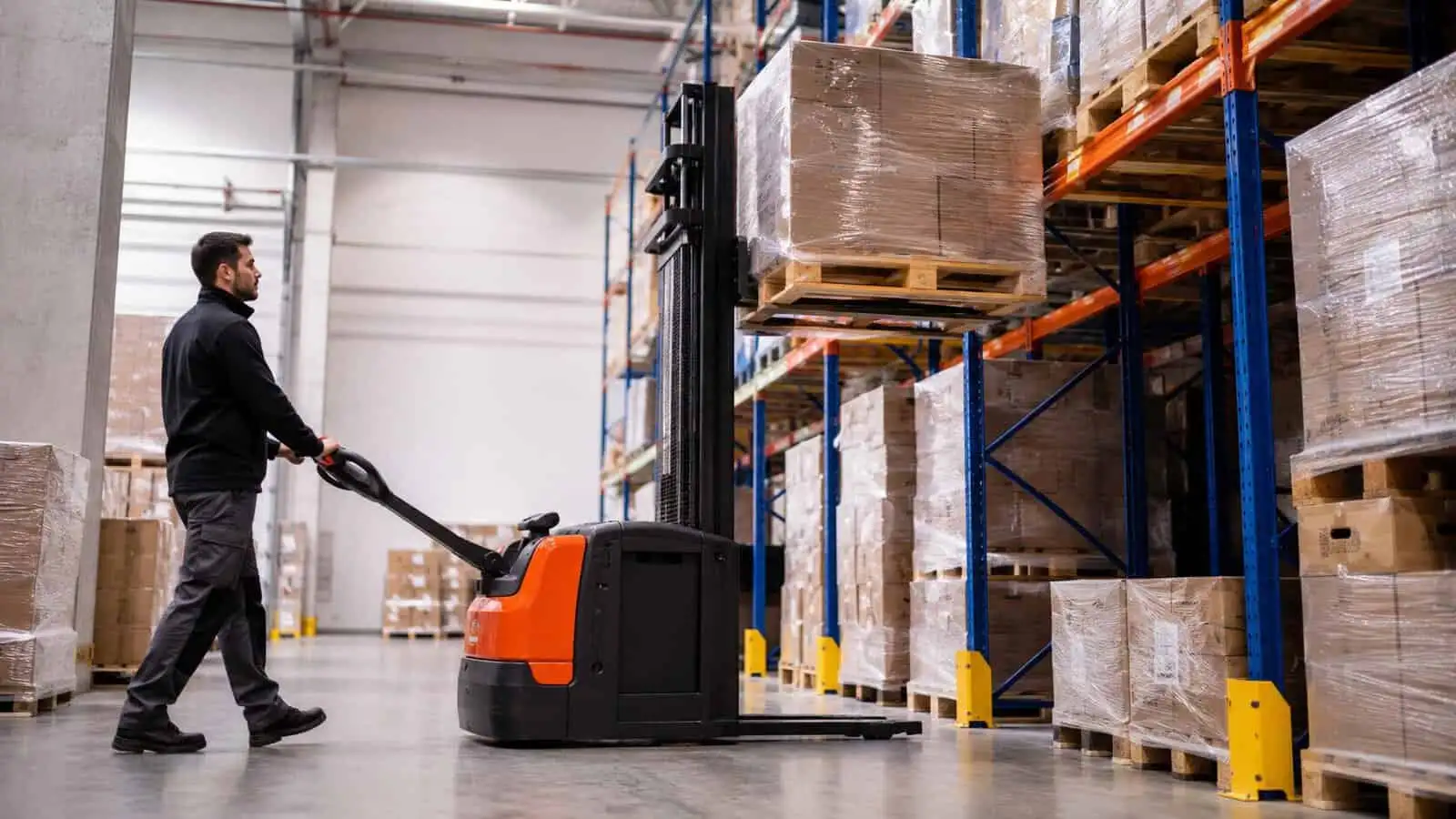
A walkie stacker is a pedestrian-operated electric machine that moves pallets and lifts them onto racking using a mast, sitting between an electric pallet jack and a forklift. To choose the right one, match the type and lift height to your highest racking level, your heaviest pallet, your aisle width, and how often the machine will run each day.
This guide covers the main walkie stacker types, the lift heights you can expect, and a clear way to pick the right model.
Most walkie stackers carry roughly 800 kg to 2,000 kg and lift from about 1.6 m up to 5.5 m, with some rated to store loads as high as 6.1 m, based on the current Toyota Material Handling Australia and Crown Equipment ranges. The right choice is rarely the cheapest one. It is the model that reaches your top shelf safely, carries your real load at that height, and fits the space your team works in.
Walkie stacker types at a glance
There are four main walkie stacker types, separated by how the machine supports and lifts the load. Use this table to shortlist, then read the details below.
| Type | How it works | Best for | Watch for |
|---|---|---|---|
| Straddle stacker | Two outer legs straddle the load | Standard and closed-bottom pallets, tight aisles | Straddle legs need floor clearance |
| Reach stacker | Forks or mast reach forward over the legs | Racking depth, better capacity at height | Higher cost, more operator skill |
| Counterbalance stacker | A counterweight balances the load, no legs | Non-standard pallets, benches, against a wall | Larger footprint, lower capacity for size |
| Fork-over (pallet) stacker | Forks sit over two support legs | Open-bottom pallets, lighter budget use | Open-bottom pallets only |
What is a walkie stacker?
A walkie stacker is a compact, pedestrian-operated lift truck that moves palletised loads and raises them onto racking or stacks them above floor level. The operator walks behind or beside the machine and steers with a tiller arm, so it takes up far less room than a ride-on forklift.
It is sometimes called a walk-behind forklift or a pedestrian stacker, and they all describe the same class of machine. The difference between an electric pallet jack and a walkie stacker comes down to one thing: a pallet jack only lifts a load enough to clear the floor and move it, while a walkie stacker has a mast that lifts to racking height.
That mast is what makes it useful for vertical storage in smaller warehouses, retail stockrooms, and dispatch areas where a counterbalance forklift would be too large.
Types of walkie stacker explained
The walkie stacker type decides which pallets you can handle, how stable the machine is, and how well it uses your space. Here is how the four main types compare in practice.
1. Walkie straddle stacker
A walkie straddle stacker has two outer legs that straddle the load, which gives it good stability without a heavy counterweight. The wide legs let it handle closed-bottom pallets, stillages, and odd-sized loads that a forklift machine cannot.
It is a common choice for general warehouse stacking in standard aisles. The trade-off is that the straddle legs need clear floor space on each side of the load, so very tight or cluttered floors can be a problem.
2. Walkie reach stacker
A walkie reach stacker uses a reaching mast or pantograph forks to extend the load forward over the support legs, so it can place pallets deeper into racking and hold more weight at height. This design suits warehouses that want to lift heavier loads to taller beams without moving up to a ride-on reach truck. If your operation is growing into deeper racking, this is often the step before a reach truck. It costs more than a straddle model and asks a little more of the operator.
3. Walkie counterbalance stacker
A walkie counterbalance stacker carries the load on forks balanced by a counterweight, with no straddle legs at all. Because nothing sits under or around the pallet, it can drive straight up to a workbench, a trailer tail or a wall, and it handles any pallet type.
That flexibility comes at a price: it has a larger footprint and usually a lower capacity for its size than a comparable straddle model, so it needs more room to turn.
4. Manual versus electric walkie stackers
Walkie stackers are also split by how they are powered, from fully manual through to fully electric. Manual and semi-electric stackers use hydraulic or assisted lifting and suit light, occasional work, while fully electric models power both the lift and the drive for daily use.
For frequent stacking, an electric model reduces operator fatigue and keeps pace across a shift. The power-type decision is covered in depth in the pallet stacker buying guide, so use that alongside this page when you are weighing manual against electric.
Walkie stacker lift heights explained
Walkie stacker lift heights generally run from about 1.6 m to 5.5 m, and your required height is the single biggest factor in narrowing the range. Crown rates some of its stackers to store loads up to 6,100 mm, while Toyota lists walkie models from 1,580 mm up to 5,400 mm, so there is a model for most low and medium racking jobs.
The table below groups typical lift heights against the work they suit. Figures are drawn from the Toyota Material Handling Australia and Crown Equipment spec pages and should always be confirmed against the data plate of the actual model.
| Lift height band | What it suits | Example models |
|---|---|---|
| Low, about 1.5 to 2.0 m | Bench-height work, low racking, floor-level double stacking, mobile work platform | Toyota Staxio SWE080L (1,580 mm), HWE100/S (2,000 mm) |
| Medium, about 3.5 to 4.5 m | Two to three racking beams, general warehouse storage | Toyota 6210 straddle (3,650 mm), Crown M Series (3,655 mm), Crown WF (4,400 mm) |
| High, about 4.8 to 5.5 m | Taller racking, fuller use of vertical space | Toyota SWE120XR reach (5,400 mm), SWE140S (5,350 mm), Crown ST/SX (5,500 mm) |
Two checks matter as much as the maximum height. First, the collapsed mast height has to clear your lowest doorway and any low roof sections, so measure those before you buy. Toyota advises measuring your highest shelf plus clearance, then checking your lowest doorway height. Second, lifting capacity drops as the mast rises, so the figure that matters is the rated capacity at your top beam, not the headline number on the floor.
How to choose the right walkie stacker
Choose a walkie stacker by working through your real tasks in order, not by starting with price. Run this checklist before you shortlist.
- Measure your highest racking beam. Add clearance above it, then pick a lift height that reaches it with room to place the pallet safely.
- Weigh your heaviest pallet, not the average. Then check the model’s rated capacity at full height, because capacity at the top beam is lower than at the floor.
- Check aisle width and turning space. A typical walkie stacker needs around 2.5 m of aisle depending on the load, per Toyota’s guidance, so confirm your aisles suit the model.
- Match the type to your pallets. Use a straddle or fork-over model for standard pallets, a counterbalance for non-standard loads or bench work, and a reach model for deeper or heavier racking.
- Confirm the floor and environment. Most walkie stackers are built for level indoor concrete, so flag ramps, rough ground or cold storage early.
- Set the duty cycle. Occasional light work can suit a manual or semi-electric model, while all-day stacking needs a fully electric one.
- Choose the battery. Lithium-ion charges faster and suits multi-shift use, while lead-acid costs less upfront. Either way, plan charging and look after the battery (see the guide to maintaining an electric pallet jack or stacker).
- Decide new or used. A sound used machine with the right capacity, lift height and battery condition can be strong value.
The criteria table below summarises what each factor decides.
| Factor | What it decides | What to check |
|---|---|---|
| Lift height | Whether you reach your top beam | Highest shelf plus clearance, lowest doorway |
| Capacity at height | Whether the load is safe up high | Rated capacity at full lift, not at floor |
| Aisle width | Whether the machine fits your layout | Turning space and load size |
| Stacker type | Which pallets you can handle | Straddle, reach, counterbalance or fork-over |
| Battery | Uptime and running cost | Lithium-ion or lead-acid, charging access |
Browse current electric stackers once your lift height, capacity and aisle figures are written down, and compare brands such as Toyota and Crown against those numbers.
Do you need a licence to operate a walkie stacker in Australia?
In most cases, no. A high risk work (LF) licence is generally not required to operate a pedestrian-operated walkie stacker in Australia, because the licensing definition of a forklift truck does not cover walk-behind machines. This position comes from the model Work Health and Safety laws published by Safe Work Australia and is administered by state regulators such as WorkSafe Victoria.
There are important conditions. The operator must still be trained, competent and authorised by the employer, who keeps a duty to provide instruction and supervision under WHS law. A ride-on stacker is treated differently and can require an LF licence, and rules can vary between states and territories.
Confirm the current requirement with your state regulator, and if your team also runs ride-on forklifts, read the guide on how to get a forklift licence in Australia.
Walkie stacker versus other equipment
A walkie stacker is the middle option between a pallet mover and a ride-on forklift, so the right machine depends on whether you mainly move, stack or lift heavy. This table gives the quick decision.
| Your main task | Better choice |
|---|---|
| Moving pallets across flat floors | Electric pallet jack |
| Lifting pallets onto low to medium racking | Walkie stacker |
| Deep racking or heavier loads at height | Reach truck |
| Heavy, all-day or outdoor lifting | Counterbalance forklift |
For the two closest calls, compare an electric pallet jack against a walkie stacker when stacking height is the question, and a reach truck against a pallet stacker when you are pushing into taller racking.
Get the right walkie stacker for your warehouse
The right walkie stacker comes down to four numbers: your top beam height, your heaviest pallet, your aisle width and your daily hours. Once you have those, the type and lift height fall into place quickly.
View the current range of electric stackers, or contact the Buy A Fork team with your figures and we will match you to a new or used model that fits the job and the budget. If you only need a machine for a short project, the Rent A Fork sister site handles hire.
Frequently asked questions about walkie stackers
1. What is a walkie stacker?
A walkie stacker is a pedestrian-operated electric lift truck that moves pallets and raises them onto racking using a mast. The operator walks with the machine and steers with a tiller, so it suits compact spaces where a ride-on forklift is too big. It sits between an electric pallet jack and a counterbalance forklift in both lifting ability and price.
2. How high does a walkie stacker lift?
Most walkie stackers lift between about 1.6 m and 5.5 m, depending on the model and mast. Crown rates some stackers to store loads up to 6,100 mm, while Toyota lists walkie models from 1,580 mm to 5,400 mm. Always match the lift height to your highest beam plus clearance, and check the collapsed mast clears your lowest doorway.
3. Do you need a licence to operate a walkie stacker in Australia?
Generally no, because pedestrian-operated walkie stackers fall outside the forklift high risk work (LF) licence under the model WHS laws administered by regulators such as WorkSafe Victoria. The operator must still be trained, competent and authorised by the employer. A ride-on stacker can require a licence, and rules vary by state, so confirm with your local regulator.
4. Straddle or reach walkie stacker, which is better?
A straddle stacker is better for general stacking of standard and closed-bottom pallets in normal aisles, while a reach stacker is better for placing heavier loads deeper into taller racking. Reach models cost more and ask a little more of the operator. Choose by your pallet type, racking depth and the weight you lift at height.
5. How much does a walkie stacker cost?
Walkie stacker prices depend on capacity, lift height, new or used condition, mast type and battery, so there is no single figure. A compact low-lift model costs far less than a high-lift reach or counterbalance machine. The most reliable way to budget is to set your specifications, then request a quote on matching new and used stock.
6. Can a walkie stacker be used outdoors or on ramps?
Walkie stackers are built mainly for level indoor concrete, so they are not suited to rough outdoor ground or steep ramps. Toyota notes minor gradients may be handled with caution, but loaded slopes raise the risk of tipping. For regular outdoor or uneven work, a counterbalance forklift is the safer tool.
7. Manual or electric walkie stacker, which should I buy?
Buy a manual or semi-electric stacker for light, occasional lifting on a tight budget, and a fully electric one for daily stacking. Electric models power both lift and travel, which cuts operator fatigue and keeps pace across a shift. If the machine will run most of the day, the electric model usually pays back through productivity and safety.