
Used vs New Electric Stackers: Which Should You Buy?
· Updated
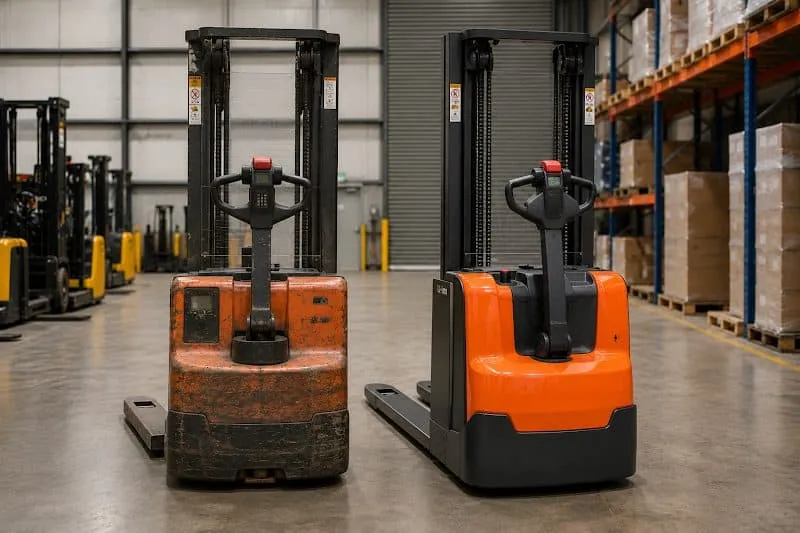
A used electric stacker is usually the better-value choice for light or moderate single-shift work when its battery, charger, mast and controls have been properly tested. A new electric stacker is generally worth the higher price when the machine will operate intensively, perform a critical role or require a specific lift height, battery system or warehouse configuration.
The decision should not be based on age or purchase price alone. Compare the complete ready-to-work cost, expected daily use, battery condition, warranty and likely downtime.
A well-prepared used stacker can deliver years of reliable service. However, an apparently cheap second-hand pallet stacker can lose its price advantage when it needs a replacement battery, charger, load wheels or mast repairs soon after purchase.
Used or New Electric Stacker: The Short Answer
Buy a used electric stacker when your workload is predictable, usage is light to moderate and the machine has a tested battery, suitable lift height and clear service history.
Buy new when the stacker will be used heavily, downtime would disrupt the business or you need a specific configuration that is difficult to find in used stock.
| Your situation | Better starting option | Why |
|---|---|---|
| Occasional pallet stacking | Used | Lower purchase cost can provide better value for limited use |
| Light single-shift warehouse work | Used | A tested machine may meet the workload without the cost of new equipment |
| Daily single-shift operation | Used or new | The answer depends on battery condition, warranty and how critical the machine is |
| Multi-shift operation | New | New batteries, full warranty and predictable availability may justify the premium |
| Critical dispatch or production role | New or late-model used | Reduced breakdown risk and stronger support become more important |
| Tight purchasing budget | Used | Lower upfront cost, provided the machine passes inspection |
| Exact mast, fork or straddle requirement | New | Ordering the required configuration may be easier than waiting for used stock |
| Cold-store or specialised environment | New or verified specialised used | The machine and battery must be approved for the operating conditions |
| Seasonal or backup use | Used | A sound used unit may be more economical for intermittent work |
| Rapid business growth expected | New | New equipment may provide more capacity and longer useful ownership |
| Limited in-house maintenance support | New or dealer-prepared used | Warranty and local service support reduce operational risk |
Used is not automatically the budget option once repairs are included. New is not automatically the better investment when a stacker will only move a few pallets each day.
The strongest decision is the machine that meets the workload at the lowest realistic cost over the period you intend to own it.
What Is an Electric Stacker?
An electric stacker, also commonly called a walkie stacker, is a compact materials-handling machine that uses electric power to move and lift palletised loads.
The operator usually walks behind the machine or controls it from a fold-down platform. Unlike an electric pallet jack, a stacker has a mast that can raise pallets onto racking or place one load above another.
Electric stackers are commonly used in:
- Small and medium warehouses
- Retail back-of-house areas
- Workshops
- Light manufacturing facilities
- Storage units
- Food and beverage operations
- Distribution areas
- Sites with narrow aisles
They are generally more compact than counterbalance forklifts and may suit businesses that need to stack lighter pallets without purchasing a full-sized forklift.
The category includes several different configurations, including:
- Pedestrian walkie stackers
- Ride-on stackers
- Straddle stackers
- Counterbalanced stackers
- Reach walkie stackers
- Duplex and triplex mast stackers
- Initial-lift stackers
- Platform stackers
These configurations are not interchangeable. The correct choice depends on the pallet type, aisle width, floor condition, load weight and required lift height.
The electric stacker types and lift-height guide explains the differences between common walkie stacker configurations.
Used vs New Electric Stackers Compared
| Buying factor | Used electric stacker | New electric stacker |
|---|---|---|
| Initial purchase price | Usually lower | Usually higher |
| Availability | Often immediately available | Stock or factory lead times may apply |
| Battery condition | Must be tested | Normally new and covered by manufacturer terms |
| Charger | May be older or separately supplied | Usually matched to the battery |
| Warranty | Depends on the machine and seller | Usually more comprehensive |
| Service history | Important to verify | No previous operating history |
| Technology | Depends on model age | Latest available controls and battery systems |
| Configuration choice | Limited to available stock | Greater ability to specify the machine |
| Immediate repairs | May require budgeting | Less likely during early ownership |
| Depreciation | Previous owner has absorbed part of it | Greater early depreciation |
| Finance | May be available | Often available |
| Best application | Light to moderate work and budget-conscious buyers | Intensive, specialised or business-critical use |
| Downtime risk | Depends heavily on preparation and condition | Generally more predictable during early ownership |
| Resale value | Depends on brand, age and condition | May retain stronger value if maintained well |
What Does a Used Electric Stacker Really Cost?
The advertised price is only the starting point.
A used electric stacker remains good value when the machine is mechanically sound and the battery can complete the required work. Its price advantage can disappear when major repairs are needed soon after delivery.
Calculate the complete cost of putting the stacker into operation.
Include:
- Purchase price
- GST
- Delivery
- Battery testing
- Battery replacement
- Charger replacement
- Load wheels and castors
- Mast chain repairs
- Hydraulic repairs
- Control system repairs
- Initial servicing
- Warranty coverage
- Required safety repairs
- Staff familiarisation
- Expected downtime
Current Buy A Fork Electric Stacker Examples
Buy A Fork’s electric stacker category included the following machines when reviewed on 13 July 2026.
| Current listing | Advertised price | Listed capacity | Other listed details |
|---|---|---|---|
| 2017 BT SWE120S | From $2,888 | 1.2 tonnes | 24V 150Ah battery and compact walkie design |
| Linde L10 to L12 AS Series 1172 | Price on application | 1 tonne | Listed with a lift height of up to 4,000 mm |
These examples show why buyers should compare specifications rather than price alone. One business may only need a compact 1.2-tonne stacker for low-level warehouse work, while another may require a machine configured to reach four metres. Current category offers also include service, warranty and local delivery benefits on selected equipment, subject to the terms applying to the individual machine.
Used inventory changes regularly. Check the current electric stacker range before relying on a specific model or price.
Use the Price-Gap Test
There is no universal percentage that makes a used stacker better value than a new one.
Use this calculation instead:
Used stacker price + immediate repairs + battery risk + charger costs + expected downtime
Compare that amount with:
New stacker price + finance costs + delivery + servicing requirements
A used stacker is generally the stronger purchase when it still provides a meaningful saving after every known repair and near-term replacement cost is included.
New becomes more attractive when the used unit needs a battery, charger and several mechanical repairs that consume most of the original price difference.
The Battery Is the Biggest Used-Stacker Risk
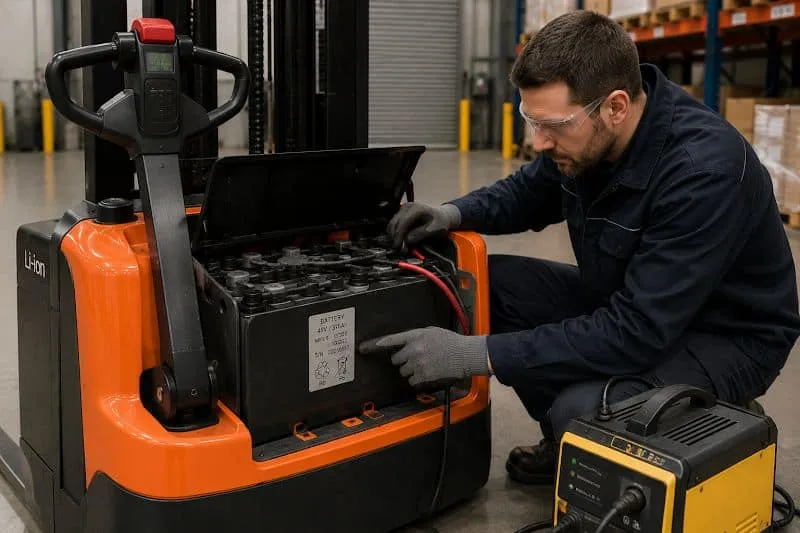
The battery can be one of the most expensive components in an electric stacker.
A machine may appear clean and operate normally during a short demonstration, yet fail to complete the buyer’s normal shift once it is placed under repeated load.
Battery condition cannot be confirmed by appearance alone.
What to Check on a Used Stacker Battery
Ask for:
- Battery chemistry
- Battery voltage
- Amp-hour capacity
- Manufacture date
- Remaining runtime
- Capacity-test results
- Charging history
- Maintenance records
- Watering history for flooded lead-acid batteries
- Cycle count, where recorded
- Battery management system reports for lithium batteries
- Evidence of cell repairs
- Warranty coverage
- Replacement cost
Also inspect:
- Battery terminals
- Connectors
- Cables
- Steel tray
- Corrosion
- Electrolyte levels
- Physical swelling
- Cracks
- Leakage
- Heat damage
A seller saying that the battery “holds charge” is not the same as proving it can complete your required workload.
Check the Battery Under Realistic Conditions
A proper test should consider:
- The heaviest normal pallet
- Maximum lift height
- Typical travel distance
- Number of lifts per hour
- Shift duration
- Ramp use
- Floor conditions
- Ambient temperature
A stacker battery that performs adequately for one hour may still be unsuitable for an eight-hour operation.
Do Not Forget the Charger
Confirm that the charger:
- Is included in the sale
- Matches the battery voltage
- Matches the battery chemistry
- Has the correct connector
- Operates without fault codes
- Can be connected to the available site power
- Charges within an acceptable period
- Has undamaged cables and plugs
Replacing a charger can add a substantial unplanned cost.
Do not automatically use a lead-acid charger with a lithium battery. Lithium systems normally require a compatible charging profile and may require communication with the battery management system.
Lead-Acid or Lithium?
Older used stackers are more likely to use lead-acid batteries. New models increasingly offer lithium-ion systems.
| Battery factor | Lead-acid | Lithium-ion |
|---|---|---|
| Initial cost | Usually lower | Usually higher |
| Watering | Required for flooded designs | Not required |
| Opportunity charging | More restricted | Commonly supported |
| Charging time | Usually longer | Often shorter |
| Cooling period | May be required | Generally not required |
| Maintenance | Regular battery care required | Lower routine maintenance |
| Multi-shift suitability | May require battery changes or planned charging | Often better suited to frequent charging |
| Used-battery assessment | Check age, capacity, cells and watering history | Check cycle data, state of health and battery management reports |
Linde states that lithium-ion technology allows charging during short operational breaks, which can support continuous two-shift or three-shift use. Linde has also previously published a guaranteed 2,500 recharge cycles for specific lithium systems. These figures apply to particular products and should not be treated as the expected life of every electric stacker battery.
Other Used-Stacker Costs Buyers Often Miss
Load Wheels and Castors
Electric stackers rely on small wheels and rollers that can wear quickly on damaged or uneven floors.
Check for:
- Flat spots
- Cracks
- Missing material
- Uneven wear
- Noisy bearings
- Loose wheel assemblies
- Difficulty turning
- Vibration during travel
One damaged wheel may indicate that the other wheels are also approaching replacement.
Mast Chains and Rollers
The mast should raise and lower smoothly without excessive movement, noise or hesitation.
Look for:
- Worn or corroded chains
- Uneven chain tension
- Damaged rollers
- Loose mast channels
- Hydraulic leaks
- Fork carriage movement
- Uncontrolled lowering
- Mast drift while holding a load
Mast repairs are more important than paint condition. A freshly repainted stacker may still have worn lifting components.
Forks and Straddle Legs
Check that the forks are straight, evenly positioned and free from cracks.
On a straddle stacker, inspect both legs for:
- Bending
- Cracking
- Damaged welds
- Wheel damage
- Uneven alignment
- Previous repairs
The straddle width must also suit the pallets used at your workplace.
Controls and Safety Systems
Test:
- Forward and reverse travel
- Lift and lower controls
- Emergency reverse button
- Emergency stop
- Horn
- Braking
- Parking brake
- Speed controls
- Operator-presence controls
- Platform interlocks
- Warning lights
- Battery discharge indicator
Do not accept disabled safety controls as normal wear.
When Is a Used Electric Stacker the Better Choice?
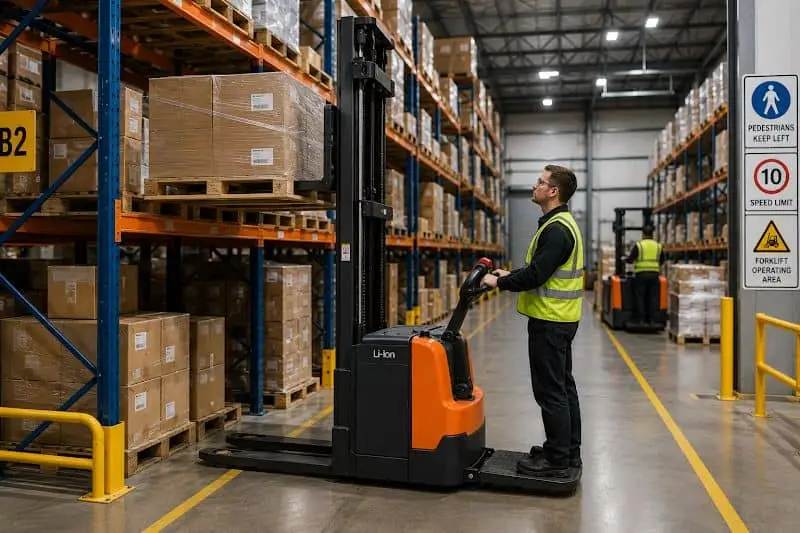
A used stacker can be the more economical decision in several situations.
- Light daily use: A business moving and stacking a limited number of pallets may not gain enough productivity from a new machine to justify the extra cost.
- Single-shift operation: A tested used battery may provide enough runtime when the stacker has a predictable overnight charging window.
- Backup equipment: A used stacker can support the main forklift during servicing, breakdowns or busy periods.
- New or growing business: Buying used can preserve working capital while the company confirms its long-term handling requirements.
- Predictable loads: Used equipment works well when pallet weights, dimensions and racking heights are consistent.
- Immediate requirement: A used machine may be available for inspection and delivery without a factory lead time.
- Strong dealer preparation: A serviced stacker with a tested battery, documented specifications and written warranty presents less risk than an unknown private-sale machine.
- Established model: A well-supported brand with parts available locally may continue to provide reliable service after its first owner.
Used is most attractive when the business can inspect the actual machine and confirm that it meets the required capacity, lift height, aisle and battery runtime.
When Is a New Electric Stacker Worth the Premium?
New equipment becomes easier to justify when the cost of interruption is higher than the cost of the machine.
- High duty cycle: A stacker performing frequent travel and lift cycles throughout the day benefits from a new battery and unworn components.
- Multi-shift operation: New lithium or appropriately configured battery systems may support opportunity charging and longer operating windows.
- Critical workflow: When production, dispatch or receiving stops without the stacker, predictable reliability becomes more valuable.
- Specific configuration: A new stacker can be ordered with the required mast, fork length, straddle width, platform, capacity and battery.
- Specialised environment: Cold stores, food operations and other controlled environments may require specific materials, lubricants, battery systems or manufacturer approval.
- Long ownership plan: A business intending to keep the stacker for many years may gain more value from starting with new equipment.
- Full warranty preference: New equipment usually provides stronger manufacturer-backed warranty coverage, although the exact terms must be reviewed.
- Latest safety features: Newer machines may offer improved speed control, stability systems, battery monitoring and pedestrian-warning technology.
- Fleet standardisation: Buying the same models, batteries and chargers across a fleet can simplify training, servicing and parts management.
- Predictable maintenance: A new machine begins with unworn components and a known service schedule.
- Business growth: A new stacker can be specified for expected future loads rather than only current demand.
Financing may also allow a business to spread the cost of new equipment. Compare interest, fees, repayments and any balloon payment against the total cost of purchasing used.
Used vs New by Duty Cycle
Duty cycle describes how intensively and frequently the stacker will be used.
| Expected usage | Used stacker suitability | New stacker suitability |
|---|---|---|
| A few lifts each week | Very suitable if correctly specified | May be unnecessary unless specialised features are needed |
| Occasional daily use | Usually suitable | Suitable but may have a longer payback period |
| Regular single shift | Suitable with a strong battery and service support | Suitable where reliability is critical |
| Continuous single shift | Battery and condition must be assessed closely | Often easier to justify |
| Two or more shifts | Greater battery and downtime risk | Usually the stronger starting option |
| Seasonal peaks | Suitable as primary or backup equipment | Consider when peaks are frequent and predictable |
| Critical production role | Late-model dealer-prepared used only | Strong choice |
| Cold or demanding environment | Only if designed and verified for the application | Easier to specify correctly |
Does New Always Mean More Reliable?
New equipment reduces uncertainty, but it does not guarantee that the machine is right for the workplace.
A new stacker can still be a poor purchase when it has:
- Insufficient capacity
- Inadequate lift height
- Incorrect fork dimensions
- Straddle legs that do not suit the pallets
- An unsuitable turning radius
- Insufficient battery capacity
- A charger that does not suit the site power
- Wheels that do not suit the floor
- Limited local parts support
The configuration must be correct before condition or age becomes relevant.
A properly specified used stacker is more useful than a new stacker that cannot handle the pallets or enter the racking aisle.
The broader pallet stacker buying guide explains the capacity, mast and warehouse measurements that should be confirmed before selecting a model.
How to Check a Used Electric Stacker Before Buying
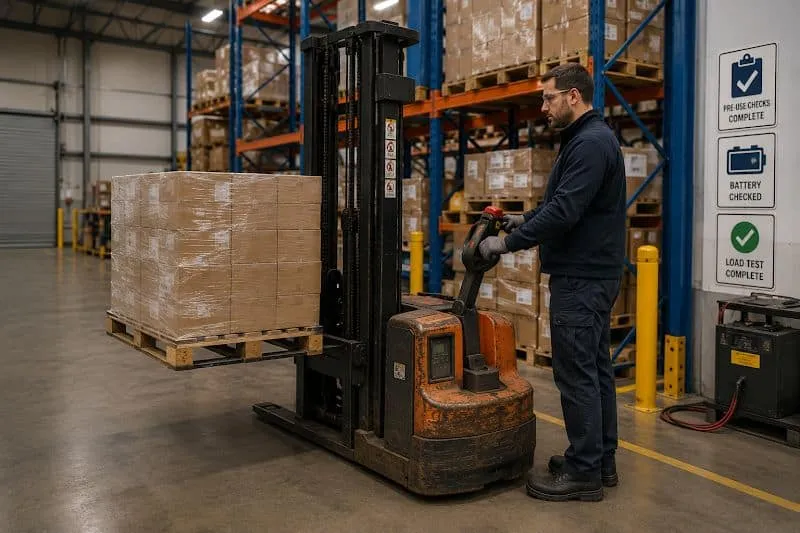
A short demonstration is not enough. Inspect the machine systematically and test it under a suitable load.
1. Confirm the Identity and Capacity
Check:
- Make
- Model
- Serial number
- Year
- Rated capacity
- Load centre
- Maximum lift height
- Lowered mast height
- Battery voltage
- Truck weight
The data plate should be present, readable and consistent with the machine.
2. Measure the Workplace
Confirm:
- Aisle width
- Doorway height
- Racking height
- Turning space
- Floor condition
- Pallet dimensions
- Ramp gradients
- Charging area
- Available electrical supply
Do not rely on a seller saying the stacker is “compact”.
3. Inspect the Battery
Ask for the battery age and test results.
Check for:
- Corrosion
- Damaged cables
- Loose connectors
- Swelling
- Leaks
- Heat damage
- Low electrolyte
- Fault codes
- Short runtime
Where possible, arrange a capacity or discharge test.
4. Test the Charger
Confirm that it starts correctly, matches the battery and connects to your available electrical supply.
Ask whether the charger is included in the advertised price.
5. Inspect the Mast and Chains
Raise the mast fully and lower it again.
Watch for:
- Uneven movement
- Excessive noise
- Damaged chains
- Hydraulic leaks
- Mast drift
- Loose rollers
- Jerking
- Delayed lifting
6. Check the Forks and Legs
Look for cracks, bending, uneven fork height and damaged locking components.
Confirm that the fork and straddle dimensions suit your pallets.
7. Test Travel and Braking
Drive the stacker forward and in reverse.
Test:
- Steering
- Braking
- Emergency reverse
- Emergency stop
- Low-speed control
- Parking brake
- Platform interlocks
- Creep functions
8. Test It Under Load
Use a load that reflects your normal operation where possible.
Lift it to the required height and check:
- Stability
- Lifting speed
- Hydraulic drift
- Battery response
- Braking
- Steering
- Warning lights
- Unusual noise
A stacker that works correctly without a load may perform differently when carrying a pallet.
9. Review the Service History
Ask for:
- Service records
- Battery maintenance
- Charger repairs
- Chain inspections
- Hydraulic work
- Wheel replacement
- Control repairs
- Previous fault reports
Records should match the machine’s serial number.
10. Confirm the Warranty and Support
Get the following in writing:
- Warranty duration
- Parts covered
- Labour coverage
- Battery coverage
- Charger coverage
- Travel or call-out fees
- Servicing requirements
- Geographic limits
- Claim procedure
Buy A Fork currently advertises free six-month basic servicing with electric stacker purchases, subject to terms. Confirm the warranty and service inclusions applying to the individual unit before payment.
For a more detailed method, follow the full used equipment inspection guide.
Straddle or Counterbalanced Stacker?
The pallet type can determine which stacker configuration you need.
Straddle Stacker
A straddle stacker has stabilising legs that extend along the outside of the load.
It can provide good stability and capacity in a compact machine. However, the legs must fit around the pallet, racking and floor-level obstructions.
A straddle model may not suit every closed-bottom pallet or tightly enclosed pallet position.
Counterbalanced Stacker
A counterbalanced stacker carries the load in front of the machine without stabilising legs surrounding the pallet.
This configuration may handle a wider variety of pallets and approach closed-bottom pallets more easily. It is generally longer than a straddle stacker and may require more turning space.
Which Should You Choose?
Choose based on:
- Pallet underside design
- Pallet width
- Racking clearances
- Aisle width
- Turning space
- Load weight
- Lift height
- Floor condition
Take pallet and racking measurements before inspecting either a used or new stacker.
Used Electric Stacker Red Flags
Investigate further or reject the machine when:
- The data plate is missing
- The serial number cannot be verified
- Battery age is unknown
- The seller will not allow a battery test
- The charger is not included or cannot be demonstrated
- The mast drops while holding a load
- Chains are heavily corroded
- Hydraulic oil is leaking
- Forks are cracked or bent
- Straddle legs show welding or distortion
- Controls have been bypassed
- Emergency reverse does not work
- Wheels have severe flat spots
- Warning lights remain active
- The stacker cannot be tested under load
- Service records do not match the machine
- Warranty promises are only verbal
- The machine does not fit the stated pallets
- Replacement parts are difficult to source locally
New Electric Stacker Questions to Ask
New buyers should still request detailed information.
Ask:
- Is the quoted model currently available?
- What is the rated capacity at the required height?
- What mast is included?
- What is the lowered mast height?
- Are the forks suitable for our pallets?
- Is it straddle or counterbalanced?
- What battery chemistry is included?
- What is the battery capacity?
- What charger is included?
- What site power does the charger require?
- How long is the full warranty?
- Is the battery covered separately?
- Who provides servicing in our area?
- What are the scheduled maintenance intervals?
- Are parts stocked in Australia?
- What is the expected delivery time?
- Can the machine be financed?
- What training or familiarisation is provided?
Should You Buy Used from a Dealer or Private Seller?
A private seller may offer a lower price, but the buyer usually carries more of the condition risk.
Private sales may not include:
- Workshop inspection
- Battery testing
- Servicing
- Written warranty
- Delivery support
- Finance
- Replacement parts
- Ongoing technical help
Dealer-prepared used equipment may cost more, but the purchase can include service support, inspection opportunities and clearer specifications.
The strongest used purchase is not necessarily the cheapest listing. It is the machine with the most transparent condition, battery information and after-sales support.
Buyers working with a restricted budget can compare current affordable electric stacker options before deciding whether a lower-cost model meets the workload.
What About Electric Pallet Jacks?
An electric pallet jack moves pallets horizontally but does not lift them into normal warehouse racking.
Choose a pallet jack when the main task is:
- Moving pallets at floor level
- Loading and unloading in suitable areas
- Transporting stock between departments
- Moving loads over longer warehouse distances
Choose an electric stacker when the business must place pallets onto raised storage positions.
The used-versus-new calculation is similar for both machine types, but stackers add mast, chain, hydraulic and lift-height considerations. The used versus new electric pallet jack comparison covers the decision for ground-level pallet equipment.
Make the Decision on Workload, Not Age
Used electric stackers provide strong value for businesses with predictable loads, light to moderate usage and a limited equipment budget.
New electric stackers are easier to justify when the machine will operate across long or multiple shifts, downtime is costly or the warehouse needs a specific battery, mast or pallet configuration.
Before choosing, compare:
- Load capacity
- Lift height
- Pallet compatibility
- Aisle width
- Battery condition
- Charger compatibility
- Daily operating hours
- Warranty
- Service support
- Complete ready-to-work cost
The best used stacker is not simply the cheapest. It is one that has enough battery life, capacity and mechanical condition to perform the required work without immediate major spending.
The best new stacker is not simply the latest model. It is one configured correctly for the workplace and used often enough to justify the premium.
Review Buy A Fork’s current electric stacker range or arrange an inspection at the Somerton warehouse to compare available machines against your load, lift-height and operating requirements.
Frequently Asked Questions
1. How Long Do Electric Stacker Batteries Last?
There is no single lifespan that applies to every electric stacker battery.
Battery life depends on:
- Battery chemistry
- Number of charge cycles
- Depth of discharge
- Charging practices
- Temperature
- Maintenance
- Daily workload
- Charger compatibility
- Battery quality
Lead-acid batteries require correct charging and, for flooded models, regular watering. Lithium batteries usually need less routine maintenance and may support more frequent opportunity charging.
Linde has published a guaranteed 2,500 recharge cycles for specific lithium-ion systems, but buyers should use the specifications and warranty for the battery fitted to the actual stacker rather than applying that figure to every model.
When buying used, request a capacity test and realistic runtime estimate instead of relying only on the battery’s age.
2. Are Used Electric Stackers Reliable?
Yes, a used electric stacker can be reliable when it has been serviced, correctly specified and tested under load.
The main risks are a weak battery, incompatible charger, worn mast components, damaged wheels and limited parts support.
A dealer-prepared machine with service records and written warranty is generally easier to assess than an unknown machine sold privately.
3. What Capacity Electric Stacker Do I Need?
Choose a stacker that can safely lift your heaviest pallet to the required height.
Do not select capacity based only on the heaviest load at floor level. Available capacity can change with lift height, load centre and attachments.
Current Buy A Fork stacker listings include examples in the 1-tonne to 1.2-tonne range, but electric stackers are available in other capacities. Confirm the actual machine’s capacity plate before purchasing.
4. What Is the Difference Between a Straddle and Counterbalanced Stacker?
A straddle stacker uses stabilising legs positioned around the pallet. It is compact and stable but must be compatible with the pallet and racking layout.
A counterbalanced stacker carries the pallet in front of the machine without surrounding straddle legs. It can handle more pallet designs but normally requires additional turning space.
5. Should I Buy a Used Stacker for Daily Use?
A used stacker can suit daily single-shift work when the battery has sufficient capacity, the machine has been serviced and downtime will not severely affect the operation.
For continuous use or multiple shifts, new equipment may provide a stronger battery, more comprehensive warranty and more predictable reliability.
6. Is Finance Available for Electric Stackers?
Finance may be available for new and used electric stackers, subject to the lender, applicant and equipment.
Compare:
- Deposit
- Interest rate
- Fees
- Repayment period
- Balloon payment
- Total amount repaid
- Tax treatment
- Effect on working capital
Financing a correctly specified machine may be better than paying cash for a cheaper stacker that cannot perform the work.
7. Is a Used Lithium Electric Stacker Better Than a New Lead-Acid Model?
Not automatically.
A used lithium stacker may offer faster charging and lower routine battery maintenance, but its battery state of health and warranty must be verified.
A new lead-acid model may provide a full equipment warranty and lower upfront price but require planned charging and battery maintenance.
Compare the whole machine, not battery chemistry alone.
8. Can an Electric Stacker Work in a Cold Store?
Only use a stacker in a cold store when the model, battery, controls, lubricants and electrical systems are suitable for that environment.
Temperature can affect battery performance and component life. Confirm the approved operating temperature and required cold-store preparation with the manufacturer or supplier.
9. Do I Need a New Stacker for Food or Pharmaceutical Work?
Not always, but new equipment may be easier to specify for hygiene-sensitive environments.
The stacker may require particular wheel materials, corrosion protection, lubricants, cleaning procedures or battery arrangements.
A used unit can still be suitable when its specification, condition and previous use are verified.