
Selective Pallet Racking: How It Works, Benefits and Forklift Requirements
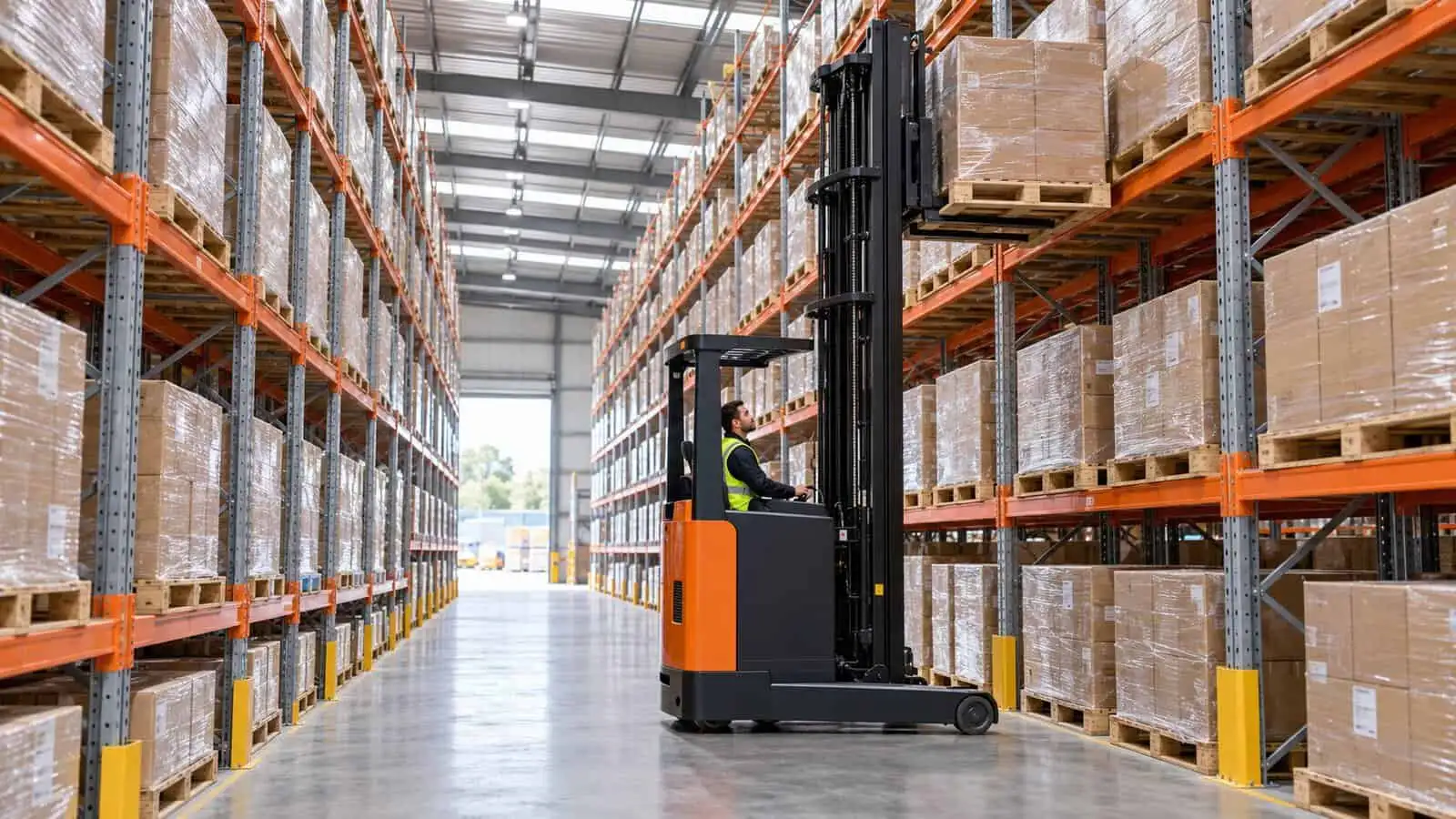
Selective pallet racking is a single-deep racking system in which every pallet position can be reached directly by a forklift from the aisle. It is the racking most people picture when they think of a warehouse, and it is common in Australian sites because it suits mixed stock and standard forklifts. How well it works, though, depends on the forklift running it, so this guide covers how the system works, its benefits and drawbacks, the dimensions to plan around and the forklift requirements that decide whether a machine can do the job safely.
How does selective pallet racking work?
Selective racking holds pallets one deep on pairs of horizontal beams fixed between upright frames, with an aisle in front of every bay. A forklift drives down the aisle, lifts a pallet to the right beam level and places it across the two beams. Because nothing sits in front of any pallet, any position can be picked or replaced without moving another load.
Racking manufacturer Dexion describes this as individual access to all pallets to the full height of the warehouse, with beam heights that can be adjusted to suit pallets of different heights. Lower pallets can also sit on the floor for picking. Runs are usually set back to back in the middle of a warehouse, with single runs against the walls.
The main components, as listed by manufacturer Vinatech, are:
- Uprights and bracing: the vertical frames that carry the load to the floor.
- Beams and beam safety locks: the horizontal members the pallets sit on, locked to stop them lifting out.
- Base plates and anchor bolts: fixing each upright to the slab.
- Pallet supports and wire mesh decking: extra support for pallets or loose stock.
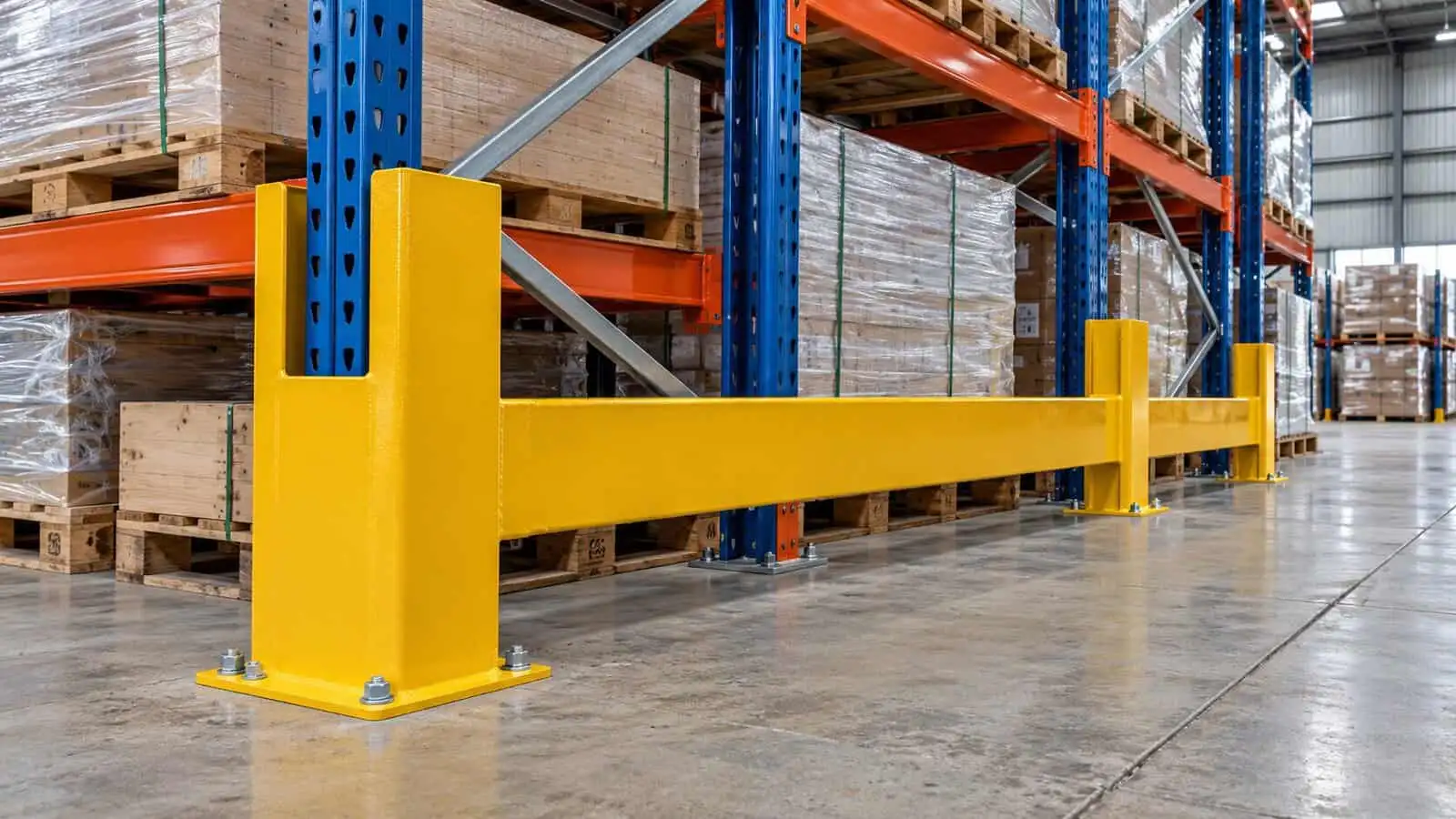
- Column and frame protectors: guards that take forklift impacts before the upright does.
What are the benefits and drawbacks of selective racking?
The main benefit is direct access to every pallet; the main drawback is that the aisles take floor space that denser systems use for storage. Gold Coast Racking, a racking supplier, describes selective racking as offering lower storage capacity but much faster retrieval.
The benefits follow from that direct access. Stock rotation is simple, because the oldest pallet can always be reached. It suits sites with many different products, since each pallet position can hold a different line. Beam levels can be moved as stock changes. And it needs no specialised truck: Dexion and Gold Coast Racking both describe it as serviced by conventional forklifts.
Where density matters more than access, deeper systems store more pallets in the same floor area, but they change the forklift you need. Double deep racking stores two pallets one behind the other and needs a double reach truck that can reach the second pallet position. Drive-in racking lets the forklift drive into the rack itself, which suits large volumes of the same product. If your stock is varied and every pallet needs to be reachable, selective is usually the better fit.
What are the dimensions of selective pallet racking?
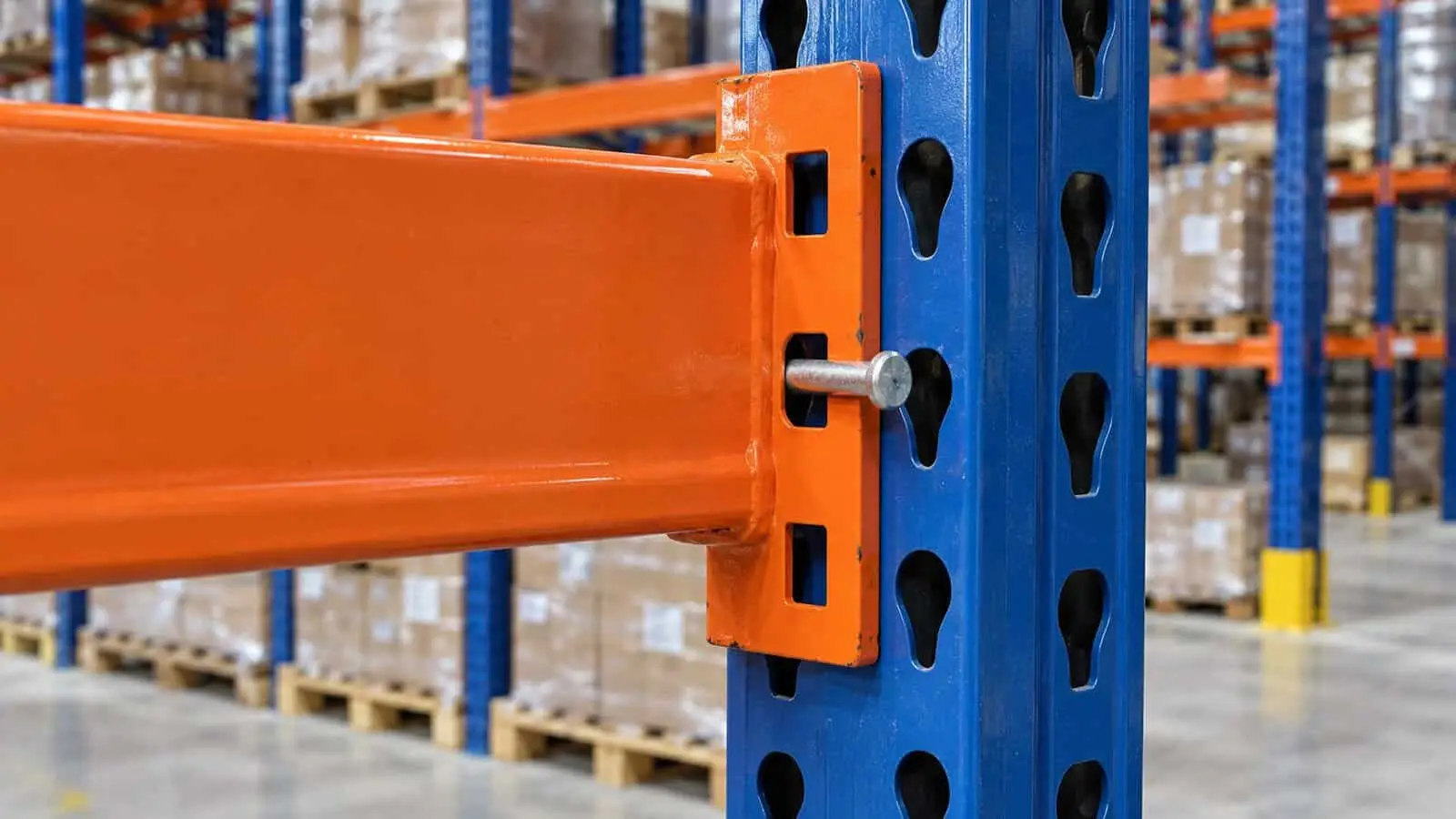
Selective racking is built to order, so dimensions vary by manufacturer and site, but published ranges give a useful starting point. Vinatech publishes the following range for its selective pallet racking, designed to AS 4084:2023.
| Specification | Published range |
|---|---|
| Height | 3,000 to 12,000 mm |
| Beam length | 1,800 to 3,600 mm |
| Depth | 800 to 1,200 mm |
| Load per beam level | 1,000 to 3,000 kg |
| Common frame depth for Australian pallets | 840 mm |
Frame depth is set by the pallet. Racking supplier Macrack states that standard selective racking is usually 840 mm deep, so an Australian pallet overhangs the frame by roughly 150 mm at the front and back. That is deliberate: the standard pallet size in Australia is 1165 x 1165 mm, and the overhang lets the pallet sit securely across both beams. Euro and imported pallets often need a different depth.
What forklift do you need for selective pallet racking?
Any forklift can run selective racking if it fits the aisle, reaches the top beam and can carry the heaviest pallet at that height. Selective racking needs no specialised truck, but the wrong standard truck is still the wrong truck. These are the checks to make against the machine’s own documents.
| Check | What to confirm | Where to find it |
|---|---|---|
| Aisle width | The machine’s working aisle width fits your aisle with clearance | Forklift specification sheet |
| Lift height | Maximum fork height clears the top beam plus the pallet | Data plate or specification sheet |
| Capacity at height | Rated capacity at the top beam height covers the heaviest pallet | Load chart on the data plate |
| Fork length | Forks support the pallet without reaching into the rear | Fork length and pallet size |
| Load centre | The pallet’s load centre matches the rated load centre | Data plate |
Aisle width
Aisle width decides which machines can work the racking at all, and published figures vary by more than two metres between machine types. Manufacturers publish working aisle width, written as Ast, against a stated pallet size and orientation. Hyster’s specification sheet gives its H2.5XT and H3.0XT engine counterbalance forklifts 3,707 to 4,002 mm. Crown publishes 2,857 to 3,716 mm for its SC 6000 electric counterbalance series, 2,787 to 3,174 mm for its RR 5700 reach trucks and 1,554 to 1,851 mm for its ST 3000 walkie stacker.
Pallet orientation alone moves the figure. Hyster’s sheet gives the H2.5XT 3,707 mm for a 1,000 x 1,200 pallet carried crossways and 3,907 mm for an 800 x 1,200 pallet carried lengthways. Measure the clear distance between loads, not between uprights, and compare it with the figure for your pallet and the machine you are considering.
Lift height and capacity at height
The forklift has to lift the pallet clear over the top beam, and it has to do it with the capacity to spare. Check the maximum fork height against the top beam height plus the pallet and a working clearance. As racking gets taller, reach trucks for high-bay racking usually become the better fit than a counterbalance machine.
Capacity falls as lift height rises, so the headline capacity on a brochure is not the figure that matters at the top beam. Read the load chart on the data plate for the actual lift height and load centre, and make sure the heaviest pallet stored at that level sits within it, because forklift weight capacity is only valid at the height and load centre the chart states.
Fork length and frame depth
The forks should support the pallet fully without reaching past it. In back-to-back racking, a fork that is too long can push into the pallet on the other side or the gap between the runs. Match forklift tyne length to the deepest pallet you store, and check it against the frame depth and the pallet overhang.
For most selective racking with Australian pallets, a counterbalance or reach truck does the job. Counterbalance forklifts suit lower racking with wider aisles and work across yard and dock as well. Reach trucks suit narrower aisles and higher beams. Walkie stackers suit small sites with low racking.
What are the Australian standards and safety rules for selective racking?
Pallet racking in Australia is designed, operated and maintained to AS 4084, the Australian standard for steel storage racking. SafeWork NSW’s pallet racking guide cites AS 4084.1:2023 for design and AS 4084.2:2023 for operation and maintenance.
The same guide sets out the practical controls. Each footplate needs at least two anchors, and anchor bolts should be checked regularly. Rated capacities should be displayed where workers can see them, and the weight on a bay must not exceed its rated capacity. A competent person must formally inspect the racking at intervals not exceeding 12 months.
Exposed lower frames need upright protectors and end-of-rack protectors, and any damage should be reported to a supervisor straight away. Racking should be set up to the manufacturer’s instructions, and any change to the configuration needs the supplier’s approval first, because it changes the safe working loads.
Forklift contact is the hazard those protectors are there for, so the operator is part of the safety system. Clear aisles, controlled speeds and good forklift operator training do as much to protect racking as the guards do.
Frequently asked questions
1. What is selective pallet racking?
Selective pallet racking is a single-deep racking system in which every pallet position can be reached directly by a forklift from the aisle. Pallets sit across pairs of beams fixed between upright frames, and beam heights can be adjusted.
2. What forklift is used for selective racking?
Selective racking needs no specialised forklift. Counterbalance forklifts, reach trucks and walkie stackers can all work it, as long as the machine fits the aisle, reaches the top beam and has enough capacity at that height.
3. How wide does an aisle need to be for selective racking?
It depends on the forklift. Published working aisle widths include about 3,707 to 4,002 mm for Hyster engine counterbalance forklifts, 2,787 to 3,174 mm for Crown’s RR 5700 reach trucks and 1,554 to 1,851 mm for Crown’s ST 3000 walkie stacker, each for a stated pallet size.
4. What are the Australian standards for pallet racking?
AS 4084 is the Australian standard for steel storage racking. SafeWork NSW cites AS 4084.1:2023 for design and AS 4084.2:2023 for operation and maintenance.
5. Does pallet racking need to be bolted down?
Yes. SafeWork NSW’s pallet racking guide states that at least two anchors are required in each footplate, and that anchor bolts should be checked regularly.
6. How often does pallet racking need to be inspected?
A competent person must formally inspect pallet racking at intervals not exceeding 12 months, according to SafeWork NSW. Damage found between inspections should be reported to a supervisor straight away.