
Standard Pallet Size in Australia: Dimensions, Types and Forklift Compatibility
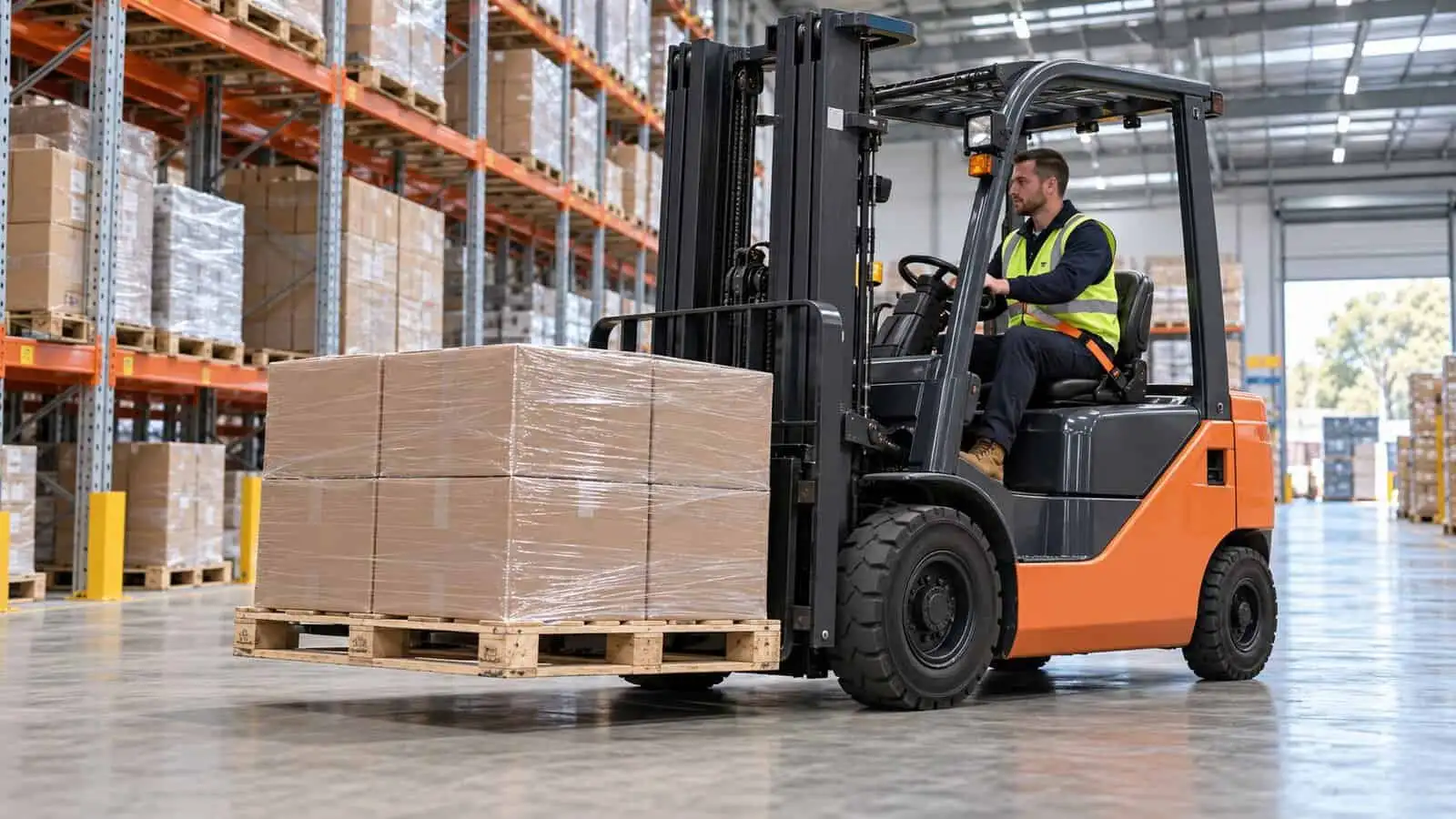
The standard pallet size in Australia is 1165 x 1165 mm (about 116.5 cm square) with a height of around 150 mm, set by Australian Standard AS 4068. Most domestic freight, warehousing and the CHEP and Loscam hire pools run on this footprint. Knowing the size is only half the job: it also decides which forks, pallet jacks and racking will handle the load safely.
What is the standard pallet size in Australia?
An Australian standard pallet is a square timber flat pallet measuring 1165 mm x 1165 mm, made to AS 4068-1993, Flat pallets for materials handling. Loscam’s specification for its Australian wooden pallet gives a height of 150 mm and a tare weight of 34 kg, and notes that the weight changes with moisture, age and timber.
That square footprint is unusual. Most of the world uses rectangular pallets, which is why imported goods so often arrive on a size your racking and equipment were not set up for.
| Pallet | Dimensions (mm) | Dimensions (cm) | Where you see it |
|---|---|---|---|
| Australian standard | 1165 x 1165 | 116.5 x 116.5 | Domestic freight, CHEP and Loscam pools |
| Euro (EPAL 1) | 1200 x 800 | 120 x 80 | European imports |
| European / ISO | 1200 x 1000 | 120 x 100 | European and Asian imports |
| Asian / container | 1100 x 1100 | 110 x 110 | Asian imports, container shipping |
| North American | 1219 x 1016 | 121.9 x 101.6 | US imports |
| Square | 1067 x 1067 | 106.7 x 106.7 | Mixed regions |
Sources: AS 4068 and Loscam (Australian), EPAL (Euro), Logistics Cluster pallet specifications (other sizes).
Why are Australian pallets a different size from the rest of the world?
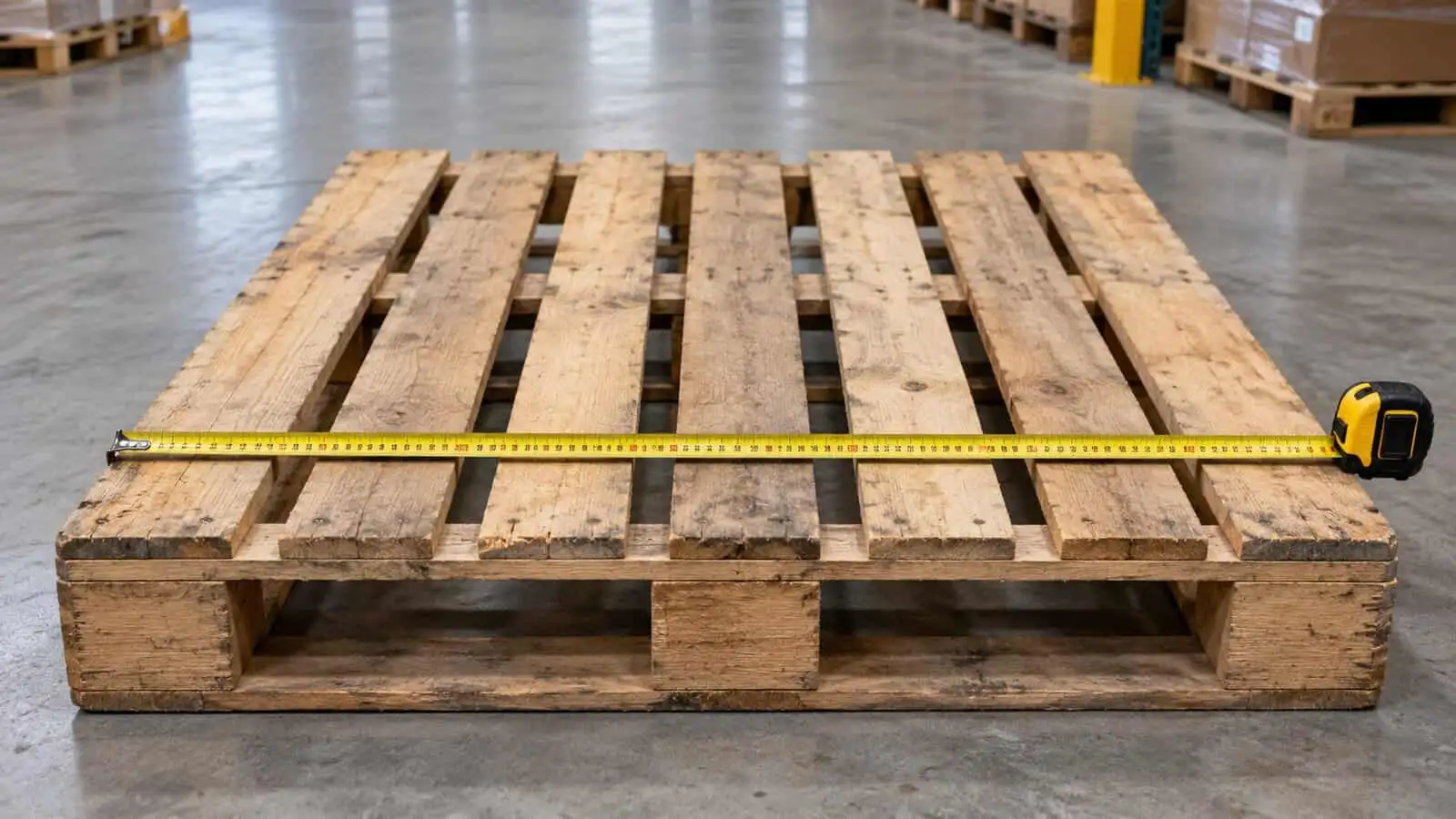
Australian pallets are square because they were sized for the railways. The pallet was first specified at 46 x 46 inches, cut down from a nominal 4 ft square, and later metricated to 1165 x 1165 mm. According to the Wikipedia entry on the Australian standard pallet, the size was designed to fit the RACE container used on Australian railways, with two pallets sitting side by side.
The trade-off is that the Australian pallet is a poor fit for standard 20 ft and 40 ft ISO shipping containers. Exporters commonly use a 1100 x 1100 mm pallet for container freight instead, and goods coming into Australia arrive on whatever size suits the country they left.
What is the difference between CHEP, Loscam and plain pallets?
CHEP and Loscam pallets are hire pallets on the same 1165 x 1165 mm footprint, while plain pallets are bought outright. CHEP and Loscam run pallet pools: the pallet moves through the supply chain and stays the property of the pool operator. A plain or “white” pallet is owned by whoever bought it, and its quality depends on who built it.
Loscam publishes a full specification for its Australian pallet. It is made from plantation radiata pine to AS 4068, measures 1165 x 1165 x 150 mm, weighs 34 kg and is two-way entry. The CHEP Australian pallet shares the same footprint; check CHEP’s own specification sheet for its weight and load ratings, because hardwood and plastic versions differ.
For a warehouse, the practical point is consistency. Pool pallets are built to a known specification, so your racking, forks and pallet jacks can be set up once. Plain pallets vary, which means more checking at receival.
How much weight can a standard pallet carry?
A standard Australian pallet is typically rated to carry up to 2,000 kg while it is being moved. Loscam rates its Australian pallet at a maximum payload of 2,000 kg and a maximum static load of 10,000 kg. Those two numbers measure different things, and the rack is a third limit again.
- Payload (dynamic): the weight the pallet can carry while it is lifted and moved by a forklift or pallet jack.
- Static load: the weight the pallet can bear sitting on a flat, solid floor, for example at the bottom of a block stack.
- Racking load: the weight the pallet can carry when supported only at its edges on rack beams, usually the most demanding case.
Board thickness changes the answer on softwood pallets. The Wikipedia entry notes softwood pallets with 19 mm boards carry up to 1 tonne and 25 mm boards up to 2 tonnes, while hardwood pallets carry more than 2 tonnes. By comparison, EPAL rates the Euro pallet at a 1,500 kg safe working load.
The pallet rating never overrides the rack rating. SafeWork NSW’s pallet racking guide sets two limits that must not be exceeded: the maximum unit load and the total rated capacity of each bay.
Two-way or four-way entry: which sides can your forks go in?
Two-way entry means forks can only go in from two opposite sides; four-way entry allows forks in from all four sides. Loscam lists its Australian pallet as two-way entry, so the bearers block fork entry on the other two sides.
This matters most for pallet jacks and for loading trucks and containers. If a pallet can only be entered from two sides, it has to be oriented correctly before it is put down, or someone ends up turning it by hand. Check the entry type when you set up racking orientation and loading bays, not after the first container arrives.
What fork length do you need for an Australian pallet?
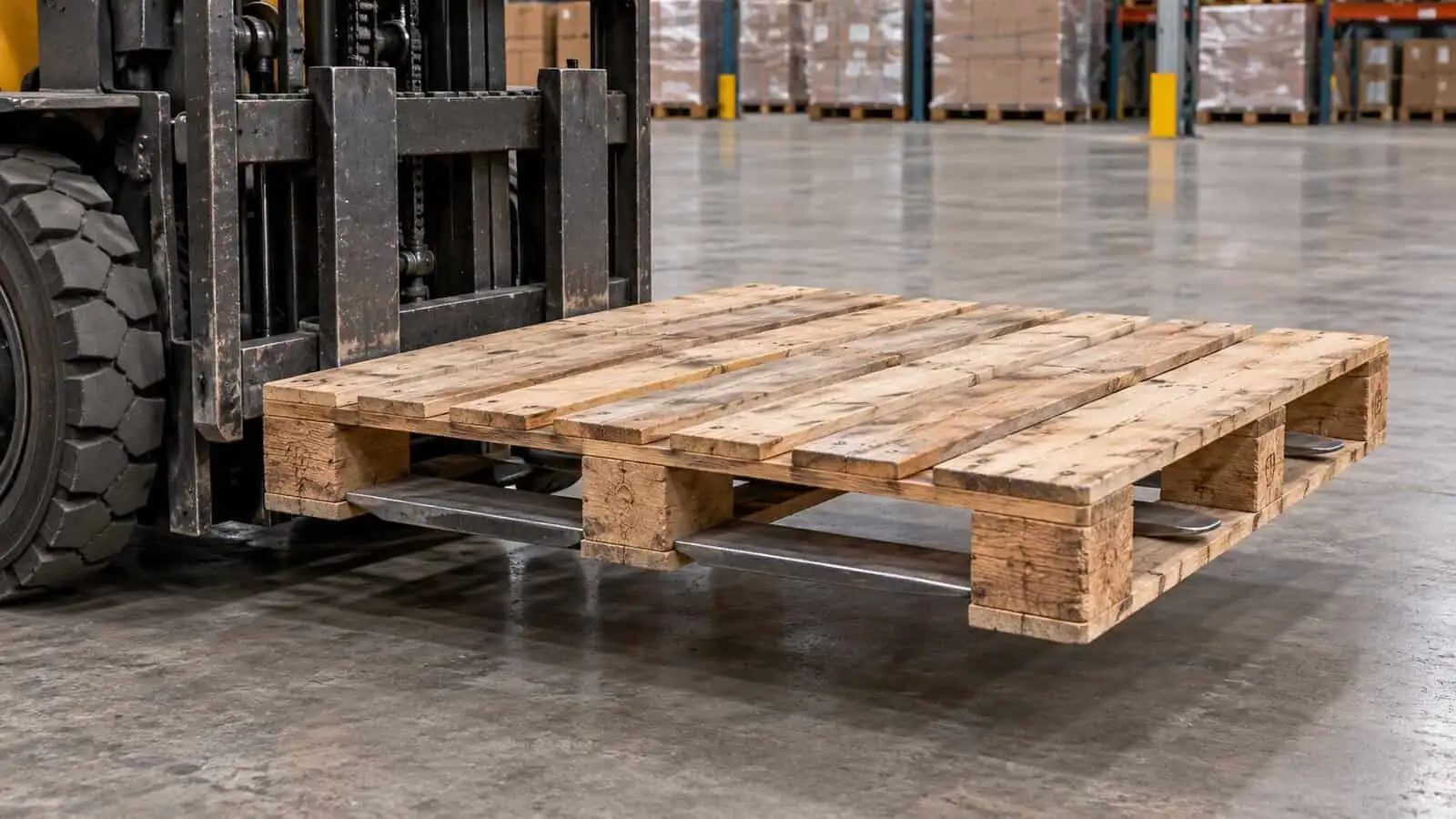
Forks should reach at least two-thirds of the way under the load, which on an Australian pallet means at least about 777 mm. That guidance comes from the Canadian Centre for Occupational Health and Safety (CCOHS), which also advises inserting the forks all the way under the load and setting them as wide as the load allows, evenly either side of centre.
In practice, most counterbalance forklifts run tynes well beyond that minimum. Forklift tyne lengths regularly listed by Australian suppliers include 1,070 mm, 1,220 mm, 1,370 mm and 1,530 mm. A 1,070 mm tyne carrying a 1165 mm pallet square leaves about 95 mm of pallet past the fork tips, which is normal and well inside the two-thirds rule.
Longer is not automatically better. A tyne that reaches past the pallet can catch the pallet behind it in racking or a truck. Match the tyne length to the deepest load you handle routinely.
Why load centre matters on a 1165 mm pallet
An evenly loaded Australian pallet puts its centre of gravity about 583 mm from the fork face, which is beyond the 500 mm load centre many forklifts are rated at. Load centre is the distance from the vertical face of the forks to the centre of gravity of the load. Forks on Class 2 and Class 3 carriages carry a 500 mm rated load centre under ISO 2328, and Class 4 and Class 5 carriages carry 600 mm.
The further the load centre moves out, the less the forklift can safely lift. The headline capacity on a brochure is quoted at the rated load centre, so a heavy, evenly loaded Australian pallet may sit outside it. Before lifting near the machine’s limit, check the data plate and load chart for the actual load centre, because forklift weight capacity falls as the load moves away from the mast.
Six checks before you lift a pallet
- Confirm the pallet size and whether it is two-way or four-way entry.
- Check for broken boards, split bearers and protruding or corroded nails.
- Check the load weight against the forklift’s capacity at the real load centre.
- Set the forks as wide as the pallet allows, evenly either side of centre.
- Insert the forks fully under the load.
- Check the rack’s unit load limit before putting the pallet away.
WorkSafe WA’s safety alert on wooden flat pallets found damaged pallets were a recurring problem in freight handling, and recommends inspecting pallets at both receival and dispatch.
Will a pallet jack or walkie stacker fit a standard pallet?
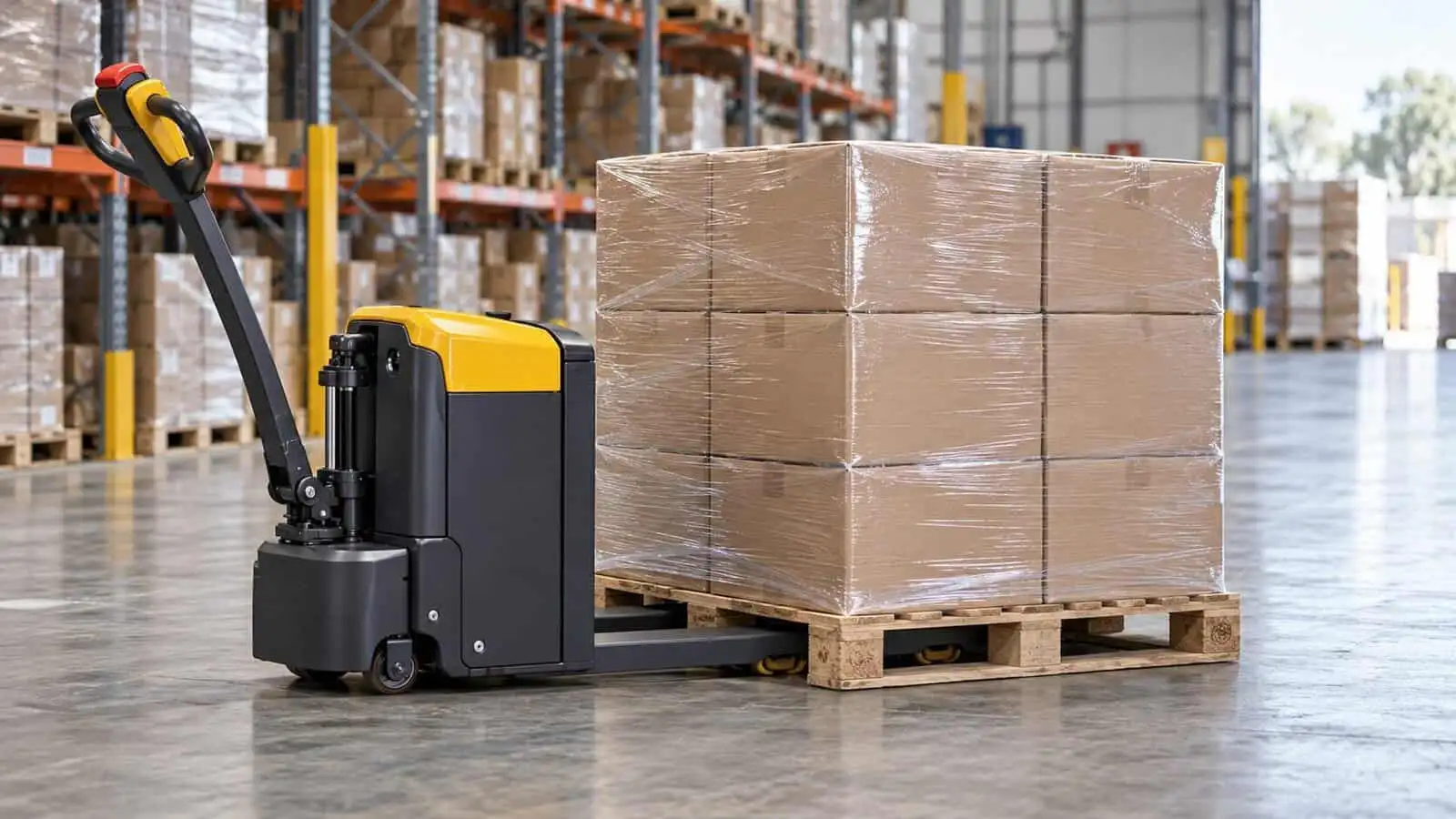
Yes, standard pallet jacks are built around the Australian pallet. Crown’s PTH 50 hand pallet truck, for example, is listed on Crown Australia’s site with fork lengths from 795 to 1,150 mm and overall fork widths from 450 to 685 mm. A 1,150 mm fork suits a 1165 mm pallet, and 685 mm is the common standard width.
Euro pallets are where jacks run into trouble. A Euro pallet is only 800 mm wide, so a jack entering from that side needs a narrower fork set, which is why suppliers list narrow-width models alongside the standard. If you regularly receive European stock, check the fork width before buying any electric pallet jack, and confirm it suits both pallet sizes.
A pallet jack moves pallets along the floor; it does not put them away. Once pallets need to go into racking, an electric pallet stacker or a forklift is the next step.
How does pallet size affect racking?
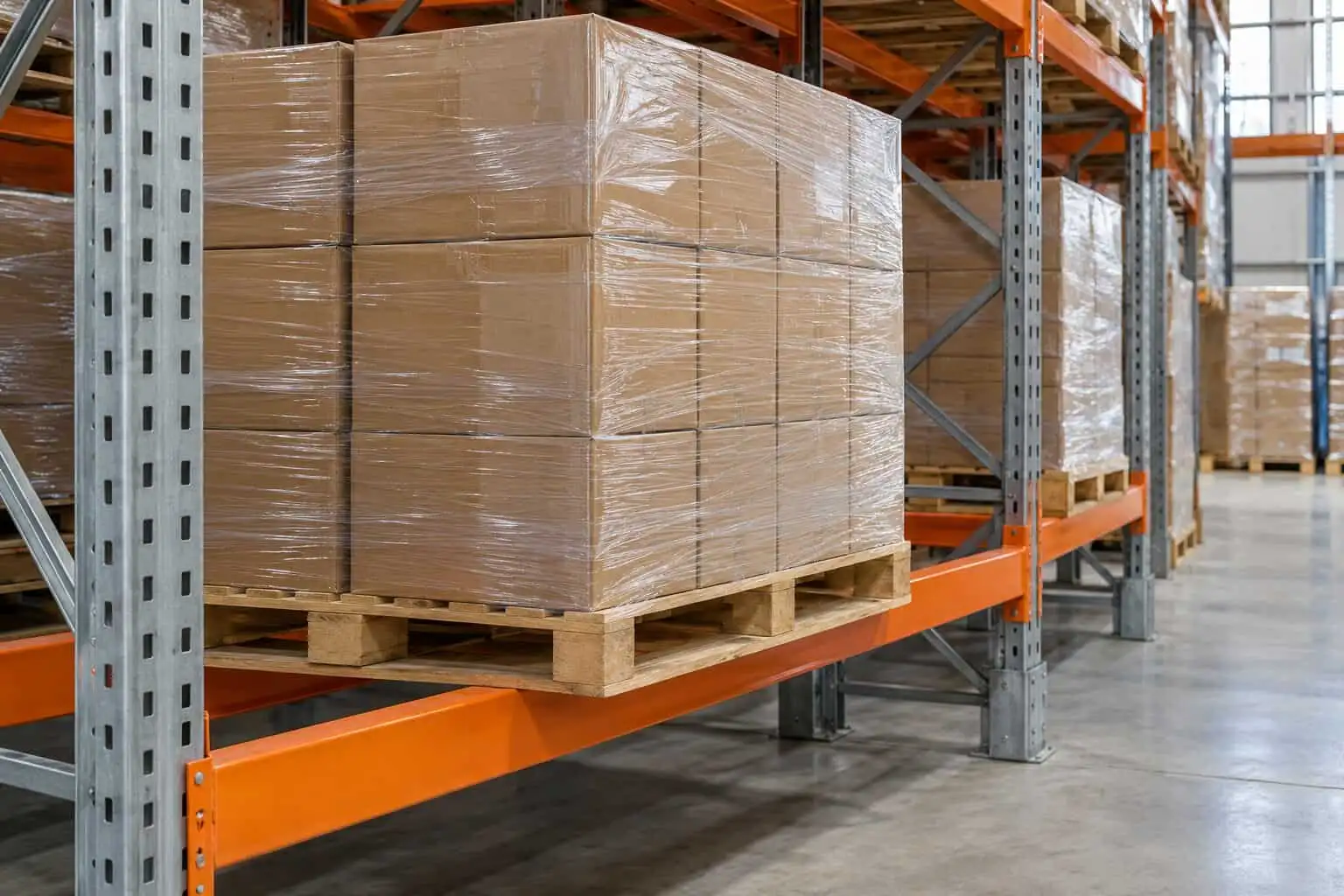
Racking is designed around a pallet size, and the wrong pallet can overload or fall through it. Selective racking in Australia is commonly 840 mm deep, according to racking supplier Macrack, so a 1165 mm pallet overhangs the frame by roughly 150 mm at the front and back. That overhang is intentional and lets the pallet sit across both beams.
SafeWork NSW’s pallet racking guide warns that oversized pallets can overlap pallets behind them or push them off their supports, while undersized pallets or skids without a timber deck can drop through. Racking is covered by AS 4084, and SafeWork NSW requires a formal inspection by a competent person at intervals of no more than 12 months, with load limits clearly marked on each bay.
Taller racking changes the machine as well as the rack. For high-bay storage of standard pallets, reach trucks built for high-bay racking are usually the right fit.
How do you handle Euro and imported pallets on Australian equipment?
Imported pallets need a plan before they arrive, because they rarely match Australian racking or pallet jacks. EPAL specifies the Euro pallet at 1200 x 800 x 144 mm, about 25 kg and a 1,500 kg safe working load. SafeWork NSW notes that overseas pallets often differ in size and may not fit Australian racking, and that any change in pallet design should be assessed by a competent person.
| Specification | Australian (Loscam) | Euro (EPAL 1) |
|---|---|---|
| Footprint | 1165 x 1165 mm | 1200 x 800 mm |
| Height | 150 mm | 144 mm |
| Tare weight | 34 kg | About 25 kg |
| Rated load | 2,000 kg maximum payload | 1,500 kg safe working load |
There are three workable options. Restack imported goods onto Australian pallets at receival, set aside racking designed for the imported size, or confirm that your fork spread and pallet jack width suit the imported pallet before the container is unpacked. The right choice depends on how often imports arrive and how long they stay on site.
Frequently asked questions
1. What is the standard pallet size in Australia?
The standard pallet size in Australia is 1165 x 1165 mm, set by AS 4068. Loscam’s specification gives a height of 150 mm for its Australian wooden pallet.
2. What size is a CHEP pallet in Australia?
A CHEP Australian pallet uses the standard 1165 x 1165 mm footprint, the same as Loscam pool pallets. Check CHEP’s specification sheet for the weight and load rating of the specific pallet type.
3. How much does a standard Australian pallet weigh?
A Loscam radiata pine Australian pallet weighs 34 kg according to Loscam’s specification. Weight varies with moisture, age and timber, so hardwood and wet pallets can weigh more.
4. How much weight can a standard pallet hold?
A standard Australian pallet is typically rated to carry up to 2,000 kg while being moved. Loscam rates its Australian pallet at a 2,000 kg maximum payload and a 10,000 kg static load, and the rack’s own unit load limit still applies.
5. What is the difference between an Australian pallet and a Euro pallet?
An Australian pallet is square at 1165 x 1165 mm, while a Euro pallet is rectangular at 1200 x 800 mm. The Euro pallet is lighter at about 25 kg and is rated by EPAL at a 1,500 kg safe working load.
6. What fork length do I need for an Australian pallet?
Forks should reach at least two-thirds of the load length, about 777 mm on an Australian pallet, according to CCOHS. Common tyne lengths such as 1,070 mm and 1,220 mm comfortably cover a standard pallet.
7. Are all pallets in Australia 1165 x 1165 mm?
No. The 1165 x 1165 mm pallet is the domestic standard, but warehouses also handle Euro pallets (1200 x 800 mm), 1200 x 1000 mm pallets and 1100 x 1100 mm export pallets, especially on imported stock.