
Warehouse Forklifts Melbourne: Which Type Suits Your Site
· Updated
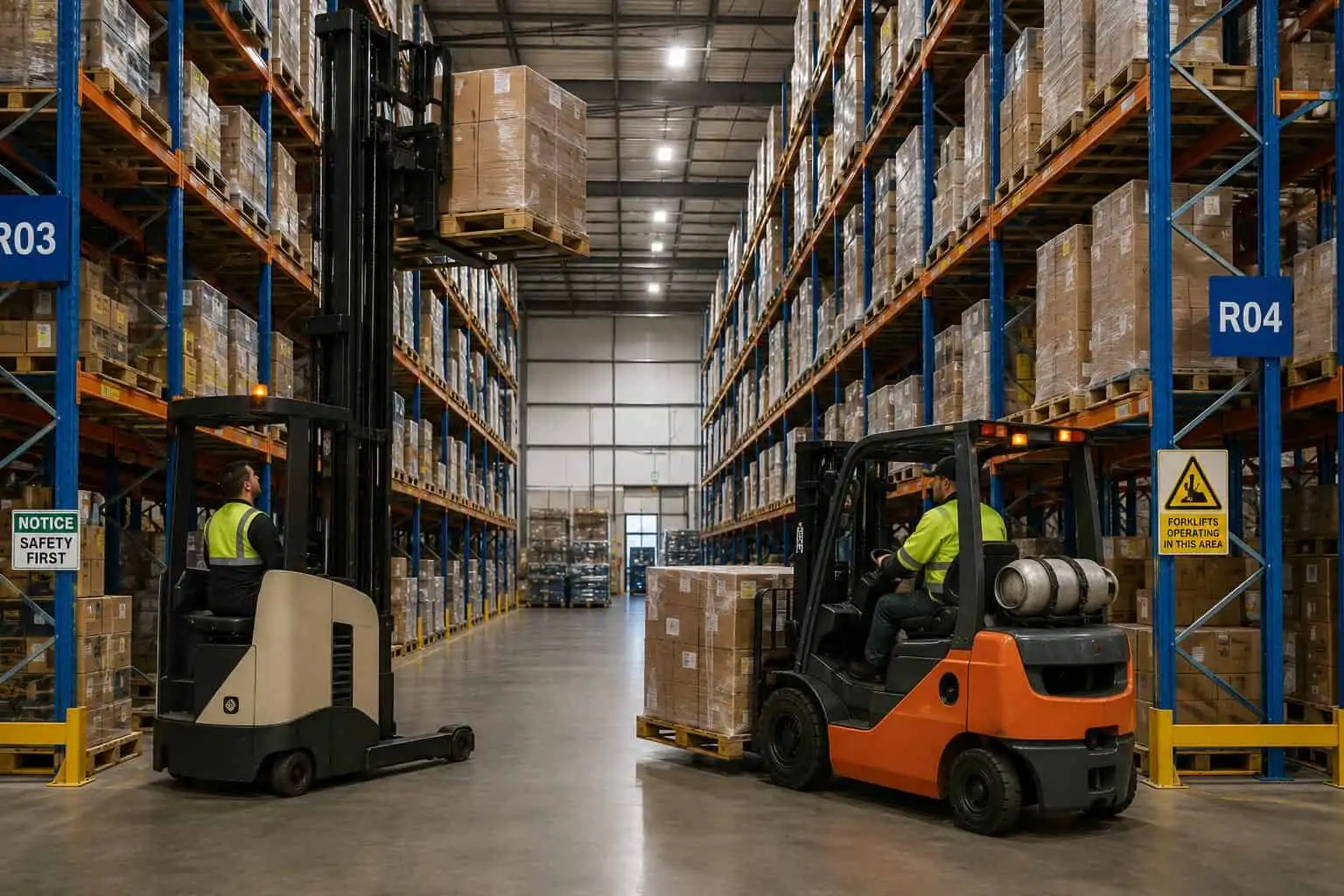
A warehouse forklift is not one machine. It is a category covering counterbalance forklifts, reach trucks, order pickers and stackers.
The right one for your site is decided by two measurements: how wide your aisles are and how high your racking goes. Get those two right and the rest of the specification follows.
This guide covers the main types, how to match them to your racking, and what to look at before buying in Melbourne.
What Is a Warehouse Forklift?
A warehouse forklift is any powered lifting truck designed to move and stack palletised goods inside a building with racked storage.
That covers several distinct machine types rather than one, and they are not interchangeable.
The defining constraints of warehouse work are aisle width, lift height and floor surface. A machine that handles all three well outdoors will usually be poor at one of them indoors, which is why warehouse machines are a category of their own.
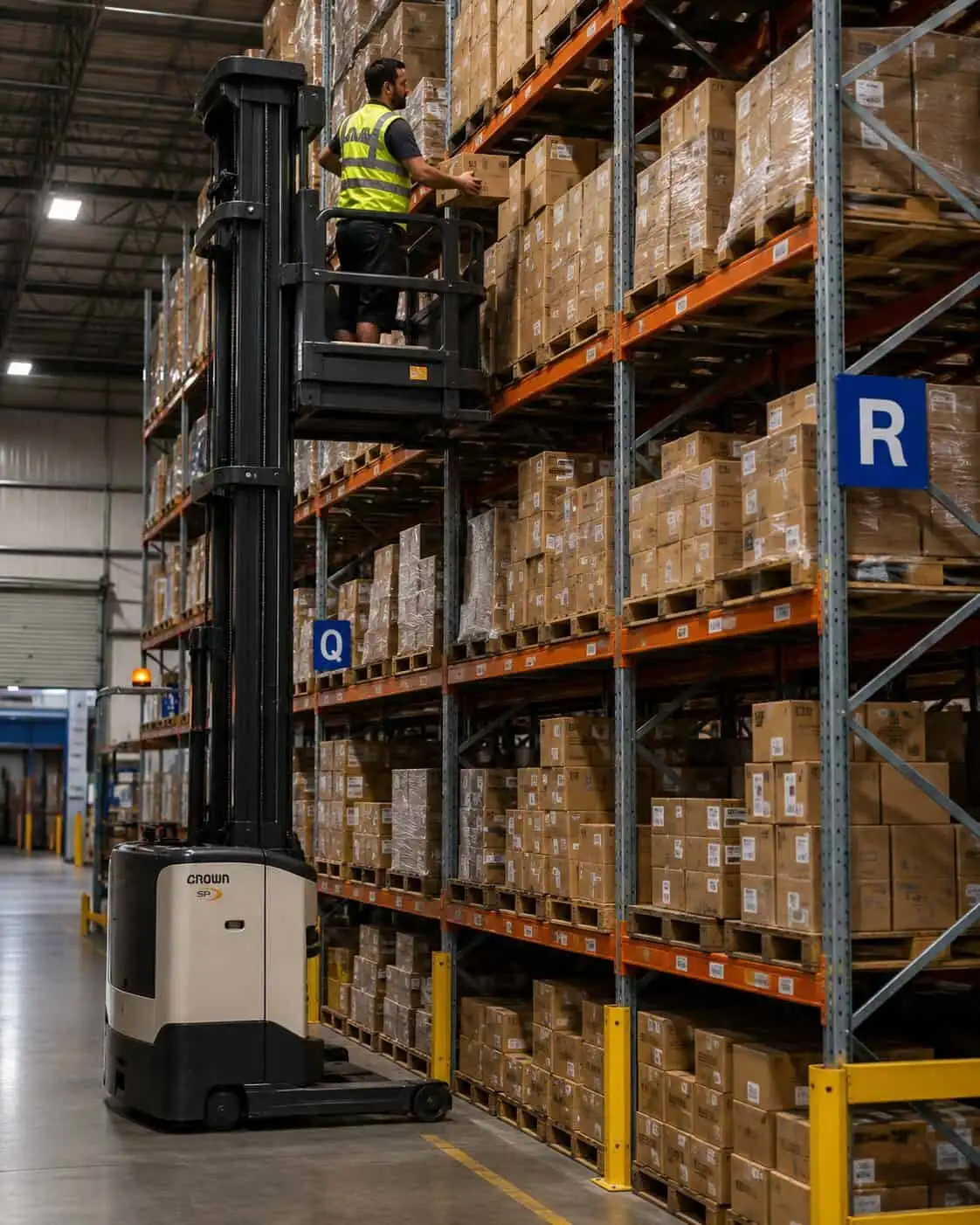
The Main Types of Warehouse Forklift
|
Machine |
What it does |
Aisle requirement |
Best for |
|---|---|---|---|
|
Counterweight at the rear, no outrigger legs, forks ahead of the front wheels |
Widest |
Truck loading, dock work, general racking, mixed indoor and outdoor duty |
|
|
Outrigger legs under the load, mast extends forward to place the pallet |
Considerably narrower |
High bay racking and dense storage |
|
|
Order picker |
Raises the operator with the forks to pick individual items |
Narrow |
Picking cartons or singles rather than full pallets |
|
Operator walks alongside, mast lifts pallets to height |
Narrow |
Light stacking in confined spaces, low throughput |
|
|
Moves pallets at ground level, no mast |
Narrowest |
Horizontal pallet movement and loading |
The most common warehouse forklift on Australian sites is the electric counterbalance, because it does most jobs adequately and loads trucks, which the narrow-aisle machines cannot.
Sites that outgrow it usually add a reach truck rather than replacing it.
Start With Your Racking and Aisles
Aisle width eliminates more options than any other factor, so measure it before you look at anything else.
Measure the narrowest real point on the run, not the nominal aisle on the plan. Rack uprights, pallet overhang, damaged rack legs and anything stored in the aisle all reduce the working width.
The figure to compare against is the machine’s right-angle stacking aisle, which is the width it needs to turn ninety degrees and place a pallet. That is not the same as its turning radius, and manufacturers publish both.
Racking height is the second measurement.
A counterbalance forklift tops out lower than a reach truck in most configurations, and capacity reduces as the mast goes up, so a machine that handles your pallet at ground level may not be rated for it at the top beam.
Broadly, wide aisles with mixed duty point to a counterbalance, narrow aisles with tall racking point to a reach truck, and very tight spaces with light loads point to a stacker.
Sites that fall between those cases usually find the answer in matching machine size to the building rather than in picking a different brand.
How Much Can a Warehouse Forklift Lift?
Capacity varies widely across the category, and the number that matters is not the one in the brochure.
Every forklift has a rated capacity that applies at a specific load centre, which is the distance from the face of the forks to the centre of gravity of the load. That rating is on the machine’s data plate along with the mast configuration it was calculated for.
Two things reduce the capacity you actually have available. Lifting higher reduces it, because the machine’s own centre of gravity rises. Fitting an attachment reduces it, because the attachment adds weight and usually pushes the load forward.
Size against your heaviest pallet at your highest beam, not your average pallet at ground level. That is the case that decides whether the machine is right.
Both effects come back to the same principle, and understanding how load centre changes what a machine can lift is what stops a buyer undersizing by a whole capacity class.
Small and Compact Warehouses: What Fits
Plenty of Melbourne warehouses are not big sheds with wide aisles.
If yours is a tenancy in an industrial estate with limited turning room and a roller door that decides your maximum mast height, the compact end of the range is where to look.
A three-wheel electric counterbalance turns in a tighter circle than a four-wheel machine of the same class, which is often enough to make a constrained aisle workable.
The trade-off is a lower capacity ceiling and less stability on anything other than good concrete, and the case for three wheels over four depends on which of those two constraints binds first.
Below that, walkie stackers and electric pallet jacks handle light stacking and horizontal movement without needing a seated machine’s turning room at all.
On a low-throughput site, they are often the honest answer, and they cost considerably less to buy and run.
Check your lowest doorway before you check anything else. Free lift, which is how far the forks travel before the mast starts to extend, decides whether a machine can lift inside a low-roofed tenancy or a shipping container.
High Bay and High Reach Work
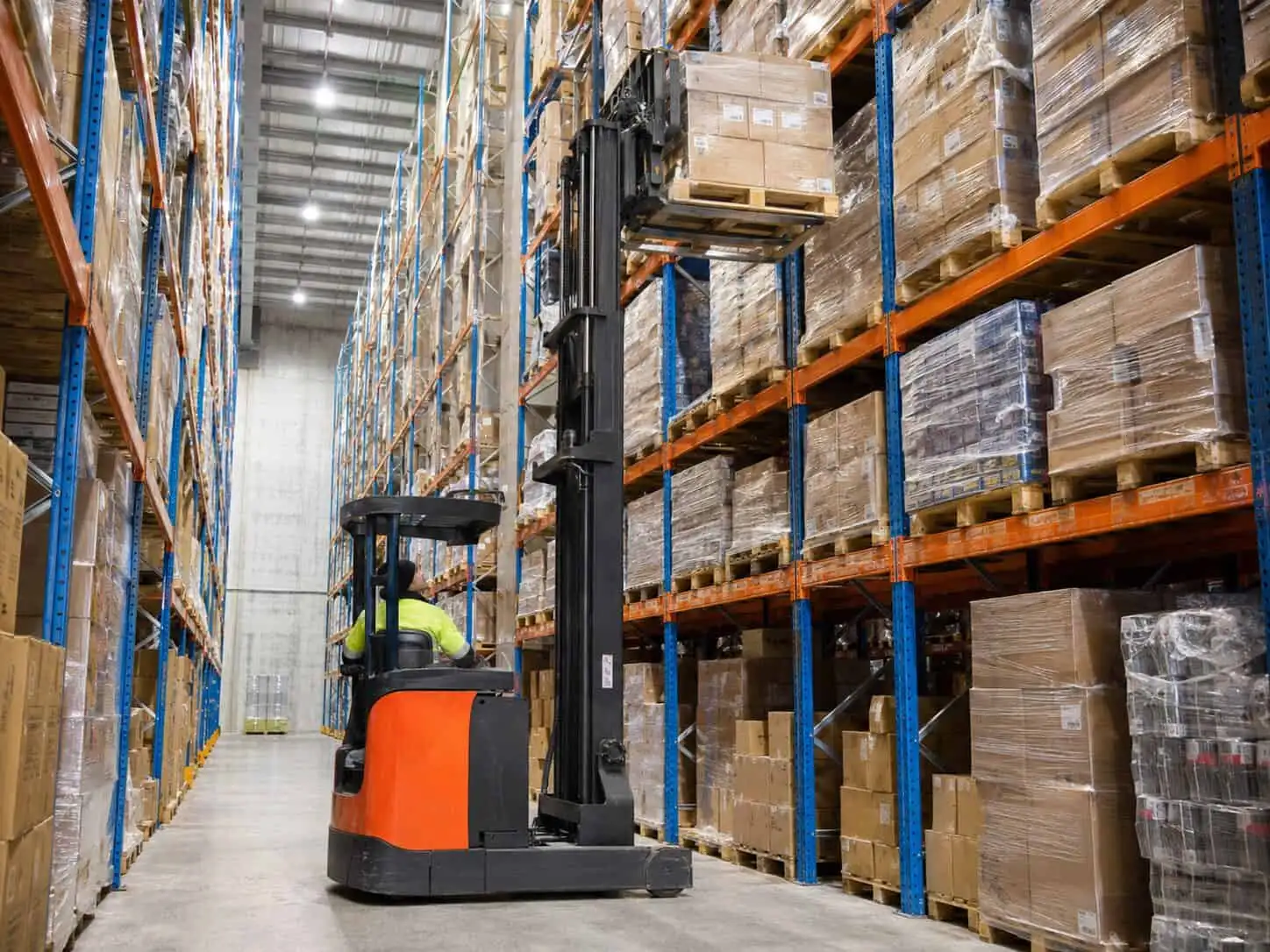
Once racking goes above what a counterbalance can comfortably reach, a reach truck is the machine.
The outrigger legs sit under the load rather than behind it, which removes the need for a counterweight and lets the machine work in far narrower aisles while reaching considerably higher.
What you give up is versatility. A reach truck cannot load a truck, does not handle uneven ground, and is not a yard machine.
Sites running both typically keep a counterbalance for the dock and a reach truck for the racking, and how reach trucks perform in high bay storage is usually what justifies the second machine.
Double reach trucks extend that further, reaching into the second pallet position on a double-deep rack. That increases storage density again at the cost of slower cycle times.
Order Picking
If your operation picks cartons or singles rather than moving full pallets, a forklift is the wrong tool and an order picker is the right one.
The operator is raised with the forks to the pick face, which removes the ladder and the double handling.
Low-level order pickers suit ground and first-level picking with high throughput. Medium and high-level machines reach further up the rack and require more operator training.
They generally fall under a separate high-risk work licence class from a standard forklift, so confirm the class with your state regulator before putting anyone on one.
On the machine itself, service intervals matter more than they do on a counterbalance, and the order pickers that need least attention tend to be the ones that stay productive across a picking shift.
Electric, LPG or Diesel Inside a Warehouse?
Electric is the default for indoor work because it produces no exhaust emissions and runs quietly.
The constraints are charging space and, for lead-acid batteries, a charging area with ventilation requirements. Choosing an electric machine for indoor work is mostly a question of where it charges rather than what it lifts.
LPG is still run indoors on some sites, and the refuelling advantage is genuine for multi-shift operations, but it produces exhaust and the ventilation has to handle it.
That is a site-specific assessment rather than a general permission. Diesel is an outdoor machine and has no place in an enclosed warehouse.
New or Used for Warehouse Work
Used makes sense for single-shift operations, for businesses buying their first or second machine, and where the budget matters more than the warranty period.
A properly serviced used machine with low hours and a documented history will do warehouse work for years.
New makes sense where the machine runs hard across multiple shifts, where downtime is expensive enough to justify the premium, and where the finance and tax treatment of a new asset suits the business.
Buy A Fork carries both, and most of the warehouse-class stock sits among the pre-owned machines in Melbourne, which is also where price and hours are easiest to compare side by side.
Buying a Warehouse Forklift in Melbourne
Buy A Fork sells new and pre-owned warehouse forklifts from the Somerton yard, with delivery across Melbourne.
Every pre-owned machine is inspected and serviced before it goes out, and finance and trade-ins are available.
If you know your aisle width, your top beam height and your heaviest pallet, we can narrow it to a machine type in one conversation. Send us those three numbers, and we will tell you what fits.
Frequently Asked Questions
1. What is a warehouse forklift?
A warehouse forklift is any powered lifting truck designed to move and stack palletised goods inside a building with racked storage.
The category covers counterbalance forklifts, reach trucks, order pickers, walkie stackers and electric pallet jacks, which are not interchangeable.
2. What is the most common warehouse forklift?
The electric counterbalance forklift, because it handles most warehouse tasks and can also load trucks, which the narrow-aisle machines cannot.
Sites that outgrow it usually add a reach truck alongside it rather than replacing it.
3. How much can a warehouse forklift lift?
Capacity varies widely across the category, and every machine has a rated capacity that applies at a specific load centre, stated on its data plate.
That rating reduces as the mast goes higher and when an attachment is fitted, so size against your heaviest pallet at your highest beam rather than the headline figure.
4. What are the three types of forklifts?
Forklifts are most usefully grouped as counterbalance machines, which carry the load ahead of the wheels with a counterweight at the rear; reach and outrigger machines, which support the load between legs and reach forward to place it; and pedestrian machines such as pallet jacks and walkie stackers, where the operator walks alongside.
Which of the three you need depends on aisle width and lift height.
5. What forklift is best for narrow aisles?
A reach truck for tall racking in narrow aisles, or a three-wheel counterbalance where the aisle is tight but the racking is not high.
For very confined spaces with light loads, a walkie stacker avoids the turning room a seated machine needs. Measure the narrowest real point on the aisle, including rack and pallet overhang, before comparing machines.
6. Can you use a diesel forklift indoors?
No, not in an enclosed warehouse. Diesel machines produce exhaust emissions and are outdoor equipment.
Electric is the standard indoor answer, and LPG can be run indoors only where the ventilation is assessed as adequate for the site.
7. Do you need a licence to operate a warehouse forklift?
Yes for counterbalance forklifts, reach trucks and order pickers, all of which require a high-risk work licence, with order picking forklift trucks falling under a separate class from standard forklifts.
Pedestrian pallet jacks generally fall outside the licence classes, though training obligations still apply. The licence classes and how to apply for one differ by state, so confirm the class for your specific machine with your regulator.