
Forklifts for Steel Handling: Capacity and Attachments
· Updated
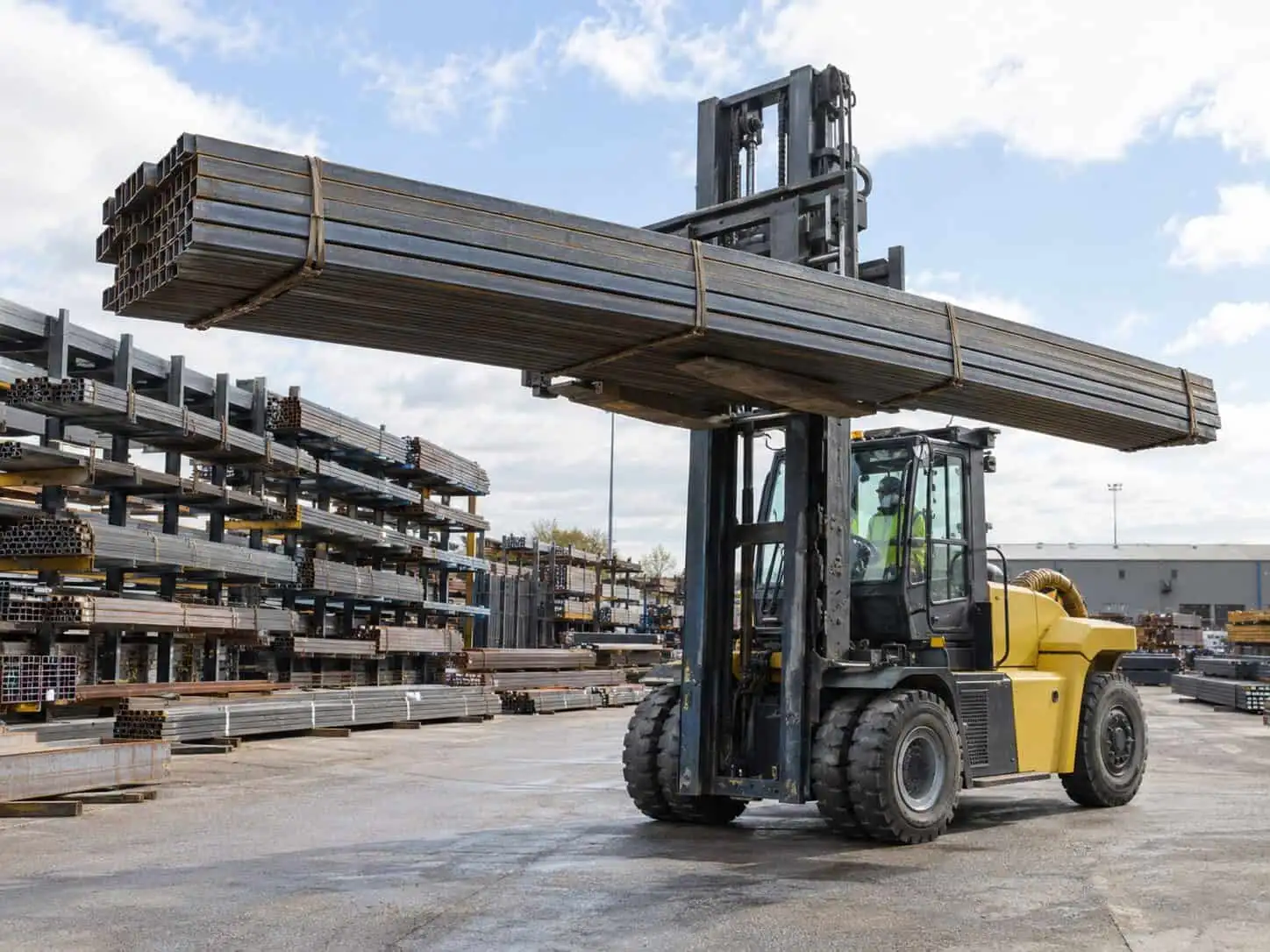
Choosing forklifts for steel handling goes wrong when the buyer specifies for weight. Steel is rarely defeated by weight on its own. It is defeated by length, and by how far that length pushes the load out in front of the forks.
A six metre length of bar has its centre of mass three metres out. On a machine rated at a 600mm load centre, that is five times the distance the rating was measured at, and the badge figure stops meaning anything useful.
This guide covers what capacity steel work actually demands, why long loads cut the rating so hard, a load centre trap that catches experienced buyers moving up the range, the attachments that solve each steel handling problem, and the point at which a counterbalance is simply the wrong machine.
What Capacity Forklift Do You Need for Steel?
Steel handling generally starts at 3.5 tonnes and runs well beyond, because the constraint is rarely the weight of the steel on its own. It is the weight combined with how far that steel extends past the fork face.
A business that handles nothing heavier than a tonne of bar stock can still need a five tonne machine, because a six metre length puts its centre of mass three metres out from the forks. Capacity ratings are not written for that, and this article is largely about what to do with the difference.
Here is the standard heavy range for reference. These are Toyota’s 8FG and 8FD models from 3.5 to 8.0 tonnes.
|
Model |
Capacity |
Load centre |
Overall width |
Length to fork face |
Turning radius |
Service weight |
|
8FG/8FD35N |
3,500kg |
600mm [500mm option] |
1,350mm |
2,925mm |
2,610mm |
5,700 / 5,800kg |
|
8FG/8FD40N |
4,000kg |
600mm [500mm option] |
1,350mm |
2,980mm |
2,660mm |
6,070 / 6,170kg |
|
8FG/8FD45N |
4,500kg |
600mm [500mm option] |
1,450mm |
3,110mm |
2,750mm |
6,610 / 6,710kg |
|
8FG/8FD50N |
5,000kg |
600mm |
1,450mm |
3,170mm |
2,810mm |
7,140 / 7,240kg |
|
8FD60N |
6,000kg |
600mm |
1,965mm |
3,490mm |
3,230mm |
8,390kg |
|
8FD70N |
7,000kg |
600mm |
1,965mm |
3,545mm |
3,280mm |
9,125kg |
|
8FD80N |
8,000kg |
600mm |
1,965mm |
3,590mm |
3,320mm |
9,980kg |
Source: Toyota 8FG/8FD 3.5 to 8.0 ton series technical catalogue, pulled 23 August 2026. Figures vary by mast and tyre configuration.
Two things in that table deserve attention before you use it. Service weight climbs to nearly ten tonnes on the 8FD80N, which is a yard surface and floor loading question as much as a machine question. And the load centre column is not constant, which is the subject of the next two sections.
Why Long Steel Loads Cut Rated Capacity
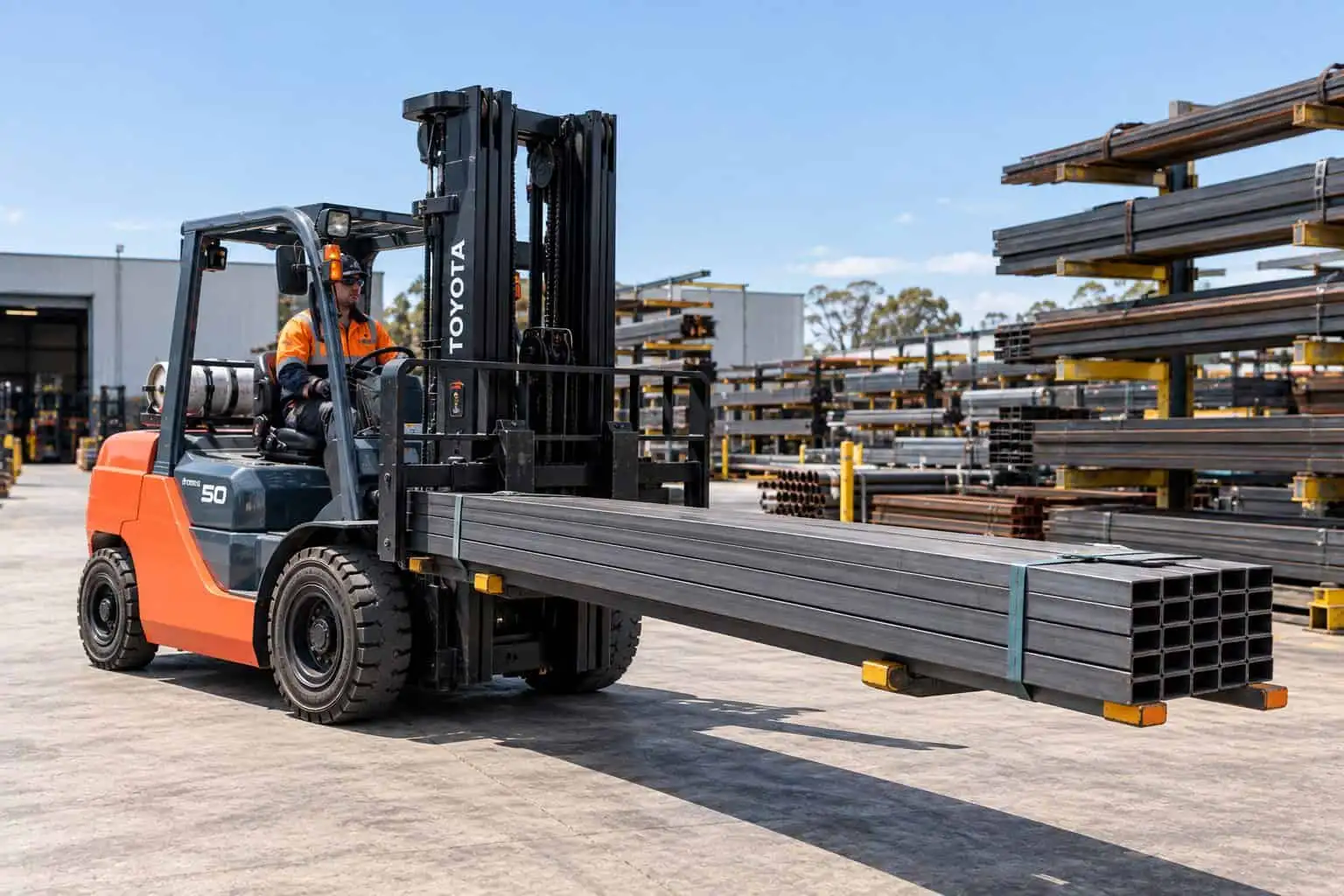
Rated capacity is measured with the load’s centre of mass at a fixed distance from the fork face. On Toyota’s heavy range that distance is 600mm. Every capacity figure in the table above assumes it.
Steel does not co-operate with that assumption. A uniform six metre length of bar balanced on the forks has its centre of mass at three metres, which is five times the rating point. The forklift’s counterweight is working against a lever five times longer than the one the rating was calculated for.
This is why the arithmetic that matters in a steel yard is not the weight of the bundle. It is the weight of the bundle multiplied by how far out it sits, and a light long load can be more demanding than a heavy compact one.
We are not going to publish a derated figure, because the reduction is specific to the model, the mast and the attachment fitted. What we will say plainly is that the number on the badge does not apply to a six metre length of anything, and that the load chart on the specific machine is the only document that gives you the real figure. How load centre and capacity interact is the whole mechanism, and steel handling is where it shows up most sharply.
Anyone specifying a machine for steel should be asking the supplier for capacity at their actual load length, in writing, rather than accepting a tonnage.
The Load Centre Trap When You Move Up in Capacity
Here is a detail that catches experienced buyers and is almost never explained.
In Toyota’s heavy range, the 3.5, 4.0 and 4.5 tonne machines are rated at 600mm with a 500mm option. From 5.0 tonnes upward, the rating is fixed at 600mm. In the lighter 1.0 to 3.5 tonne range, the standard rating point is 500mm.
That means a capacity figure is not directly comparable across the range unless you check the load centre it was measured at. A machine rated 3,500kg at 500mm and one rated 3,500kg at 600mm are not the same machine: the second is holding the same weight a hundred millimetres further out, which takes more counterweight and more machine.
When you are comparing quotes from different suppliers or different brands, this is the first column to check and the easiest to overlook, because both quotes will say the same tonnage. Ask what load centre each figure is quoted at before you compare anything else.
Matching the Machine to the Steel You Handle
Different steel products create different problems, and the machine that suits one can be poor at another.
Bar, tube and long sections are the load centre problem in its purest form. The weight is often modest and the length is the constraint. Fork extensions help, a sideloader helps more, and a standard counterbalance handles it badly beyond a few metres.
Plate and sheet is heavy, compact and awkward to grip. The load centre is manageable, the weight is not, and the risk is the sheet sliding on smooth forks. This is where capacity in the table above is genuinely the binding constraint.
Coil is the specialist case. It is heavy, it is round, and it will roll if it is not restrained. A coil ram or a coil-specific attachment is not an optimisation here, it is the difference between a controlled lift and a load rolling off the forks.
Structural sections and fabricated assemblies vary too much to generalise, and the practical approach is to specify for the worst regular case rather than the average.
Most steel businesses end up with more than one machine because of this spread, typically a high capacity counterbalance for plate and bundles and something more specialised for length.
Attachments for Steel Handling
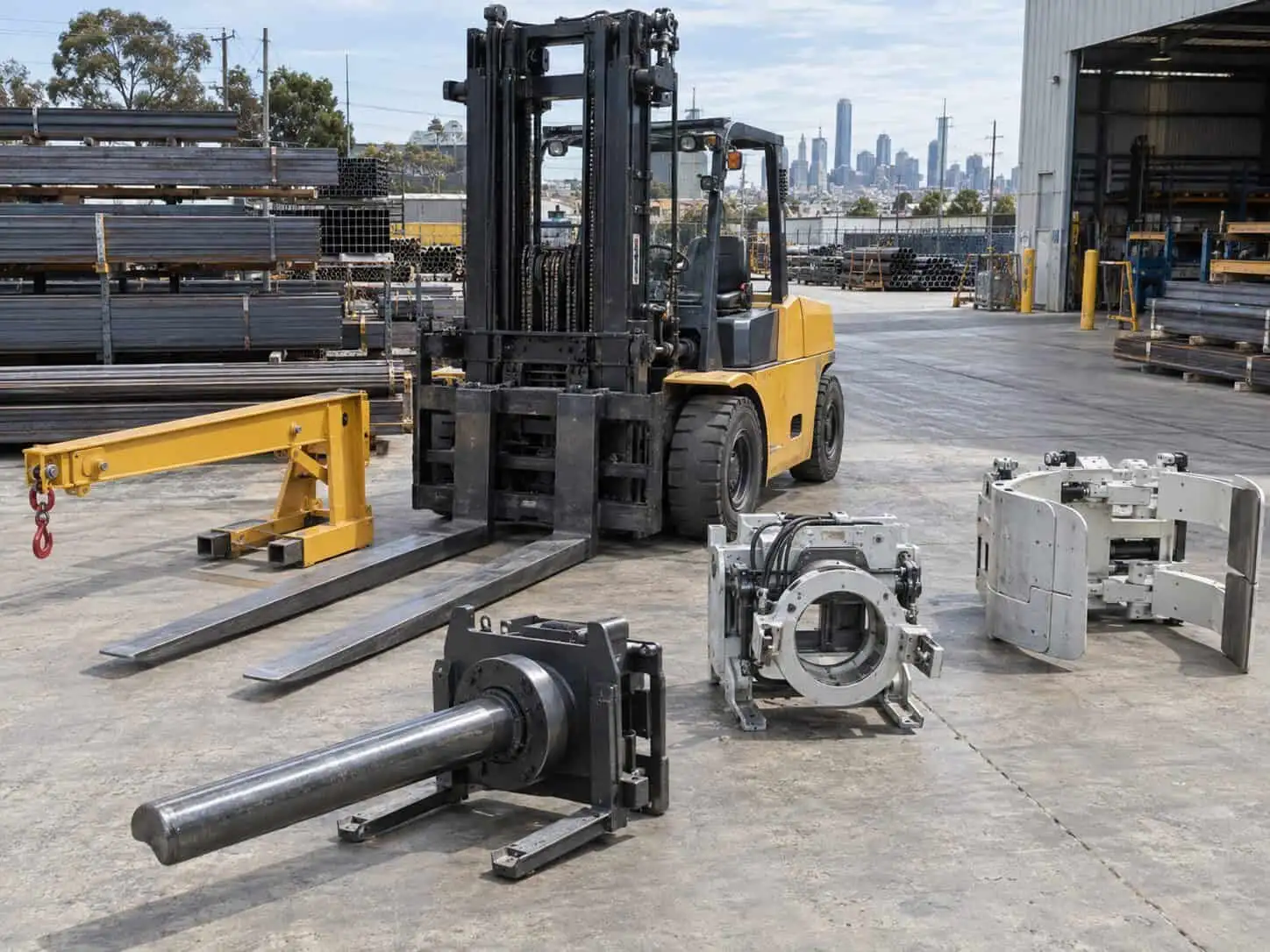
Attachments are what turn a general purpose forklift into a steel handling machine, and each solves a different problem.
- Fork extensions: the cheapest way to handle longer material, and the one that moves the load centre furthest out. They reduce usable capacity substantially and should only be fitted within the manufacturer’s stated limits.
- Boom or jib: converts the forklift into a short-reach crane for lifting bundles and awkward assemblies. It moves the load a long way forward, so the capacity penalty is the largest of any attachment.
- Coil ram: a single tapered arm that carries coil through its centre, keeping it controlled and preventing roll.
- Rotator: allows the load to be turned, which suits tipping and repositioning operations in fabrication.
- Clamps: grip the load rather than carrying it on forks, which suits material that cannot be safely supported from underneath.
The point that gets forgotten with all of them is that every attachment carries a capacity penalty. It adds its own weight ahead of the front axle and it usually pushes the load further out, so net capacity drops before anything is lifted. Choosing an attachment changes what the machine can carry, and the data plate has to be revised to show the rating with that attachment fitted. Running a boom or a clamp against the original plate is a compliance failure as well as a safety one.
Sideloaders and Multi-Directional Forklifts for Long Loads
If long material is the core of the business rather than an occasional job, the honest answer is often a machine type that most forklift dealers do not lead with.
A sideloader carries length along the machine rather than across it. The load sits on a deck parallel to the direction of travel, which means the machine can move a twelve metre length down an aisle that a counterbalance could not turn in with a two metre one. It removes the load centre problem rather than managing it.
Multi-directional machines take a similar approach with wheels that rotate to allow sideways travel, giving some of the same benefit with more general purpose flexibility.
These are specialist machines and they cost accordingly, so the threshold question is volume. If long material moves a few times a week, a counterbalance with fork extensions and a slow careful operator is the sensible answer. If it moves all day, a sideloader will pay for itself in throughput and in damage avoided, and a counterbalance will never do the job properly no matter how much capacity you buy.
Tyres, Surfaces and Steel Yards
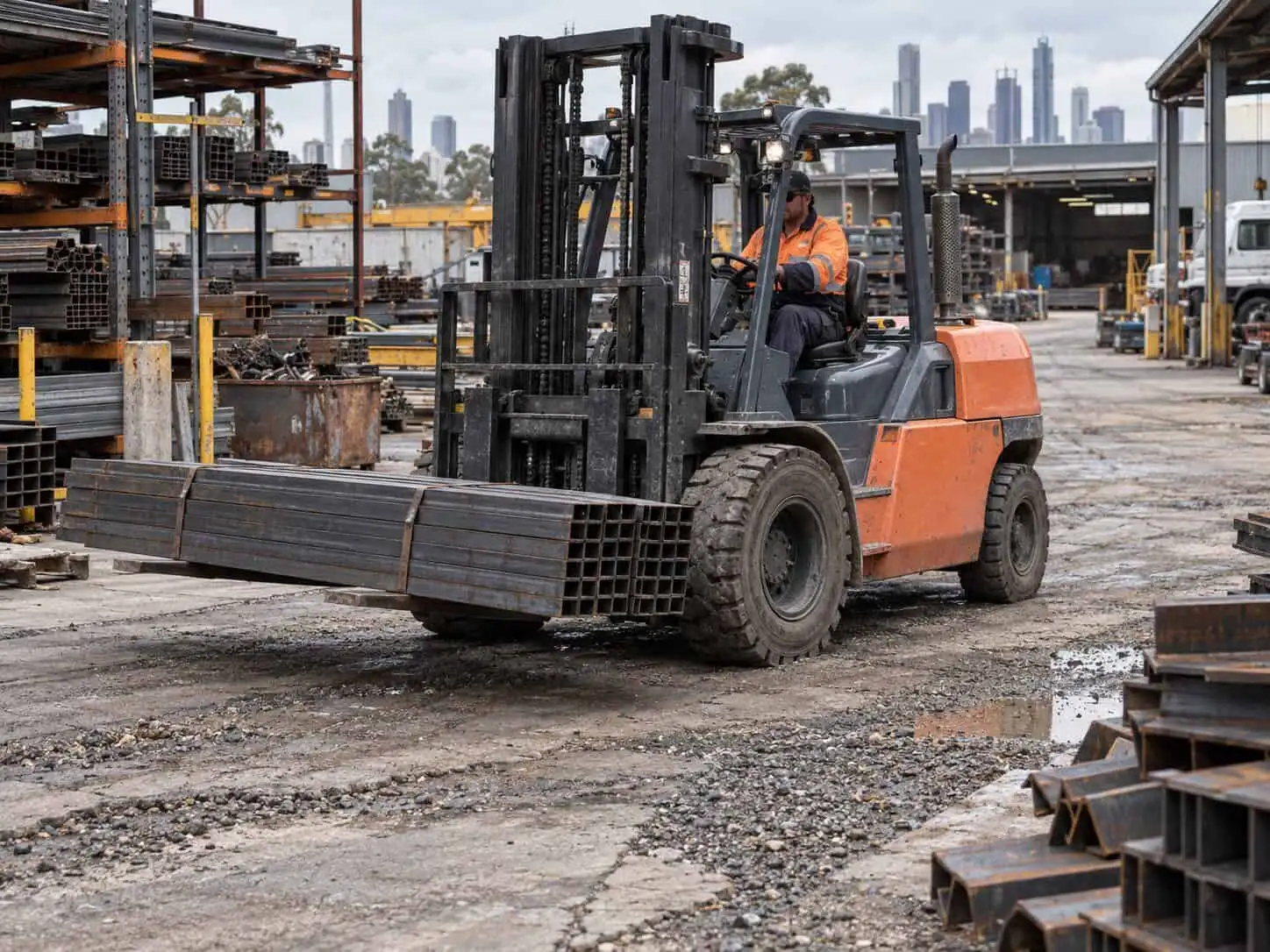
Steel yards are hard on tyres in a way that warehouses are not, and the tyre decision is a real one rather than a detail.
Offcuts, swarf, weld spatter and dropped fixings are constant in a fabrication or stockholding environment, and a pneumatic tyre in that setting will find them. Punctures are not just downtime, they are downtime with a loaded machine in an awkward position.
Solid and solid pneumatic tyres remove the puncture risk at the cost of ride quality and some traction on loose surfaces. On an unsealed yard that trade needs thinking about, because a solid tyre on a soft or rutted surface handles differently under a heavy load.
Surface condition also affects the capacity conversation. A rated capacity assumes a firm level surface, and a heavy machine at nearly ten tonnes service weight on an unsealed yard is working outside that assumption. Tyre choice and condition is one of the few things in a steel yard you can control cheaply.
Safety Requirements for Steel Handling
Steel creates hazards that general forklift training does not fully cover, and they are worth setting out explicitly in a site’s procedures.
Load restraint is the first. Long material can slide, bundled material can shift as strapping loosens, and coil can roll. A load that is stable on a level surface may not be stable on a ramp or during a turn.
Exclusion zones are the second, and they matter more here than almost anywhere. A six metre length swinging through a turn sweeps a large area, and a rolling coil is unstoppable. Pedestrian separation in a steel yard needs to account for the load, not just the machine.
Visibility is the third. A long load ahead of the machine blocks the operator’s forward view entirely, which is why travelling in reverse with the load trailing is standard practice for long material. That has to be trained and it has to be built into the site’s traffic plan.
Operators need an LF high risk work licence for a counterbalance machine of this type. Speed control matters more with a heavy long load because stopping distance grows with mass and the load’s momentum works against the machine in a turn. Setting a workplace speed limit is a risk assessment made under the general duty rather than a fixed national figure.
Safe Work Australia sets the model framework for plant safety and load restraint and WorkSafe Victoria administers it here. Confirm current requirements with your regulator rather than relying on any summary.
Specifying a Steel Handling Forklift in Melbourne
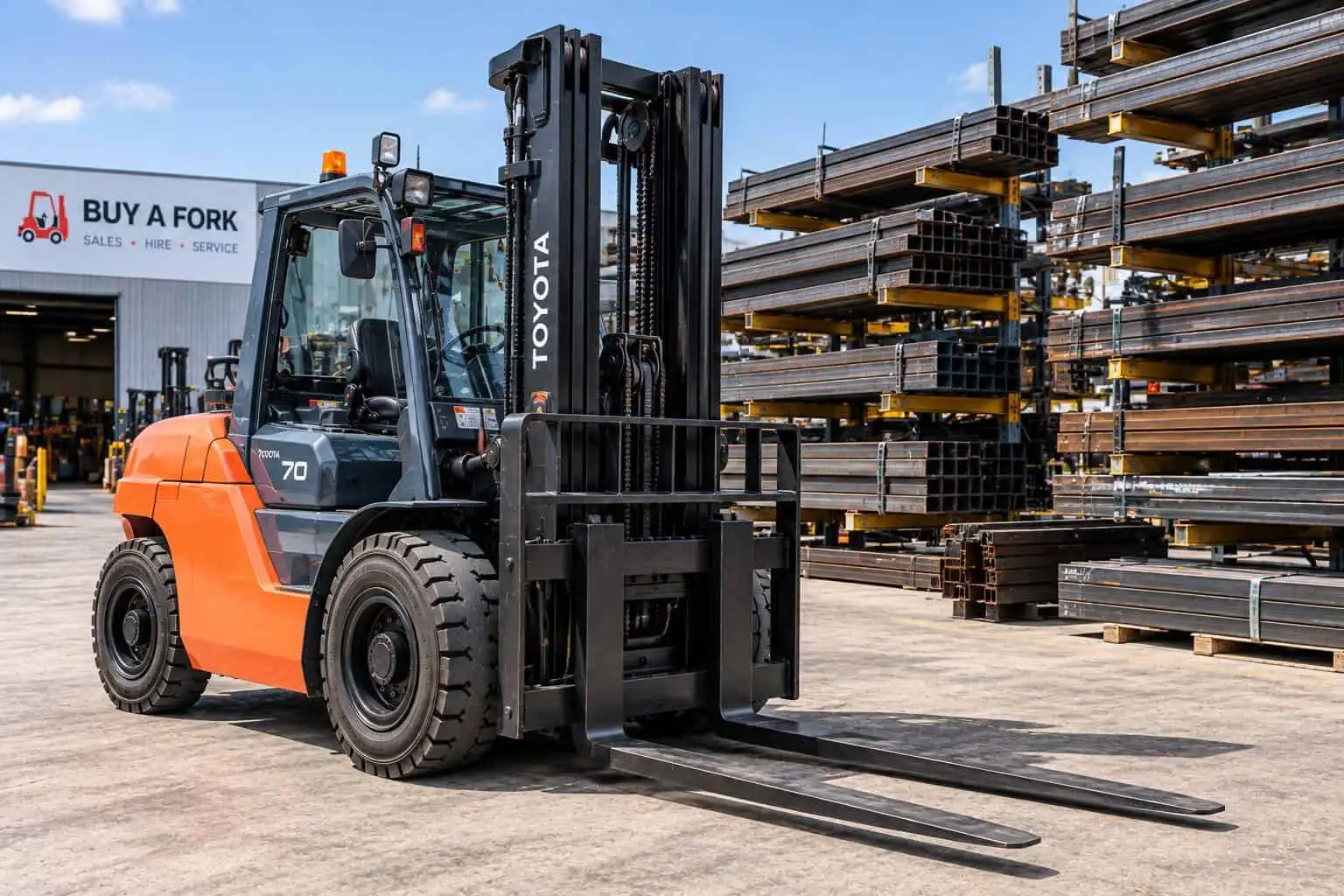
Four numbers get you a specification: the heaviest load you handle regularly, the longest, the surface it travels on, and the narrowest point it has to pass through. The first two together determine capacity, and they matter more in combination than separately.
Used high capacity machines are often good value in this application, because a heavy forklift doing yard work accumulates hours slowly compared with a warehouse machine on double shifts. The checks that matter on a used machine apply here with extra attention to the mast and the front axle, since heavy work concentrates wear there.
We carry high capacity diesel machines at Somerton as part of our diesel range, including units well above the standard warehouse capacities. Bring us your weight and length figures and we will tell you what actually works, including where the honest answer is a sideloader we would refer you elsewhere for.
Frequently Asked Questions
1. What size forklift do I need for steel handling?
Generally 3.5 tonnes and up, but the answer depends more on load length than load weight. A light six metre length can demand more machine than a heavy compact bundle, because its centre of mass sits far beyond the rating point. Work out your worst regular combination of weight and length, then ask a supplier for capacity at that load centre in writing.
2. Can a standard forklift carry six metre lengths?
Only with a substantial capacity reduction and usually only with fork extensions fitted within the manufacturer’s limits. A uniform six metre load has its centre of mass at three metres, five times the 600mm rating point on a typical heavy machine. For regular long load work, a sideloader is the machine designed for the job.
3. What attachment do I need for steel coils?
A coil ram, which carries the coil through its centre and prevents it rolling. Forks alone are unsuitable for round material of any weight. Note that fitting the ram reduces the machine’s rated capacity and the data plate must be revised to reflect it.
4. Do long loads need a spotter?
Where the load blocks the operator’s view or the travel path crosses pedestrian areas, a spotter or an exclusion zone is usually required by the site’s risk assessment. A long load ahead of the machine blocks forward vision entirely, which is why travelling in reverse is standard practice for long material.
5. Why does a light steel load need a big forklift?
Because capacity is a function of weight multiplied by distance, not weight alone. Rated capacity is measured with the load’s centre of mass at 500mm or 600mm from the fork face depending on the machine. A long load sits far beyond that, so the effective demand on the machine is much greater than the weight suggests.
6. Should a steel yard forklift be diesel or electric?
Diesel dominates in outdoor steel yards, because the capacities required, the surfaces involved and the duty cycles all suit it. Electric machines are increasingly viable for indoor fabrication work at lower capacities. The decision comes down to whether the machine works outdoors and at what capacity.