
Best Forklifts for Food and Beverage Facilities
· Updated
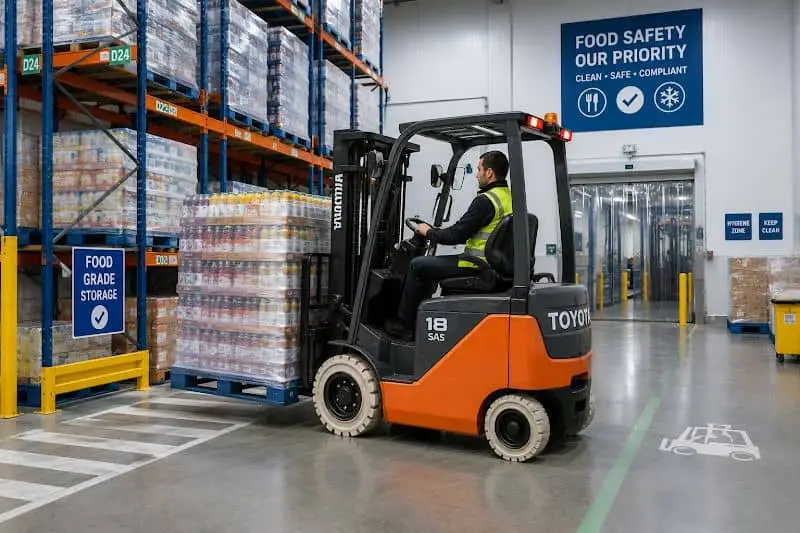
Electric forklifts and electric warehouse equipment are usually the best starting point for enclosed food and beverage facilities. They produce no combustion exhaust at the point of use, operate quietly and remove the need to handle LPG cylinders or diesel fuel inside production and storage areas.
The right equipment still depends on the zone. An electric counterbalance forklift may suit receiving and production, a reach truck may suit high racking, and an electric pallet jack or stacker may be more efficient for short internal movements. Cold stores require equipment specifically approved for low temperatures.
LPG may be considered in some well-ventilated areas with appropriate controls. Diesel forklifts are generally better kept outside because diesel engine emissions pose a workplace health risk. WorkSafe Victoria specifically recommends electric forklifts instead of petrol, diesel or LPG machines in poorly ventilated spaces such as freezers, chillers and cold stores.
Which Forklifts Suit Food and Beverage Facilities?
The best forklift for a food or beverage facility depends on where it will work, what it will lift and whether products are sealed or exposed.
Electric equipment is usually the preferred option inside enclosed production, packaging and storage areas. LPG may suit selected ventilated loading areas, while diesel is more appropriate for outdoor yards and external transport tasks.
| Facility area | Typical task | Recommended equipment | Key specification |
|---|---|---|---|
| External receiving yard | Unloading trucks and moving heavy pallets | Electric, LPG or diesel counterbalance forklift | Outdoor tyres, suitable capacity and weather protection |
| Enclosed receiving dock | Unloading and staging incoming pallets | Electric counterbalance forklift or electric pallet jack | Compact dimensions, no combustion exhaust and good manoeuvrability |
| Raw material warehouse | Moving wrapped ingredients and packaging | Electric counterbalance forklift, stacker or reach truck | Correct capacity, non-marking tyres and easy-clean surfaces |
| Production floor | Supplying lines and removing finished products | Electric pallet jack, stacker or compact electric forklift | Precise controls, low noise and clean operating condition |
| Packaging area | Moving cartons, bottles and finished pallets | Electric pallet jack or compact electric forklift | Tight turning radius and non-marking wheels |
| High-rack warehouse | Storing and retrieving pallets | Electric reach truck | Required lift height, residual capacity and aisle clearance |
| Cool room | Moving chilled goods | Cold-store-specified electric equipment | Low-temperature components and moisture protection |
| Freezer room | Pallet storage and retrieval | Cold-store electric reach truck or pallet equipment | Approved operating temperature and condensation protection |
| Dispatch area | Staging and loading orders | Electric pallet jack or counterbalance forklift | Fast pallet movement and suitable dock controls |
| Beverage yard | Handling full and empty beverage pallets | Electric, LPG or diesel counterbalance forklift | Capacity for dense beverage loads and suitable tyres |
This zone-by-zone approach is important because a forklift suitable for an outdoor beverage yard may be inappropriate beside open food or inside a poorly ventilated cool room.
Why Electric Forklifts Are the Default for Food Environments
Electric forklifts are not automatically suitable for every task, but they solve several of the main concerns found in enclosed food and beverage sites.
No Combustion Exhaust at the Point of Use
Electric forklifts do not have an internal-combustion engine producing exhaust while they operate.
This makes them the strongest starting option for production floors, packaging areas, dry stores, cool rooms and other enclosed spaces where air quality and contamination controls matter.
WorkSafe Victoria advises that electric forklifts should be used in preference to petrol, diesel or LPG forklifts in poorly ventilated places such as freezers and cold storage rooms.
Lower Operating Noise
Electric forklifts generally operate more quietly than internal-combustion machines.
Lower equipment noise can help in facilities where operators need to hear alarms, communicate around production lines or work beside packaging and processing machinery. Warning devices, pedestrian separation and traffic controls are still required.
No Indoor Fuel Cylinder Changes
An electric forklift removes the need to exchange LPG cylinders inside the handling area or bring diesel fuel close to production operations.
A dedicated battery charging system is still required. WorkSafe Victoria advises that charging and refuelling zones should be located in separate areas, away from pedestrians, with suitable emergency equipment and protection for chargers.
Precise Low-Speed Control
Food and beverage facilities often contain tight aisles, production machinery, pallet wrappers, conveyors and pedestrian routes.
Electric forklifts and warehouse equipment commonly provide controlled acceleration and responsive low-speed movement, which can help operators position pallets accurately.
Wide Equipment Choice
Electric power is available across several equipment classes:
- Counterbalance forklifts
- Reach trucks
- Electric pallet jacks
- Walkie stackers
- Ride-on pallet trucks
- Order pickers
- Narrow-aisle equipment
- Cold-store models
The correct machine should be selected around the task rather than purchasing one counterbalance forklift for every area.
Buyers can compare the current electric forklift range or review suitable electric forklifts for indoor operations before narrowing the specification.
Are Electric Forklifts Emission-Free?
An electric forklift produces no combustion exhaust at the point where it operates.
That does not mean the entire equipment lifecycle or electricity supply has no environmental impact. For food-site selection, the immediate advantage is that the machine does not release diesel or LPG exhaust into the working area.
This distinction matters when comparing equipment for:
- Open-food handling areas
- Packaging lines
- Enclosed warehouses
- Cool rooms
- Freezer rooms
- Facilities with limited ventilation
The forklift must still be kept clean and maintained to prevent contamination from hydraulic leaks, dirty wheels, damaged batteries or debris trapped around the chassis.
What Does “Food-Grade Forklift” Mean?
“Food-grade forklift” is best treated as a purchasing specification rather than the name of one universal forklift class.
The correct specification depends on:
- Whether food is open or fully packaged
- The cleaning system used at the site
- Whether the floor is wet or dry
- Operating temperature
- Corrosive cleaning chemicals
- Hygiene zoning
- Allergen controls
- Explosion or ignition risks
- Pallet type
- Required tyre compound
- Battery charging arrangements
Food Standards Australia New Zealand states that food businesses must manage contamination risks and maintain premises and equipment so they can be effectively cleaned. Its guidance also explains that smooth, clear surfaces are generally easier to keep clean than rough surfaces or areas with difficult-to-access fittings.
A forklift is not normally a direct food-contact surface, but it can carry dirt, packaging debris, tyre residue, moisture or leaking fluids into a controlled area. The site should therefore specify the machine features and cleaning procedures needed for each hygiene zone.
Can You Use LPG or Diesel Forklifts in a Food Facility?
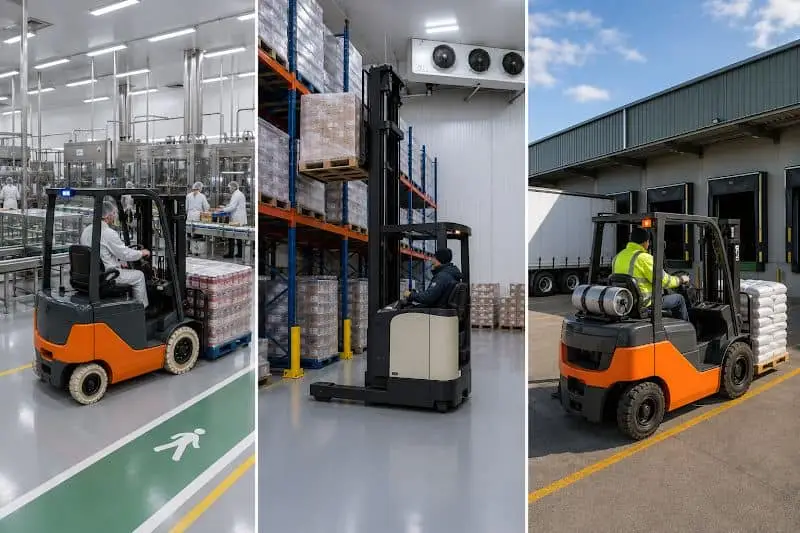
LPG and diesel forklifts are not automatically prohibited across every food or beverage site. Their suitability depends on the location, ventilation, food exposure and workplace risk controls.
They should not be treated as direct substitutes for electric equipment in all areas.
Fuel Suitability by Environment
| Power source | Enclosed production area | Packaged-food warehouse | Cold store or freezer | Receiving dock | Outdoor yard |
|---|---|---|---|---|---|
| Electric | Preferred starting option | Highly suitable | Preferred when cold-store specified | Highly suitable | Suitable if designed for the surface and weather |
| LPG | Usually not the first choice near open food | May be considered with ventilation and risk controls | Requires high-level controls in poorly ventilated spaces | May suit ventilated areas | Suitable |
| Diesel | Generally unsuitable | Generally avoid indoors | Not recommended | Limit to outdoor-facing or properly controlled applications | Strong outdoor option |
LPG Forklifts
LPG forklifts usually produce cleaner visible exhaust than diesel machines, but they still produce carbon monoxide and other airborne contaminants.
WorkSafe Victoria warns that LPG forklifts can produce dangerous carbon monoxide levels in poorly ventilated cool stores and freezer rooms, especially when the machine is poorly maintained or incorrectly tuned. Where LPG use is unavoidable, the regulator recommends documented procedures, exhaust testing, ventilation, maintenance and air monitoring.
LPG may still suit:
- Open or highly ventilated loading docks
- Outdoor and indoor transition work
- Packaged-goods warehouses with suitable controls
- Operations that cannot accommodate charging downtime
Review the practical limits and controls for using LPG forklifts indoors before selecting one for a food site.
Diesel Forklifts
Diesel forklifts are better suited to outdoor yards, heavy loads and rougher surfaces.
Safe Work Australia states that exposure to diesel engine emissions poses a risk to lung health and can cause cancers. Forklift drivers and loading dock workers are among the groups that may be exposed.
Diesel may suit:
- Outdoor raw-material yards
- External truck unloading
- Beverage pallet handling outside
- Uneven or exposed operating areas
- Heavy loads not entering controlled food zones
It should not be chosen for routine work inside an enclosed food warehouse simply because it has greater power or an attractive purchase price.
The diesel forklift indoor-use guide explains why ventilation and exhaust exposure must be assessed before bringing diesel equipment inside.
Features to Specify for Food and Beverage Sites
A suitable power source is only the first requirement. The machine must also match the hygiene, surface, temperature and load conditions.
Non-Marking Tyres or Wheels
Non-marking tyres replace the carbon black commonly used in standard tyres with different materials to reduce dark marks on floors. They are available on many electric forklift and warehouse-equipment models.
They may suit:
- Food processing areas
- Retail backrooms
- Clean warehouses
- Packaging facilities
- Light-coloured resin or sealed floors
Non-marking does not automatically mean suitable for every wet or slippery surface.
Confirm:
- Tyre compound
- Tread pattern
- Load rating
- Wet-floor traction
- Heat resistance
- Expected wear rate
- Compatibility with floor-cleaning chemicals
Smooth polyurethane wheels can be non-marking but may require good, dry floor conditions. Siped or treaded options may provide better traction in some applications.
Easy-to-Clean Surfaces
Look for a forklift that can be cleaned without leaving large amounts of debris trapped around:
- Floor plates
- Steps
- Wheel arches
- Battery covers
- Counterweights
- Mast channels
- Operator compartments
- Under-seat areas
- Protective guards
Smooth and accessible surfaces make routine cleaning easier. FSANZ guidance links effective cleaning with reducing contamination risks from dirty surfaces.
The site should define how often the forklift will be cleaned and which areas must be included.
Corrosion Protection
Moisture, salt, ingredients and cleaning chemicals can accelerate corrosion.
Facilities using frequent wet cleaning should ask about:
- Rust-resistant specification
- Protected electrical connectors
- Sealed control components
- Corrosion-resistant fasteners
- Coated chassis components
- Protected mast sensors
- Suitable wheel and bearing materials
- Manufacturer-approved cleaning methods
Cold-store and rustproof specifications are available on selected electric forklift models, but they are not standard on every machine.
Battery Type
Both lead-acid and lithium batteries can power food-industry forklifts, but they create different site requirements.
| Battery factor | Lead-acid | Lithium-ion |
|---|---|---|
| Initial purchase cost | Usually lower | Usually higher |
| Watering | Required for flooded batteries | Not required |
| Charging | Longer planned charging periods are common | Opportunity charging may be supported |
| Battery handling | May require changing equipment on intensive shifts | Battery often remains in the forklift |
| Routine maintenance | Higher | Lower |
| Food-area consideration | Control electrolyte, corrosion and watering activities | No routine watering or exposed electrolyte maintenance |
| Cold-store suitability | Requires a correctly sized and approved system | Can suit refrigerated applications when manufacturer approved |
Linde identifies lithium-ion battery systems as particularly useful in multi-shift, refrigerated, pharmaceutical and food-industry applications because they avoid routine lead-acid watering and can support opportunity charging. The actual suitability still depends on the forklift, battery and operating temperature.
Dedicated Battery Charging Area
The charging area should not be improvised beside ingredients, packaging or pedestrian traffic.
WorkSafe Victoria advises businesses to locate charging areas separately, provide suitable emergency equipment, use ventilation and protect chargers from forklift movements. Only trained and authorised people should charge or change batteries.
The area may need:
- Electrical supply matched to the charger
- Mechanical protection
- Ventilation
- Fire equipment
- Eyewash facilities
- Spill controls
- Cable management
- Restricted access
- Charging instructions
- Separation from food and packaging
Correct Load Capacity
Food and beverage pallets can vary greatly in weight.
Beverage pallets, bottled products and liquid containers can be particularly dense. A forklift selected around an average pallet may be under-capacity for the heaviest load.
Confirm:
- Maximum pallet weight
- Load dimensions
- Load centre
- Lift height
- Attachment weight
- Residual capacity at height
- Pallet condition
- Whether loads can shift
The capacity plate must reflect the actual mast and attachments fitted to the forklift.
Suitable Attachments
Food and beverage sites may use:
- Side shifts
- Fork positioners
- Double pallet handlers
- Clamps
- Rotators
- Drum handlers
- Slip-sheet attachments
Attachments add weight and move the load centre, which can reduce the forklift’s usable capacity.
Any attachment should be approved for the machine and reflected on the capacity plate.
Low-Temperature Specification
A standard warehouse forklift should not automatically be placed in a freezer.
Cold-store preparation may involve:
- Low-temperature oils and greases
- Protected electrical systems
- Sealed connectors
- Heated operator areas
- Cold-resistant cables
- Moisture protection
- Special displays
- Battery sizing for reduced cold-temperature performance
- Condensation management
- Corrosion-resistant components
Some manufacturer cold-store reach trucks are designed to operate at temperatures as low as minus 30°C. That capability is model-specific and must be confirmed from the exact specification.
Warning and Pedestrian-Safety Systems
Food facilities often combine forklifts, production staff, cleaners, visitors and truck drivers in restricted areas.
Consider:
- Reversing alarms
- Flashing beacons
- Blue or red warning lights
- Mirrors
- Cameras
- Pedestrian-detection systems
- Speed limiting
- Automatic braking
- Access control
- Impact monitoring
These systems support a traffic management plan but do not replace barriers, exclusion zones or pedestrian separation.
Food-Site Forklift Feature Checklist
Use this checklist before requesting quotes.
| Requirement | Confirmed? |
|---|---|
| Power source is approved for every operating zone | ☐ |
| Forklift capacity covers the heaviest real load | ☐ |
| Residual capacity is adequate at maximum lift height | ☐ |
| Machine fits aisles, doors, docks and racking | ☐ |
| Tyres suit the floor and hygiene requirements | ☐ |
| Non-marking tyres are fitted where required | ☐ |
| Forklift can be cleaned using the site’s approved method | ☐ |
| Electrical systems suit moisture exposure | ☐ |
| Corrosion protection suits the cleaning environment | ☐ |
| Battery type suits daily shifts and charging windows | ☐ |
| Charger matches the site’s electrical supply | ☐ |
| Charging area is separated from food operations | ☐ |
| Cold-store preparation is documented where required | ☐ |
| Attachments are approved and shown on the capacity plate | ☐ |
| Safety and warning systems suit pedestrian risks | ☐ |
| Parts and local servicing are available | ☐ |
| Warranty terms cover the intended application | ☐ |
Matching Equipment to Each Area of the Plant
One food facility may need several equipment types rather than one forklift used everywhere.
Receiving Docks
Receiving areas handle incoming ingredients, packaging, empty containers and returned pallets.
Recommended options include:
- Electric counterbalance forklift
- Ride-on electric pallet jack
- Pedestrian pallet truck
- LPG counterbalance forklift in suitable ventilated areas
An electric counterbalance forklift suits operations that unload trucks and then continue into an enclosed warehouse.
Electric pallet equipment can move goods from the dock to staging areas without using a larger forklift for every pallet. The current electric pallet jack range includes equipment for ground-level pallet transport.
Check:
- Dock plate capacity
- Trailer floor condition
- Turning space
- Door height
- Pedestrian separation
- Pallet weight
- Ramp gradient
Production Floors
Production areas usually favour compact electric equipment.
Suitable machines may include:
- Three-wheel electric counterbalance forklifts
- Walkie stackers
- Electric pallet jacks
- Compact ride-on pallet trucks
The equipment should have controlled low-speed handling and enough capacity for ingredients, packaging or finished goods.
Avoid oversizing the machine. A large forklift can increase congestion and reduce visibility where a smaller pallet jack or stacker would complete the work.
Packaging and Bottling Areas
Packaging lines often require frequent, short pallet movements.
Electric pallet jacks and compact forklifts can supply:
- Empty bottles
- Cans
- Cartons
- Closures
- Labels
- Pallets
- Finished cases
Non-marking wheels and precise controls may be particularly useful on sealed floors.
For beverage facilities, ensure the selected machine can manage the weight of full liquid pallets rather than relying on carton counts alone.
Dry Storage Warehouses
A dry warehouse storing sealed products may use:
- Electric counterbalance forklifts
- Reach trucks
- Order pickers
- Electric pallet jacks
- Walkie stackers
The correct choice depends on the racking height and aisle dimensions.
A reach truck is often more suitable than a counterbalance forklift for high racking and narrow aisles. A walkie stacker may be sufficient for light loads and moderate heights.
Cold Stores and Freezer Rooms
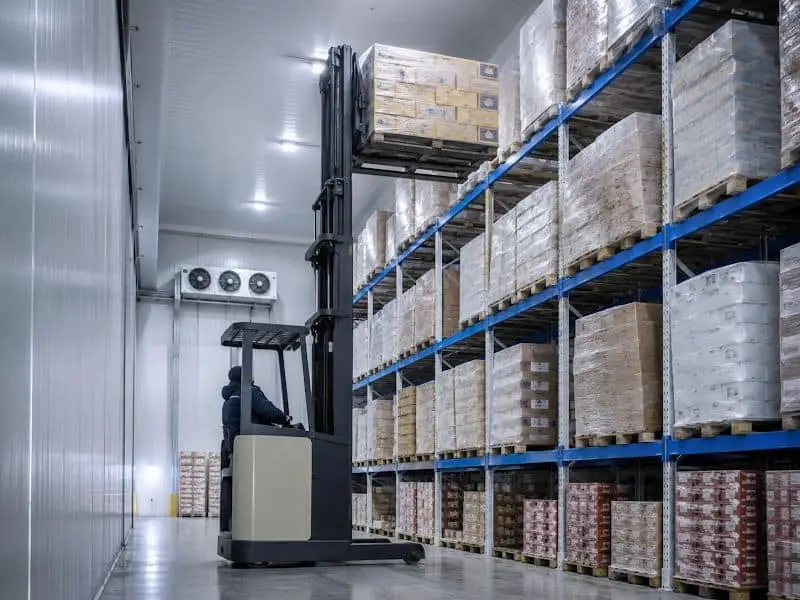
Electric equipment should be the starting point for cool stores and freezer rooms, particularly where ventilation is limited.
WorkSafe Victoria states that electric forklifts are safer than petrol, diesel or LPG forklifts in poorly ventilated cold-storage spaces because they remove the combustion source of carbon monoxide.
The machine must also have a cold-store specification suited to:
- Operating temperature
- Time spent inside the freezer
- Travel between warm and cold zones
- Condensation
- Battery performance
- Operator exposure
- Ice and floor traction
The cold-storage forklift guide covers the equipment and inspection issues that need closer attention in chilled and frozen environments.
Dispatch Areas
Dispatch areas need fast, repeatable movement between staging lanes and loading docks.
Suitable equipment includes:
- Ride-on electric pallet trucks
- Electric counterbalance forklifts
- Walkie pallet jacks
- Double pallet handlers where approved
- Reach trucks for retrieving orders from storage
Dispatch equipment should be matched to:
- Pallets moved per hour
- Travel distance
- Truck-loading pattern
- Dock layout
- Shift length
- Battery runtime
A machine selected only around lift capacity may be too slow for the required throughput.
Outdoor Beverage and Raw-Material Yards
Outdoor zones may justify LPG or diesel equipment where loads are heavy and surfaces are uneven.
Electric outdoor forklifts are also available, but the machine must be approved for:
- Rain exposure
- Yard surfaces
- Gradients
- Longer travel distances
- Required runtime
- Tyre type
- Outdoor charging arrangements
Keep outdoor equipment from carrying mud, oils or debris into clean internal zones. Some sites use separate forklifts for internal and external work.
What to Check When Buying a Used Forklift for a Food Site
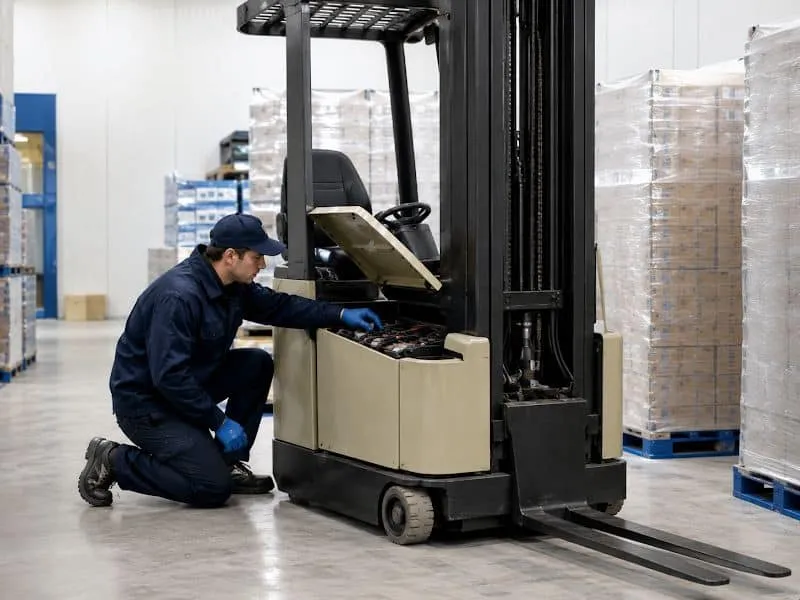
A used electric forklift can suit a food or beverage operation when its condition, specifications, and cleaning requirements are properly assessed.
Inspect more than the paintwork.
1. Check for Fluid Leaks
Inspect:
- Hydraulic hoses
- Cylinders
- Steering components
- Transmission areas
- Battery cells
- Connectors
A leaking machine should not enter a controlled food area before repair and cleaning.
2. Inspect Cleanability
Look under panels, around the battery compartment and inside the operator area.
Heavy grease, corrosion or deeply trapped debris may make it difficult to bring the machine up to the site’s hygiene standard.
3. Confirm Battery Condition
Ask for:
- Battery age
- Runtime
- Capacity-test results
- Charger condition
- Watering history
- Corrosion repairs
- Lithium battery health data, where available
A weak battery may not complete a full production or dispatch shift.
4. Check Tyres and Wheels
Confirm that the tyres:
- Suit the floor
- Have sufficient traction
- Do not shed excessive material
- Meet any non-marking requirement
- Are free from deep cuts and contamination
Changing a complete set of forklift tyres can add a substantial immediate cost.
5. Verify Cold-Store Specification
Do not assume a forklift previously used in a general warehouse is suitable for freezer work.
Request documentation for:
- Approved temperature range
- Cold-store package
- Oils and lubricants
- Electrical protection
- Heating systems
- Battery specification
- Condensation procedure
6. Review Its Previous Application
Ask where the forklift was used.
A machine from a dusty, chemical or waste environment may require more intensive cleaning and inspection before entering a food facility.
7. Inspect Rust and Corrosion
Pay close attention to:
- Battery tray
- Steps
- Floor plates
- Mast
- Chassis
- Connectors
- Wheel assemblies
- Guard mounting points
Surface corrosion may be repairable. Structural corrosion or damage requires professional assessment.
8. Confirm Attachments and Capacity
Check that every fitted attachment appears on the capacity plate.
A side shift or fork positioner can reduce residual capacity, particularly at height.
9. Test Under Load
Test the forklift using a representative pallet where possible.
Confirm:
- Lift performance
- Braking
- Steering
- Stability
- Battery response
- Hydraulic drift
- Warning devices
10. Get the Preparation and Warranty in Writing
Confirm:
- Service completed
- Repairs completed
- Battery included
- Charger included
- Tyres included
- Cleaning completed
- Warranty period
- Parts covered
- Labour coverage
- Delivery terms
A full used forklift inspection should be completed before committing to a machine for a controlled food environment.
New or Used Forklift for a Food Facility?
Both can be suitable.
A Used Forklift May Suit When:
- The food is fully packaged
- The facility has moderate usage
- The machine can be thoroughly inspected
- Battery condition is documented
- The correct tyres can be fitted
- Cold-store preparation is verified
- There is no serious corrosion
- The forklift can be cleaned to the site standard
- Parts and service support are available
- Written warranty is included
A New Forklift May Be Better When:
- The machine will work beside open food
- A specific hygiene configuration is required
- Washdown or moisture exposure is frequent
- The forklift will enter a freezer every shift
- The site needs lithium power
- Multi-shift use is expected
- Downtime would stop production
- Corrosion-resistant components are required
- A specific tyre compound is needed
- The facility requires an exact safety package
A new machine can be ordered closer to the required specification. A used machine may provide better value when its condition and configuration already match the site.
Questions to Ask a Forklift Dealer
Provide the dealer with more than the pallet weight.
Ask:
- Is this model suitable for enclosed food-handling areas?
- Does it produce any combustion exhaust?
- What tyres are fitted?
- Are non-marking tyres available?
- What is the approved operating temperature?
- Does it have a documented cold-store specification?
- Can its electrical system tolerate the planned cleaning process?
- Is a rustproof specification available?
- What battery chemistry is fitted?
- How long will the battery run in our application?
- What charger and electrical supply are required?
- Can the forklift handle our heaviest pallet at maximum height?
- Are the attachments shown on the capacity plate?
- What cleaning method does the manufacturer permit?
- Are parts stocked locally?
- What warranty applies in our operating environment?
- Can the forklift be inspected under load?
- What servicing is included before delivery?
Choose the Forklift by Zone, Not Industry Label
The best forklift for a food or beverage business is usually not one machine used in every area.
Electric counterbalance forklifts suit many enclosed receiving and production tasks. Electric pallet jacks handle short internal movements. Reach trucks suit high racking, while cold stores require low-temperature preparation. LPG and diesel equipment may still have a role in ventilated docks and outdoor yards.
Before buying, document:
- Every operating zone
- Product exposure
- Maximum pallet weight
- Lift height
- Aisle width
- Floor condition
- Cleaning process
- Operating temperature
- Shift length
- Battery charging arrangements
- Tyre requirements
- Corrosion risks
Review Buy A Fork’s electric forklift range and compare available machines against the hygiene, temperature and workload requirements of each area.
Information note: This article provides general equipment-selection guidance. Food-safety and workplace requirements vary according to the facility, products, jurisdiction and risk assessment. The regulatory and manufacturer sources used were reviewed on 13 July 2026.
Frequently Asked Questions
1. Do Forklifts Need to Be Food Grade?
There is no single forklift model that automatically suits every food facility.
“Food grade” should be translated into a written specification covering the power source, cleaning method, tyres, corrosion protection, battery, temperature range and contamination risks.
A forklift used near open food may require stricter controls than one used only for sealed products in a dispatch warehouse.
2. Are Electric Forklifts Safe Near Open Food?
Electric forklifts are generally the preferred starting point near open food because they do not produce combustion exhaust at the point of use.
The forklift must still be kept clean, free from leaks and separated from food where practical. The site should assess contamination risks from tyres, hydraulic systems, batteries, packaging debris and pedestrian traffic.
FSANZ requires food businesses to protect food from contamination and maintain clean premises and equipment.
3. What Tyres Are Best for a Food Warehouse?
Non-marking tyres are commonly selected for clean indoor warehouses because they reduce dark marks on flooring.
The best tyre also depends on traction, moisture, floor condition, load and travel distance. Smooth non-marking tyres may suit dry sealed floors, while treaded or siped options may provide better grip in damp areas.
4. Can LPG Forklifts Be Used in Food Warehouses?
An LPG forklift may be used in some food warehouses when ventilation, maintenance and workplace controls are suitable.
It is not the preferred option in poorly ventilated cool stores or freezer rooms. WorkSafe Victoria advises using electric forklifts in those environments wherever practicable.
5. Can Diesel Forklifts Be Used Inside Food Facilities?
Diesel forklifts should generally be restricted to outdoor work unless a detailed workplace assessment and effective exposure controls justify another arrangement.
Diesel engine emissions pose a lung-health and cancer risk, and indoor use can expose forklift drivers, dock workers and other employees.
6. Are Lithium Batteries Better for Food Facilities?
Lithium batteries can suit food and beverage sites because they do not require routine watering and can support opportunity charging.
They can be particularly useful for multi-shift, refrigerated and high-hygiene applications. The battery and forklift must be approved for the site temperature, workload and charging system.
7. Can a Used Electric Forklift Be Used in Food Production?
Yes, provided it is suitable for the exact zone and passes a detailed inspection.
Check for hydraulic leaks, corrosion, battery damage, unsuitable tyres, trapped contamination and missing cold-store preparation. The machine should be serviced and cleaned before entering the production area.
8. Can Buy A Fork Supply a Washdown-Ready Forklift?
Washdown suitability must be confirmed for the exact forklift rather than assumed from its electric power source.
Provide Buy A Fork with:
- Cleaning method
- Water pressure
- Cleaning chemicals
- Operating temperature
- Hygiene zone
- Required corrosion protection
- Required electrical protection
- Tyre specification
Current stock can then be assessed against those requirements. Do not describe or purchase a standard forklift as washdown-ready unless the manufacturer or supplier confirms that the machine and its components are approved for the intended cleaning process.
9. What Is the Best Forklift for a Cold Store?
A cold-store-specified electric reach truck is often suitable for high racking, while electric pallet jacks and stackers can handle lower-level movement.
The best model depends on temperature, racking height, aisle width, shift duration and whether the forklift repeatedly travels between warm and cold zones.
10. What Capacity Forklift Does a Beverage Warehouse Need?
Base the capacity on the heaviest complete pallet, not the average shipment.
Bottled and canned drinks can create dense loads. Confirm the pallet weight, load centre and required lift height, then check the forklift’s residual capacity with every attachment fitted.