
Can You Use an LPG Forklift Indoors? Safety and Advantages
· Updated
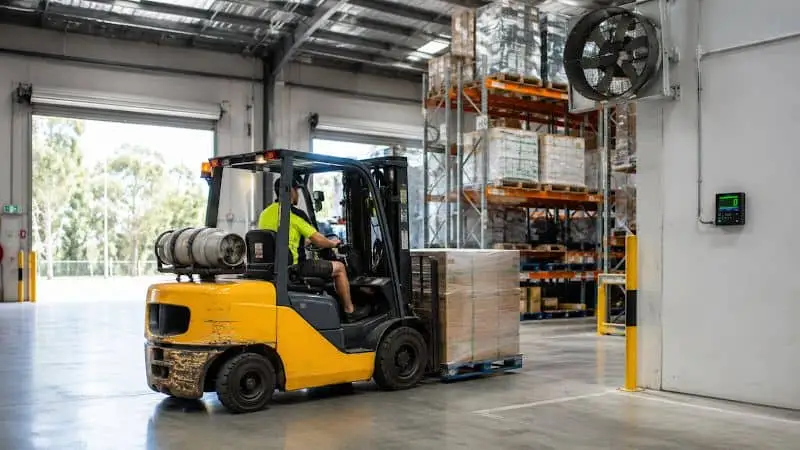
Yes, an LPG forklift can be used indoors, but only where ventilation, equipment maintenance, carbon monoxide controls and safe cylinder-handling procedures are adequate for the workplace.
An LPG forklift should not operate in an enclosed or poorly ventilated area where safe air quality cannot be maintained under all expected conditions. This includes times when warehouse doors are closed, mechanical ventilation is reduced or the forklift enters confined areas such as cool rooms and shipping containers.
LPG forklifts remain useful for businesses that need fast refuelling, consistent performance and the flexibility to work across indoor and outdoor areas. However, an electric forklift is usually the safer and more practical choice for enclosed, indoor-dominant or air-quality-sensitive operations.
Can You Use an LPG Forklift Indoors?
An LPG forklift can be used indoors when a workplace risk assessment confirms that ventilation and other controls will prevent harmful exhaust gases from accumulating.
LPG forklifts use an internal combustion engine. Although LPG is commonly selected instead of diesel for mixed indoor and outdoor work, it still produces exhaust emissions, including carbon monoxide.
Carbon monoxide is particularly dangerous because it has no colour, smell or taste. Workers may not realise that they are being exposed until symptoms such as headaches, tiredness, nausea, dizziness or confusion begin. High exposure can cause unconsciousness or death.
The decision should therefore be based on the actual warehouse, not on a general claim that gas forklifts are suitable indoors.
Consider:
- The size and layout of the building
- Natural and mechanical ventilation
- How often roller doors and windows are closed
- The number of LPG forklifts operating at once
- How long each forklift operates indoors
- Whether the forklift enters cool rooms, trailers or shipping containers
- The condition and maintenance history of the engine
- Whether carbon monoxide monitoring is required
- The number of workers exposed to the indoor air
- Whether food, pharmaceuticals or other sensitive products are handled
WorkSafe Victoria recommends considering engine type, exhaust ventilation, indoor and outdoor operating areas, loads, attachments and extreme temperatures when selecting a forklift.
Conditions That Make Indoor LPG Forklift Use Safer
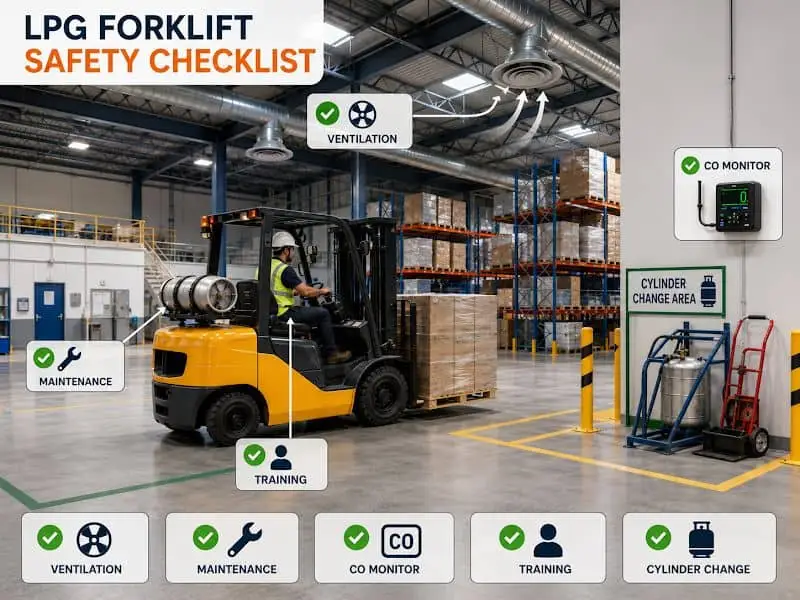
Using an LPG forklift indoors requires more than opening a warehouse door. The workplace needs controls that remain effective during normal operations, seasonal changes and foreseeable disruptions.
1. Complete a Workplace Risk Assessment
Assess where the forklift will operate, how long it will remain indoors and whether exhaust can collect in enclosed sections of the building.
The assessment should consider changing conditions. A warehouse that appears well ventilated during summer may become poorly ventilated when doors and windows are closed in winter.
SafeWork SA advises that internal combustion forklifts, including LPG machines, should not be used where adequate ventilation cannot be guaranteed under all possible operating conditions. It also recommends involving a competent person, such as an occupational hygienist, when workplace assessment or air monitoring is required.
2. Provide Effective Ventilation
The ventilation system must remove forklift exhaust and introduce enough fresh air to prevent contaminants from accumulating.
Depending on the workplace, this may involve:
- Open roller doors and wall vents
- Mechanical extraction
- Supply and exhaust fans
- Local exhaust ventilation
- Portable ventilation equipment
- Changes to forklift routes and operating times
- Limits on how many fuel-powered forklifts operate indoors
There is no single ventilation rate that suits every warehouse. Requirements depend on the building volume, forklift engine, duty cycle, number of machines, airflow pattern and other sources of contamination.
A competent person should determine whether the ventilation system is adequate. WorkSafe guidance identifies loading docks, shipping containers and cold stores as locations where fumes from gas, petrol or diesel forklifts can accumulate.
3. Maintain and Tune the Engine
An LPG forklift must be regularly serviced in accordance with the manufacturer’s requirements.
The maintenance program should include:
- Engine tuning
- Fuel-system inspections
- Exhaust-system checks
- Leak inspections
- Air-filter replacement
- Emissions-system maintenance
- Repairs to damaged or worn components
A poorly maintained LPG engine may produce substantially more carbon monoxide than a correctly operating machine. SafeWork SA recommends regular servicing and exhaust-system inspections, while WorkSafe Victoria identifies maintenance by qualified personnel as an important control for LPG-powered equipment.
Do not rely on the absence of visible smoke or a noticeable smell. Carbon monoxide cannot be detected by sight or smell.
4. Assess the Need for Carbon Monoxide Monitoring
Carbon monoxide detectors or workplace air monitoring may be required where LPG forklifts operate indoors.
Controls may include:
- Fixed carbon monoxide alarms
- Portable area monitors
- Personal monitors worn by workers
- Periodic air-quality testing
- Alarm testing and calibration
- Documented action levels and evacuation procedures
Monitoring should be selected and positioned with advice from a competent person. It should confirm that other controls are working, not replace ventilation or equipment maintenance.
SafeWork SA recommends carbon monoxide detectors in indoor workplaces where fuel-powered equipment is used. NT WorkSafe also recommends alarms, competent assessment and air monitoring where fuel-powered forklifts cannot be eliminated from enclosed areas.
5. Train Workers to Recognise Carbon Monoxide Exposure
Operators and nearby workers should understand that carbon monoxide exposure can cause:
- Headaches
- Dizziness
- Unusual tiredness
- Nausea
- Confusion
- Poor coordination
These symptoms can be mistaken for fatigue, dehydration or illness. Workers should know how to stop work, leave the area, raise an alarm and obtain medical assistance.
The site should also have a documented response for a carbon monoxide alarm, equipment fault or suspected exposure. NT WorkSafe recommends training workers on symptoms, emergency procedures and internal incident reporting.
6. Handle and Store LPG Cylinders Correctly
Cylinder storage and changeover areas should be designated, ventilated and separated from ignition sources.
Operators changing a cylinder should:
- Park in the approved changeover area
- Apply the parking brake
- Turn off the engine
- Close the cylinder valve
- Wear suitable gloves and eye protection
- Inspect the cylinder and connections
- Secure the replacement cylinder correctly
- Check the connection for leaks
- Keep smoking, flames and sparks away from the area
Australian LPG supplier Elgas advises that forklift cylinders should be changed in a safe designated area without ignition sources. Empty cylinders should be stored upright in the designated storage area, even when believed to be empty.
Indoor LPG Forklift Safety Checklist
Before allowing an LPG forklift to operate indoors, confirm the following:
| Indoor-use condition | What the workplace should confirm |
|---|---|
| Risk assessment | The operation has been assessed under normal and foreseeable conditions. |
| Ventilation | Exhaust cannot accumulate when doors, windows or mechanical systems change. |
| Forklift condition | The engine, fuel system and exhaust are regularly serviced and inspected. |
| Air monitoring | A competent person has determined whether fixed, portable or personal monitoring is needed. |
| Worker training | Operators and nearby workers recognise carbon monoxide symptoms and know the emergency procedure. |
| Cylinder changeover | Cylinders are changed in a designated area away from ignition sources. |
| Cylinder storage | Full and empty cylinders are stored securely in the correct orientation and location. |
| Operating restrictions | The forklift is kept out of enclosed areas that are not approved for fuel-powered equipment. |
| Emergency response | Workers know what to do when a detector alarms or someone develops symptoms. |
| Review process | Controls are reassessed after layout, ventilation, equipment or workload changes. |
Where LPG Forklifts Should Not Be Used
An LPG forklift is not suitable for every indoor environment.
Enclosed or Poorly Ventilated Spaces
Do not use an LPG forklift where adequate ventilation cannot be guaranteed.
High-risk locations can include:
- Shipping containers
- Small loading docks
- Underground areas
- Enclosed workshops
- Trailers
- Internal rooms without effective extraction
- Warehouses with closed doors and limited air movement
SafeWork SA recommends substituting electric or manual equipment where possible and states that internal combustion forklifts should not be used where adequate ventilation cannot be guaranteed.
Cool Rooms and Cold Stores
Cold stores often have restricted airflow because the facility is designed to retain temperature-controlled air. This can allow forklift exhaust to accumulate.
NT WorkSafe issued a safety alert after workers experienced carbon monoxide poisoning while an LPG forklift operated in an enclosed cool room. Its guidance recommends avoiding fuel-powered forklifts in enclosed or poorly ventilated areas and using an electric forklift or manual equipment instead.
An LPG forklift should only enter a cold room where a competent assessment confirms that ventilation, monitoring and operating controls are adequate. For most enclosed cold-store operations, an electric machine designed for low-temperature work is the more suitable option.
Food Production and Open-Food Areas
Food facilities must manage both worker air quality and the risk of airborne contaminants affecting food.
Food Standards Australia New Zealand states that food premises must have sufficient natural or mechanical ventilation to remove fumes, smoke, steam and vapours. Its guidance also notes that fumes and objectionable odours can taint food or create hygiene issues.
For production rooms, packaging lines and areas where food is exposed, an electric forklift is generally the cleaner option because it does not produce combustion exhaust at the point of use.
The best machine will still depend on washdown requirements, cold temperatures, floor conditions and hygiene procedures. These considerations are covered in more detail when selecting forklifts for food and beverage facilities.
Hazardous or Flammable Atmospheres
A standard LPG forklift should not enter an area classified for flammable gases, vapours or combustible dust unless the machine is specifically engineered and approved for that hazardous area.
General indoor suitability does not make a forklift flameproof or suitable for dangerous goods zones.
Indoor-Dominant Operations With Limited Airflow
A warehouse that conducts nearly all forklift work indoors may gain little from LPG’s indoor and outdoor flexibility.
Where charging can be managed without disrupting shifts, electric forklifts may offer a simpler way to eliminate combustion exhaust from the operating area.
The Real Advantages of LPG Forklifts
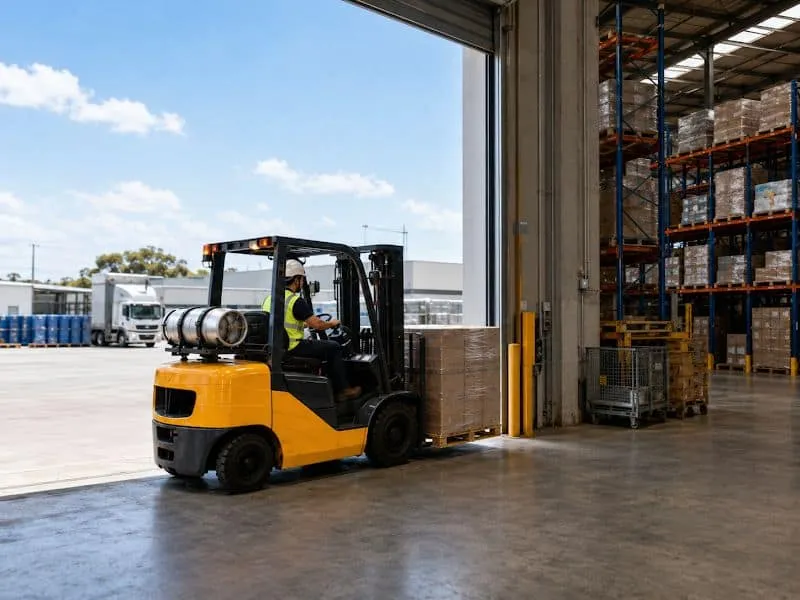
LPG forklifts remain popular because they combine several practical advantages. These benefits are most valuable in well-ventilated warehouses and businesses that regularly move between indoor and outdoor areas.
Fast Refuelling: Replace a Cylinder in Minutes
An LPG cylinder can be changed quickly by a trained operator using the correct procedure.
This can reduce the downtime associated with waiting for a conventional lead-acid battery to recharge. A business can keep additional cylinders available rather than maintaining spare traction batteries or scheduling long charging periods.
Cylinder supply, storage and changeover still require safe systems and suitable space.
Consistent Performance: Maintain Power Throughout the Shift
LPG forklifts can provide steady engine performance while fuel remains available.
Electric forklift performance depends on the machine, battery chemistry, battery condition, charging system and operating demands. Modern lithium-ion machines can also provide strong, consistent performance, so buyers should compare current models rather than relying on assumptions about older electric forklifts.
Indoor and Outdoor Flexibility: Use One Machine Across Mixed Areas
An LPG counterbalance forklift can move between an approved indoor warehouse and an outdoor yard without requiring a change of power source.
This can suit businesses that:
- Unload trucks outside
- Move goods through a ventilated warehouse
- Travel across covered loading areas
- Handle mixed indoor and outdoor tasks
- Need one counterbalance forklift for several work zones
Buyers with this type of workflow can review the available LPG counterbalance forklift range based on capacity, mast height, tyre type and site conditions.
Quick Shift Changes: Reduce Charging Delays
A full cylinder can be fitted when the current one is depleted, allowing the forklift to return to work quickly.
This may suit multi-shift businesses that do not have sufficient breaks for battery charging. However, the benefit depends on maintaining a safe cylinder supply, storage system and trained changeover process.
Familiar Mechanical Systems: Access Conventional Servicing
LPG forklifts use internal combustion engines and fuel systems that many forklift service technicians are familiar with.
They still require regular engine, exhaust, cooling and fuel-system maintenance. Maintenance requirements are generally higher than for an electric drivetrain, which has no combustion engine or exhaust system.
Potentially Lower Initial Setup Requirements
An LPG operation may avoid some of the electrical upgrades, chargers or battery infrastructure required for an electric fleet.
This does not guarantee that an LPG forklift will be cheaper overall. The final cost depends on:
- Forklift purchase price
- Fuel consumption
- LPG cylinder supply
- Maintenance
- Ventilation
- Emissions monitoring
- Battery and charger costs
- Operating hours
- Expected ownership period
The LPG and electric forklift running-cost comparison explains how these expenses affect the total cost of ownership.
LPG or Electric for Mostly Indoor Work?
Electric forklifts are usually the stronger choice for operations that remain indoors for most of the shift. LPG may be more suitable where the machine frequently moves between indoor and outdoor areas and fast refuelling is important.
| Decision factor | LPG forklift | Electric forklift |
|---|---|---|
| Indoor exhaust | Produces combustion exhaust and requires effective ventilation. | Produces no tailpipe exhaust at the point of use. |
| Carbon monoxide risk | Must be assessed and controlled indoors. | Does not produce carbon monoxide during operation. |
| Refuelling or charging | Cylinder changes can be completed quickly. | Requires charging time and suitable electrical infrastructure. |
| Indoor and outdoor work | Well suited to mixed work where indoor areas are approved and ventilated. | Suitable outdoors when the model, tyres and weather protection match the conditions. |
| Enclosed spaces | Generally unsuitable where ventilation cannot be guaranteed. | Usually the preferred option, subject to the site and machine specification. |
| Cold-store work | Exhaust can accumulate in enclosed cold rooms. | Often preferred when designed for low-temperature operation. |
| Food environments | Exhaust and fumes require additional air-quality and contamination controls. | Commonly preferred around food production and packaging. |
| Maintenance | Requires engine, exhaust, cooling and LPG-system maintenance. | Requires battery, electrical and charger maintenance but has no combustion engine. |
| Shift continuity | A replacement cylinder can minimise refuelling downtime. | Lithium-ion opportunity charging can support long shifts, while lead-acid systems may require longer charging periods. |
| Infrastructure | Requires compliant cylinder storage and changeover areas. | Requires appropriate charging equipment, power supply and battery controls. |
| Best fit | Mixed indoor and outdoor operations with reliable ventilation. | Indoor-dominant, enclosed or air-quality-sensitive operations. |
For businesses comparing several power sources, the broader guide to diesel, electric and LPG forklifts can help match the fuel type to the site, workload and operating environment.
Warehouses considering combustion-powered alternatives should also understand why diesel forklift use indoors presents additional exhaust and ventilation concerns.
When an LPG Forklift Is the Better Choice
An LPG forklift may be suitable when:
- The warehouse is large and effectively ventilated
- The forklift regularly works both indoors and outdoors
- Fast refuelling is important
- The business operates long or multiple shifts
- A compliant cylinder storage area is available
- Operators are trained in LPG handling
- The engine and exhaust can be maintained properly
- Air-quality risks have been assessed
- Enclosed and sensitive areas are excluded from the route
When an Electric Forklift Is the Better Choice
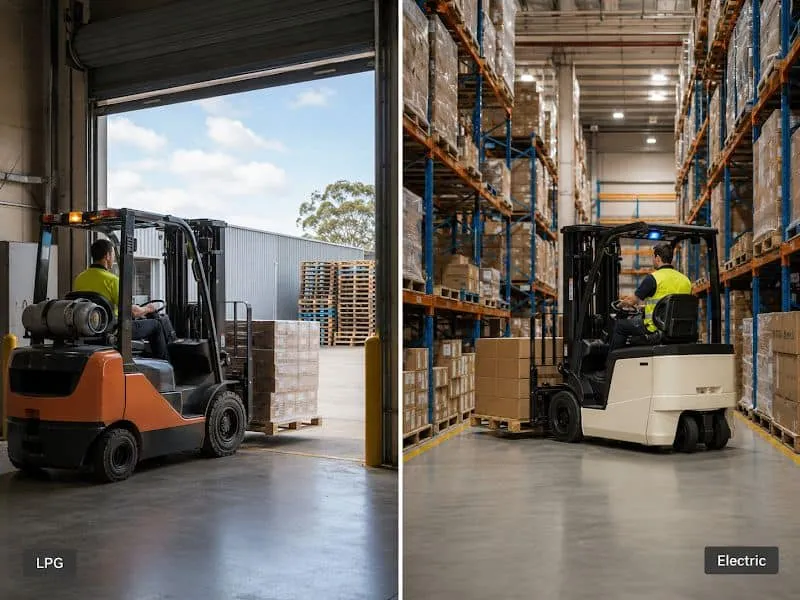
An electric forklift may be more appropriate when:
- Most or all work occurs indoors
- The warehouse has limited natural ventilation
- The forklift enters cool rooms or enclosed storage areas
- Food, pharmaceuticals or sensitive products are handled
- Reducing indoor fumes and noise is a priority
- The business can support battery charging
- The forklift follows predictable shifts and travel patterns
- The site wants to remove combustion exhaust from the work area
- Carbon monoxide monitoring and ventilation upgrades would make LPG impractical
How to Change an LPG Cylinder Safely
Change forklift cylinders only in the designated area, with the forklift parked, the handbrake applied, the engine switched off and all ignition sources removed.
Operators should wear suitable personal protective equipment, close the cylinder valve, inspect the replacement cylinder and connection, secure the cylinder correctly and check for leaks before returning the forklift to service. Elgas also advises storing removed cylinders upright in the designated storage location.
The full forklift propane cylinder change procedure provides a step-by-step breakdown of the removal, installation and leak-check process.
Questions to Ask Before Buying an LPG Forklift
Before purchasing a gas forklift for indoor work, ask:
- Where will the forklift operate during a normal shift?
- How much of the work will occur indoors?
- Can effective ventilation be maintained throughout the year?
- Will the machine enter cool rooms, trailers or containers?
- Has the workplace assessed carbon monoxide exposure?
- Is fixed or portable monitoring required?
- Who will maintain and tune the engine?
- Where will LPG cylinders be changed?
- Where will full and empty cylinders be stored?
- Are operators trained in cylinder handling and leak response?
- Would an electric forklift eliminate significant controls or costs?
- Does the forklift have the required capacity, mast and tyres for outdoor work?
The right choice should account for both productivity and the cost of maintaining safe indoor air.
Choose an LPG Forklift That Suits the Entire Site
An LPG forklift can be a practical option for a business that needs strong counterbalance performance, quick cylinder changes and the flexibility to move between indoor and outdoor areas.
The decision should not be based on the fuel type alone. Warehouse ventilation, carbon monoxide controls, cylinder storage, maintenance capacity, operating hours and enclosed work areas all affect whether LPG is suitable.
Buy A Fork can help you compare the available LPG forklift range by lifting capacity, mast height, condition and application. Workplace air quality and safety controls should be confirmed through your site risk assessment and competent safety advisers before the forklift begins operating indoors.
Frequently Asked Questions
1. Is LPG Forklift Exhaust Harmful Indoors?
Yes. LPG forklift exhaust can contain carbon monoxide and other combustion by-products.
Carbon monoxide is colourless, odourless and tasteless, so workers cannot reliably detect it without appropriate equipment. Exposure may cause headaches, nausea, dizziness, confusion and tiredness. Severe exposure can result in unconsciousness or death.
Proper ventilation, maintenance, air-quality assessment and monitoring are therefore important whenever an LPG forklift operates indoors.
2. How Much Ventilation Does an LPG Forklift Need?
There is no universal ventilation figure that applies to every LPG forklift and warehouse.
The required ventilation depends on the building size, airflow, forklift model, engine condition, operating time, number of machines and other sources of exhaust. A competent person should assess the workplace and determine whether natural ventilation, mechanical extraction or air monitoring is required.
Adequate ventilation must remain available under foreseeable conditions, including when external doors are closed.
3. Can LPG Forklifts Work in Cold Stores?
An LPG forklift should not be used in an enclosed cold store unless a competent assessment confirms that ventilation, monitoring and other controls are sufficient.
Cold rooms can restrict airflow and allow carbon monoxide to accumulate. NT WorkSafe recommends avoiding fuel-powered forklifts in enclosed or poorly ventilated areas and using electric or manual equipment where possible.
An electric cold-store forklift is generally the safer option for regular work inside enclosed temperature-controlled areas.
4. How Long Does an LPG Forklift Cylinder Last?
There is no reliable operating time that applies to every LPG forklift.
Cylinder duration depends on:
- Cylinder capacity
- Forklift engine size
- Load weight
- Travel distance
- Lifting frequency
- Idling time
- Engine condition
- Operator behaviour
- Attachments
- Site gradients
Use the forklift manufacturer’s fuel-consumption information and your actual operating data when estimating cylinder requirements.
5. Are LPG Forklifts Cheaper Than Electric Forklifts?
LPG forklifts may have a lower purchase price or simpler initial setup in some situations, but they are not always cheaper over their working life.
LPG costs can include:
- Fuel
- Cylinder delivery or storage
- Engine servicing
- Exhaust maintenance
- Ventilation
- Carbon monoxide monitoring
- Additional workplace controls
Electric forklift costs may include:
- Battery purchase
- Charger installation
- Electrical upgrades
- Battery maintenance
- Battery replacement
- Charging downtime
The lowest-cost option depends on annual operating hours, energy prices, servicing, battery type and how long the forklift will be kept.
6. Can You Use a Gas Forklift in a Food Warehouse?
An LPG forklift may be used in some ventilated storage or dispatch areas if the workplace risk assessment and food-safety controls permit it.
Electric forklifts are generally preferred in production rooms and areas with open food because they do not produce combustion exhaust at the point of use. Food premises must also have sufficient ventilation to remove fumes and other airborne contaminants that could affect food safety or suitability.