
How Much Does a Forklift Battery Cost in Australia?
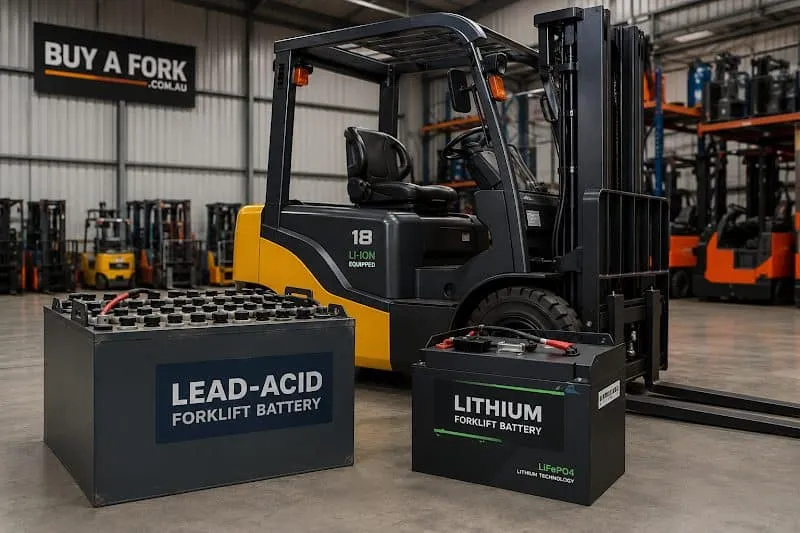
A forklift battery in Australia can cost from about $3,000 for a 36V lead-acid cell kit to $9,500 or more for a higher-capacity lithium battery with a compatible charger. The final replacement cost depends on the battery voltage, amp-hour capacity, chemistry, tray condition, charger requirements, freight and installation.
Public Australian listings reviewed on 12 July 2026 included 36V and 48V lead-acid cell kits advertised at $2,999 and $3,990, while 48V lithium forklift batteries were advertised from $7,044.75 to $9,500. These are indicative examples rather than fixed market prices, as many industrial batteries are manufactured or configured for a specific forklift.
Before ordering, confirm that the battery matches the forklift’s voltage, battery compartment, minimum battery weight, connector, communication system and charger.
How Much Does a Forklift Battery Cost in Australia?
Forklift battery prices vary considerably because a small pallet truck battery and a large 80V counterbalance forklift battery are not comparable products.
The following table shows publicly advertised Australian examples available at the time of review.
| Battery type | Example specification | Indicative advertised price |
|---|---|---|
| Lead-acid cell kit | 36V, 440Ah | $2,999 |
| Lead-acid cell kit | 48V, 440Ah | $3,990 |
| Lithium forklift battery | 48V, 300Ah | $7,044.75 to $7,500 |
| Lithium battery with 100A charger | 48V, 460Ah | $8,800 |
| Lithium battery with 200A charger | 48V, 460Ah | $9,500 |
| Rebuilt battery using the existing steel tray | Custom specification | Quote required |
| Complete custom replacement with a new tray | Custom specification | Quote required |
Pricing note: These prices were publicly listed on Australian supplier websites on 12 July 2026. The lead-acid examples are cell kits rather than guaranteed complete fitted battery assemblies. Confirm whether GST, the steel tray, charger, cables, connectors, freight, removal and installation are included before comparing quotes.
A complete electric forklift battery replacement may cost more than the advertised battery cells because the supplier may also need to provide or modify:
- The steel battery tray
- Battery cables and connectors
- A compatible charger
- A battery management system
- Forklift communication hardware
- Counterweight material
- Delivery and lifting equipment
- Installation and commissioning
A battery specialist will usually need the forklift make, model, serial number, existing battery details and tray dimensions before providing an accurate quote.
Lead-Acid vs Lithium Forklift Battery Prices
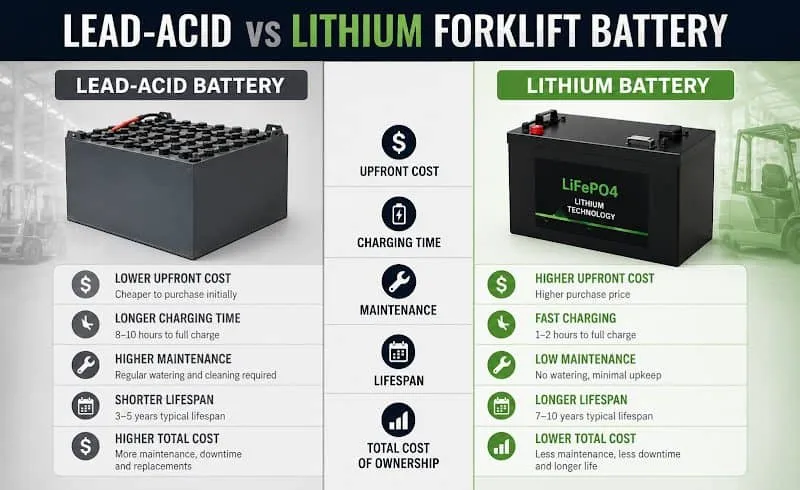
Lead-acid batteries generally cost less upfront. Lithium batteries have a higher purchase price but may offer longer life, faster charging and lower routine maintenance.
The right choice depends on how many hours the forklift operates, how often it can be charged and whether the business can maintain a flooded lead-acid battery correctly.
| Factor | Lead-acid forklift battery | Lithium forklift battery |
|---|---|---|
| Initial price | Usually lower | Usually higher |
| Typical publicly listed example | $2,999 to $3,990 for 36V or 48V cell kits | $7,044.75 to $9,500 for selected 48V batteries |
| Watering | Required for flooded models | Not required |
| Equalisation charging | Commonly required | Managed electronically |
| Charging time | Usually longer | Usually faster |
| Cooling period | Often required after charging | Generally not required |
| Opportunity charging | Limited by battery and charger requirements | Commonly supported |
| Typical application | Single-shift or moderate use | High-use and multi-shift operations |
| Battery management system | Usually limited | Normally integrated |
| Expected cycle life | Commonly around 1,200 to 1,500 cycles | Commonly 2,000 to 3,500 or more, depending on the product |
| Charger | Must match voltage and battery profile | Lithium-compatible charger required |
A lead-acid battery designed for approximately 1,200 to 1,500 cycles can last about five or six years in a one-shift-per-day operation. Maintenance and charging practices can either extend or shorten that working life.
Lithium lifespan varies by cell chemistry, battery management system and operating conditions. Forklift battery manufacturers commonly specify around 2,000 to 3,500 cycles, while selected products advertise more than 3,500 cycles and a design life of up to ten years. These figures are product-specific and should not be treated as a guarantee for every lithium battery.
A more detailed lithium versus lead-acid forklift battery comparison can help determine which chemistry suits your shifts, charging windows and maintenance resources.
What Drives the Price of a Forklift Battery?
Two batteries with the same voltage can have very different prices. The quote depends on the amount of stored energy, physical configuration and equipment required to integrate the battery safely.
- Battery chemistry: Lead-acid is normally cheaper to purchase. Lithium uses more expensive cells, electronic controls and a battery management system.
- Voltage: Larger forklifts commonly use 48V, 72V or 80V systems. Higher-voltage batteries contain more cells and usually cost more than 24V or 36V batteries.
- Amp-hour capacity: Amp-hours indicate how much charge the battery can store. A 600Ah battery will normally cost more than a 300Ah battery of the same chemistry and voltage.
- Battery dimensions: The replacement must fit securely inside the forklift’s battery compartment. A custom tray or unusual battery shape can increase the price.
- Minimum battery weight: On many electric forklifts, the battery forms part of the counterweight. A replacement that is too light can affect the forklift’s rated capacity and stability.
- New or reconditioned condition: A new battery uses new cells and normally includes stronger warranty protection. A reconditioned battery may be cheaper, but its remaining capacity and service life must be verified.
- Existing steel tray: Reusing a sound steel tray can reduce replacement costs. Rebuilding a pack inside an existing tray can avoid the cost of manufacturing a complete new tray.
- Charger compatibility: Changing from lead-acid to lithium often requires a compatible charger. Charger output also affects the charging speed and total package price.
- Communication system: Some modern forklifts communicate directly with the battery management system. Additional programming or hardware may be required.
- Brand and warranty: Premium cells, longer warranties and local technical support generally increase the initial price.
- Freight and handling: Forklift batteries are large and heavy. Delivery may require a pallet, tailgate vehicle, forklift or crane.
- Installation: Removing the old battery, fitting connectors, checking polarity and commissioning the replacement can add labour costs.
Do You Need a New Battery or a Battery Rebuild?
A battery that no longer completes a full shift does not always need an entirely new tray and assembly.
A supplier may test the battery to determine whether it needs:
- Individual cell repairs
- Cable or connector replacement
- Cleaning and corrosion treatment
- Battery regeneration
- A new set of cells inside the existing tray
- A complete new battery and tray
Reusing the existing steel tray may lower the price when the tray is structurally sound and has not been badly damaged by corrosion. A battery rebuild should still use suitable cells and come with clear test results and written warranty terms.
Reconditioning may be appropriate when a lead-acid battery is only moderately degraded. It may not restore full capacity, and it is not always a long-term alternative to replacement.
Ask the supplier to provide:
- The measured battery capacity
- The condition of each cell
- The expected runtime after repair
- The parts being replaced
- The warranty period
- The estimated remaining service life
- The complete fitted price
Will Your Existing Charger Work With the New Battery?
Never assume that the existing charger will work with a replacement battery.
The charger must match:
- Battery voltage
- Battery chemistry
- Amp-hour capacity
- Charging current
- Connector type
- Charging profile
- Battery management system requirements
A charger designed for a flooded lead-acid battery should not automatically be used with a lithium battery. Lithium batteries normally require a charger that communicates correctly with the battery management system and stops charging within the approved voltage and temperature limits.
The difference between a 100A and 200A charger also affects price. One Australian supplier listed the same 48V 460Ah lithium battery at $8,800 with a 100A charger and $9,500 with a 200A charger.
A higher-output charger may reduce downtime, but only when the battery, electrical supply and manufacturer specifications support the charging rate.
How Long Do Forklift Batteries Last?
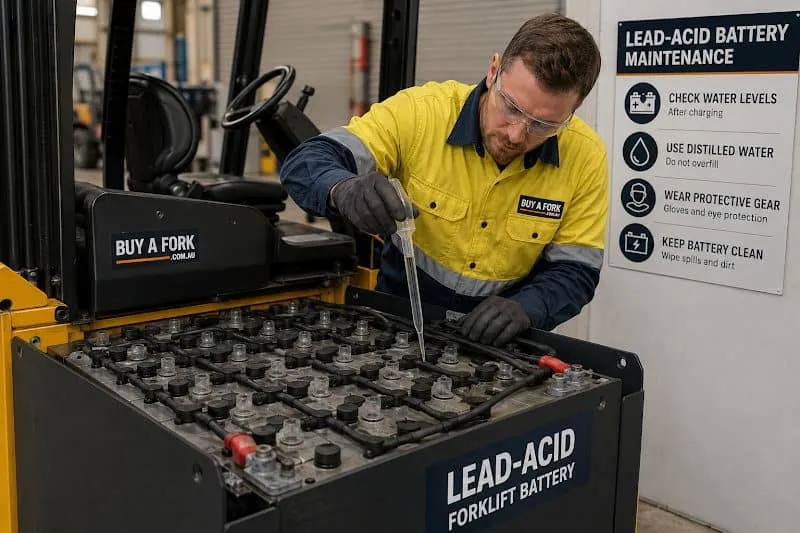
A well-maintained lead-acid forklift battery commonly lasts around five to six years in a single-shift operation, while a lithium battery may last longer depending on its chemistry, usage and manufacturer specifications.
Battery life should be measured in both years and charge cycles.
One full charge and discharge is generally treated as a cycle. A warehouse completing more cycles each day will reach the battery’s cycle limit sooner, even when the battery is only a few years old.
Typical Forklift Battery Lifespan
| Battery type | Indicative cycle life | Possible service life |
|---|---|---|
| Flooded lead-acid | Approximately 1,200 to 1,500 cycles | Around five to six years in suitable single-shift use |
| Lithium-ion | Approximately 2,000 to 3,500 or more cycles | Often longer, depending on daily cycles and manufacturer specifications |
These ranges are not guarantees. Temperature, discharge depth, charging practices, maintenance and shift intensity can significantly change the result.
What Shortens Forklift Battery Life?
- Deep discharging: Regularly draining the battery beyond the manufacturer’s recommended depth of discharge places additional stress on the cells.
- Incorrect charging: Undercharging, overcharging or using the wrong charger can reduce capacity and damage the battery.
- Low water levels: Exposed plates in a flooded lead-acid battery can become permanently damaged.
- Overfilling: Adding too much water can cause electrolyte to overflow during charging.
- High temperatures: Excess heat accelerates battery deterioration and can substantially reduce working life.
- Poor equalisation: Lead-acid cells can become unbalanced when equalisation charging is neglected.
- Corroded connectors: Damaged or dirty connections increase resistance and can affect charging performance.
- Opportunity charging the wrong battery: Frequent partial charging should only be used when the battery and charger are designed for it.
- Heavy multi-shift use: More daily cycles mean the battery reaches its cycle limit sooner.
Following a consistent forklift battery watering schedule can help prevent exposed plates, electrolyte overflow and premature lead-acid battery failure.
How Do You Know When a Forklift Battery Needs Replacing?
A declining forklift battery normally provides warning signs before it fails completely.
Look for:
- The forklift no longer completing a normal shift
- Longer charging times
- Rapid loss of charge
- Reduced travel or lifting performance
- Excessive battery heat
- Strong odours during charging
- Damaged cables or connectors
- Heavy corrosion around the tray
- Individual cells repeatedly requiring repair
- The battery failing a capacity test
- Error codes from the battery management system
- Bulging, leaking or physically damaged cells
Do not judge battery condition from the dashboard charge indicator alone. A professional battery capacity test provides a clearer measure of the energy the battery can still deliver under load.
An ageing battery may also increase electricity use and charging frequency. When comparing the broader cost of ownership, include the machine’s electricity consumption per operating hour rather than looking only at the replacement price.
Should You Replace the Battery or Replace the Forklift?
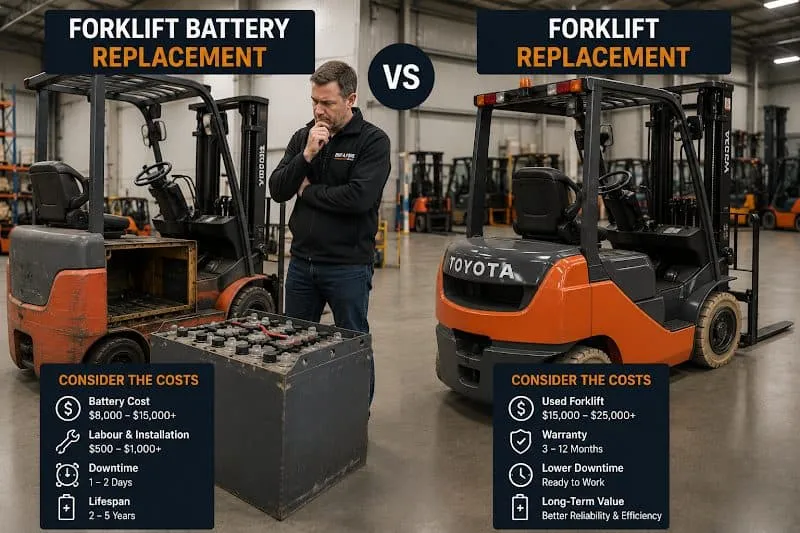
A battery replacement costing several thousand dollars should be compared with the forklift’s condition and current market value.
Replace the Battery When:
- The forklift is mechanically and structurally sound
- The mast, hydraulics, motors and controllers are in good condition
- The machine still suits the required load and lift height
- The forklift has a reliable service history
- Parts and technical support remain available
- The replacement battery will provide several more years of useful service
- Repairing the forklift costs considerably less than replacing it
Consider Replacing the Forklift When:
- The machine also needs major hydraulic, motor or controller repairs
- The mast or chassis has structural damage
- Several expensive components are nearing the end of their working life
- The forklift no longer suits the warehouse layout
- Its capacity or lift height is inadequate
- Downtime is affecting warehouse output
- A battery and charger package approaches the value of a better used machine
- The existing forklift has poor parts availability
At the time of review, Buy A Fork’s electric counterbalance forklift range included used electric equipment priced close to the cost of some lithium battery and charger packages.
This illustrates why a battery replacement approaching $9,500 should be compared against the price and condition of a complete replacement forklift. Stock and advertised prices can change.
A newer used electric forklift with a tested battery may offer better value than installing an expensive battery in an ageing machine that also needs other major repairs.
When considering another machine, use the used electric forklift buying guide to check the battery, charger, mast, controls and service history before committing.
Questions to Ask Before Ordering a Forklift Battery
Provide the supplier with accurate information before requesting a quote.
Confirm:
- What is the forklift make and model?
- What is the forklift serial number?
- What voltage does the forklift require?
- What is the current battery’s amp-hour rating?
- What are the battery tray dimensions?
- What is the minimum permitted battery weight?
- What connector is fitted?
- What charger is currently used?
- Is the forklift operated for one or multiple shifts?
- How many hours must it run between charges?
- Is opportunity charging required?
- Is the existing tray reusable?
- Does the quote include freight and installation?
- Is GST included?
- What warranty applies?
- What happens to the old battery?
The battery data plate should contain many of these details. Ask a battery technician or forklift dealer to inspect the machine when the plate is missing, damaged or inconsistent with the fitted battery.
Get the Full Cost Before Choosing
A forklift battery can cost anywhere from a few thousand dollars for a lead-acid cell kit to $9,500 or more for a lithium battery and charger package.
Do not compare batteries on advertised price alone. Confirm the voltage, capacity, dimensions, minimum weight, chemistry, tray, charger, freight, installation and warranty.
When replacement costs approach the value of the existing machine, compare the quote against Buy A Fork’s current electric forklift range. A properly inspected used forklift with a healthier battery may provide better long-term value than fitting an expensive new battery to an unsuitable or heavily worn machine.
Frequently Asked Questions
1. How Much Does a Forklift Battery Cost?
Public Australian listings reviewed in July 2026 ranged from approximately $2,999 for a 36V 440Ah lead-acid cell kit to $9,500 for a 48V 460Ah lithium battery with a 200A charger.
A complete fitted replacement may cost more once the tray, charger, connectors, freight and installation are included.
2. How Much Is a Battery for an Electric Forklift?
A battery for a full-sized electric forklift commonly costs several thousand dollars.
The exact price depends on voltage, amp-hour capacity, chemistry, battery weight, tray dimensions and charger compatibility. Small pallet truck batteries may cost much less, while large 80V traction batteries can cost considerably more than the publicly listed 36V and 48V examples.
3. How Long Do Forklift Batteries Last?
A properly maintained lead-acid forklift battery designed for approximately 1,200 to 1,500 cycles may last about five or six years in a one-shift operation.
Lithium products commonly advertise longer cycle lives, with some manufacturers specifying 2,000 to more than 3,500 cycles. Actual service life depends on use, charging, temperature and maintenance.
4. What Is the Best Forklift Battery?
Lead-acid is often suitable for businesses that operate one shift, have predictable charging time and can complete regular battery maintenance.
Lithium may be the better option for multi-shift warehouses, opportunity charging and operations where downtime and battery maintenance are significant costs.
The best battery is the one approved for the forklift and matched to the site’s workload, charging system and budget.
5. Is a Lithium Forklift Battery Worth the Higher Price?
A lithium battery may justify its higher price when the forklift runs for long hours, operates across multiple shifts or cannot be left charging and cooling for extended periods.
For light or occasional use, the lower purchase price of lead-acid may provide better value. Compare purchase price, expected cycles, electricity, maintenance, chargers and downtime over the planned ownership period.
6. Can an Old Forklift Battery Be Reconditioned?
Some lead-acid batteries can be repaired or reconditioned when the tray is sound and the damage is limited.
Reconditioning may not restore the battery to its original capacity. Request a capacity test, estimated runtime, repair details and written warranty before proceeding.
7. Does a Forklift Battery Affect Trade-In Value?
Yes. An electric forklift with a weak or failed battery will normally have a lower trade-in value because the dealer or buyer must account for testing, repair or replacement.
A recent battery, clear service records and a compatible charger can make an electric forklift easier to assess and more attractive to a buyer.