
Electric vs Diesel Forklifts: Which Is Better for Your Business?
· Updated
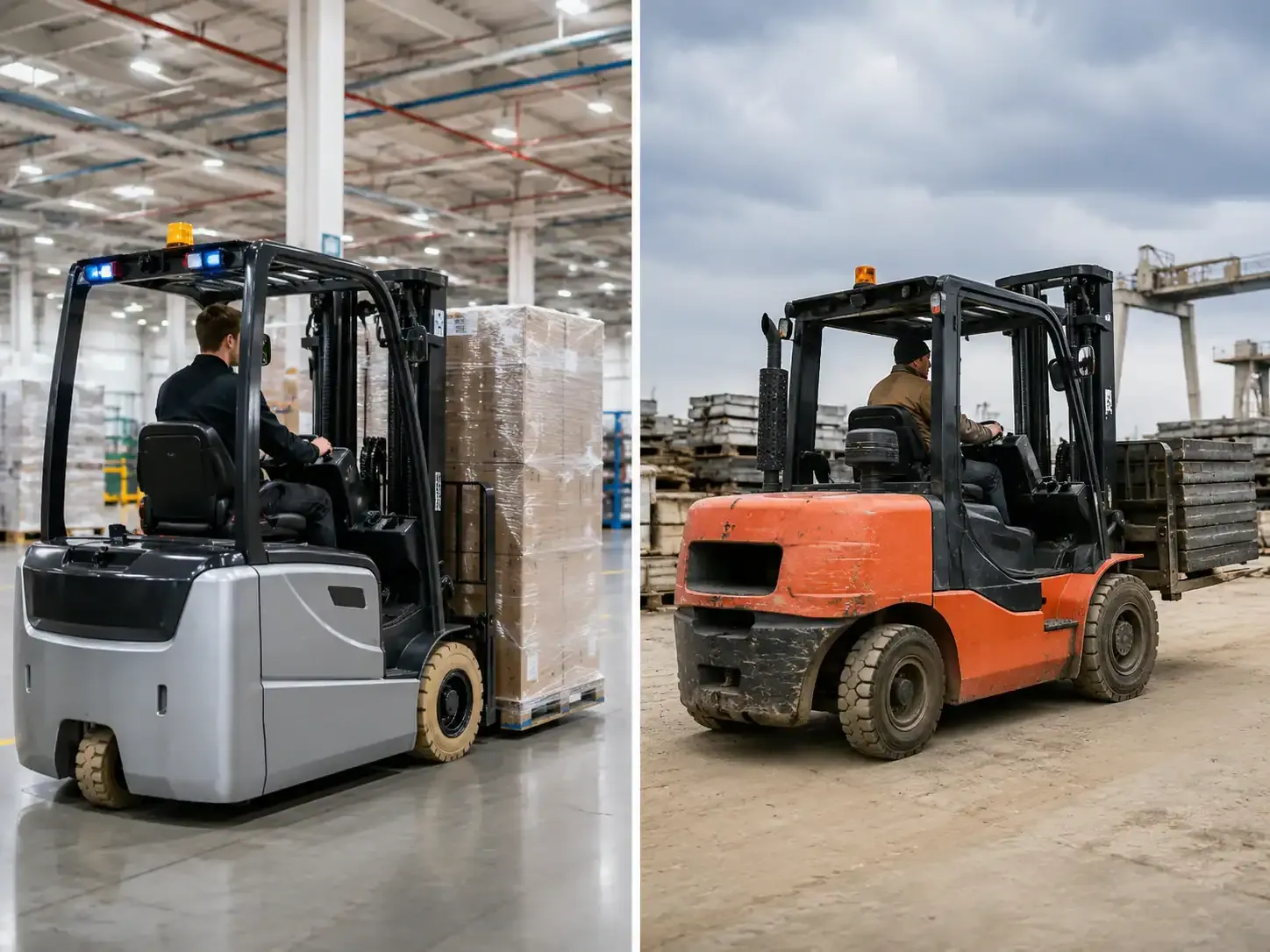
Electric forklifts are usually the better choice for indoor warehouses because they are quiet, produce no tailpipe emissions at the point of use and generally cost less to operate and maintain. Diesel forklifts are often better for demanding outdoor work, rough surfaces, heavier loads and applications where rapid refuelling is essential.
That is the basic verdict, but the right forklift still depends on your working environment, operating hours, load capacity, floor conditions, charging access and long-term budget.
Electric or Diesel Forklift? The Short Answer
Choose an electric forklift when most work takes place indoors, noise and air quality matter, floors are relatively smooth and the business can provide suitable charging infrastructure.
Choose a diesel forklift when the machine will spend most of its time outdoors, travel over rough or uneven surfaces, handle demanding loads or operate where stopping to recharge would interrupt production.
Choose an Electric Forklift If:
- Most work takes place inside a warehouse or factory
- Tailpipe emissions need to be avoided
- Noise needs to be kept low
- The forklift works around employees, customers or food products
- Floors are level and reasonably smooth
- The daily workload fits the selected battery and charging plan
- Lower routine maintenance is a priority
- The business wants to reduce direct fossil fuel use
Choose a Diesel Forklift If:
- Most work takes place outdoors
- The forklift regularly travels over gravel, damaged concrete or uneven yards
- High capacity and sustained heavy work are required
- Refuelling needs to take minutes rather than hours
- The machine operates far from charging infrastructure
- Gradients, weather and long travel distances are common
- The site can safely manage diesel exhaust, fuel storage and noise
Modern electric forklifts are increasingly capable of outdoor and high-capacity work, so diesel is no longer automatically required for every demanding application. The final decision should be based on the individual model and worksite rather than fuel type alone.
Electric vs Diesel Forklifts at a Glance
| Comparison factor | Electric forklift | Diesel forklift |
| Best operating environment | Indoor warehouses and suitable paved outdoor areas | Outdoor yards, construction supply sites and rough surfaces |
| Upfront cost | Can be higher once the battery and charger are included | Often competitive, particularly in the used market |
| Energy or fuel cost | Usually lower in suitable applications | Depends heavily on diesel prices and fuel consumption |
| Routine maintenance | Generally lower because there is no diesel engine | Higher due to engine oils, filters, cooling and fuel systems |
| Tailpipe emissions | None at the point of use | Produces diesel exhaust emissions |
| Noise | Quiet | Louder |
| Refuelling or charging | Requires charging time and infrastructure | Fast refuelling |
| Multi-shift operation | Requires sufficient battery capacity, opportunity charging or battery changes | Can continue after rapid refuelling |
| Cold-store suitability | Strong when correctly specified for cold environments | Generally unsuitable indoors because of exhaust emissions |
| Wet outdoor use | Possible with a correctly rated and configured model | Commonly suited to outdoor use |
| Rough surfaces | Depends on tyres, clearance and forklift design | Often well suited to uneven outdoor surfaces |
| Heavy loads | Increasingly capable, but model selection is critical | Traditionally strong in heavy-duty applications |
| Manoeuvrability | Compact designs and precise low-speed control | Often larger, particularly at higher capacities |
| Major long-term expense | Battery replacement | Engine, transmission and fuel-system repairs |
| Best overall fit | Indoor, clean, quiet and cost-conscious operations | Heavy outdoor and continuous-duty operations |
Businesses comparing similar counterbalance machines can examine the practical differences between electric versus diesel counterbalance models before choosing a specific capacity and mast configuration.
How Electric and Diesel Forklifts Differ
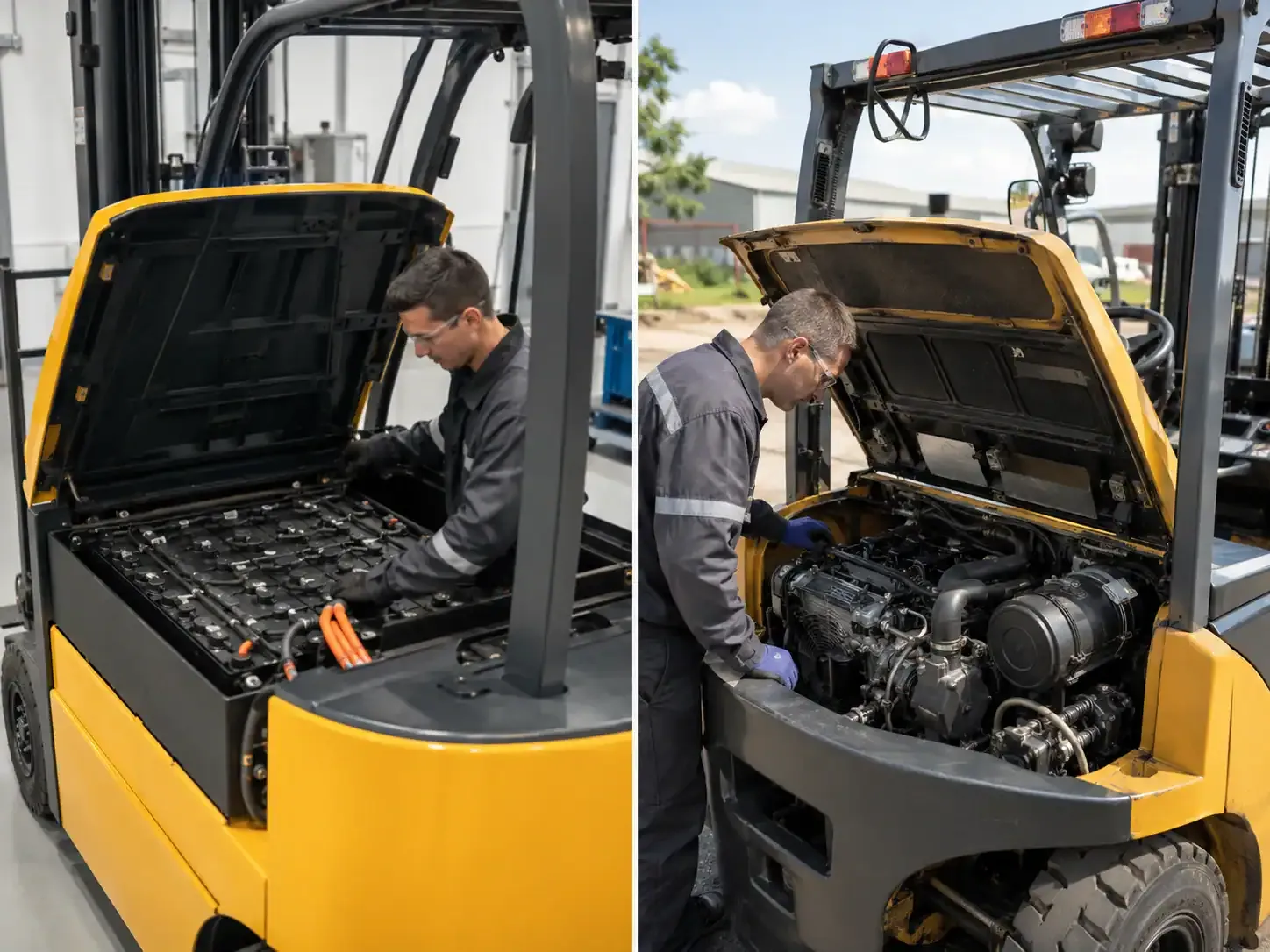
The main difference is how each forklift generates and delivers power.
An electric forklift uses energy stored in a lead-acid or lithium-ion battery. Electric motors power the drive system and hydraulic functions.
A diesel forklift uses an internal combustion engine. Diesel fuel is burned to power the drivetrain and hydraulic system.
This difference affects acceleration, noise, maintenance, emissions and how the forklift is prepared for each shift.
Power Delivery
Electric motors deliver immediate torque and smooth low-speed control. This can make an electric forklift precise when approaching racking, positioning pallets or working in congested spaces.
Diesel engines deliver strong sustained power and are well established in heavy outdoor applications. They can be suitable for long travel distances, gradients and demanding work where engine-powered equipment already forms part of the operation.
Power should not be judged by fuel type alone. Rated capacity, load centre, mast height, attachments, tyre type and drivetrain design all affect what a forklift can safely handle.
Lift and Travel Performance
Diesel forklifts have traditionally been associated with higher travel speeds, faster refuelling and demanding duty cycles. Modern electric systems have narrowed that performance difference.
Current electric forklifts can offer:
- High-capacity lifting
- Programmable performance modes
- Regenerative braking
- Precise acceleration
- Automatic speed reduction while turning
- Opportunity charging
- Pneumatic tyres for outdoor work
- Sealed components for wet or dusty conditions
Manufacturer specifications should be compared model by model. A high-performance electric forklift may outperform an older diesel machine, while a heavy-duty diesel model may remain better suited to a rough yard than a compact warehouse electric forklift.
Traction and Ground Clearance
Diesel forklifts commonly use pneumatic or solid pneumatic tyres and often provide the ground clearance needed for outdoor industrial sites.
Electric counterbalance forklifts were traditionally designed mainly for smooth indoor floors. Many newer models are now available with four-wheel designs, pneumatic tyres and weather-protected electrical components.
Before buying either type, assess:
- Floor and yard condition
- Potholes and surface transitions
- Gradients
- Dock plates and ramps
- Ground clearance
- Tyre type
- Turning space
- Exposure to rain, dust and mud
Electric vs Diesel Forklift Running Costs
Electric forklifts generally have lower energy and routine maintenance costs in suitable warehouse applications. Diesel forklifts can cost more to fuel and service, but their fast refuelling and outdoor productivity may justify the difference.
A fair cost comparison must include more than electricity and diesel prices.
| Ownership cost | Electric forklift | Diesel forklift |
| Energy or fuel | Electricity costs are generally predictable and comparatively low | Cost changes with diesel prices and fuel consumption |
| Routine servicing | Fewer engine-related service items | Engine oil, filters, fuel system and cooling system require servicing |
| Battery or engine | Battery condition and eventual replacement are major considerations | Engine and transmission repairs can become significant as the machine ages |
| Charging or refuelling infrastructure | Requires a compatible charger, electrical supply and charging location | Requires safe fuel storage or access to refuelling |
| Daily downtime | Depends on battery capacity and charging plan | Usually limited to refuelling and routine checks |
| Tyres and hydraulics | Required on both power types | Required on both power types |
| Ventilation controls | Charging controls depend on battery type | Exhaust exposure must be controlled where diesel equipment is used |
| Resale value | Strongly affected by battery condition | Strongly affected by engine hours and mechanical history |
Electricity Use
Electricity consumption varies according to the battery voltage, forklift capacity, load weight, lift height, travel distance, floor condition and hours worked.
A light-duty warehouse forklift moving small pallets will use less energy than a high-capacity electric forklift operating continuously across multiple shifts.
Rather than relying on a generic cost figure, estimate how much electricity a forklift uses per hour using the expected workload, battery specifications and local electricity tariff.
Also include:
- Charger efficiency
- Peak and off-peak electricity rates
- Battery cooling or heating
- Battery maintenance
- Charging-room infrastructure
- Eventual battery replacement
- Solar generation available on site
Diesel Use
Diesel consumption depends on engine size, load, travel speed, idling time, surface conditions and operator behaviour.
A forklift that spends significant time idling may consume fuel without moving stock. Long travel distances, gradients and high-capacity loads can increase consumption further.
Businesses can estimate how much diesel a forklift uses per hour and multiply that amount by expected annual operating hours and the applicable fuel price.
Diesel cost calculations should also include:
- Engine oil and filters
- Fuel filters
- Cooling-system maintenance
- Air filters
- Exhaust-system maintenance
- Fuel storage or delivery
- Unproductive idling
- Ventilation or air-quality controls
Why Cost Per Pallet Can Matter More
A forklift with the lowest hourly energy cost is not automatically the cheapest machine for the operation.
The more useful measure may be the cost per pallet moved, truck unloaded or order dispatched.
For example, a diesel forklift may cost more per operating hour but complete demanding outdoor work without charging interruptions. An electric forklift may deliver a lower cost per pallet indoors because it uses less energy, requires less maintenance and works efficiently in narrow spaces.
Calculate total annual ownership cost and divide it by the productive work completed. This provides a more realistic comparison than fuel price alone.
Indoor Use, Emissions and Ventilation
Electric forklifts are normally the preferred option for enclosed warehouses because they produce no tailpipe emissions at the point of use.
Diesel forklifts produce exhaust containing gases and fine particles. Safe Work Australia identifies forklift drivers and loading-dock workers among the groups that may be exposed to diesel exhaust and recommends eliminating or minimising that exposure where reasonably practicable.
WorkSafe Victoria also warns that exposure can be higher when diesel-powered equipment operates in enclosed or poorly ventilated workplaces.
Can a Diesel Forklift Be Used Indoors?
A diesel forklift should not be treated as a normal indoor warehouse forklift.
Any indoor use requires a risk assessment and controls appropriate to the exhaust exposure. The employer must consider whether the diesel machine can be eliminated or replaced with electric equipment before relying on ventilation or procedural controls.
The requirements for using a diesel forklift indoors may include:
- Eliminating unnecessary indoor operation
- Restricting the time the engine runs inside
- Providing effective mechanical ventilation
- Preventing extended idling
- Maintaining and tuning the engine
- Monitoring workplace air where required
- Keeping people away from exhaust discharge
- Reviewing enclosed loading docks and containers
- Training operators to report visible smoke or strong fumes
- Replacing diesel equipment with electric alternatives where practicable
Opening a roller door does not automatically provide adequate ventilation. Airflow, building volume, exhaust quantity, forklift activity and the location of workers all affect exposure.
Other Indoor Benefits of Electric Forklifts
Electric forklifts can also provide:
- Lower noise levels
- Less vibration
- No engine oil or diesel fuel on the machine
- Better suitability around food and packaged products
- Reduced heat from an internal combustion engine
- Easier communication between workers
- Improved comfort during long indoor shifts
Electric power does not remove every hazard. Battery charging, electrical supply, pedestrian movement, forklift stability and operator competence still need to be managed.
Charging Time vs Diesel Refuelling
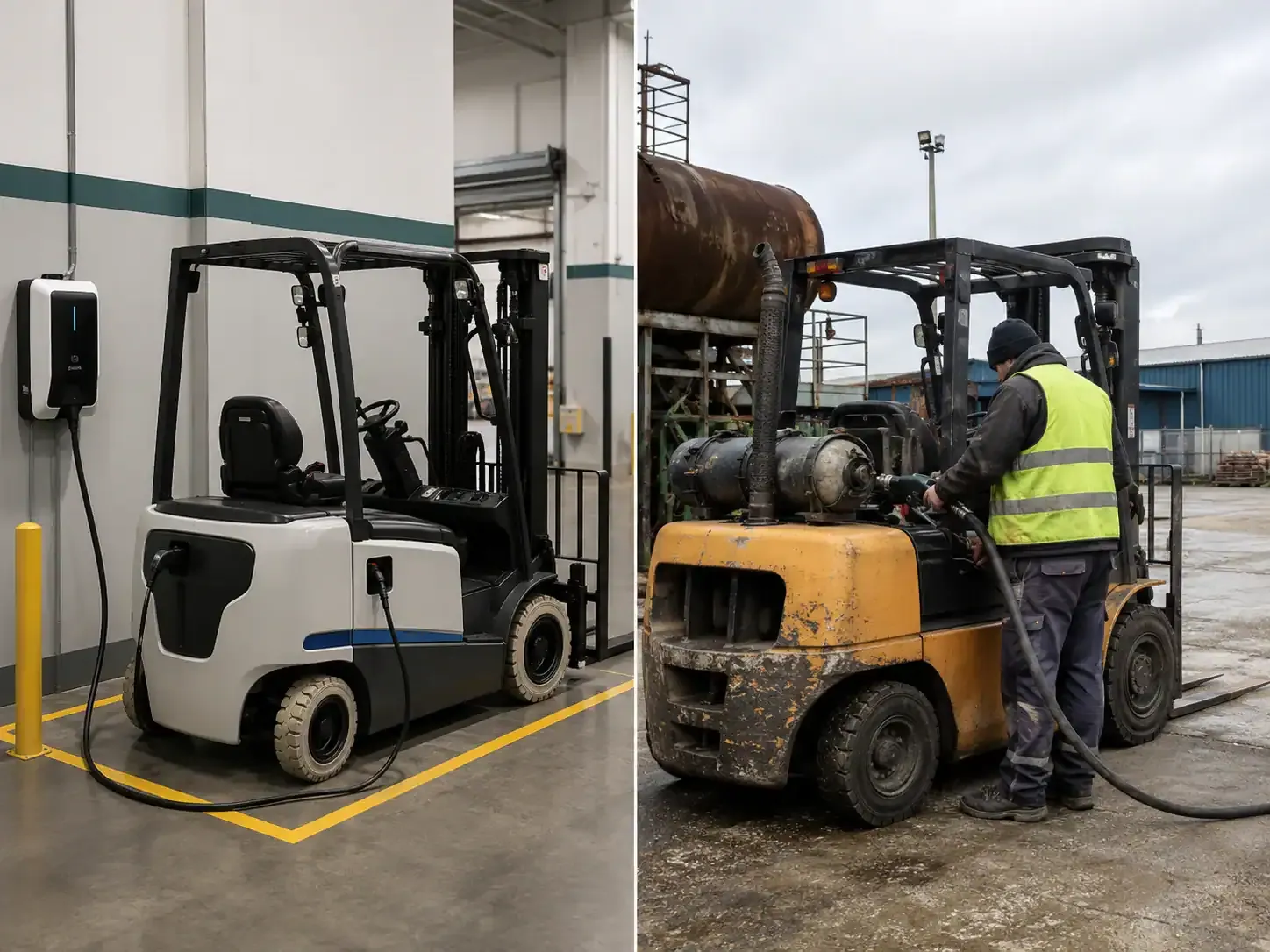
Diesel has a clear advantage when rapid refuelling is the main priority. A tank can be filled quickly, allowing the forklift to return to work with limited interruption.
Electric forklift availability depends on battery type, charger capacity and how work is scheduled.
Lead-Acid Batteries
Traditional lead-acid batteries are proven and widely available, but they require a structured charging and maintenance routine.
Depending on the battery and operation, this may involve:
- Charging after the planned discharge cycle
- Allowing sufficient time for charging
- Providing cooling time where required
- Checking electrolyte levels
- Adding water correctly
- Cleaning corrosion
- Ventilating the charging area
- Using a second battery for extended shifts
Incorrect charging or maintenance can reduce capacity and battery life.
Lithium-Ion Batteries
Lithium-ion systems can generally be charged faster and can often be opportunity charged during breaks and natural pauses in production.
Lithium-ion batteries may also offer:
- No battery watering
- Minimal routine battery maintenance
- More consistent voltage during use
- Fast interim charging
- No battery swapping in suitable operations
- Better use of short charging windows
- Longer service life in some applications
Their initial price is generally higher, so the return is strongest where the forklift works enough hours to benefit from reduced charging downtime and maintenance.
Cold Storage, Winter and Outdoor Performance
Temperature and weather can change which fuel type performs best.
Electric Forklifts in Cold Storage
Electric forklifts are commonly selected for refrigerated warehouses and cold stores because they avoid combustion exhaust inside enclosed areas.
However, the forklift must be specified for low-temperature use.
Cold conditions can affect battery capacity, charging performance, lubricants, seals, electronics and condensation.
A cold-store electric forklift may require:
- Cold-temperature lubricants
- Heated controls or operator compartment
- Sealed electrical components
- Corrosion protection
- Battery heaters
- Condensation management
- Cold-rated tyres
- Suitable hydraulic fluids
- Protected display and control systems
- A charging area outside the coldest zone
Do not assume a standard warehouse forklift can be moved permanently into a freezer without modification.
Diesel Forklifts in Winter
Diesel forklifts can be effective in cold outdoor environments, but low temperatures may affect starting batteries, fuel, engine oil, hydraulics and warm-up time.
The answer to which performs better in winter depends on whether the forklift works in an enclosed freezer, a wet outdoor yard or both.
For indoor refrigerated areas, a cold-store-specified electric forklift is usually the stronger choice.
For an exposed outdoor yard with rough surfaces and no practical charging access, a diesel forklift may provide better operational flexibility.
Outdoor Electric Forklifts
Electric forklifts can work outdoors when the model is designed for the conditions.
Check:
- Ingress-protection ratings
- Tyre type
- Ground clearance
- Traction
- Braking on wet surfaces
- Battery enclosure
- Electrical connector protection
- Operating-temperature range
- Cab and weather protection
- Manufacturer approval for outdoor use
A smooth paved loading area is very different from a muddy timber yard or unsealed construction supply site.
Outdoor Diesel Forklifts
Diesel forklifts remain well suited to demanding external applications such as:
- Building-material yards
- Timber and steel handling
- Agricultural supply sites
- Container yards
- Recycling operations
- Manufacturing yards
- Uneven industrial surfaces
- Remote work areas
Diesel should not be selected only because a forklift occasionally travels outside. A suitable electric forklift may handle mixed indoor and paved outdoor work without introducing diesel exhaust into the building.
Maintenance, Downtime and Service Life
Electric forklifts generally require less routine powertrain maintenance because they do not have a diesel engine, engine oil, combustion system, fuel filters or engine-cooling system.
Both forklift types still require regular inspection and servicing of:
- Brakes
- Tyres
- Steering
- Hydraulic systems
- Mast channels
- Lift chains
- Forks
- Safety devices
- Operator restraints
- Warning systems
Electric Forklift Maintenance
Electric forklift maintenance focuses on the battery, charger, cables, connectors, motors and electronic controls.
Lead-acid battery care may include:
- Checking electrolyte levels
- Correct watering
- Cleaning the battery
- Inspecting connectors
- Managing charging cycles
- Equalisation charging where specified
- Preventing excessive discharge
- Monitoring battery temperature
Lithium-ion batteries require less routine battery maintenance, but repairs should be completed only by trained technicians using approved procedures.
Diesel Forklift Maintenance
Diesel forklifts require maintenance of:
- Engine oil and filters
- Fuel system
- Air intake
- Cooling system
- Starter battery
- Belts and hoses
- Exhaust system
- Transmission
- Engine mounts
- Emissions-control components where fitted
Dusty and demanding outdoor work may increase servicing requirements.
Battery Replacement vs Engine Repairs
The battery is one of the largest potential lifecycle costs for an electric forklift. When purchasing used equipment, ask for a battery-capacity test rather than relying only on the forklift’s age or displayed hours.
For diesel forklifts, engine hours, cold-start behaviour, smoke, fluid leaks, transmission performance and service history provide important indications of condition.
A cheap electric forklift with a weak battery or a cheap diesel forklift with engine problems can become expensive shortly after purchase.
Which Type Lasts Longer?
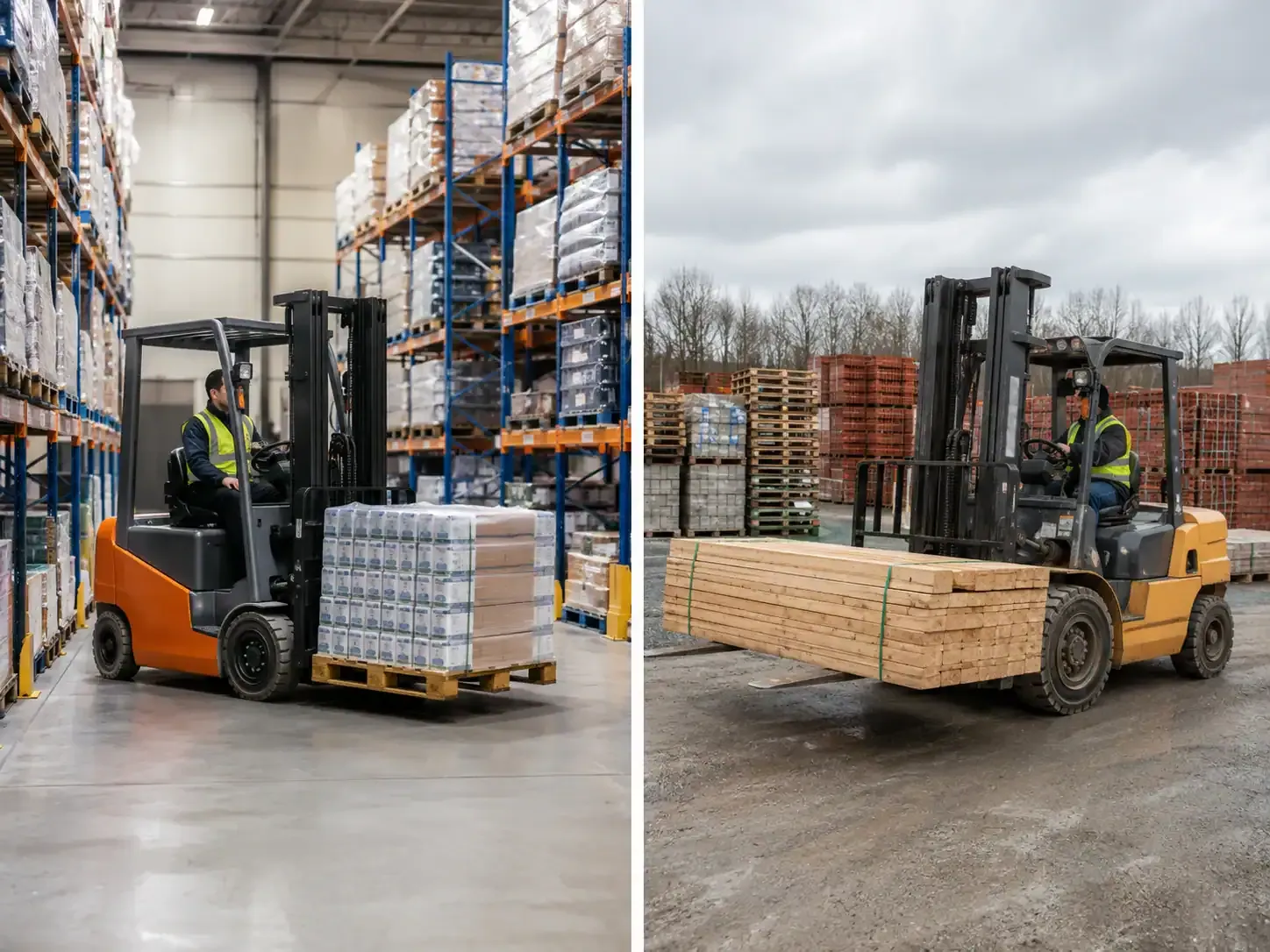
Neither power type has a guaranteed longer life in every operation.
An electric forklift can remain productive for many years because the electric drivetrain has relatively few service components. Its battery may need replacement during the forklift’s working life.
A well-maintained diesel forklift can also deliver a long service life, particularly in applications suited to its design. Poor servicing, excessive idling, contaminated fuel and harsh operation can shorten that life.
Condition, maintenance history and workload usually matter more than the word “electric” or “diesel” on the specification sheet.
Environmental Impact and Sustainability
Electric forklifts have no tailpipe emissions at the point of operation, making them a strong option for businesses seeking cleaner indoor workplaces.
Their total environmental impact still depends on:
- How the electricity is generated
- Forklift energy efficiency
- Battery manufacturing
- Battery lifespan
- Battery recycling
- Annual operating hours
- Whether solar or renewable electricity is used
A business with on-site solar generation may be able to charge electric forklifts partly from its own renewable supply.
Diesel forklifts produce direct greenhouse gas emissions and local exhaust pollution whenever the engine operates. Fuel extraction, transport and storage also contribute to their overall impact.
Replacing a diesel forklift with electric equipment can reduce on-site emissions, but the replacement must still meet operational requirements.
Which Forklift Should You Choose?
The following scenarios provide a practical starting point.
| Business scenario | Recommended starting point | Reason |
| Small indoor warehouse | Electric | Quiet, compact and lower routine running costs |
| Food or beverage warehouse | Electric | No tailpipe emissions at the point of use |
| E-commerce fulfilment centre | Electric | Precise control and suitability for frequent indoor movement |
| Cold store or freezer | Cold-store electric | Avoids combustion exhaust and can be specified for low temperatures |
| Mixed indoor and paved outdoor work | Outdoor-rated electric | Avoids bringing diesel exhaust inside |
| Building-material yard | Diesel | Strong outdoor performance and fast refuelling |
| Rough or unsealed yard | Diesel or purpose-built outdoor electric | Depends on traction, clearance and charging access |
| Heavy continuous outdoor work | Diesel or high-capacity lithium electric | Compare performance, charging and total ownership cost |
| One light shift per day | Electric | Overnight charging may suit the schedule |
| Multiple shifts with regular breaks | Lithium-ion electric | Opportunity charging may maintain availability |
| Remote site without charging access | Diesel | Fuel may be easier to transport and store |
| Noise-sensitive operation | Electric | Quieter drivetrain |
| Tight indoor aisles | Electric | Compact designs and precise low-speed control |
| Very high annual operating hours indoors | Electric | Energy and maintenance savings can accumulate over time |
Choose Electric When the Workplace Is Mainly Indoors
Electric is the stronger default when the forklift operates inside for most of the day.
It normally offers:
- Cleaner operation
- Lower noise
- Lower energy cost
- Reduced routine maintenance
- Better low-speed control
- Easier compliance with indoor air-quality objectives
Businesses ready to shortlist machines can compare the current electric counterbalance range by capacity, lift height and configuration.
Choose Diesel When Outdoor Productivity Comes First
Diesel is often the stronger choice where work involves rough surfaces, weather exposure, longer travel distances and rapid refuelling.
It can suit businesses that:
- Handle construction materials
- Work in remote yards
- Carry demanding loads
- Operate across large outdoor areas
- Lack sufficient electrical infrastructure
- Cannot schedule charging periods
Available diesel forklifts for sale should be compared by rated capacity, mast, tyre type, engine hours, ground clearance and service history.
Consider Electric Even for Heavy Work
Do not dismiss electric solely because the load is heavy.
High-capacity electric forklifts are increasingly available, and lithium-ion systems can support intensive applications when correctly sized.
Compare:
- Maximum capacity at the required load centre
- Residual capacity at full lift height
- Battery capacity
- Charger output
- Opportunity-charging windows
- Outdoor rating
- Tyres and ground clearance
- Required annual throughput
- Purchase price
- Expected ownership period
Consider Diesel Even When Fuel Costs Are Higher
Diesel may still produce the lower overall cost when electric charging would interrupt a critical operation or require extensive electrical upgrades.
For example, a remote outdoor site may find diesel more practical because:
- Fuel can be delivered
- Refuelling is fast
- No high-capacity charger is required
- The forklift can work across long shifts
- Rough-terrain models are readily available
The correct comparison is the total cost of completing the work, not fuel cost by itself.
A Five-Step Electric vs Diesel Decision Checklist
1. Define the Operating Environment
Record how much time the forklift will spend:
- Indoors
- Outdoors
- In cold storage
- On wet surfaces
- On rough ground
- On ramps
- Inside containers or trailers
Indoor operation generally pushes the decision towards electric.
2. Measure the Workload
Calculate:
- Operating hours per day
- Number of shifts
- Average load weight
- Maximum load weight
- Travel distance
- Lift height
- Pallets moved per hour
- Available breaks
- Seasonal peaks
A battery and charger should be sized for the real duty cycle rather than an average quiet day.
3. Check the Available Infrastructure
For electric forklifts, confirm:
- Electrical supply
- Charger compatibility
- Charging location
- Ventilation for the selected battery type
- Available charging time
- Capacity for future forklifts
For diesel forklifts, confirm:
- Safe fuel storage
- Refuelling procedure
- Spill controls
- Outdoor or well-controlled operating areas
- Engine-service access
4. Calculate the Total Ownership Cost
Compare:
- Purchase price
- Finance
- Electricity or fuel
- Scheduled servicing
- Battery replacement
- Engine repairs
- Tyres
- Charging infrastructure
- Ventilation controls
- Downtime
- Resale value
Use the same estimated operating hours and ownership period for both options.
5. Test the Forklift in the Actual Application
Where possible, test the shortlisted model using:
- A representative load
- The narrowest aisle
- The highest rack
- The steepest approved gradient
- The normal loading area
- Outdoor surface transitions
- Typical shift duration
A specification sheet cannot reveal every visibility, comfort, traction or manoeuvrability issue.
Where LPG Fits
LPG forklifts can provide a middle ground between electric and diesel. They refuel quickly and may suit mixed indoor and outdoor work, but they still produce combustion emissions and require suitable ventilation and cylinder handling.
Businesses considering all three fuel types should use the full three-fuel comparison including LPG rather than extending this two-way decision beyond electric and diesel.
The Final Verdict
Electric is the better choice for most indoor warehouses, factories, food facilities and e-commerce operations. It offers no tailpipe emissions at the point of use, lower noise, precise control and generally lower energy and routine maintenance costs.
Diesel is the better choice for rough outdoor yards, remote sites, heavy continuous work and operations that depend on rapid refuelling.
The decision becomes less obvious when a business combines indoor and outdoor work or handles heavy loads. Modern electric forklifts can now perform tasks once reserved for diesel, but the battery, charger, tyres and machine configuration must match the duty cycle.
Choose according to the environment and total ownership cost rather than purchase price alone. The best forklift is the one that completes the required work safely, reliably and economically across its entire service life.
Frequently Asked Questions
1. Is an Electric or Diesel Forklift Cheaper to Run?
An electric forklift is generally cheaper to run in indoor warehouse applications because electricity typically costs less than diesel for the equivalent productive work and the electric drivetrain has fewer routine service requirements.
The actual saving depends on electricity tariffs, diesel prices, operating hours, battery type, charging efficiency and maintenance.
2. Can You Use a Diesel Forklift Indoors?
Diesel forklifts should not be used routinely indoors without a detailed assessment and effective controls for exhaust exposure.
An electric forklift should be considered before relying on ventilation, limited operating time or other controls.
3. Do Electric Forklifts Have Enough Power for Heavy Outdoor Work?
Some electric forklifts are capable of heavy outdoor work, including high-capacity lifting.
Their suitability depends on capacity, battery system, tyres, ground clearance, weather protection, gradients and charging access.
4. How Long Does an Electric Forklift Run on One Charge?
There is no universal runtime.
Battery capacity, battery condition, load weight, lift frequency, travel distance, temperature and operator behaviour all affect how long an electric forklift can work.
5. How Long Does an Electric Forklift Take to Charge?
Charging time depends on the battery chemistry, battery capacity, charger output and remaining charge.
Traditional lead-acid systems usually require a longer planned charging period. Lithium-ion batteries can often accept fast and opportunity charging.
6. Which Lasts Longer, an Electric or Diesel Forklift?
Both types can remain productive for many years when correctly specified and maintained.
Electric forklifts have fewer engine-related components but may require battery replacement. Diesel forklifts can deliver long mechanical life but require regular engine, fuel, cooling and exhaust-system maintenance.
7. Are Electric Forklifts Worth It for a Small Warehouse?
Electric forklifts are often worth considering for small warehouses because they are quiet, compact, suitable for indoor use and relatively inexpensive to operate.
The business still needs a suitable charger and enough time to recharge the battery.
8. Which Type Has Better Resale Value?
Resale value depends on brand, age, hours, capacity, mast type, service history and overall condition.
For electric forklifts, battery health has a major influence on value. For diesel forklifts, buyers pay close attention to engine hours, smoke, transmission condition, leaks and maintenance records.