
Drive-In Racking Explained: How It Works, Pros and Cons, and the Right Forklift
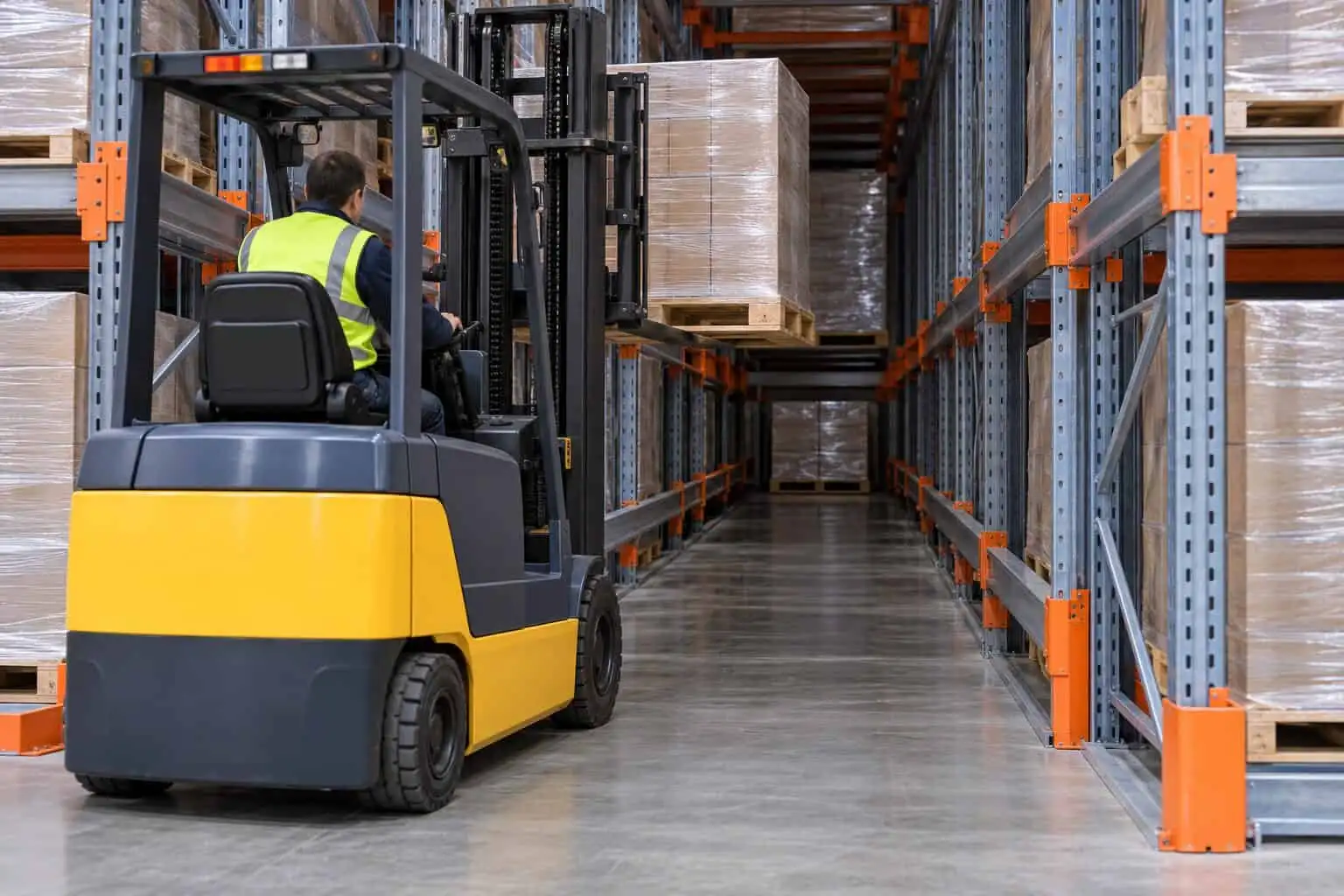
Drive-in racking fits far more pallets into the same shed. But put a forklift a few centimetres too wide in those lanes and it can start clipping uprights on day one. Drive-in is high-density pallet storage where the truck drives into deep lanes and sets each pallet on steel rails along both sides, so the last pallet in is the first one out.
How Drive-In Racking Works
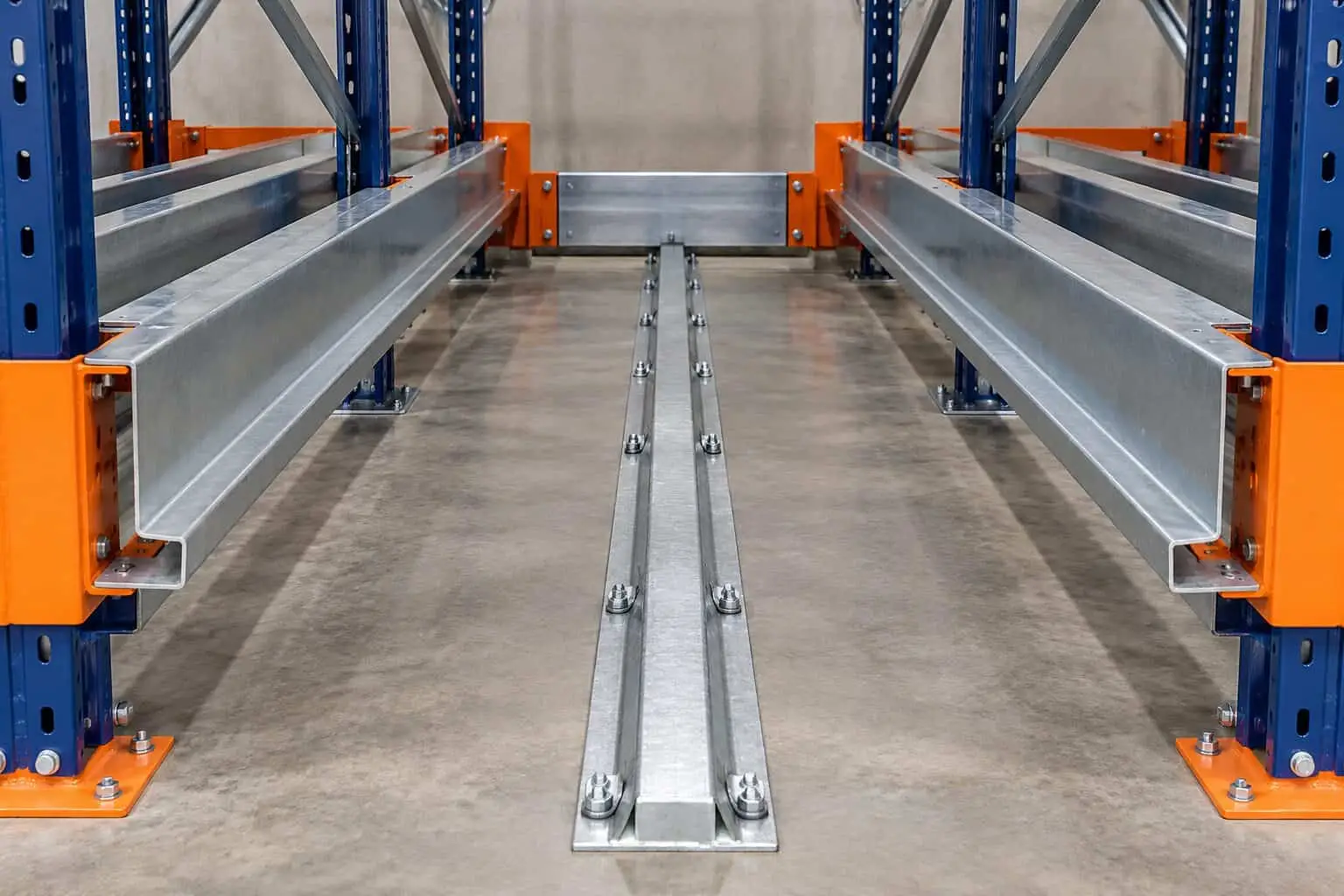
A drive-in rack is a solid block of upright frames split into deep lanes, each just wide enough for a forklift. Instead of beams across the front, every level has a steel rail along each side of the lane, and pallets sit across the two rails by their outer edges, one behind the other.
You fill each lane from the back. The operator drives in with the pallet raised just above its rail, sets it down at the deepest free spot and reverses out.
With only one way in, the rack runs LIFO (last in, first out), which some racking makers call FILO. That’s why each lane normally holds one product: mix two in a lane and you’ll be pulling pallets out to reach the one behind.
The parts that keep it safe:
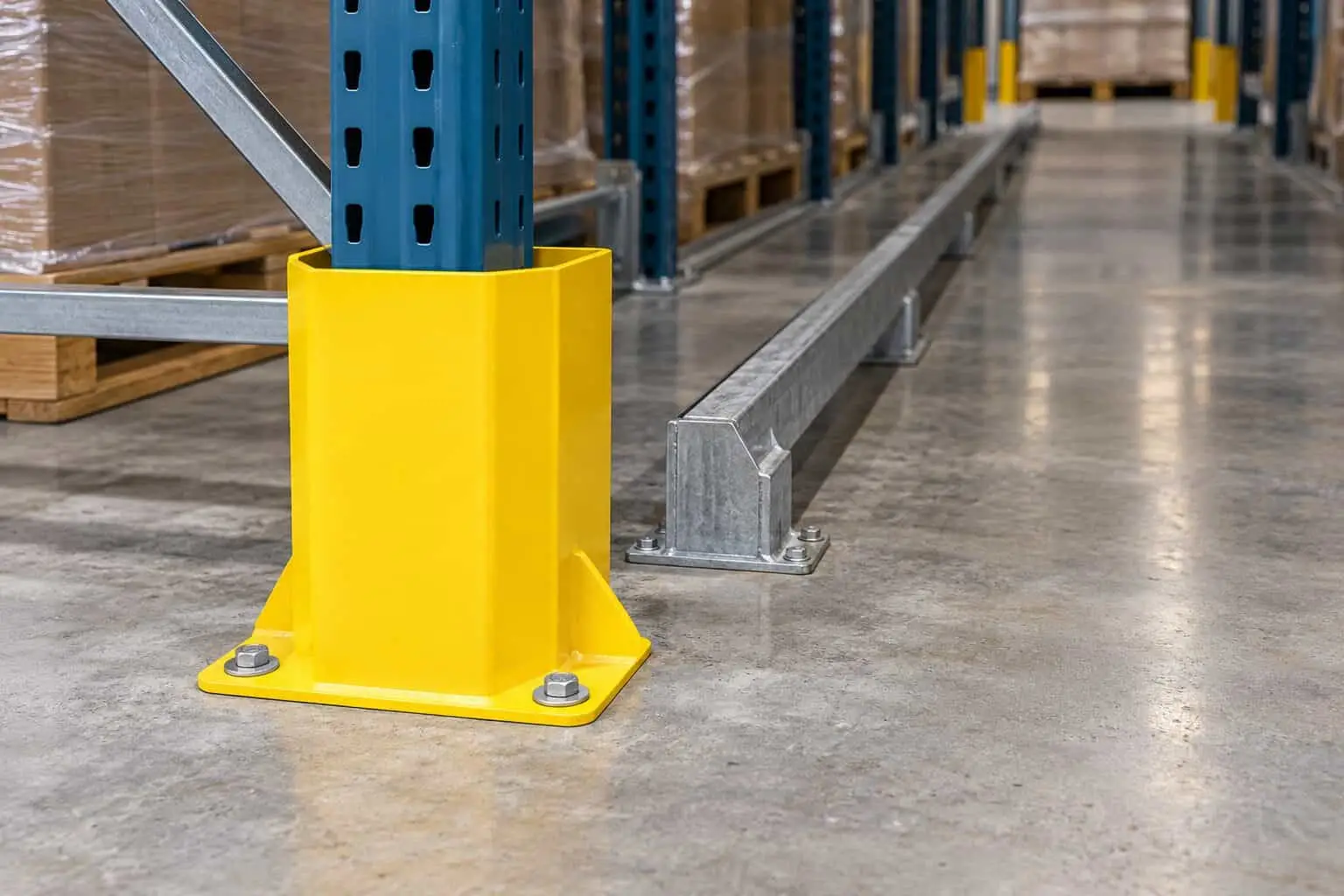
- Floor guide rails: steel rails along the floor of each lane that steer the truck straight and keep its wheels off the uprights.
- Pallet stops: stops at the back of each rail so the first pallet can’t be pushed out the back of the rack.
- Upright protectors: guards on the front uprights at each lane entry, where trucks are most likely to clip the rack.
Lanes are built around one pallet size, which in Australia is usually the 1165 x 1165 mm standard pallet. Each pallet rests on a narrow strip of rail along two edges, so a broken bottom board or an undersized pallet can slip off. Keep damaged pallets out of the lanes.
Drive-In vs Drive-Through Racking
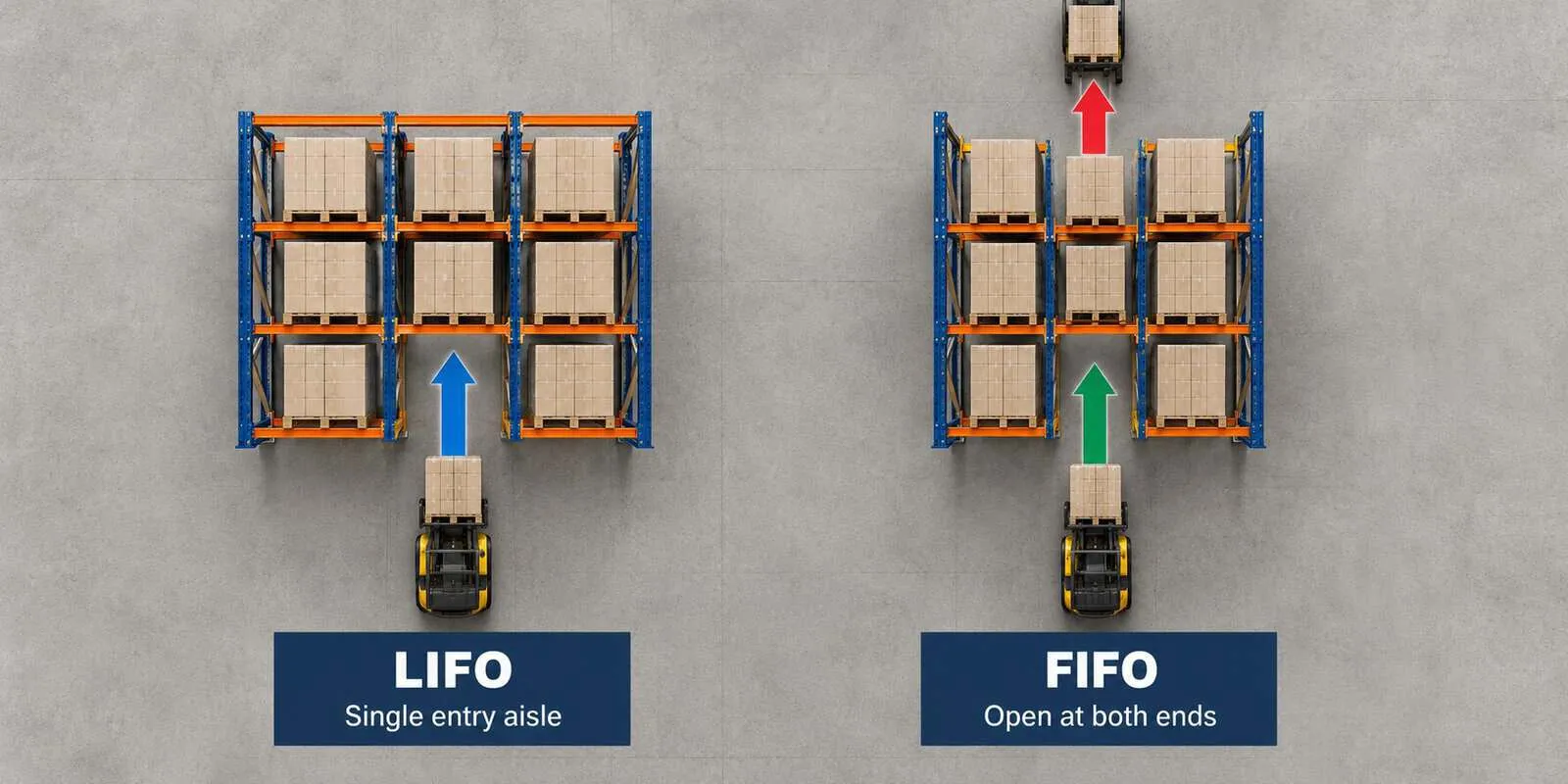
Drive-through racking is the same structure with both ends open. Pallets go in one side and come out the other, so you get FIFO (first in, first out) rotation.
Drive-through’s price is floor space. Manufacturer AR Racking’s comparison of drive-in and drive-through racking notes that drive-in’s single entry lets it sit against a wall, while drive-through needs access at both ends.
| Feature | Drive-in racking | Drive-through racking |
| Access | One end, for loading and unloading | Both ends: load one side, unload the other |
| Stock rotation | LIFO | FIFO |
| Floor space | Can sit against a wall with one working aisle | Needs a working aisle at each end |
| Typical stock (per AR Racking) | Cement, bricks, DIY goods, metal products | Food, drink, chemicals |
If your stock has a use-by date or loses value as it ages, go drive-through or another FIFO system. If it’s long-life bulk product, drive-in gets more pallet positions out of the same building.
Pros and Cons of Drive-In Pallet Racking
Drive-in pallet racking gives you density and takes away selectivity, which is the ability to reach any pallet without moving another one first.
| What you gain | What you give up |
| More pallet positions in the same footprint, with fewer aisles to light or refrigerate | Direct access to individual pallets |
| A simple static structure, with no carts or rollers to maintain | Stock rotation, since drive-in is LIFO only |
| One product per lane, which keeps stock easy to count | Space in part-empty lanes (honeycombing) |
| Works with standard counterbalance forklifts and reach trucks | Speed, plus a higher risk of rack impacts and a need for experienced operators |
How Much Storage Density Does Drive-In Racking Give?
On paper, a lot. Manufacturer AR Racking says its drive-in systems can use more than 80% of the available space, because the service aisles are gone. That figure assumes every lane is full.
Real occupancy is lower because of honeycombing. Once you pull pallets from the front of a lane, those gaps can’t take a different product until the lane is cleared. Racking supplier Elbowroom puts typical drive-in occupancy at around 65 to 75%.
So size lanes to your stock. An eight-deep lane for a line you rarely hold more than four pallets of will sit half empty most of the time. Double deep racking sits between drive-in and selective racking: two pallets back to back with an aisle in front, though you’ll need a forklift that can reach the second pallet.
What Products Suit a Drive-In Racking System?
A drive-in racking system works best with few product lines, lots of pallets of each, and stock that can go out in any order. Good fits include:
- Bulk stock of one product: building materials, bagged goods and metal products, where every pallet in a lane is interchangeable.
- Seasonal stock: product built up ahead of a peak and shipped in volume, which Dexion names as a good fit for its drive-in racking.
- Cold and freezer storage: drive-in warehouse racking is very common in cold stores, because fewer aisles means less space to refrigerate. Dexion rates its P90 drive-in racking for -25°C to +35°C.
It’s the wrong choice if you carry hundreds of lines with a couple of pallets each, because the lost access costs more than the extra positions save. Selective pallet racking suits that stock better, since every pallet has its own face and any standard forklift can work it.
Stock that needs strict rotation is a poor fit too. According to Australian supplier Macrack, pallet flow racking runs FIFO on gravity rollers, which suits dated bulk stock. For density without trucks entering the rack, it says push back racking stores pallets up to six deep on carts.
Which Forklift Should You Use in Drive-In Racking?
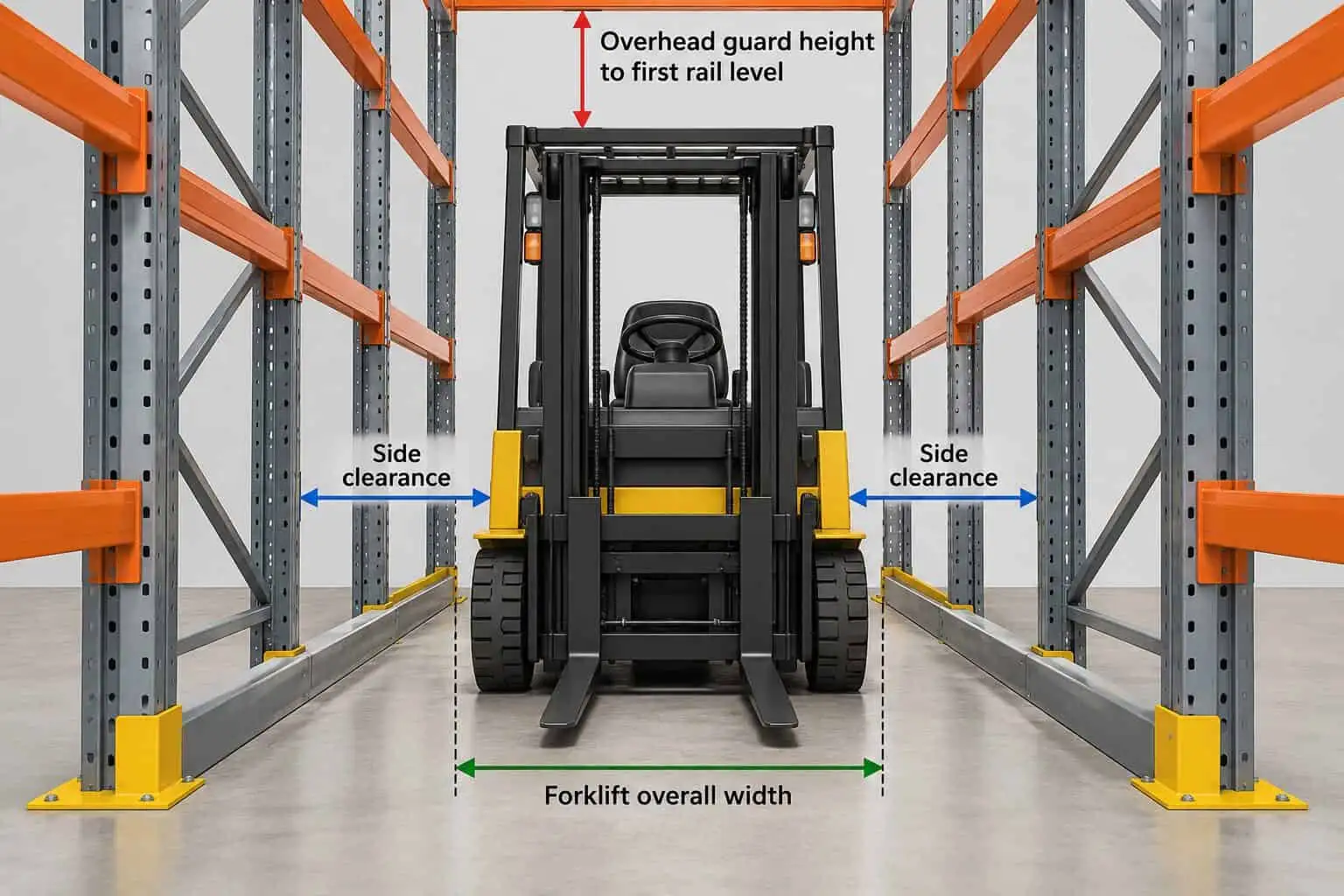
Use a counterbalance forklift or reach truck that fits between the lane’s guide rails with clearance to spare, passes under the first rail level, lifts comfortably past the top rail and has side shift. Racking makers design each drive-in around a specified truck, so the forklift has to suit the rack, not the other way round.
1. Counterbalance or Reach Truck?
Both work, and AR Racking names them as the most common drive-in choices.
A counterbalance forklift suits lower racking and shallower lanes, and it can work the dock and yard as well. The catch is rear-wheel steering: any correction inside a lane swings the counterweight toward the uprights.
Reach trucks have a shorter chassis, a mast that moves forward to place the pallet ahead of the base legs, and generally more lift. Most put the operator side-on, which helps when you’re reversing out of a deep lane, but they need smooth indoor floors.
Whichever you pick, electric suits enclosed lanes and cold rooms because there’s no exhaust. An LPG truck puts its fumes into the very lane the operator is working in.
2. Overall Width and Clearance Inside the Lane
Measure the truck at its widest point, and don’t assume that’s the chassis. Mirrors, the overhead guard, the tyres and a hook-on side shifter can all sit further out.
For the gap itself, Mecalux’s guidance on forklifts in drive-in racks asks for at least 25 mm a side between the truck and the floor guide rails, or 10 mm if the truck has centring wheels. Interlake Mecalux quotes about 75 mm a side to the uprights. Your own rack designer’s figure beats both.
Replacing a truck is where this usually bites. The rack was designed around whatever the site ran when it went in, so check the new machine’s widths against the rack’s design documents before you sign anything.
3. Overhead Guard, Cabin and the First Rail Level
The truck drives under the first level of rails, and Mecalux is blunt about it: that first raised level can’t be lower than the forklift’s roof.
Check the overhead guard height on the spec sheet, then add any beacon or lights mounted on top. Cold-store cabins add height and width too.
If a truck sits too tall, ask the manufacturer about a lower guard. Any change to a guard has to come from, or be approved by, the manufacturer.
4. Mast Type and Lift Height
Mecalux’s rule is that the top support rail should sit at least 200 mm below the truck’s maximum lift height. The extended mast still has to clear roof beams, lights and sprinklers.
A three-stage mast reaches the same height from a lower closed height, which helps with low doorways. Check the width across the mast and carriage as well, because the raised mast passes between the rails of the lower levels.
Capacity drops as lift height rises, so read the load chart on the data plate for your top rail and your heaviest pallet.
5. Side Shift
We’d treat side shift as a must-have on any drive-in truck. It lets the operator centre the pallet over the rails without touching the steering.
The type matters. A hook-on side shifter adds weight, moves the load centre forward and cuts rated capacity, while an integral one is more compact. Either way, the data plate should include it.
6. Operator Skill and Why Impacts Are So Common
Drive-in lanes put most of the conditions behind rack strikes in one place: travelling with the load raised, uprights on both sides for the full depth of the lane, poor sightlines past the load, and reversing all the way out.
AR Racking says drive-in needs experienced operators and carries a higher risk of accidental impact than conventional racking. And because each upright carries rails on every level, one damaged upright affects every pallet position it supports.
Beyond a forklift licence, drive-in work needs site-specific operator training and firm rules: line up square before entering, travel slowly with the load raised, don’t correct with the steering inside the lane, and report every contact, however small.
Drive-In Racking Safety and AS 4084
WorkSafe Victoria’s pallet racking guidance is written for selective racking, and it notes that drive-in racking may need additional safety measures. It points you to the manufacturer’s instructions and AS 4084.2:2023, the operation and maintenance part of the Australian standard for steel storage racking.
That means routine checks at intervals set by the manufacturer or a competent person (WorkSafe gives daily or weekly as examples), plus a formal inspection by a competent person every 12 months.
In a drive-in, aim the routine checks at lane-entry uprights, rail connections and floor guide rails. Report damage straight away, display safe working load signs, and don’t change rail levels without the rack designer’s approval.
Find the Right Forklift for Drive-In Racking
Before you shortlist a truck, grab a tape measure and get four numbers from your lanes: the narrowest gap between the guide rails or uprights, the first rail height, the top rail height and the weight of your heaviest pallet. With those, a spec sheet quickly shows whether a machine fits. As a Melbourne forklift dealer, Buy A Fork sells counterbalance forklifts and reach trucks, so bring those measurements when you enquire or call 1300 057 880.
Frequently Asked Questions
1. What Is the Difference Between Drive-In and Drive-Through Racking?
Drive-in racking has one entry, so pallets are loaded and unloaded from the same end and the last pallet in is the first out. Drive-through racking is open at both ends, so it rotates stock first in, first out, but it needs a working aisle at each end.
2. What Forklift Do I Need for Drive-In Pallet Racking?
Most drive-in racks are worked by counterbalance forklifts or reach trucks. The truck has to fit between the guide rails with clearance, pass under the first rail level and lift past the top rail with capacity to spare, ideally with side shift.
3. Can You Use a Reach Truck in Drive-In Racking?
Yes. AR Racking names reach trucks and counterbalance forklifts as the most common drive-in choices. Reach trucks have a short chassis and generally lift higher, but they need smooth floors, and their width, guard height and lift still have to suit the lane.
4. How Much Clearance Does a Forklift Need in Drive-In Racking?
The rack’s designer sets it for a specified truck. As a guide, Mecalux asks for at least 25 mm a side to the floor guide rails (10 mm with centring wheels), and the forklift’s roof has to sit below the first rail level.
5. How Often Should Drive-In Racking Be Inspected?
WorkSafe Victoria recommends a formal inspection by a competent person every 12 months, plus routine checks (daily or weekly, for example) at intervals set by the manufacturer or a competent person. It points to AS 4084.2:2023 and notes that drive-in racking may need extra safety measures.