
Switching to an Electric Forklift: Do You Need 3-Phase Power to Charge It?
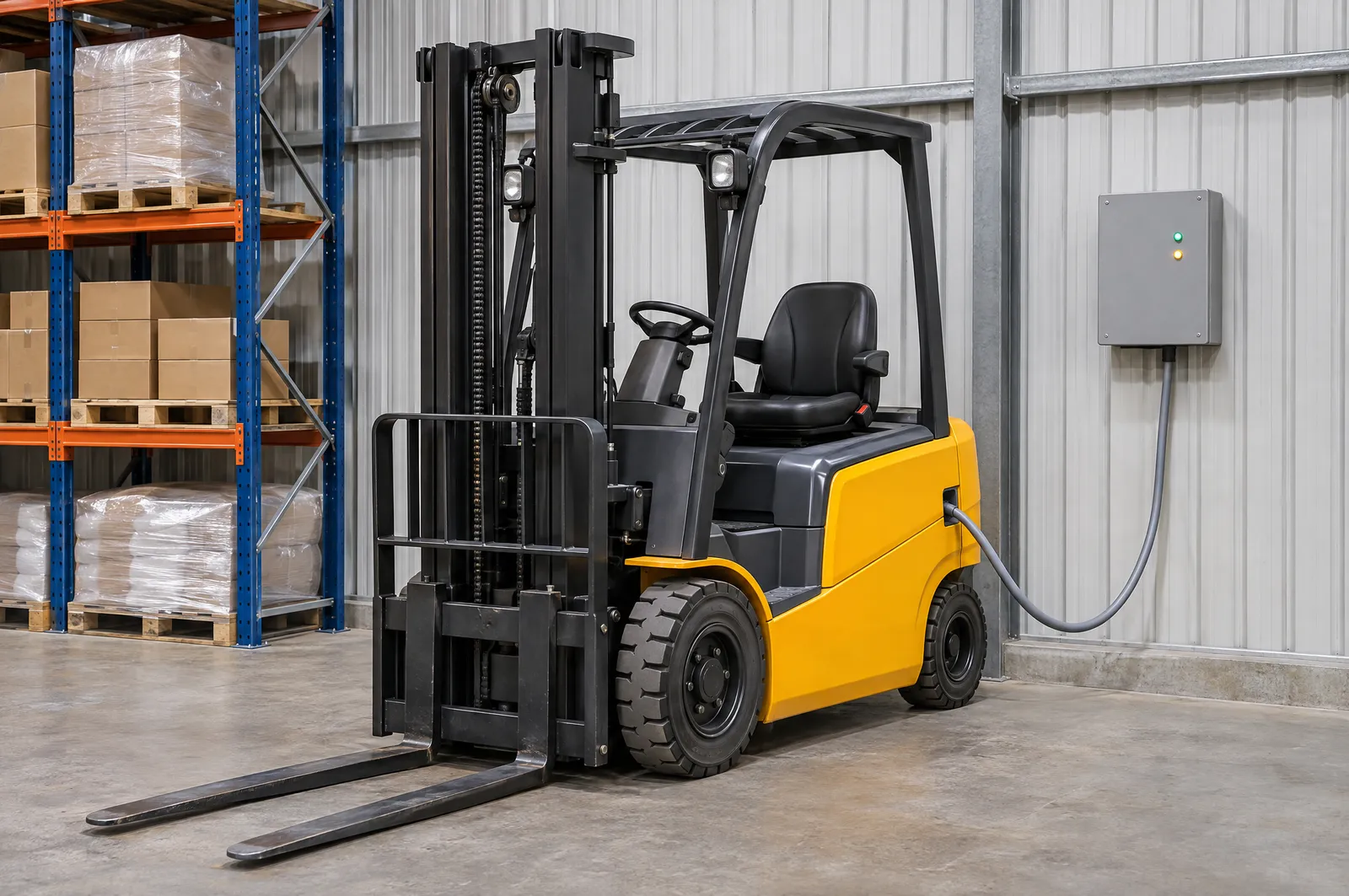
You're swapping an LPG forklift for an electric one, and the shed only has single-phase power. Many 24 V and 48 V forklift chargers run on single-phase, so you may not need a 3 phase forklift charger at all. Big batteries, fast charging and 80 V trucks usually do. The charger's data plate decides it, and a licensed electrician confirms whether your supply can carry the load.
Buy A Fork sells mostly used forklifts, electric models included, so this is a question worth settling before you choose the truck.
Do Electric Forklifts Need 3-Phase Power?
Not always: the charger is the part that plugs into mains power, and many forklift chargers are built for a single-phase supply. The forklift itself runs on its battery. What matters is how much power its charger draws.
Crown's V-Force charger range shows the split. Its FS1 models are single-phase chargers for 12, 24, 36 and 48 V batteries, with output options of 48, 85 and 120 amps, while its larger FS3, FS4 and FS6 models are three-phase, with outputs of up to 300, 400 and 600 amps. Other charger makers draw the line in different places, but the pattern is the same: smaller and slower on single-phase, bigger and faster on three-phase.
So for any electric forklift you're considering, the useful question is what its charger needs.
What Decides Whether You Need a 3 Phase Forklift Charger?
The charger's power, which comes down to the battery's voltage and size and how quickly you want it charged.
- Battery voltage: forklift batteries commonly run at 24, 36, 48 or 80 volts. The higher the voltage, the more power the charger needs for the same charge current.
- Battery capacity: measured in amp-hours (Ah). A bigger battery holds more energy, so it takes more power, or more time, to refill.
- Charge time: an overnight charge can use a smaller charger. Fast charging or topping up during breaks (opportunity charging) needs more current, and more current means more power from the wall.
- Battery type: the charger has to suit the battery's chemistry, lead-acid or lithium-ion, and its voltage. Lithium-ion batteries suit topping up during the day, and a faster top-up needs a bigger charger.
The Arithmetic Behind It
A charger's output is roughly the battery voltage multiplied by the charge current. A 48 V battery charged at 100 amps needs about 4.8 kW from the charger before losses, which is more than 20 amps from a single-phase supply and well past what a standard 10 amp power point is rated for.
An 80 V battery charged at the same current needs about 8 kW. On single-phase, that's around 35 amps. Spread across a three-phase supply, it's roughly 12 amps per phase, which is why larger chargers move to three-phase.
These figures are illustrations, not a sizing guide. The real draw for any charger is on its data plate and in its manual, and that's what your electrician works from. In Australia, single-phase supply is nominally 230 V and three-phase 400 V, and many charger plates still show the older 240 V and 415 V figures.
What the Charger's Data Plate Tells You
Before you buy an electric forklift, photograph the charger's data plate, or ask for it, because it answers the three-phase question in one look.
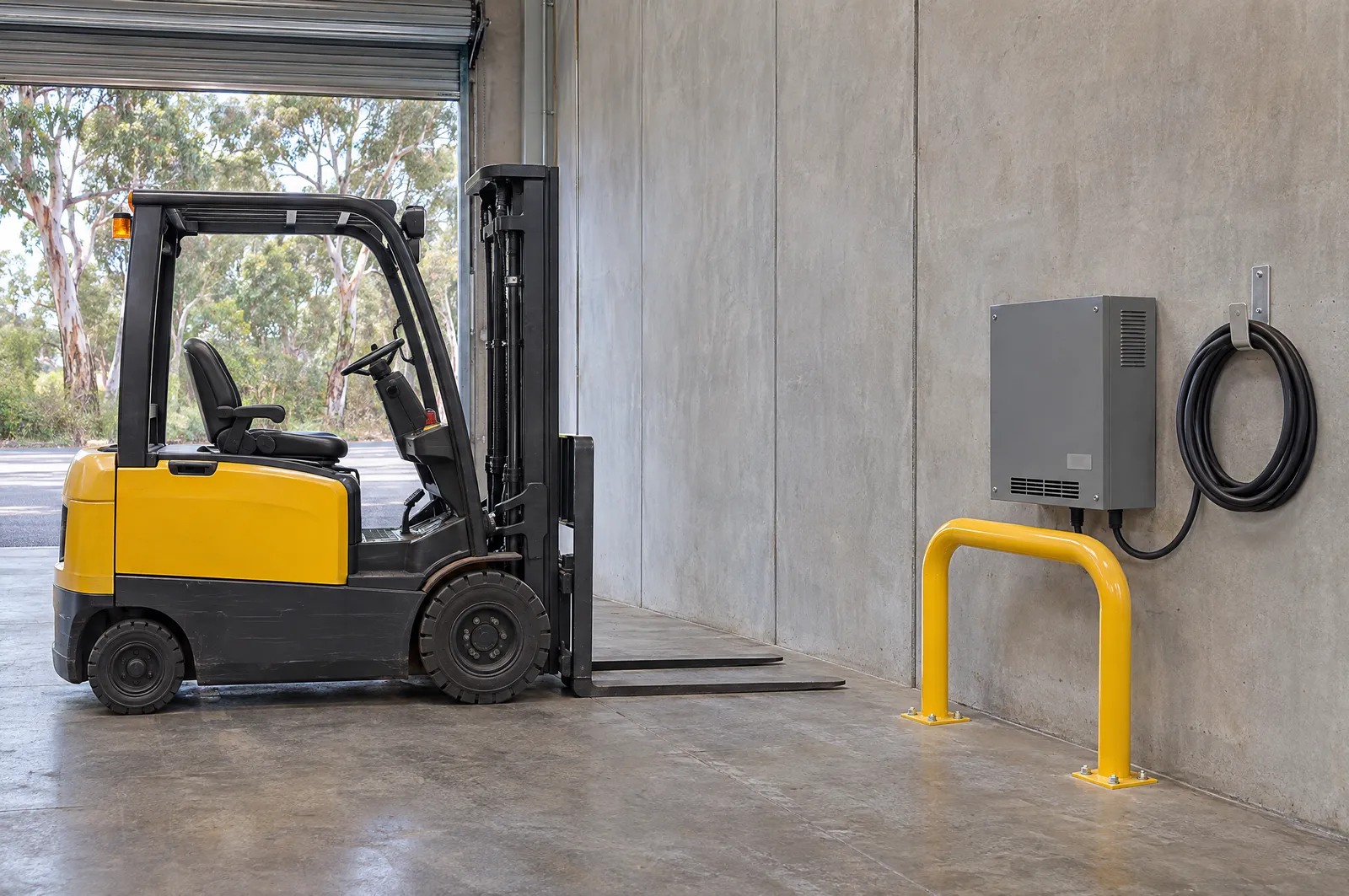
Look for the input side of the plate: the AC voltage, the number of phases (often shown as 1~ or 1-phase for single-phase, 3~ or 3-phase for three-phase), and the input current in amps. Then check the output side: the battery voltage and charge current it's set for, and whether it's for lead-acid, lithium-ion or both.
On a used forklift, also confirm the charger comes with the sale and suits the battery fitted now. A charger that was matched to an older battery, or to a different battery type, is a problem to sort out before delivery, not after, and a missing charger is a real cost: some of the forklift battery prices in Australia are quoted with a charger included. The checks in a used electric forklift buying guide cover the battery side of the same inspection.
If the charger's plug has a wider earth pin, it's a 15 amp plug, made so it won't fit a standard 10 amp power point. Don't modify the plug or use an adaptor. Ask an electrician whether the right outlet can be installed.
What If Your Shed Only Has Single-Phase Power?
You have three realistic routes: choose a forklift whose charger runs on single-phase, accept a slower charge from a smaller single-phase charger the battery maker approves, or have an electrician assess a supply upgrade.
A single-phase charger from the start: single-phase chargers are made for batteries up to 48 V, as Crown's range shows, so make the charger's input a condition when you shortlist, rather than an afterthought.
A slower charge: if the work is one shift and the forklift sits overnight, a smaller charger may refill the battery in the time available. The charger still has to match the battery's voltage, chemistry and capacity, so only use one the battery or forklift maker approves.
A supply upgrade: a new circuit, a bigger switchboard capacity or a three-phase connection can all be options, but whether they're possible, and what they cost, depends on your building and your network. That's a question for a licensed electrician, who can also tell you whether your network distributor needs to be involved.
Don't improvise with extension leads, double adaptors or converters to make a charger work on the supply you have; ask an electrician instead. Energy Safe Victoria puts it plainly: unqualified electrical work isn't only extremely dangerous, it's illegal.
Setting Up a Safe Forklift Charging Station
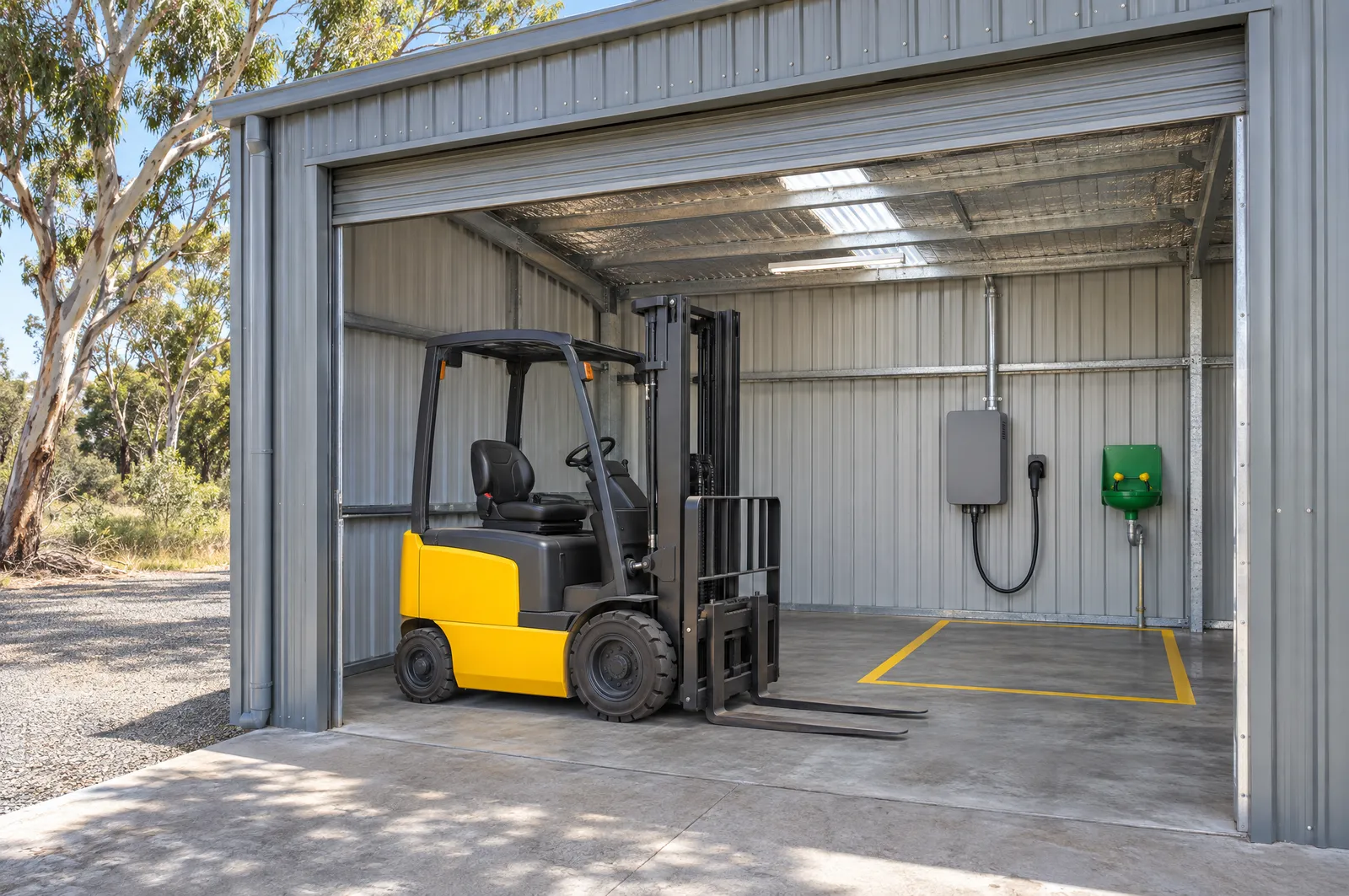
WorkSafe Victoria's guidance is to charge batteries only at locations designed for it, by trained and authorised people, in a recharging zone kept separate from pedestrians.
Its page on work practices to control forklift risks also lists emergency eyewash, a spill kit and fire-fighting equipment for recharging zones, in a well-ventilated area. It says to protect chargers from forklift movements, keep power leads off the floor, follow the forklift's own charging instructions, and that it's best to use a charger that charges the battery while it stays in the forklift.
Lead-acid and lithium-ion batteries don't make the same demands on the charging area. Lead-acid batteries release hydrogen while charging and need watering, which is one reason lithium vs lead-acid forklift batteries is often a floor-space decision as much as a cost one.
Questions to Settle Before You Switch to Electric
Get these answered before you commit to a particular forklift, so the charger and your power supply match on delivery day.
- What charger comes with the forklift, and what input does its data plate show: voltage, phases and amps?
- What battery voltage, capacity and type is fitted, and does the charger suit it?
- How long does a full charge take, and does that fit the hours the forklift sits idle?
- Is the charger included in the price, along with any cables and connectors?
- Can your electrician confirm the supply, circuit and outlet the charger needs, and the cost of any changes?
- Where will the charging station go, and does that spot meet WorkSafe's guidance on separation, ventilation and emergency equipment?
Once the charger is settled, the running cost is the next number to check: how much electricity a forklift uses per hour gives you a figure to set against your current gas bill.
Find an Electric Forklift That Suits Your Power Supply
Buy A Fork's range of electric forklifts is mostly used, so ask what charger comes with any machine you're considering before you commit. Trade-ins are accepted on your LPG forklift, and finance and rent-to-own are available.
Contact the team in Somerton or call 1300 057 880 with the capacity you need and how many hours a day the forklift will work. For the wiring itself, talk to a licensed electrician.
Frequently Asked Questions
1. Can I Charge an Electric Forklift From a Normal Power Point?
Only if the charger is rated for it. Some small chargers draw little enough current for a standard 10 amp power point, but many forklift chargers need more, and some need three-phase. The input current on the charger's data plate tells you, and an electrician confirms whether your circuit can carry it.
2. How Many Volts Is a Forklift Charger?
The charger's output matches the battery, commonly 24, 36, 48 or 80 volts. Its input is mains power: nominally 230 V on single-phase or 400 V on three-phase in Australia, often still marked as 240 V or 415 V on older chargers.
3. Are All Forklift Chargers the Same?
No. A charger has to match the battery's voltage, capacity and chemistry, so a lead-acid charger isn't automatically right for a lithium-ion battery, or the other way round. Use the charger specified by the battery or forklift maker.