
What Is a Telehandler and When to Use One Over a Forklift
· Updated
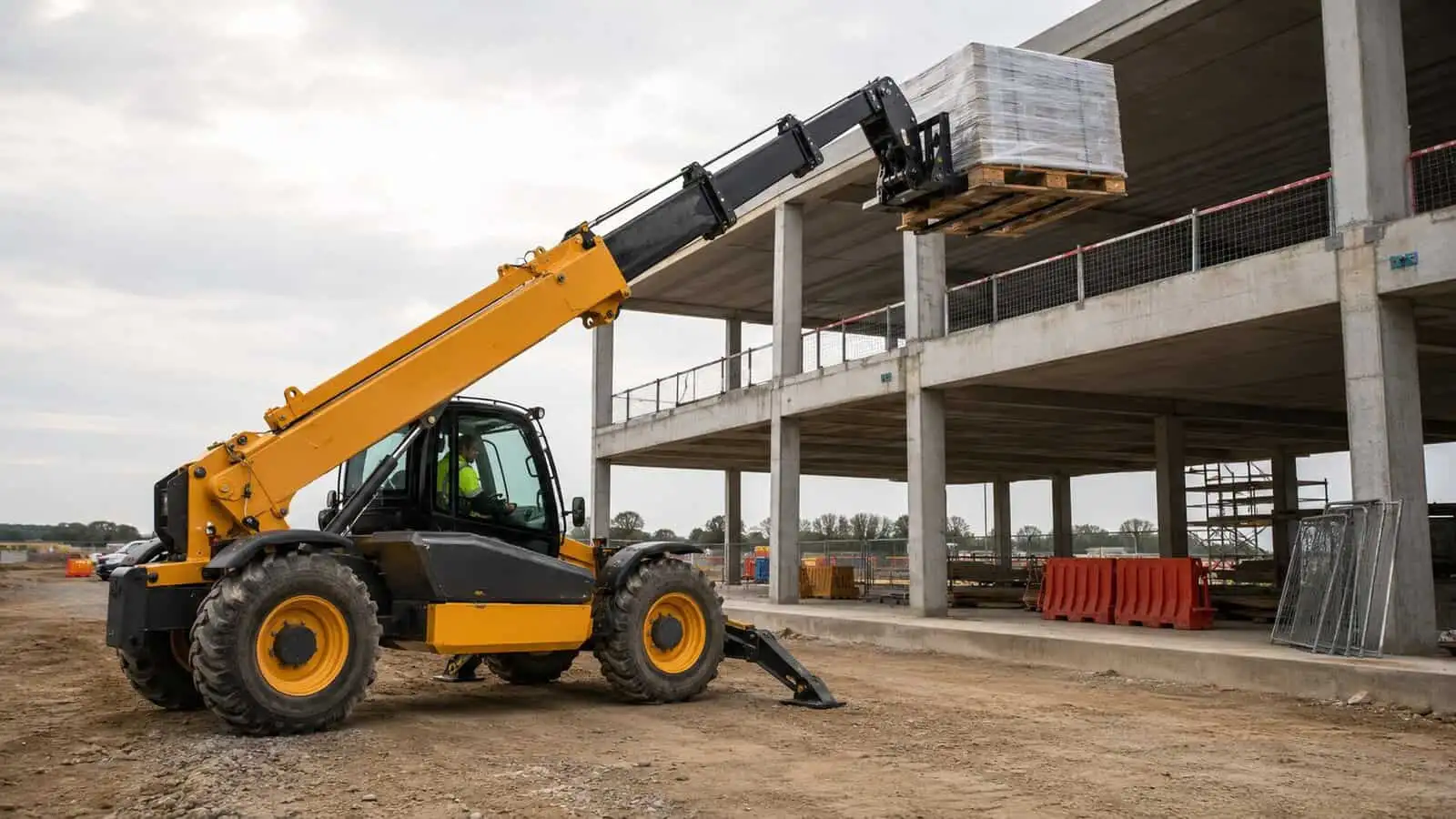
A telehandler is a lifting machine with a telescopic boom that extends forward and upward, which lets it place a load over an obstacle or onto a structure rather than only lifting it straight up. JCB describes the class as machines that lift 1,500 kg to 6,000 kg with reach up to 20 metres, and specialist ranges go higher again.
What is a telehandler?
A telehandler is a wheeled machine that carries a telescopic boom in place of a forklift’s fixed vertical mast, with a quick-change attachment on the boom head. JCB defines it as “a lifting machine equipped with a telescopic boom and a lifting attachment, allowing it to function as a forklift and a crane”, which is the clearest short description of what the machine actually does on site.
The boom is the whole difference. A forklift mast raises a load vertically along a fixed track directly in front of the machine, so the machine has to be positioned under the destination. A telehandler boom extends outward as it rises, so the machine can sit back from an obstacle, a trench or a partly built wall and still put the load where it needs to go. That single capability is why telehandlers dominate construction and agricultural sites where forklifts struggle.
- Telescopic boom: extends forward and up on hydraulic sections, giving forward reach a mast cannot match.
- Quick-change attachments: the boom head takes a fork carriage, bucket, jib or work platform, so one machine covers several jobs.
- Rough terrain running gear: large tyres, high ground clearance and usually four-wheel drive, built for unsealed and uneven ground.
In Australia you will also see these machines called telescopic handlers, telehandler forklifts, and sometimes rough terrain or all terrain forklifts. The first two are straightforward synonyms. The last two are looser: a rough terrain forklift can be a mast machine built for site work rather than a boom machine, so check whether a listing means a boom or a mast before you compare prices.
How far can a telehandler reach and how much can it lift?
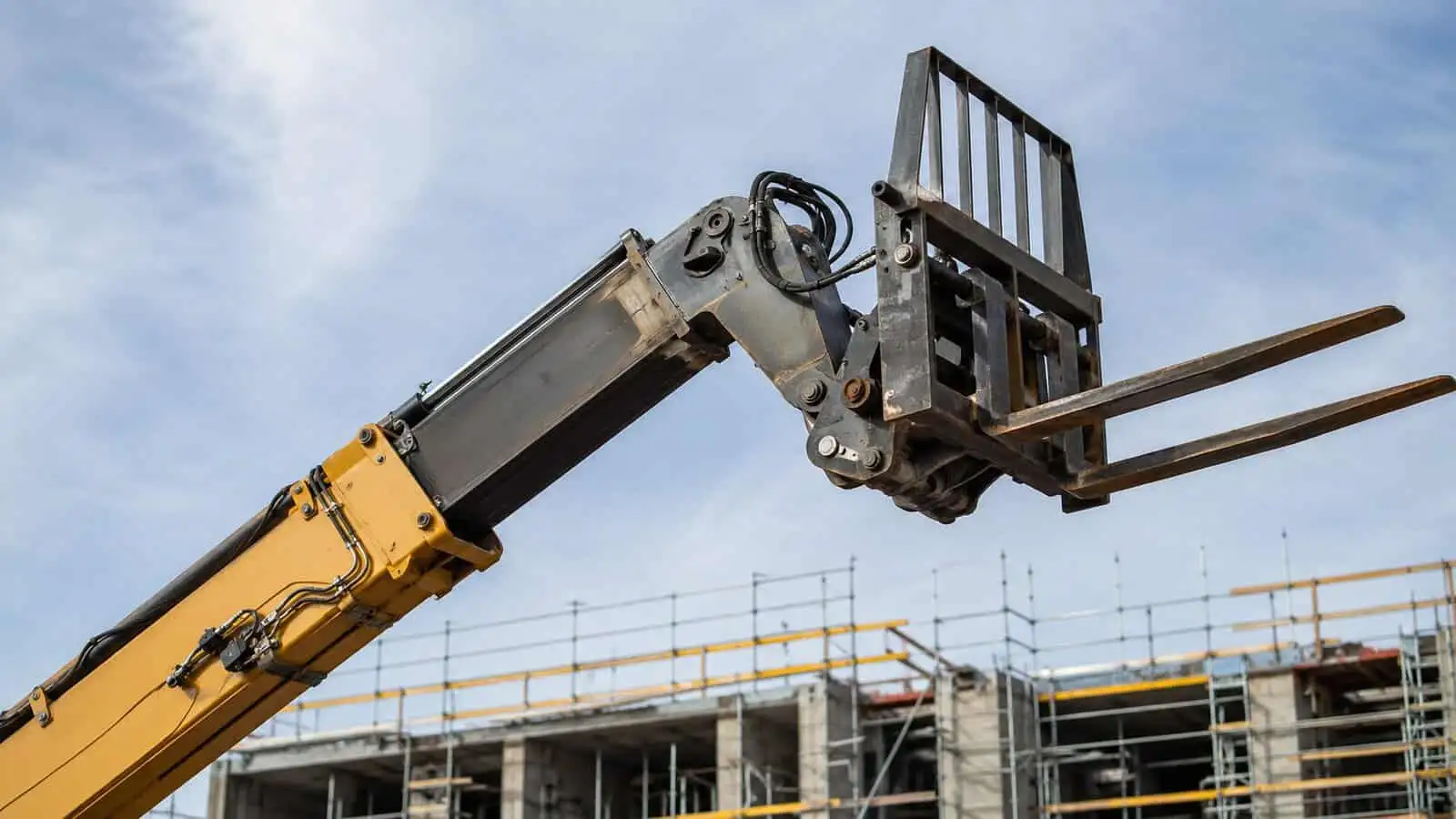
Most construction telehandlers lift between 1,500 kg and 6,000 kg and reach up to about 20 metres, with heavy and rotating models going well beyond that. The published ranges differ by manufacturer and by what the machine is built for.
JCB puts its telehandler range at 1,500 kg to 6,000 kg lifting capacity with reach up to 20 metres. Merlo Australia publishes capacities of 2.5 to over 12 tonnes and operating heights up to 35 metres in Roto models, which are the rotating machines built for the heaviest and highest work. Manitou describes its MT-X and MHT-X heavy ranges as “models from 4 to 18 metres”. Compact site machines sit at the bottom of those bands.
Reach and capacity trade off against each other exactly as they do on a forklift mast. A machine rated at 4,000 kg does not hold 4,000 kg at full boom extension, because moving the load away from the machine reduces what it can safely carry.
Every telehandler carries a load chart that states capacity against boom angle and extension, and that chart is the document to match against your heaviest load and your furthest placement, not the headline capacity figure. The same principle governs choosing forklift capacity, and it matters more on a boom because the load moves further from the machine.
Telehandler vs forklift: which one does your site need?
A forklift is the better machine on sealed level ground with repetitive pallet work, and a telehandler is the better machine on uneven ground where loads need placing at height or over an obstacle. Most sites that need a telehandler still need a forklift as well.
| Telehandler | Counterbalance forklift | Rough terrain forklift | |
|---|---|---|---|
| Lifting mechanism | Telescopic boom, extends forward and up | Fixed vertical mast | Fixed vertical mast |
| Reach | Forward and up, to about 20 m (JCB range) | Vertical only, ahead of the front axle | Vertical only, ahead of the front axle |
| Capacity | 1,500 to 6,000 kg (JCB range) | Up to 5,000 kg on Crown’s C-B Series | Varies by model |
| Terrain | Unsealed, uneven and sloping ground | Level sealed surfaces | Unsealed and uneven ground |
| Attachments | Forks, bucket, jib, work platform | Forks and a limited attachment range | Forks and a limited attachment range |
| Indoor use | Rarely, the machine is too large | Yes, the standard warehouse machine | Limited |
| Licence class | See the licensing table below | Forklift truck (LF) licence | Forklift truck (LF) licence |
| Typical job | Construction, agriculture, placing loads at height | Warehouse and dock pallet handling | Yard, timber and ground-level site work |
Figures above are drawn from the manufacturer pages cited at the end. Match the numbers for the specific model you are quoted against your own loads rather than working from a class average.
The honest verdict: a telehandler does not replace a warehouse forklift. It is too large for aisles, too heavy for most warehouse floors and unnecessary for repetitive pallet work at low height. Where a business already runs counterbalance forklifts for the shed and dock, a telehandler is an addition for the yard and site work, not a substitution.
The cheaper answer is worth ruling out first. If the work is outdoor but stays at ground level and the loads sit within mast height, a diesel forklift on the right tyres will handle it for a fraction of what a boom machine costs to buy and maintain.
When a telehandler beats a forklift
A telehandler earns its place when the ground is rough, the destination is high, or the load has to go somewhere a machine cannot drive up to. Five situations account for most purchases.
- Unsealed or uneven ground: construction, farm and quarry surfaces defeat cushion and standard pneumatic forklift tyres, while a telehandler’s four-wheel drive and ground clearance are built for them.
- Placing a load over an obstacle: putting materials onto scaffolding, over a trench, across a fence line or onto a partly built structure needs forward reach that a vertical mast cannot deliver.
- Reach beyond mast height: once the destination is above roughly eight metres, a mast machine runs out and a boom does not, which is where forklifts on construction sites hit their practical ceiling.
- Work that needs more than forks: if the same machine has to shift soil, lift a suspended load or raise workers, the attachment range is the reason to buy a telehandler rather than a second forklift.
- One machine covering several tasks: on smaller sites where a separate loader, forklift and access platform cannot be justified, a telehandler with the right attachments consolidates the work.
What attachments can a telehandler take?
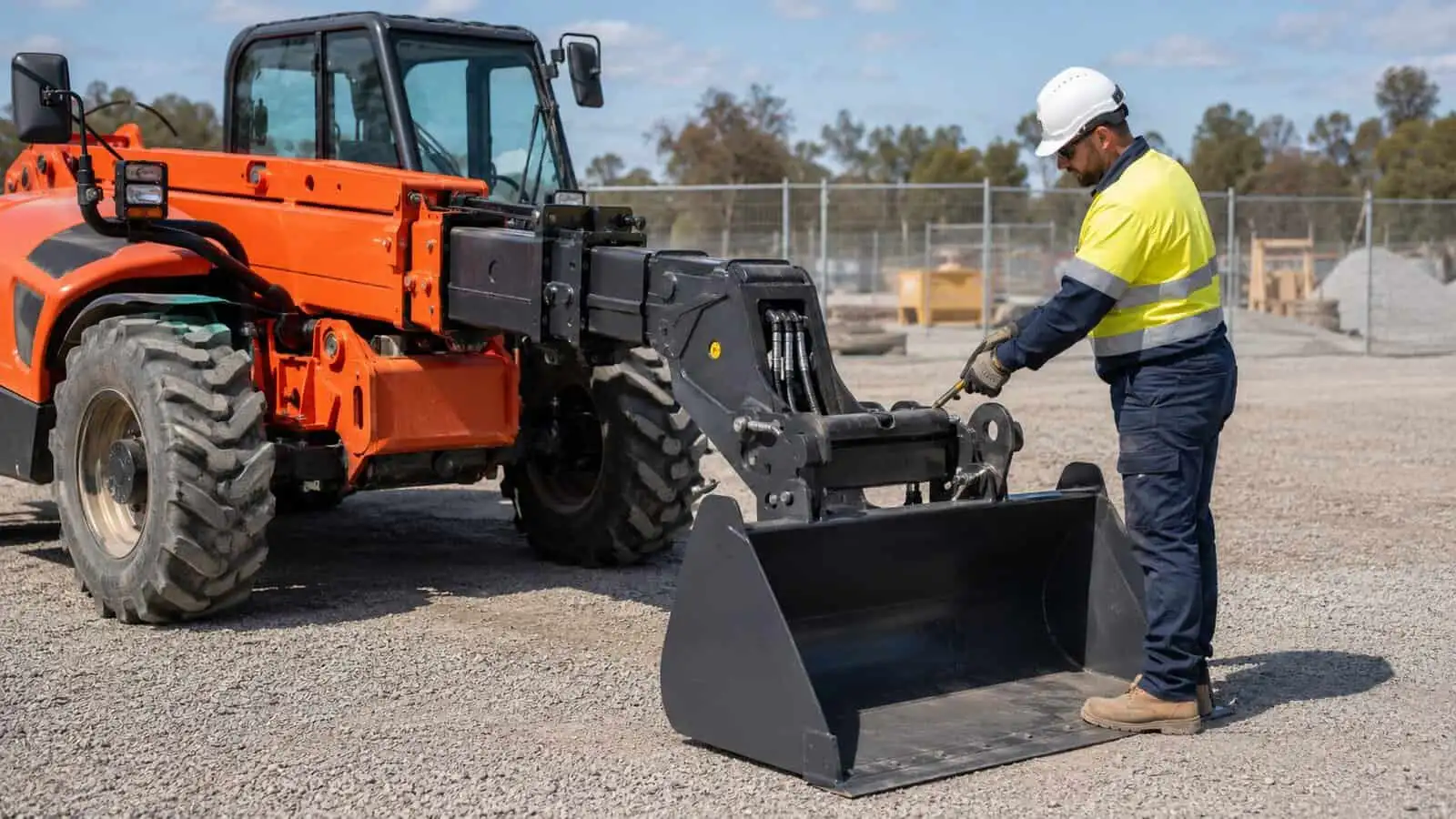
The boom head takes interchangeable attachments, and that flexibility is the real point of difference from a forklift. Four families cover most site work.
A fork carriage is the default and makes the machine behave like a very long-reaching forklift, handling pallets, packs of timber and bricks. A bucket turns it into a light loader for soil, sand, gravel and site clean-up, which is the attachment that most often removes the need for a separate machine on a small site.
A jib hangs a hook or a winch off the boom head so the machine can lift a freely suspended load, which is closer to crane work than forklift work. This is the attachment that most changes the operating and licensing picture, so it should never be fitted casually.
A work platform carries workers at height. Fitting a boom-type work platform with a boom length of 11 metres or more brings its own licence requirement in Victoria, covered in the next section. Attachment thinking on a boom machine follows the same logic as forklift attachments generally: the attachment changes the machine’s rated capacity, so the load chart for that exact combination is the one that applies.
What licence do you need to operate a telehandler in Australia?
It depends on the machine’s rated capacity, whether it slews, and what is fitted to the boom. A non-slewing telehandler rated at three tonnes or less needs no high risk work licence in Victoria, while anything above that threshold does. The table below sets out WorkSafe Victoria’s published position.
| Machine and configuration | Licence required in Victoria | Source |
|---|---|---|
| Non-slewing, rated capacity 3 tonnes or less | No high risk work licence required | WorkSafe Victoria |
| Non-slewing, rated capacity over 3 tonnes | At least one of TV, CN, C2, C6, C1 or C0 | WorkSafe Victoria |
| Slewing telehandler | A slewing mobile crane licence by rated capacity: C2, C6, C1 or C0 | WorkSafe Victoria |
| Fitted with a boom-type work platform, boom 11 m or more | A boom-type elevating work platform (WP) licence, in addition to the capacity-based requirement | WorkSafe Victoria |
TV is a new licence class, available from 1 July 2024, covering non-slewing telehandler operation specifically. It is the class most relevant to a standard construction telehandler above three tonnes, and it is worth naming when you book training, because the older crane classes also satisfy the requirement.
No licence requirement does not mean no obligation. WorkSafe Victoria states that where no high-risk work licence applies, the employer must still provide “information, instruction, training and supervision to employees to use the telehandler safely”. A three-tonne machine with a boom at full extension is capable of serious harm, and the licensing threshold is not a competence threshold.
One point worth stating plainly: WorkSafe Victoria’s telehandler guidance does not list the forklift truck licence among the classes that cover telehandler operation. Holding an LF licence should not be assumed to authorise telehandler work. The forklift licence pathway in Australia is a separate process covering mast machines.
High risk work licensing is nationally harmonised but administered by each state and territory regulator, so the classes and thresholds above are the Victorian position. Operators working in New South Wales, Queensland or elsewhere should confirm the requirement with their own regulator before assuming it transfers.
Buying a telehandler: what to check
Check the rated capacity against the three tonne licensing threshold before anything else, because that number decides your compliance obligations as well as what the machine can lift. From there, the boom and its hydraulics carry most of the cost risk on a used unit.
- Rated capacity against the licensing threshold: a 2.5 tonne machine and a 3.5 tonne machine sit on opposite sides of the Victorian licence requirement, which is a real operating cost difference, not only a capacity difference.
- Boom condition and wear pads: extend and retract the boom through its full travel and watch for judder, scoring on the boom sections and play at the joints, since wear pads are a scheduled replacement item.
- Hydraulic hoses and cylinders: inspect the lift and extension cylinders and the hoses running along the boom with the boom raised, where leaks show up clearly, and repairs are most expensive.
- Hours against age and application: a machine off a construction site has had a harder life than one off a farm at the same hour reading, so ask what work it did.
- Tyres and drive configuration: check tyre condition and confirm whether the machine is all-wheel drive and which steering modes it has, because two-wheel steer limits manoeuvrability on tight sites.
- Attachments and the load chart: confirm what attachments come with the machine, and get the load chart for every combination you intend to run rather than for the bare fork carriage alone.
Buy A Fork currently has a 2.5 tonne all-wheel-drive JCB telehandler on the floor at Somerton, which sits under the Victorian three tonne licensing threshold. Specifications, hours and price for that unit are on its JCB telehandler listing, and the team can walk through the load chart and the licence position before you commit.
Frequently asked questions
1. What is a telehandler?
A telehandler is a lifting machine with a telescopic boom and a quick-change attachment, which lets it extend a load forward and upward rather than only lifting it vertically like a forklift mast. JCB describes the class as machines that lift 1,500 kg to 6,000 kg with reach up to 20 metres. It is also called a telescopic handler.
2. Is a telehandler the same as a forklift?
No. A forklift lifts a load vertically on a fixed mast directly ahead of the machine, while a telehandler extends a telescopic boom forward and up, so it can place a load over an obstacle or onto a structure. Telehandlers also take buckets, jibs and work platforms, where forklifts are largely limited to forks.
3. What is a telehandler called in Australia?
Telehandler and telescopic handler are the standard terms, and telehandler forklift is common in listings. You will also see rough terrain forklift and all terrain forklift used loosely, though those can describe mast machines built for site work rather than boom machines, so check which one a listing means.
4. Can you drive a telehandler with a forklift licence?
Do not assume so. WorkSafe Victoria’s telehandler licensing guidance sets out the TV, CN, C2, C6, C1, C0 and WP classes and does not list the forklift truck licence among them. Confirm the requirement for your specific machine and your state with the relevant regulator before putting an LF holder on a telehandler.
5. Do you need a licence to operate a telehandler?
In Victoria, a non-slewing telehandler rated at three tonnes or less requires no high-risk work licence, though the employer must still provide information, instruction, training and supervision. Above three tonnes, the operator needs at least one of the TV, CN, C2, C6, C1 or C0 classes. Slewing machines require a slewing mobile crane licence.
6. How high can a telehandler reach?
Standard construction telehandlers reach up to about 20 metres, based on JCB’s published range. Merlo lists operating heights up to 35 metres on its Roto rotating models, which are specialist machines for the highest work. Capacity reduces as the boom extends, so check the load chart for the height you actually need.