
Side Loader Forklifts Explained: How They Work, What They Carry and the Alternatives
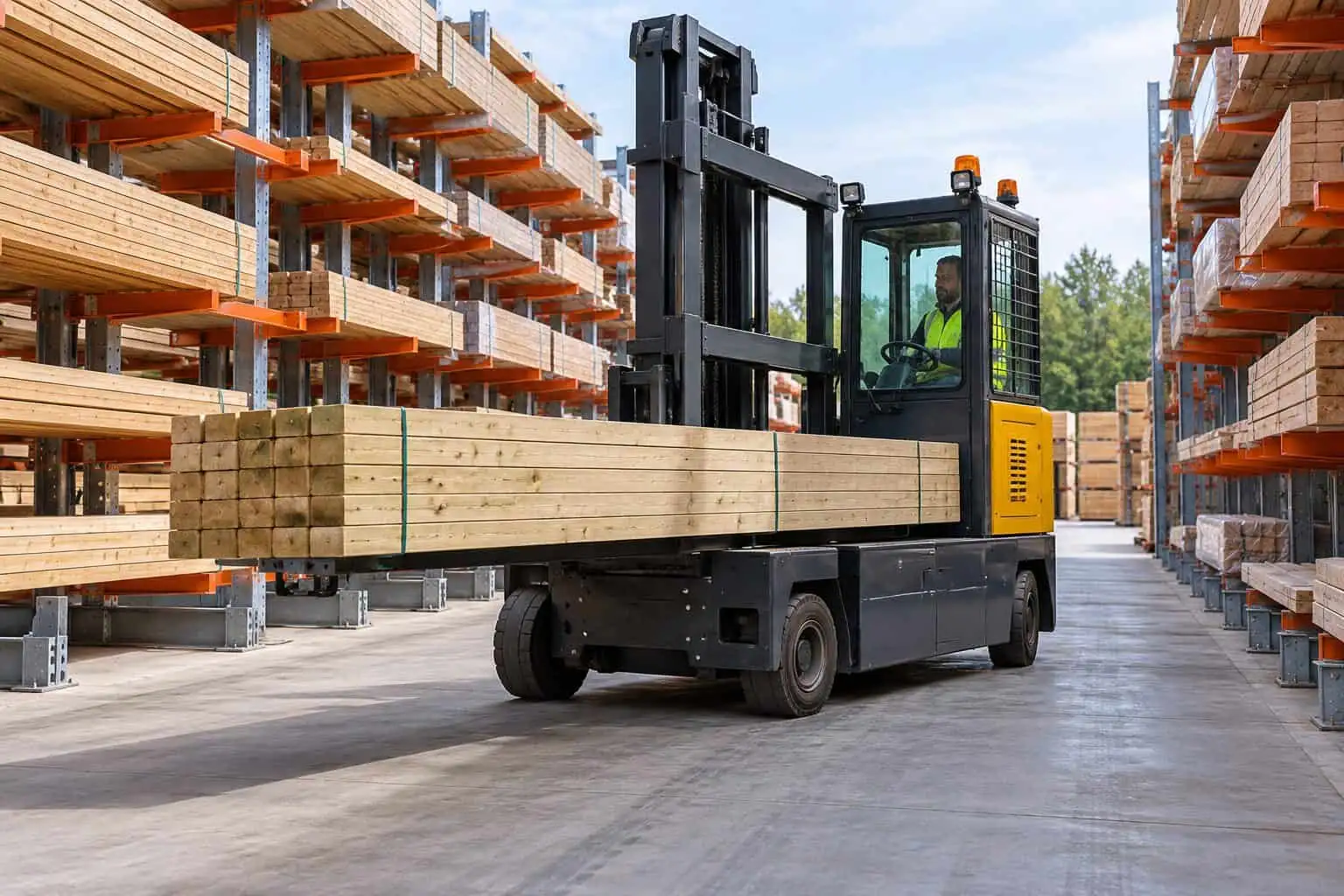
Carry a 6 metre timber pack crossways on a standard forklift and you need an aisle wider than the pack is long. A side loader forklift gets around that by lifting from the side, then lowering the load lengthways onto a flat deck beside the driver. It’s the right truck when long loads are daily work and your aisles are tight.
How Does a Side Loader Forklift Work?
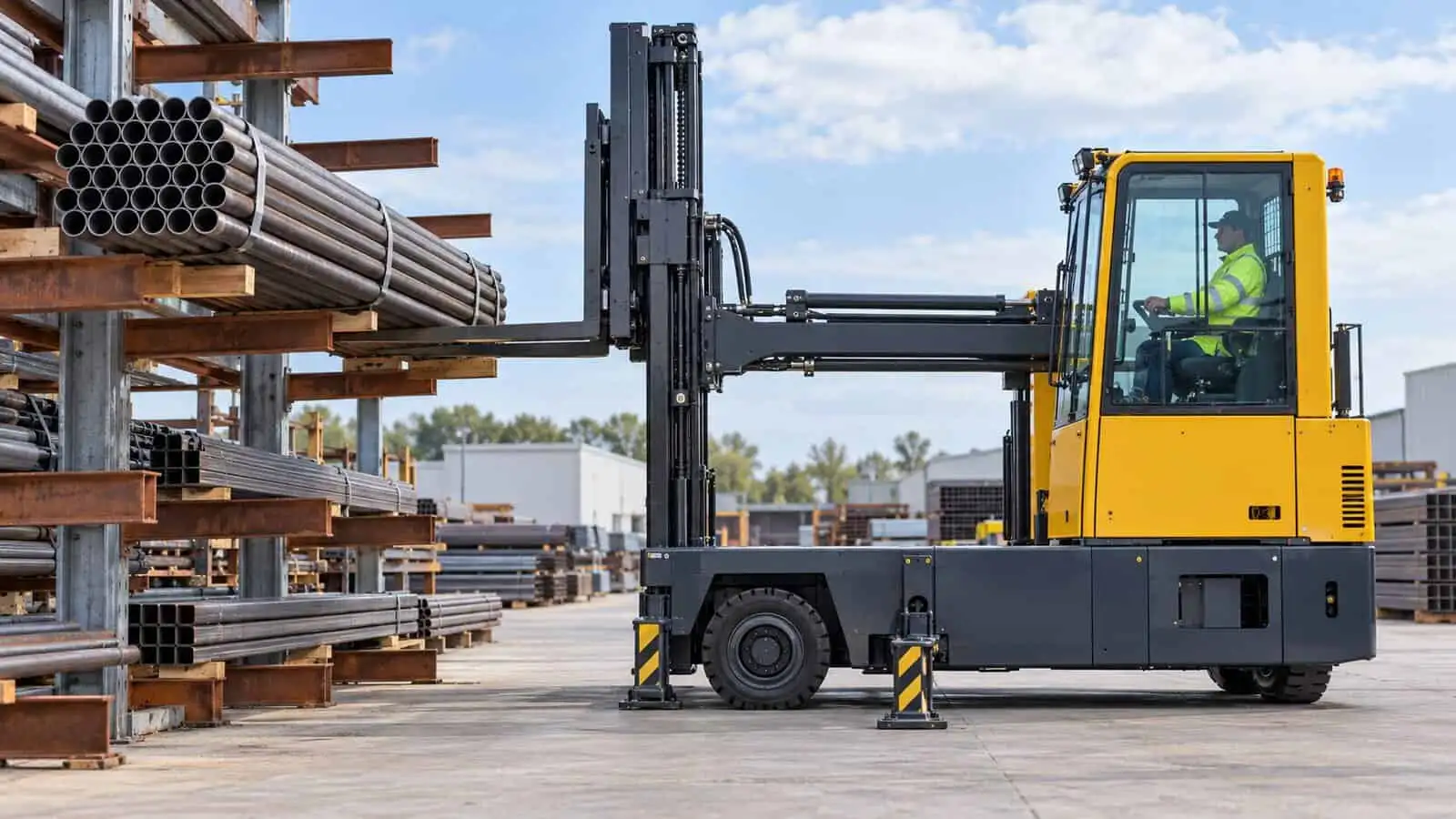
The truck stays put and the mast does the moving. A typical pick goes like this:
- Pull up alongside the load. The driver parks parallel to the rack, trailer or ground stack.
- Drop the stabilisers, if fitted. Some side loaders lower hydraulic jacks on the loading side. Others have none and rely on the chassis and counterweight.
- Reach out and lift. The mast runs out past the edge of the deck, the forks go under the load near its centre, and the load comes up clear.
- Pull back and lower. The mast retracts and the load settles onto the deck, low and lengthways along the truck.
- Lift the jacks and go. The truck drives forwards or backwards, with the driver facing the way it’s travelling.
Many side loaders don’t tilt the mast back the way a counterbalance does. They tilt the chassis or deck instead to settle the load. Baumann, a specialist sideloader maker, says the auto-stabilising chassis on its GX diesel series keeps loads level and secure on uneven surfaces.
Stabilisers change the numbers too. Where jacks are fitted, the capacity plate usually shows one rating with the jacks down and a lower one without them, and your drivers need to know which figure applies to the lift in front of them. It’s the first number we’d check on any side loader.
You’ll hear the same machine called a sideloader, a side loader fork truck or just a side forklift. A truck that lifts shipping containers on and off its own trailer is something else again, usually called a side lifter.
What Loads Is a Sideloader Forklift Built For?
A sideloader forklift is built for long, heavy loads that are awkward to balance across a set of front forks. Think packs of sawn timber and plywood, steel bar, tube and sheet, pipe, aluminium extrusions, roof trusses and rolls of carpet.
That’s why you’ll find them in timber yards, steel distributors, truss plants and building supply yards. The side carry helps the driver too. With the load lying low along the deck, they can see ahead and behind without a long pack sticking out either side.
A lot of long stock also lives in cantilever racking. A side loader drives along the face and lifts straight off the arms. Pallets are another story. A side loader can lift them, but it’s slow at it. Even HUBTEX, which builds sideloaders, says a conventional forklift or reach truck may be enough if most of your work is standard pallets and boxes.
Why Side Loaders Suit Narrow Aisles
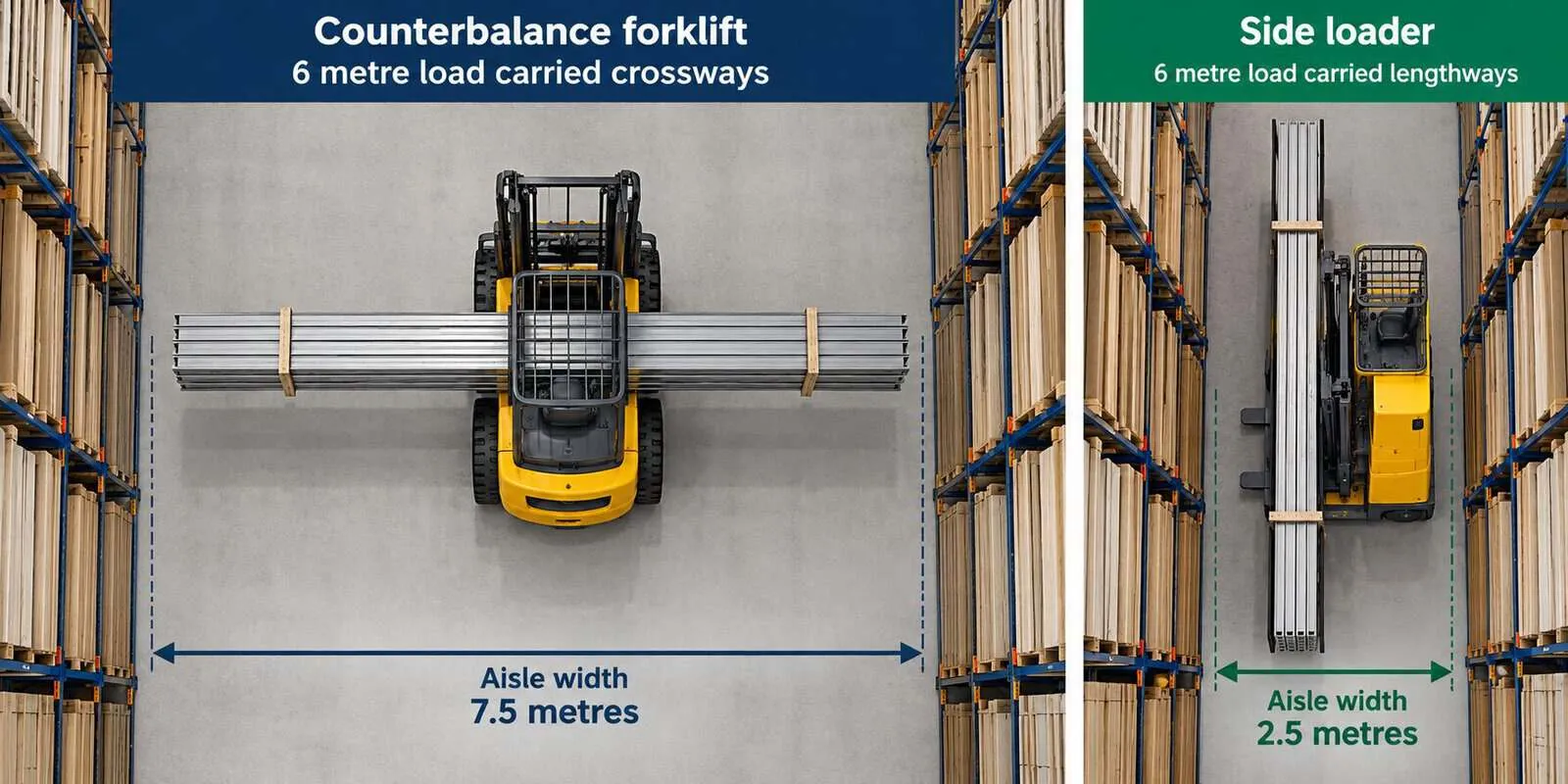
A side loader only needs an aisle a little wider than itself, because it never turns to face the rack. Baumann’s ELX electric sideloaders, for example, are listed at 1,950 or 2,150 mm wide.
A counterbalance carrying that 6 metre pack crossways needs more than 6 metres of clear path, plus room to turn into the rack.
The same goes for doorways, loading bays and the gaps between yard stacks. Floor space you’d otherwise give to wide turning aisles can go to more racking.
There’s a catch. Narrow aisles only work if the floor is good and the racking is set out for the truck you run. And if your stock is mostly palletised, reach trucks and other narrow aisle forklifts are usually the better fit.
Side Loader vs Counterbalance vs Multidirectional Forklifts
Pick a side loader for high volumes of long loads in tight aisles, a counterbalance for pallets and general yard work, and a multidirectional forklift when one machine has to do both.
| Side loader | Counterbalance | Multidirectional | |
| How it carries the load | On a side deck, lengthways | On the front forks | On the front forks, but can drive sideways |
| Best at | Long loads, high volume, tight aisles | Pallets, truck loading, general yard work | A mix of long loads and pallets |
| Aisle needed for a long load | Truck width plus clearance | Wider than the load is long | Narrower, because it drives sideways with the load lengthways |
| Pallet handling | Possible, but slow | Its main job | Good |
A counterbalance carries its load on the front forks, balanced by weight built into the back of the truck. For pallets, truck loading and general yard jobs, a counterbalance forklift is still where most sites start. Its weak spot is length: a long pack carried crossways needs wide aisles, wide doors and care at every corner.
A multidirectional forklift is a front-loader whose wheels turn so it can drive sideways down an aisle. Combilift calls its C-Series “three forklifts in one” (a sideloader, a counterbalance and a narrow aisle truck), with capacities from 2,500 to 25,000 kg.
As a rule of thumb, a dedicated side loader suits sites moving mostly long loads over longer yard runs. A multidirectional truck suits the shed that handles long loads in the morning and pallets in the afternoon.
Electric Side Loader Forklift vs Diesel and LPG
You can get a side loader in all three fuel types, and the right one comes down to where the truck spends its day. Combilift, for one, builds its sideloader range in electric, diesel or LPG.
Electric: An electric side loader forklift makes the most sense indoors, or on a mixed site with good surfaces. It’s quiet and has no exhaust emissions. Baumann lists electric models from 3,000 to 8,000 kg with lithium-ion or lead-acid batteries.
LPG: Gas sits in the middle. Cylinder swaps are quick and the truck works inside and out, but it still produces exhaust, so indoor use needs good ventilation.
Diesel: This is the yard workhorse for heavier capacities and long outdoor shifts. Baumann’s GX diesel series covers 5 to 8 tonnes, and its heavy-duty range goes beyond 10 tonnes.
Indoor, Outdoor and Ground Conditions
Ground matters more for a side loader than for most forklifts, because the load is lifted out to the side. A soft patch or cross-fall under the loading side hurts stability just when the load is furthest out.
Indoor models are often compact, with smaller wheels that need flat, sound concrete. Yard models tend to have bigger tyres, more ground clearance and levelling decks or chassis. Stabiliser jacks, where fitted, need firm, level ground under them.
Before you pick a model, walk the route it’ll actually drive. Check the surface, slopes and cross-falls, potholes, drainage after rain, and the ramps or thresholds between yard and shed. A truck that’s perfect in the aisle but bottoms out on the dock plate isn’t the right truck.
When Is a Side Loader Worth the Money?
A side loader pays its way when long loads are daily, high-volume work and space is tight. These are the signs it’s worth pricing one:
- Long loads are most of your work: You’re moving timber, steel or pipe all day, not a few packs a week.
- Aisles or doors are the bottleneck: Long loads carried crossways are slowing every move.
- You store in cantilever racking: That’s the rack a side loader is built to work.
- Loads travel a long way: Across a big yard or between buildings, carrying on the deck beats balancing a long pack on the forks.
Be realistic about the costs. HUBTEX notes that sideloaders usually cost more upfront than standard forklifts, that servicing can call for trained technicians and original parts, and that operators need specialised training.
So the honest test is whether the space and handling time you save cover that premium. Do that sum before you sign anything, not after.
When a Counterbalance with a Long-Load Attachment Does the Job
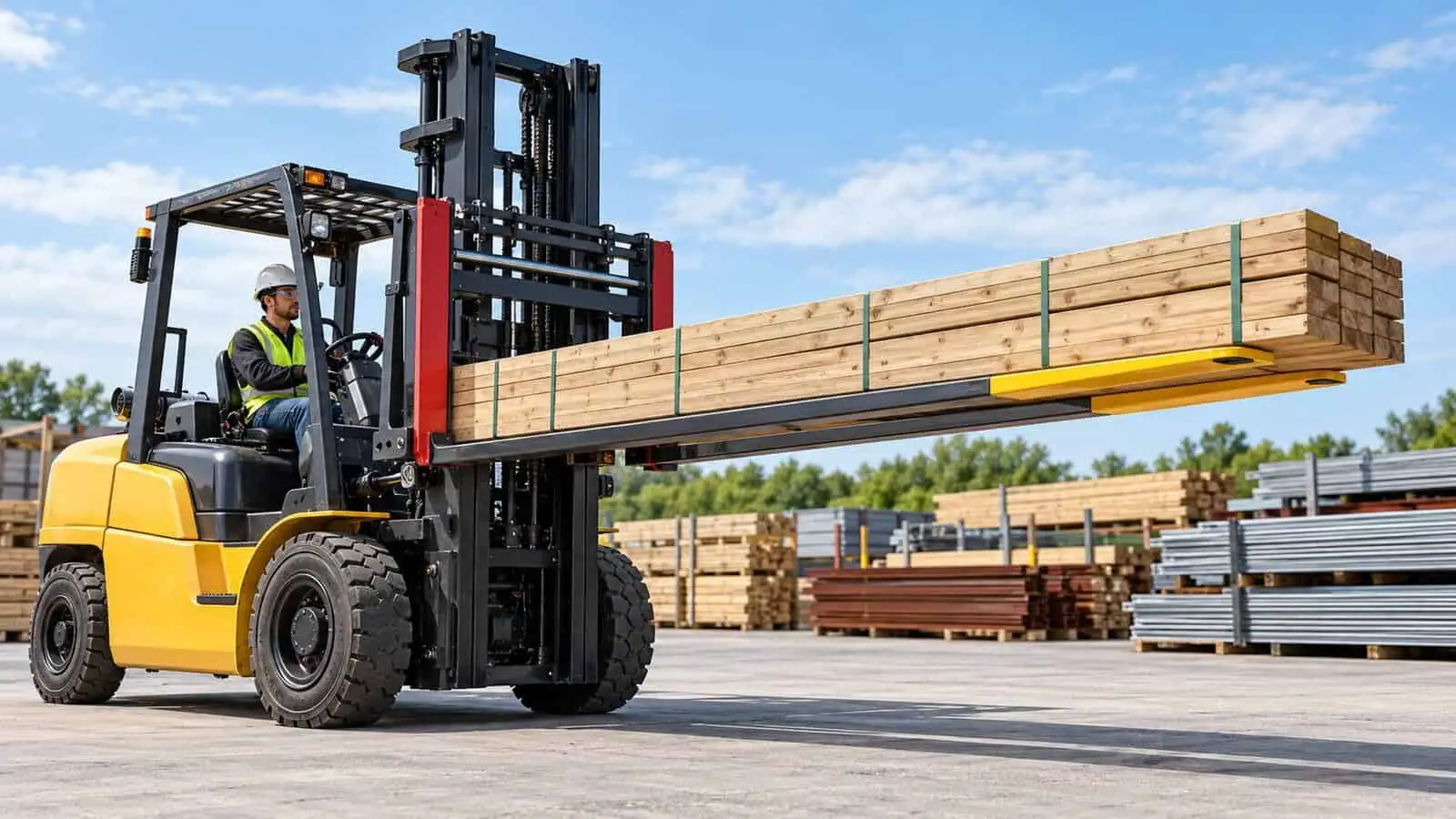
If long loads are occasional and you’ve got room to move, a counterbalance with the right attachment is often enough.
A fork positioner spreads the forks wide so a long pack doesn’t droop at the ends. Longer forks or fork extensions handle deeper loads, and a side shift lets the driver line up without shuffling the truck. With the right forklift attachments, a standard truck handles long loads well in open yards and over short runs.
The trade-off is capacity. Forklifts rated above one tonne are typically designed around a 600 mm load centre, and a deeper load on longer forks pushes that centre further out, which cuts what the truck can safely lift.
WorkSafe Victoria says an attachment must be shown on the forklift’s information plate before it’s used, with the supplier amending the plate or supplying a supplementary one.
You’ve outgrown the workaround when the counterbalance can only move a long load by reversing out of an aisle, angling it through a doorway or with someone guiding every move.
Do You Need a Special Licence for a Side Loader?
No. In Victoria, a side loader falls under the standard forklift licence, class LF.
WorkSafe Victoria defines a forklift for high risk work licensing as a powered industrial truck with a mast and an elevating load carriage fitted with fork arms or another load-holding attachment. A side loading forklift truck has all three, so its operator needs a high risk work licence.
WorkSafe lists only two forklift classes: LF for forklift trucks and LO for order-picking forklift trucks. That means new operators sit the same forklift licence assessment as anyone driving a counterbalance. Outside Victoria, check with your state regulator.
The licence alone doesn’t make someone ready, though. The reach mast, stabilisers and tilting deck feel different from a counterbalance, so plan for familiarisation on the actual machine before anyone works alone.
Find the Right Forklift for Long Loads
If you’re weighing up a side loader against a counterbalance with longer forks, have your load lengths and weights, aisle and door widths and racking height handy, and the Buy A Fork team can work through the options with you. The full forklift range shows the counterbalance, reach truck and pallet handling machines available now.
Frequently Asked Questions
1. How much weight can a side loader forklift lift?
Common side loaders are rated between about 3 and 8 tonnes, and heavy-duty models go well beyond that. Combilift’s sideloader range tops out at 8,000 kg, while Baumann lists a heavy-duty range above 10 tonnes. The figure that counts is the rated capacity on the truck’s plate, which can be lower at full height or without the stabilisers down.
2. Why use a sideloader instead of a standard forklift?
A sideloader carries long loads lengthways on its deck, so it works in aisles and doorways only a little wider than the truck. A standard forklift carries the same load crossways, which needs far more room and more care at every corner.
3. Can a side loader forklift handle pallets?
Yes, but it’s slower at pallet work than a counterbalance or reach truck. If your site handles a real mix of pallets and long loads, a multidirectional forklift is often the more practical choice.
4. Do you need a special licence to drive a side loader?
Not in Victoria. A side loader meets WorkSafe Victoria’s definition of a forklift, so the operator needs the standard LF licence, the same as for a counterbalance, plus training on the specific machine.
5. Can an electric side loader forklift work outdoors?
Some can. Manufacturers build electric side loaders for yard work as well as indoor aisles, but check the tyres, ground clearance, weather protection and battery capacity against a full outdoor shift. On rough or unsealed ground, diesel or LPG is often the better fit.