
Rough Terrain Forklifts: Specs, Tyres and When a Yard Machine Wins
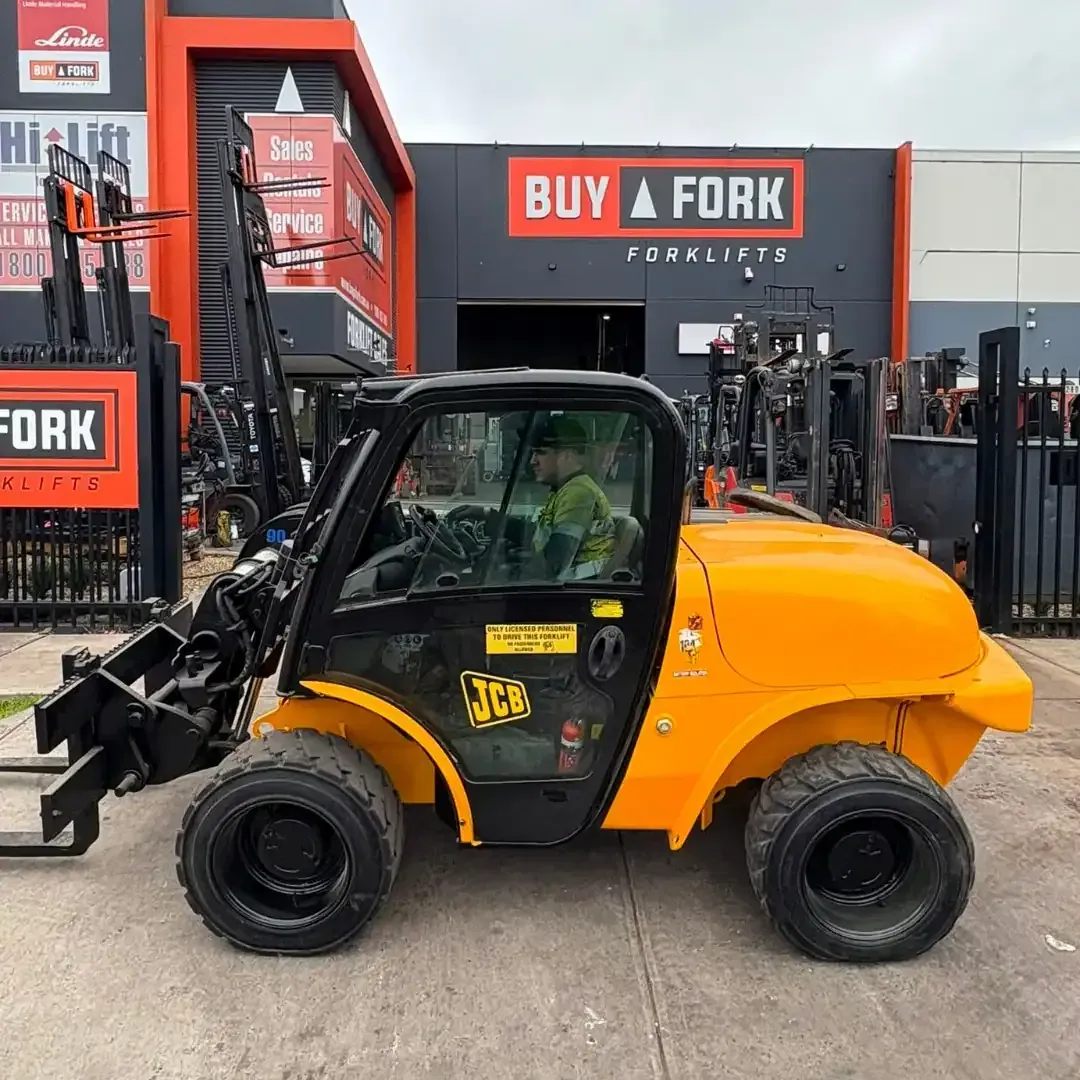
A rough terrain forklift is a mast-type forklift built on a heavy chassis with large treaded tyres and high ground clearance, designed to lift loads on unsealed, uneven or soft ground where a standard forklift bogs, scrapes or loses traction. It is the right machine for genuine site work. It is also the wrong machine for a large share of the businesses that go looking for one, because a compacted yard with the occasional rough crossing is handled far more cheaply by a standard diesel forklift on pneumatic tyres.
This guide covers what the machine actually is, how to judge your own ground, what the tyre and drive specifications buy you, and where the cheaper option wins.
What is a rough terrain forklift?
A rough terrain forklift lifts on a vertical mast like any counterbalance forklift, but sits on a taller, heavier chassis with deep-tread tyres and far more clearance underneath. Most are diesel, and they come in both two-wheel drive and four-wheel drive. The mast is the defining feature: the load goes straight up and down in front of the machine, exactly as it would in a warehouse.
Australian listings use several names for the same broad category. “Rough terrain forklift”, “all terrain forklift” and “4WD forklift” are used more or less interchangeably, and none of them is a fixed technical class. What matters is checking the drive configuration, tyres and clearance on the individual machine rather than trusting the label.
One distinction is worth getting right before you compare prices. A telehandler is not a rough terrain forklift. A telehandler lifts on an extending boom that reaches up and forward, which lets it place loads over obstacles and at height, and it is priced and licensed differently as a result. Some listings describe telehandlers as rough terrain forklifts because both work on site. If you are comparing two machines on price and one has a boom and the other has a mast, you are comparing two different jobs.
Rough terrain forklift vs standard forklift vs telehandler
The choice between these three comes down to your ground and your lift pattern, not your industry.
| Rough terrain forklift | Diesel counterbalance (pneumatic tyres) | Telehandler | |
|---|---|---|---|
| Ground it suits | Unsealed, soft, rutted or sloped site ground | Sealed and compacted yards, hardstand, sheds | Unsealed and uneven site ground |
| Typical drive | 2WD or 4WD | 2WD | Usually 4WD or all-wheel drive |
| Tyres | Large treaded pneumatic or solid | Standard pneumatic | Large treaded pneumatic |
| Lift pattern | Vertical mast | Vertical mast | Extending boom, up and forward |
| Best use | Construction, rural and industrial sites | Transport depots, yards, mixed indoor and outdoor work | Placing loads at height or over an obstacle |
| Main limitation | Higher purchase and service cost, narrow resale market | Struggles on soft or badly uneven ground | Larger footprint, different licence class |
The practical reading is that the mast machines do the same job on different surfaces, while the telehandler does a different job altogether. If you never need to place a load over something, the boom is cost you are not using.
How to tell whether your site actually needs one
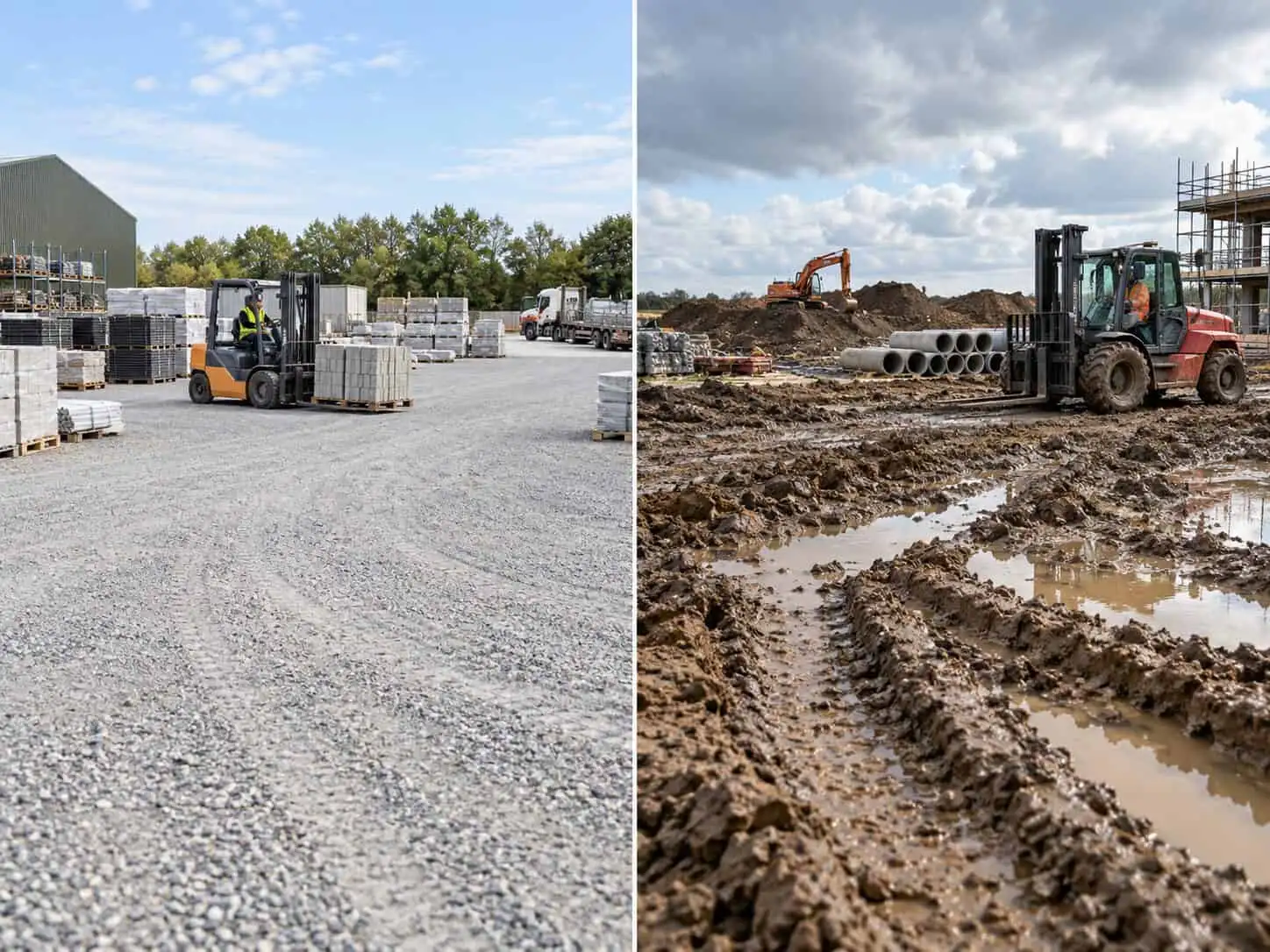
Judge the machine against the worst ground it has to work on regularly, not the worst ground it will ever see. A single wet week each winter is not a reason to buy a purpose-built machine.
Work through these:
- Surface type: Sealed concrete or asphalt, compacted gravel, loose fill, or soft ground that gives way under weight. Compacted gravel is comfortably within reach of a standard forklift on pneumatic tyres.
- Behaviour after rain: Whether the working area drains or turns to mud. Ground that stays workable wet is a very different problem to ground that does not.
- Gradient: Whether loaded travel involves any real slope. Slope with a load on soft ground is where two-wheel drive machines run out of traction.
- Kerbs, thresholds and ruts: The height of the worst obstacle the machine has to cross routinely, which is what ground clearance is actually for.
- Time off the hardstand: What share of the working day is spent on rough ground rather than crossing it occasionally.
- Indoor work: Whether the same machine also has to operate inside a shed, where a large rough terrain machine is awkward and its exhaust is a ventilation problem.
The rule that catches most buyers: if the machine spends most of its day on hardstand and crosses gravel a few times a shift, that is a yard forklift job, not a rough terrain forklift job.
What capacity and lift height do you need?
Size the machine for the load you handle every week, not the heaviest thing you have ever lifted. Over-buying on capacity is the standard mistake in this category, and it costs you twice: once at purchase and again in fuel, tyres and servicing across the machine’s life.
Two things pull the effective capacity down from the headline figure. The first is load centre, the distance from the face of the forks to the centre of the load. Rated capacity is quoted at a specific load centre, and a long or awkwardly balanced load shifts that centre forward and derates the machine, sometimes sharply. The second is ground. Soft or sloped ground reduces what a machine can safely handle, because stability depends on the machine sitting level and the tyres holding.
On lift height, measure the tallest thing you routinely stack or reach rather than the tallest thing on site. Every extra mast stage adds cost, weight and free-lift complications you may not need. Always read the capacity and load centre figures from the machine’s own data plate and specification sheet, and treat any figure in an advertisement as something to verify rather than rely on.
Rough terrain forklift tyres: what actually matters
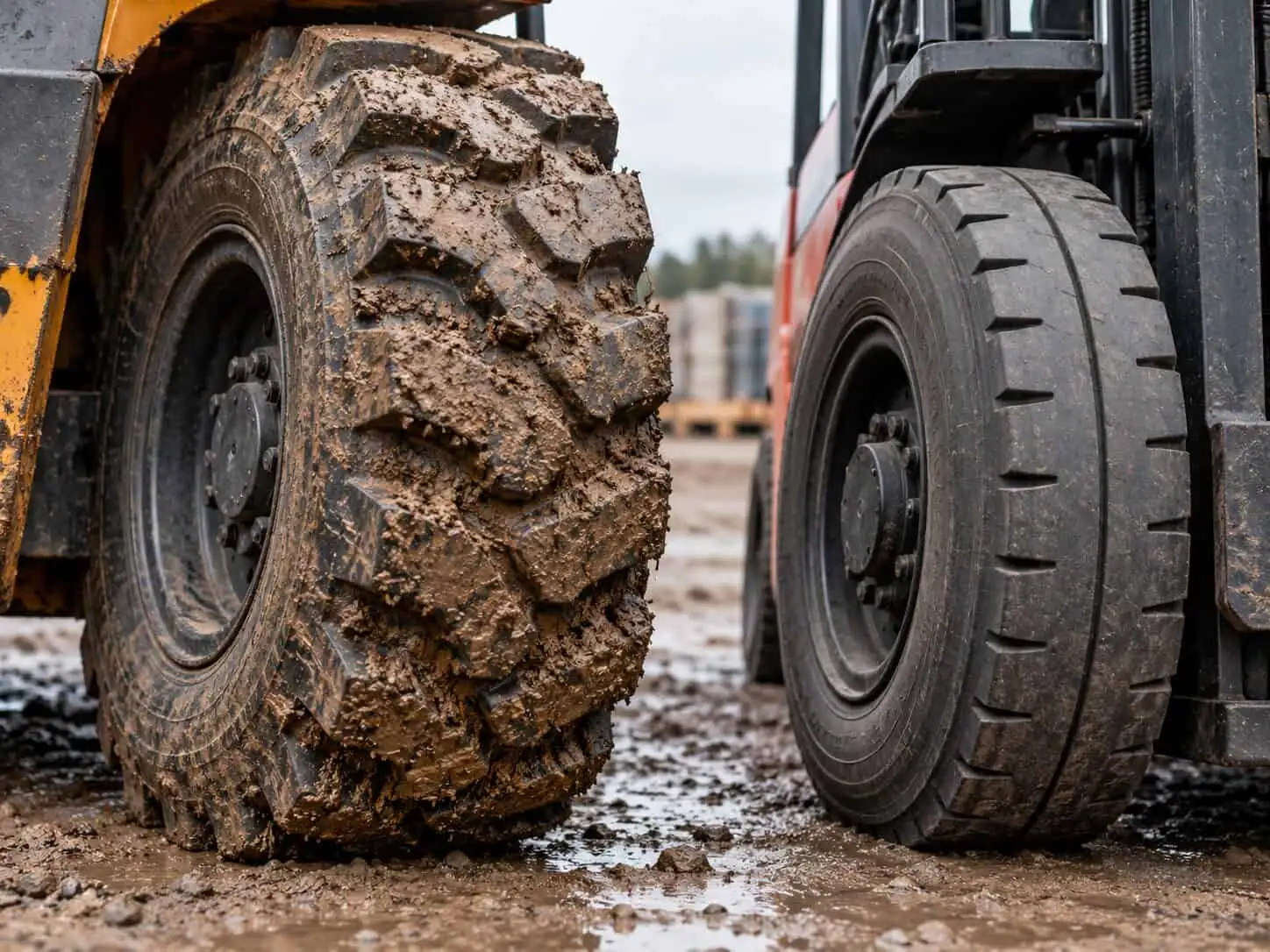
Tread pattern and ground clearance matter more than tyre size on rough ground. A large tyre with a warehouse tread will still spin in mud, while a properly treaded tyre on a machine with clearance underneath will keep working long after a standard forklift has bottomed out on a rut.
The pneumatic versus solid decision is genuinely site-specific, and a machine sold as a rough terrain or all terrain forklift can still ship on solid tyres, so check the individual listing rather than assuming.
| Pneumatic (air-filled) | Solid (or foam-filled) | |
|---|---|---|
| Traction on soft ground | Better, the tyre deforms and spreads load | Reduced, less contact patch under load |
| Ride and operator comfort | Cushions ruts and impacts | Harsher, transmits shock through the machine |
| Puncture risk | Real, and costly on a remote site | None, which is why debris-heavy sites choose them |
| Running cost | Lower purchase, higher risk of downtime | Higher purchase, longer service life |
| Best suited to | Mud, sand, loose fill and slope | Yards with steel offcuts, glass, nails or demolition debris |
Foam-filled tyres sit between the two: a pneumatic casing filled with polyurethane, giving puncture immunity while keeping most of the tread profile. They are heavier and cannot be repaired, but on a site that punctures tyres regularly they remove a recurring cost.
Whatever you fit, replace tyres as a matched set across an axle. Mismatched wear changes how the machine sits and how it steers under load. If you are handling replacement in-house, our guide on changing forklift tyres covers the process.
Two-wheel drive or four-wheel drive?
Four-wheel drive earns its cost on slope, mud and loose fill, and almost nowhere else. Driving all four wheels keeps the machine moving when the rear axle loses grip, which is exactly the situation that strands a two-wheel drive machine partway up a wet ramp with a load on the forks.
What it costs is not only the purchase price. A 4WD driveline adds differentials, driveshafts and hubs to service, more to go wrong, and more weight to move around, which shows up in fuel. Parts availability also matters more on a 4WD machine, because the drivetrain components are less common than the ones shared with standard forklift production.
Plenty of site work is handled by a well-specified two-wheel drive machine. Weight over the drive axle, the right tread and enough ground clearance solve most traction problems that are not actually slope problems. If your ground is flat and firm but rough, look hard at 2WD before paying for 4WD. If your ground is soft, sloped, or both, a 4WD diesel forklift is the honest answer and worth the extra.
When a standard yard forklift is the better buy
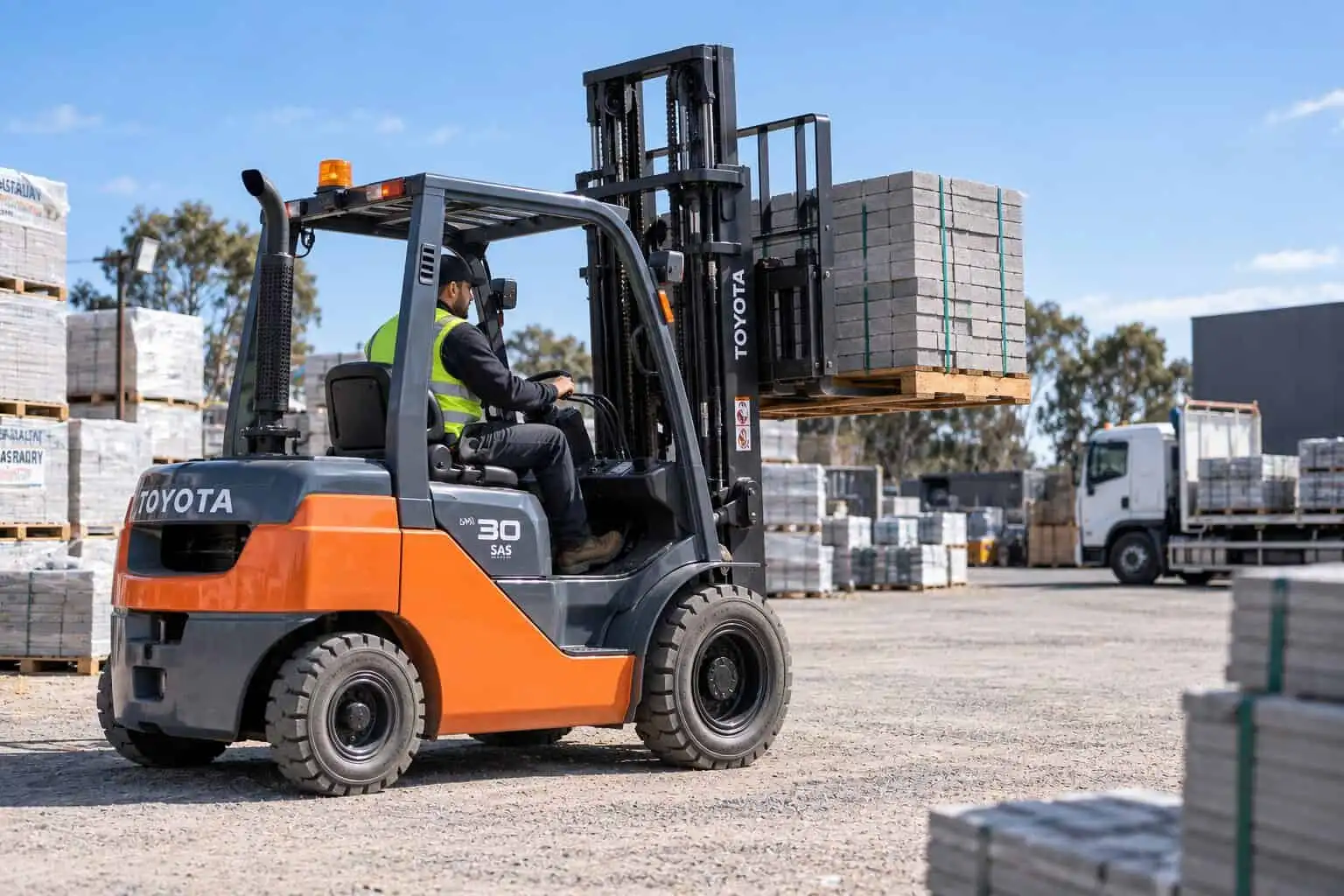
For most Australian yards, a diesel counterbalance forklift on pneumatic tyres does the job for considerably less money. Transport depots, builders’ merchants, storage yards and manufacturing sites usually run on compacted hardstand with rough patches, and that is squarely within what a standard machine handles.
The cost gap is not only the purchase price. A standard counterbalance forklift is cheaper to service, its parts are stocked everywhere, any competent forklift technician can work on it, and the used market for it is deep. That last point matters more than buyers expect. When you come to sell a rough terrain machine, the pool of buyers is small and regional, and the price reflects it.
Choose a yard machine if:
- Your working surface is sealed or well-compacted, with rough ground only crossed occasionally.
- The site drains and stays workable in wet weather.
- The same machine also needs to work inside a shed or under cover.
- You want a machine that is straightforward to service and easy to resell.
Should you buy or hire a rough terrain forklift?
Buy when the machine has ongoing work, hire when it has a project. The dividing line is utilisation rather than duration: a machine that works most days for six months is usually worth owning, while one that works two days a week across a build is not.
The resale point cuts the same way. A rough terrain forklift sells into a narrower Australian market than a standard counterbalance, so the money you get back at the end is less predictable. If the work is a defined project with an end date, hiring keeps that risk with someone else.
What licence do you need in Australia?
A mast-type rough terrain forklift falls under the forklift truck licence class. WorkSafe Victoria lists LF, forklift truck operation licence, among its high risk work licence classes, and the machine type rather than the terrain is what sets the requirement. A rough terrain forklift with a mast and fork arms is a forklift truck for licensing purposes.
A telehandler is a different matter, because it is a boom machine. WorkSafe Victoria lists a separate class, TV, non-slewing telehandler operation licence, for non-slewing units over 3 tonnes, with crane classes applying to slewing machines. This is one of the practical reasons the boom-versus-mast distinction is worth getting right before you buy.
Licensing is administered state by state, so confirm the position with your own regulator if you operate outside Victoria. If you are working out which class your operators need, our guide on getting a forklift licence in Australia walks through the process.
What to check before you buy a used rough terrain forklift
Used rough terrain machines have usually had a harder working life than a warehouse forklift of the same age, so inspect them accordingly.
- Tyre wear across all four corners. Look for matched tyres on each axle and even wear. Uneven wear points at alignment or driveline problems, and a full set of rough terrain tyres is a significant cost.
- Chassis and mast condition. Check for cracking, repair welds and distortion, particularly around the mast mounts and the counterweight. Repair welds are not automatically a problem, but you want to know why they are there.
- Hydraulic leaks. Check the lift and tilt rams, the hoses and the fittings while the mast is raised and lowered under load.
- Drivetrain noise under load. Drive the machine loaded, on a slope if the yard has one, and listen for differential and hub noise. This is the check most buyers skip and the one that costs most to get wrong.
- Steering and brakes on rough ground. Test them on a surface like the one you will actually work on, not on a flat concrete apron.
- Service history. Ask for records. A machine with a documented service history from a site operator is a better risk than one with no paperwork at any price.
- Parts availability for the brand in Australia. Some imported rough terrain machines are excellent and some leave you waiting weeks for a driveline part. Check before you commit.
- A legible compliance and data plate. You need the capacity, load centre and machine details readable. An unreadable plate is both a safety problem and a sign of neglect.
- A loaded test lift. Lift a load close to what you handle daily, to full height, and watch for mast judder, drift and hydraulic hesitation.
Working out which machine suits your ground
If your yard is compacted and your rough ground is something you cross rather than work on, look at the diesel range first, since that is where most buyers in this position end up. If the ground is genuinely soft or sloped, a purpose-built machine is worth the money. Tell us what your surface does after rain and how heavy your routine load is, and we will tell you straight which of the two you need.
Frequently asked questions
1. What is a rough terrain forklift used for?
A rough terrain forklift is used to lift and move loads on unsealed, uneven or soft ground where a standard forklift cannot operate safely. Typical work includes construction sites, rural properties, timber and building supply yards, and industrial sites with unmade ground.
2. Is an all terrain forklift the same as a rough terrain forklift?
In Australian listings the two terms are used interchangeably and generally describe the same category of machine. Neither is a fixed technical classification, so compare the actual drive configuration, tyres and ground clearance rather than relying on the name in the advertisement.
3. Can a normal forklift be used outside?
Yes, a standard forklift on pneumatic tyres works well outdoors on sealed and compacted surfaces such as yards, hardstand and depot areas. Where it struggles is soft ground, deep ruts and slope, which is the point at which a rough terrain machine starts to justify its cost.
4. Do rough terrain forklifts need 4WD?
No, many rough terrain forklifts are two-wheel drive and handle firm but uneven ground perfectly well. Four-wheel drive earns its extra purchase and servicing cost on slope, mud and loose fill, so specify it based on your ground rather than by default.
5. What licence do you need for a rough terrain forklift in Australia?
A mast-type rough terrain forklift falls under the forklift truck licence class, listed by WorkSafe Victoria as LF, forklift truck operation licence. Licensing is administered state by state, so operators outside Victoria should confirm the current requirement with their own regulator.
6. Is it cheaper to hire or buy a rough terrain forklift?
Hiring is usually cheaper for a defined project, while buying wins when the machine has ongoing work most days. Factor in resale as well, because rough terrain machines sell into a narrower market than standard counterbalance forklifts.