
Forklift Jibs: Types, Capacity and the Australian Rules
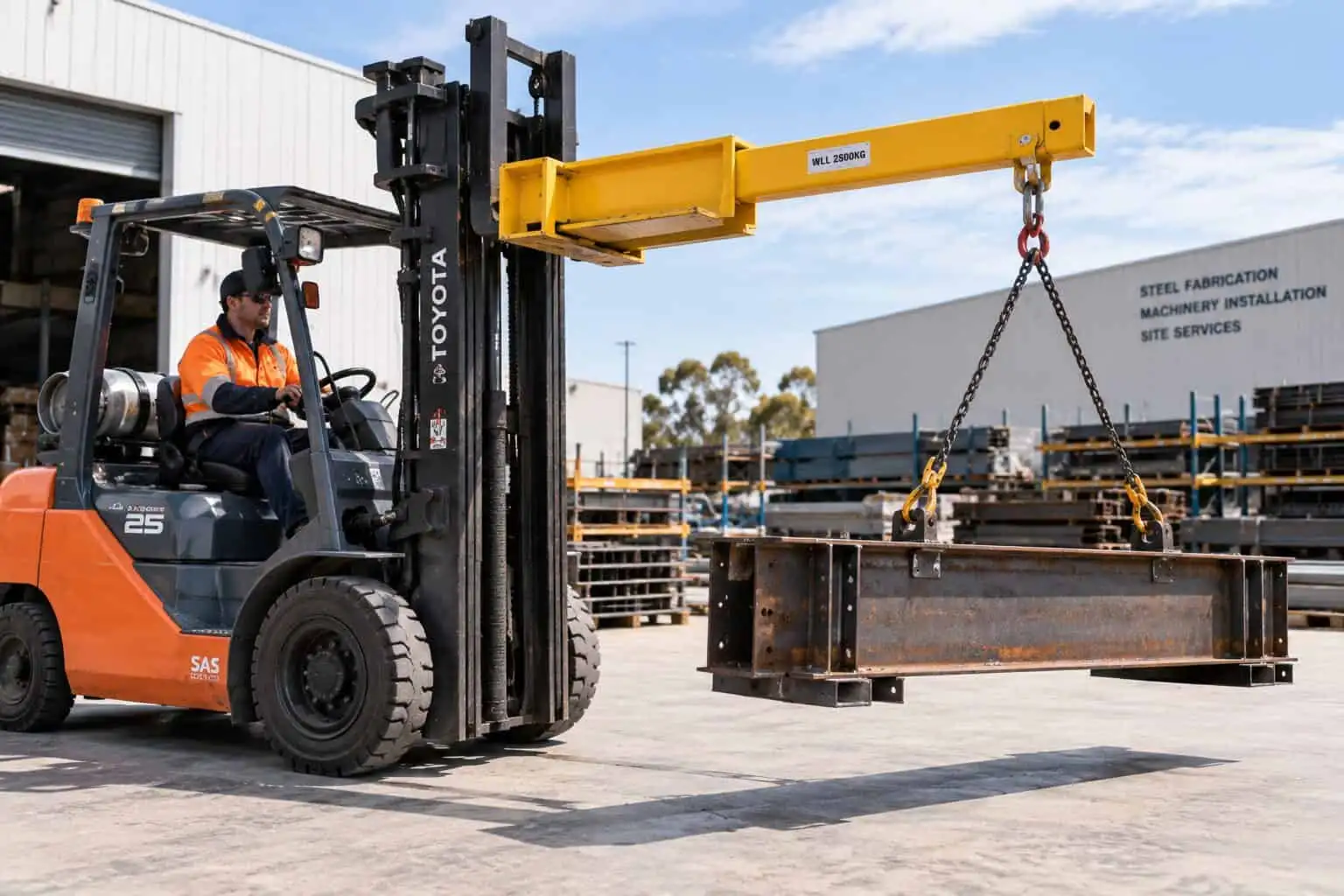
A forklift jib is an attachment that slides onto the forks or mounts to the carriage and gives the machine a hook, so awkward loads can be slung underneath instead of carried on the forks. It turns a forklift into a lifting device for loads that will never sit flat on a pallet.
There is a catch that most buyers meet after they have bought one. Fitting a jib changes what the forklift can safely lift, and in Australia the attachment has to appear on the forklift’s information plate before it can be used at all.
This article covers what a jib is for, the main types and how they mount, why the combination lifts far less than either rated figure suggests, what the Australian rules require, and when the honest answer is a different machine.
What Is a Forklift Jib and What Is It For?
A forklift jib is a beam that attaches to a forklift and ends in a hook, converting fork-based carrying into crane-style slinging. The load hangs from the hook on a sling, chain or shackle rather than resting on the fork blades.
The reason to use one is load shape. Anything with a lifting eye, anything round, anything that will not sit stable on forks and anything that needs to be lowered into position rather than set down is a job forks handle badly and a hook handles well.
Typical work for a jib includes:
- Machinery with lifting eyes: pumps, motors, gearboxes and fabricated assemblies designed to be lifted from a single point.
- Round or irregular loads: tanks, drums, pipe bundles and coils that will roll or slip on flat forks.
- Placing rather than stacking: lowering a load into a pit, a frame or a machine bed, where the load needs to come down vertically and controlled.
- Bundled long steel: sections and bar that overhang forks badly but sling cleanly from a central point.
One thing a jib does not do is turn a forklift into a crane. A crane is designed and rated for suspended loads and has the controls to manage them. A forklift with a jib is a forklift carrying a swinging load, and that difference runs through everything below.
The Main Types of Forklift Jib
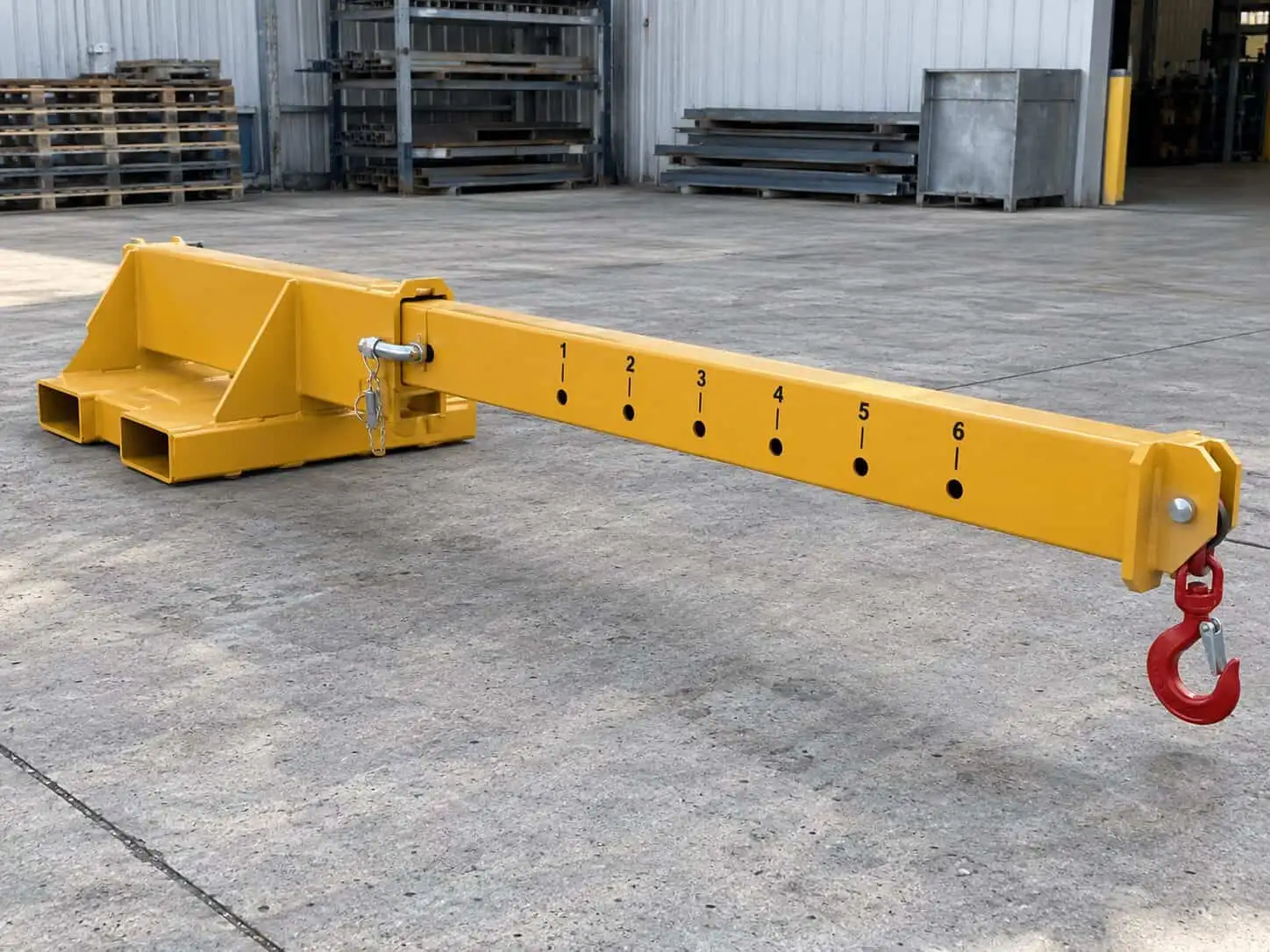
Jibs split three ways on function and two ways on how they mount, and the combination decides what you can lift and how far out you can lift it.
A fixed jib, sometimes called a rigid jib, has a hook at a set distance from the carriage. It is the simplest, lightest and cheapest option, and the one to choose when every load is handled in roughly the same place.
A telescopic jib extends and retracts, usually by pulling a locking pin and sliding the beam to one of several set positions. Reflex Equip publishes a 4,700 kg unit (EWFJA470ZINC) with four different lifting positions set by removing the locking pin, and the Adaptalift Store lists a 2.5 tonne unit (FJCS25) that measures 1.3 m retracted and 1.96 m at full extension. Reach is the point of these units, and reach is also what costs you capacity.
A tilting or hydraulic jib adds a powered angle change, which lets the operator adjust the hook height without raising the mast. It needs a spare hydraulic service on the forklift, and it adds weight and cost, so it earns its place only when the job genuinely needs fine height control.
Mounting matters as much as type. A fork-mounted jib slips over the fork blades and is held with a safety chain, which makes it quick to fit and easy to move between machines. A carriage-mounted jib bolts or hooks directly to the forklift carriage, which sits the load closer to the mast and is more stable, at the cost of taking longer to fit.
| Jib type | How it mounts | Reach | Best for | Watch for |
|---|---|---|---|---|
| Fixed or rigid | Fork pockets or carriage | Set at one position | Repetitive lifts at a consistent distance | No adjustment if the job changes |
| Telescopic | Usually fork pockets | Several set positions | Mixed loads needing different reach | Capacity falls at every extension |
| Tilting or hydraulic | Carriage, plus a hydraulic service | Set or adjustable, with powered angle | Placing loads where height control matters | Needs spare hydraulics, adds weight and cost |
Two specifications decide whether a given jib physically fits your machine, and both are published. Fork pocket size and fork pocket centres have to match your fork blades and their spacing: the FJCS25 lists 185 x 65 mm pockets at 275 mm centres and the EWFJA470ZINC lists the same 185 x 65 mm pockets at 350 mm centres. Check those against your forks before anything else, because a jib that does not seat properly is not a jib you can use.
Why a Jib Cuts Your Forklift’s Lifting Capacity
A jib reduces what your forklift can lift because it moves the load away from the fork face, and a forklift’s rated capacity only applies at the load centre stamped on its plate. The further out the weight sits, the less the machine can carry.
This is where the published numbers get interesting, because the derating starts before you have hung anything on the hook. Both units cited above list a load centre of 790 mm: the FJCS25 at 2.5 tonnes and the EWFJA470ZINC at 4,700 kg. Australian forklifts are commonly plated at 500 mm or 600 mm, so a jib is already pushing the load well past the rating point as a starting condition, not as a worst case.
The relationship is proportional, and the working approximation for forklift capacity at an extended load centre is the same one that governs any deep or overhanging pallet: actual capacity = (rated load centre ÷ actual load centre) × rated capacity. Applied to a 790 mm jib load centre, the arithmetic looks like this.
| Forklift plate | Load centre on the jib | Share of rated capacity | Illustrative capacity |
|---|---|---|---|
| 2,500 kg at 500 mm | 790 mm | 63% | 1,582 kg |
| 2,500 kg at 600 mm | 790 mm | 76% | 1,899 kg |
| 3,500 kg at 500 mm | 790 mm | 63% | 2,215 kg |
| 3,500 kg at 600 mm | 790 mm | 76% | 2,658 kg |
These figures are arithmetic worked from the formula and the published 790 mm jib load centre. They are not manufacturer data for any specific machine. They are here to show the scale of the effect, and the effect is large: a 2.5 tonne machine plated at 500 mm is working to something in the region of 1.5 tonnes before the jib’s own weight is counted.
Three things make the real figure lower still. The jib itself weighs something and that weight sits forward of the axle, with the FJCS25 listed at 100 kg tare and the EWFJA470ZINC at 140 kg. Extending a telescopic jib pushes the load centre further out again, so capacity drops at every position. And lift height cuts capacity independently of load centre, so the figure that actually governs a jib lift comes off the forklift’s residual capacity chart rather than off the badge on the counterweight.
The governing number is the lower of two figures: the jib’s own working load limit, and the forklift’s residual capacity at the load centre the jib creates. A 4,700 kg jib on a 2.5 tonne forklift is a 2.5 tonne forklift, derated. The jib’s rating is a ceiling for the attachment, not a capacity for the combination.
What Australian Rules Apply to Forklift Jib Attachments?
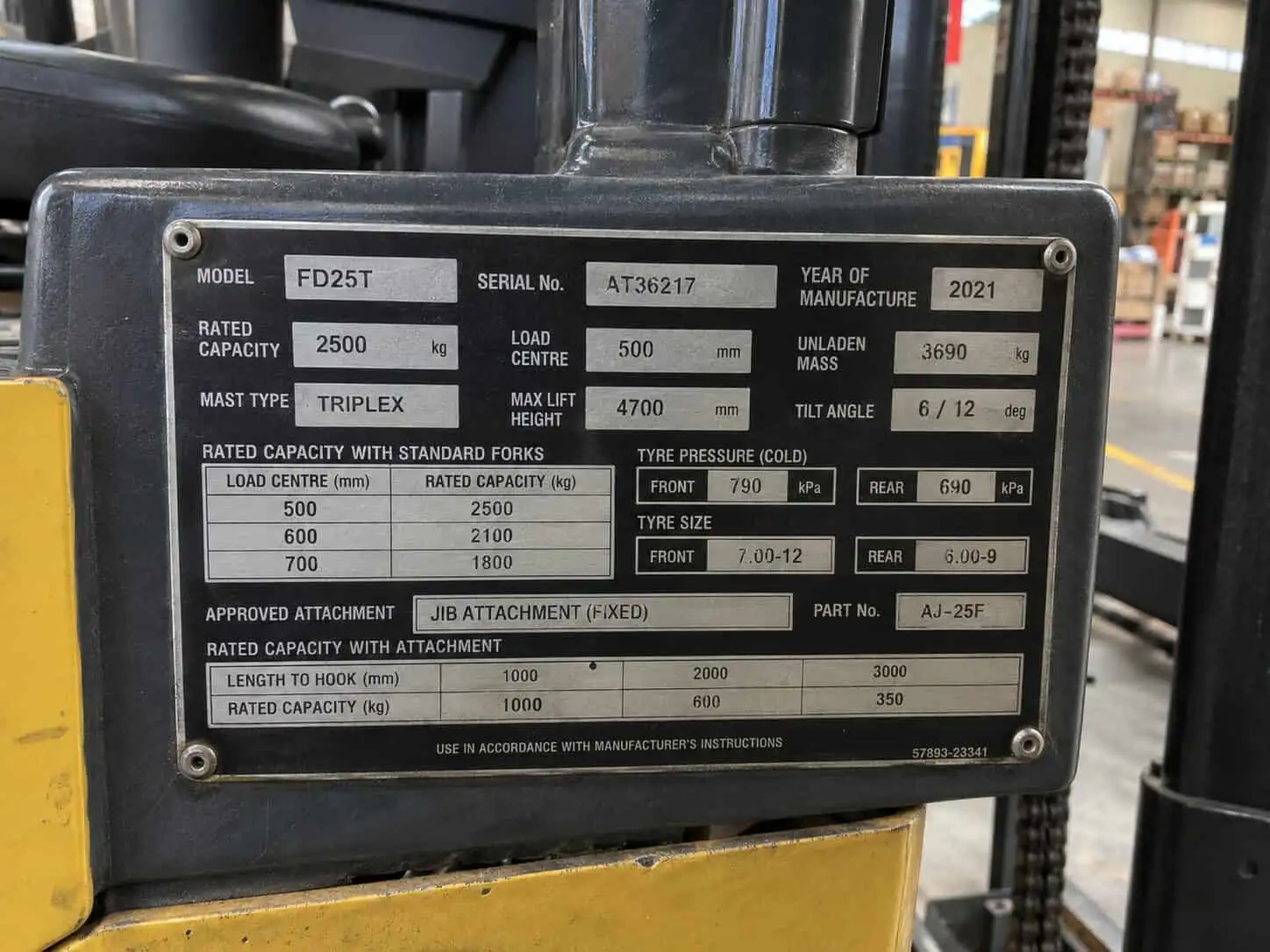
Three conditions must all be met before an attachment can be used on a forklift in Australia, and WorkSafe Victoria states them plainly: the forklift manufacturer has approved the use of the attachment, the attachment has a rated capacity, and the attachment is listed on the forklift information plate.
The last one is not advisory. WorkSafe Victoria’s position is direct: “If it is not on the information plate, the attachment must not be used.”
The plate itself has to be updated to reflect the new combination. WorkSafe Victoria states that “the information plate needs to indicate the rated capacity for the forklift when used with specific attachments”, and that where an attachment is fitted, “the supplier will amend the information plate or provide a supplementary information plate for the forklift’s rated capacity”. Suppliers say the same thing: the Adaptalift Store’s own product documentation for the FJCS25 notes that forklift attachments require a forklift to be re-rated so the rating plate includes the new attachment.
Two ongoing obligations sit alongside the plate. WorkSafe Victoria requires that the attachment is inspected as part of the daily pre-operational inspection, and that operators receive information, training or supervision for each attachment they use. Holding a forklift licence is not the same as being trained on the jib.
The practical sequence is worth setting out in order, because doing it backwards is how businesses end up with an attachment they cannot legally use.
- Check the forklift manufacturer approves the attachment on that specific model before you buy anything.
- Confirm the jib has a rated capacity from its manufacturer, published and documented.
- Have the combination rated and get the information plate amended, or a supplementary plate provided, by the supplier.
- Add the jib to the daily pre-start check alongside the machine’s own inspection items.
- Train every operator on the attachment, separately from their licence.
This is broader than jibs. Clamps, rotators, fork extensions and slippers all sit under the same three conditions, because the obligation attaches to forklift attachments as a category rather than to any one design. Buy A Fork sells into more than one state, so confirm the position with your own regulator as well: the duties are consistent nationally but the guidance and the administering body differ.
How to Choose a Jib for Your Forklift
Work through the specification in this order, because each step can rule out the step before it.
- Weigh the heaviest load you will sling. Not the average load, the worst case you handle regularly.
- Measure the reach you need from the fork face to where the hook has to sit, and treat that as your working load centre.
- Check the forklift’s residual capacity at that load centre, from the machine’s own chart rather than the formula. This is the step where most buyers find out the machine is too small, and it is much cheaper to find that out here than after the purchase.
- Confirm the forklift manufacturer approves a jib on that model. No approval, no attachment.
- Match the fork pockets. Pocket size and centres have to suit your fork blades and their spacing.
- Decide whether you genuinely need telescopic or tilting function. Both add weight and cost, and the extra weight sits forward of the axle where it hurts capacity most.
- Budget for the re-rating and the plate amendment, because the attachment is not usable until that is done.
If step three fails, the answer is a bigger machine rather than a smaller load, and a larger counterbalance forklift is usually cheaper than the alternative of a lift that sits outside its rating.
When a Jib Is the Wrong Answer
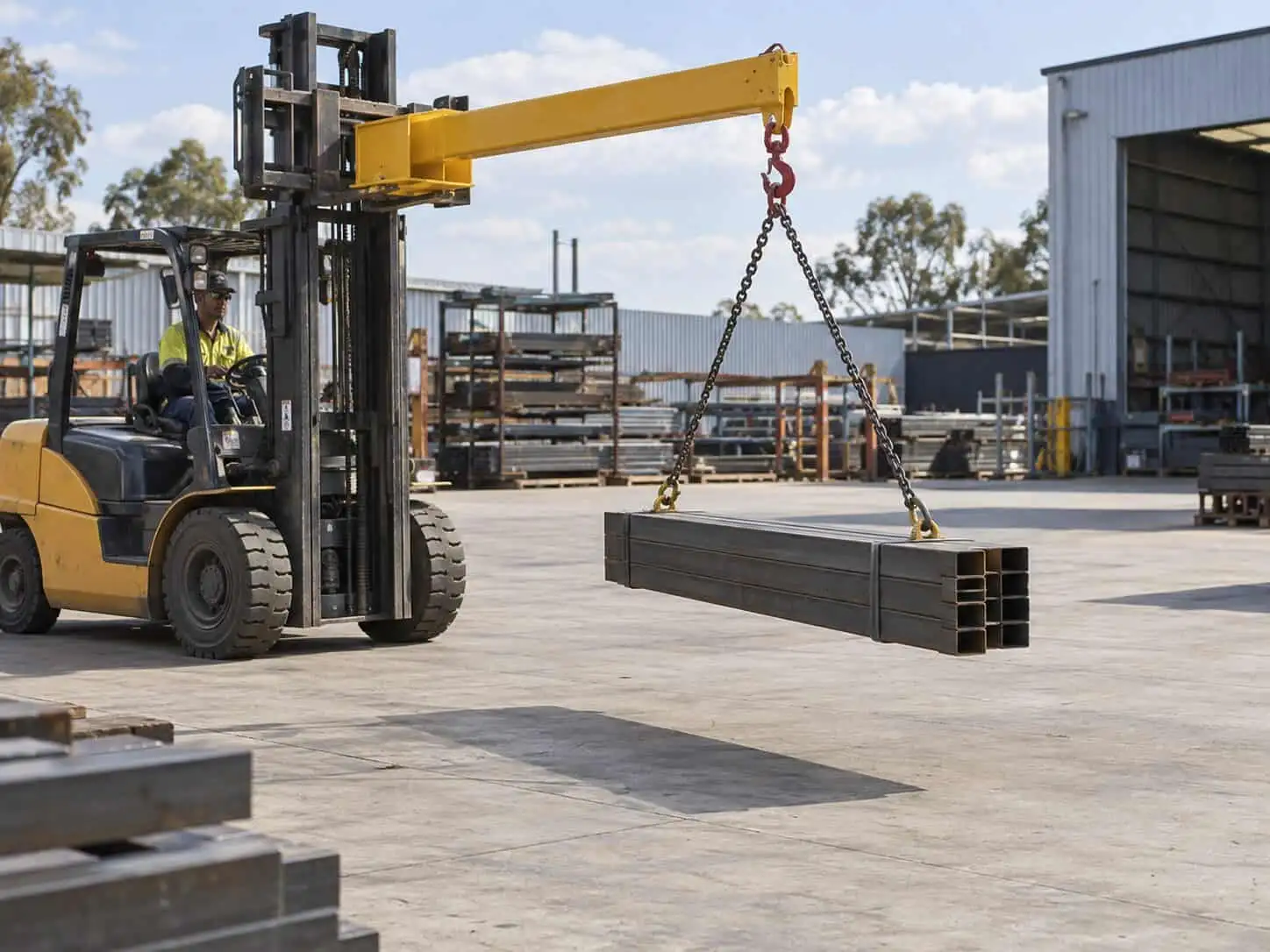
A jib is the wrong tool when the lifting is frequent, overhead, or fine enough that a swinging load becomes the main hazard. A slung load moves, and a forklift has no way to control that movement beyond the operator driving gently.
Four situations point somewhere other than a jib:
- Repeated overhead lifting in one location: a gantry or an overhead crane is designed for the job, safer for it, and usually cheaper to run than tying up a forklift.
- Loads close to the forklift’s limit: if a load is near capacity at the standard load centre, it will be outside capacity at 790 mm, and there is no configuration that fixes that.
- Uneven or sloping ground: sway gets worse as the surface gets worse, and a slung load on a yard slope behaves very differently to the same load on a level slab.
- Reaching over an obstacle: a telehandler is built to reach out and place, and a forklift with a jib is not a substitute for one.
We would rather point you at a gantry or a telehandler than sell you an attachment that sits in the corner because it never felt safe to use.
Frequently Asked Questions
1. What is a jib on a forklift?
A jib is an attachment that mounts to a forklift’s forks or carriage and ends in a hook, so loads can be slung underneath rather than carried on the fork blades. It is used for loads with lifting eyes and for round or irregular items that will not sit safely on forks.
2. Do you need a licence to use a forklift jib in Australia?
The licence class does not change because an attachment is fitted, but the training requirement does. WorkSafe Victoria requires that forklift operators receive information, training or supervision for each attachment they use, so a licensed operator still needs to be trained specifically on the jib before using it.
3. How much can a forklift lift with a jib fitted?
Less than the plate says, and often much less. The jib moves the load away from the fork face, and published fork-mounted jibs list a load centre of 790 mm against forklifts commonly plated at 500 mm or 600 mm. The governing figure is the lower of the jib’s rated capacity and the forklift’s residual capacity at that load centre, taken from the machine’s own chart.
4. Does a forklift jib need to be on the information plate?
Yes. WorkSafe Victoria states that if an attachment is not on the information plate, it must not be used, and that the supplier will amend the plate or provide a supplementary plate showing the rated capacity for the forklift with that attachment fitted.
5. Can any forklift take a jib attachment?
No. The forklift manufacturer has to approve the attachment for that model, the fork pockets have to match your fork blades and spacing, and the machine has to have enough residual capacity at the jib’s load centre to do the job. Any one of those can rule a machine out.
6. Can you hire a forklift jib instead of buying one?
Yes, and for occasional work hire often makes more sense than buying, since the re-rating and plate amendment sit with the hire company rather than with you. Hire is handled by our sister company, Rent A Fork.
Fitting a Jib to Your Forklift in Melbourne
Three numbers start the conversation: the heaviest load you need to sling, the reach from the fork face to the hook, and your forklift’s rated capacity with the load centre it is plated at. With those, we can tell you fairly quickly whether the machine you have will do the job.
If it will, the next questions are whether the manufacturer approves an attachment on that model and what the plate amendment involves. If it will not, we would rather say so and talk about the machine that will, or about whether a gantry or telehandler is the better answer. Those are all faster to settle in conversation than in email, and our team in Somerton can work through them with the plate and the chart in front of us.