
Pallet Racking Inspection and Safety: An AS 4084 Guide for Warehouses
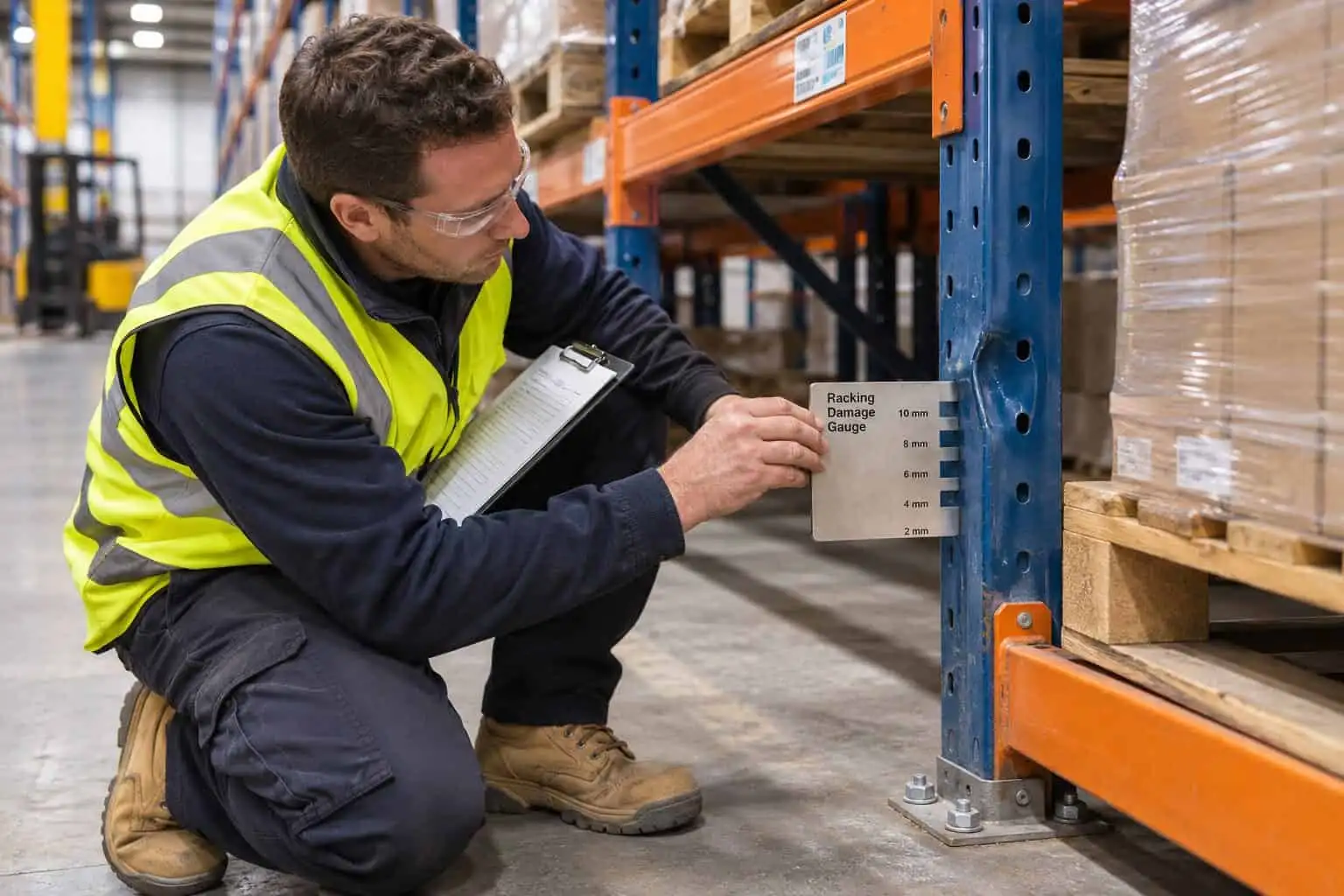
A fork tip clips an upright during line-up, the driver keeps going, and nobody reports the dent. That’s how a lot of racking damage builds up. A pallet racking inspection finds it: WorkSafe Victoria says a competent person should formally inspect your racking against AS 4084.2:2023 every 12 months, with in-house checks in between and every impact assessed straight away.
What AS 4084 Actually Covers
AS 4084 is the Australian Standard for steel storage racking. Its 2023 edition comes in two parts: AS 4084.1:2023 for design, and AS 4084.2:2023 for operation and maintenance, including inspections, damage ratings and repairs. Part 2 is the one your warehouse lives with.
Standards Australia sells the standard, so most sites work from WorkSafe Victoria’s guidance on pallet racking operation and maintenance instead. It says racking should be set up, operated and maintained to the manufacturer’s instructions and AS 4084.2:2023, and never loaded past its safe working load.
That guidance is written around selective racking. Drive-in, double-deep, push-back and cantilever systems can need extra safety measures.
How Often Do You Need a Pallet Racking Inspection?
Only the formal inspection has a fixed interval: at least every 12 months, by a competent person. WorkSafe wants the in-house checks in between done with simple gauges, not by eye.
Most sites end up with three layers of checking, plus an immediate check after any impact.
| Check | Who does it | How often | What it covers |
| Operator walk-past | Forklift operators and storepersons | Every shift | Fresh dents, dislodged beams, leaning loads, missing clips |
| In-house inspection | A trained supervisor or storeperson | As the manufacturer or a competent person recommends (weekly or monthly suits many busy sites) | Every bay walked with a checklist and gauge, findings recorded |
| Formal inspection | A competent person | At least every 12 months | Every component, load signs and configuration, with a written report |
| Damage assessment | Supervisor, then a competent person | Straight after any impact | Rating the damage and deciding whether to unload |
The formal inspection ends with a written report of findings and corrective actions. On racking taller than 8 metres, the inspector should check the upper levels from an elevating work platform.
Twelve months is a ceiling, not a target. Extra shifts, new operators, reconfigured bays and a different type of forklift all tend to bring more damage, so tighten your in-house checks to match.
Who Can Carry Out Pallet Racking Safety Inspections?
A competent person does the formal inspection, and neither WorkSafe Victoria nor SafeWork NSW sets a formal qualification for the role. What matters is that they understand racking systems, AS 4084 and how to measure damage against the manufacturer’s limits. That’s why many sites bring in an independent racking inspector or the original supplier for the annual job.
Day-to-day checks can stay in-house, with a trained storeperson or supervisor tagging what they find and escalating anything over the limit. WorkSafe also says employees should report any damage to their employer immediately so it can be assessed.
Racking Inspection Checklist: What the Inspector Looks For
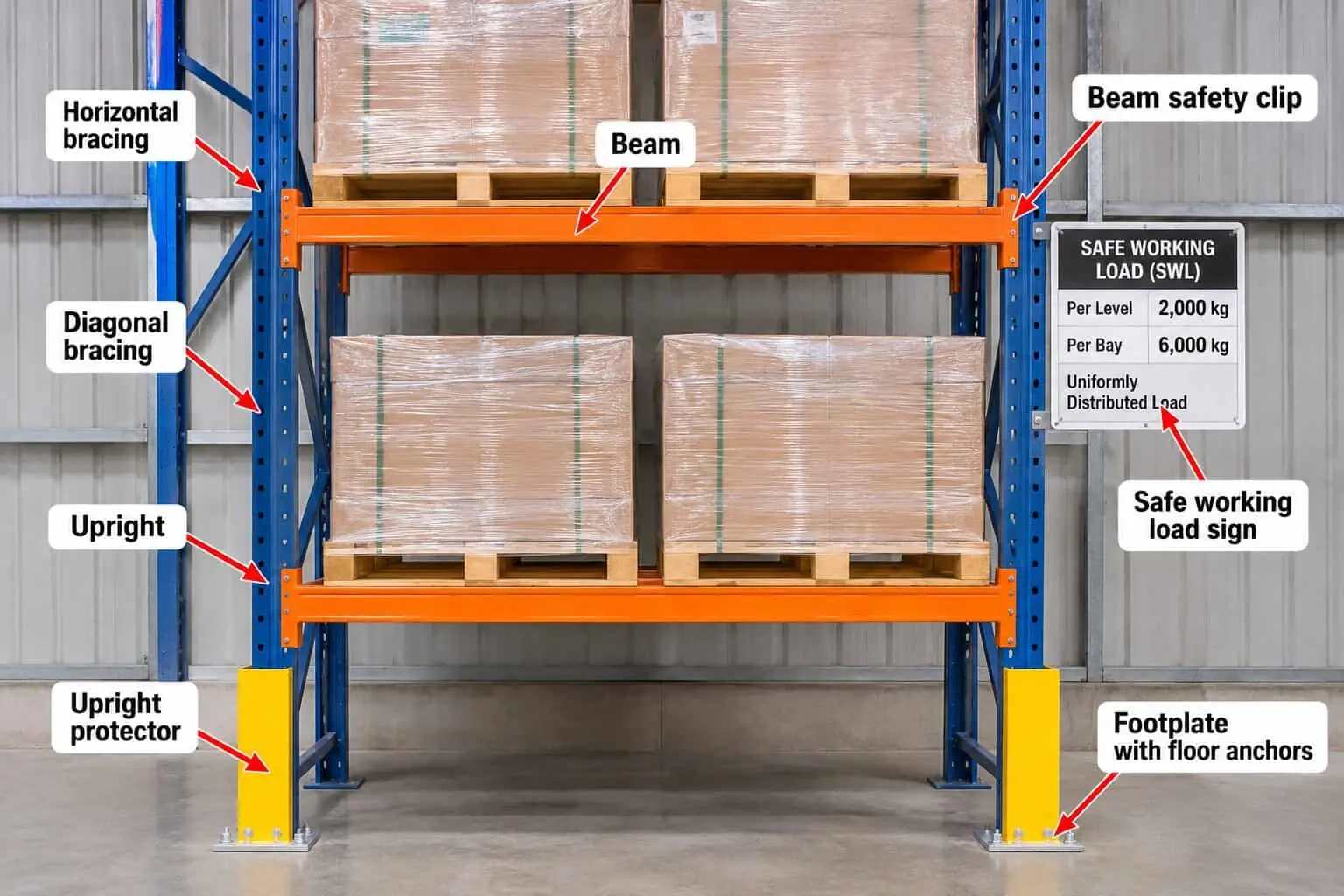
The same parts get checked at every level of inspection. This list follows WorkSafe Victoria and SafeWork NSW guidance.
- Beams: excess sag, a permanent bow or end connectors bent into a V (all signs of overloading), plus impact dents, missing safety clips and any beam hanging off one connector.
- Uprights: dents, twists, splits and cracks, especially low down where forks and pallets make contact, and the condition of any splices.
- Bracing: bent horizontal or diagonal braces. Deviation from a 1 metre straight edge shouldn’t exceed 10 mm.
- Plumb: racking leaning out of vertical.
- Footplates and floor fixings: at least two anchors in every footplate, with damaged fixings or footplates replaced.
- Load signs: present, legible and visible, with the bays still set up the way the sign assumes.
- Loads and pallets: within rated limits, stable, secured to sound pallets and sitting with proper clearances.
- Protection: upright and end-of-rack protectors in place and undamaged.
Record each finding against its bay and beam level. “Damage in aisle 4” is no help to whoever has to order the replacement upright.
How Racking Damage Is Rated and What You Do Next
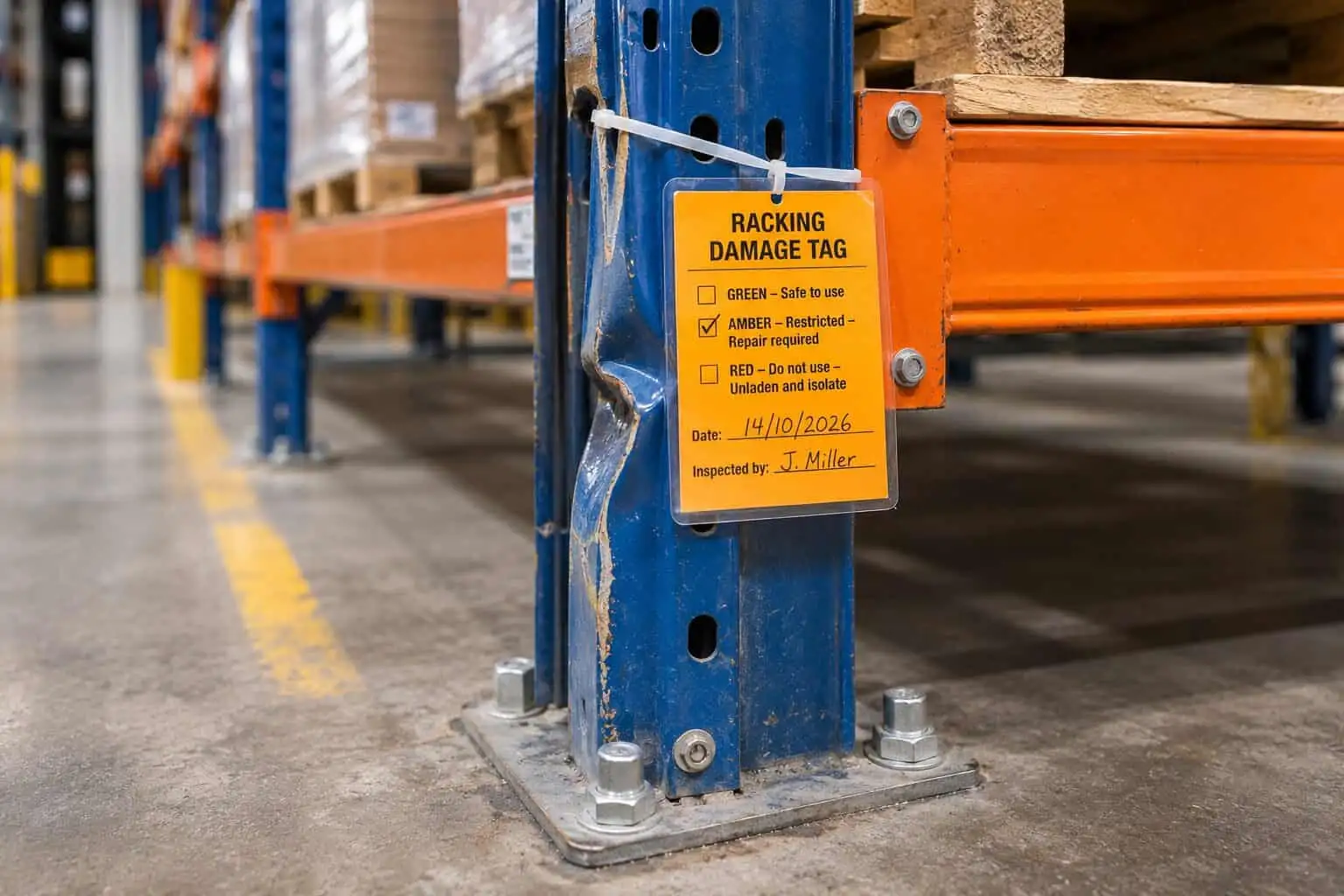
Each defect is rated by how far it exceeds the allowable limit, and each level has a set response. Here’s WorkSafe Victoria’s version, in line with AS 4084.2:2023:
| Damage level | What it means | What to do |
| Very serious | Needs immediate attention (for frames, more than twice the limit) | Unload the affected bays straight away, then repair or replace parts before reloading |
| Hazardous | Needs action as soon as possible (for frames, up to twice the limit) | Tag and date it, order parts and don’t reload emptied locations. Reclassify as very serious if it isn’t repaired within 4 weeks |
| Acceptable | Within the limit, but needs watching | Tag and date it and review it at the next inspection. If it gets worse, treat it as hazardous |
Inspection companies often label these levels red, amber and green on their reports and tags, which makes a bay’s status easy to read from the aisle. The colours are shorthand: the level itself comes from measuring the damage against the standard and the manufacturer’s limits.
What to Do When a Forklift Hits the Racking
- Keep people clear of the bay, especially if an upright is bent or a beam has dislodged.
- Report it to a supervisor straight away, even if the strike seemed light.
- Tag the damaged component with its location and the date.
- Have it assessed against the three damage levels, and unload the bay if it’s very serious.
- If anyone was hurt or put at serious risk by a falling load, check whether it’s a notifiable incident (covered below).
Keep reporting no-blame. If you change one habit on site, make it this one. An operator who expects trouble won’t own up to a light strike, and unreported damage is how a hazardous upright becomes a collapsed bay.
Pallet Racking Regulations in Victoria
WorkSafe Victoria’s racking guidance doesn’t point to a racking-specific regulation. It rests on the general duties in the Occupational Health and Safety Act 2004, with AS 4084.2:2023 as the benchmark.
Under the OHS Act, employers must provide and maintain safe plant and safe systems of work, and give workers the information, instruction, training and supervision they need, so far as is reasonably practicable.
For racking, that means safe working load signs where workers can see them, naming the manufacturer, supplier, designer and installation date and showing the working unit load limit plus the totals per beam level and per bay. Only the supplier, their representative or a suitably competent person should change the configuration. Once damage has been assessed, management should tell the health and safety representative.
Some racking incidents must also be reported. If someone is seriously injured, or exposed to serious risk from something falling from height, it may be a notifiable incident under the OHS Act. Call WorkSafe on 13 23 60 immediately, preserve the site until an inspector arrives or directs otherwise, and follow up in writing within 48 hours.
Why Forklifts Cause So Much Racking Damage
The bottom of the uprights and the first beam level take the most punishment, because that’s where forks, pallets and the truck itself make contact. WorkSafe Victoria notes that lower upright sections are exposed to collisions with forklifts and other moving equipment.
Very little of it comes from big crashes. It’s small strikes, like a load brushing the beam above as it’s lifted off, adding up across a few hundred pallets a day.
Operator Habits That Protect Your Racking
Habits come first, because a guard only takes the hit after it happens. Operators should square up to the bay before lifting, not lift while still turning, and raise the load clear of the beam before driving in or backing out.
Pallets go onto the beams, never pushed or dragged along them. Watch fork length too: forks much longer than the pallet can poke through the back of the bay and shove the pallet behind it.
Slowing right down for the last couple of metres gives an operator time to fix a bad line-up before steel meets steel. These habits have to be taught and supervised, and solid forklift operator training builds them early.
Choosing a Forklift That Fits Your Aisles
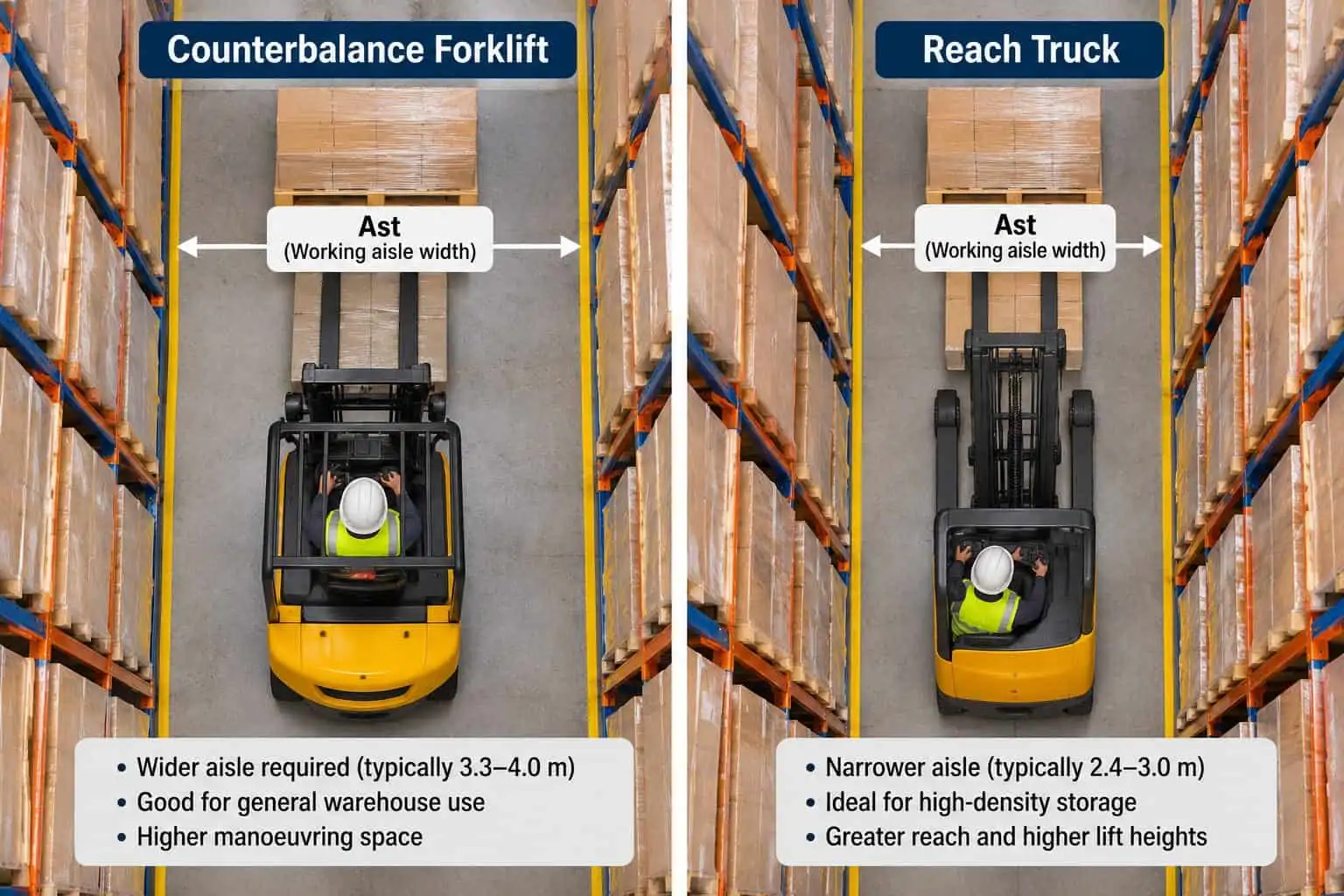
A forklift that’s too big for the aisle will keep hitting the racking, however careful the driver is. This is the mistake we see most: a machine chosen on capacity and price, with nobody measuring the aisle first.
Manufacturers publish a working aisle width, written as Ast, for a stated pallet size and orientation. Compare it with your real aisle, measured between the faces of the stored loads rather than the uprights, and leave some clearance.
A counterbalance forklift needs the widest aisle, because the whole truck turns in front of the rack. A reach truck works in a noticeably narrower one: its mast moves the load forward to place it, then draws it back inside the truck’s footprint to travel. That’s why the aisle width in a selective pallet racking layout is usually set by the forklift you plan to run.
Check height too. Maximum fork height has to clear your top beam with room to lift the pallet off, and in high bay racking a height indicator or mast camera helps place loads at the top levels without touching the beams. WorkSafe also says the racking’s operating instructions should state which forklifts are permitted, so check any change of machine against them.
Guards, Column Protectors and Safety Clips
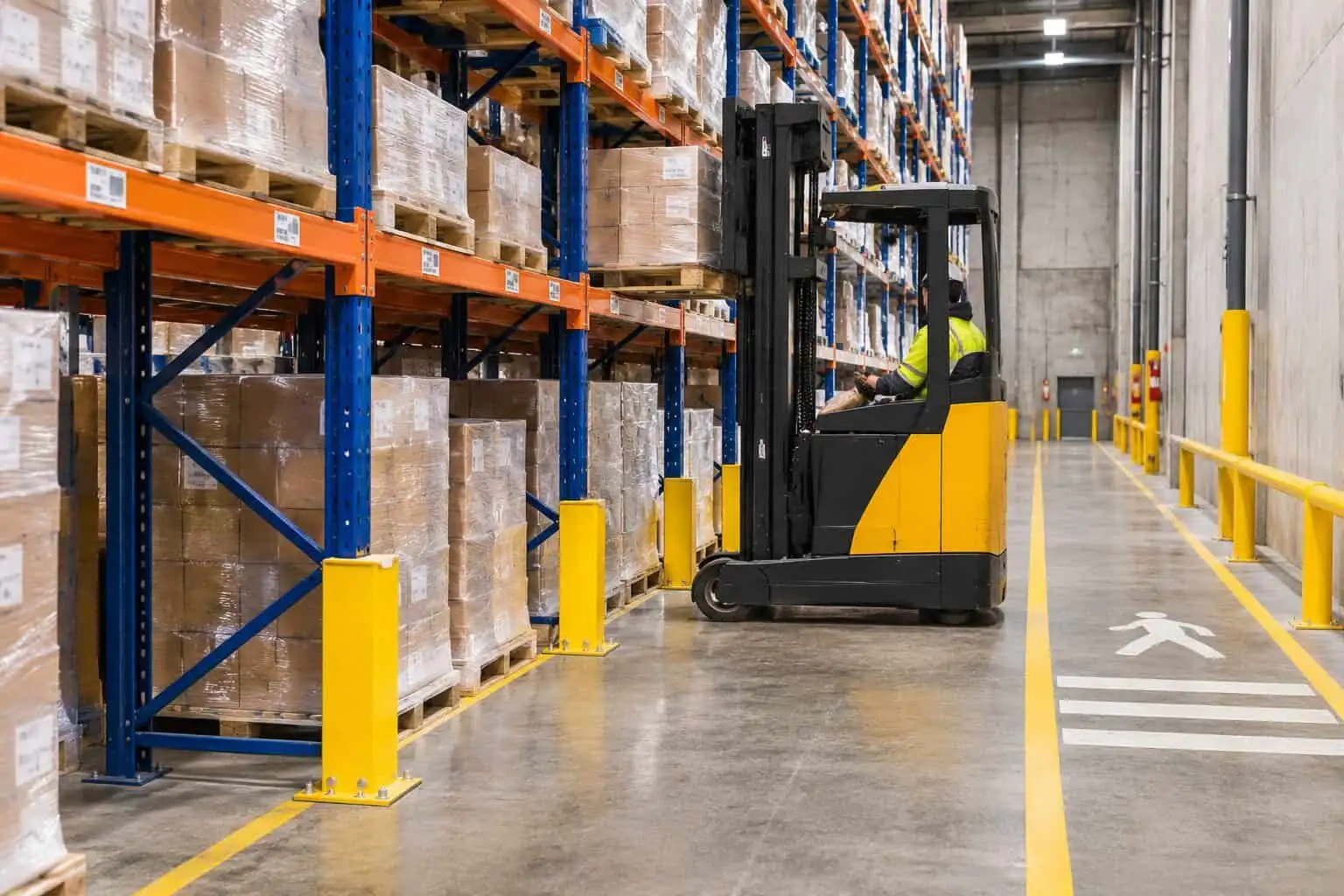
Physical protection catches the strikes that habits and machine choice don’t. WorkSafe Victoria says racking should have upright protectors and end-of-rack protectors, and single-row racking with pedestrian access at the back needs rear protection so loads can’t fall onto people.
Some sites also fit a beam at knee height in the bottom bay to cut damage from pallets being lifted off the floor. Beam safety clips matter too: they let a beam dislodge when a forklift strikes it, which lowers the chance of structural damage to the frame. That’s why WorkSafe says fixed bolts must not be used to retain beams.
Treat protectors as part of the inspection. A crushed column guard has done its job once and needs replacing before it can do it again. Marked walkways and a traffic management plan, which SafeWork NSW also calls for, keep pedestrians out of forklift aisles.
Find a Forklift That Suits Your Racking
If the same aisles keep turning up on your damage reports, look at the machine as well as the driver. A counterbalance forklift suits wider aisles and loading trucks outside, while a reach truck suits narrow, high bays. The Buy A Fork team can talk you through which machines suit your racking, aisle width, top beam height and pallet size.
Frequently Asked Questions
1. How often should pallet racking be inspected?
At least every 12 months, by a competent person. That’s the WorkSafe Victoria and SafeWork NSW guidance, which references AS 4084. In-house checks should happen more often, and any impact should be checked straight away.
2. What Australian standard applies to pallet racking?
AS 4084 covers steel storage racking in Australia. Its 2023 edition has two parts: AS 4084.1:2023 for design and AS 4084.2:2023 for operation and maintenance, which includes inspections and damage classification.
3. Is a racking inspection a legal requirement in Victoria?
Victorian employers have a duty under the OHS Act 2004 to provide and maintain safe plant and systems of work, so far as is reasonably practicable. WorkSafe Victoria’s guidance calls for a formal inspection by a competent person every 12 months, so without one it’s hard to show you’ve met that duty.
4. What are the top two pallet racking safety issues?
Overloading and impact damage are the two problems WorkSafe Victoria’s inspection guidance spends the most time on. Overloading shows up as sagging beams and connectors bent into a V, while impact damage comes from forklifts and pallets striking uprights and beams.
5. How do you identify who made your pallet racking?
Start with the safe working load sign, which should name the manufacturer, supplier, designer and installation date. If the sign is missing or unreadable, that’s an inspection finding in itself. A racking inspector or supplier can help identify the system, confirm the ratings and make a new sign.
6. Can damaged pallet racking be repaired?
Damaged components are replaced, not bent back into shape. SafeWork NSW says damaged beams and bent braces should be replaced, and damaged uprights replaced or spliced with the manufacturer’s approval. Alterations to uprights, bracing or beams also need approval from the manufacturer, supplier or a qualified engineer.