
How to Transport a Forklift: Methods, Preparation and Costs
When a forklift move goes wrong, it’s rarely on the highway. It’s in your driveway, when the truck can’t clear a low awning and you pay for a wasted trip.
The usual way to transport a forklift is on a tilt tray truck, with a low-loader for heavy or tall machines and a crane truck for tight sites. The price comes down to weight, distance and access.
How Do You Transport a Forklift? The Four Options
Three things decide which one you need: the machine’s weight, its lowered mast height and the access at each end.
1. Tilt Tray Truck
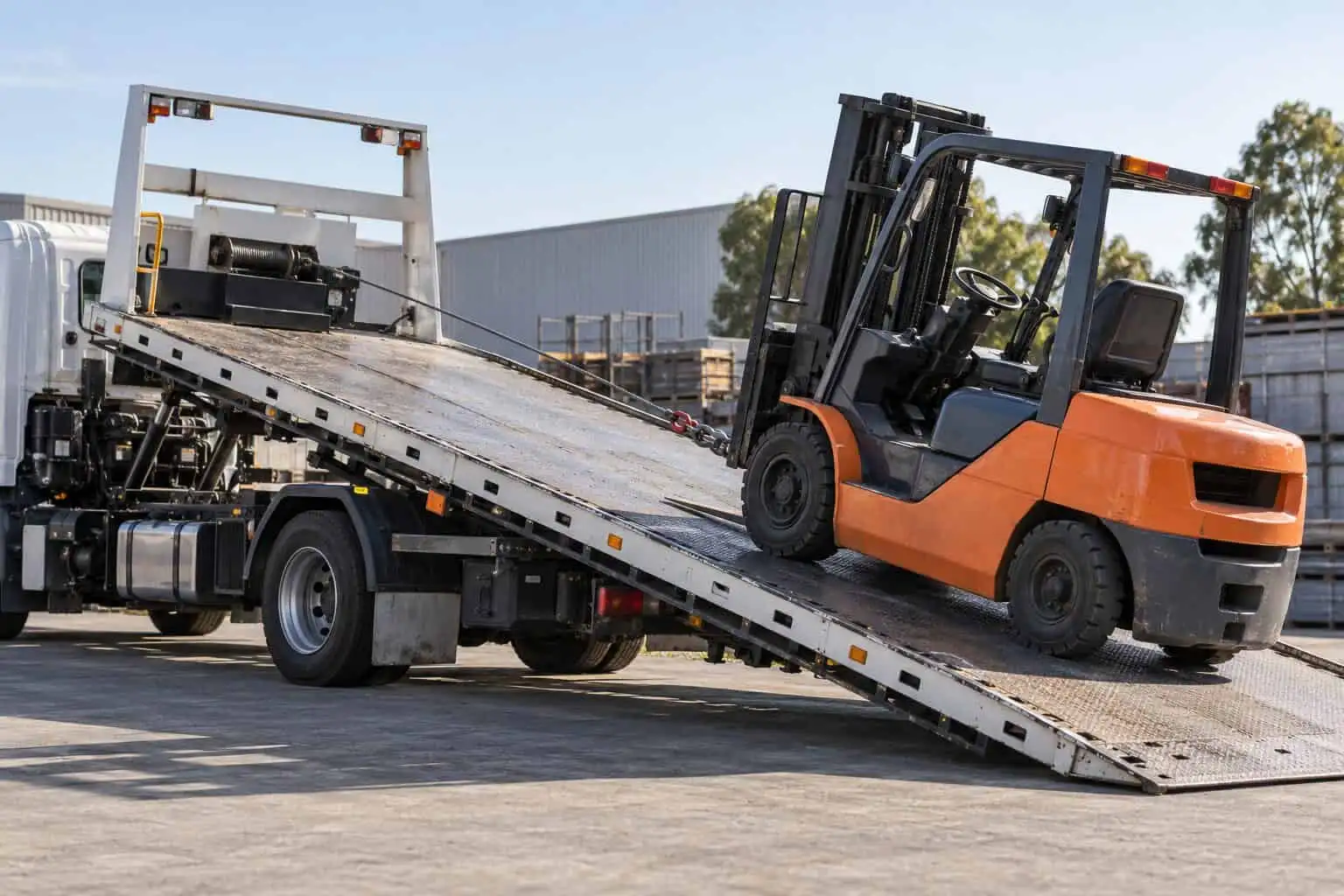
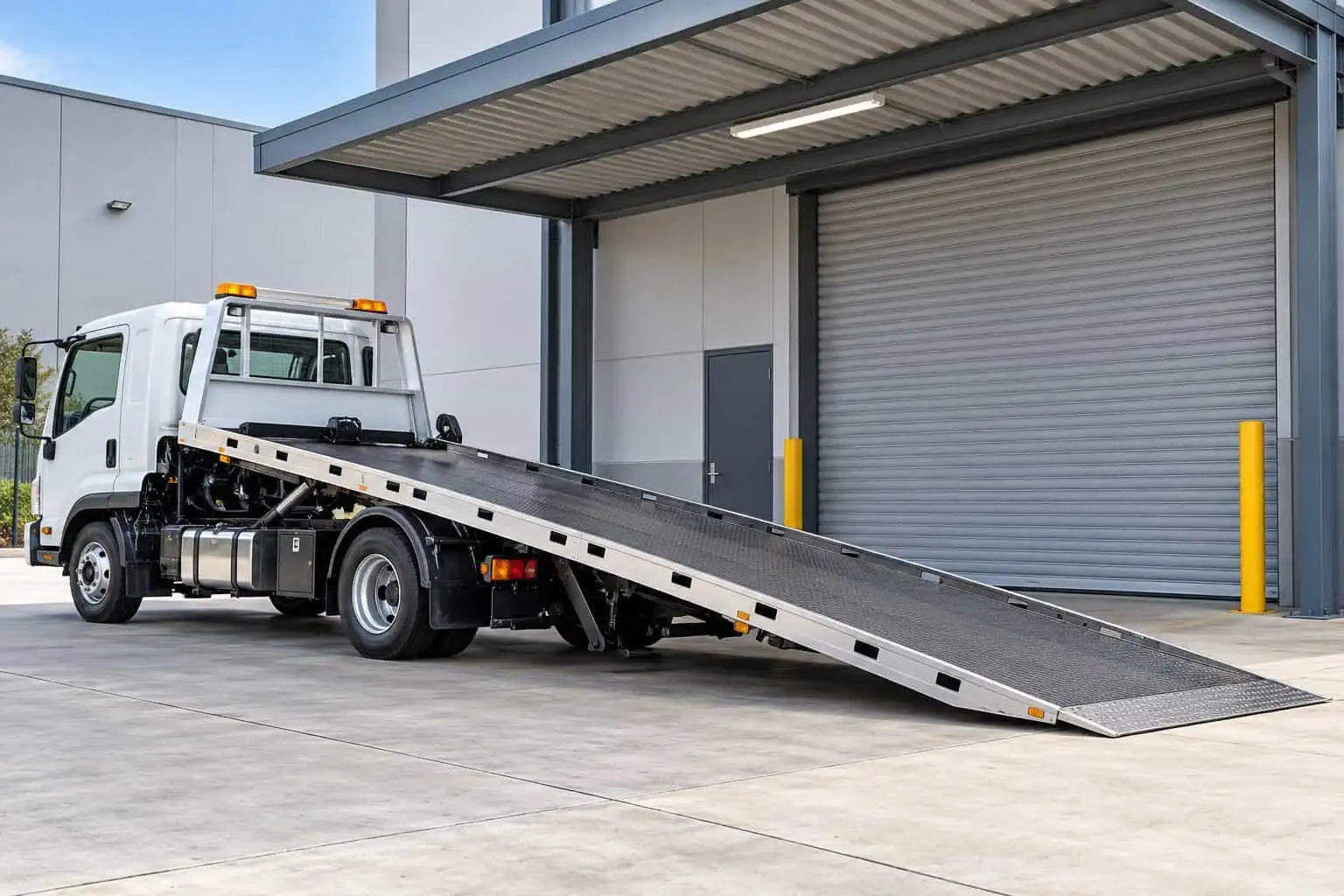
A tilt tray is the default for most standard counterbalance forklifts, reach trucks and stackers. The tray slides back and tilts to the ground, the forklift goes up, and the deck levels out with the machine on board.
The forklift is normally reversed up with the winch cable attached as a backup. The forks then go down flat on the tray before it’s chained.
One driver can do the lot, so it’s the quickest way to move a single machine. The catch is space: the truck needs a long, firm, straight run behind it to lay the deck down.
2. Crane Truck (Hiab)
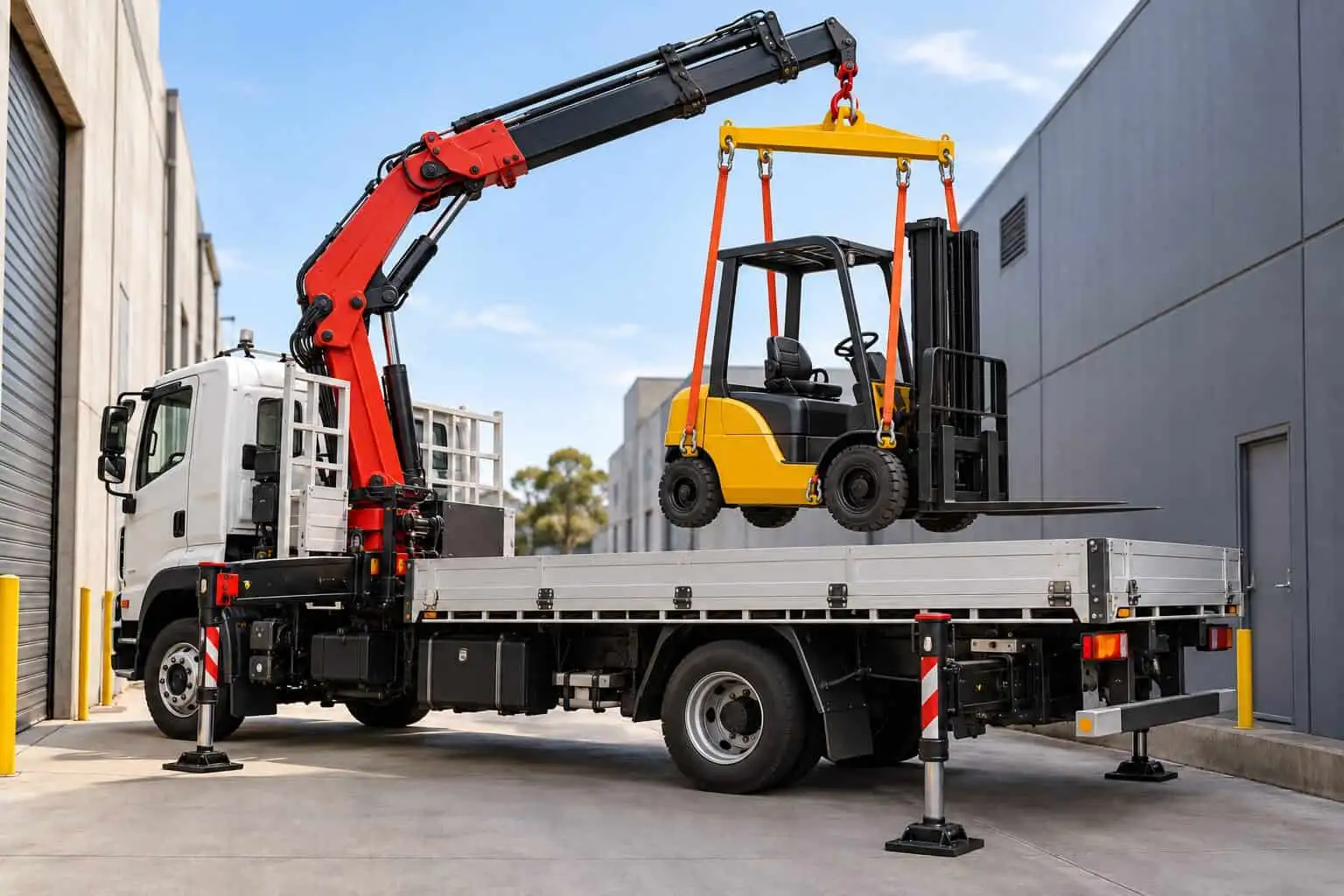
A crane truck, often called a Hiab after the crane brand, lifts the forklift on and off using the lifting points the manufacturer specifies. It’s the fix when a tilt tray can’t lay its deck down, such as in a narrow laneway or on a sloping driveway.
The crane has to be rated for the forklift’s weight at the reach needed. A heavy machine sitting well back from the kerb can rule it out.
3. Low-Loader or Float Trailer
Big machines ride on a low-loader, a trailer with a deck that sits close to the ground, usually pulled by a prime mover. The low deck gives a gentler loading angle and keeps a tall mast under the height limit.
High-capacity counterbalance forklifts, container handlers and high-mast machines usually travel this way.
4. Driving It Under Its Own Power
This only works inside one site, like moving a machine between two sheds on the same property. It’s illegal to use an unregistered motor vehicle on a public road in Victoria, so even a short hop to the factory next door normally means booking a truck.
| Method | Suits | What your site needs | Main limit |
| Tilt tray | Standard counterbalance forklifts, reach trucks, stackers | A firm, level, straight run behind the truck | Machine weight and loaded height |
| Crane truck (Hiab) | Tight sites a tilt tray can’t unload at | Room for the stabiliser legs and a clear lift | Crane capacity at the reach needed |
| Low-loader or float | Heavy machines and tall masts | Space for a long rig to pull in and turn | Bigger rig, higher cost |
| Driving | Moves within one private site | A clear route away from foot traffic | Not allowed on public roads unless registered |
Forklift Trailer or Tilt Tray: Which Makes Sense?
Honestly, for a one-off move, book the tilt tray. The operator brings the truck, the chains and the experience.
A forklift trailer is a plant trailer with a low or tilting deck, loading ramps and tie-down points. Small ones go behind a ute or light truck, while heavy-duty tri-axle versions sit behind a prime mover. Owning one starts to make sense when you move small machines often, say a walkie stacker shuttled between two sites every week.
Towing it yourself? Check the numbers first. The trailer’s ATM (aggregate trailer mass, its maximum loaded weight) has to cover the forklift plus the trailer, and your tow vehicle must be rated for that total. A full-size counterbalance on a trailer strong enough to carry it can be more than many utes are rated to tow.
What to Check Before You Book Forklift Transport
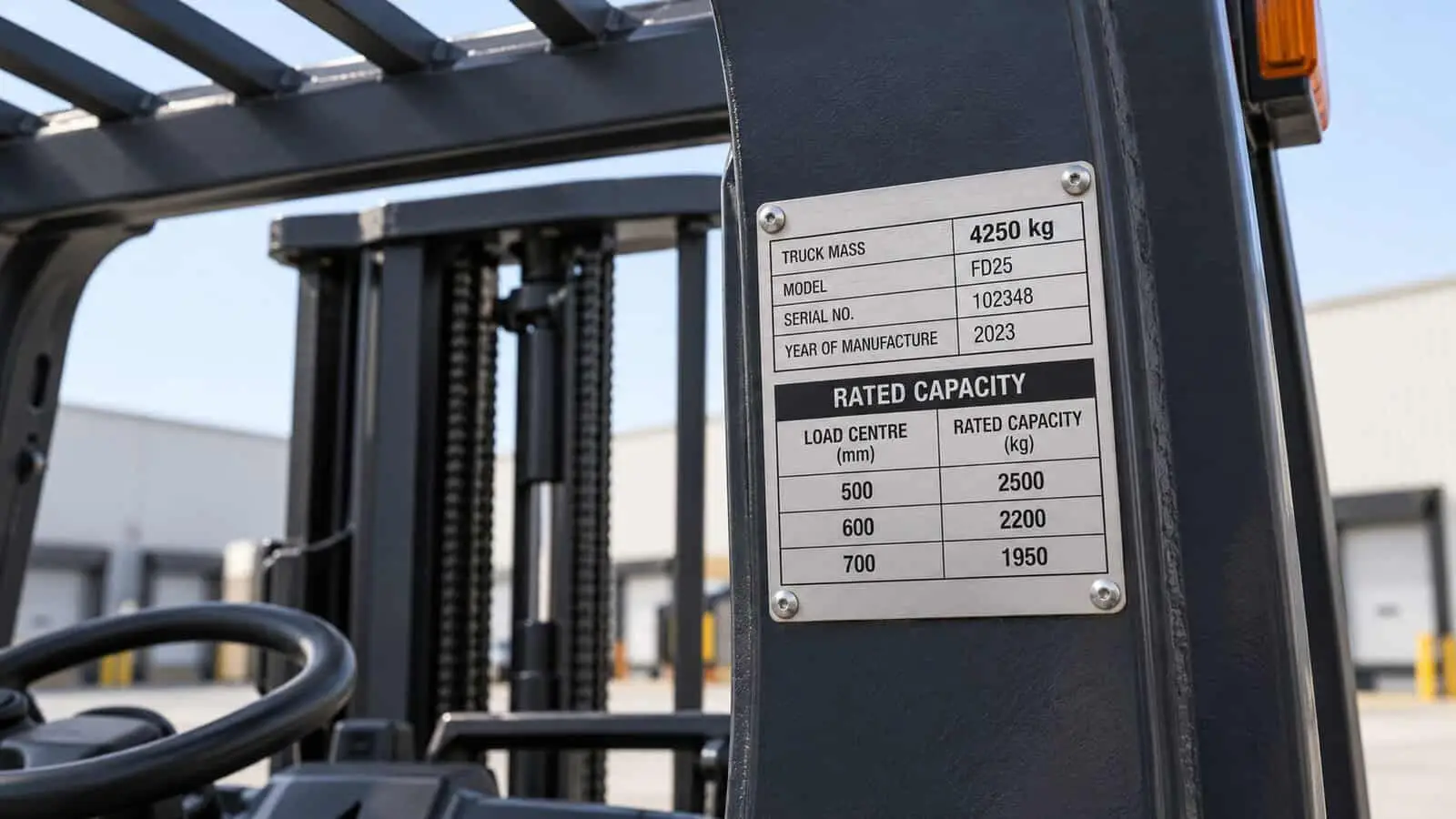
Give the operator the machine’s real weight and size, or you’ll pay for a bigger truck than you need.
A forklift weighs more than it lifts. Its counterweight has to balance the rated load, so a 2.5 tonne forklift (one rated to lift 2,500 kg) weighs more than 2,500 kg itself. This is the mistake we see most: a truck booked off the capacity on the badge. Use the truck mass printed on the forklift’s data plate instead.
Electrics catch people out too: the battery forms part of the counterweight, so don’t assume the electric is the lighter machine. Height is the next limit. The height limit for a heavy vehicle is 4.3 metres for most trucks, and the width limit is 2.5 metres. Your forklift’s lowered mast height plus the deck height has to fit under that line.
Machines with a low closed height, such as container mast forklifts, fit on a standard tilt tray most easily. A tall triple-stage mast often needs a low-loader.
When you book, also tell the operator:
- Make and model: so they can check the dimensions if the plate is hard to read.
- Attachments: clamps, rotators and jibs change the weight and size, and some come off for the trip.
- Running condition: a machine that won’t start, steer or brake has to be winched on.
- Access at both ends: a few phone photos of the driveway, gate and drop-off point.
How to Prepare a Forklift for Transport
Do this the day before the truck turns up. None of it takes long.
- Confirm it runs, steers and brakes. If any of those are in doubt, say so when you book so the operator allows for winching.
- Lower the forks and clear the machine. Take everything off the forks and out of the seat, and secure any attachment that’s travelling separately.
- Make the fuel or power safe. Turn off the LPG cylinder valve or disconnect an electric’s battery, and fix any oil, fuel or hydraulic leak that would make the deck slippery.
- Knock off loose dirt and debris. Anything sitting on the counterweight or in the mast channels can blow off at highway speed.
- Have the keys, a contact and a clear path ready. Move parked cars, open the gates and keep people well back while the machine goes on.
How Should a Forklift Be Chained Down for Transport?
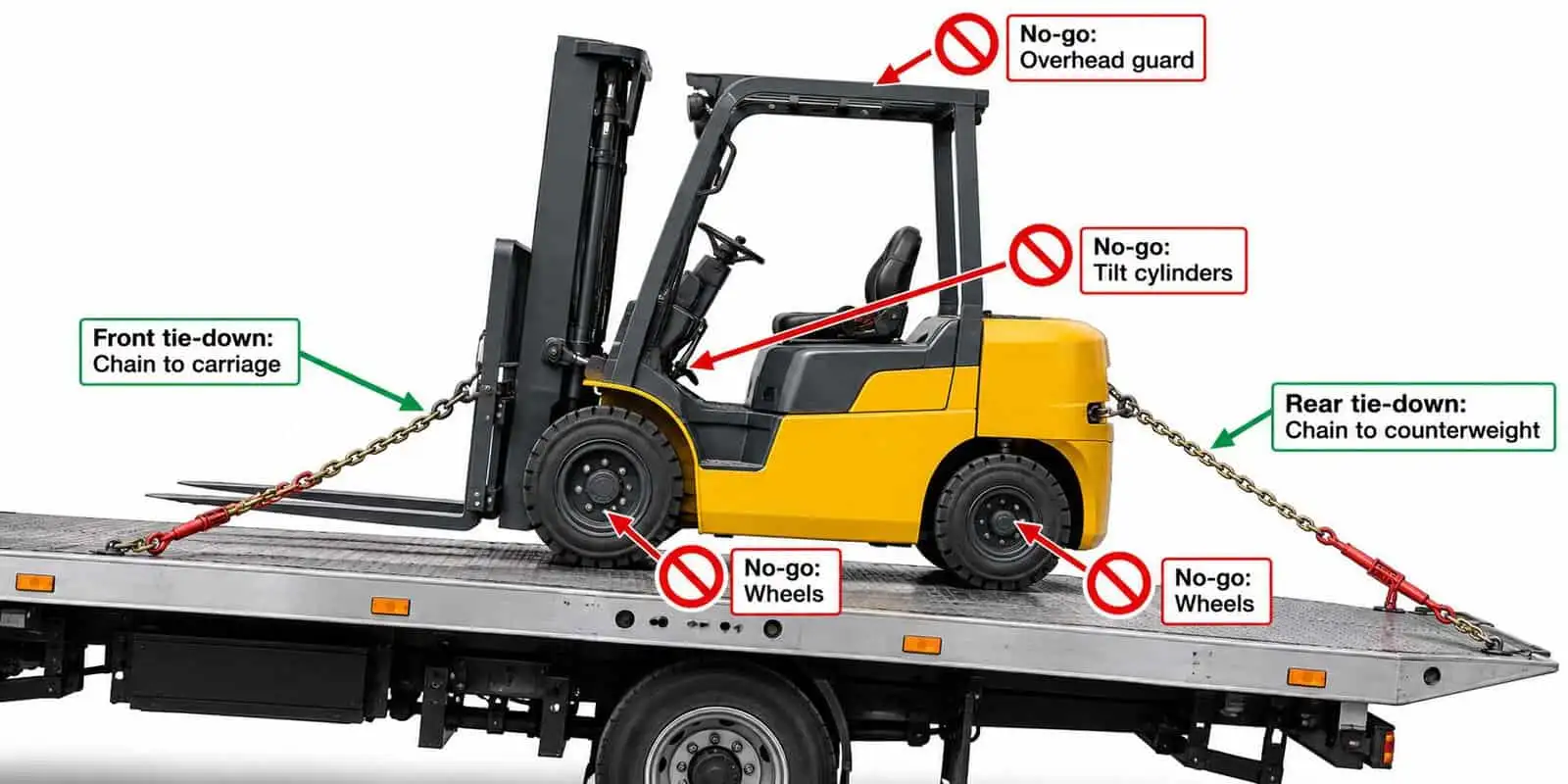
With rated chains running from the truck deck to the forklift’s own tie-down points, set up to meet the national loading performance standards.
Those standards say the restraint has to hold 80 per cent of the load’s weight forwards, 50 per cent sideways and rearwards, and 20 per cent upwards where friction is part of the system. For a machine weighing 4 tonnes, that’s about 3.2 tonnes of force pushing it forward under hard braking. The NHVR’s Load Restraint Guide explains how to meet them.
The NHVR names forklifts among the heavy machinery that suits direct restraint, where chains attach straight to the machine rather than relying on friction to hold it. The same guidance says to follow the manufacturer’s restraint recommendations, use the lashing points the manufacturer fitted and never use lifting points for restraint.
In practice, that means rated chains, not ratchet straps, usually attached at the carriage at the front and the counterweight at the back. Keep chains off the overhead guard, the tilt cylinders and the wheels, because those parts aren’t built to take restraint loads.
The driver isn’t the only one on the hook. The NHVR’s chain of responsibility covers everyone from the vehicle owner to whoever sends or receives the goods, and each has a duty to keep its transport activities safe so far as is reasonably practicable. If your team loads the machine or directs the restraint, you’re part of that chain.
How Much Does Forklift Transport Cost in Melbourne?
There’s no flat rate for forklift transport in Melbourne. Operators quote each job on the machine and the route, and these are the things that move the number.
| Cost factor | Why it changes the price |
| Distance | You pay for the kilometres and usually the truck’s trip back. A run across Melbourne’s north is a short job; Bendigo or Warrnambool takes most of a day. |
| Machine weight and size | These decide whether a standard tilt tray will do or the job needs a heavier truck or a low-loader. |
| Site access | Tight, sloping or gated sites add loading time, and some need a crane truck. |
| Machine condition | A machine that doesn’t run has to be winched on and off. |
| Oversize loads | A loaded truck over a dimension limit needs a notice or permit, which adds cost and lead time. |
| Timing | Urgent, after-hours and tight-window jobs cost more than one the operator can fit into a normal run. |
| Backloading | Sharing a truck that’s already heading your way can bring a longer move down. |
For a firm quote, send the truck mass, lowered mast height, make and model, both addresses and some access photos. A quote built on guesses tends to come back padded.
If you’re buying, transport is part of the real price.
When you compare used forklifts from different sellers, ask each one for a delivered price to your address, with unloading included. Buy A Fork offers free local delivery within 10 km on a selected range of its forklifts, so it’s worth checking whether the machine you’re after qualifies.
Unloading at Your Site: Checks That Prevent a Wasted Trip
A five-minute walk around your site before you book will catch most delivery problems.
Start with the ground. Soft ground after rain, a steep crossover or a kerb the truck can’t mount can stop a tilt tray on the spot.
Then look up. Awnings, signs, branches, powerlines and low roller doors sit at heights that suit vans and catch trucks. If the forklift has a tall mast, measure the doorway it has to drive through, not just the gate.
Check gate width and turning room, especially on shared estates where a neighbour’s truck can block the driveway. A laneway factory in Collingwood is a very different drop-off from a big yard in Dandenong South, and the laneway is where a crane truck earns its money.
Last, pick where the machine will live: out of the traffic flow, away from walkways and close to where it’ll be charged or refuelled.
Buying a Forklift in Melbourne? Sort the Delivery at the Same Time
The easiest forklift transport job is the one you plan before you buy. A quick chat with the Buy A Fork sales team can cover the machine you’re considering, your site access and whether delivery is included, or you can call 1300 057 880.
Frequently Asked Questions
1. How Much Does It Cost to Transport a Forklift?
It depends on the machine’s weight, the distance, the truck it needs and the access at both sites, so operators quote every job separately. A short metro move on a tilt tray costs far less than a low-loader run to regional Victoria that needs a permit.
2. Can a Forklift Be Towed?
Not on a public road. It’s illegal to use an unregistered motor vehicle on a public road in Victoria, and forklifts aren’t built to be pulled at road speed, so forklift towing behind a tow truck isn’t an option. A machine that won’t drive gets winched onto a tilt tray or lifted with a crane truck instead.
3. What Kind of Trailer Do You Need to Haul a Forklift?
You need a plant trailer with a low or tilting deck, ramps and rated tie-down points, with an ATM above the forklift’s weight plus the trailer’s own weight. Your tow vehicle must be rated for the combined weight, and heavier machines need a low-loader behind a truck or prime mover.
4. Do You Need a Permit to Transport a Forklift?
Usually not, as long as the loaded truck stays within the general limits of 4.3 metres high and 2.5 metres wide. If it goes over a dimension limit, it becomes a restricted access vehicle and needs a notice or permit to travel, which the transport operator normally arranges.