
Forklift Gas Bottles: LPG Cylinder Sizes, Costs and Safe Changeover
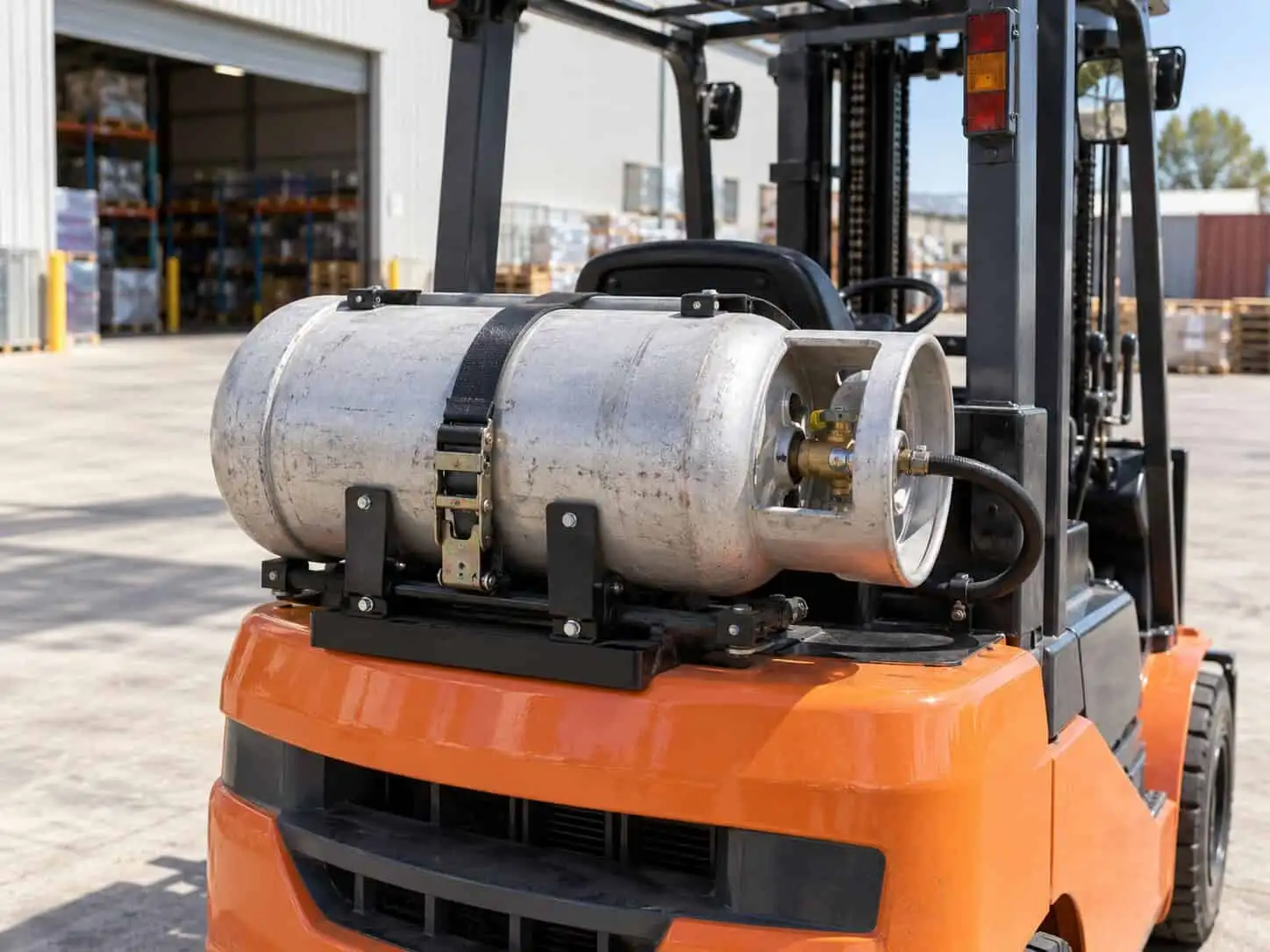
LPG forklifts in Australia run on a 15kg or 18kg forklift gas bottle, mounted horizontally on the counterweight and drawing liquid gas rather than vapour. Most sites get their gas by cylinder exchange, swapping empties for full bottles on a regular delivery run. LPG supplier Elgas says a bottle typically lasts 6 to 8 hours of running, depending on the size of the engine.
What size gas bottle does a forklift use?
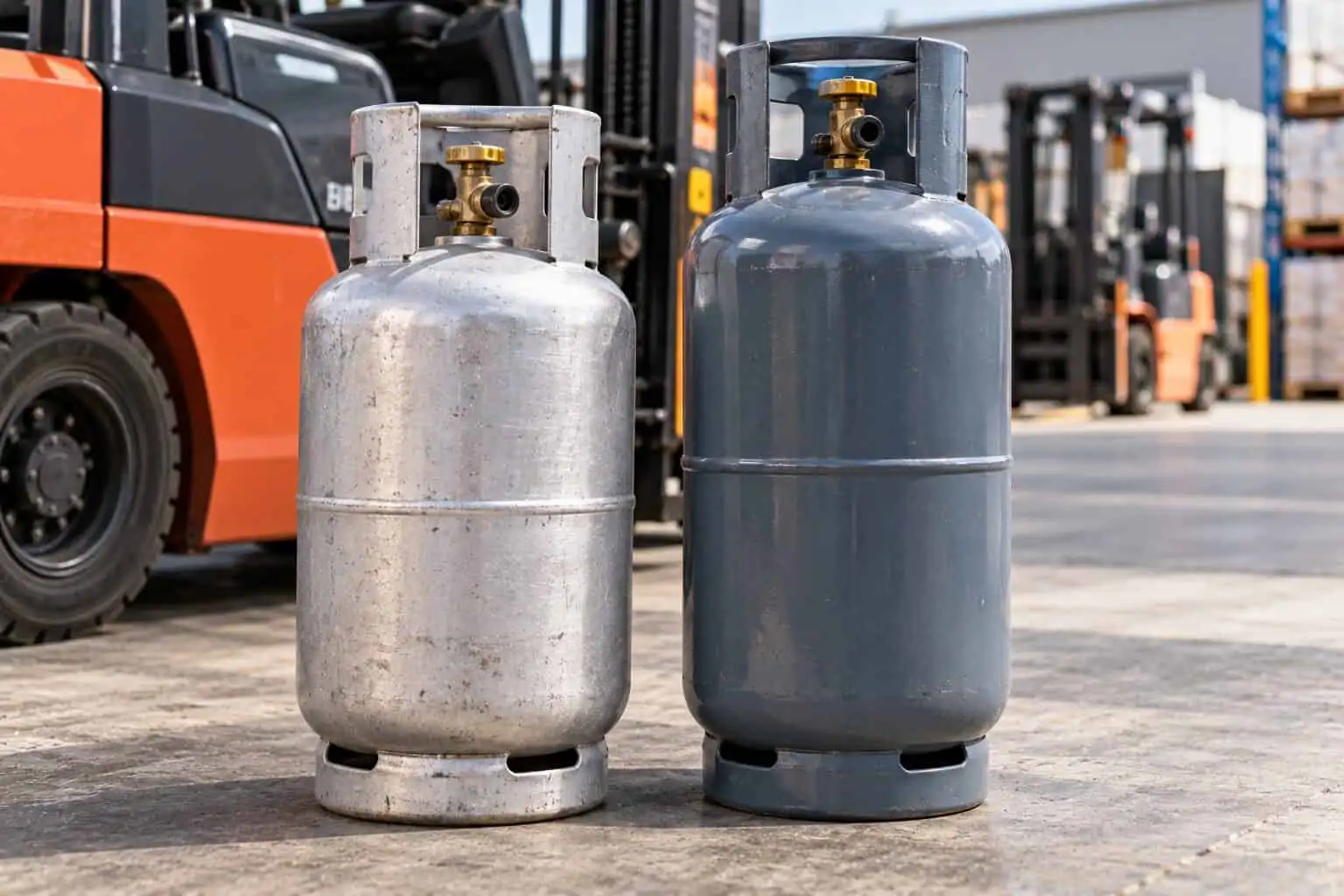
Forklifts use two sizes of LPG bottle: a 15kg aluminium bottle and an 18kg steel bottle. Both use the same 1.75 inch Acme outlet, but the 18kg bottle is about 95 mm longer, so check it fits your forklift’s bracket before switching sizes. The figures below are from Elgas and Supagas.
| Specification | 15kg bottle | 18kg bottle |
|---|---|---|
| Material | Aluminium | Steel |
| Height | 735 mm (Elgas), 734 mm (Supagas) | 830 mm (Elgas), 826 mm (Supagas) |
| Diameter | 305 mm (Elgas), 310 mm (Supagas) | 310 mm |
| Weight empty | 9.7 kg | 18.0 kg |
| Weight full | 24.7 kg | 36.0 kg |
| Gas capacity | 29.4 litres of LPG | 35.3 litres of LPG |
| Outlet | 1.75 inch Acme | 1.75 inch Acme |
The weight difference is the practical one. A full 15kg aluminium bottle weighs 24.7 kg, against 36.0 kg for a full 18kg steel bottle, and an operator lifts it onto the bracket at every change. The 18kg bottle holds about 20% more gas, according to Elgas, so it means fewer changes per week in exchange for a heavier lift each time.
Supagas quotes water capacity (36 and 44 litres) rather than gas capacity, which is why supplier figures sometimes look inconsistent. Water capacity is the size of the empty vessel; LPG is never filled to the top.
Can you use a 9kg gas bottle on a forklift?
No. A 9kg BBQ bottle is a different cylinder with a different connection. Elgas states that 9kg bottles now use the LCC27 connection, while forklift bottles use a 1.75 inch Acme outlet (Supagas) and are built to supply liquid gas while lying on their side (Elgas). The two are not interchangeable, and adapting one to the other is not a safe workaround.
How long does a forklift gas bottle last?
Elgas puts a forklift gas bottle at 6 to 8 hours of running: around 8 hours on a four-cylinder engine and around 6 on a six-cylinder engine. Load, travel distance, idling time and engine condition all move that figure, so treat it as a planning number rather than a promise.
Turn it into bottles per shift: a machine running most of an eight-hour shift may need a change part way through, and a two-shift site needs spares on hand. Track actual use for a few weeks and set your exchange order from that.
Diesel fleets plan the same way, working from diesel forklift fuel use per hour rather than bottles per shift.
How do you get forklift gas: exchange, refill or bulk?
Most businesses use cylinder exchange, where a supplier swaps empty bottles for full ones on a set delivery schedule. Larger fleets sometimes install a bulk tank and refill their own bottles on site. The table compares the three common models.
| Supply model | How it works | Usually suits |
|---|---|---|
| Cylinder exchange | The supplier collects empties and leaves full bottles, on a regular run or on call | Most single-site fleets |
| Owned cylinders, refilled by a supplier | You own the bottles and have them refilled rather than swapped | Small or occasional users |
| On-site refilling from bulk | A bulk tank and filling equipment on site; trained staff refill bottles | Larger fleets that can manage the setup and compliance |
Suppliers offer both cylinder rental and ownership. Speed Gas, for example, runs rental and “own your own bottle” programs with weekly or fortnightly deliveries across metro Melbourne, Sydney and Brisbane. Rental leaves testing with the supplier; ownership removes the rental fee but makes the test date your responsibility.
A standard forklift gas bottle cannot be filled at a service station. Elgas states that the LPG bowser at a service station is incompatible with forklift gas bottle fittings, even though the gas is the same. Some cylinders are sold with a valve designed for service station filling, so check the valve before assuming either way.
On-site refilling carries real risk. In 2022, WorkSafe Queensland reported two workers suffering burns, one with second and third degree burns, when LPG ignited while a forklift gas bottle was being refilled from a larger tank. Its guidance is to keep the filling area away from ignition sources, dispensers, building exits and public places, and to inspect the O-ring on the filling valve for cracks or tears.
What does a forklift gas bottle cost?
Most forklift gas suppliers do not publish prices, because the cost depends on your account, volume and contract. None of the four major suppliers ranking for forklift gas in Australia (Elgas, BOC, Supagas and Speed Gas) lists a forklift gas price on its website. What you pay is made up of several parts:
- The gas: priced per bottle or per kilogram, and it moves with the wholesale LPG market.
- Exchange or refill fee: sometimes bundled into the bottle price, sometimes separate.
- Cylinder rental: a periodic charge per bottle held on site, if you rent rather than own.
- Delivery: may be included above a minimum order or charged per run.
- Minimum order or contract terms: these decide the price per bottle more than anything else.
- Changeover labour: the time your operators spend swapping bottles, which is rarely counted.
As one published example, WA Gases in Perth listed a 15kg forklift cylinder exchange at $62.70 inc GST with free delivery in Perth, as at 6 October 2026. Melbourne pricing will differ, so get written quotes from two or three suppliers on the same basis (bottle size, number of bottles, delivery frequency and whether rental is included), then weigh the total against the running costs of diesel and electric forklifts if a change of fleet is on the table.
How should forklift gas bottles be stored?
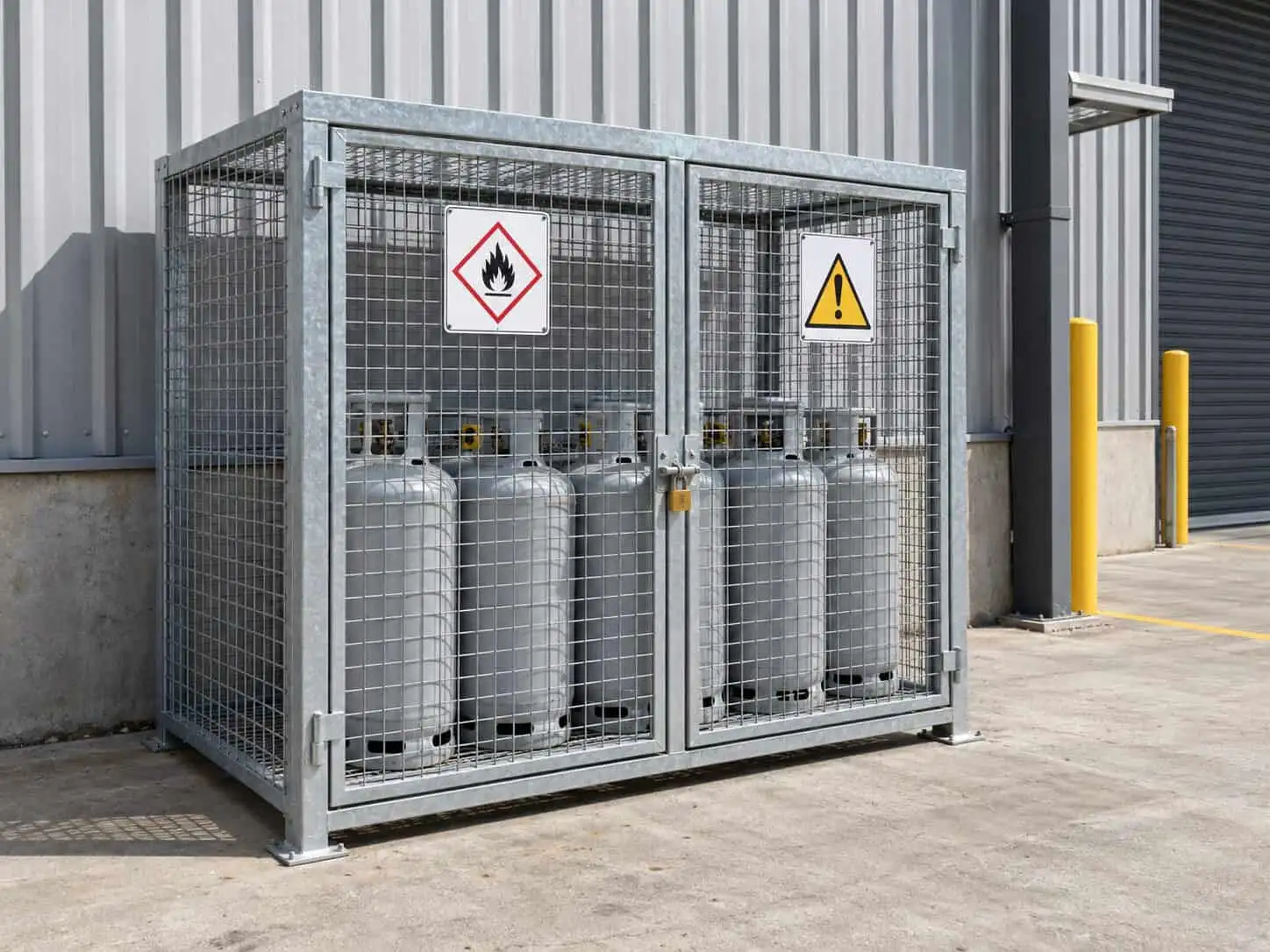
Store forklift gas bottles upright, outdoors or in a well-ventilated area, secured, away from ignition sources and protected from being struck. That wording comes from the Canadian Centre for Occupational Health and Safety’s guidance on forklift LPG. WorkSafe Queensland’s guidance also calls for cylinders to be stored upright.
In Australia, the storage and handling of LP gas is governed by AS/NZS 1596, the standard that WorkSafe Victoria and WorkSafe Queensland both refer to. It sets the detailed requirements for how many bottles can be stored, where, and how far from buildings, drains and other hazards. Your gas supplier or a dangerous goods consultant can tell you what it means for your site.
Most sites use a purpose-built, lockable forklift cylinder cage. Keep it clear of exits, pits and drains (LPG is heavier than air and collects in low points), and keep full and empty bottles clearly separated so nobody fits an empty.
How do you change a forklift gas bottle safely?
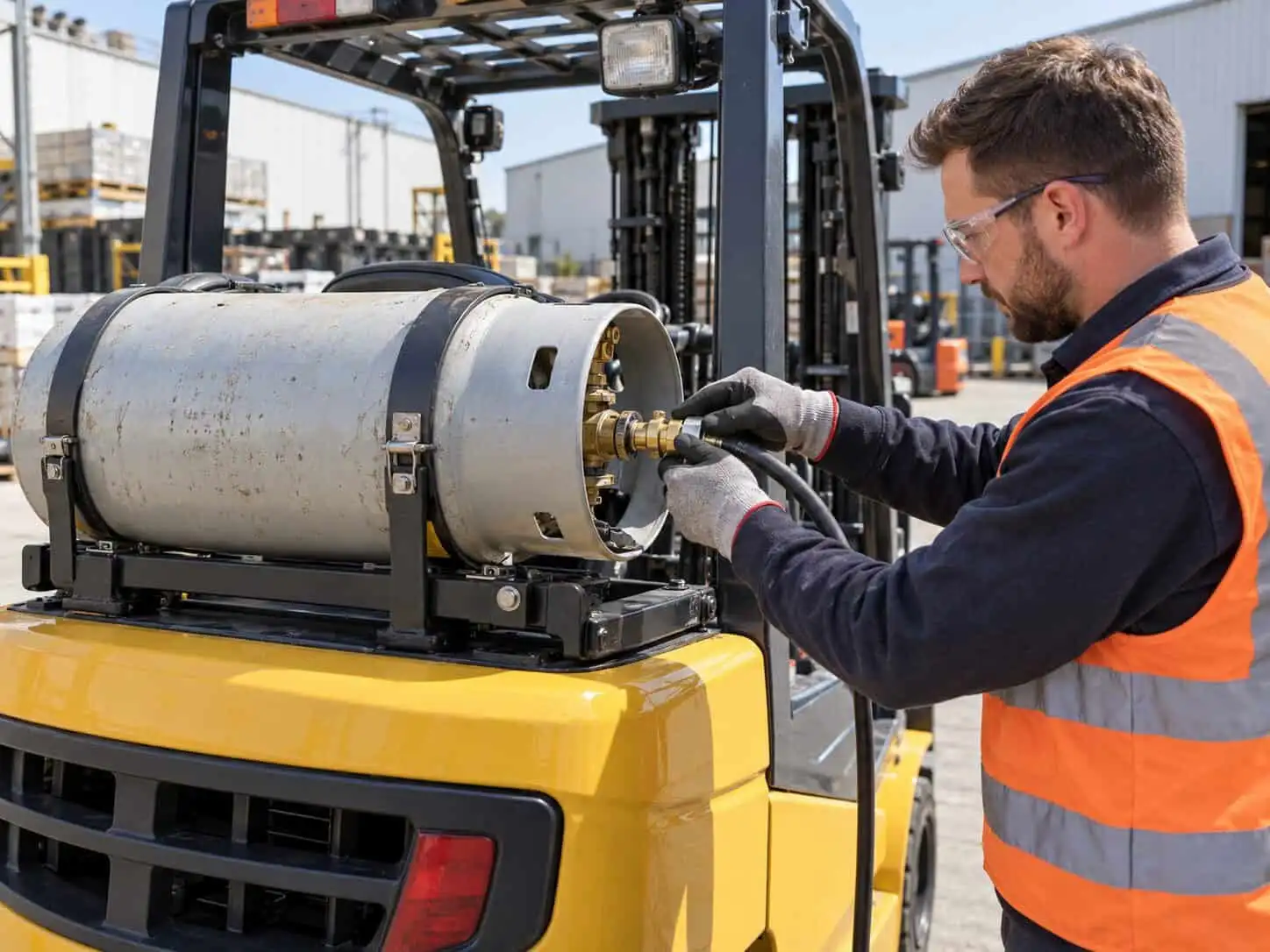
Only trained workers should change a forklift gas bottle, and the job should be done the same way every time. WorkSafe Queensland requires that removal and replacement of LPG cylinders is carried out only by trained workers. The steps below combine its guidance with the Canadian Centre for Occupational Health and Safety’s, and your forklift’s operator manual takes priority where it differs.
- Park in the designated changeover area, away from ignition sources, with the forks lowered and the park brake on.
- Put on gloves and eye protection. Liquid LPG can cause frostbite on contact with skin, and CCOHS recommends leather or insulated neoprene gloves.
- Close the bottle valve and run the engine until it stops, so the fuel line is empty before you disconnect.
- Turn the ignition off and disconnect the hose coupling.
- Release the bracket strap and lift the empty bottle off. Use a correct lift, as a full 18kg steel bottle weighs 36 kg.
- Check the coupling and its O-ring for cracks, tears or damage before fitting the new bottle.
- Fit the full bottle with the relief valve facing up. Line it up with the positioning pin so the valve sits in the correct position, then secure the strap.
- Reconnect the coupling and open the valve slowly. A brief hiss of one to two seconds is normal; anything longer suggests a leak.
- Check for leaks with soapy water or a leak detector, never a flame.
- Close the bottle valve whenever the forklift is not in use, as WorkSafe Queensland advises.
If a bottle leaks and the leak cannot be stopped by closing the valve, move people away, remove ignition sources and contact your gas supplier. The bottle change is one part of the daily routine, alongside the other items in a forklift pre-start inspection.
When does a forklift gas bottle need to be retired?
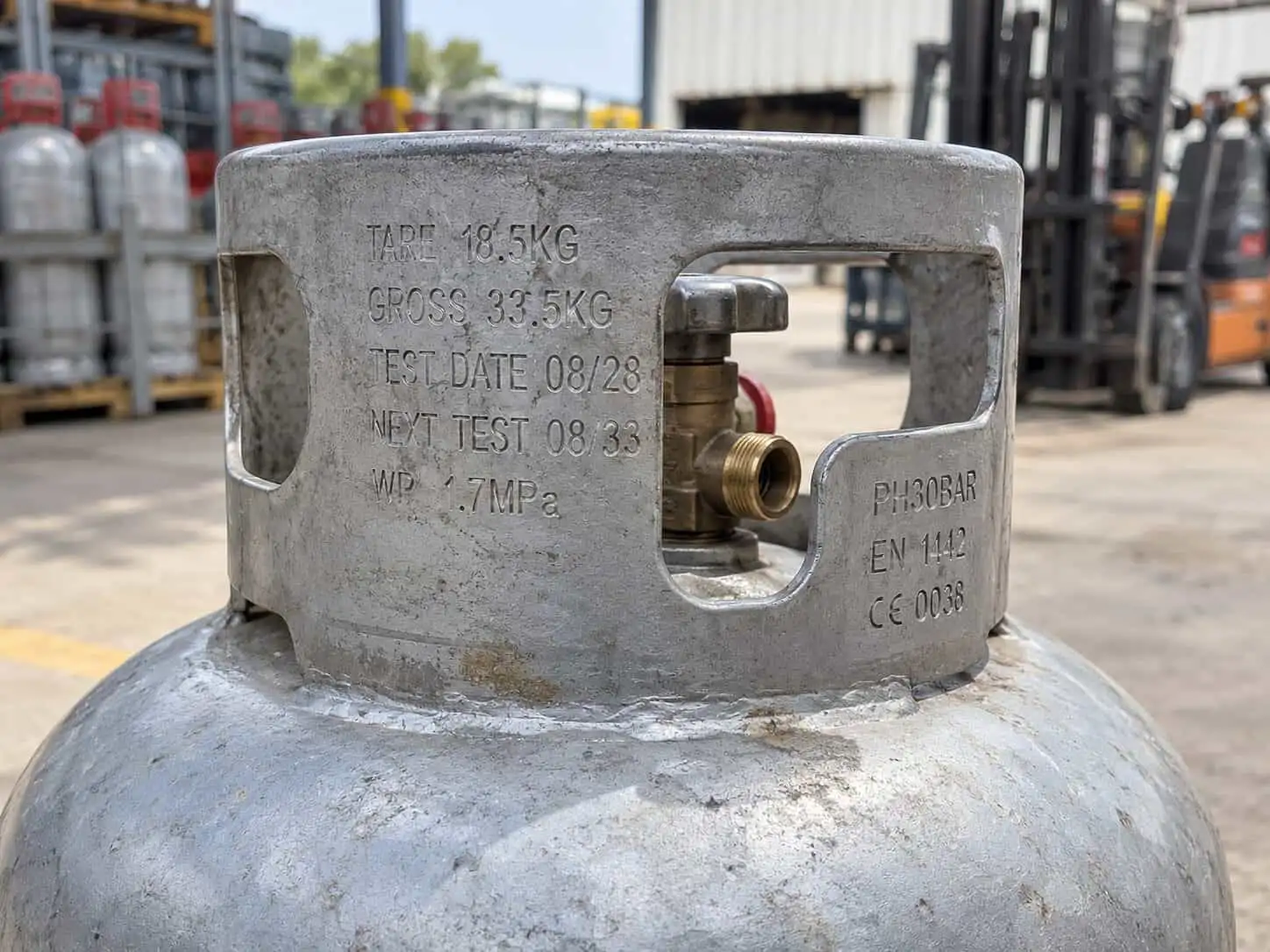
A forklift gas bottle must be retested every 10 years, and it cannot be refilled once that date has passed. WorkSafe Victoria states that LPG cylinders with removable valves and a water capacity of 5.5 kg or more must be inspected and tested every 10 years under AS 2030.5, with the test date usually stamped into the cylinder collar. Only approved gas cylinder test stations can test and restamp them. An out-of-test cylinder can still be used, sold and transported, but it cannot be refilled until it passes inspection.
Dents, corrosion, a damaged collar or a valve that will not seal are also reasons to take a bottle out of use and return it.
Who deals with this depends on your supply model. On exchange or rental, testing and retirement are the supplier’s job, and Elgas states it inspects each bottle every time it is filled. If you own your bottles, tracking the test dates is your responsibility.
Is LPG still the right fuel for your forklift?
LPG suits sites that need continuous running and quick refuelling, but the bottle logistics are a real cost. If storage, changeover time or indoor air quality are becoming the problem, an electric machine may suit your site better. Ventilation and carbon monoxide tend to decide the question when running an LPG forklift indoors.
Buy A Fork stocks both LPG gas forklifts and electric counterbalance forklifts, so either path can be compared machine by machine.
Frequently asked questions
1. What size LPG gas bottle do forklifts use?
Forklifts use either a 15kg aluminium bottle or an 18kg steel bottle. Both mount horizontally on the counterweight and use a 1.75 inch Acme outlet. The 15kg bottle is lighter to lift (24.7 kg full), while the 18kg bottle holds about 20% more gas (36.0 kg full).
2. Can you use a 9kg gas bottle on a forklift?
No. A 9kg BBQ bottle uses an LCC27 connection, while forklift bottles use a 1.75 inch Acme outlet and are designed to supply liquid gas while lying horizontally. The two are not interchangeable.
3. Can you refill a forklift gas bottle?
Yes, provided it is within its 10-year test date. Most businesses exchange empty bottles for full ones through a supplier rather than refilling, and larger sites sometimes refill on site from a bulk tank. An out-of-test bottle cannot be refilled until it passes inspection.
4. How much does a forklift gas bottle cost?
It depends on your supplier, volume and contract, and most suppliers do not publish prices. The cost is made up of the gas, any exchange fee, cylinder rental and delivery. As one published example, WA Gases in Perth listed a 15kg exchange at $62.70 inc GST as at 6 October 2026.
5. What are the storage requirements for forklift gas cylinders?
Store them upright, outdoors or in a well-ventilated area, secured, away from ignition sources and protected from impact, usually in a lockable cage. Detailed requirements are set by AS/NZS 1596, the Australian standard for storing and handling LP gas.
6. Can you fill a forklift gas bottle at a service station?
Not a standard one. Elgas states that service station LPG bowsers are incompatible with forklift gas bottle fittings. Some cylinders are sold with valves designed for service station filling, so check the valve on your bottle.
Whether LPG is still the right fit for a site is a question the Buy A Fork team can work through with you.