Forklift Buying Guide for Australian Businesses
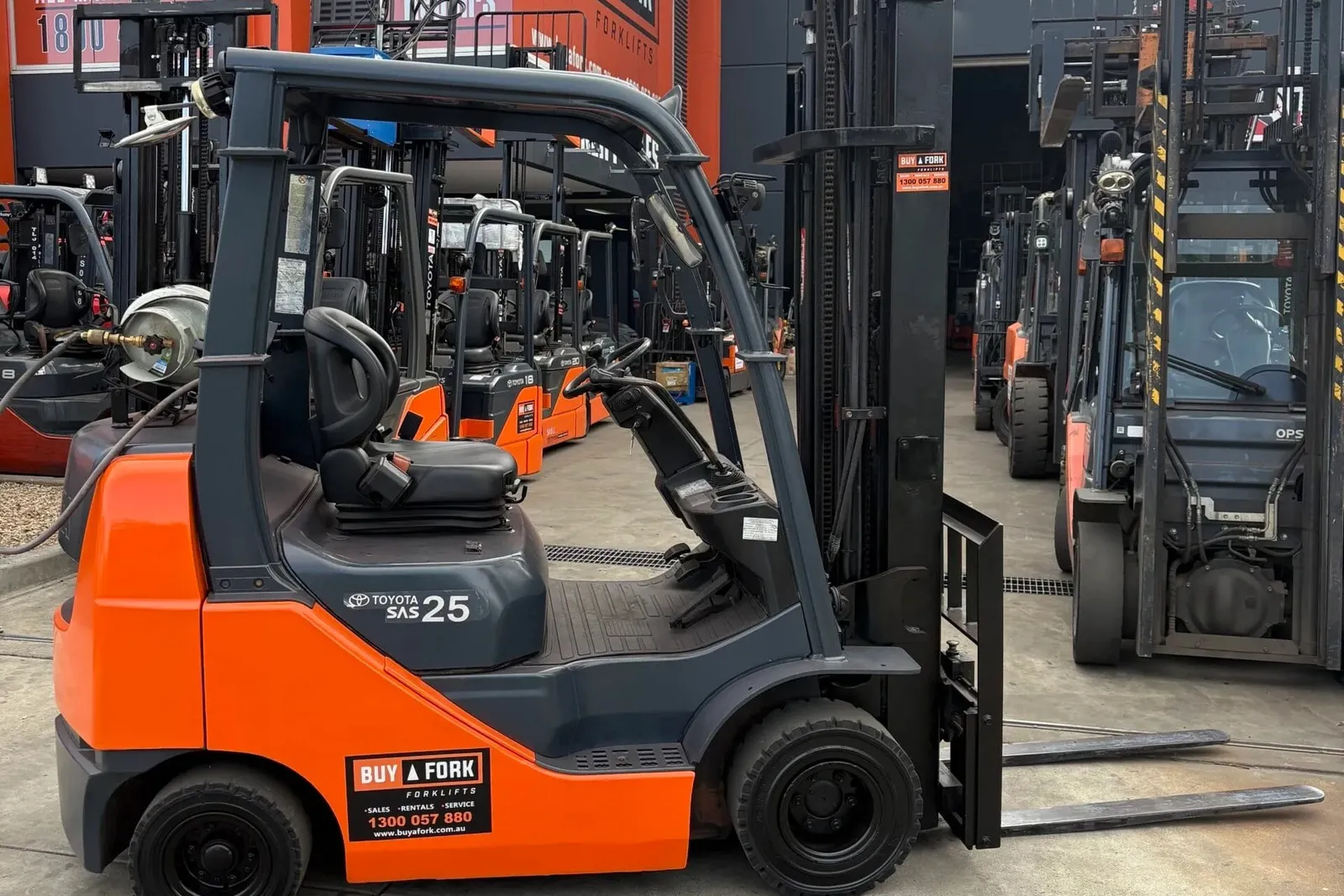
This forklift buying guide sets out the order that avoids expensive mistakes: work out your loads, lift height and site first, choose the type of forklift that fits, decide between new and used, check the machine and its paperwork, then choose how to pay. Most buying problems start when someone picks a machine before measuring the job. WorkSafe Victoria makes the same point: base the choice on the loads, the site and the operators, not on whichever forklift happens to be available.
Buy A Fork is a forklift dealer in Somerton, Melbourne, selling mostly pre-owned forklifts, so this guide is written from the questions buyers ask us before they commit.
What to Work Out Before You Look at Forklifts
Start with the job, not the machine: your heaviest load, how high it goes, where the forklift will work and who will drive it. WorkSafe Victoria's forklift selection guidance lists the factors to weigh before buying, hiring or leasing, and says the same review applies to a second-hand forklift.
| What to measure | Why it matters |
|---|---|
| Heaviest load and its size | Sets the capacity you need, with a margin; wide, tall or liquid loads change how a forklift handles them |
| Load centre | A forklift's rated capacity applies at a stated load centre; longer loads reduce what it can safely lift |
| Highest lift | Sets the mast height, and capacity usually falls as the lift height rises |
| Lowest overhead clearance | Doorways, sprinklers, racking and containers limit the closed height of the mast |
| Aisle width and turning space | Decides between a counterbalance forklift, a reach truck or a walk-behind machine |
| Indoor, outdoor or both | Engine fumes need ventilation indoors; rough or wet ground needs the right tyres |
| Hours of use per day | Shapes the fuel choice and how much the machine's hours and condition matter |
| Attachments | A side shift, fork positioner or clamp adds weight and reduces the rated capacity |
Which Type of Forklift Do You Need?
Most businesses need a counterbalance forklift; narrow aisles and high racking call for a reach truck, and short pallet moves suit a walk-behind machine. A counterbalance forklift carries its load out in front with a weight at the rear, so it works in yards, on docks and in standard warehouse aisles.
The fuel follows the site: electric for indoor and enclosed areas, LPG for mixed indoor and outdoor work, and diesel for heavier outdoor use. Order pickers and telehandlers are among the other types of forklifts, each built for a narrower job.
Should You Buy a New or Used Forklift?
Buy new when you need a long life ahead, zero hours and a factory warranty; buy used when a proven machine at a lower upfront cost fits the work. For a business running one shift a day, a well-maintained used forklift can make more sense than a new one, while a site running machines all day may justify buying new.
| What you are weighing | New forklift | Used forklift |
|---|---|---|
| Upfront cost | Higher | Lower for the same capacity |
| Hours | Zero | Whatever is on the meter; check it against the service history |
| Warranty | Factory warranty | Dealer warranty, which varies between sellers |
| Availability | Can involve a wait for the model you want | What is in stock today, so check the specification closely |
How Much Does a Forklift Cost?
The price depends on capacity, fuel, mast, age, hours and condition, which is why forklift prices in Australia vary so widely between machines of the same capacity. The running cost matters as much as the price: fuel or electricity, servicing, tyres and, for electric machines, the battery.
What to Check Before You Buy a Used Forklift
Check the hours, the service history, the data plate and the condition of the parts that wear, in that order. A forklift with a clean, documented history is usually a safer buy than one with fewer hours and no records. Run through these on the day you inspect the machine, ideally with a used forklift pre-purchase checklist in hand:
- Hours: read the hour meter and match it against the service records, because what counts as high depends on the type of machine and how it was used.
- Service history: ask for the records, including repairs and when major parts were replaced.
- Data plate: confirm the model, year and rated capacity, and that the capacity covers your loads with any attachment fitted.
- Wear parts: mast chains, hydraulics, tyres and, on electric machines, the battery and charger.
- Brakes and steering: test both under load, because worn brakes show up far more clearly on a test drive than on paper.
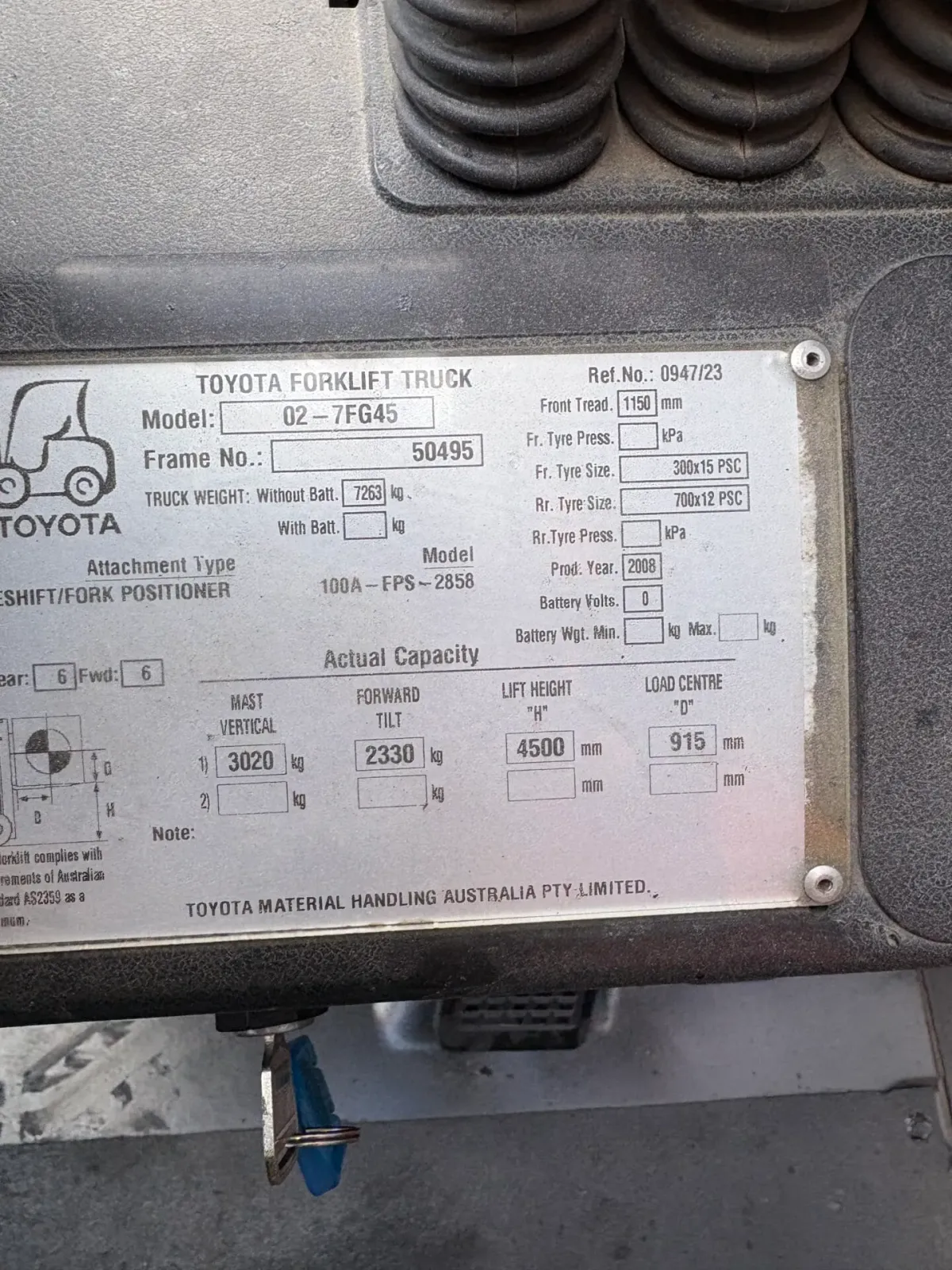
The data plate above shows why step three matters. This 2008 Toyota 02-7FG45 is a 4.5 tonne class model, but with its side shift and fork positioner fitted, its plate rates it at 3,020 kg at a 4,500 mm lift height and a 915 mm load centre. The plate, not the model name, tells you what the machine can lift.
Paying for It: Buy Outright, Finance, Lease or Rent to Own
Buying outright is cheapest overall, finance and leasing spread the cost, and rent to own lets you pay weekly and keep the machine at the end. The right choice depends on cash flow, how long you will keep the forklift and whether you want to own it.
| Option | How it works | Suits |
|---|---|---|
| Buy outright | Pay the full price and own the forklift | Businesses with cash on hand that will keep the machine for years |
| Finance | Borrow to buy and repay over a term | Owning the machine while spreading the cost |
| Lease | Pay to use the forklift for a set term | Fixed monthly costs and upgrading at the end of the term |
| Rent to own | Weekly payments, and the forklift is yours at the end | Smaller businesses that want ownership without a large upfront payment |
Finance suits buyers who want to own the forklift but keep cash in the business, so it is worth knowing how forklift finance in Australia works, from loan terms to what lenders ask for, before you settle on a machine. Leasing makes more sense if you expect to upgrade at the end of the term rather than keep the forklift.
Warranty, Servicing and Insurance
Ask exactly what the warranty covers and for how long, who will service the forklift, and whether your insurance covers it before it arrives. Every pre-owned forklift Buy A Fork sells carries a minimum six-month warranty on the engine or drive motor, transmission, hydraulics and electrical systems, with extended cover available, plus a free six-month service.
Check your business insurance too, and confirm the forklift is covered before it arrives.
When to Buy, and Trading In Your Old Forklift
Buy when the need is clear and the right machine is available, rather than waiting for a perfect moment. Some buyers time a purchase around the end of the financial year, but tax treatment depends on your business, so check with your accountant first.
If you are replacing an older machine, its hours, condition and brand set its trade-in value, which can come straight off the price of the next one.
Buying a Forklift Online or in Melbourne
You can shortlist online, but see the forklift, or a detailed video and its records, before you pay. Check the seller's address, the warranty terms and how the machine will be delivered. For Melbourne buyers, inspecting the forklift in person removes most of the risk.
Frequently Asked Questions
How much is a good forklift?
It depends on capacity, fuel, age and hours. A used forklift costs less upfront than a new one of the same capacity, and the running costs over the years you own it matter as much as the price.
Is 7,000 hours a lot for a forklift?
Not on its own. Hours mean little without the service history: a forklift with 7,000 hours and full records can be a better buy than one with fewer hours and none.
Do I need a licence to drive a forklift I buy?
Yes. In Victoria, an employer must not let anyone operate a forklift unless they hold the appropriate high risk work licence, according to WorkSafe Victoria. A trainee working towards a licence needs direct supervision from a licence holder.
Should I buy a forklift with attachments?
Only if you will use them. Attachments add weight and reduce the rated capacity, so check the data plate with the attachment fitted.
Once you know your loads, lift height and site, the pre-owned forklifts at our Somerton yard can be matched against them before you visit.