
Flameproof Forklifts for Chemical Storage: A Buyer’s Guide
· Updated
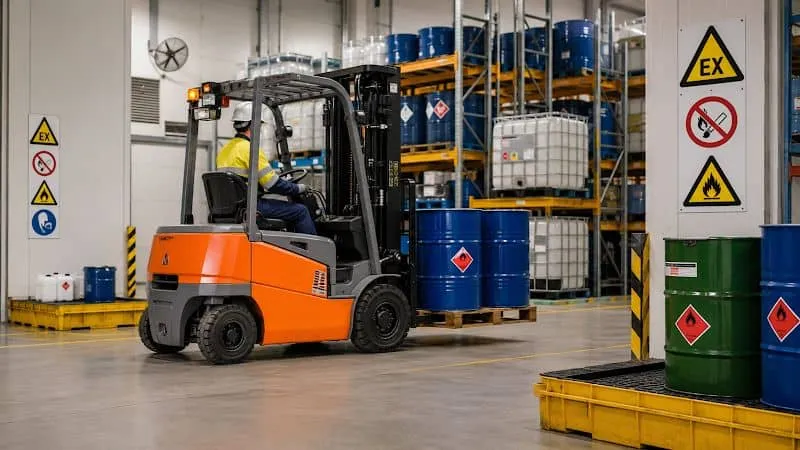
A standard forklift should not enter a classified hazardous area simply because it is electric or designed for indoor use. Forklifts can introduce ignition risks through electrical components, hot surfaces, static discharge, mechanical sparks and engine exhaust.
Where flammable gases, vapours or combustible dusts may form an explosive atmosphere, the forklift must be selected for the facility’s documented hazardous-area classification. This may require a purpose-built zoned forklift, a professionally converted machine or a redesigned workflow that keeps standard forklifts outside the hazardous zone.
Important: This article provides general purchasing information. Hazardous-area classification, equipment selection and compliance should be confirmed by competent safety and engineering professionals familiar with the facility and the applicable state or territory requirements.
What Is a Flameproof Forklift?
A flameproof forklift is a forklift engineered and documented for operation in a specific classified hazardous area without becoming an unacceptable ignition source.
The term is commonly used to describe forklifts that are purpose-built or modified for hazardous-area work. However, flameproof does not mean that the entire machine is completely spark-free or suitable for every chemical environment.
The protection required depends on several factors:
- The classified zone: How often an explosive atmosphere is expected to be present.
- The hazardous substance: The gas, vapour, mist or combustible dust involved.
- The material group: The ignition characteristics of the hazardous material.
- The temperature class: The maximum permitted surface temperature of the equipment.
- The operating conditions: Where the forklift travels, lifts, parks, charges and is serviced.
WorkSafe Victoria advises that equipment used in an explosive gas atmosphere must match the zone, material group and required temperature classification. A forklift approved for one hazardous environment should not be assumed suitable for another.
The Australian Forklift and Industrial Truck Association, or AFITA, also places responsibility on the forklift user to have the operating area properly classified and to ensure the selected machine is suitable for that particular hazardous area.
When Does a Chemical Store Need a Flameproof Forklift?
A chemical facility may need a hazardous-area forklift when the machine must enter an area where an explosive atmosphere is present or could reasonably occur.
The presence of dangerous goods alone does not automatically mean that every forklift on the premises must be flameproof. The main question is whether the forklift will enter a formally classified hazardous area and whether it could introduce an ignition source.
Forklifts may create ignition risks through electrical motors, switches, batteries, hot components, mechanical contact and static discharge.
A specialist assessment is particularly important where a facility handles:
- Flammable gases: Including LPG, hydrogen, acetylene and other Division 2.1 substances.
- Flammable liquids: Including solvents, fuels, thinners, coatings, alcohol-based products and many Class 3 dangerous goods.
- Flammable solids or reactive materials: Including certain Class 4 dangerous goods.
- Combustible dusts: Including fine powders that can create an explosive dust atmosphere.
- Chemical transfer activities: Such as decanting, filling, blending, pumping or emptying containers.
- Spill-prone operations: Where a foreseeable leak could release flammable vapour into a forklift travel area.
Explosive atmospheres are more likely around flammable gases and liquids, although materials from other dangerous goods classes can also create hazardous conditions under certain circumstances.
Questions to Answer Before Selecting a Forklift
Before purchasing or converting a machine, establish:
- Has the facility undergone a hazardous-area classification?
- Does the forklift need to enter one of the classified zones?
- Which chemicals could be present in that area?
- What gas, vapour or dust group applies?
- What temperature class must the equipment meet?
- Can the forklift route be moved outside the classified area?
- Where will the machine be parked, serviced and charged?
A general dangerous goods risk assessment may not provide enough information to select a zoned forklift. The forklift supplier or conversion specialist should receive the actual hazardous-area classification and supporting facility information.
Hazardous Zones Explained for Forklift Buyers
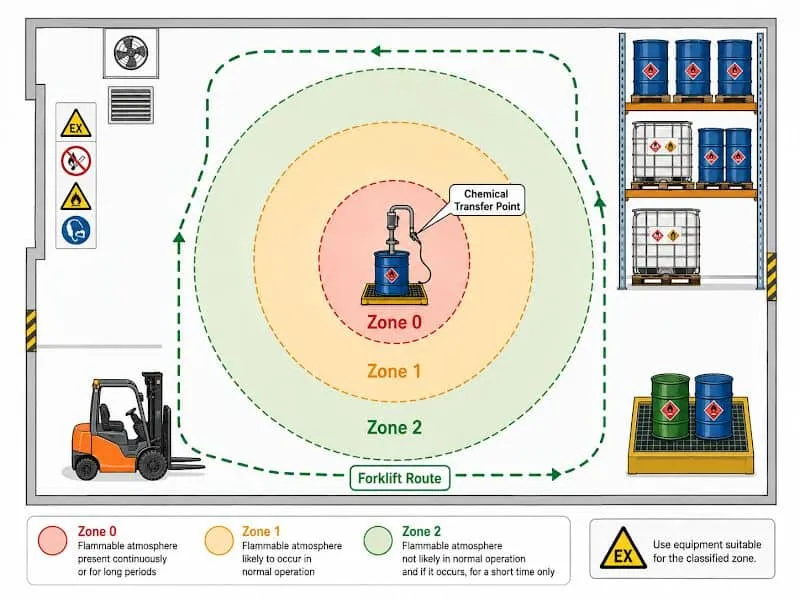
Hazardous-area zones describe how likely it is that a flammable atmosphere will be present. They do not describe the severity of a possible explosion and should not be treated as a universal forklift rating.
For gases and vapours, the main classifications are Zone 0, Zone 1 and Zone 2.
| Hazardous zone | Plain-English meaning | What it means for forklift selection |
|---|---|---|
| Zone 0 | A flammable atmosphere is present continuously, frequently or for long periods. | Do not assume a mobile forklift can enter. Any proposed equipment must be assessed specifically for the classified area and operating task. |
| Zone 1 | A flammable atmosphere is likely to occur occasionally during normal operation. | The forklift must have protection suitable for the zone, hazardous material group and temperature classification. |
| Zone 2 | A flammable atmosphere is unlikely during normal operation but may occur briefly following a release or abnormal event. | A standard forklift is not automatically acceptable. The equipment must still be suitable for the classified Zone 2 environment. |
Hazardous-area classification should be completed by a suitably qualified person.
Combustible dust environments use separate classifications, commonly identified as Zones 20, 21 and 22. A forklift selected for a gas or vapour zone should not be assumed suitable for an explosive dust atmosphere.
Dust characteristics, accumulation, cleaning methods and equipment surface temperatures require separate assessment.
Standard vs Flameproof Forklifts: What Changes?
A flameproof or zoned forklift is not simply a standard forklift with a warning label. Potential ignition sources throughout the machine may need to be removed, contained, isolated or controlled.
| Area of the forklift | Standard forklift | Flameproof or hazardous-area forklift |
|---|---|---|
| Electrical components | May contain switches, contactors, motors and connections that can arc or spark. | Electrical systems are selected, enclosed or modified for the required hazardous-area protection. |
| Maximum surface temperature | Components may become hot during normal operation. | Surface temperatures must remain within the required temperature classification. |
| Static electricity | Standard tyres, seats, body components and attachments may allow static accumulation. | Static risks are assessed and controlled according to the conversion design and operating environment. |
| Mechanical sparks | Forks, brakes and moving metal components may create sparks through impact or friction. | Mechanical spark risks are evaluated and suitable controls are incorporated where required. |
| Engine and exhaust | LPG and diesel machines produce heat and exhaust and contain fuel and electrical systems. | Engine, exhaust, intake, fuel and electrical components may need extensive protection or replacement. |
| Battery and connectors | Electric forklifts may have exposed connectors or components capable of arcing. | The battery, enclosure, connectors, isolation systems and related components must suit the specified environment. |
| Documentation | Supplied with standard manufacturer and service records. | Should include evidence showing the protection method, approved operating environment and applicable conditions. |
| Servicing | Can generally be serviced by a competent forklift technician. | Hazardous-area protection must be inspected and maintained by appropriately competent personnel. |
| Purchase cost | Lower initial purchase price. | Usually costs more because of specialist engineering, components, assessment and documentation. |
| Lead time | Often available from stock. | May require sourcing a suitable machine or completing a specialist conversion. |
Safe Work Australia recommends controlling ignition sources, preventing vapour accumulation and using equipment suitable for hazardous environments.
The exact conversion scope should never be assumed from a general checklist. It will depend on the base forklift, facility classification and hazardous material.
Which Forklift Fuel Type Suits Chemical Storage?
The safest fuel type depends on whether the forklift will enter a classified hazardous area, the materials stored and the conditions inside the facility.
A power source that works well in a conventional warehouse is not automatically suitable for dangerous goods handling.
Electric Forklifts
Electric forklifts are commonly chosen for indoor warehouses because they do not produce diesel or LPG exhaust while operating. They can also offer lower noise levels and more precise control in narrow storage areas.
However, a standard electric forklift is not automatically suitable for a hazardous area.
Potential ignition sources include:
- Electric motors
- Contactors and switches
- Battery terminals
- Plug connections
- Damaged insulation
- Static discharge
- Hot electrical components
- Mechanical impacts involving forks or other metal components
Battery charging can also introduce electrical, heat and ventilation risks. Chargers should be located in an area approved through the facility risk assessment rather than placed inside a hazardous zone without specialist approval.
Outside classified hazardous zones, electric forklifts designed for indoor work can be practical for warehouses that prioritise low operating emissions, quiet performance and manoeuvrability.
These operational advantages should not be confused with hazardous-area approval.
LPG Forklifts
A standard LPG forklift should not be treated as suitable for a dangerous goods area simply because LPG forklifts are commonly used indoors.
An LPG machine has several potential ignition sources, including:
- A flammable fuel supply
- Hot engine surfaces
- Exhaust components
- Electrical circuits
- Mechanical sparks
- Fuel connections and valves
LPG forklifts may still be suitable in sections of a warehouse that are outside the classified hazardous area, provided ventilation, emissions, traffic and other risks have been assessed.
The normal advantages of LPG forklifts for indoor operations include fast refuelling and consistent performance across longer shifts. Chemical storage facilities require an additional hazardous-area assessment before relying on those benefits.
Diesel Forklifts
Diesel engines use compression ignition rather than spark ignition, but that does not make an ordinary diesel forklift flameproof.
A diesel forklift can still introduce risk through:
- Hot exhaust systems
- High surface temperatures
- Electrical components
- Mechanical sparks
- Fuel leaks
- Air intake and exhaust pathways
Diesel machines are generally more suited to outdoor or well-ventilated heavy-duty applications.
Any diesel forklift intended to enter a hazardous zone must be specifically engineered and documented for that environment.
Where operations include both indoor and outdoor areas, comparing diesel, electric and LPG forklift power options can help determine which fuel type suits the wider site before hazardous-area modifications are considered.
Option 1: Buy a Purpose-Built Zoned Forklift
Buying a forklift already engineered for a defined hazardous environment can reduce the uncertainty involved in converting an existing machine.
The main advantages include:
- A known protection design
- Documentation prepared for the intended operating environment
- Fewer compatibility questions between the forklift and protective components
- A clearer maintenance and inspection history when purchased new
The limitation is that zoned forklifts can be difficult to source, particularly where the buyer needs a specific lift capacity, mast height, attachment or aisle configuration.
Before buying, confirm that the machine’s documentation matches:
- The required zone
- The gas, vapour or dust involved
- The applicable material group
- The temperature classification
- Any operating restrictions
- The forklift attachment and configuration
- The facility’s state or territory requirements
A machine described only as flameproof without supporting details is not enough.
Option 2: Convert a Suitable Forklift
A standard forklift may be converted for hazardous-area operation where a specialist determines that the base machine is appropriate.
Conversion may involve changes to electrical, mechanical, fuel, exhaust, temperature and static-control systems.
The exact work depends on the forklift and the facility classification.
Factors That Affect Conversion Cost and Lead Time
There is no responsible fixed price for flameproofing a forklift without inspecting the machine and reviewing the hazardous-area requirements.
The main cost drivers include:
- The required zone
- Gas, vapour or dust classification
- Temperature class
- Forklift power type
- Number and type of electrical components
- Engine and exhaust modifications
- Battery enclosure and connection requirements
- Attachments and hydraulic functions
- Condition and age of the base forklift
- Engineering, testing and documentation
- Availability of approved parts
- Required inspection and certification processes
A low-cost base forklift is not always the cheapest final option.
An older machine with poor parts availability or extensive electrical systems may cost more to convert and maintain than a newer, simpler model.
Option 3: Redesign the Workflow
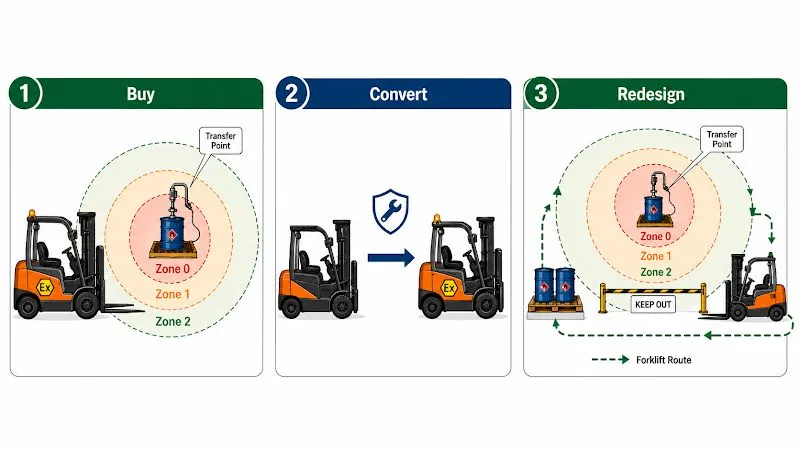
A flameproof forklift may not be necessary if the material-handling process can be redesigned to keep the machine outside the hazardous zone.
Possible controls include:
- Moving the pallet transfer point outside the classified area
- Using a physical barrier or controlled handover area
- Repositioning chemical decanting or filling operations
- Improving ventilation to control vapour accumulation
- Separating storage from vehicle traffic
- Using fixed conveyors or other suitable handling equipment
- Reducing the quantity of flammable material held in the work area
- Restricting forklift entry through marked exclusion zones
Safe Work Australia identifies ventilation, segregation, reduced quantities and the elimination of ignition sources as important controls for fire and explosion risks.
Workflow redesign should be assessed by the facility’s safety and engineering team. Moving a painted line or adding a warning sign does not change the formal hazardous-area classification.
How to Choose Between Buying, Converting and Redesigning
Use the following sequence as an initial decision framework.
1. Confirm Whether the Forklift Enters a Classified Area
If the forklift remains outside all hazardous zones, a standard machine may be suitable, subject to the wider facility risk assessment.
2. Obtain the Hazardous-Area Classification
Do not request a generic flameproof forklift.
Provide the supplier with the documented zone, material group, temperature classification and operating boundaries.
3. Check Whether a Suitable Zoned Machine Is Available
A purpose-built unit may offer the clearest compliance path if its rating, capacity and dimensions match the facility.
4. Assess a Conversion
Where a suitable purpose-built unit is unavailable, ask a specialist to assess the proposed base forklift before purchasing it.
5. Compare the Full Project Cost
Include:
- Purchase price
- Conversion work
- Engineering and documentation
- Transport
- Downtime
- Specialist inspections
- Future servicing
- Replacement component availability
6. Consider Keeping the Forklift Outside the Zone
Workflow redesign may provide a more practical long-term solution where forklift access to the hazardous area is infrequent.
Information to Give a Forklift Supplier
A supplier cannot properly assess a hazardous-area forklift request from lifting capacity alone.
Prepare the following information before requesting options:
- Hazardous-area classification report: Include current drawings and zone boundaries.
- Chemical information: Provide relevant safety data sheets and identify the materials that could be released.
- Required equipment rating: Include the zone, material group and temperature class identified by the competent person.
- Load details: State the maximum load weight, dimensions and load centre.
- Lift requirements: Include maximum lift height, mast closed height and free-lift requirements.
- Attachments: Identify clamps, rotators, fork positioners or other hydraulic functions.
- Operating environment: Include aisle width, gradients, floor conditions and ambient temperature.
- Duty cycle: State expected operating hours, shifts and charging arrangements.
- Access restrictions: Provide door heights, turning space and transport requirements.
- Preferred procurement route: State whether you are considering a purpose-built unit, used forklift or conversion.
The hazardous-area assessment should be considered alongside the broader forklift safety standards buyers need to check when comparing machines, documentation and supplier support.
Certification, Inspection and Maintenance
Hazardous-area suitability must be maintained throughout the forklift’s working life.
Damage, unauthorised modifications or missing components can compromise the protection system. Even a missing bolt, damaged enclosure or incorrect replacement component may affect the machine’s hazardous-area protection.
A suitable maintenance program should address:
- Scheduled specialist inspections
- Approved replacement parts
- Battery and connector condition
- Enclosures and seals
- Earthing and static-control components
- Tyres and conductive pathways
- Forks and other potential mechanical spark points
- Exhaust and temperature-control systems
- Repairs and modifications
- Updated compliance records
Do not add electrical accessories, warning lights, cameras, radios or attachments without checking whether the change affects the forklift’s hazardous-area suitability.
Flameproof Forklift Buyer Checklist
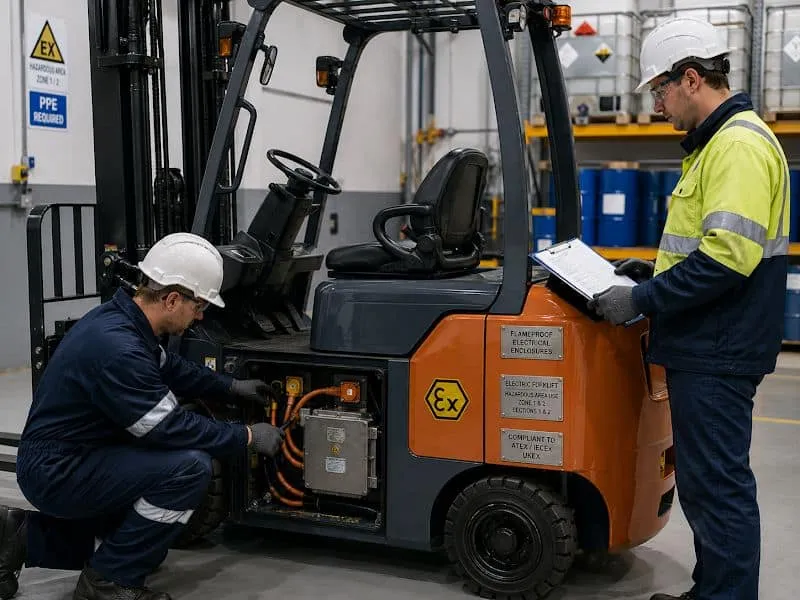
Before committing to a machine, confirm that you have:
- A current hazardous-area classification
- A clear forklift travel map
- The required zone and equipment rating
- Relevant safety data sheets
- Written confirmation of machine suitability
- Details of all operating restrictions
- Conversion or equipment documentation
- Inspection and maintenance requirements
- Local access to suitable service personnel
- Approval for charging, parking and servicing locations
- Confirmation that attachments are included in the assessment
- A process for controlling future modifications
Find the Right Forklift for Your Chemical Storage Operation
The correct forklift should be chosen only after the hazardous-area requirements and normal handling needs are understood.
Bring your zone information, chemical details, load capacity, lift height and operating conditions when discussing available machines.
Buy A Fork can help you browse the available forklift range and identify suitable machines for further specialist assessment.
Final approval for hazardous-area use should come from competent professionals who have reviewed the actual facility, forklift configuration and applicable compliance requirements.
Frequently Asked Questions
1. Can Any Forklift Be Converted Into a Flameproof Forklift?
No. Conversion feasibility depends on the forklift’s design, condition, power source, electrical system, components and required hazardous-area rating.
A specialist should assess the proposed base machine before it is purchased. Some forklifts may require extensive changes, while others may not be practical to convert or support over the long term.
2. How Much Does It Cost to Flameproof a Forklift?
There is no reliable universal price.
Costs depend on the zone, hazardous material, temperature class, forklift design, required modifications, testing, documentation and parts availability.
Obtain a written assessment based on the facility classification rather than relying on an estimate for a different forklift or chemical environment.
3. Who Certifies a Flameproof Forklift Conversion?
The design and conversion should be managed by specialists competent in hazardous-area equipment and the relevant Australian requirements.
The buyer should ask:
- Who completed the engineering?
- Which standards and classifications were used?
- What inspections or certification apply?
- What documents will be supplied?
- Who can maintain the machine after conversion?
Requirements may differ between jurisdictions and according to the protection method used.
4. Are Electric Forklifts Spark-Free?
No. Standard electric forklifts can contain components that arc, spark or become hot.
Battery terminals, contactors, switches, motors and damaged electrical connections can all present potential ignition risks.
Only use an electric forklift in a hazardous zone when its documented protection is suitable for that specific area.
5. Are LPG Forklifts Allowed in Dangerous Goods Stores?
An LPG forklift may be used in parts of a dangerous goods facility that are outside classified hazardous areas if the facility risk assessment permits it.
A standard LPG forklift should not enter a hazardous zone unless it has been specifically engineered and documented for that environment.
6. Does Every Chemical Warehouse Need a Flameproof Forklift?
No. Some facilities store dangerous goods without creating a classified explosive atmosphere in the forklift operating area.
The decision depends on:
- The chemicals being stored
- The quantities involved
- Packaging and containment
- Ventilation
- Transfer processes
- Potential spills and releases
- The documented hazardous-area classification
A facility should not purchase or reject a flameproof forklift based only on the dangerous goods labels present.