
Toyota vs Mitsubishi Forklifts: Which Is Better for Australian Warehouses?
· Updated
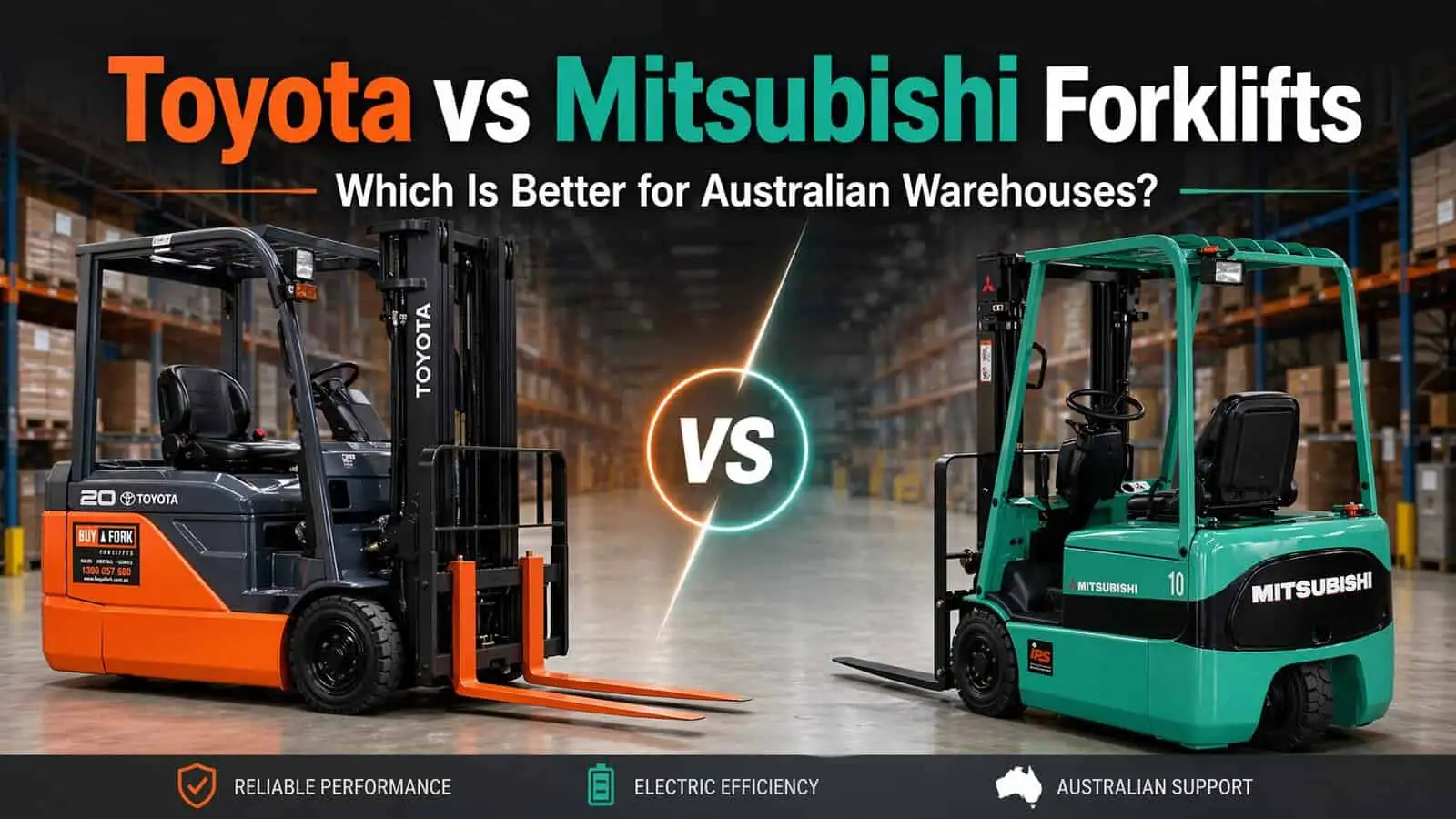
Walk into almost any Australian warehouse and you’ll see the same two names stamped on forklift masts more often than any others: Toyota and Mitsubishi. Both Japanese, both with decades on Aussie soil, both sitting near the top of every best-selling brand list year after year. That close rivalry makes for interesting reading until you’re the one signing the invoice. Then it becomes a genuine headache.
The honest answer to “which is better” depends entirely on what your operation looks like. A single-shift cold storage site in Laverton has very different needs to a multi-shift timber yard out Dandenong way. Get the call wrong and you’re not just stuck with a forklift you don’t love. You’re locked into higher fuel bills, slower parts turnaround, and a weaker resale position five years down the track.
Quick Verdict
After 20-plus years of selling both brands from our Somerton yard, here is the straight call.
Choose Toyota if you are running heavy daily shifts, building a long-term fleet, operating in regional Australia where parts lead times matter, or you plan to resell within three to five years and want the residual value to hold up.
Choose Mitsubishi if you are watching upfront cost, running light to medium duty, buying your first or second forklift, or you want the mechanically comparable machine at a lower price point and are happy to trade a few percentage points of resale value for it.
Either brand will serve an Australian warehouse well. The right answer depends on how hard you will work it and how long you plan to keep it.
How Toyota and Mitsubishi Forklifts Compare at a Glance
Before we get into the detail, here’s the quick side-by-side. These comparisons focus on the 2 to 3 tonne counterbalance bracket, which is the size most Australian warehouse buyers are actually shopping for.
If you’re the sort of person who skims first and reads properly later, this table will give you most of the picture.
| Factor | Toyota | Mitsubishi |
| Popular models in Australia | 8FG, 8FD, 8FBE series | FG, FD, EDiA series |
| Typical used price, 2.5T LPG | $18,000 to $30,000 | $14,000 to $24,000 |
| Parts availability | Excellent nationwide | Very good, slightly longer in regional areas |
| Signature safety tech | System of Active Stability (SAS) | Integrated Presence System (IPS) |
| Resale value after 5 years | Stronger | Moderate |
| Standard compliance | AS 2359 | AS 2359 |
| Best suited to | Heavy daily use, long-term fleets | Light to medium duty, budget-conscious buyers |
Prices reflect typical pre-owned units moving through the Melbourne market and will vary with hours, mast height, attachments and condition. For a current quote on any model in our yard, call 1300 057 880 or browse our forklift range.
Who you are actually buying from in Australia
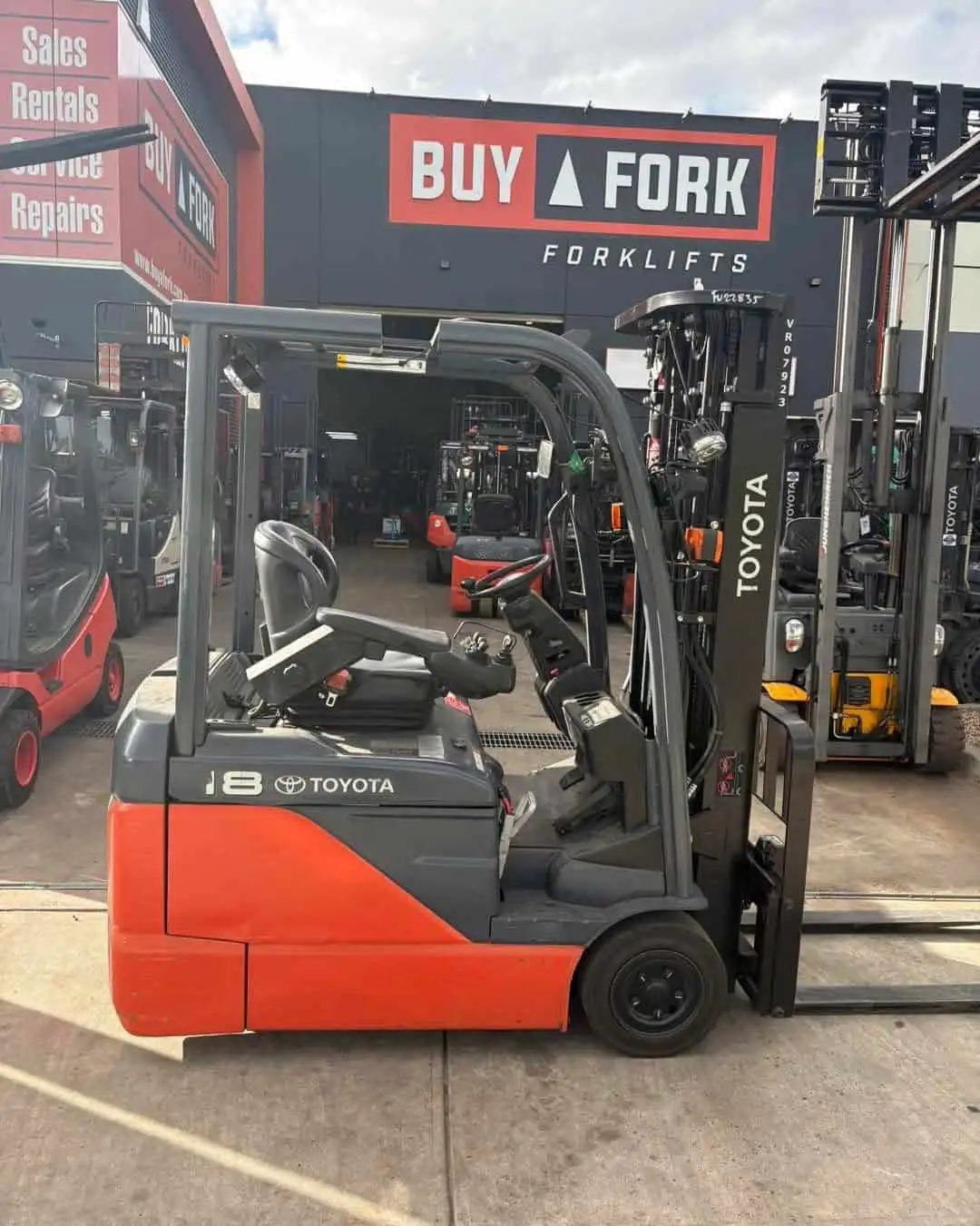
The badge on the counterweight matters less than the distributor standing behind it. In Australia, Toyota and Mitsubishi forklifts reach buyers through two very different networks, and that shapes everything from parts lead times to resale value.
Toyota forklifts are distributed by Toyota Material Handling Australia (TMHA), a wholly owned arm of Toyota Industries Corporation. TMHA runs branches in every state and territory, holds deep parts inventory locally, and services the full Toyota range from 1.0-tonne walkie stackers through to heavy container handlers. For most Australian warehouses, a genuine Toyota part is available within 24 to 48 hours.
Mitsubishi forklifts are distributed by MLA Holdings, which has been the official Australian dealer since 1972. MLA operates branches across the eastern states and has expanded nationally over the past decade. Parts availability is strong in metro areas, though regional Victoria, Queensland and Western Australia can see slightly longer lead times than the Toyota network.
For Melbourne warehouses, both distributors are well represented and either brand will have you covered for routine servicing. The gap shows up when you operate in regional areas or run interstate fleets, where Toyota’s larger footprint often translates to faster uptime.
At Buy A Fork we work alongside both networks. Whichever brand you buy from us, we include a free 6-month service warranty and free extended warranty, with free local delivery within 10 kilometres of Somerton and Australia-wide delivery on request.
Head-to-head: Toyota vs Mitsubishi forklifts compared
Build quality and reliability
Toyota forklifts have earned their reputation the honest way, by outlasting expectations on site after site. The 8-series, covering most 1.5 to 3.5-tonne models, routinely pushes past 15,000 hours when serviced on schedule.
Mitsubishi forklifts, built under Mitsubishi Logisnext, are closer in engineering quality than most buyers realise. The FG and FD series share plenty of DNA with Caterpillar lift trucks. Reliability at 8,000 to 12,000 hours sits on par with Toyota. Past that mark, Toyota drivetrains and hydraulics hold up a fraction better under continuous heavy use.
Running costs: LPG, diesel and electric
LPG is the Melbourne warehouse default, and for good reason. Gas bottles swap in under a minute, fuel costs are predictable, and both brands run cleanly enough for mixed indoor-outdoor work. A Toyota 8FG25 and a Mitsubishi FG25N burn gas at near-identical rates, roughly 2.5 to 3 kilograms an hour under typical load.
Diesel favours Toyota slightly on fuel economy over a full shift. Electric is where the gap closes completely. The Toyota 8FBE and Mitsubishi EDiA both deliver a full shift on a single charge with modern lithium-ion options and comparable energy draw.
Operator comfort and safety
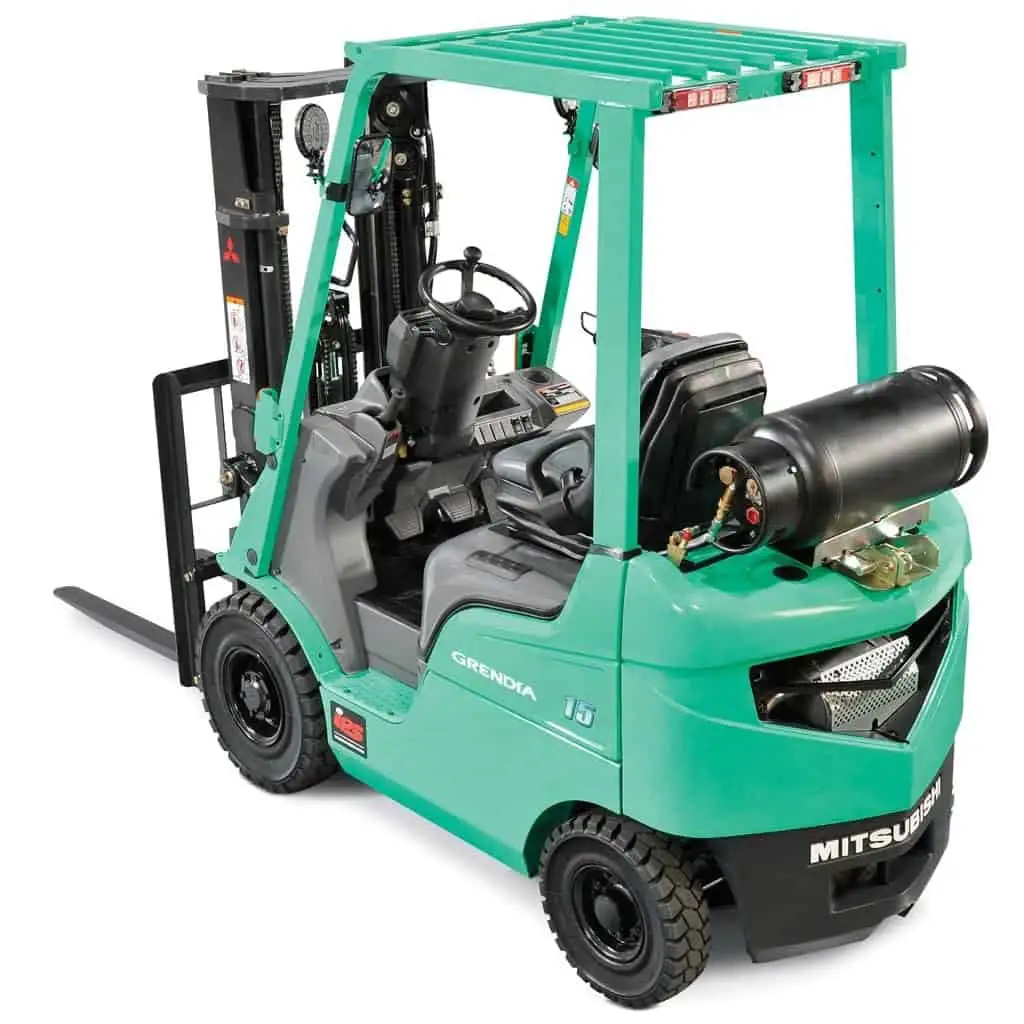
Toyota’s System of Active Stability (SAS) is the standout safety feature across the 8-series. It automatically locks the rear axle when the truck senses tip risk and limits mast tilt speed when loads are raised. For warehouses with mixed operator experience, it is genuinely useful.
Mitsubishi counters with the Integrated Presence System (IPS), which disables key functions the moment the operator leaves the seat. Cabin layout on the FG series is roomy and visibility over the load is strong. Both brands comply with AS 2359, the Australian standard for powered industrial trucks, and both offer comparable operator fatigue levels across a full shift.
Parts availability and service across Australia
This is the factor that decides more fleet purchases than any other. A forklift out of action costs more per day than most businesses realise, and parts lead time is what separates a one-day fix from a one-week headache.
Toyota’s TMHA network holds the deepest parts inventory in Australia, with most common components available same-day in metro Melbourne and within 48 hours almost anywhere on the east coast. MLA Holdings runs a strong Mitsubishi parts operation too, though regional lead times can stretch a day or two longer.
Every forklift sold at Buy A Fork, Toyota or Mitsubishi, includes a free 6-month service warranty.
Warranty terms, new and used
A new Toyota forklift from TMHA typically ships with a 12-month or 2,000-hour manufacturer warranty, whichever comes first, with extended options available. New Mitsubishi units through MLA Holdings run similar terms, usually 12 months or 2,000 hours with extended warranty bolt-ons.
On pre-owned units, the manufacturer’s warranty has normally expired, which is where dealer backing becomes the deciding factor. Every pre-owned forklift sold through Buy A Fork, regardless of brand, includes a free 6-month service warranty and a free extended warranty as standard. Hydraulics, mast, drivetrain and major components are all covered, which is rare in the used forklift market.
Resale value in the Australian used market
This is where Toyota’s edge shows most clearly. A well-kept 5-year-old Toyota 8FG25 with 6,000 to 8,000 hours typically resells in the Melbourne market for 55 to 65 percent of its original price. A comparable Mitsubishi FG25N from the same year and hours usually moves at 45 to 55 percent.
The reason is demand, not durability. Toyota is the most recognised forklift brand in Australia, which means more buyers shortlist it, which holds the secondary price up. Mitsubishi units are arguably the better value buy on the used market for exactly that reason, you get a mechanically comparable forklift for a few thousand less.
Which brand suits your operation
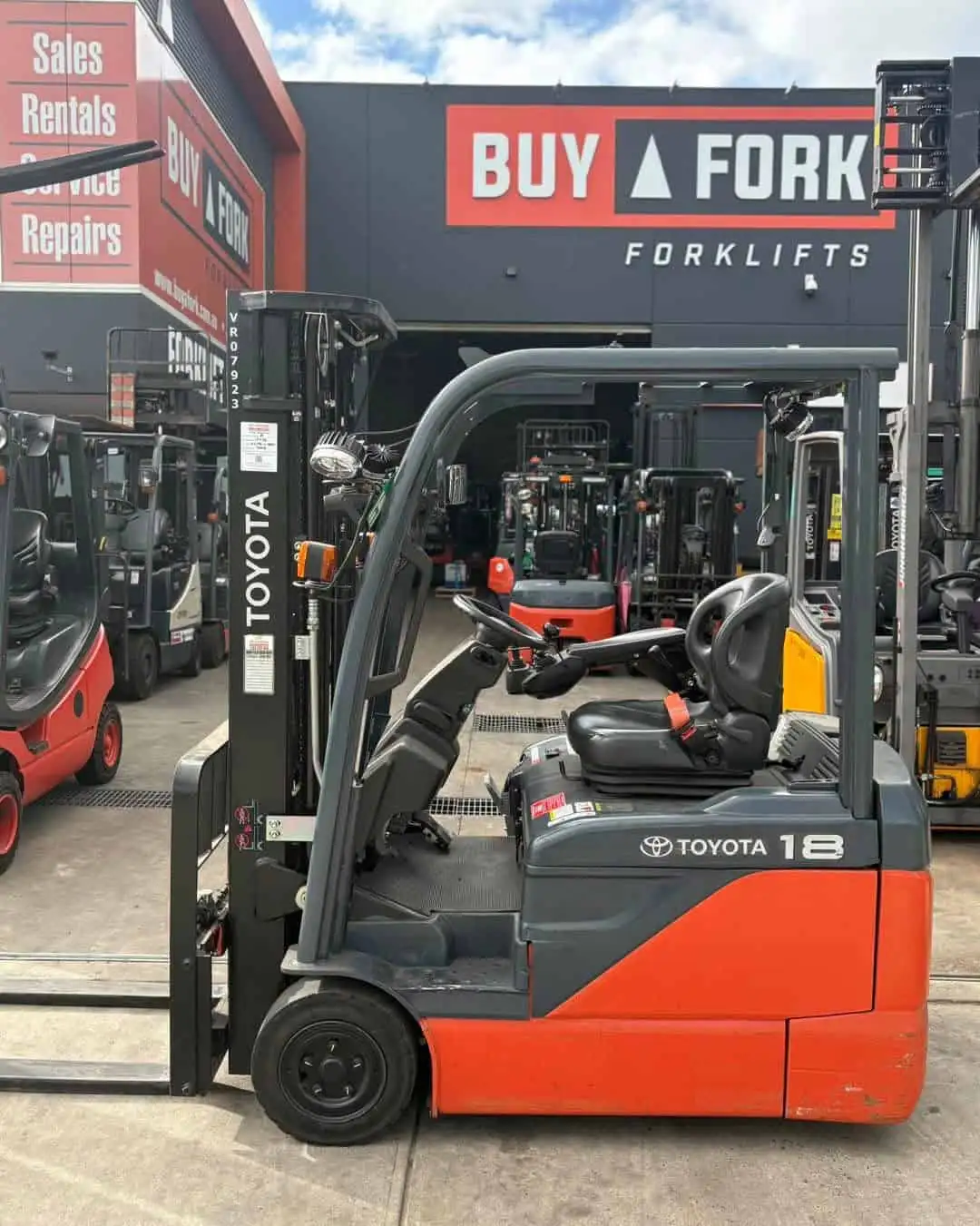
Here is a quick scenario-based guide drawn from the kind of buyers who walk into our Somerton yard every week.
Small to medium Melbourne warehouses under 2,000 square metres. Mitsubishi usually wins on value. A pre-owned FG25N delivers everything a single-shift operation needs for a few thousand dollars less than the Toyota equivalent. Browse our pre-owned range in Melbourne for current stock.
High-throughput distribution centres running two or three shifts. Toyota is the safer pick. Parts availability and drivetrain longevity past 12,000 hours matter more at this volume, and resale value protects the fleet investment at trade-in time.
Cold storage and food-grade environments. Electric is the answer for both brands. The Toyota 8FBE and Mitsubishi EDiA both handle 2-degree to 4-degree work, though Toyota has broader cold-room certification across its AC drive range.
Timber yards, construction and outdoor operations. Diesel is typically the right engine, and Toyota’s 8FD series has a slight edge on rough terrain stability. For more on this sector, see our guide to forklifts for timber and logging.
Automotive parts and assembly. Either brand works well. Tight turning circles and operator visibility matter most here. Our automotive forklift guide breaks down the best fits.
First-time buyers on a tight budget. A pre-owned Mitsubishi FG or FD is the smartest entry point, often landing under $20,000 for a 2.5-tonne LPG unit in good condition.
Seasonal operators and project-based work. Buying either brand outright rarely makes sense for short-term needs. For rental enquiries, Buy A Fork refers customers to our partner Rent A Fork, who offer daily, weekly and monthly hire across LPG, diesel, petrol and electric forklifts from 1 to 20 tonnes.
Fleet buyers running five or more units. Toyota makes more sense for standardisation. One parts supplier, one service relationship, one operator training pattern across the fleet. Finance across multi-unit fleet purchases runs through our partner Ausloans, who quote fleet applications across a panel of more than 70 Australian lenders.
New or pre-owned: the honest take
Most forklift buyers start out assuming they need a new unit, and most of them end up better served by pre-owned. Here is the honest breakdown from someone who sells both.
New makes sense when you are running heavy fleets at 6,000-plus hours a year, you want the full manufacturer warranty and service plan, or you need the instant tax depreciation benefit for your balance sheet. For high-throughput distribution centres and two-shift operations, the cost per hour over a 10-year life often favours buying new.
Pre-owned makes sense when you are a small to medium business, a first-time buyer, or a fleet operator looking to add capacity without a balance-sheet hit. A well-maintained 3 to 5-year-old Toyota or Mitsubishi typically sells at 50 to 60 percent of its new price with 70 to 80 percent of its working life still ahead of it. That is the sweet spot most of our customers buy into.
Whichever way you lean, the five things to check on any used unit are the same. Hour reading on the clock. Mast condition, looking for bent channels and worn rollers. Hydraulic performance with no visible leaks. Tyre wear. And a documented service history showing the last 12 months of maintenance.
Every pre-owned forklift at Buy A Fork is inspected, refurbished and fully serviced before delivery, and every unit is backed by our free 6-month service warranty and free extended warranty.
Frequently asked questions
1. Which forklift brand lasts longer, Toyota or Mitsubishi?
Toyota forklifts generally last slightly longer under heavy continuous use, with the 8-series routinely reaching 15,000-plus hours when properly serviced. Mitsubishi forklifts are mechanically comparable up to 10,000 to 12,000 hours, after which Toyota drivetrains and hydraulics tend to hold up a fraction better.
2. Which is cheaper to maintain in Australia?
Running costs are very close for both brands on scheduled servicing. Parts pricing is within 5 to 10 percent of each other across common wear items. Toyota has a small edge on parts availability, particularly in regional areas, which reduces downtime costs on urgent repairs.
3. Which holds resale value better on the Australian used market?
Toyota holds stronger resale value. A 5-year-old Toyota 8FG25 typically resells at 55 to 65 percent of its original price in the Melbourne market, while a comparable Mitsubishi FG25N usually moves at 45 to 55 percent. The gap is demand-driven rather than a reflection of build quality.
4. Are Toyota and Mitsubishi forklifts made in the same factory?
No. Toyota forklifts are built by Toyota Industries Corporation, the parent company of the global Toyota group. Mitsubishi forklifts are built by Mitsubishi Logisnext, a separate manufacturer that also builds Caterpillar and Jungheinrich models under licence. They are distinct companies with different engineering lineages.
5. Where can I buy Toyota and Mitsubishi forklifts in Melbourne?
Buy A Fork stocks both brands, new and pre-owned, at our Coburg yard at 430 Russell Street. Every forklift includes a free 6-month service warranty, free extended warranty, free pallet jack and free local delivery within 10 kilometres of Somerton. Call 1300 057 880 or browse our current forklift range online.